

Getting ISO 27001 certified in Australia has moved well past being a simple box-ticking exercise. These days, it's a strategic imperative for any business serious about protecting sensitive data and, just as importantly, earning client trust. This global standard gives you a rock-solid framework for an Information Security Management System (ISMS), proving you're committed to keeping critical information safe.
Why ISO 27001 Is a Business Essential in Australia
Many Australian business owners initially write off ISO 27001 as just another hurdle—a costly and time-consuming line item for a tender application. That perspective is becoming dangerously outdated. The truth is, certification has gone from a "nice-to-have" to a non-negotiable asset for survival and growth.
The push isn't just coming from auditors anymore; it’s coming directly from the market. Clients, particularly in government, finance, and healthcare, have lifted their security expectations sky-high. They demand absolute confidence that their data is in safe hands, and ISO 27001 is the most respected international benchmark for that assurance.
The Rising Tide of Cyber Threats
Let's be blunt: the operational environment for Australian businesses is getting more hostile by the day. Cyber threats aren't some distant problem for massive corporations; they are a direct and immediate danger to small and medium-sized businesses right across the country.
The numbers tell a sobering story. The Australian Cyber Security Centre recorded over 94,000 reports of cybercrime in the last year alone. That's a staggering 23% jump from the year before. This isn't just about stolen data; it’s about business continuity, financial stability, and the reputational damage that can cripple an SME.
Implementing an ISO 27001 framework forces you to systematically find and fix your vulnerabilities before they can be exploited. It shifts your business from a reactive "hope for the best" stance to a structured, resilient one.
Turning Compliance into a Commercial Advantage
While shoring up your defences is vital, the real power of ISO 27001 lies in its ability to open doors. For many businesses, certification becomes the key differentiator that unlocks entirely new streams of revenue.
Think of a small IT provider in Sydney. They kept losing out on big contracts to larger, more established players. After getting ISO 27001 certified, they suddenly met a crucial requirement for a major government tender—which they won. That certificate wasn't just a piece of paper; it was the key that unlocked a new level of business.
This isn't a one-off story. It's happening all over Australia. The certification proves a level of professionalism and diligence that builds instant trust.
- Win Major Contracts: Many government and enterprise tenders now list ISO 27001 as a mandatory prerequisite. If you don't have it, you're out of the running before you even start.
- Build Unbreakable Client Trust: When you can show your security meets global standards, clients feel far more comfortable sharing sensitive information, leading to deeper, more valuable partnerships.
- Establish a Sterling Reputation: Certification positions your brand as a leader in security and reliability, setting you miles apart from competitors who haven't made the same investment.
To get a better handle on the wider business benefits of meeting international standards, exploring resources like Your Guide to Global Compliance Certification can provide some excellent context for your journey.
The table below breaks down the core benefits you can expect to see.
Core Benefits of ISO 27001 for Australian SMEs
| Benefit Category | Description for Australian Businesses |
|---|---|
| Market Access | Unlocks opportunities with government and large corporations by meeting mandatory tender requirements. |
| Competitive Edge | Differentiates your business from competitors, positioning you as a more secure and trustworthy partner. |
| Risk Reduction | Systematically identifies and mitigates cyber threats, reducing the likelihood and impact of a costly data breach. |
| Client Confidence | Provides tangible proof of your commitment to data security, strengthening relationships with existing and new clients. |
| Operational Efficiency | Establishes clear processes and responsibilities, leading to fewer errors and more streamlined operations. |
Achieving ISO 27001 certification is far more than a compliance activity; it’s a powerful investment in your business’s future resilience and growth.
A Framework for Sustainable Growth
Looking beyond winning new work, ISO 27001 gives you a structured framework that supports genuine, long-term growth. It helps instil a culture of security awareness across your whole organisation, turning every employee into a part of your defence.
The process makes you document your procedures, define roles, and set up clear protocols for handling information. This operational discipline reduces mistakes, boosts efficiency, and ultimately makes your business more scalable. As you grow, your security posture grows with you.
It’s not just about passing an audit; it's about building a more robust, reliable, and trustworthy business from the inside out.
Building Your Foundation for a Successful Certification
Long before you draft a single security policy, the fate of your ISO 27001 certification Australia journey is often sealed. It all comes down to the groundwork. Get this right, and you're building on solid rock; get it wrong, and you’re building on sand.
The very first—and arguably most critical—piece of this foundation is getting genuine buy-in from your leadership.
This isn't just about a signature on a budget request. We're talking about creating active champions at the top. When your leadership team truly grasps that ISO 27001 is a powerful commercial tool, not just an IT expense, they become advocates. They’ll fight for the resources, protect the time, and drive the cultural shifts you need to succeed. Without their full-throated support, projects like this tend to stall, get starved of funds, and never really become part of the business fabric.
Defining Your ISMS Scope
Once leadership is on board, the next challenge is defining the scope of your Information Security Management System (ISMS). This is where you draw the line in the sand, clearly stating which parts of your business the ISMS will protect. A tightly defined scope prevents confusion and keeps your efforts laser-focused on what actually matters.
The scope isn't a one-size-fits-all template; it has to mirror your specific business and its unique risks.
Let’s look at a couple of real-world examples:
- A Melbourne-based SaaS Provider would likely need to include everything involved in the development, deployment, and upkeep of their cloud platform. We're talking customer data, infrastructure, source code, and employee access—the whole lot.
- A Brisbane Consulting Firm, on the other hand, might have a narrower focus. Their scope could concentrate on client engagement data, project management systems, and the laptops their consultants use. The physical security of their office and how they handle documents would also be front and centre.
A classic rookie error is making the scope too broad or vague. Start with your crown jewels—your most critical assets and processes—and be specific. You can always expand the scope later, but a clear, manageable boundary is the secret to a successful start.
This is the cornerstone of your management system. You can get a better handle on what this involves by exploring what a comprehensive information security management system really entails.
Team Structure: The Right People in the Right Roles
So you know what you're protecting. Now you need to decide who will do the protecting. For Australian SMEs, this usually boils down to one big question: do we build an internal team or bring in an external consultant? There’s no easy answer here, and both paths have their pros and cons.
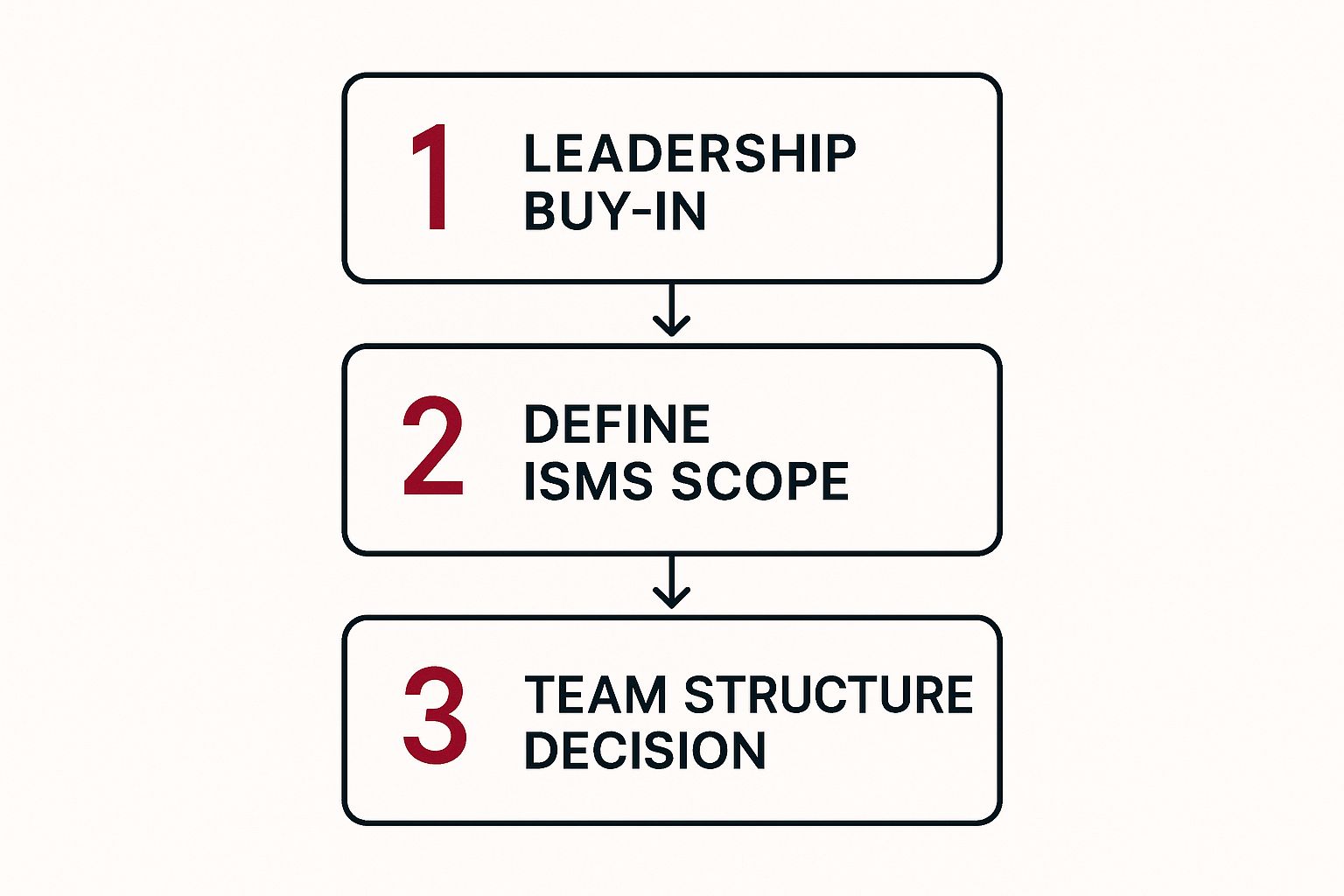
This process isn't just a checklist; it’s a strategic sequence. Each step logically builds on the last, taking you from high-level support right down to the nitty-gritty of implementation.
An internal team knows your business inside and out. They understand the culture, the people, and the operational quirks that don't show up on any org chart. The catch? They might lack specific ISO 27001 expertise, which means a lot of time spent on training and learning, potentially dragging out your timeline.
An external consultant, however, arrives with a ready-made toolkit of specialised expertise and a proven methodology. They’ve seen all the common pitfalls and can navigate the certification maze efficiently, often putting you on the fast track. The trade-off is usually a higher upfront cost and the risk of ending up with a system that your own team doesn't truly own or understand.
Weighing Your Options
To make the right call, you need to look past the initial price tag and think about long-term value and your team's capacity. A robust ISMS needs a solid governance structure underneath it all. To really get this right, it's worth exploring the essential IT governance frameworks that work hand-in-glove with ISO 27001.
Here’s a quick breakdown to help you weigh it up:
| Factor | Building an Internal Team | Hiring an External Consultant |
|---|---|---|
| Expertise | Requires a lot of training and learning on the fly. | Brings immediate, specialised ISO 27001 knowledge. |
| Cost | Lower direct fees, but higher hidden costs (salaries, training time). | Higher upfront fees, but can be more cost-effective overall. |
| Timeline | Usually longer because of the steep learning curve. | Often much faster due to their experience and processes. |
| Knowledge Transfer | Builds lasting expertise and ownership right inside your business. | Needs a conscious effort to make sure knowledge is passed to your team. |
| Business Context | Already has a deep understanding of your unique operations. | Brings an objective, outside view that can spot your blind spots. |
Many Australian businesses land on a hybrid approach. They might hire a consultant to steer the initial setup, scope definition, and risk assessment. At the same time, they train an internal "ISO Champion" to take the reins and manage the system for the long haul.
This model gives you the best of both worlds: external expertise to get you started and internal ownership to make it last. Ultimately, the right choice for you will come down to your budget, your deadline, and the skills you already have in-house.
Putting Your ISO 27001 Plan into Action
Alright, you've done the groundwork. Now it's time to roll up your sleeves and start building your Information Security Management System (ISMS). This is where the theory and planning get real, turning concepts on a page into the day-to-day security habits of your business.
It all kicks off with a risk assessment, but we're not talking about some generic, box-ticking exercise. To be truly effective, your risk assessment needs to be deeply connected to how your Australian business actually operates.
Getting Real with Your Risk Assessment
Think of your risk assessment as the engine driving your entire ISMS. It's the process of finding, analysing, and evaluating the unique threats and weak spots your company faces. Forget abstract fears about shadowy hackers; what could genuinely go wrong for your business, right here in Australia?
A Perth-based software company with a remote team has a completely different risk profile than a manufacturing firm in Adelaide with a physical supply chain. The software team’s biggest worries might be insecure home Wi-Fi networks or someone getting unauthorised access to their cloud servers. The manufacturer, on the other hand, is probably more concerned about vulnerabilities in their factory equipment or the security practices of their local delivery partners.
The end goal is a risk register that tells a clear story. It should document potential threats, weigh up their likelihood and impact, and assign a risk level. This isn't just paperwork—it's your strategic roadmap for where to focus your security efforts first.
Choosing the Right Controls from Annex A
Once you have a handle on your risks, you can start picking the right controls to manage them. ISO 27001 gives you a comprehensive menu of options in what’s known as Annex A. The crucial thing to understand is that this is not a mandatory checklist you have to tick off from top to bottom.
Instead, you strategically choose the controls that directly address the risks you just identified. It’s a pragmatic approach that means your security measures are targeted and effective, not just bureaucratic overhead.
Let’s look at a couple of real-world Australian scenarios:
- The Risk: An employee at your Melbourne office loses a company laptop on the tram, and it’s full of sensitive client data.
- The Controls: Here, you’d implement Annex A controls like mobile device management (A.8.1), full-disk encryption (A.10.1), and having the ability to remote-wipe the device (A.8.27).
- The Risk: Your Sydney sales team uses a third-party CRM to manage all their customer information.
- The Controls: You'd lean on controls for managing supplier security (A.5.19) and making sure your supplier agreements include specific security requirements (A.5.20).
This selective process ensures your security budget and effort are aimed at genuine threats, giving you the best protection without unnecessary complexity.
The real art of implementation isn't blindly applying every control. It’s about thoughtfully picking the right tools from the Annex A toolbox to build a security posture that fits your business like a glove.
Creating Your Statement of Applicability
All this work culminates in a critical document: the Statement of Applicability (SoA). This document is a cornerstone of your ISO 27001 certification Australia audit, and your auditor will pore over it. For every single control in Annex A, it clearly states three things:
- Whether you've implemented it.
- Why you've implemented it (linking it back to a specific risk).
- The justification for any controls you’ve decided not to implement.
For instance, if your business doesn't develop any software in-house, you can easily justify excluding the controls related to secure development. The SoA becomes the definitive record of your security choices, proving to an auditor that your approach is considered and risk-based.
It's also vital to keep an eye on the standard's evolution. The latest version, ISO 27001:2022, requires Australian businesses to transition from the 2013 framework by 31 October 2025. To make sure your ISMS is ready for the future, you can discover more insights about these changes and what they mean for your business.
Turning Your Staff into Your Strongest Defence
You can have the best policies and tech in the world, but your security will be full of holes if your team isn't on board. Staff training isn’t a nice-to-have; it’s absolutely fundamental to making your ISMS a living, breathing part of your culture.
And please, forget those dull, hour-long presentations that everyone just clicks through. Training that actually sticks is engaging, relevant, and ongoing.
- Make it role-specific. Your finance team needs different training on spotting invoice fraud than your developers need on secure coding.
- Use real-world examples. Don't just talk about "phishing." Show them a fake email designed to look like it’s from an Australian bank or a supplier they deal with every week.
- Make it interactive. Use quizzes, competitions, and even simulated phishing attacks to make learning about security a bit of fun.
- Keep the conversation going. A single session during induction is not enough. Security needs to be a constant drumbeat through regular updates, posters in the office, and quick chats in team meetings.
The real goal is to shift your team's mindset from seeing security as a list of rules to understanding it as a shared responsibility. The moment an employee in your Brisbane office instinctively flags a weird email, you’ll know your training is working.
Navigating the Audit Process with Confidence
Let's be honest, the word "audit" can make even the most seasoned business owner a bit tense. But it really doesn’t need to be an intimidating experience. Try to think of it less like a final exam you could fail, and more as a collaborative review. It's designed to validate all your hard work and even point out a few ways you can get even better.
With the right preparation and mindset, you can walk into your audit with genuine confidence. This is the final hurdle, the moment where you get to show that your Information Security Management System (ISMS) isn't just a pile of documents, but a living, breathing part of how you do business.
Demystifying the Stage 1 Audit
The certification journey is split into two key parts, kicking off with the Stage 1 audit. Think of this as a "readiness review." It’s essentially a detailed check of your documentation. The auditor isn't there to interview your entire team or poke around the server room just yet.
Their main job here is to review the core paperwork of your ISMS to make sure all the foundational pieces are in place for the main event. They'll be looking closely at things like your ISMS scope, your risk assessment report, and the all-important Statement of Applicability (SoA). At this point, they just want to see that the system you’ve designed on paper meets the requirements of the ISO 27001 standard.
The best advice for Stage 1? Be obsessively organised. Have all your key documents indexed and ready. If an auditor asks for your risk treatment plan, you should be able to produce it in seconds, not minutes. This initial display of organisation sets a powerful, positive tone for the entire process.
What Auditors Really Look For in Stage 1
Auditors are trained to spot gaps and inconsistencies. They’re searching for a clear, logical thread that connects every part of your system.
- Logical Links: Does your Statement of Applicability directly map back to the risks you identified in your risk assessment?
- Completeness: Have you documented all the mandatory policies and procedures that the standard requires?
- Scope Clarity: Is your ISMS scope statement crystal clear, unambiguous, and a true reflection of your business operations?
Passing Stage 1 is your green light to move forward. The auditor will also give you some feedback, often highlighting minor tweaks or potential concerns to address before the Stage 2 audit. This is incredibly valuable intel—make sure you use it.
Preparing for the Stage 2 Implementation Audit
This is the main event. The Stage 2 audit is where the auditor shifts from looking at your documents to verifying that your ISMS is actually up and running as you said it would be. They’ll be looking for real-world evidence that your security controls are in place and working.
This means they'll be talking to your people, observing processes, and digging into records. For example, if your policy says you conduct quarterly access reviews, the auditor will want to see the records from the last few quarters, complete with dates and sign-offs. If you have a procedure for signing in visitors, they’ll want to see it in action.
Before they arrive, it's smart to do your own dress rehearsal. A crucial part of this preparation is understanding how an internal review works. You can learn more about how to structure these self-assessments in our guide on what is an ISO internal audit. Running your own internal audit is the best way to find and fix issues before the external auditor ever lays eyes on them.
Empowering Your Team to Succeed
During the Stage 2 audit, your team is your biggest asset. The key isn't to coach them on rehearsed answers, but to make sure they genuinely understand their role within the ISMS.
An auditor might casually ask a developer, "How do you make sure your code is secure?" Or they might ask someone in marketing, "How do you handle the personal data you collect from the website?" Confident, honest answers based on their everyday work are infinitely more impressive than someone fumbling for a memorised line from a policy document.
Handling Non-Conformities The Right Way
It’s entirely possible the auditor will find a "non-conformity." This is simply an instance where your practice doesn't quite meet a requirement of the standard. It is not a failure. In fact, it's a normal part of the process and a fantastic opportunity to make your system even stronger.
Non-conformities usually come in two flavours: major or minor. A minor non-conformity might be a small, isolated slip-up, like a single missing record. A major non-conformity points to a more systemic problem, like a required process that hasn't been implemented at all.
If you get a non-conformity, the path forward is clear:
- Acknowledge the finding without getting defensive.
- Dig in and do a root cause analysis to figure out why it happened.
- Develop a corrective action plan to fix the immediate problem and stop it from happening again.
- Submit this plan to the auditor for their review and approval.
Tackling non-conformities professionally and proactively shows your commitment to continuous improvement—which is what ISO 27001 is all about.
Selecting a JAS-ANZ Accredited Certification Body
Finally, this is a big one for any business seeking ISO 27001 certification Australia: you must choose the right certification body. Not all certificates are created equal. To ensure your certification is recognised and respected, you have to select a body accredited by JAS-ANZ (the Joint Accreditation System of Australia and New Zealand).
JAS-ANZ is the government-appointed authority that assesses and accredits the organisations that perform these audits. Choosing a JAS-ANZ accredited certifier is your guarantee that the audit will be conducted with the highest level of integrity and skill.
A certificate from a non-accredited body holds very little weight and might even be rejected by potential clients or during a tender process. Always check a certification body’s credentials on the JAS-ANZ website before signing anything. It’s the final step to ensure your significant investment of time and effort pays off with a credential that truly opens doors.
Keeping Your ISMS Alive and Kicking After Certification
Getting that ISO 27001 certificate is a huge milestone. It’s easy to think, "Right, job done," pop the champagne, and stick the certificate on the wall. But here’s the truth: certification isn't the finish line. It's the starting gun for the real work.
Real security isn’t a project you complete; it’s a commitment you live out every day.
That certificate is only worth the paper it’s printed on if it reflects what’s actually happening in your business. An Information Security Management System (ISMS) that just sits on a shelf gathering dust is worse than having nothing at all—it gives you a dangerous, false sense of security.
To keep your certification valid, and more importantly, to keep your business genuinely safe, you have to weave these security habits into the fabric of your daily operations. This isn't about ticking boxes for an auditor once a year. It's about building a system that flexes and adapts as your business grows and as the Australian threat landscape inevitably shifts.
The Power of a Regular Internal Audit Rhythm
Your single most powerful tool for keeping the ISMS sharp is the internal audit. Don't think of this as a scary dress rehearsal for the main event. Think of it as your opportunity to look in the mirror, find the cracks, and fix them long before an external auditor ever sees them. A smart internal audit program gives you priceless, on-the-ground intel on how your security controls are really holding up.
A classic mistake so many Australian businesses make is trying to cram a single, massive internal audit into the month before their surveillance audit is due. It’s a recipe for chaos, stress, and frankly, it misses the entire point.
There’s a much better way. Break it down into manageable chunks.
Instead of one giant audit, schedule a series of smaller, more focused reviews throughout the year.
- First Quarter: You could dive deep into your access control policies. Who has access to what? Are your processes for new starters and leavers actually being followed?
- Second Quarter: Shift your focus to supplier security. Are you properly vetting your third-party vendors and managing those risks?
- Third Quarter: Time to test your incident response and business continuity plans. Run a simulation. See what breaks.
- Fourth Quarter: Look at the tangible stuff—physical security around the office and how you're tracking your assets.
This bite-sized approach turns a mammoth task into something you can actually handle. It lets you go deeper into each area and ensures that when the external auditor does show up, you’ve already calmly and thoroughly reviewed every single part of your ISMS within the last 12 months.
Making Management Reviews a Strategic Huddle
If internal audits are your tactical, on-the-ground check-ups, the management review is your strategic huddle. This is a formal, scheduled meeting where the leadership team takes a step back and looks at the big picture. It’s where you ask the hard questions.
Is our ISMS still pointing in the same direction as the rest of the business? Are we actually hitting our security goals? What have we learned from our internal audits? What new threats are coming over the horizon that we need to prepare for?
This meeting can't be a dry presentation full of charts nobody understands. It needs to be a real, strategic conversation that leads to concrete decisions and actions.
Your management review isn’t just about reporting on what’s already happened. It's about actively steering the ship and charting the course for the future. It’s the engine that ensures your security strategy is a living thing that helps the business thrive, not just a document in a folder.
To make these meetings genuinely useful, have a tight agenda, take proper minutes, and assign clear action items. This creates a fantastic evidence trail for your surveillance audit, proving that your leadership team is fully engaged and in control.
A Practical Schedule for Staying on Track
Staying ready for your annual surveillance audits shouldn't feel like a last-minute panic. It just takes a simple, repeatable schedule. A bit of discipline in how you maintain your ISO 27001 certification in Australia removes all the stress and builds a culture where security is just part of what you do.
Here’s what a simple annual rhythm for your ISMS activities could look like:
| Month | Key ISMS Activity | What It Achieves |
|---|---|---|
| January | Conduct Q1 Internal Audit (e.g., Access Control) | Kick the year off by checking a fundamental control area. |
| February | Review & Update Risk Register | What’s new? What’s changed? Identify emerging risks. |
| March | Roll Out Security Awareness Training Refresher | Keep security front-and-centre for all your staff. |
| April | Conduct Q2 Internal Audit (e.g., Supplier Management) | Take a close look at the security of your supply chain. |
| May | Run a Phishing Simulation | Test how well your team spots a common, and dangerous, threat. |
| June | Hold Mid-Year Management Review | Check progress against H1 goals and adjust your plans for H2. |
| July | Conduct Q3 Internal Audit (e.g., Incident Response) | Don't just have a plan—test your ability to use it. |
| August | Test Your Backup and Recovery Procedures | Verify that you can actually get your critical data back if needed. |
| September | Review and Update Key Policies & Procedures | Make sure your documents reflect how you actually work. |
| October | Conduct Q4 Internal Audit (e.g., Physical Security) | Check the security of your office, hardware, and assets. |
| November | Prepare for the Annual Surveillance Audit | Pull together your evidence and review all your findings. |
| December | Hold Year-End Management Review | Look back at the year's performance and set goals for the next 12 months. |
This steady drumbeat of activity means you’re never scrambling. You’re always prepared.
Adapting to a World That Won't Stand Still
Your business is always evolving, and so are the threats you face. A static ISMS is a sitting duck. Maybe you're launching a new cloud service, bringing AI into your workflow, or hiring more remote staff. Every single one of those changes brings new risks that need to be properly assessed and managed.
The Australian cyber threat landscape is also constantly changing. New attack methods pop up, and government and client expectations get higher. Your ISMS needs to be agile enough to keep up.
This is why the cycle of internal audits and management reviews is so critical. It gives you that agility. It’s your built-in mechanism for constantly tweaking and recalibrating your security to meet new challenges head-on. When you treat your ISMS as a living, breathing part of your business, you ensure it remains a powerful asset that doesn’t just protect you, but actively supports your growth for years to come.
Facing the Common Hurdles for Aussie SMEs
Let's be real—getting ISO 27001 certified in Australia isn't always a walk in the park for a small or medium-sized business. It’s a journey, and like any good journey, it has its fair share of challenges that can feel pretty full-on when you're already spinning a dozen other plates. But just knowing what these hurdles are is the first, and most important, step to clearing them.
The good news? You're not the first to walk this path. Thousands of Australian SMEs have been through this exact process, and their experiences have paved the way. From figuring out the budget to finding the right people, every challenge has a practical, real-world solution.
Tackling the "It's Too Expensive" Myth
One of the first things that comes up when talking to business owners is the cost. There's this persistent myth that ISO 27001 is a luxury item reserved for the big end of town with bottomless budgets. And yes, there are costs involved—that won't be sugarcoated—but with a bit of smart thinking, you can make it surprisingly affordable.
The trick is to stop thinking of it as a cost and start seeing it as an investment. You have to weigh the initial spend on consulting, tools, and the audit against what you stand to gain. Think about what landing just one big contract could mean for your business, or the peace of mind that comes from preventing a data breach that could cost you a fortune and your reputation.
A classic mistake is getting fixated on the upfront price tag. The real cost isn't what you spend on certification; it's the deals you lose because you can't tick that box on a tender, or the financial black hole a security incident would create.
A cost-effective approach isn't about cutting corners; it's about being clever. Start by focusing on the security controls that give you the most bang for your buck—the ones that tackle your biggest, scariest risks. You don't need to rush out and buy a suite of expensive, enterprise-level software on day one. A lot of the time, you can get more out of the tools you already own or find affordable solutions built specifically for businesses like yours.
Navigating the Talent and Resource Squeeze
Another huge challenge for Aussie SMEs is simply not having enough hands on deck. Chances are, you don't have a dedicated cybersecurity team just waiting for a project like this. The person tapped to lead the ISO 27001 charge is probably already wearing several hats—IT manager, operations guru, maybe even chief coffee maker.
This is where the shortage of skilled security pros really starts to bite. The talent market in Australia is tight, which often means high costs and a long wait to find someone with the right experience. But the local scene is adapting. We're seeing more and more businesses get creative, with recent data showing 48% of certifications now use cloud-based solutions and 35% lean on automated auditing tools to fill those gaps. You can dive deeper into these market trends and their impact on certification to see how the landscape is shifting.
This leaves you with a critical decision: do you train up your own team or bring in some outside help?
- Upskill Your Team: Investing in training for one of your key people builds a valuable, long-term asset for your business. They become your internal champion, owning the security system long after the auditors have packed up and gone home.
- Bring in a Partner: A good consultant can be a game-changer. They bring the expertise you're missing, help you sidestep common mistakes, and keep the project moving forward, which frees up your team to focus on what they do best.
In our experience, a hybrid approach often delivers the best results. Use a consultant to get the ball rolling with the initial setup and risk assessment, while you train someone internally to take the reins for the day-to-day management.
Making Sense of the Standard's Complexity
When you first open up the ISO 27001 standard, it can look like an intimidating wall of dense, technical jargon. It's incredibly easy to get lost in the details and feel completely overwhelmed. The secret? Don't try to boil the ocean.
Break it down into four simple, logical chunks:
- Figure Out Your 'Why': What does your business do, and what are your specific security responsibilities?
- Find Your Weak Spots: What could realistically go wrong with the information you hold?
- Put Up Your Defences: Choose the right security controls from Annex A to manage those risks.
- Check, Learn, and Improve: Keep an eye on how your controls are working and constantly look for ways to do things better.
When you look at it like that, it suddenly feels a lot less complicated, doesn't it? The goal isn't to memorise the entire standard. It's to build a practical, efficient security management system that's perfectly sized for your business.
Remember, the standard is a flexible framework, not a rigid set of instructions. A 10-person software startup in Adelaide is going to have a very different-looking system to a 100-person logistics company in Brisbane—and that's exactly how it should be. Don't let the jargon put you off; focus on the core principles and build something that genuinely works for you.
Your ISO 27001 Questions Answered
Getting started with ISO 27001 often brings up a lot of questions. We get it. To help you get your head around the process, here are some straightforward answers to the most common queries we hear from Australian businesses just like yours.
How Long Does Certification Take?
Let's get straight to it: how long will this take? For a typical small to medium-sized business here in Australia, you're generally looking at a timeframe of 6 to 12 months.
That might sound like a while, but it's a realistic window. This covers everything from the initial gap analysis to see where you stand, right through to implementing the necessary security controls, training your team, and then going through the formal two-stage audit with an official certification body. The biggest things that will stretch or shrink that timeline are the size and complexity of your business and how solid your current security practices are.
What Are the Main Costs Involved?
Budgeting is a big deal, so it’s crucial to understand where the money goes. When planning your ISO 27001 certification Australia project, the costs really fall into a few key buckets.
You'll need to account for:
- External Audit Fees: This is what you pay the certification body to conduct the Stage 1 and Stage 2 audits, plus the ongoing annual surveillance audits needed to keep your certificate valid.
- Consultant Fees: If you choose to bring in an expert to steer the ship, their fees are a key part of the investment. Frankly, this often saves a lot of time, money, and headaches in the long run.
- Technology and Tools: You might find you need to invest in new security software, upgrade some hardware, or sign up for specific cloud services to tick off certain control requirements.
- Internal Resources: Never underestimate the value of your own team's time. Your staff will be spending a good chunk of their hours on documentation, attending training, and putting new processes into practice.
Do I Need to Hire a Consultant?
Hiring a consultant isn't a mandatory part of the standard, but it's something many Aussie SMEs find invaluable. An experienced ISO 27001 consultant can seriously accelerate the entire process and help you dodge the common mistakes that can derail a project.
They come armed with a proven playbook, making sure your Information Security Management System (ISMS) isn't just a binder on a shelf, but a practical, efficient system that’s the right size for your business. That said, if you have strong leadership support and a switched-on, dedicated internal team, going it alone is definitely achievable.
Is ISO 27001 a Legal Requirement in Australia?
No, ISO 27001 isn't a law that every business in Australia has to follow. Its real clout comes from the demands of the market and specific industry rules.
More and more, you'll see it as a contractual requirement if you want to work with government departments, big banks, healthcare organisations, and other major players. It’s their way of vetting suppliers. Beyond that, it’s also a fantastic way to prove you’re taking your obligations under laws like the Australian Privacy Act seriously.
Ready to stop wondering and start securing your business? The expert team at Anitech has walked hundreds of Australian businesses through this process, with a 100% certification success rate. We handle the heavy lifting so you can focus on what you do best. Start your journey with confidence at https://iso-27001.com.au.
Recent Comments