

When we talk about ISO 27001 certification in Australia, we're referring to the gold standard for managing information security risks. It's a formal, independently verified framework that proves to your clients, partners, and regulators that you take data protection seriously.
Why ISO 27001 Is Now a Strategic Imperative in Australia
Let’s be blunt—treating information security as an IT-only problem is a thing of the past. For Australian businesses, the conversation around data protection has well and truly moved from the server room to the boardroom. Achieving ISO 27001 certification is no longer a 'nice-to-have' badge; it’s become a critical driver for survival and growth.
This isn't just about avoiding a negative headline. It’s about dealing with the real, tangible risks out there. A single data breach can send devastating ripples through every part of your business, hitting your revenue, shredding your brand reputation, and eroding the trust you've spent years building. The standard gives you a proven playbook for building resilience against these exact threats.
The Escalating Cyber Threat Landscape
The security environment in Australia is getting more hostile by the day. According to the Australian Cyber Security Centre (ACSC), they fielded over 94,000 cybercrime reports in the 12 months leading up to 2023. That’s a staggering 23% jump from the year before.
Nasty attacks like ransomware and phishing are still the main culprits behind these breaches, which really hammers home the need for a properly structured defence. This alarming trend has put massive pressure on organisations of every size. It's no surprise that the Australian Government’s 2023–2030 Cyber Security Strategy is now laser-focused on risk management and resilience, strongly pushing businesses to adopt robust security frameworks.
ISO 27001 is precisely that. It’s a systematic way to find, manage, and shut down information security risks before they have a chance to do real damage.
Unlocking Commercial Opportunities
But it's not all doom and gloom. Beyond just playing defence, ISO 27001 certification is a powerful tool for going on the offence and actively growing your business. In a crowded market, it's a clear differentiator, especially when you're bidding for those big, high-value contracts.
Just think about these common scenarios:
- Government Tenders: Many federal and state government contracts now list ISO 27001 as a non-negotiable requirement for any supplier handling sensitive data. No certificate, no chance.
- Major Corporate Clients: Big players in finance, healthcare, and tech are increasingly demanding their partners and vendors be certified. They need to know their supply chain is secure from top to bottom.
- International Expansion: Looking to take your business overseas? ISO 27001 is an internationally recognised mark of quality that instantly builds credibility and trust with global partners.
Without this certification, you’ll find doors slamming shut on lucrative opportunities, effectively locking you out of entire market segments. For a deeper dive, check out our guide on strengthening information security practices for Australian businesses.
The real win with ISO 27001 isn't just about passing an audit. It’s about fundamentally changing how your organisation values and protects its most critical asset: information. That commitment is what turns a compliant business into a trusted one.
Building Unbreakable Client Trust
In an age where data breach headlines are a daily occurrence, trust is the most valuable currency you have. Your customers are more clued-in than ever about the risks of sharing their personal and financial details. They want solid proof that the companies they deal with are responsible guardians of their data.
ISO 27001 certification provides that tangible proof. It’s a public statement that you've implemented a world-class Information Security Management System (ISMS) and are committed to keeping it sharp. It shows you’ve moved beyond empty promises and put your security practices under the microscope of a rigorous, independent audit.
This level of assurance can easily be the deciding factor for a client choosing between you and a non-certified competitor. It shows a proactive commitment to security that builds real confidence and fosters long-term, loyal relationships.
Ultimately, ISO 27001 offers a comprehensive cybersecurity framework, giving you a structured way to manage the information security risks that are so critical for Australian businesses today. By embracing this standard, you’re not just ticking a compliance box; you’re investing in a more resilient and trustworthy future for your organisation.
Your Practical Roadmap to Getting Certified
Let’s be honest, staring down the barrel of ISO 27001 can feel intimidating. For many Australian businesses, it looks like a mountain of dense, technical requirements. But the secret isn't about memorising the standard; it's about turning that checklist into a practical, step-by-step plan that fits your organisation.
This is where we cut through the noise. We're going to demystify the entire journey, breaking it down into achievable phases. Forget just ticking boxes – this is about building a genuine, resilient security culture from the inside out. We'll start with the fundamentals, like figuring out where you truly stand with a gap analysis and making the crucial call on the scope of your Information Security Management System (ISMS). Getting that scope right from the start can make or break your entire project.
Getting Management on Board
Before a single policy is drafted or a single new tool is deployed, your first job is to get genuine commitment from the leadership team. This is non-negotiable. ISO 27001 isn't just an "IT thing"; it's a strategic business decision that demands real resources, a proper budget, and the authority to make changes. Without rock-solid support from the top, your certification journey will fizzle out before it even gets going.
To win them over, you need to speak their language. Ditch the technical jargon and focus on what they really care about:
- Reducing real-world business risk
- Gaining a serious competitive advantage
- Building unbreakable client trust
These are the drivers that get a 'yes' in the boardroom.
The infographic below highlights the key motivators that typically resonate most with leadership when it comes to pursuing iso27001 certification in australia.
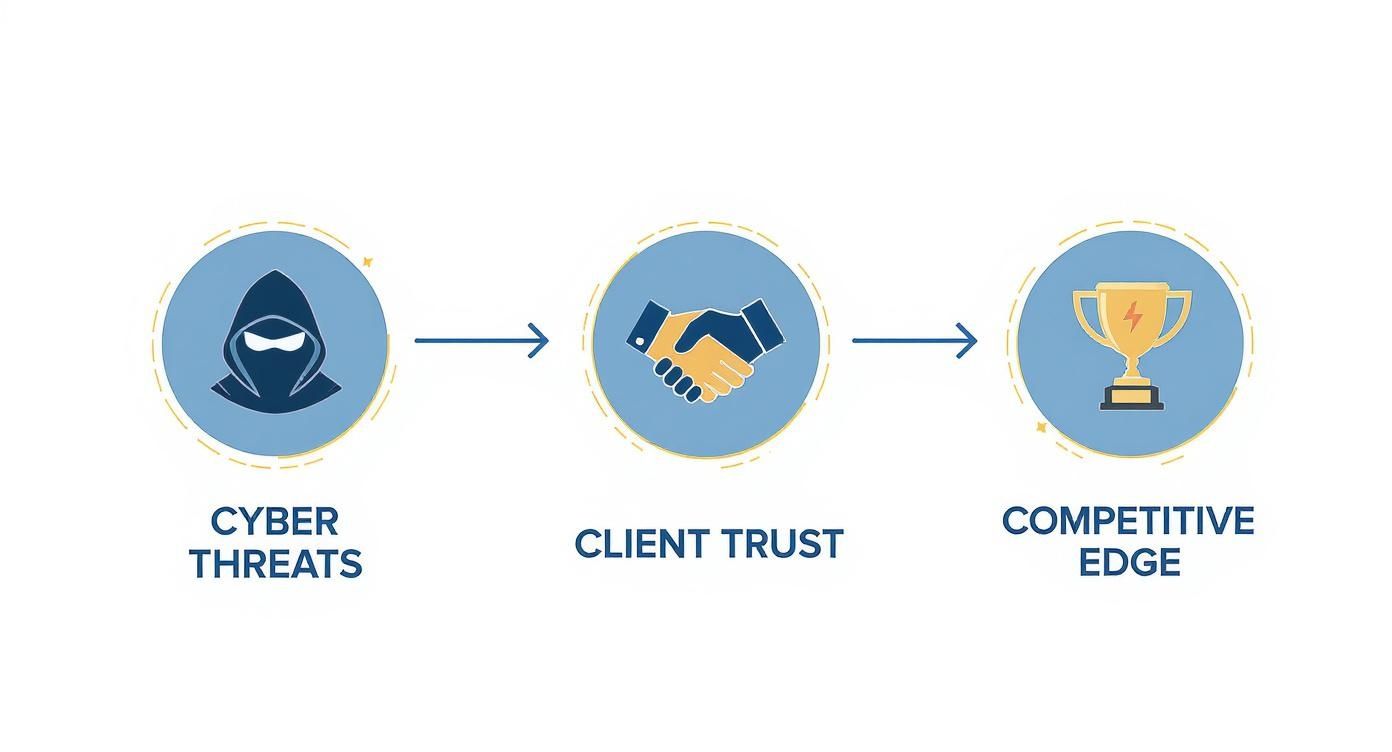
As you can see, it's all about pushing back against cyber threats, cementing client relationships, and standing out in a crowded market.
Finding Out Where You Really Stand with a Gap Analysis
With the executive team backing you, it's time for a reality check. A gap analysis is basically a health check of your current security posture against the specific requirements of the ISO 27001 standard. It's designed to give you a brutally honest picture of where you are right now.
The aim is simple: identify every gap between what you're doing today and what the standard demands. This process will shine a light on your strengths but, more importantly, it will uncover your weaknesses and blind spots.
A solid gap analysis needs to dig into:
- Your Policies: Are your security policies actually documented, approved, and understood by everyone? Or do they just exist on an old hard drive?
- Technical Defences: Have you got the basics covered, like firewalls, proper access controls, and encryption?
- Physical Security: How are you protecting your offices, server rooms, and hardware from people who shouldn't be there?
- People Power: Does your team know their security responsibilities? Can they spot a phishing email a mile away?
The results of this analysis will become the blueprint for your entire implementation plan, helping you prioritise tasks and put your resources where they’ll have the most impact.
Defining the Scope of Your ISMS
Deciding on the scope of your Information Security Management System (ISMS) is one of the most important decisions you’ll make. It’s where you draw the line in the sand, defining which parts of your business will be covered by the certification.
If you get this wrong, you risk either biting off more than you can chew or, even worse, leaving critical parts of your business exposed.
Your scope needs to be clearly defined based on:
- The Business Itself: Which departments, office locations, and legal entities are in?
- Your Crown Jewels: What are the most critical information assets you need to protect (think customer data, IP, financial records)?
- Key Processes: Which core business operations rely on that information?
- The Technology: What systems, networks, and applications hold it all together?
Here's a pro tip: don't make your initial scope too broad. It's a classic rookie mistake. For your first go-around, it’s much smarter to start with a well-defined, critical part of the business—like a flagship product line or a single key office. You can always expand the scope later once your ISMS is humming along.
For example, a mid-sized Sydney tech company I worked with chose to limit their first scope to just the development and support teams for their main software product. This made the project far more manageable and let them get certified for their most valuable asset first, giving them immediate proof of security to show their clients.
Getting Real with a Risk Assessment
Once you’ve drawn your line in the sand with the scope, you can get to the heart of the ISMS: the risk assessment. This is where you methodically identify potential threats to your information, figure out the likelihood and potential damage of each, and then decide on a plan of attack.
The goal isn't to magically eliminate all risk—that's a fantasy. It's about making smart, informed decisions to bring risk down to a level your business is comfortable with.
Here’s a simple breakdown of how it works:
- Map Your Assets: List all the valuable information and systems inside your defined scope.
- Identify Threats & Vulnerabilities: For each asset, think about what could go wrong. A threat might be a ransomware attack; a vulnerability could be an old, unpatched server.
- Analyse the Risks: Estimate the likelihood and impact for each scenario. A simple 'High, Medium, Low' scale is a great place to start.
- Evaluate and Prioritise: Now, compare those risks against your company’s appetite for risk. Which ones are simply unacceptable and must be dealt with?
This structured approach forces you to focus your time, money, and energy on the threats that actually matter, instead of chasing ghosts.
Putting Annex A Controls into Action
After your risk assessment has told you what you need to protect against, you turn to Annex A of the ISO 27001 standard to figure out how. Annex A is essentially a catalogue of 93 potential security controls, organised into four areas: organisational, people, physical, and technological.
Now, it’s crucial to understand you don't have to implement every single one. That’s not the point. You strategically select the controls that are relevant to treating the specific risks you’ve already identified.
For every control you choose to implement, you have to justify why it's necessary. And just as importantly, for any control you decide to exclude, you have to document a valid reason.
This entire process feeds into a document called the Statement of Applicability (SoA). Think of the SoA as the master plan that lists all 93 controls, clearly states whether you're using them or not, and explains your reasoning. Auditors live and breathe this document; a well-crafted SoA shows them you've been thorough and logical. For any Australian business on this journey, a solid SoA is absolutely essential. It proves that your path to iso27001 certification australia is built on a practical, risk-based foundation that’s perfectly aligned with your business needs.
Assembling Your Team and Budgeting for Success
Getting your ISO 27001 certification in Australia is absolutely a team sport, not a solo mission. It demands the right people in the right roles, all backed by a realistic, well-thought-out budget. This is where the rubber meets the road, where solid resource planning is what separates a successful project from one that stalls out due to surprise costs or a lack of manpower.

Too many organisations stumble by underestimating the sheer amount of time and money needed. This almost always leads to frustration and delays. Real success hinges on two things: putting together a dedicated team and securing a budget that sees you through the entire journey, from that first planning meeting to keeping the system running years down the track.
Building Your ISO 27001 Implementation Team
First things first, you need to decide who’s going to lead the charge. This is more than just handing out a to-do list; it’s about creating genuine ownership and accountability. You’ve got a few proven models to pick from, and the best one for you will depend on your company’s size, complexity, and the expertise you already have in-house.
The most common paths are to appoint an internal project lead, bring in an external consultant for their specialist knowledge, or create a hybrid team that gives you the best of both worlds.
Key Roles and Responsibilities
No matter which path you take, some roles are simply non-negotiable for a smooth implementation. Think of it like casting a movie—every actor is critical to making the final cut a success.
- Project Manager/Lead: This is your director. They run the day-to-day show, coordinating tasks, keeping an eye on deadlines, and making sure all the key stakeholders know what’s happening.
- Information Security Officer (ISO): This person is your technical guru. They’ll provide expert advice on security controls, run the risk assessments, and will likely be the one writing most of the documentation.
- Departmental Champions: You need buy-in from every corner of the business. Getting people from HR, IT, and legal involved ensures the policies you create are practical and will actually be followed by staff.
- Executive Sponsor: You absolutely need a senior leader in your corner, someone who will champion the project at the executive level. They’re invaluable for getting the budget approved and clearing any organisational roadblocks that pop up.
Here’s a pro tip: don't even think about siloing your ISO 27001 project within the IT department. It’s a classic mistake. This is a business-wide initiative that touches people, processes, and technology. A diverse team ensures your new ISMS becomes part of the company culture, not just another system that’s bolted on.
Start by looking at the skills you already have. You might be surprised to find you have staff with strong project management or risk assessment experience ready to step up. But be honest about your blind spots—it’s crucial to know what you don’t know.
When to Engage an Australian ISO 27001 Consultant
Bringing in an external consultant is a big decision. While some companies have the internal firepower to manage it themselves, a specialist consultant brings a wealth of experience you just can’t replicate. They’ve walked countless Australian businesses through this exact process and know where all the common traps are hidden.
You should seriously consider bringing in an expert if:
- Your team has never worked with the ISO 27001 standard before.
- You’re on a tight deadline and need to fast-track the certification.
- You want a fresh pair of eyes to challenge your existing security practices.
- Your team is already flat out and simply doesn’t have the bandwidth for a project this big.
A great consultant does more than just hand over templates. They act as a guide and a mentor, upskilling your own team so you can confidently manage the ISMS long after they’re gone. They get the nuances of applying the standard to Australian businesses, ensuring your approach is both compliant and genuinely practical.
A Transparent Look at the Budget
Budgeting for ISO 27001 is about more than just the auditor's final invoice. A smart budget plans for costs across several key areas, helping you dodge those nasty financial surprises that can completely derail a project. For businesses in Australia, costs can range anywhere from $15,000 to over $27,000, heavily influenced by your company's size and complexity.
To help you get a clearer picture, here’s a breakdown of what you can expect to pay for certification in Australia.
Estimated ISO 27001 Certification Costs for Australian Businesses
| Cost Component | Small Business (1-50 Employees) | Medium Business (51-250 Employees) | Large Enterprise (250+ Employees) |
|---|---|---|---|
| Certification Body Fees (Stage 1 & 2) | $8,000 – $15,000 | $15,000 – $25,000 | $25,000+ |
| Consulting Fees (Optional) | $10,000 – $20,000 | $20,000 – $40,000 | $40,000+ |
| Employee Training | $1,000 – $3,000 | $3,000 – $7,000 | $7,000+ |
| Technology & Tools | $2,000 – $10,000 | $10,000 – $30,000 | $30,000+ |
| Penetration Testing | $2,000 – $5,000 | $5,000 – $15,000 | $15,000+ |
| Annual Surveillance Audits | $4,000 – $7,500 | $7,500 – $12,500 | $12,500+ |
This table provides a solid starting point for your financial planning, but remember that these are estimates. The final figure will always depend on your unique situation. For a more detailed financial breakdown, you can learn more about ISO 27001 certification costs in our dedicated article.
Planning for Ongoing and Hidden Costs
Certification isn't a "set and forget" exercise; it's an ongoing commitment to security. Your budget needs to reflect this to keep your ISMS healthy for the long haul.
Beyond the initial outlay, you need to factor in:
- Technology Upgrades: Your gap analysis might show you need new tools, like a better firewall, an endpoint detection solution, or a new password manager.
- Penetration Testing: You’ll likely need regular vulnerability assessments, which can cost anywhere from $2,000 to $20,000 a pop.
- Surveillance Audits: To keep your certificate valid, you'll have annual audits in years two and three. These usually cost about half of your initial audit fee.
- Internal Resources: And don't forget the time-cost of your own team. The hours they’ll spend on ISMS management, running internal audits, and conducting management reviews are a very real, ongoing expense.
By building a comprehensive budget that covers all these pieces, you give your project the financial stability it needs and show leadership you have a realistic plan. This proactive approach ensures your journey towards ISO 27001 certification in Australia is smooth, predictable, and a winning move for your business.
Navigating the Audit Process with Confidence
The external audit often feels like the final boss battle in the ISO 27001 certification journey. It's the moment all your hard work, policy writing, and risk assessments are put to the test. But this shouldn't be a source of anxiety.
Honestly, you should think of it as your opportunity to proudly showcase the robust Information Security Management System (ISMS) you've built.

With the right preparation, you can transform the audit from an intimidating interrogation into a confident conversation. This is about more than just having the right paperwork; it's about demonstrating that information security is genuinely embedded in your organisation's culture.
So, let’s pull back the curtain on what really happens during the audit stages.
Understanding the Stage 1 Audit
The Stage 1 audit is essentially a readiness review. The auditor isn't there to pick apart every single control you've implemented. Their job is to verify that you have a complete and documented ISMS in place—basically, to check you have all the necessary components ready for the main event.
Think of it as a dress rehearsal. The auditor will primarily focus on your high-level documentation, such as:
- Your ISMS scope statement
- The overarching information security policy
- Your risk assessment methodology and the resulting risk treatment plan
- The Statement of Applicability (SoA)
They're just confirming that, on paper, your system meets the requirements of the ISO 27001 standard. This stage is your best chance to get valuable feedback directly from the auditor. They might highlight minor gaps or areas that need a bit more polish before the more intensive Stage 2 audit kicks off.
Preparing for the Stage 2 Certification Audit
The Stage 2 audit is where the deep dive happens. The auditor will arrive on-site (or connect remotely) to verify that your ISMS isn't just a collection of well-written documents. They need to see it’s fully implemented and operating effectively in your day-to-day business.
This means they’ll be looking for tangible evidence. They will want to see your policies in action, interview your team members, and review records to confirm that you are actually doing what your documentation says you do.
Auditor's Insight: Auditors are not trying to catch you out. Their goal is simply to confirm conformity with the standard. They are looking for evidence that your ISMS is a living, breathing part of your business, not just a folder of documents collecting dust.
To make this process as smooth as possible, your evidence needs to be organised and easily accessible. Imagine an auditor asks to see your process for new employee onboarding. You should be able to quickly pull up the relevant policy, show them the training records for a recent hire, and demonstrate exactly how access rights were granted according to that policy.
What Auditors Really Look For
Beyond the paperwork, auditors are assessing the maturity and integration of your security practices. They want to see that your team understands their roles and responsibilities and that security is a shared commitment, not just an "IT problem".
Here’s what makes them nod in approval:
- Clear Evidence Trails: Can you easily link a risk from your risk assessment to a specific control in your SoA, and then show a record of that control being implemented?
- Knowledgeable Staff: When an auditor interviews a team member, can they articulate their security responsibilities confidently? For instance, can a developer explain the secure coding practices they follow?
- Management Commitment: Is there proof of regular management review meetings? Auditors love to see meeting minutes showing that leadership is actively involved in overseeing the ISMS.
This is exactly why staff training and awareness are so critical. An engaged team that understands the "why" behind the security controls is your most powerful asset during an audit.
Handling Non-Conformities
It's entirely possible the auditor will find a non-conformity. It's crucial to understand that this is not a failure; it’s a normal part of the process and a valuable opportunity to strengthen your ISMS.
There are two main types you might encounter:
- Minor Non-conformity: This is a small lapse or an isolated incident that doesn't undermine the entire ISMS. A classic example is a single missing record from a visitor log.
- Major Non-conformity: This indicates a systemic failure or a complete absence of a required process, like having no internal audit program at all.
For minor issues, you'll typically be asked to submit a corrective action plan outlining how you'll fix the problem and prevent it from happening again. Certification can usually proceed once the plan is approved. A major non-conformity, however, will need to be fully addressed and re-audited before certification can be granted. The key is to address any findings constructively and show your commitment to continuous improvement. For businesses undergoing their first ISO 27001 certification in Australia, this feedback is invaluable.
The entire audit is a detailed process, and having a clear plan is non-negotiable. To ensure you're fully prepared, you might want to review this ultimate audit preparation checklist. For a more in-depth look at what to expect, our detailed guide on the ISO 27001 audit process can provide further clarity and help you face the audit with complete confidence.
Beyond Certification: How to Keep Your ISMS Alive and Kicking
Getting your ISO 27001 certificate is a massive win, but don't pop the champagne and put the binder on the shelf just yet. The real work—and the real value—starts now. Think of your certification not as the finish line, but as the starting block for building a truly resilient security posture.
This is where you shift from a one-off project to a living, breathing part of your business. It's about embedding security so deeply into your operations that it becomes second nature. Your focus moves from frantic implementation to steady, consistent maintenance, creating a culture where security isn't just a policy document, but a shared responsibility.
The Rhythm of Surveillance Audits
Your three-year certification cycle is kept honest by annual surveillance audits. These aren't the full-blown, deep-dive audits you just went through, but they are absolutely critical. Treat them as regular health checks to prove your Information Security Management System (ISMS) is still effective, fit for purpose, and meeting the ISO 27001 standard.
Each year, an auditor will come in to sample key areas of your ISMS. They’re looking for hard evidence that you're:
- Actively maintaining your system: This means you've been running your internal audits and holding proper management reviews.
- Closing out issues: They’ll check on the progress of any corrective actions from previous audits. No sweeping problems under the rug.
- Adapting to the real world: Your ISMS must evolve as your business grows, technologies change, and new threats emerge.
Failing a surveillance audit can lead to the suspension or even withdrawal of your certificate. That’s why treating your ISMS as a continuous program is non-negotiable for any business with an ISO 27001 certification in Australia.
Driving Real Progress with Management Reviews
Management reviews are the engine room of continuous improvement, but far too often, they become a stale, box-ticking exercise. A great review is a strategic meeting where your leadership team gets hands-on, actively assessing the ISMS's performance and making smart, informed decisions to make it stronger.
This isn’t just about looking at a few PowerPoint slides with graphs. It’s a critical discussion that should spark action.
Key Inputs for a Productive Management Review
| Input Category | Example Evidence | Purpose |
|---|---|---|
| Previous Actions | Status update on tasks from the last review meeting. | Ensures accountability and follow-through. |
| Performance Metrics | Dashboards showing incident numbers, threat trends, or control effectiveness. | Provides a data-driven view of ISMS performance. |
| Audit Results | Findings from internal and external audits, including non-conformities. | Highlights areas for immediate improvement. |
| Stakeholder Feedback | Comments from clients, partners, or internal teams about security. | Aligns the ISMS with business and client expectations. |
| Risk Assessment | Review of the current risk register and any emerging threats. | Keeps the ISMS relevant to the current threat landscape. |
The most important part? The meeting must end with a list of clear, actionable tasks assigned to specific people with firm deadlines. That’s how you turn a review from a report into a rocket booster for progress.
Weaving Security into Your Company Culture
Let's be honest: policies and controls are only as strong as the people who have to follow them. The ultimate goal is to move beyond mere compliance and build a genuine security-aware culture where every single employee understands their role in protecting information.
This takes more than a once-a-year training video.
It’s about knitting security into the fabric of daily work. For example, your software development team shouldn't just be handed a set of secure coding guidelines; security checks should be built directly into their development pipeline. When HR onboards new starters, security training relevant to their specific role should be part of day one, not an afterthought.
Continuous improvement is about making security a habit, not a hurdle. When protecting data becomes an instinctive part of how your team works, you've moved beyond certification and achieved true security resilience.
This cultural shift is reinforced through constant, clear communication. Regular updates on new phishing scams, celebrating security "wins" (like a team spotting a potential threat), and providing easy-to-find resources all help keep security top-of-mind for everyone.
The Mandatory Jump to ISO 27001:2022
A huge part of keeping your certification relevant is adapting to updates in the standard itself. And a big one landed with the release of the ISO 27001:2022 standard, which has now completely replaced the old 2013 version. For Australian businesses, this isn't an optional upgrade—it’s mandatory.
The ISO 27001 certification in Australia has gone through a major shift. Organisations certified under the 2013 framework must transition to the 2022 version by a hard deadline of 31 October 2025 to keep their certification valid. This change puts real pressure on Australian companies to get up to speed with updated controls and risk management approaches that tackle modern challenges like cloud security and AI. Miss this deadline, and you risk losing your certification and the trust that comes with it. You can find out more about what this means for local businesses on IQC Global.
So, what’s actually new in the 2022 version?
- A Tidier Annex A: The controls have been restructured and condensed from 114 to 93, now grouped into four simple themes: Organisational, People, Physical, and Technological.
- New Controls for a New Era: Eleven new controls were added to address modern security headaches, including threat intelligence, data leakage prevention, and security for cloud services.
- Helpful "Attributes": Controls can now be tagged with attributes (like "Preventive" or "Detective"), making it much easier to filter and align them with your specific risk management framework.
Your transition plan needs to be in motion now. Start with a gap analysis against the new controls, get your Statement of Applicability updated, and begin rolling out any new processes or tech required. Being proactive here ensures your certification remains a powerful, current, and valuable asset for your business.
Your ISO 27001 Certification Questions, Answered
Starting the journey to ISO 27001 certification naturally brings up a lot of practical questions. For most Australian businesses, the early days are filled with uncertainty around timelines, costs, and the best way to get started.
Let's cut through the confusion. We've pulled together the most common questions we hear from organisations just like yours and laid out some clear, straightforward answers to help you move forward with confidence.
How Long Does It Take to Get ISO 27001 Certified in Australia?
Honestly, there's no single timeline that fits everyone. How long it takes to achieve ISO 27001 certification in Australia really comes down to your business's size, how complex your operations are, and where your security stands right now.
For a typical small to medium-sized business that already has some decent security practices in place, you’re likely looking at a timeframe of 6 to 12 months.
Bigger companies, or those starting from scratch with their security, might need 12 to 18 months or even longer. That extra time is crucial for properly embedding all the new processes and controls across different departments and complex systems without rushing things.
Remember, the clock starts ticking from the moment you begin the gap analysis, moves through the heavy lifting of building your Information Security Management System (ISMS), and includes your own internal audits before you even get to the formal two-stage external audit.
What’s the Difference Between Certification and Compliance?
This is a big one, and the distinction is critical. Getting this right is key to how you talk about your security posture with clients, partners, and stakeholders.
Compliance is essentially an internal claim. It means you’ve put the controls and processes from the ISO 27001 standard in place yourself. You’re following the rulebook, but no one has officially checked your work.
Certification, on the other hand, is the official, independent seal of approval. It means an accredited auditor has put your ISMS under the microscope and formally confirmed that it meets every single requirement of the standard.
Certification gives you that undeniable external validation. It’s the proof that clients and regulators are looking for. Without it, you’re just asking people to take you at your word, and in the world of security, that's rarely enough.
Can We Implement ISO 27001 Without an External Consultant?
Yes, you absolutely can. If your internal team has dedicated people with real expertise in project management, risk assessment, and information security, tackling it in-house can work.
However, most Australian businesses find that partnering with a specialist consultant is a game-changer. A good consultant brings more than just templates; they bring the hard-won experience from dozens, if not hundreds, of other implementations.
A seasoned consultant can help you:
- Dodge common pitfalls that derail projects and cause major headaches.
- Speed up the process with a proven, structured roadmap.
- Provide an objective eye, challenging your internal assumptions about your security.
- Translate the standard's language into practical actions that make sense for your business.
- Get your team ready for what the formal audit will actually feel like.
It really comes down to your team’s capacity, their existing expertise, and your deadline. Think of a consultant as an investment in getting it done faster and with far more certainty.
Is ISO 27001 a Legal Requirement in Australia?
While no federal law says every single Australian business must have ISO 27001, it’s increasingly becoming a de facto requirement in the market.
For many, it's a contractual necessity. Government tenders, particularly at state and federal levels, frequently demand suppliers have a valid ISO 27001 certificate if they're handling sensitive data.
It's the same story in the private sector. Major players in finance, tech, and healthcare often mandate certification for their vendors to protect their own supply chain.
On top of that, being able to show you follow a globally respected standard like ISO 27001 goes a long way in meeting your legal duties. It serves as powerful evidence that you’re taking "reasonable steps" to protect personal information—a cornerstone of the Australian Privacy Act and the Notifiable Data Breaches (NDB) scheme.
What Are the Ongoing Commitments After Certification?
Earning your ISO 27001 certificate is a huge achievement, but it's not the finish line. Your certification is valid for three years, and keeping it means staying committed to the standard.
Here’s what you need to keep on top of:
- Annual Surveillance Audits: In the second and third years, your certification body will return for a check-up. These are smaller audits to confirm your ISMS is still running effectively.
- Regular Internal Audits: You need to keep auditing yourself. This is how you proactively find and fix weaknesses before they become bigger problems.
- Management Reviews: Your leadership team needs to meet at least once a year to review how the ISMS is performing and drive improvements.
- Continuous Improvement: Your ISMS can't stand still. It must evolve with your business, adapting to new technologies, business goals, and the ever-changing threat landscape.
This ongoing cycle ensures your ISO 27001 certification in Australia is more than just a certificate on the wall—it's a living part of your business that builds genuine, long-term security resilience.
At Anitech, we specialise in guiding Australian small businesses through every step of the certification process, from initial planning to successful audit. With our 100% success rate and over 20 years of experience, we make achieving ISO 27001 straightforward and stress-free. Let us help you secure your business and unlock new opportunities. Learn more about our ISO 27001 consulting services.
Recent Comments