

Achieving ISO 27001 certification in Australia isn’t just a badge of honour anymore; it’s become a core requirement for any business serious about protecting its data, earning customer trust, and getting ahead of the competition. Think of it as the gold standard—a proven roadmap for building and maintaining a rock-solid Information Security Management System (ISMS).
Why ISO 27001 Is a Game-Changer for Australian Businesses
The whole conversation around data security in Australia has shifted. What used to be a technical problem for the IT department is now a critical issue discussed at the board level.
We've all seen the headlines about major data breaches. They’re no longer distant stories from overseas; they are local cautionary tales hitting businesses right here, wrecking reputations and costing a fortune. This new reality has turned ISO 27001 from a 'nice-to-have' certificate into an essential strategic asset.
If you’re just starting to wrap your head around What ISO 27001 certification truly means and why it's recognised globally, that guide is a brilliant primer. It will give you the foundational knowledge before we dive into the nitty-gritty for your business.
Getting certified isn't about ticking boxes or creating more paperwork. It's a public declaration to your clients, partners, and regulators that you take security seriously. It shows you have a structured, internationally respected system for managing cyber risks—something that's fast becoming a non-negotiable for anyone you want to do business with.
The Cyber Threat Is Real and It’s Growing
The cyber threat facing Australian organisations is escalating at a frightening pace. This isn't just talk; the numbers speak for themselves. The Australian Cyber Security Centre reported a massive spike in malicious activity, with over 94,000 cybercrime incidents logged in the year leading up to 2023. That’s a staggering 23% jump from the year before.
This isn't just a problem for big corporations. Small and medium businesses are prime targets. Nasty stuff like ransomware, data theft, and phishing scams—which often start with a single deceptive email—make up 91% of all breaches reported to the Office of the Australian Information Commissioner (OAIC). It's no wonder that industries handling sensitive client data or research are turning to ISO 27001 as their first line of defence.
In this climate, doing nothing is the biggest risk you can take. Proactive security isn't just an expense; it's a fundamental investment in your company's survival and future. ISO 27001 gives you the blueprint for that investment.
More Than Just a Shield—It's a Competitive Edge
While fending off threats is a huge driver, the real magic of ISO 27001 certification in Australia lies in how it can actively grow your business. The smartest companies see it not just as a defensive measure, but as a powerful offensive tool.
Picture this: two local IT companies are pitching for a major government contract. Their services and prices are almost identical. But one of them is ISO 27001 certified. For the decision-maker, it's an easy choice. The certified company offers independently verified proof that it can be trusted with sensitive information, instantly lowering the perceived risk.
This advantage plays out across almost every industry:
- Win Bigger Deals: Certification is a powerful trust signal. It opens doors to lucrative contracts with government agencies, large corporations, and global partners who won’t even consider suppliers without robust security credentials.
- Sharpen Your Operations: The journey to certification forces you to take a hard look at your internal processes. You'll inevitably find and fix inefficiencies, clarify who’s responsible for what, and generally get your house in order.
- Build Unshakeable Customer Trust: After seeing so many big names suffer data breaches, customers are warier than ever. Displaying your ISO 27001 certificate is a clear, simple way to tell them, "Your data is safe with us." That’s how you build loyalty that lasts.
A Framework for a Stronger Future
At its heart, ISO 27001 is about building a more resilient business. It helps you shift from a reactive, "fire-fighting" mode to a proactive, risk-aware culture. Instead of scrambling when something goes wrong, you'll have a clear plan to spot potential threats, understand their impact, and put smart controls in place to handle them.
This guide will walk you through it all, step-by-step. We'll demystify the process and give you practical, actionable advice tailored for Australian small and medium businesses. Our goal is to help you not just get certified, but to build a stronger, more secure future for your company.
Breaking Down The ISO 27001 Framework
Let's be honest, the moment you start looking into ISO 27001, you're hit with a wall of acronyms. ISMS, SoA, Annex A… it can feel like you’ve stumbled into a completely different language, making the whole thing seem impossibly complex.
But here’s the secret: at its heart, ISO 27001 is a surprisingly straightforward, business-first framework designed to protect your most important asset—your information. It's not about creating a mountain of paperwork that sits on a shelf; it's about building a practical, living system that makes genuine sense for your business and the specific threats you face here in Australia.
The core of this system is your Information Security Management System (ISMS). Think of it as the central nervous system for all your security efforts.
What Is An Information Security Management System, Really?
Forget the idea that an ISMS is a piece of software or a specific document. It’s the entire web of policies, procedures, and practical controls you establish to keep your company’s sensitive information safe. It’s a holistic approach that weaves security into the very fabric of your day-to-day work.
This isn't a "set and forget" exercise. The framework is built around a continuous improvement loop called Plan-Do-Check-Act (PDCA). This means your ISMS is never truly "finished." You establish it (Plan), you implement it (Do), you monitor how well it's working (Check), and then you make smart adjustments based on what you find (Act).
This cycle is what keeps your security relevant. It ensures your defences evolve as your business grows and as new threats emerge. It’s the difference between installing a burglar alarm once and having a dedicated security team that’s always adapting its patrols.
To make this less abstract, let's break down the key components you'll be working with. I’ve put together a simple table to explain what these core concepts actually mean in the real world for a typical Australian SME.
Core ISO 27001 Components Explained
| Component | What It Really Means | Practical Example for an Australian Business |
|---|---|---|
| ISMS | The overall system of policies, procedures, and controls for managing information security. | An accounting firm in Melbourne documents its processes for handling client tax file numbers, including access rules, data encryption, and staff training requirements. |
| Risk Assessment | Identifying what could go wrong with your information and how badly it would affect your business. | A Brisbane-based e-commerce store identifies a data breach of its customer database as a major risk, analysing the likelihood of a phishing attack and its potential financial and reputational impact. |
| Annex A Controls | A menu of 93 possible security measures you can choose from to address your specific risks. | The Brisbane e-commerce store selects controls from Annex A related to staff security awareness training (to combat phishing) and technical vulnerability management for its website. |
| SoA | The document that lists every Annex A control and justifies why you've chosen to use it or not. | The Brisbane store's SoA formally states it has implemented the training control to mitigate the phishing risk but has excluded a control for physical server room security because it's a 100% cloud-based business. |
As you can see, each piece logically connects to the next. The risk assessment tells you where the dangers are, Annex A gives you the tools to fight them, and the SoA proves you've made deliberate, well-reasoned choices.
The Risk Assessment: Your Strategic Starting Point
Everything in ISO 27001 begins with a thorough risk assessment. This isn’t as scary as it sounds. You already assess risk in other parts of your business, like finance or operations. This is simply applying that same commercial logic to your data.
First, you pinpoint your critical information assets. What data, if lost or stolen, would cause serious damage? This might be your customer database, your unique intellectual property, or sensitive employee records.
Next, you identify the threats to those assets (like a ransomware attack, an employee mistake, or a flood in your office) and the vulnerabilities that a threat could exploit (like unpatched software or a lack of staff training). Once you map this out, you can clearly see which risks pose the biggest danger and focus your time and money where they'll make a real difference.
Your risk assessment is your strategic map. It pinpoints your exact weaknesses and gives you a clear, evidence-based reason for every security control you implement. It turns security spending from a guess into a smart, calculated investment.
Choosing Your Defences With Annex A
Once you know your risks, you need to decide how to handle them. This is where Annex A of the standard comes into play. Think of it as a catalogue of 93 potential security controls, organised into four practical themes:
- Organisational Controls: The high-level policies and rules of the road.
- People Controls: Focussing on the human side, like security awareness training.
- Physical Controls: Securing tangible things like server rooms and office access.
- Technological Controls: The tech measures you’d expect, like encryption and firewalls.
Here’s the most important part: you do not need to implement all 93 controls. You only select the ones that are directly relevant to mitigating the risks you found in your assessment. This is precisely why ISO 27001 certification in Australia is so effective for businesses of all sizes—it’s completely adaptable.
For instance, a cloud-native software startup in Sydney will naturally focus more on technological controls like secure development practices. A logistics company in Perth, however, might place a much heavier emphasis on physical controls to protect its warehouses and operational systems.
Justifying Your Choices: The Statement of Applicability
The Statement of Applicability (SoA) is one of the most critical documents you'll produce. It's a formal record that lists every single Annex A control and explains your decision for each one.
For each of the 93 controls, your SoA must clearly state:
- Whether you’ve implemented the control.
- Why you implemented it (linking it directly back to a risk you identified).
- If you have not implemented it, the business justification for leaving it out.
This document gives an auditor a crystal-clear window into your security thinking. It proves you’ve thoughtfully considered every potential control and made deliberate, risk-based decisions. The SoA is the bridge that connects your risk assessment to your real-world security measures, proving your ISMS is perfectly tailored to your business.
To get a head start on building your ISMS and documenting these decisions, you can use high-quality information security policy templates to guide your efforts.
By breaking the framework down into these logical chunks, the journey to ISO 27001 becomes much less intimidating. It’s a process of understanding your assets, identifying your risks, and choosing the right defences—a powerful project that strengthens your business for the future.
Your Path to ISO 27001 Certification in Australia
So, you’re thinking about getting ISO 27001 certified in Australia. It’s a smart move, but let’s be honest, it can feel like a monumental task. The good news? It doesn’t have to be overwhelming. Think of this as your practical roadmap—no generic checklists, just a clear guide on how to get from A to B, designed specifically for Australian small and medium businesses.
The whole journey is a structured project. It kicks off with getting the bosses on board and wraps up with you passing the final audit. It definitely requires focus, but with the right plan, any business can get there.
Getting Leadership on Board and Building Your Case
Before you even think about writing a policy or assessing a risk, you have one critical job: get your leadership team to buy in. This isn't just an IT project; it's a strategic business decision that needs real resources—both time and money. Your first step is to build a business case they can't ignore, and that means speaking their language.
Ditch the technical jargon. Instead, talk about what really matters to them:
- Risk Reduction: Frame it as an insurance policy against the catastrophic financial and reputational fallout of a data breach. Point to recent high-profile Australian cyber-attacks to make the threat feel real and close to home.
- A Serious Competitive Edge: Explain how having that ISO 27001 badge can be the deciding factor in winning tenders. It's common for government contracts and big corporate clients to list it as a non-negotiable requirement.
- Better Operations: Let them know that this process forces you to clean house. It clarifies who is responsible for what, tidies up messy systems, and almost always leads to a more efficient business.
Your mission is to help them see ISO 27001 not as a cost, but as a direct investment in the company's resilience and future growth.
Defining a Realistic Scope for Your ISMS
Once you have the green light from management, it's time to draw a line in the sand and define the scope of your Information Security Management System (ISMS). This is a make-or-break moment. If your scope is too broad, you'll drown in work. Too narrow, and the certification might not cover what you need it to.
The scope simply defines which parts of your business will be covered. This could be certain departments, a specific office location, key technologies, or particular business processes.
Let’s look at a real-world Aussie example. A fintech startup in Melbourne handling sensitive financial data would almost certainly need to include their entire operation in the scope. Their cloud infrastructure, development pipeline, customer support—it all touches critical information.
Now, contrast that with a logistics company out of Perth. They might decide to start smaller. Perhaps they’ll focus on certifying only the systems and processes that manage client shipping details and billing, leaving something like their vehicle maintenance division out of scope for now. This makes the initial project far more manageable.
The trick is to be specific and have a good reason for your decisions. Your scope statement needs to be crystal clear about what's in and what's out. The auditor will look at this very closely, so make sure it’s a true reflection of your operations and what you’re trying to protect.
Conducting a Meaningful Risk Assessment
With your scope locked in, you can get into the real meat of the preparation: the risk assessment. This is where you methodically figure out what security risks your business is actually facing.
This isn't a box-ticking exercise. It's about uncovering the real-world threats that could harm the information within your scope. Start by listing your most important information assets—things like your customer database, proprietary source code, or employee files—and then ask, "What could go wrong here?"
Make sure you get a mix of people involved in this process, not just the IT folks. Your sales team, HR, and operations staff will have unique perspectives on how data is handled day-to-day and where the weak spots are. Getting them involved ensures your assessment is based on reality, not just theory.
The process boils down to three core activities:
- Identify Risks: What could happen? (e.g., A ransomware attack encrypts all our client files).
- Analyse Risks: How likely is it, and how bad would it be? (e.g., Highly likely given current phishing trends; the impact would be catastrophic, shutting down our operations).
- Evaluate Risks: Based on that analysis, which risks are simply too big to ignore and need to be dealt with?
This process gives you the hard evidence you need to justify every single security control you decide to implement later on.
Selecting and Implementing Annex A Controls
Your completed risk assessment is now your shopping list for selecting the right security controls from Annex A of the ISO 27001 standard. And here’s a key point: you don’t need to implement all 93 controls. You only pick the ones that address the unacceptable risks you've already identified.
This is where the process gets tailored to your specific business. Let’s go back to our Melbourne fintech startup. Their risk assessment would have flagged major risks around someone getting unauthorised access to customer financial records.
To tackle that risk, they would implement specific controls from Annex A, such as:
- A.5.15 Access Control: Writing a formal policy that clearly states who can access what information and why.
- A.8.2 Privileged Access Rights: Putting tight restrictions on who has 'admin' level access to their live databases.
- A.8.24 Use of Cryptography: Making sure all sensitive customer data is encrypted, both when it's sitting in the database (at rest) and when it's being sent over the internet (in transit).
Every control you put in place needs to be practical and documented. For that access control policy, it means creating a straightforward document that everyone can understand. It’s not about creating red tape; it's about setting clear, sensible rules for handling important information.
This visual gives you a great high-level overview of the process, from that initial analysis right through to the final audit.
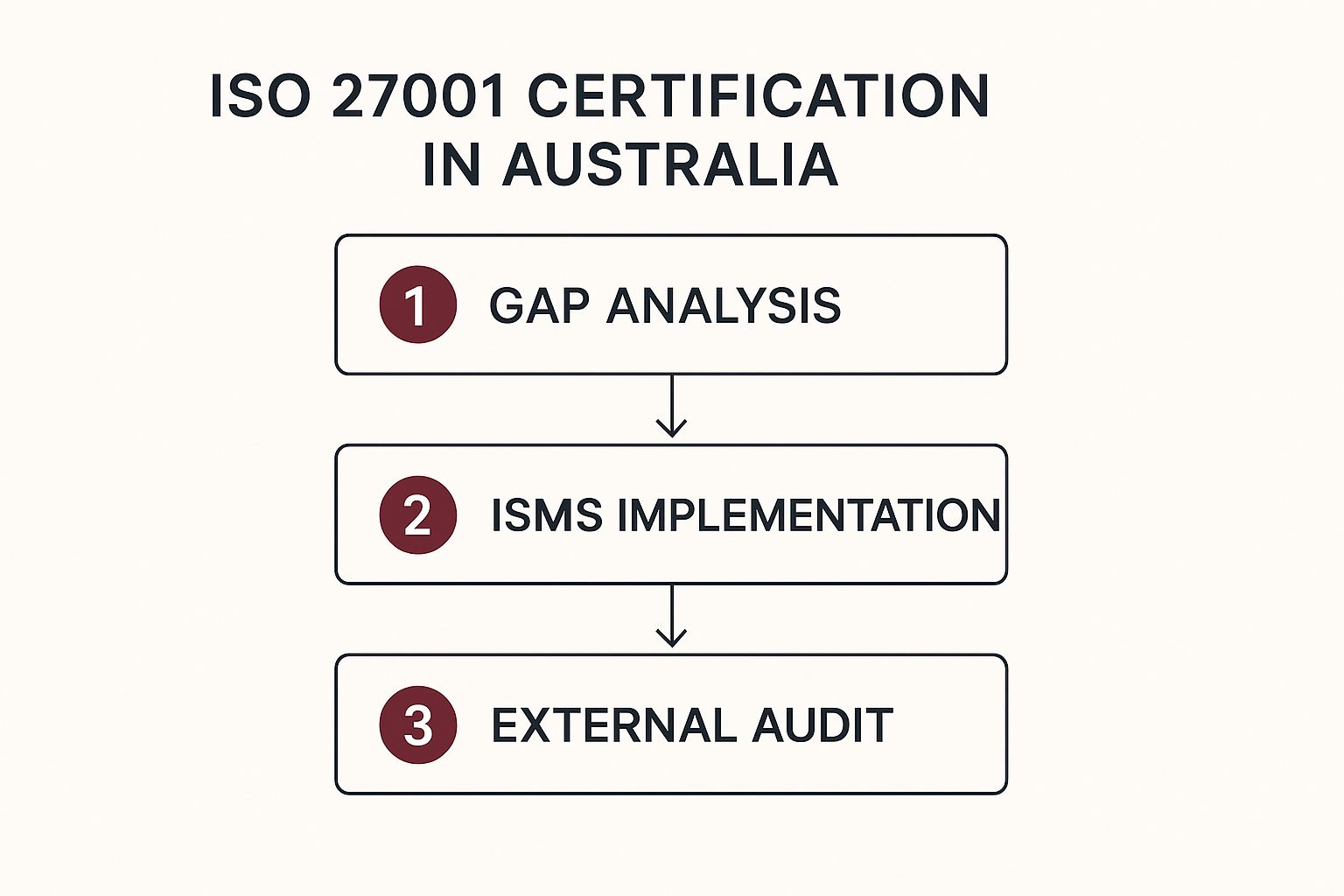
As you can see, each stage builds on the one before it, methodically turning your plan into real-world security measures that are ready to be tested.
As you work through this, remember the process itself is valuable. If you want a more detailed breakdown of what to expect at each stage, our guide on the ISO certification process is an excellent resource to have on hand. By following this logical path, you turn a complex challenge into a series of achievable steps, setting your business up for a much more secure and successful future.
Navigating The Audit and Choosing Your Certification Body
You’ve put in the hard yards. The scope is defined, the risks have been painstakingly assessed, and your security controls are in place. Now for the final hurdle: the external audit that stands between you and your ISO 27001 certification in Australia.
This stage can sound daunting, but it's really just about verification. An external expert is coming in to confirm that your Information Security Management System (ISMS) not only exists on paper but is also effective, practical, and truly meets the standard's requirements.
Try to see it less as a pass-fail exam and more as a professional peer review. The auditor is there to validate all your hard work. With the right preparation and the right partner, you can sail through this process with confidence.
Understanding the Two-Stage Audit Process
The external audit isn't a single, all-or-nothing event. It's cleverly broken down into two distinct phases, and knowing what’s coming in each stage is the key to managing any nerves and getting your team ready.
First up is the Stage 1 Audit. Think of this as a 'readiness check'. The auditor will primarily review your documentation—your scope statement, risk assessment, and your Statement of Applicability—to make sure you’ve built a solid foundation.
It’s a high-level review to confirm that, on paper, your ISMS looks complete and aligns with the ISO 27001 standard. They're looking for any major gaps or glaring omissions that would make the full audit a waste of everyone's time.
Once you’ve successfully passed Stage 1, it's time for the Stage 2 Audit. This is where the auditor really gets their hands dirty. They'll visit you on-site (or conduct the review remotely) to see your ISMS in action.
They’ll interview your team, observe your processes, and ask for hard evidence that you're actually doing what your policies say you do. If your access control policy states that only senior developers can access production servers, they'll want to see the system logs that prove it. It's the ultimate proof-in-the-pudding test of your implementation.
Selecting the Right Certification Body in Australia
Your choice of certification body is one of the most critical decisions you'll make in this entire journey. They aren't just a supplier; they become a long-term partner in maintaining your compliance. A good one understands your business context and works with you. A poor fit can make the whole process feel adversarial and unnecessarily painful.
Here in Australia, there's one golden rule: your chosen body must be accredited by JAS-ANZ (the Joint Accreditation System of Australia and New Zealand). This accreditation is your guarantee that they are competent, impartial, and operate to the highest professional standards. Honestly, an unaccredited certificate is worthless.
Once you've got a shortlist of JAS-ANZ accredited bodies, it's time to dig a little deeper. Don't be shy about asking some pointed questions to find the best fit.
- Do you have auditors with experience in our industry? An auditor who gets the fast-paced world of a tech startup will ask far more relevant questions than someone who's only ever audited manufacturing plants.
- Can you walk me through your audit process and philosophy? You're looking for a partner who sees the audit as a constructive, value-adding exercise, not just a box-ticking chore.
- How do you approach non-conformities? Their answer here is telling. You want a practical partner who helps you find workable solutions, not just points out problems.
When you're comparing quotes, look beyond the price. The cheapest option might come with junior auditors or a rigid, frustrating process. Investing in a quality certification body pays for itself through a smoother, more valuable audit experience.
Preparing Your Team for Audit Day
The audit isn't just about your documents and systems; it’s about your people. Auditors will want to chat with staff at various levels to see if that security-aware culture you’ve been building has actually taken hold.
Your job is to prepare them, not to feed them scripted answers. Hold a pre-audit briefing to explain what's going to happen and what the auditors are looking for. Most importantly, reassure them that it’s perfectly fine to say, "I'm not sure, but I know exactly where to find that information." Honesty and knowing the process is far more impressive than faking it.
Make sure key people are available and that all the evidence is easy to access. This means having things like:
- Meeting Minutes: From management reviews and risk workshops.
- Training Records: To show who has completed their security awareness training.
- System Logs: To demonstrate that your access controls are working as designed.
- Incident Reports: To prove you have a solid process for handling security events.
Being organised shows the auditor you're in control and that you respect their time, which always helps set a positive tone.
Handling Non-Conformities Constructively
It's actually pretty common for an audit to turn up a few issues. These are called non-conformities, and they are not a sign of failure—they are opportunities to get better. An auditor might find a small gap in a procedure (a Minor Non-conformity) or a more significant issue where a requirement of the standard isn't being met (a Major Non-conformity).
If a non-conformity is raised, don't panic. Look at it as free consulting. An expert has just pointed out a specific weakness in your defences that you now have a chance to fix.
You’ll be asked to submit a corrective action plan detailing how you'll fix the root cause and stop it from happening again. For a minor issue, you'll usually have a few weeks for this, and your certificate can be issued once the plan is approved. A major non-conformity might require a quick follow-up visit from the auditor to check that the fix is in place before they'll grant certification.
The entire process, from finding the right partner to navigating the audit itself, is a landmark part of your security journey. For businesses looking for guidance, it can be incredibly helpful to find an ISO certification body that truly aligns with your needs here in Australia. By choosing wisely and preparing thoroughly, you transform the audit from a stressful test into a valuable milestone in building a more secure, resilient organisation.
Life After Certification: Sustaining Compliance and Security
Holding that ISO 27001 certificate in your hands is a monumental achievement. It’s the result of months of intense effort, meticulous planning, and a huge commitment from your entire team. But this isn't the finish line; it’s actually the starting gun for the real race.
The most successful businesses I’ve worked with treat their certification not as a final destination, but as the foundation of an ongoing security culture. The certificate on the wall is proof of a moment in time. Sustaining it means turning those documented processes into living, breathing habits that protect your business every single day. This is where compliance becomes true security.
The journey now shifts from implementation to maintenance. Your Information Security Management System (ISMS) isn't a static set of documents locked away somewhere. It’s a dynamic framework that must adapt to new threats, evolving business goals, and a constantly changing operational environment.
The Rhythm of Continuous Improvement
To keep your certification valid and your security sharp, ISO 27001 requires a steady rhythm of monitoring, reviewing, and improving. This isn't about creating more work; it’s about making your ISMS smarter and more effective over time.
This cycle primarily revolves around three key activities that will become a regular part of how you operate:
- Regular Internal Audits: Think of these as your internal health checks. They are systematic reviews to ensure your policies and procedures are being followed correctly and are still effective.
- Periodic Management Reviews: This is where your leadership team steps in to review the ISMS's performance, making sure it still aligns with your business's strategic direction.
- Annual Surveillance Audits: Your external certification body will return each year to verify that you are maintaining the standard and continuously improving.
These ongoing tasks are what separate a 'paper-based' ISMS from a genuinely resilient security posture. They ensure your controls remain effective and that your senior leadership stays actively engaged with information security.
Mastering the Internal Audit Cycle
Internal audits are arguably the most powerful tool you have for maintaining compliance. They aren't about finding fault or blaming individuals. Instead, think of them as your early warning system, designed to spot small deviations from the process before they can grow into major non-conformities that an external auditor would flag.
It's like servicing your car. You don't wait for it to break down on the M1; you get it checked regularly to keep it running smoothly. The same logic applies here. A well-run internal audit program keeps your ISMS in peak condition. For a deeper understanding of this crucial activity, our guide on what is an ISO internal audit provides a detailed breakdown.
These audits should be conducted by someone impartial—either a trained member of your own team from a different department or an external consultant. They'll methodically check if your controls are working as intended, providing valuable feedback for improvement.
Keeping Leadership Engaged Through Management Reviews
Your management review is the formal checkpoint where security strategy meets business reality. At least once a year, your senior leaders must sit down and assess the health and effectiveness of the ISMS. This isn't just a quick chat; it's a structured meeting with a formal agenda.
The review should cover critical inputs, including:
- The results of recent internal and external audits.
- Feedback from clients and other interested parties.
- The current status of your risk assessment and treatment plan.
- Any security incidents that have occurred.
The output of this meeting is a set of documented decisions and actions for improvement. It ensures that information security remains a top-level priority, with the resources and strategic direction it needs to succeed.
This formal review process is non-negotiable for maintaining your ISO 27001 certification in Australia. It provides documented proof that your leadership is actively steering the ship, not just letting the ISMS drift.
Preparing for Annual Surveillance Audits
While your internal audits are about self-improvement, the annual surveillance audit is your accountability check-in with your certification body. Each year, they will return to conduct a smaller, more focused audit than your initial Stage 2 certification audit.
They will check that you are maintaining your ISMS, following your processes, and have been conducting your own internal audits and management reviews. They'll also look for evidence of continuous improvement. This is your chance to showcase how your ISMS has matured and adapted over the past year.
For Australian businesses, staying on top of evolving requirements is particularly important. A major milestone affecting organisations is the mandatory transition from ISO 27001:2013 to the updated ISO 27001:2022 framework. Companies must re-accredit to the new version by 31 October 2025, to keep their certification valid and meet client expectations for modern security practices. For more details on this important deadline, you can discover more insights about what Australian businesses need to know for 2025.
Real-World Scenario: A Growing Australian E-commerce Business
Let's imagine an e-commerce company in Sydney, "Aussie Outdoor Gear," which achieved ISO 27001 certification last year. Their quarterly management reviews are central to keeping their ISMS effective as they grow.
During their Q3 review, the team discusses a recent trend of sophisticated phishing attacks targeting online retailers. Their risk assessment identified this, but the management review is where they decide on a concrete action plan.
The outcomes of this single meeting demonstrate the ISMS in action:
- Risk Treatment Update: They agree the current risk of a data breach via phishing is now "high," up from "medium."
- Control Enhancement: They approve a budget for a new, more advanced email filtering system (a technological control).
- Security Culture Boost: They decide to run mandatory, interactive phishing simulation exercises for all staff every quarter, not just annually (a people control).
Because of this proactive review cycle, Aussie Outdoor Gear doesn’t just maintain compliance. They actively strengthen their security posture in response to a real-world threat, ensuring their ISMS evolves and protects the business as it expands. This is the true spirit of life after certification.
Frequently Asked Questions About ISO 27001
Starting the journey to ISO 27001 certification in Australia can feel like a massive undertaking, so it's only natural to have a few questions swirling around. We get it. Here, we tackle the most common queries we hear from Aussie business owners, giving you straight, practical answers to help you decide on your security future.
How Much Does ISO 27001 Certification Cost in Australia?
This is always the first question, and the honest answer is: it really depends. The cost isn't a simple, single fee. It's a mix of factors unique to your business. Think of it less like buying a product off the shelf and more like a custom renovation for your security framework.
Your total investment will pivot on a few key things:
- Your Business Size and Complexity: A 15-person tech startup in a single Sydney office is going to have a much simpler—and cheaper—path than a 200-employee logistics company with depots in three different states.
- Your Current Security Posture: If you’ve already got solid security habits and documentation, the gap you need to close is smaller. That means less time and less money. Starting from ground zero? Expect a higher initial investment.
- Internal vs. External Resources: Do you have a team you can dedicate to managing the project, or will you need to bring in a consultant? Consultants add to the upfront cost, but believe me, they can shave months off the timeline and help you dodge expensive mistakes.
The final piece of the cost puzzle is the certification body's fee for the Stage 1 and Stage 2 audits, plus the ongoing annual surveillance audits. These can vary, so it’s smart to get a few quotes from different JAS-ANZ accredited bodies.
Here's a tip from experience: budget for both the direct costs (consultants, auditors) and the indirect ones (your team's time). When you frame it as a strategic investment in risk reduction and business growth, not just another compliance cost, the value becomes much clearer.
What Is the Typical Timeline for Certification?
While every business is different, a realistic timeframe for an Australian small to medium-sized business to achieve ISO 27001 certification is usually somewhere between six and twelve months. This gives you enough breathing room to properly plan, implement, and actually run your new Information Security Management System (ISMS) before the external auditors show up.
Here’s a rough guide to how that time usually breaks down:
- Scoping and Risk Assessment (1-3 months): This is your foundation. You’ll get leadership buy-in, define what's in and out of scope, and conduct a thorough risk assessment. Trying to rush this stage is a classic rookie error that will cost you later.
- Implementation (3-6 months): This is where the real work happens. You'll be developing policies, putting your chosen Annex A controls into practice, and getting your team trained up.
- Internal Audit and Review (1-2 months): Before you call in the pros, you need to run the system for a bit, conduct your own internal audit, and hold a formal management review to check everything is working as it should.
- External Audits (1-2 months): This covers the Stage 1 and Stage 2 audits, plus any time you might need to fix potential issues they uncover.
Honestly, the biggest variable here is the availability of your own people. If you have a dedicated project manager who has the full backing of leadership, you can really speed things up.
Who Needs to Be Involved From Our Team?
Getting ISO 27001 certified is a team sport. This is not a mission for the IT department to go on alone. While IT is absolutely critical for the technical side of things, a successful rollout needs buy-in and input from all corners of the business.
Your core project team should have people from:
- Senior Management: Having a sponsor from the leadership team is non-negotiable. They bring the authority, budget, and strategic oversight needed to see this through.
- IT and Security: These are your technical gurus who will implement controls like firewalls, access rights, and encryption.
- Human Resources: HR is vital. They’ll help shape policies for securely onboarding and offboarding staff, not to mention rolling out security awareness training.
- Operations and Department Heads: These are the people on the ground. They understand the daily workflows and can tell you if a proposed control is practical or if it will just get in the way of business. Their insight during the risk assessment is invaluable.
When you involve a cross-functional team, you're not just ticking a box; you're building a genuine security culture. That kind of shared ownership is exactly what auditors love to see, and it's the secret to keeping your data safe long after you've framed the certificate.
Can We Achieve Certification Without an External Consultant?
Yes, it's definitely possible for a business to go it alone, especially if you're lucky enough to have someone in-house with previous ISO or project management experience. But for most Australian SMEs, bringing in a seasoned consultant is the faster, more reliable option.
A good consultant does more than just parrot the standard. They bring:
- A Proven Roadmap: They’ve walked this path dozens of times and know where all the potholes are.
- Time-Saving Expertise: They come with templates and guidance that can save your team hundreds of hours of trying to create documentation from scratch.
- An Objective Eye: An outsider's perspective is gold during risk assessments and internal audits. They'll spot weaknesses your team might be too close to see.
At the end of the day, it's a trade-off between time and money. Doing it yourself saves on consulting fees, but it will almost certainly take longer and demand a huge time commitment from your key people.
Is ISO 27001 a Legal Requirement in Australia?
ISO 27001 is an international standard, not an Australian law. For most businesses, this means you are not legally required to be certified.
But here’s where it gets interesting. While it’s not the law itself, certification is fast becoming the accepted way to prove you’re meeting your legal obligations under things like the Australian Privacy Act. If you suffer a data breach, being able to show the Office of the Australian Information Commissioner (OAIC) that you have a certified ISMS can be a huge factor in your favour.
More importantly, it’s becoming a commercial requirement. Government departments and big corporations are now frequently making ISO 27001 certification a must-have in their tender documents. For many businesses, the choice is becoming simple: get certified, or get locked out of major opportunities.
This trend is a huge driver behind the standard's growth. Globally, the ISO 27001 market size was valued at USD 16.14 billion in 2024 and is predicted to grow at a compound annual growth rate of 15.2%, reaching USD 56.18 billion by 2033. Most Australian organisations are now achieving certification within 6-12 months of starting their journey. You can learn more about the global growth of ISO 27001 certification.
This commercial pressure, paired with the undeniable benefit of stronger security, makes pursuing ISO 27001 certification in Australia a smart, strategic move for any forward-thinking business.
Navigating the world of ISO 27001 can be daunting, but you don’t have to do it alone. At Anitech, we have over 20 years of experience and a 100% success rate in guiding Australian small businesses through every step of the process. Let our experts provide the tailored support you need to achieve certification efficiently and build a more resilient business. https://iso-27001.com.au
Recent Comments