

When you start looking into ISO 27001 certification, one of the first questions you'll ask is, "How much is this going to cost?" In Australia, you can expect the initial certification to land somewhere between $20,000 and $70,000. The final figure really depends on the size and complexity of your business and the path you take to get there. This investment covers everything from getting your house in order to the final external audit fees.
The Real Cost of ISO 27001 Certification
Starting the journey to ISO 27001 is a big strategic move, and let's be honest, the first thing on any leader’s mind is the price tag. Getting a handle on the financial commitment is absolutely essential for planning, budgeting, and getting everyone on board. But the cost isn't a simple, off-the-shelf number; it’s shaped by the unique reality of your organisation.
Think of it like securing your home. A small apartment with one front door might just need a decent alarm – a pretty straightforward and affordable fix. But a large rural property with multiple buildings, sheds, and gates? That’s going to need a much more sophisticated setup with cameras, sensors, and professional monitoring, which naturally comes with a higher price.
It’s the same story with the ISO 27001 certification cost. A small tech startup with 15 staff and a simple cloud setup will have a completely different bill compared to a large corporation with thousands of employees, complex legacy systems, and multiple data centres.
Finding Your Path to Certification
The good news is there isn't one set way to get certified. Your organisation can pick a path that fits its internal skills, budget, and timeline. Each option strikes a different balance between putting in your own team's time and paying for external help.
Here are the most common approaches:
- The DIY Route: If you have some in-house security expertise, you might tackle it yourself. This means your team handles the gap analysis, policy writing, and implementing controls, often with the help of a pre-made toolkit. You'll spend less on external fees, but you'll invest a huge amount of internal time and effort, which has its own cost.
- Hiring a Consultant: Many businesses bring in specialists to do the heavy lifting. Consultants have been through this process countless times and can guide you from the initial assessment right through to the final audit. It fast-tracks the process and boosts your chances of passing the first time, though it requires a bigger direct financial outlay.
- The Hybrid Model: A third popular option is to use a compliance automation platform to streamline the work while your internal team still manages the project. This can be a great middle-ground, balancing cost and effort.
A Clear View of the Investment
To give you a better idea of what to expect, let's look at the typical investment for each of these approaches in Australia. These figures will help you figure out which strategy makes the most sense for your business.
It's helpful to see this as a strategic investment, not just a cost. When you explore the value of ISO 27001 certification, you realise it strengthens your security, builds incredible customer trust, and opens doors to new markets—delivering a return that far outweighs the initial price.
The table below breaks down the estimated costs for each certification pathway, giving you a clear financial snapshot to start your planning.
Summary Of ISO 27001 Certification Cost Ranges
| Certification Method | Estimated Cost Range (AUD) |
|---|---|
| DIY with Toolkit | $15,000 – $30,000 |
| Consultant-Led Project | $25,000 – $60,000+ |
| Hybrid (Platform & Internal Team) | $20,000 – $45,000 |
Remember, these are ballpark figures for the initial certification. The final ISO 27001 certification cost will be influenced by several other factors we’ll dig into later.
Think of these numbers as a solid starting point for your internal chats. They help you move past the simple question of "how much?" and into the more strategic discussion of "which approach gives us the best value for our security goals?" This financial overview is the first step towards building a budget that truly supports your organisation's future.
So, What Really Drives Your Certification Costs?
Ever wonder why quotes for ISO 27001 certification can be all over the map? It’s not random. The final figure is a direct reflection of your organisation’s unique DNA. Getting your head around these core cost drivers is the first, and most important, step to building a realistic budget and confidently picking the right partner.
Think of it like building a house. A standard, two-bedroom home on a flat block has a pretty predictable price. But if you’re dreaming of a custom-designed mansion clinging to a hillside, complete with a state-of-the-art security system and an infinity pool, the cost skyrockets. It all comes down to the size, complexity, and specialised work involved.
It's exactly the same principle with the ISO 27001 certification cost. Your total investment is shaped by a handful of key factors that dictate the amount of time, resources, and expertise needed to get you across the finish line.
The Big Three Cost Drivers
Three main variables will have the biggest say in your final budget: your company's size, the complexity of your operations, and how you choose to tackle the project. Let’s pull each one apart.
-
Company Size and Structure: This is usually the easiest one to grasp. A bigger company simply has more moving parts. More people to train, more devices to lock down, and more departments to bring under the umbrella of your Information Security Management System (ISMS). A certification body will naturally need more audit days to thoroughly check a business with 500 employees spread across three offices than a start-up with 20 people in a single room.
-
Scope and System Complexity: How intricate is your world? A business that runs on a few standard cloud apps has a much simpler road ahead than one with bespoke software, multiple data centres, and a web of complex integrations. The more systems, vendors, and types of data you’re trying to protect, the more heavy lifting is required to map processes, assess risks, and put the right controls in place.
-
Your Chosen Implementation Path: How you get there matters. A DIY approach can save you cash on consultant fees, but be prepared for a serious investment of your team's time and energy. On the other hand, bringing in an expert consultant can fast-track the whole process, but it comes with a higher upfront price tag.
These three factors intertwine to create a cost profile that’s unique to every single business.
Making Sense of the Audit Process
The audit itself is a significant chunk of your certification cost, and it’s split into a few key stages. Learning the lingo here will help you understand exactly what you’re paying for when that quote from a certification body lands in your inbox.
The International Organization for Standardization (ISO) itself explains that the standard is all about helping organisations "manage the security of assets"—and that’s precisely what the auditors are there to verify.
This isn’t about a single, make-or-break event. The audit is a journey with multiple steps, all designed to make sure your ISMS doesn't just look good on paper but actually works in the real world.
An audit isn't about finding fault; it's about verifying effectiveness. A good auditor acts as a partner in your security journey, confirming that your systems and processes meet the standard's requirements to protect your valuable information assets.
You’ll hear two key terms thrown around:
-
Stage 1 Audit (Documentation Review): Think of this as the "desktop audit." The auditor pores over your ISMS documentation—your policies, procedures, risk assessments, and Scope of Applicability. They’re checking to see if, on paper, you’ve built a system that ticks all the boxes required by the ISO 27001 standard. It's all about confirming you have a solid plan.
-
Stage 2 Audit (Implementation Audit): This is the main event. The auditor comes to your site (or connects remotely) to see your ISMS in action. They’ll chat with your team, look at records, and check that the controls you documented back in Stage 1 are actually up and running as intended. This is where you prove the plan really works.
But passing these two stages isn't the end of the story. You also need to factor in the ongoing costs.
Planning for the Long Haul
Achieving certification is a milestone, not the destination. ISO 27001 isn't a "set and forget" exercise. The standard demands constant maintenance and improvement, which is checked through regular audits.
-
Surveillance Audits: These take place every year for the first two years after you’re certified. They're lighter touch than the big Stage 2 audit, usually focusing on specific areas of your ISMS to make sure you’re staying on track and continuously improving.
-
Recertification Audit: Every three years, it’s time for a full recertification audit. This is a deep dive, similar in scope and cost to your initial Stage 2 audit, to confirm your ISMS is still fully compliant and effective over the long term.
Knowing about these different audits is vital for budgeting accurately. They aren't hidden fees; they are a predictable and essential part of the certification lifecycle.
Here in Australia, your approach can dramatically influence these figures. Our research shows that initial certification costs can land anywhere from AUD 20,000 to AUD 70,000. For smaller outfits, a DIY toolkit might only set you back AUD 390, while consultant fees can range from AUD 9,000 to AUD 30,000. If you hire a full-time internal expert, you could be looking at a salary of around AUD 75,000 a year.
A Detailed Breakdown of Your Investment
So, you've seen the ballpark figures, but what are you actually paying for? To get a real handle on your budget, we need to pull apart the ISO 27001 certification cost and look at where every dollar goes.
Think of it less like buying a software licence and more like building a house. There are one-off costs for the foundation and framework, and then there are ongoing maintenance costs to keep it standing strong for years to come. Splitting your budget this way is the key to managing your cash flow and avoiding any nasty surprises down the track.
Mapping Your Initial Setup Costs
This is the foundational stage—the heavy lifting required to build your Information Security Management System (ISMS) from the ground up and get you ready for audit day.
First up is the gap analysis. This is basically a health check for your current security posture. A consultant (or your internal team) will hold up your existing processes against the ISO 27001 standard and pinpoint exactly where the gaps are. It’s the roadmap that tells you what needs to be done.
Once you know what's missing, you get into the real work of building your ISMS. This typically involves:
- Writing the Rulebook (Documentation): This is where you create all the formal policies and procedures that define your security operations. It’s everything from your top-level Information Security Policy right down to specific instructions for managing user access or responding to a data breach.
- Putting Theory into Practice (Implementation): A policy is just a document until you actually do what it says. This phase involves putting your new rules into action. That could mean buying new security software, reconfiguring your network, or even upgrading the locks on your server room door.
- Getting Your Team On Board (Training): Your people are your most important security asset. This cost covers training everyone on the new policies and, crucially, explaining why they matter. It’s about building a security-first culture, not just ticking a box.
These initial steps are often where the bulk of the upfront investment lies, demanding a lot of time and resources, whether you’re using your own team or bringing in external experts to help.
Demystifying the Certification Audit Fees
With your ISMS built and humming along, it’s time to call in the independent auditors. This is where a third-party accredited body comes in to verify your work. The audit itself is split into two parts, and you'll be invoiced for each.
The process begins with the Stage 1 Audit. Think of this as an open-book exam. The auditor reviews all your documentation—your policies, procedures, and risk assessments—to make sure everything is present and correct on paper. They’re checking that your ISMS design is solid and meets all the standard's requirements.
If you get the green light, you move on to the Stage 2 Audit. This is the practical driving test. The auditor will visit you (physically or virtually) to see your ISMS in action. They’ll interview your staff, check system logs, and verify that the security controls you've documented are actually working as intended in the real world. This is the final hurdle before you’re officially certified.
This infographic shows how your company’s size, complexity, and the path you choose to get certified all play a big role in these costs.
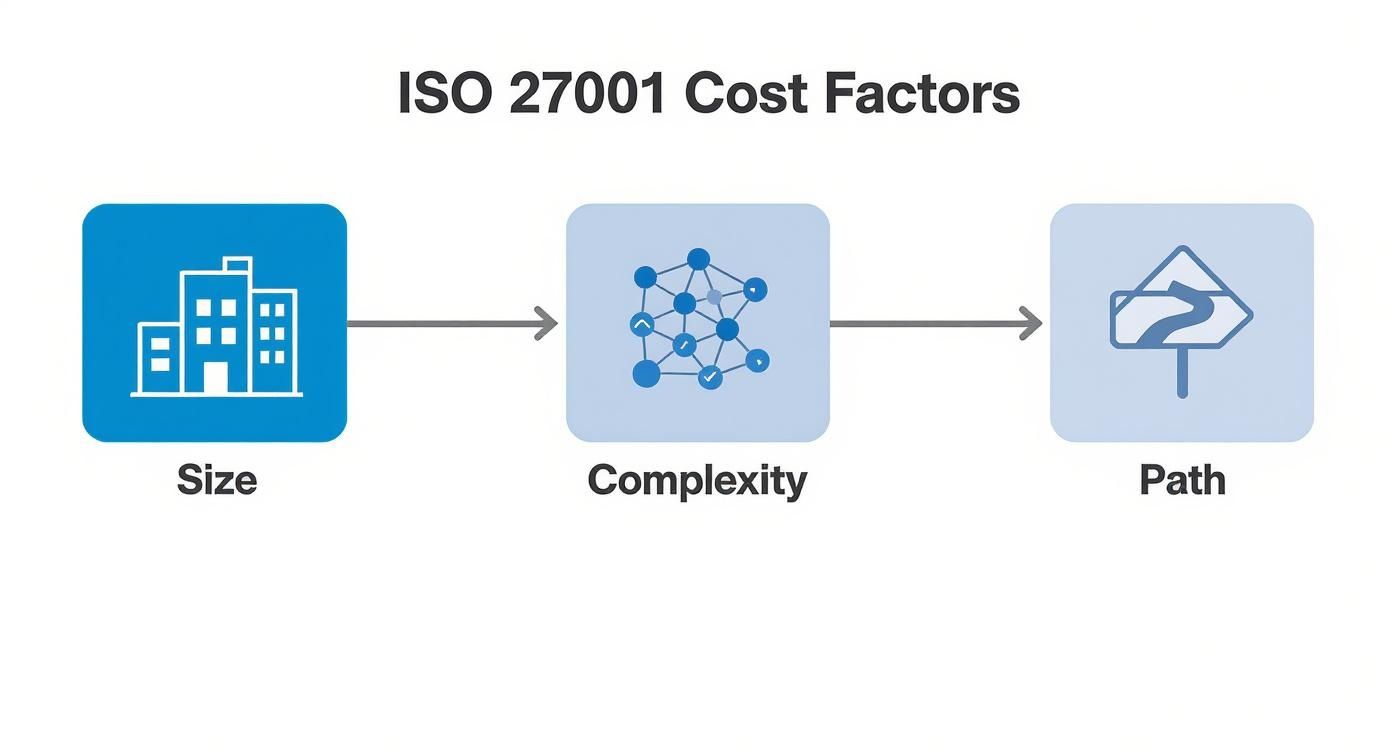
As you can see, a large, complex business that relies heavily on consultants will naturally have a higher price tag than a small, straightforward company handling most of the work in-house.
Planning for the Long Haul: Ongoing Costs
Earning your ISO 27001 certificate is a massive achievement, but it's not a "set and forget" exercise. Your certification is a living thing, and maintaining it requires ongoing investment.
Certification isn’t a trophy you put on the shelf. It’s a living commitment to continuous improvement, verified through regular check-ups that ensure your security posture remains strong and effective over time.
For businesses in Australia, these recurring costs are a crucial piece of the puzzle. After the initial certification, you’ll have annual surveillance audits to prove you’re still compliant. These can cost anywhere from AUD 2,000 to AUD 10,000 each year. Then, every three years, you’ll undergo a full recertification audit, which is a more intensive review costing between AUD 5,000 and AUD 15,000.
To put that into perspective, a medium-sized company with 50-200 employees might face an initial investment of AUD 40,000 to AUD 70,000, plus those ongoing annual fees.
Let’s lay out these recurring expenses more clearly.
Mapping Your Ongoing Certification Expenses
To keep your certification active, you'll need to budget for regular check-ins from your certification body. Here's a typical schedule and what you can expect to pay.
| Audit Type | Frequency | Typical Cost Range (AUD) |
|---|---|---|
| Surveillance Audit | Annually (Years 1 & 2) | $6,000 – $10,000 per audit |
| Recertification Audit | Every 3 Years | $10,000 – $15,000+ |
| Internal Maintenance | Continuous | Varies (Internal time, software) |
These figures show that the ISO 27001 certification cost is an ongoing operational expense, not just a one-off project. Factoring these surveillance and recertification audits into your budget from day one is essential for maintaining your security program without financial stress.
To make sure you’re getting good value, it's always smart to shop around. We recommend you get 3 ISO certification quotes from different accredited auditors to find the best fit for your budget and needs.
Leveraging Tax Benefits to Reduce Your Costs
Embarking on ISO 27001 certification is a major strategic move. While it’s easy to get bogged down by the upfront investment, there's a powerful financial lever many Australian businesses miss. What if you could reframe a good portion of the ISO 27001 certification cost from a pure expense into a smart, tax-efficient investment?
It’s not just possible; it’s a standard business practice. By getting a handle on the tax implications, you can seriously reduce the net cost of your certification, making the business case for it even stronger. It’s all about working smarter with your budget and remembering that the Australian tax system often encourages investments in business security and resilience.
Think about it like this: when you buy new equipment to make your factory more efficient, you claim it as a business expense. Investing in a rock-solid Information Security Management System (ISMS) to protect your most valuable asset—your data—should be seen through the exact same financial lens.
Turning Security Expenses into Tax Advantages
The core idea here is really straightforward. Many of the costs you'll incur getting and keeping your ISO 27001 certification can be classified as operational expenses. This means they are very often tax-deductible, which lowers your overall tax bill and reduces the final, out-of-pocket cost of the whole project.
This financial strategy allows you to build a much stronger security posture while optimising your tax position at the same time. It’s a genuine win-win, strengthening both your digital defences and your bottom line.
By looking at certification through a financial lens, you shift the conversation from "How much is this going to cost?" to "What's the real investment after we factor in the tax benefits?" This subtle but crucial change in perspective is key to getting full executive buy-in.
The trick is knowing exactly which expenses typically qualify. A clear understanding here empowers you to have a productive chat with your accountant and accurately forecast the true financial impact of your ISO 27001 journey.
What Certification Costs Can You Typically Deduct?
When you're budgeting for your ISO 27001 project, it's vital to pinpoint which parts of it qualify as tax-deductible business investments to keep your overall spend as low as possible. Of course, you should always get advice from a qualified tax professional for your specific circumstances, but a few common cost areas are generally seen as deductible.
These often include:
- Consulting Fees: The money you pay an external consultant to guide you through the gap analysis, documentation, and implementation stages is typically a deductible expense.
- Audit and Certification Fees: This covers the cost of those all-important Stage 1, Stage 2, and ongoing annual surveillance audits from your accredited certification body.
- Staff Training: The costs of training your team on new security policies, procedures, and their responsibilities under the ISMS are essential for success and are often deductible.
- Compliance Software Subscriptions: If you use a Governance, Risk, and Compliance (GRC) platform to manage your ISMS, the subscription fees are usually considered a standard operational expense.
From a financial and tax viewpoint, Australian businesses can often treat ISO 27001 certification costs as tax-deductible operational expenses, making the whole thing much more achievable. The Australian Taxation Office generally allows businesses to deduct these costs because they're directly related to protecting business assets and managing risk. This really backs up the idea that ISO 27001 is a critical investment in your business's future, not just another line on an expense report.
A Practical Example of Tax Deductions in Action
Let’s put some real numbers to this. Imagine your business, "SecureTech," invests $40,000 in its initial ISO 27001 certification.
The cost breakdown might look a bit like this:
- Consultant Fees: $15,000
- Stage 1 & 2 Audits: $14,000
- Staff Training Program: $5,000
- GRC Software (Annual Subscription): $6,000
Assuming all these are tax-deductible and your company tax rate is 25%, you could claim the entire $40,000 as a business expense. This would reduce your taxable income by that amount, leading to a tax saving of $10,000 ($40,000 x 25%).
Suddenly, the actual net cost of your certification drops from $40,000 down to $30,000. That's a massive 25% reduction, which makes the ROI on your security program look a whole lot more appealing.
For smaller businesses, there have also been government initiatives aimed at encouraging technology adoption. It’s worth investigating if your investment qualifies for extra benefits, like the bonus tax deductions for technology that were part of previous budgets. For a bit more context, you might be interested in our article on past bonus tax deductions for technology investments.
This ability to claim deductions transforms the ISO 27001 certification cost from a simple expenditure into a financially sharp investment in your company's long-term health and reputation. By planning ahead and working with your financial advisor, you can build a budget that not only gets you compliant but also maximises your financial advantages.
Building Your Smart Budget and Action Plan

Alright, you've got a handle on the potential expenses. But staring at a list of costs and actually building a financial plan can feel like a massive leap. It doesn't have to be. Creating a smart, actionable budget is all about breaking the journey down into manageable pieces, making shrewd decisions, and planning ahead so there are no nasty surprises.
Think of it like planning a major home renovation. You wouldn't just start swinging a sledgehammer without a detailed blueprint and a firm budget. You’d get quotes, figure out your non-negotiables, and set a timeline to manage the chaos and the cost. That same structured approach is exactly what you need to navigate your ISO 27001 project without blowing the budget.
This is where you turn all that information into a real plan. By mapping out a detailed financial roadmap, you not only get a firm grip on your spending but also build a powerful business case that links your security goals directly to the company's bottom line. It’s about being proactive, not reactive.
Your Practical Project Kick-Off Checklist
Before you spend a single dollar, you need a solid foundation. This initial planning phase is what separates a smooth project from a chaotic one, ensuring your budget is based on reality, not just wishful thinking. A methodical start now will save you from expensive backtracking later.
Here’s a practical checklist to get you started:
-
Conduct a Preliminary Gap Analysis: This is your ground zero. Before you do anything else, get a high-level view of where your current security stands against the ISO 27001 standard. This first look will immediately flag the biggest gaps and give you a rough idea of the effort ahead.
-
Define Your ISMS Scope: Are you certifying the entire organisation, or just one critical department? A smaller, tightly defined scope can dramatically lower your initial ISO 27001 certification cost and complexity. Be strategic here.
-
Allocate Internal Resources: Pinpoint who on your team will be driving this. Their time is a real and significant cost, even if it doesn't show up on an invoice. You need to account for it.
-
Schedule Key Milestones: Map out a realistic timeline. When do you aim to have documentation done? When will you be ready for the Stage 1 audit? A clear schedule helps you forecast cash flow and manage your team's time effectively.
-
Gather Preliminary Quotes: Start talking to a few consultants and certification bodies to get some ballpark figures. This market research is absolutely invaluable for building a budget that holds up.
Ticking off these steps gives you the hard data you need to build a financial plan that's both ambitious and achievable.
Phased Budgeting for Better Cash Flow Management
One of the smartest ways to manage the ISO 27001 certification cost is to stop thinking of it as one massive, upfront expense. A phased approach lets you spread the investment over time, which is much kinder to your company’s cash flow.
A phased rollout is a powerful financial tool. It turns a daunting one-time cost into a series of manageable investments, allowing you to demonstrate value and secure buy-in at each stage of the journey.
Consider starting with a pilot project. You could implement the Information Security Management System (ISMS) in a single, high-risk department first—think IT or finance. This lets you learn crucial lessons on a smaller scale, tweak your processes, and show a quick win to the rest of the business.
Once that department is humming along under the new ISMS, you can use it as a proven template to roll out everywhere else. This tactic not only smooths out your spending but also builds genuine expertise and confidence within your team as you go.
Insider Tips for Smart Negotiations
When you start talking to external partners like consultants and certification bodies, remember one thing: you're the customer. Don't be shy about negotiating to make sure you're getting the best possible value. A little preparation here goes a long way.
Here are a few tips to keep in your back pocket:
-
Request Itemised Quotes: Always ask for a detailed breakdown of costs. This lets you see exactly what you’re paying for and compare apples with apples. Vague, bundled pricing can easily hide unnecessary fees.
-
Clarify 'Out-of-Scope' Items: Get it in writing what is included and what might be billed as an extra. Things like travel expenses, report writing time, or follow-up audit work are common add-ons.
-
Discuss Multi-Year Agreements: When you're talking to certification bodies, ask about discounts for committing to the full three-year certification cycle. Many prefer the stability of a long-term relationship and will offer better pricing for it.
-
Leverage Your Strengths: If you’ve already put in the hard yards with a gap analysis or have solid policies drafted, make sure they know it. This should reduce the time they need to spend, and that reduction should be reflected in their quote.
Your Actionable Next Steps
You’re now armed with the knowledge to move forward with confidence. The path to ISO 27001 certification is a marathon, not a sprint, and a well-crafted budget is the plan that will get you to the finish line without running out of steam.
Here are your immediate next steps to get the ball rolling:
-
Finalise Your Budget: Use all the information you’ve gathered to create a detailed, line-item budget. Get this in front of your leadership team for a formal sign-off.
-
Select Your Partners: Based on the quotes and your negotiations, officially engage your chosen consultant and certification body.
-
Launch the Project: Kick off your internal project team, communicate the plan to the wider organisation, and start working through your checklist. It's time to get started.
By taking this structured approach, you turn the ISO 27001 certification cost from a daunting hurdle into a predictable and strategic investment—one that will enhance your security, build trust with your customers, and drive your business forward.
Your ISO 27001 Cost Questions, Answered
Even with the best planning, it's natural to have lingering questions about the financial side of ISO 27001. Let’s tackle some of the most common queries we hear from Australian businesses. Think of this as the final piece of the budgeting puzzle, giving you the clarity you need to move forward with confidence.
We'll dig into the biggest budget eaters, clever tactics for smaller businesses, potential surprise expenses, and what really matters when you're weighing up quotes from different auditors. Getting these final details right is what separates a smooth certification journey from a stressful one.
What’s the Single Biggest Cost Driver for Most Companies?
Hands down, the single biggest cost driver for ISO 27001 certification is your people's time. It's easy to focus on the invoices from auditors or consultants, but the internal hours your team invests are often the largest, albeit less visible, part of the budget.
This includes the time your IT crew spends setting up new security controls, the hours your managers pour into writing and reviewing policies, and the collective effort of every staff member sitting through security awareness training. For a small business with 50 employees, just getting ready for the audit can easily eat up two to four months of a senior team member's time if you tackle it all in-house.
The most significant cost in any ISO 27001 project isn't what you pay auditors; it's the commitment of your internal team. Underestimating the time your own people need to dedicate is the fastest way to blow your budget and timeline.
This is exactly why a pure DIY approach can be a false economy. You might save on external fees upfront, but the cost of lost productivity and pulling people away from their core work can be staggering. To truly understand your total investment, you have to track this internal time.
How Can a Small Business Get Certified on a Tight Budget?
The thought of a five-figure investment can feel daunting for a small business, but achieving certification is absolutely possible with a smart, lean approach. The secret is to be strategic and resourceful, putting your money where it delivers the most impact.
One of the most powerful strategies is to tightly define the scope of your Information Security Management System (ISMS). Instead of trying to certify the entire organisation in one go, start with the most critical part of your business. This could be the department that handles sensitive customer data or a specific product line. A smaller scope means fewer processes to document, fewer assets to protect, and fewer audit days—all of which directly lower your costs.
Compliance automation platforms can also be a game-changer. These tools offer policy templates, automate the tedious work of collecting evidence, and streamline your entire workflow. We've seen them reduce the manual effort required from a team by as much as 88%, letting you manage the project internally without the hefty price tag of a full-time consultant.
When putting your budget together, it also helps to look at general business strategies to reduce operational costs. Freeing up resources in other areas can make the investment in your security a much more manageable commitment.
Are There Hidden Costs I Should Be Aware Of?
While a good quote from an auditor should be transparent, some costs can catch you by surprise if you're not prepared. They aren't "hidden" in a deceptive way, but they're often overlooked in the initial budgeting phase.
Here are a few common ones to keep on your radar:
- Technology Upgrades: Your gap analysis might show you need new software or hardware to meet a specific security control. This could mean investing in new tools for encryption, endpoint protection, or even a security information and event management (SIEM) system.
- Fixing Problems: If your audit uncovers a non-conformity, you'll have to invest time and potentially money to fix it. In some cases, this could even require a follow-up audit, which usually comes with an extra fee.
- Ongoing Upkeep: The costs don't stop once you have the certificate. You need to budget for the ongoing effort of running your ISMS. This includes time for regular risk assessments, internal audits, and management review meetings, not to mention the annual surveillance audit fees.
Thinking about these potential expenses from the get-go helps you build a more realistic budget, ensuring you can not only achieve certification but maintain it year after year.
What Should I Look For When Comparing Quotes from Certification Bodies?
Choosing the right certification body is a huge decision, and it’s about more than just finding the lowest price. A cheap quote isn't always good value.
First, make sure any auditor you're considering is accredited by a recognised national body, which for us in Australia is JAS-ANZ. This is non-negotiable. Accreditation guarantees their competence and ensures your certificate will be recognised internationally.
When you get the quotes, ask for a proper itemised breakdown. It should clearly separate the costs for the Stage 1 and Stage 2 audits, plus the fees for the two annual surveillance audits that follow. Check the fine print: are travel and expenses included, or are they billed on top?
Finally, look at their experience in your industry. An auditor who already understands the specific risks and technologies of your sector will deliver a much more efficient and relevant audit. Don't be shy about asking for references from businesses like yours. You'll be working with this auditor for at least three years, so finding a knowledgeable and communicative partner is a vital long-term investment.
Ready to take the next step toward ISO 27001 certification with confidence? At Anitech, we specialise in guiding Australian small businesses through the entire process, ensuring a smooth, cost-effective journey with a 100% success rate. Let our 20 years of experience simplify your path to compliance.
Get a clear, no-obligation quote and start your certification journey today at iso-27001.com.au
Recent Comments