

So, you're wondering what it really costs to get ISO 27001 certified in Australia. The straight answer is that initial certification typically falls somewhere between $20,000 and over $70,000. On top of that, you've got annual maintenance costs that will add a few thousand more.
But thinking of this purely as a cost is the wrong way to look at it. This is a serious investment in your business's security, its reputation, and frankly, its ability to compete. The final number on the invoice will swing quite a bit depending on your company's size, how complex your operations are, and the path you choose to get there.
Demystifying The Real Cost Of ISO 27001 Certification
When businesses start exploring ISO 27001, the first question is always the same: "What's the damage?" While everyone wants a single, clean number, the reality is a lot more layered. To get a real grip on the cost, you have to look past the final audit fee and see the entire process for what it is—an investment in building a more resilient and trustworthy organisation.
Think of it like building a custom home. You wouldn't expect a builder to give you a final price without knowing the square footage, the quality of the materials, or the specific features you want. In the same way, the ISO 27001 certification cost is shaped by your business's unique blueprint and its current security setup. It’s an investment in your operational foundations, designed to protect your most critical asset: your information.
Getting certified isn't just about passing a test. It's about fundamentally lifting your security game, which in turn builds client trust, opens doors to new markets, and protects you from the nightmare of a data breach.
To give you a clearer picture from the get-go, here’s a quick breakdown of what you might expect based on your company's size.
Quick Cost Snapshot For ISO 27001 Certification In Australia
This table provides a high-level summary of potential costs based on company size, giving you an immediate reference point for budgeting.
| Company Size | Typical Initial Certification Cost (AUD) | Annual Surveillance Audit (AUD) |
|---|---|---|
| Small (1-50 employees) | $20,000 – $40,000 | $2,000 – $5,000 |
| Medium (51-200 employees) | $40,000 – $70,000 | $5,000 – $10,000 |
| Large (200+ employees) | $70,000+ | $10,000+ |
Remember, these are ballpark figures. The real cost will depend on the specifics we'll dive into next.
The Core Components Of Your Investment
To budget properly, you need to understand where the money actually goes. These aren't just separate expenses; they're all interconnected parts of your overall security strategy.
- Internal Legwork: This is the time your own team will spend getting their heads around the standard, mapping out the scope of your Information Security Management System (ISMS), and pulling all the necessary documentation together.
- External Help & Tools: Let's be honest, most businesses bring in experts to guide them or use software to make the process less painful. These resources can seriously fast-track your implementation and take a huge load off your internal team.
- The Formal Audits: This is the non-negotiable part. It's the fee you pay an accredited certification body to conduct the two-stage audit and, hopefully, hand over that official certificate.
Breaking it down like this gives you a much clearer financial roadmap and turns a big, scary number into a project you can actually plan for.
Why A Simple Price Tag Is Misleading
Just asking for a "price" really misses the point. The investment for a small, cloud-native tech startup with ten people is going to be worlds away from a 200-person manufacturing company with multiple physical locations.
For example, some very small businesses might try a DIY approach with a toolkit, which could cost as little as $390 and take a few months of intense effort. At the other end of the spectrum, larger organisations can expect to spend between AUD 40,000 and AUD 70,000 just for the initial certification, plus another AUD 2,000 to AUD 10,000 each year for the required surveillance audits.
This huge variation is exactly why a proper, upfront assessment is so important. Before anyone can give you an accurate quote, you need to have a clear picture of where your security stands today.
When you start viewing ISO 27001 as a strategic move instead of just another compliance checkbox, the conversation shifts from "cost" to "value." The real ROI isn't just a certificate; it's stronger client confidence, a lower risk of breaches, and a much sharper competitive edge.
Setting The Stage For A Successful Budget
Planning your budget requires a healthy dose of realism. This journey is about more than just writing cheques; it demands your team's time, solid backing from leadership, and a real commitment to keeping the momentum going. Most of the financial hit comes upfront during the preparation and initial audit phases.
But the costs don't just stop once the certificate is on the wall. You need to maintain your compliance, which means annual surveillance audits and a full-blown recertification audit every three years. Factoring these ongoing expenses into your long-term budget from day one is the key to sustainable security.
The smartest first step? Get a precise understanding of what your organisation might need to invest. A great way to do that is to get 3 ISO certification quotes to compare tailored options. It's the best way to build an accurate and actionable budget for your certification journey.
Key Factors That Drive Your Certification Price

Trying to pin down the exact cost of ISO 27001 certification is a bit like asking, "How much does a house renovation cost?" There’s no simple answer. The final bill depends entirely on the size of the house, its current condition, and the quality of the finishes you choose.
It's the same with ISO 27001. Several critical factors will shape your final investment, and getting a handle on them is the first step to building a realistic budget. These variables directly influence the time, effort, and resources required from your team, any consultants you hire, and the certification body itself.
Let's break down the five biggest drivers that will determine the final price tag on your certification journey.
Company Size and Organisational Complexity
Right off the bat, the most significant factor is the sheer size and complexity of your organisation. A larger company simply has more moving parts to secure, document, and audit. It’s a matter of scale.
Think of it this way: getting a small, single-office startup with 15 employees certified is like securing a one-bedroom apartment. Now, imagine certifying a 250-person company with multiple departments, offices across different states, and a mix of on-site and remote workers. That’s like securing an entire apartment building. The job is fundamentally bigger, demanding more locks, more cameras, and a far more detailed security plan.
This principle applies directly to ISO 27001. More employees mean more potential security risks and more training to deliver. Multiple physical locations add layers of complexity to asset management and physical security, and each one needs to be assessed during the audit.
Auditors often use a few key metrics to gauge this complexity:
- Employee Headcount: This is the primary yardstick for estimating how long an audit will take. More people mean more interviews and a wider scope for checking security awareness.
- Number of Physical Locations: Every office or data centre you include in your scope adds to the audit time and can rack up travel expenses for the auditors.
- Hybrid Work Models: A distributed workforce brings its own set of challenges. Securing home networks, personal devices, and remote access all need to be addressed in your ISMS, adding to the workload.
Ultimately, as your organisation grows, so does the surface area you need to protect, analyse, and audit. That translates directly to a higher cost.
The Scope of Your ISMS
Here’s where you have some real control. One of the most powerful tools you have for managing the ISO 27001 certification cost is carefully defining the scope of your Information Security Management System (ISMS). The good news is you don't have to certify your entire organisation from day one.
The scope sets the boundaries. It defines which departments, processes, locations, and technologies your ISMS will cover. A tightly defined, strategic scope can make the initial certification process much faster and more affordable.
For instance, a software company might decide to limit its ISMS scope to just the development team, the production cloud environment, and the customer support platform. This approach deliberately leaves departments like marketing or finance out of the initial audit, slicing away a huge chunk of complexity.
But be careful—a narrow scope isn't always the best long-term play. If your most important clients demand that your entire business operation is certified, a limited scope simply won't cut it. The trick is to find that strategic sweet spot.
Scoping your ISMS is a strategic decision, not just a technical one. It allows you to focus your resources on protecting the most critical parts of your business first, creating a manageable path to certification while still delivering significant security value.
A crystal-clear scope statement is non-negotiable. It must spell out exactly what's in and what's out. This clarity prevents "scope creep" during the audit and ensures the auditors focus only on the relevant areas, keeping the whole process efficient and on budget.
Your Current Security Maturity
Your starting line has a massive impact on the length and cost of the race. The gap between where your security practices are today and where ISO 27001 needs them to be is a direct cost driver.
A company with no formal security policies, haphazard access controls, and no incident response plan is starting from scratch. That "gap" represents all the work that has to be done before you can even think about calling in the auditors. Closing it takes time, expertise, and often, an investment in new tools or technology.
On the other hand, if your business already has solid security practices—maybe because of industry regulations or a proactive security team—you've got a huge head start. For you, the journey is less about building from the ground up and more about formalising, documenting, and fine-tuning what you already do.
To get a quick read on your maturity, ask yourself:
- Documentation: Do you have written policies and procedures for things like access control, data backups, or managing suppliers?
- Risk Management: Have you ever done a proper risk assessment to figure out your biggest information security threats?
- Technical Controls: Are foundational tools like firewalls, anti-malware software, and encryption already in place and configured correctly?
A thorough gap analysis is the best way to get an honest answer. It will give you a clear action plan and help you accurately forecast the resources you'll need to get your house in order before the formal audit begins.
Your Chosen Implementation Path
How you decide to tackle the project is another major fork in the road, with each path having different financial implications. You generally have three options.
-
The DIY Approach: This means managing the whole process internally with your own team. On the surface, it looks like the cheapest option because you're not paying external fees. But beware of the hidden costs—namely, your team's time. This path is only really feasible if you have people on staff with deep, proven expertise in ISO 27001.
-
Hiring an Expert Consultant: Bringing in an ISO 27001 consultant is a very common route. They bring the expertise, project management skills, and templates to speed things up dramatically and boost your chances of passing the audit the first time around. While it comes with an upfront fee, it can often lower your total cost by helping you avoid expensive mistakes and taking the pressure off your internal team.
-
Using a Compliance Platform: A growing number of businesses are turning to software platforms to guide their compliance journey. These tools can automate evidence collection, provide ready-made policy templates, and give you a central dashboard to track your progress. This can be a great, cost-effective middle ground, often paired with some targeted consulting support.
The Choice of Certification Body
The final piece of the cost puzzle is the certification body itself. These are the accredited organisations that conduct the official Stage 1 and Stage 2 audits and, if you pass, issue your certificate. Their fees aren't standardised and can vary wildly.
Things like brand reputation, accreditation, and even location influence their pricing. A "Big Four" auditing firm, for example, will almost certainly charge a premium for their services compared to a smaller, local certification body.
It’s absolutely essential to get quotes from several accredited bodies. When you're comparing them, don't just fixate on the price. Look at their experience in your industry, ask about their audit approach to see if it feels practical, and pay attention to how clearly they communicate. Choosing the right partner can make the audit process feel less like an interrogation and more like a valuable business improvement exercise.
Your Detailed Financial Overview for ISO 27001
So, you're wondering what ISO 27001 certification will actually cost. The truth is, there's no single price tag. To really understand the investment, we need to stop thinking about a lump sum and start treating it like a proper project budget. Let's break down every potential expense into clear, manageable chunks. This way, you get a financial roadmap that shows exactly where your money is going, turning a big, scary number into a predictable plan.
Think of it like building a house. You wouldn't just get a single quote for "one house." You'd want to see the costs for the foundation, the framing, the plumbing, and the finishes. We'll do the same for the iso 27001 certification cost, splitting the expenses into three main buckets: your team's internal effort, the external help you hire, and the formal audit fees.
This financial breakdown shows how the total cost is spread across the entire journey, from the first planning meeting right through to the final audit.
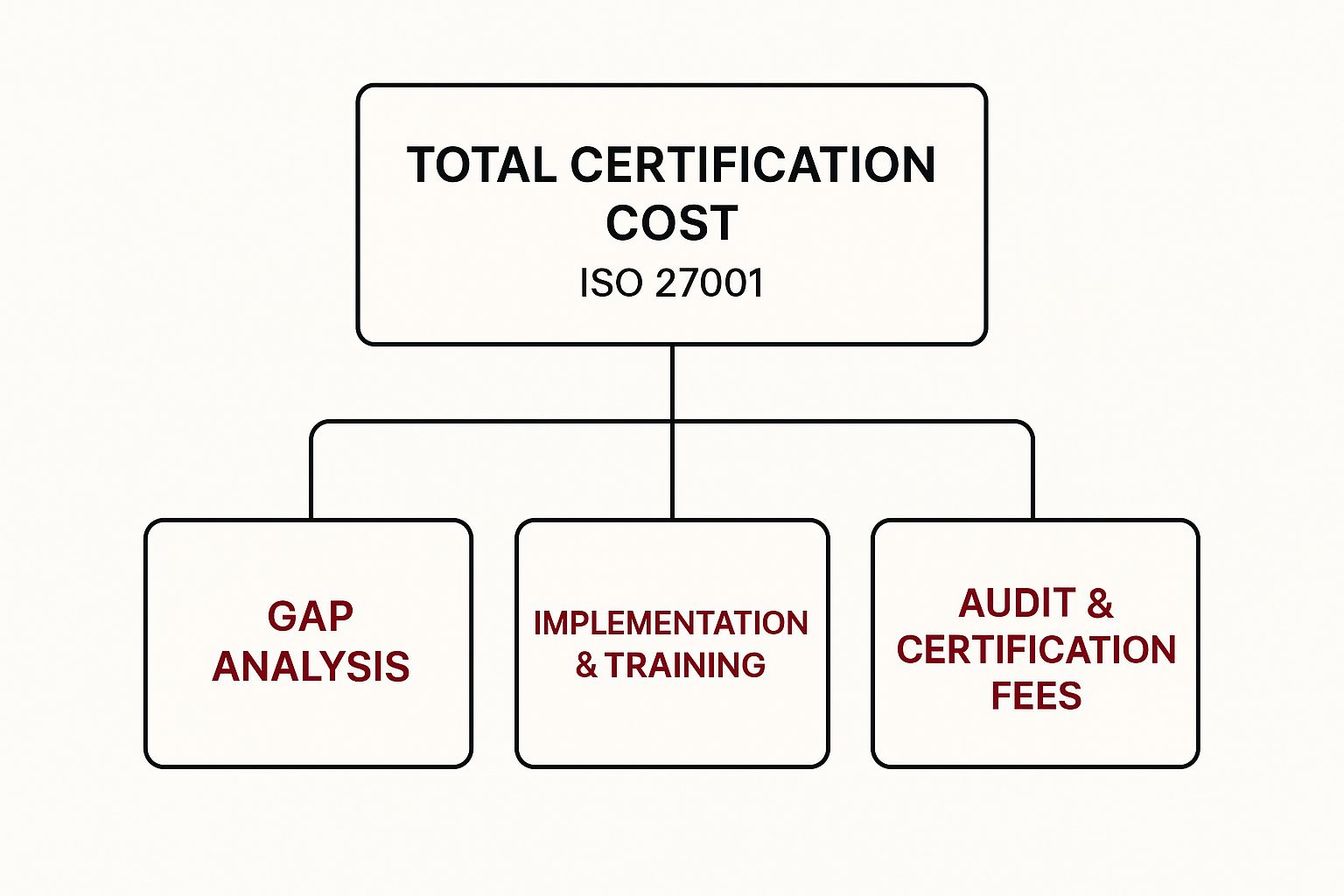
As you can see, the formal audit is just one piece of the puzzle. A huge part of your investment actually goes into getting your organisation ready for it.
Internal Costs: Your Team's Contribution
The first, and often most overlooked, cost is the time and effort your own team puts in. This won't show up on an invoice from a supplier, but the hours your people dedicate to the project are a very real financial commitment. It's the "sweat equity" of your certification.
Your IT managers, security analysts, and even department heads will be spending significant time on tasks like:
- Learning the Standard: Getting their heads around the specific requirements of ISO 27001.
- Documenting Processes: This is a big one. They'll be writing the policies, procedures, and day-to-day instructions that form the backbone of your Information Security Management System (ISMS).
- Coordinating with Auditors: Finding the right evidence and being available to answer questions when the auditors are on-site.
On top of that, you might need to invest in new tools or upgrade existing ones to meet certain security controls. This could be anything from new antivirus software or an encryption tool to physical security upgrades like better access control for your server room.
The time your internal team dedicates to ISO 27001 is a direct investment. By assigning a dollar value to these hours, you gain a far more accurate picture of the true total cost and can better justify the resources needed for a successful outcome.
Finally, don't forget training. Every single person, from the CEO down to the newest hire, needs to understand their role in protecting information. This often means developing or buying security awareness training programs to get everyone on the same page—a non-negotiable part of the standard.
Itemised ISO 27001 Cost Breakdown
To give you a clearer picture, let's itemise the typical costs you can expect on your ISO 27001 journey here in Australia. This table provides a general guide, but remember that your final figures will depend on your unique circumstances.
| Cost Category | Description | Estimated Cost Range (AUD) |
|---|---|---|
| Consulting & Implementation | Expert guidance, gap analysis, project management, and template development to prepare your ISMS. | $15,000 – $30,000+ |
| Compliance Software | Optional platforms (e.g., Vanta, Drata) to automate evidence collection and policy management. | $1,000 – $10,000+ (Annual) |
| Internal Resource Time | The "hidden cost" of your team's hours spent on documentation, implementation, and training. | Varies significantly |
| Technology & Upgrades | New software (e.g., encryption, antivirus) or physical security enhancements needed to meet controls. | $500 – $5,000+ |
| Employee Training | Security awareness programs and materials for all staff. | $1,000 – $4,000+ |
| Certification Audits | Fees paid to an accredited body for the Stage 1 and Stage 2 audits. | $14,000 – $16,000 |
| Annual Surveillance Audits | Ongoing annual audits required to maintain your certification. | $7,000 – $9,000 (Annual) |
This breakdown helps illustrate that the upfront certification fee is just the beginning. Planning for the full spectrum of costs, including ongoing maintenance, is key to a sustainable and successful ISMS.
Implementation Costs: External Support and Tools
This second bucket covers all the outside help and tech you bring in to speed things up and fill any knowledge gaps in your team. For a lot of businesses, especially small to medium-sized ones, this is where a fair chunk of the budget goes. These costs are all about getting you to the finish line faster and boosting your chances of passing the audit the first time.
The most common implementation costs are:
- External Consultants: Hiring an ISO 27001 consultant can be a complete game-changer. They bring the expertise, project management skills, and pre-written templates that can slash the time and stress for your internal team. You can expect their fees to range from $15,000 to over $30,000, depending on how much support you need.
- Gap Analysis: This is usually the first step with a consultant. They'll assess where you are now versus where you need to be for ISO 27001, giving you a clear, actionable roadmap.
- Compliance Automation Platforms: Software tools are becoming a popular way to manage the process. They help automate the tedious work of collecting evidence, managing policies, and tracking your progress, which can seriously cut down on manual effort and consulting fees.
For many Australian organisations, this is the most crucial phase. Looking at the numbers, a small business (up to 50 employees) can expect an initial certification cost between AUD 20,000 and AUD 40,000. For a medium-sized company (50-200 employees), that figure jumps to between AUD 40,000 and AUD 70,000, while large corporations often go well beyond AUD 70,000.
Putting money into these external resources often pays for itself. You can find out more about how this works in our guide on the ROI of cyber security.
Certification Costs: The Formal Audit Fees
The third and final bucket is for the non-negotiable fees you pay directly to an accredited certification body. This is the official finish line, where an independent expert comes in to assess your ISMS and confirm it meets the ISO 27001 standard. These fees cover the audit itself and the piece of paper—your certificate.
The audit is officially split into two parts, and you pay for both:
- Stage 1 Audit: Think of this as an open-book exam. The auditor mainly reviews your documentation to make sure you have all the necessary policies, procedures, and a solid ISMS foundation. It’s a check to see if you’re ready for the main event.
- Stage 2 Audit: This is where the rubber meets the road. The auditor does a deep dive, interviewing your staff and checking that your security controls are actually working in the real world as described in your paperwork.
For a small Australian business, the combined cost for the Stage 1 and Stage 2 audits usually lands somewhere in the $14,000 to $16,000 range. This can change based on the certification body's reputation and how complex your business is.
And it doesn't stop there. To keep your certificate valid, you'll need to have annual surveillance audits. These are less intense (and less expensive) than the initial one, but they are a mandatory, recurring expense. If you're interested in how different professional services are priced, a general overview of service pricing structures can offer some useful context.
Uncovering Hidden Costs and Long-Term Commitments

Getting that ISO 27001 certificate is a huge win, but it’s a mistake to see it as the finish line. In reality, it’s just the starting gun. The initial investment gets the certificate on the wall, but keeping it there involves a whole series of ongoing costs and long-term commitments that catch many businesses by surprise.
Thinking of the ISO 27001 certification cost as a one-off payment is a common pitfall. The truth is, genuine compliance becomes a living, breathing part of your organisation. It needs constant attention, monitoring, and, yes, financial support to stay effective and valid.
This shift in perspective is absolutely crucial for budgeting accurately and making sure your Information Security Management System (ISMS) is sustainable for the long haul. So, let's pull back the curtain on the recurring expenses that make up the real total cost of ownership.
The Mandatory Audit Cycle
Once you're certified, the clock immediately starts ticking on your maintenance duties. The certification body that issued your certificate will be back on a regular schedule to make sure you’re still toeing the line. This isn’t a friendly check-in; it’s a mandatory part of keeping your certification active.
This cycle is built around two key types of audits:
- Annual Surveillance Audits: These happen in year one and year two of your three-year certification cycle. Think of them as a "health check"—less intense than the initial audit, but designed to verify your ISMS is being maintained and is still working as it should.
- Recertification Audit: In year three, it’s time for the main event again. You’ll go through a full recertification audit, which is just as comprehensive and detailed as your initial Stage 2 audit, to renew your certificate for another three years.
And of course, these audits aren't free. They represent a significant and predictable recurring expense that you absolutely must factor into your annual operational budget.
Continuous Employee Training and Awareness
Your people are your greatest security asset—and, if we're being honest, your biggest potential weakness. ISO 27001 is very clear that all employees must understand their information security responsibilities. This isn't just about a one-off training session during the setup phase; it's a permanent commitment.
New threats are popping up all the time, and your own security policies will need to adapt. That means your training has to keep up.
Maintaining a security-conscious culture isn't a project with an end date; it's a perpetual process. The recurring cost of training is a direct investment in reducing human error, which continues to be a leading cause of security breaches.
These ongoing costs often include:
- New Hire Onboarding: Every single new employee needs security awareness training as part of their induction process. No exceptions.
- Annual Refresher Courses: Regular training keeps security top-of-mind for everyone and gets them up to speed on new threats or policy changes.
- Specialised Role-Based Training: Your developers, system admins, and HR team handle different types of sensitive data. They often need more specific training tailored to the unique risks of their roles.
Whether you build this training in-house or buy it from a specialist provider, it’s a recurring line item on your annual budget.
The True Cost of Maintaining Your ISMS
Beyond the big-ticket items like audits and training, a number of other ongoing expenses are vital for keeping your ISMS in fighting shape. These costs can sometimes be hidden away in various departmental budgets, but they are a direct consequence of your commitment to ISO 27001.
Historically, the cost of ISO 27001 certification in Australia has been seen to range from AUD 15,000 to AUD 27,000 for some organisations, but that figure really only covers the initial push. The ongoing costs, like recertification audits every three years, can easily add another AUD 5,000 to AUD 15,000 to the bill. This really highlights the long-term financial reality of compliance.
Let’s dig into some of these key long-term financial commitments.
Technology Upgrades and Subscriptions
The tech that powers your security controls isn't a "set and forget" deal. Software needs patching, hardware eventually becomes obsolete, and new tools are constantly needed to fight off ever-smarter threats like sophisticated phishing or ransomware attacks.
Your budget needs to have room for:
- Software Renewals: Those annual subscription fees for your antivirus, firewalls, encryption software, and vulnerability scanners add up.
- Hardware Lifecycle: You need a plan to replace servers, laptops, and network gear before they become a security liability.
- Compliance Automation Platforms: If you’re using a platform to help manage your ISMS, its annual subscription fee is a fixed, recurring cost.
Internal Management and Oversight
Your ISMS won’t run itself. It needs someone at the helm—often an IT Manager, a Compliance Officer, or a dedicated Information Security Manager. The salary (or at least a portion of it) for the person tasked with managing the ISMS is a very real, and very ongoing, cost.
Their job includes running internal audits, managing risk assessments, keeping documentation up to date, and leading management review meetings. For businesses that need continuous expert guidance without the hefty price tag of a full-time executive, an annual ISO support program can be an incredibly cost-effective way to manage these ongoing duties. This kind of program provides dedicated support to make sure your ISMS stays compliant and effective, year in and year out.
Getting your head around these long-term commitments is the secret to building a realistic and sustainable budget for your ISO 27001 journey.
Smart Strategies to Optimise Your Certification Budget
Getting ISO 27001 certified is a brilliant strategic move, but it doesn't have to break the bank. With a bit of smart planning and a clear-eyed view of your options, you can get a firm handle on the iso 27001 certification cost without ever cutting corners on your security.
This isn’t about being cheap; it’s about making intelligent financial decisions that give you the best possible return. Every choice you make, from how you start the project to where you draw the line on its boundaries, will directly hit your bottom line.
Let's walk through the most effective ways to build a rock-solid Information Security Management System (ISMS) on a budget that actually works for your business.
Choose Your Implementation Path Wisely
One of the very first, and biggest, cost decisions you'll make is how you're going to tackle the implementation. This choice really sets the tone for the entire project, shaping both the upfront cash outlay and the amount of internal time you’ll need to invest.
You've basically got three roads you can go down, each with its own financial flavour.
-
The DIY Approach: On paper, managing the whole journey in-house looks like the cheapest option. But be careful. This path only really works if you have genuine, seasoned ISO 27001 expertise on your team already. If you don't, the hidden costs of your team's time—plus the huge risk of making a critical mistake—can quickly make this the most expensive option of all.
-
Hiring an Expert Consultant: Bringing in a consultant gives you instant expertise and a proven roadmap. They speed things up, provide templates, and help you dodge common mistakes, which dramatically increases your chances of passing the audit the first time around. Yes, there's an upfront fee, but the efficiency you gain often means a lower total cost for the project.
-
Using a Compliance Platform: This is a popular middle ground. Compliance automation software can streamline how you collect evidence, offer up policy templates, and track your progress, slashing the amount of manual work. For many small to medium-sized businesses, pairing a platform with some targeted help from a consultant strikes the perfect balance between cost-effectiveness and expert guidance.
Right-Size Your ISMS Scope
A tightly defined scope is your best friend when it comes to controlling costs. Right from the get-go, you need to know that you are not required to certify your entire organisation at once.
Instead, you can be strategic and limit the scope of your ISMS to the most critical parts of your business. If you're a software company, that might just mean including the development team and the production environment, leaving departments like finance or marketing out of scope for now.
Think of a well-defined scope as a financial guardrail for your project. It stops "scope creep" in its tracks, focuses your resources where they matter most, and makes the whole audit process far more manageable and predictable.
This focused approach simplifies absolutely everything. You'll have fewer assets to manage, fewer policies to write, and fewer processes for the auditor to check. The result? A faster and more affordable path to getting that first certificate on the wall.
Bundle Certifications for Greater Value
Is your organisation also looking at other standards, like ISO 9001 for Quality Management or ISO 45001 for Health and Safety? If so, bundling them together can unlock some serious savings.
Many certification bodies offer discounted rates for integrated audits. Why? Because a lot of the core management system principles and documents overlap between the standards.
Running a single, integrated audit is so much more efficient for both your team and the auditor than doing three separate ones. You save money on auditor day rates, cause less disruption to your business, and end up with a more cohesive management system. If other certifications are on your roadmap, always ask about integrated audit pricing.
Leverage Automation to Cut Down Manual Effort
The sheer amount of time people spend on documentation, gathering evidence, and ongoing monitoring is a massive hidden cost. This is exactly where compliance automation platforms deliver a huge return on investment.
These tools can plug directly into your cloud services, HR systems, and other tech to automatically pull the evidence auditors need to see. This practically gets rid of the soul-crushing, manual work of taking screenshots and chasing down logs.
A good platform can cut the time your team spends on getting ready for an audit by as much as 88%. That frees up your best people to focus on their actual jobs instead of getting bogged down in compliance paperwork, which directly lowers the internal cost of the project.
Negotiate with Certification Bodies
The prices quoted by certification bodies are not set in stone. The market for auditing services is competitive, and that gives you some power to negotiate.
It is absolutely essential to get quotes from at least three different accredited certification bodies. This gives you a clear picture of the going rate and provides real leverage for your discussions.
When you're comparing quotes, don't just fixate on the price tag. Look at the auditor's experience in your industry and their general approach. But once you've picked your favourites, don't be shy about discussing the price. See if there's any wiggle room, especially if you're committing to a full three-year certification cycle with them. To really get the most out of your budget, it pays to explore a range of proven high-impact cost reduction strategies that can be applied across your business.
Focus on a Phased Implementation
Finally, just remember: you don't have to boil the ocean. If the budget is tight, think about tackling the implementation in phases.
Start by zeroing in on the highest-risk areas of your business. This lets you make real security improvements and show progress without needing a massive upfront investment.
For instance, your first phase might be all about securing your main customer-facing application. Once that part of the business is under control, you can reinvest the value you've created into expanding the ISMS to cover other areas. This step-by-step approach makes the overall iso 27001 certification cost much less intimidating, turning one huge project into a series of achievable milestones.
Got More Questions About ISO 27001 Costs?
As you get closer to committing, a few practical questions always seem to pop up. You’ve seen the big-picture numbers and the line-by-line breakdowns, but what about those small financial details that can really make a difference to your budget?
This final section is all about tackling those lingering questions head-on. We'll give you clear, straightforward answers to the most common queries we hear from Australian businesses about the ISO 27001 certification cost. Think of this as the last piece of the puzzle you need to move forward with real confidence.
Can We Get Government Grants to Help Cover the Cost?
This is a fantastic question, and the answer is often a very welcome "yes." Both federal and state governments in Australia are keen to see businesses, especially small and medium-sized enterprises (SMEs), lift their cybersecurity game. They often back this up with grants and support programs.
Now, you probably won't find a grant explicitly called "The ISO 27001 Grant." It's a bit more nuanced than that. The trick is to look for broader programs where your certification project fits perfectly.
These grants often fall under categories like:
- Cybersecurity Uplift Programs: These are designed to help businesses adopt stronger security controls and frameworks like ISO 27001.
- Business Competitiveness Grants: These programs help companies win bigger contracts—especially government or international tenders—where a certification like ISO 27001 is a must-have.
- Technology Adoption Grants: This kind of funding supports the implementation of new software or systems, which could easily include the GRC tools needed for your ISMS.
Your best bet is to start digging around on government business portals like business.gov.au. The grant landscape is always shifting, so keeping an eye on what's available is key. Nailing even a partial grant can take a serious chunk out of the overall financial burden.
Are ISO 27001 Certification Costs Tax-Deductible?
For the vast majority of Australian businesses, the answer is yes. Almost all expenses related to achieving and maintaining your ISO 27001 certification are considered operational business expenses, making them generally tax-deductible.
Think of it this way: you're investing in a system to protect your business assets, manage risk, and stay competitive. It’s no different from other deductible costs you already have, like professional services, insurance, or software subscriptions.
It's crucial to view your ISO 27001 expenses as a legitimate cost of doing business. The investment directly contributes to your operational resilience and market competitiveness, making it a standard deductible expense.
So, what costs can you typically claim?
- Fees paid to consultants and external advisors.
- The bills for your Stage 1, Stage 2, and ongoing surveillance audits.
- Subscriptions for compliance automation software (like GRC platforms).
- Expenses for staff security awareness training.
Of course, you should always run this by your accountant or a registered tax agent. They can give you the definitive green light based on your specific business structure and financial situation.
What's the Best Way to Get an Accurate Quote?
A generic online cost calculator might give you a ballpark figure, but it will never capture the unique details of your organisation. To get a quote you can actually take to the bank for your ISO 27001 certification cost, you need a proper, tailored assessment.
The most effective way to get there involves a few simple, structured steps:
- Define Your Scope Early: Before you even pick up the phone, have a good think about the scope of your Information Security Management System (ISMS). Which departments, locations, and services need to be included? This is the single biggest lever that moves the price up or down.
- Talk to a Consultant First: A good consultant can perform a detailed gap analysis. This isn't just another meeting; it's a process that produces a clear roadmap of exactly what work needs to be done. This document is gold when you go out for quotes later.
- Get Quotes from Multiple Certification Bodies: Don't just accept the first price you're given. Reach out to at least three accredited certification bodies. This lets you compare not just their costs, but also their audit styles and their experience in your industry. A little competition here ensures you’re paying a fair market rate.
By following this process, you stop guessing and start planning. You’ll transform a vague estimate into a firm, budgetable figure based on your real-world needs, letting you move forward without any nasty financial surprises.
At Anitech, we specialise in demystifying the ISO 27001 process for Australian businesses. Our expert consultants can provide you with a clear, accurate, and no-obligation quote tailored to your specific needs, ensuring you have a predictable path to certification. Start your journey with confidence by visiting us at https://iso-27001.com.au.
Recent Comments