

At its core, ISO 27001 certification is about one thing: giving your business a rock-solid system for managing information security risks. It’s a globally recognised standard that helps you build what's known as an Information Security Management System (ISMS) – a structured way to keep your sensitive company and customer data safe, sound, and available when you need it. An ISMS is a comprehensive framework of policies and procedures that includes all legal, physical, and technical controls involved in an organization's information risk management processes. It's a systematic approach to managing sensitive company information so that it remains secure. It includes people, processes and IT systems by applying a risk management process. This ensures that the security measures are fine-tuned to keep pace with changes to the security threats, vulnerabilities, and business impacts—an important aspect in such a dynamic field. The benefits of implementing an ISMS are numerous; it helps protect your assets, comply with legal requirements, and most importantly, gain customer trust.
Why ISO 27001 Is a Non-Negotiable Asset
Let's get straight to the point. In today's business world, seeing ISO 27001 as just another compliance task is a massive mistake. It's so much more than a certificate for the reception wall; it's a game plan for survival and growth. The real question isn’t whether you can afford to get certified, but whether your business can survive the fallout of not being certified. The modern business landscape is fraught with digital threats, and demonstrating a commitment to information security is no longer optional—it's a fundamental requirement for operating responsibly and competitively.
Think about the damage a single, well-placed data breach could do. It’s not just the immediate financial hit. The blow to your reputation can be devastating, wiping out years of client trust overnight. Then come the potential regulatory fines and the eye-watering costs of cleaning up the mess—a combination that could easily cripple a small business. A breach can lead to significant operational downtime, legal battles, and a loss of competitive advantage. For many smaller enterprises, the financial and reputational repercussions are insurmountable, leading to closure. Therefore, investing in a robust security framework like ISO 27001 is a proactive measure to safeguard the very existence of your business. The process of certification itself forces an organization to conduct a thorough risk assessment, which in turn highlights vulnerabilities that might have otherwise gone unnoticed. Addressing these vulnerabilities not only prevents potential breaches but also enhances the overall efficiency and reliability of business operations.
From Compliance Hurdle to Competitive Edge
If you're viewing the ISO 27001 certification process as just another hurdle to jump, you're missing the point. It’s actually a blueprint for building a tougher, more resilient business. It forces you to get serious about identifying your most important information, understanding the real threats you face, and putting sensible controls in place to protect it all. This proactive approach to risk is what separates businesses that thrive from those that are just one bad click away from disaster. It transforms security from a reactive, firefighting exercise into a strategic, forward-thinking discipline that is embedded in the company culture. By adopting this standard, you're not just meeting a set of requirements; you're fundamentally improving your organization's ability to manage and protect its information assets, which are often among its most valuable.
But this isn't just about defence. It's also a powerful tool for opening doors to new business. For a lot of organisations—especially in government, finance, and tech—ISO 27001 isn't a "nice to have," it's a non-negotiable requirement for even getting a foot in the door. Many large corporations and government agencies mandate ISO 27001 certification for their suppliers and partners as a baseline for security assurance. Without it, you may be automatically disqualified from bidding on lucrative contracts, effectively shutting your business out of significant market segments.
When you achieve certification, you’re not just ticking a box. You're sending a powerful signal to the market that you take security seriously. This becomes your competitive advantage, a trust mark that can help you win contracts over rivals who haven't made the same commitment.
The relentless rise of cyber threats makes this more critical than ever. Just look at the numbers. The Australian Cyber Security Centre (ACSC) reported over 94,000 cybercrime incidents in the 2022-2023 financial year—that’s a shocking 23% jump from the year before. A huge number of these attacks, especially the ones that lead to data breaches, start with something as simple as a dodgy email. A standard like ISO 27001 gives you the framework to shut down these vulnerabilities and build genuine cyber resilience. For more on this, you can explore deeper insights into Australian cybersecurity trends and see how this standard directly helps. This data underscores the escalating threat environment and the necessity for a structured defense mechanism. ISO 27001 provides just that, offering a comprehensive set of controls and management processes to mitigate risks from various vectors, including human error, which is often the root cause of security incidents.
A Real-World Scenario
Let's imagine a small marketing agency. They keep all their client campaign data and customer lists on a shared server. An employee, rushing to hit a deadline, downloads a file from an unverified website. It looks harmless, but it's loaded with ransomware. Suddenly, every client file is encrypted, and the business grinds to a halt. The immediate consequences are severe: client campaigns are stalled, deadlines are missed, and the agency's reputation is instantly tarnished. The attackers demand a hefty ransom, and there's no guarantee that paying it will result in the recovery of the data. The agency now faces a multifaceted crisis encompassing operational, financial, and reputational damage.
Now, how would things have played out if they had an ISO 27001-certified Information Security Management System (ISMS)?
- Risk Assessment: The ISMS process would have flagged that shared server and its precious client data as a critical asset. The risk of malware from dodgy downloads would have been identified and prioritised. This proactive identification would have led to the implementation of specific controls to mitigate this exact type of threat, long before an incident could occur.
- Access Controls: Proper role-based access could have stopped that employee from installing software or even accessing certain critical folders in the first place, containing the damage. This principle of least privilege ensures that employees only have access to the information and systems necessary for their specific job functions, dramatically reducing the potential attack surface.
- Security Awareness Training: That employee would have gone through mandatory training, making them far more likely to spot a phishing attempt or understand the danger of downloading from untrusted sources. Regular, engaging training transforms the workforce from a potential vulnerability into an active line of defense, creating a culture of security awareness across the organization.
- Incident Response Plan: A clear, practiced plan would have kicked in immediately. This means isolating the infected machine, quickly restoring data from secure backups, and communicating clearly with clients—massively reducing downtime and protecting their reputation. An effective incident response plan minimizes the impact of a breach by ensuring a swift, coordinated, and effective reaction, turning a potential catastrophe into a manageable event.
In this situation, the certification is anything but a piece of paper. It’s a living system that fundamentally changes how your business handles risk, earns trust you can't buy, and carves out a secure place in a very competitive market. The structured approach of an ISMS ensures that the organization is not just prepared for specific threats but is resilient enough to handle unforeseen security challenges, thereby safeguarding its long-term viability and success.
Building Your Information Security Management System
The journey to ISO 27001 certification doesn’t start with buying expensive security software. It starts with clear thinking. Building your Information Security Management System (ISMS) might sound intimidating, but it really just boils down to making a series of smart, deliberate decisions from the get-go. This initial planning phase is crucial as it lays the foundation for the entire security framework. It’s about understanding your organization’s unique context, identifying what needs protection, and defining clear objectives for your security efforts. This strategic groundwork ensures that the resulting ISMS is not only compliant with the standard but is also practical, effective, and aligned with your business goals.
Think of it like building a house. You wouldn't just start hammering nails into wood. You’d first survey the property lines, figure out who’s going to live there and what they need, and check for any risks like a potential flood zone. Your ISMS is exactly the same. This analogy highlights the importance of a methodical and well-planned approach. Just as a solid foundation is essential for a stable house, a well-defined scope and clear policies are essential for a robust ISMS. Rushing this stage often leads to an ISMS that is disconnected from business realities, difficult to maintain, and ultimately ineffective.
This initial setup is where many small businesses get bogged down, but it’s absolutely the most important part of the entire process. Get this right, and your whole certification effort will be focused, efficient, and actually aligned with what your business is trying to achieve. Taking the time to properly define the scope, identify stakeholders, and craft a clear policy will save significant time and resources later in the implementation and audit phases. It ensures that your efforts are concentrated on the areas of highest risk and greatest importance to the business, maximizing the return on your security investment.
Defining Your ISMS Scope
First things first: what are you actually trying to protect? In ISO 27001 lingo, this is your "scope." For a small business, trying to secure everything with the same level of intensity is a fast track to burnout and wasted money. You have to be strategic. The scope defines the boundaries of your ISMS, specifying which parts of the organization, locations, assets, and technologies are included. A poorly defined scope can lead to either leaving critical assets unprotected or wasting resources on securing non-critical areas.
Let's imagine an Aussie fintech startup. They have a customer-facing mobile app, a development team, and a small marketing department. Does the marketing team's brainstorming whiteboard need the same heavy-duty security as the production database holding sensitive customer financial data? Of course not. This example illustrates the necessity of a risk-based approach to scoping. The goal is to focus the ISMS on the "crown jewels" of the organization—the information assets that are most critical to its operations and most attractive to potential attackers.
Defining your scope is about drawing a clear boundary around the parts of your business that the ISMS will cover. This might be a specific product, a physical office, or a particular department. A tight, well-defined scope keeps the project manageable and laser-focused on your highest-risk areas. It makes the certification process more achievable for small businesses with limited resources, allowing them to certify the most critical parts of their operations first and potentially expand the scope over time as the business grows and matures.
An ISMS scope isn’t about boiling the ocean. It’s about identifying your crown jewels—the information, systems, and processes that are absolutely critical to your business—and drawing a protective circle around them first.
For example, our fintech startup might decide its initial scope includes:
- The entire cloud infrastructure that supports its mobile application.
- The development team responsible for building and maintaining the app.
- All customer data that is processed and stored by the service.
This means the marketing team's internal files and the general office guest Wi-Fi could be considered "out of scope" for now. This massively simplifies the initial push for certification. This strategic exclusion allows the startup to concentrate its limited resources on protecting the most sensitive and high-risk components of its business, ensuring that the most critical areas are robustly secured before addressing lower-priority domains. This phased approach is both practical and effective.
To help you think through this, here's a quick guide on what to consider including or excluding.
Key ISMS Scoping Decisions for a Small Business
| Business Area | Consider Including If… | Consider Excluding If… |
|---|---|---|
| Product/Service | It handles sensitive customer data or is critical to revenue. | It's a non-critical internal tool or an experimental product. |
| Departments | The team has access to "crown jewel" data (e.g., developers, finance). | The team's work has a very low information security impact (e.g., office admin). |
| Physical Locations | Your main office or data centre houses critical infrastructure or staff. | A satellite sales office doesn't handle sensitive information on-site. |
| Key Systems | The system stores or processes critical data (e.g., CRM, production database). | The system is standalone and holds no sensitive info (e.g., project management tool for non-sensitive tasks). |
Getting your scope right from the start prevents scope creep and focuses your resources where they matter most. It is a foundational decision that will influence every subsequent step of the ISO 27001 implementation, from risk assessment to control selection and auditing. A well-justified scope is also a key requirement that auditors will examine closely.
Mapping Key Stakeholders and Expectations
Once you've decided what you're protecting, you need to understand who cares about it and why. These are your interested parties, or stakeholders. This isn't just a corporate box-ticking exercise; their expectations will directly shape your security controls. Stakeholders can be internal, like employees and management, or external, such as customers, suppliers, regulators, and investors. Understanding their requirements and expectations regarding information security is a mandatory part of the ISO 27001 standard (Clause 4.2).
Your stakeholders are anyone with a vested interest in your information security. Obvious ones are clients and investors, but don't forget internal teams, regulators, and even your key suppliers. Each one has a different set of needs. For example, customers are concerned with the confidentiality of their personal data, while regulators may have specific legal and compliance requirements that must be met.
- Clients: They simply expect their personal and financial data to be kept safe, period. Their trust is paramount, and a security breach can irreparably damage this relationship.
- Investors: They need confidence that a cyber-attack won't torpedo their investment. They are looking for assurance that the business has adequate measures in place to protect its assets and ensure business continuity.
- Regulators: They demand you comply with laws like Australia's Privacy Act. Non-compliance can result in hefty fines, legal action, and reputational damage.
- Employees: They need clear rules on handling data and the right tools to do their jobs securely. Clear policies and procedures empower employees to act as a strong line of defense.
By mapping out these expectations, you get a clear picture of what your ISMS must achieve. This step ensures your security efforts are tied directly to real business needs, which makes your ISO 27001 certificate far more than just a piece of paper on the wall. It helps in prioritizing security controls and demonstrating to auditors and stakeholders that your ISMS is comprehensive and responsive to the needs of all relevant parties.
This visual shows how these pieces logically fit together, moving from the 'what' to the 'who' and finally to the 'how'.
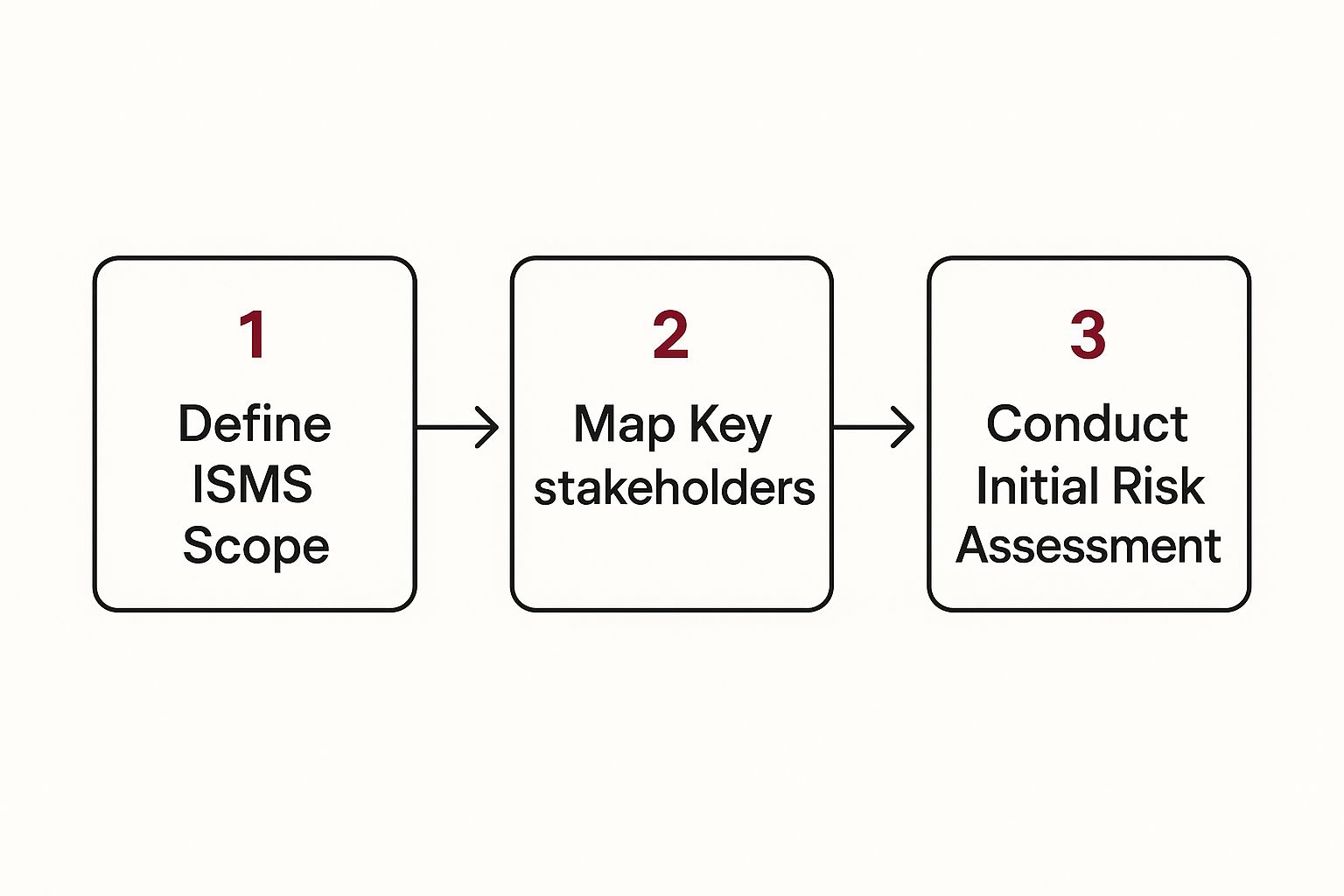
This sequence makes sure your risk assessment is grounded in reality, not guesswork. Following this logical progression—from defining the scope to understanding stakeholder needs and then to crafting policy—ensures that the subsequent risk assessment is relevant, comprehensive, and addresses the actual security requirements of the business and its environment.
Crafting a Clear Information Security Policy
Think of your Information Security Policy as the constitution for your ISMS. It's the cornerstone document—a high-level statement from management that signals your commitment to protecting information. And for it to work, it has to be a document your team can actually understand and get behind. This policy sets the overall direction and principles for information security within the organization. It should be endorsed by top management to demonstrate leadership commitment, a key requirement of the ISO 27001 standard.
Forget the technical jargon and vague corporate fluff. A great policy is clear, concise, and sets the tone for your entire security culture. It should plainly state your main goals—like protecting customer data, ensuring service uptime, and meeting legal obligations—and commit the business to getting better over time. This principle of continual improvement is central to the ISO 27001 framework. The policy should be easily accessible to all employees and relevant stakeholders to ensure everyone is aware of their security responsibilities.
This policy isn't just for the auditor. It's for every single person in your company. It’s the "why" behind all the security rules they'll be asked to follow. As your ISMS grows, staying on top of all the related documents is key. It's worth looking into some document management best practices to keep everything organised and secure. A well-managed documentation system is essential for maintaining the integrity and usability of your ISMS, ensuring that policies, procedures, and records are up-to-date, approved, and readily available when needed.
Conducting Your First Risk Assessment
Okay, you've got your scope, stakeholders, and policy. Now you're ready for the heart of the ISMS: the risk assessment. This is where you methodically identify, analyse, and evaluate your information security risks. You don't need a team of expensive consultants to do this, either. The risk assessment process is the engine that drives the selection of appropriate security controls. It allows the organization to make informed decisions about where to invest its security resources to achieve the greatest reduction in risk.
At its core, a risk assessment just answers three simple questions:
- What could go wrong? (Identifying your threats and vulnerabilities) This involves identifying potential threats to your information assets and the vulnerabilities that could be exploited by those threats.
- How bad would it be if it did? (Analysing the potential impact) This step involves assessing the potential business impact if a vulnerability is exploited, considering factors like financial loss, reputational damage, and legal consequences.
- How likely is it to happen? (Evaluating the probability) Here, you estimate the likelihood of a threat exploiting a vulnerability, which helps in prioritizing the risks.
For our fintech startup, a risk might be "unauthorised access to the customer database due to weak developer passwords." The impact? Catastrophic. We're talking a massive data breach and total loss of customer trust. The likelihood? Pretty high if they have no password policy. This risk immediately shoots to the top of the priority list. This example demonstrates how the risk assessment process translates abstract threats into concrete, prioritized issues that require specific actions, such as implementing a strong password policy and multi-factor authentication.
This straightforward process helps you move past gut feelings and focus your limited time and budget on fixing the most dangerous problems first. It’s the engine that drives the entire ISO 27001 certification standard, and keeping good records of your decisions is a must. For a deeper dive, check out our guide on the minimum documented information to be maintained for achieving ISO 27001 certification. Proper documentation of the risk assessment methodology, findings, and treatment decisions is not only a requirement of the standard but also a critical component of a defensible and auditable ISMS.
The push for this certification is growing fast in Australia, especially as cyber threats become more common. Industries like finance and healthcare are leading the way due to the sensitive data they handle. To manage the complexity, many Aussie businesses get help; globally, third-party consulting and certification services account for 60% of the market. This trend highlights the recognized value of expert guidance in navigating the intricacies of the standard and achieving a successful certification outcome.
Implementing Security Controls Without Enterprise Budgets
Right, so you've mapped out your scope and stared your risks in the face. Now comes the part that makes most small businesses nervous: implementing security controls. Many people hear about the 93 potential controls in ISO 27001's Annex A and immediately picture a mountain of tech work and an invoice with too many zeros. This perception often acts as a barrier for SMEs, who believe that robust security is beyond their financial reach. However, this is a common misconception.
But here’s a secret I've learned from years in the field: you don't need a corporate-sized budget to build corporate-grade security. The whole point isn't to buy the most expensive tool for every single control. It's about being clever and applying them in a way that makes sense for your business and your specific risks. The ISO 27001 standard is not prescriptive about the specific technologies to be used; it is a risk-based framework. This means that the choice and implementation of controls should be proportionate to the identified risks, allowing for flexibility and cost-effectiveness.
For a small business, this means getting creative and making the most of the tools you probably already pay for. This stage of your ISO 27001 certification journey is all about smart, focused action—not just throwing money at the problem. By leveraging existing technologies and focusing on foundational process improvements, SMEs can achieve a high level of security without breaking the bank. It's about working smarter, not just spending more.
Grouping Controls for Practical Application
Staring at a list of 93 controls is a sure-fire way to feel overwhelmed. Instead of trying to tackle them one by one, let's group them into themes that actually make sense in the real world. Think of them in broader categories like People Security, Access Control, and Asset Management. The 2022 version of the standard itself groups the controls into four themes: Organisational, People, Physical, and Technological, which provides a helpful structure. Adopting a thematic approach makes the implementation process more intuitive and manageable.
This approach is so much more manageable. You’ll often find that a single smart solution can tick the box for multiple controls at once. For a small team where everyone wears multiple hats, that kind of efficiency is gold. For example, implementing a robust identity and access management solution can address numerous controls related to user registration, access rights, password management, and user access reviews simultaneously. This bundling of efforts saves time and reduces complexity.
Fortifying Your Human Firewall: People Security
We've all heard the cliché that people are the weakest link in security. I disagree. With the right guidance, your team can absolutely be your strongest line of defence. The 'People Security' controls are all about giving your team the awareness and processes to handle information securely every day. This involves creating a security-conscious culture where every employee understands their role in protecting the organization's information assets.
A common mistake is thinking you need some expensive, formal training platform. You really don't. You can build a fantastic security awareness program with next to no budget. The key is making it engaging, not expensive. Simple, regular, and practical training is often more effective than infrequent, lengthy sessions. Consistency is key to reinforcing secure behaviors.
For instance, why not start a simple "Security Tip of the Week" email? You can find endless free resources online to cover topics like spotting a dodgy phishing email, why password managers are a lifesaver, or the simple act of locking a computer screen. It keeps security top-of-mind without feeling like a boring lecture. These small, consistent reminders can have a significant cumulative impact on the overall security posture of the organization.
Building a security-conscious culture isn't about a single, massive training day. It's about the small, consistent, and practical habits that become second nature. An engaged team is a far more effective control than any piece of software.
Another brilliant, low-cost tactic is to run your own simulated phishing campaigns. There are plenty of tools out there with free tiers that are perfect for small businesses. Sending a safe, simulated phishing email and then openly discussing the results is one of the most powerful and memorable training exercises you can do. This provides a safe environment for employees to make mistakes and learn from them, dramatically improving their ability to identify and report real phishing attempts.
Mastering Access Control with Everyday Tools
Figuring out who can access what is the bedrock of information security. The 'Access Control' group of controls is all about preventing unauthorised eyes from seeing sensitive data, and you can nail this with the business tools you're likely already using. The principle of least privilege—granting users the minimum level of access necessary to perform their job functions—is fundamental to a strong access control policy.
Let's imagine a small marketing agency using Microsoft 365. They have a design team, an accounts team, and a few project managers. Without proper controls, a junior designer could accidentally stumble upon sensitive client contracts or payroll spreadsheets. This scenario highlights a common risk in many organizations where access permissions are not properly managed.
An auditor will spot that risk a mile away. The fix isn't some complex new system; it's right there in the Microsoft 365 admin centre. Many popular business productivity suites, like Microsoft 365 and Google Workspace, have powerful, built-in security features that are often underutilized.
Practical Steps in Microsoft 365:
- Create Groups: Set up distinct security groups in Azure Active Directory for each team (e.g.,
design-team@yourcompany.com.au,accounts-team@yourcompany.com.au). This role-based access control (RBAC) simplifies permission management. - Assign Folder Permissions: In SharePoint and OneDrive, share folders with these groups instead of with individuals. Give the accounts team "Edit" access to the finance folders but only "View" access to the creative assets library. This enforces the principle of least privilege.
- Implement a Leaver Process: When someone leaves, you just remove them from their group. Boom. Their access to all relevant company data is revoked in one clean step. This is a critical control to prevent unauthorized access from former employees.
This simple setup directly addresses several Annex A controls around user access management and information access restriction. The exact same logic applies if you use Google Workspace and its groups for Google Drive permissions. You’re using existing features to build a powerful, auditable access control system without spending an extra cent. This demonstrates the principle of leveraging existing investments to meet security requirements efficiently.
Taking Stock of Your Assets
You can't protect what you don't know you have. This is where 'Asset Management' comes in. These controls require you to identify all your information assets and, crucially, assign an owner to each one. An information asset is anything that has value to the organization and requires protection. For a small business, an "asset" is way more than just laptops.
Think about these critical assets:
- Information: Your customer list, your source code, your financial records. This is often the most valuable type of asset.
- Software: Your CRM, your accounting platform, your project management tool. Both commercial off-the-shelf and custom-developed software need to be managed.
- Hardware: Laptops, servers, phones. This includes all physical devices that process or store information.
- People: The invaluable knowledge held by your key staff. While not a traditional asset, the skills and experience of personnel are critical to information security.
Creating an asset register sounds daunting, but it doesn't have to be. Just start with a simple spreadsheet. The register should be comprehensive enough to allow for effective risk management but simple enough to be maintained easily.
| Asset ID | Asset Description | Asset Type | Location | Owner |
|---|---|---|---|---|
| ASSET-001 | Customer Database | Information | Production Server | Head of Sales |
| ASSET-002 | Xero Account | Software (SaaS) | Cloud | Finance Manager |
| ASSET-003 | Dell Laptop | Hardware | Sydney Office | John Smith |
This simple register becomes the foundation for your entire security program. Once you have it, applying other controls becomes logical. For example, you can see that the laptop owned by John Smith (ASSET-003) needs hard drive encryption and anti-malware software—controls you can now track against a specific item. The asset register is a living document that must be reviewed and updated regularly to reflect changes in the organization's environment.
This process ensures every valuable piece of information has a designated guardian responsible for its protection. It’s a foundational step that brings much-needed structure to your ISO 27001 certification efforts. Assigning ownership creates accountability and ensures that there is a clear point of contact for decisions regarding the protection of each asset.
Ultimately, implementing controls on a budget is about being resourceful. It's about changing your mindset from "What do I need to buy?" to "How can I use what I already have more securely?" While this approach helps keep implementation costs down, it's smart to see the full financial picture. You can explore a detailed breakdown of potential ISO 27001 certification costs to budget for the entire process, ensuring there are no surprises when it's time for your final audit.
Navigating the Audit Process With Confidence

After months of hard work—defining your scope, assessing risks, and putting controls in place—the audit can feel like the final boss battle. It’s easy to get a bit of dread creeping in, but it’s time to reframe that thinking. The certification audit isn't some high-stakes test designed to catch you out; it’s a validation of all the effort you’ve poured in. A well-prepared organization should view the audit as an opportunity to showcase its commitment to information security and to receive valuable feedback from an independent expert.
Think of the auditor as a professional partner, not an adversary. Their job is simply to confirm that your Information Security Management System (ISMS) works as intended. Walking into the process with confidence and solid preparation makes all the difference, turning what could be a source of anxiety into a genuine opportunity to improve. A collaborative and transparent approach during the audit will foster a positive relationship with the auditor and lead to a more productive outcome.
The entire external audit for your ISO 27001 certification is typically broken into two main parts. Knowing what to expect in each stage will demystify the whole thing and put you firmly in the driver's seat. Understanding the audit process and the objectives of each stage allows you to prepare effectively and ensure that all necessary evidence is readily available.
The Power of a Dress Rehearsal
Before we get into the formal stages, let’s talk about the single most powerful thing you can do to prepare: run your own internal audit. This is your dress rehearsal, your chance to find and fix any issues before the certification auditor even walks through the door. An internal audit is a mandatory requirement of the ISO 27001 standard itself (Clause 9.2), and for good reason. It provides a critical self-assessment mechanism.
An internal audit follows the same principles as the real thing. It’s a systematic review to check if your ISMS is hitting all the marks required by the standard and your own policies. You can have a trained staff member or a consultant do it, but the goal is to be brutally honest with yourselves. The internal auditor should be impartial and objective, and the findings should be reported directly to management for action.
An internal audit is your secret weapon. It’s where you get to ask the tough questions and find the gaps in your armour before they become official findings. A clean internal audit report is one of the strongest signals you can send that you're ready for the real deal.
This proactive step shows the external auditor you're serious about continuous improvement. It proves your ISMS is a living, breathing system, not just a folder of documents gathering dust. You can get a much deeper understanding of the process by exploring our detailed guide on what an ISO internal audit entails. A thorough internal audit program is a hallmark of a mature ISMS and gives the external auditor confidence in your organization's commitment to the standard.
Stage 1: The Documentation Review
The first formal step is the Stage 1 audit. This is mostly a "desktop review" where the auditor digs into your documentation. They're looking to see if you have designed an ISMS that, at least on paper, meets all the requirements of the ISO 27001 standard. This stage is about assessing the design and completeness of your ISMS framework. The auditor is verifying that you have established the necessary policies, procedures, and controls to manage information security effectively.
The auditor will sit down with your core team and go through key documents, like:
- Your ISMS Scope Statement: Is it clearly defined? Does it make sense for your business? The auditor will check that the scope is appropriate and well-justified.
- Your Information Security Policy: Is it approved by management and actually communicated to staff? They will look for evidence of management commitment and communication.
- Your Risk Assessment and Treatment Plan: Have you identified the right risks and chosen sensible controls? The auditor will review your risk assessment methodology and the results of the assessment.
- The Statement of Applicability (SoA): Have you documented which of the 93 Annex A controls apply and, just as importantly, why? The SoA is a critical document that links your risk assessment to your control implementation.
This stage is all about checking your theoretical framework. The auditor isn't digging deep into your day-to-day operations just yet. They're making sure you've built a solid foundation. If they spot any gaps, they'll raise them, giving you a chance to fix your documents before moving on to the more intensive next stage. The output of the Stage 1 audit is a report that identifies any areas of concern and confirms the readiness for the Stage 2 audit.
Stage 2: The Implementation Audit
Once you’ve got the green light from Stage 1, it's time for the main event: the Stage 2 audit. This is where the auditor gets out from behind the desk to verify that your ISMS isn't just good on paper—it's actually alive and working within your organisation. This is an evidence-based audit, where the auditor will seek objective proof that your controls are implemented and operating effectively as described in your documentation.
The auditor will want to see tangible evidence that your policies and procedures are being followed. This often means interviewing staff from various departments, not just the IT or compliance team. They need to see that security is truly embedded in your company culture. These interviews are designed to assess awareness and adherence to the ISMS across all levels of the organization.
So, what do auditors actually look for? It's all about evidence.
Real-World Audit Checks
| Area of Focus | What an Auditor Might Check | Example Evidence |
|---|---|---|
| People Security | Interviewing a new employee from the marketing team. | A signed Non-Disclosure Agreement (NDA) in their file and a training log showing they completed security awareness training. |
| Physical Security | Requesting a tour of the office, paying special attention to the server room. | A visitor logbook at reception, a locked server room door, and records proving access is restricted to authorised personnel. |
| Access Control | Asking to see how a former employee's access was removed. | A screenshot or system log showing the user's accounts were disabled on their last day, as dictated by your leaver policy. |
| Incident Management | Inquiring about the last minor security incident you had. | A completed incident report form, notes from the follow-up meeting, and proof of any corrective actions taken. |
As you can see, this stage is all about proving you do what you say you do. It’s one thing to have a policy; it’s another thing entirely to show that policy in action. This is why keeping good records throughout your implementation is absolutely vital. Consistent and thorough record-keeping is the key to successfully demonstrating compliance during the Stage 2 audit.
Handling Audit Findings Gracefully
It's entirely possible—even common—for an auditor to find issues. These are called 'non-conformities'. Don't panic. How you respond is what truly matters and can strengthen your security in the long run. An audit finding should be viewed as an opportunity for improvement, not as a failure.
Non-conformities typically fall into two categories:
- Minor Non-conformity: A single, isolated lapse or a small gap in your process. For instance, one employee missed their annual security training. These are typically issues that do not undermine the overall effectiveness of the ISMS.
- Major Non-conformity: A systemic failure where a big part of your ISMS isn't implemented, or a key requirement of the standard has been completely missed. This could be the absence of a formal risk assessment process or a failure to conduct management reviews.
For minor findings, you’ll just need to submit a corrective action plan explaining how you'll fix the issue and stop it from happening again. For a major one, the auditor might need to return for a quick follow-up visit to verify your fix before they can recommend you for ISO 27001 certification. The corrective action plan should address the root cause of the non-conformity to prevent its recurrence.
The key is to treat every finding as a free piece of expert advice. Acknowledge the issue, thank the auditor for spotting it, and work with them to agree on a sensible plan to address it. A collaborative, non-defensive attitude will make the entire experience smoother and more productive for everyone involved. This professional approach demonstrates maturity and a genuine commitment to the principles of the standard.
Keeping Your Certification and Continuously Improving
Getting your ISO 27001 certification is a fantastic achievement, but it’s crucial to see it for what it is—the starting line, not the finish. The real value isn’t in the certificate you hang on the wall; it’s in the resilient, security-first culture you build day in and day out. True security comes from a relentless commitment to getting better. Certification is not a one-time event; it is the beginning of an ongoing journey of maintenance and improvement.
This is where your Information Security Management System (ISMS) truly comes alive. It stops being a one-off project and becomes the living, breathing heart of your organisation's security posture. To keep it effective, you need to embrace continuous monitoring, run insightful management reviews, and turn your internal audits into a powerful tool for improvement. The Plan-Do-Check-Act (PDCA) cycle, which is central to ISO management standards, embodies this principle of continual improvement.
The Lifecycle of an ISMS
Your ISMS was never meant to be a static set of documents gathering dust on a shelf. It's a dynamic system designed to adapt. The threats you face will change, your business will grow, and your technology will be updated. Your security practices have to keep pace, and that’s exactly what this maintenance phase is all about. The information security landscape is constantly evolving, with new threats and vulnerabilities emerging daily. An effective ISMS must be agile enough to respond to these changes.
It means regularly checking that your security controls are actually working as intended. It involves gathering real-world data, reviewing incidents, and making sure the policies you wrote months ago are still relevant and effective. A dormant ISMS is a useless one, and trust me, auditors can spot one from a mile away. They will look for evidence of ongoing activities, such as recent risk assessments, management review meetings, and internal audit reports.
Mastering Your Annual Surveillance Audits
Once you’re certified, you enter a three-year cycle. This usually means a full-blown recertification audit every three years, with lighter "surveillance audits" in years one and two. These annual check-ins are designed to confirm that your ISMS is still operating effectively and that you're genuinely committed to continuous improvement. Surveillance audits are less intensive than the initial certification audit, typically focusing on specific aspects of the ISMS, including follow-ups on previous non-conformities.
Panicking a month before the auditor is due to arrive is a recipe for stress and failure. The secret to acing your surveillance audits is to make ISMS management a normal part of your business rhythm. By integrating ISMS activities into your regular business operations, you ensure that you are always in a state of audit-readiness.
Here’s a practical checklist to keep you prepared all year round:
- Review Your Risk Assessment: At least once a year, properly revisit your risk assessment. Have new threats emerged? Have you rolled out new systems or services that change your risk profile? This should be a formal, documented process.
- Conduct Internal Audits: Schedule and complete your internal audits well ahead of the external one. This gives you precious time to find and fix any non-conformities on your own terms. A well-planned internal audit schedule is crucial.
- Hold Management Reviews: These meetings are mandatory for a reason. Use them to have honest discussions about ISMS performance, review audit results, and allocate resources for improvements. Keep detailed minutes—auditors will always ask for them.
- Track Your Objectives: Are you actually making progress on the security objectives you set? You need to collect the metrics to prove it. Measurement and monitoring are key to demonstrating effectiveness.
- Maintain Your Documentation: Keep your asset register, policies, and procedures up to date as the business changes. Nothing looks worse than outdated documents. Document control is a fundamental aspect of the ISMS.
Think of your surveillance audit as an open-book test. If you’ve made continuous improvement a habit throughout the year, you’ll already have all the answers and evidence you need. It becomes a simple exercise in demonstrating the great work you’re already doing.
The Urgent Need to Transition to ISO 27001:2022
Adding a layer of urgency to this whole cycle is the mandatory transition to the new version of the standard. The move from ISO 27001:2013 to the updated ISO 27001:2022 version is a major compliance milestone for Australian organisations. This new version reflects the evolution of the cybersecurity landscape, addressing modern threats and technologies like cloud computing and data leakage.
Here's the bottom line: Australian businesses must complete their transition and re-accreditation to ISO 27001:2022 by 31 October 2025. If you miss this deadline, you risk losing your certification altogether. This isn't as far away as it sounds, and many companies are facing a narrow window to get their ISMS reviewed and upgraded. You can get a deeper dive into this critical update on cybersapiens.com.au. Procrastination is not an option, as the transition requires careful planning, risk assessment updates, and potential implementation of new controls.
This isn't just a minor tweak. The 2022 version introduces several new controls and completely restructures Annex A to better reflect the modern threat landscape. You are required to review these changes, update your risk assessment and Statement of Applicability (SoA), and implement any new controls needed to meet the revised standard. Waiting until 2025 is simply not an option. Early adoption will not only ensure continued certification but also enhance your security posture against current threats.
Key Changes to Address in the 2022 Version
While the core principles of the ISMS haven't changed, the Annex A controls have been reorganised into four themes: Organisational, People, Physical, and Technological. More importantly, 11 entirely new controls have been added, demanding attention in areas that are incredibly relevant today. This restructuring makes the control set more logical and easier to navigate.
Here are a few of the most significant new controls your business will need to get its head around:
- Threat Intelligence: You now need a formal process for gathering and analysing information about current cyber threats to shape your security defences. This requires a proactive approach to understanding the threat landscape.
- Information Security for Use of Cloud Services: The standard now explicitly requires you to define and manage the security of your cloud services, right from procurement through to exit. This addresses the widespread adoption of cloud computing.
- Data Leakage Prevention: You must implement measures to prevent the unauthorised disclosure of sensitive information from your systems, networks, and devices. This control focuses on mitigating the risk of data exfiltration.
To help you get started, we've put together a quick comparison of some key changes and the actions you'll need to take.
ISO 27001:2013 vs 2022 Key Control Changes
| Control Area | Key Change in ISO 27001:2022 | Action for Your Business |
|---|---|---|
| Cloud Security | New Control 5.23: Information security for use of cloud services. | Develop or update your policy for cloud procurement and management. Ensure security requirements are defined in all your cloud service agreements. |
| Threat Management | New Control 5.7: Threat intelligence. | Establish a process to actively collect and analyse threat intelligence from trusted sources and use it to adapt your security controls. |
| Data Protection | New Control 8.12: Data leakage prevention. | Implement technical controls on systems and networks (e.g., endpoint protection, network monitoring) to detect and prevent data exfiltration. |
| Configuration | New Control 8.9: Configuration management. | Document a process for securely configuring all hardware, software, and services. Maintain a baseline and track any changes made. |
Getting on top of these changes isn’t just about ticking a compliance box; it’s about modernising your entire security posture. By tackling the transition to ISO 27001:2022 proactively, you not only secure your certification but also ensure your business is far better protected against the very real threats it faces today. This update provides a valuable opportunity to reassess and strengthen your information security defenses in line with current best practices.
Got Questions About ISO 27001? You're Not Alone.
You've seen the value, you've wrapped your head around the process, but now come the practical questions. The "what ifs" and "how much" can often be the biggest hurdles. Let's tackle the most common queries we hear from Australian businesses just like yours, with straight, honest answers. It's natural to have questions when embarking on a significant undertaking like ISO 27001 certification. Addressing these common concerns can help demystify the process and build confidence.
How Much Does ISO 27001 Certification Actually Cost?
This is always the first question, and the honest answer is: it depends. There’s no single price tag. For a small to medium-sized Australian business, the total investment is a mix of a few key things. The cost is influenced by factors such as the size of the organization, the complexity of its operations, the scope of the ISMS, and the current maturity of its information security practices.
Let's break down where the money really goes:
- Consulting and Prep Work: If you bring in an expert, this is often the biggest piece of the pie. It covers things like the initial gap analysis, running risk assessment workshops, and helping you write all the necessary documentation. While this is a significant cost, it can save money in the long run by ensuring the process is efficient and successful.
- The Certification Body's Fees: These are the direct costs for the Stage 1 and Stage 2 audits, plus the ongoing surveillance audits each year. The price here is shaped by the size and complexity of your ISMS. It's advisable to get quotes from several accredited certification bodies.
- Your Team's Time: This is the hidden cost. Your people will be involved in creating policies, doing the training, and helping out during the audits. Don't underestimate the value of their time. This internal resource commitment is a critical factor in the overall cost.
- New Tools or Tech: Your risk assessment might uncover a few gaps. You might need to invest in new software, like a proper password manager, better endpoint protection, or security monitoring tools. However, as discussed, often existing tools can be leveraged.
While there's an upfront cost, it's crucial to see it as an investment. A single data breach could cost you far more in fines, lost clients, and a damaged reputation than the price of certification. The return on investment (ROI) for ISO 27001 certification comes from reduced risk, increased business opportunities, and enhanced customer trust.
A classic mistake is to only budget for the external audit fees. The real investment is the time and internal resources it takes to build a good Information Security Management System. That's where the lasting value comes from, not just the certificate on the wall.
How Long is This Whole Process Going to Take?
Like the cost, the timeline for getting ISO 27001 certified isn't set in stone. But for a small business starting from scratch, a realistic timeframe is usually somewhere between six to twelve months. This timeline allows for proper planning, implementation, and maturation of the ISMS before the certification audit. Rushing the process can lead to a superficial implementation that fails to deliver real security benefits.
So, what makes it faster or slower?
- Your Starting Point: If you've already got some decent security policies and controls in place, you're ahead of the game. If you’re starting with a blank page, it's naturally going to take longer. A gap analysis at the beginning of the project will provide a clearer picture of the work required.
- The Scope of Your ISMS: Trying to certify your entire organisation is a much bigger job than focusing on a single product line or department. A tighter, well-defined scope means a faster result. A phased approach, starting with a smaller scope, can be an effective strategy.
- Who You've Got on Deck: The speed of the project really comes down to how much time your team—and any consultants you hire—can dedicate to it. Having a dedicated project manager can make a world of difference. Securing senior management commitment and allocating adequate resources are critical success factors.
Trying to rush it is a false economy. It’s far better to take the time to build the system properly, get your team on board with the new security culture, and walk into that audit feeling genuinely prepared. A well-implemented ISMS is an asset that provides ongoing value, whereas a rushed job is merely a compliance exercise.
Can We Get Certified Without an External Consultant?
Technically, yes, you can. But for most small businesses, going it alone is a tough road. It often ends up taking more time and costing more in the long run because of rookie mistakes and having to redo work. The standard can be complex, and a lack of experience can lead to misinterpretations and implementation errors.
An experienced consultant doesn't just know the standard inside and out. They bring years of practical, on-the-ground experience. They know what auditors look for, they have templates that will save you hundreds of hours, and they can spot the common traps before you fall into them. They can act as a guide and a mentor, transferring knowledge to your internal team and ensuring the project stays on track.
Think of it like this: you could learn to do your own business tax, but you hire an accountant because they’re faster, they reduce your risk of getting it wrong, and their advice is invaluable. An ISO 27001 consultant does the exact same thing for your information security. For SMEs with limited in-house security expertise, the guidance of a consultant can be the difference between success and failure.
Is ISO 27001 Really Worth It for a Small Business?
Without a doubt. People often think of this standard as something for the big end of town, but the benefits can be even more powerful for smaller companies. In today's market, you need every competitive edge you can get. While large enterprises may have the resources to absorb the impact of a security incident, for an SME, it can be an existential threat.
Here’s why it’s a game-changer for SMEs:
- It Opens Doors to Bigger Deals: Many large companies and government departments won't even look at you without ISO 27001. Certification gets you on the tender list and past the first hurdle. It acts as a passport to new markets and larger clients.
- It Builds Rock-Solid Trust: For a small business, your reputation is everything. Proving you take security seriously is a powerful way to win over clients and stand out from the crowd. It provides a tangible demonstration of due diligence and commitment to protecting customer data.
- It Protects You From Disaster: A data breach can be a knockout blow for a small business. The disciplined risk management at the heart of ISO 27001 is your best defence against a catastrophic incident. It helps you move from a reactive to a proactive security posture.
At the end of the day, ISO 27001 certification isn't just another business expense; it’s a strategic move that builds growth, trust, and resilience. It is an investment in the long-term health and sustainability of your business in an increasingly digital and interconnected world.
Ready to turn compliance into your competitive advantage? At Anitech, we specialise in guiding Australian small businesses through every step of the ISO 27001 certification process. Let our 20 years of experience and 100% success rate give you the confidence to get certified the right way. Learn more about our expert ISO 27001 consulting services.
Recent Comments