

Getting ISO 27001 certified isn't just about ticking a box. For any Australian business, it's a strategic move that provides a clear, internationally-recognised framework to defend against cyber threats and, just as importantly, build unbreakable client trust. It’s the gold standard for managing information security, showing you're serious about protecting sensitive data.
Your Playbook for Resilience and Growth
We live in a market where a single data breach can completely derail a business. In this environment, ISO 27001 certification is far more than a compliance exercise; it’s a powerful statement that you are a reliable and trustworthy partner.
For small and medium-sized businesses across Australia, this certification can become the deciding factor in winning major contracts and forging lasting partnerships.
Think of it as your ultimate competitive edge. When a potential client is weighing you up against a competitor, your certified status instantly answers their biggest unspoken question: "Can I trust them with my data?" It's a proactive demonstration of security excellence that builds a level of confidence your non-certified competitors simply can't match.
The Rising Tide of Cyber Threats in Australia
Let's be blunt: the security landscape for Australian businesses has never been more hostile. Cyber attacks aren't just happening more often; they're becoming alarmingly sophisticated, and they target businesses of all sizes—no one is too small to be a target.
The numbers don't lie. The Australian Cyber Security Centre received over 94,000 cybercrime reports in just one 12-month period. That's a staggering 23% increase from the year before, which tells us this threat isn't just persistent—it's accelerating.
This reality makes a robust Information Security Management System (ISMS), the very core of ISO 27001, an absolutely non-negotiable part of modern business strategy. It gives you a systematic way to manage sensitive information, making sure it stays secure through a combination of people, processes, and technology.
By implementing the ISO 27001 framework, you stop just reacting to threats. Instead, you build a proactive security culture that anticipates and neutralises risks before they can cause real damage.
Unlocking Commercial Opportunities
Beyond just defence, ISO 27001 certification is a key that unlocks significant commercial doors. Many businesses have found that government tenders and large corporate supply chains in Australia now frequently list ISO 27001 as a mandatory requirement. Without it, you might not even get a foot in the door.
Here’s a real-world scenario: a growing Aussie tech company is bidding for a huge contract with a major financial institution. The competition is fierce, but this company has one thing its rivals don't—an ISO 27001 certificate. That single credential proves they have a vetted, internationally recognised system for protecting client data, instantly elevating their proposal above the rest.
This certification serves as a universal language of trust. It signals to potential partners that your security practices meet a global benchmark. The table below outlines some of the core benefits clients can achieve.
Core Benefits of ISO 27001 for Australian Businesses
| Strategic Benefit | Real-World Impact on Your Business |
|---|---|
| Win More Business | Suddenly, you can meet tender requirements that were previously out of reach, opening up new revenue streams. |
| Boost Client Loyalty | Your existing clients feel safer knowing their data is protected by a world-class standard, which strengthens relationships. |
| Enhance Brand Reputation | You're seen as a leader in security, setting you apart from the competition in a crowded market. |
| Avoid Costly Breaches | A well-implemented ISMS drastically reduces the financial and reputational fallout from a potential data breach. |
These benefits aren't just theoretical; they have a direct and positive impact on your bottom line. To dig deeper into this, our detailed guide explores more about why your business should get ISO 27001 certified.
A Framework for Continuous Improvement
Perhaps the most powerful part of the ISO 27001 standard is its focus on continuous improvement. This isn't a one-and-done award you hang on the wall. Certification is a commitment to maintaining and constantly refining your security posture.
This ongoing cycle of review, assessment, and enhancement ensures your ISMS evolves right alongside your business and the ever-changing threat landscape. It embeds a culture of security awareness from the boardroom to the front line, making every single employee a part of your defence.
Ultimately, getting ISO 27001 certified transforms information security from a technical IT problem into a strategic business advantage. It gives you a clear, actionable playbook for building resilience, earning trust, and driving sustainable growth in an uncertain world. It’s the definitive way to show clients, partners, and regulators that you take their data as seriously as they do.
Laying the Groundwork for a Successful Audit

Before you write a single policy or think about a new security control, you need to get the foundation right. This is where the success of your entire ISO 27001 journey is decided. So many businesses jump straight into the technical weeds, only to have their efforts grind to a halt because they lack clear direction, senior support, or the right resources.
Getting these first few steps right is what separates a smooth, efficient certification process from a frustrating and expensive ordeal. Think of it like building a house—you wouldn't dare put up walls without a solid foundation and a clear set of blueprints. This initial stage is all about smart planning and strategic alignment, making sure everyone understands the why behind the what.
Securing Genuine Leadership Buy-In
Let's be blunt: the single most critical factor for success is getting genuine, enthusiastic buy-in from your senior management. Without it, you’ll constantly fight for budget, resources, and the authority you need to make changes. A simple nod of approval isn't enough; you need active champions in the C-suite.
To get them on board, you have to frame this as a strategic business move, not just another compliance tick-box exercise. Stop talking in technical jargon and start talking their language: risk and return on investment (ROI).
Put together a compelling business case that focuses on what they truly care about:
- Risk Mitigation: Clearly explain how becoming ISO 27001 certified tackles real-world business risks like data breaches, reputational damage, and hefty regulatory fines.
- Commercial Advantage: Find concrete examples of tenders or client contracts that were won—or could have been won—with certification. This immediately reframes the cost as an investment in business growth.
- Operational Efficiency: Show them how the framework will actually streamline processes, cut out redundancies, and clarify who is responsible for what when it comes to information security.
Your mission is to make them see certification as a powerful business enabler, not a roadblock.
Defining Your ISMS Scope Correctly
Once the leadership team is behind you, your next crucial decision is to define the scope of your Information Security Management System (ISMS). This is arguably the most important strategic choice you'll make, as it directly impacts the complexity, cost, and timeline of the whole project.
The ISMS scope sets the boundaries. It specifies which parts of your organisation, what information, which technologies, and even which physical locations will fall under the certification. Get it wrong, and you're in for a world of pain. A scope that’s too narrow might leave critical business areas exposed. But a scope that's too broad can make the project unmanageable and incredibly expensive, especially for a small business.
For instance, a software company might decide to only scope its ISMS around the development team and the production environment holding client data. It's a focused start. But what if the sales team handles sensitive client contracts on their laptops? Excluding them from the scope creates a massive security gap.
The art of scoping is finding that sweet spot. You need to protect your 'crown jewels'—your most valuable information assets—without trying to boil the ocean. Be strategic, but also be realistic.
To nail down your scope, start by asking some hard questions:
- What is our most critical information?
- Where does this information live and how does it move around our business?
- What do our key stakeholders (clients, regulators) expect from us?
- Which business units are absolutely essential for delivering our core services?
Assembling Your Internal A-Team
ISO 27001 is absolutely not a solo mission for the IT department. To get this right, you need a cross-functional team with a mix of skills and perspectives. This internal 'A-team' is the engine that will drive the entire project.
The team doesn’t have to be huge, but it has to be empowered. You'll want to pull in people for a few key roles:
- Project Manager: Someone to keep everything on track, manage timelines, and coordinate efforts.
- IT/Security Lead: Your technical expert who knows your systems and security controls inside and out.
- HR Representative: Absolutely vital for policies around onboarding, training, and staff exit procedures.
- Legal/Compliance Officer: To make sure you’re aligned with regulatory and contractual must-haves.
- Department Heads: Get representatives from key areas like Operations or Sales to provide real-world context and help roll out changes within their teams.
By getting these people involved from day one, you build a sense of shared ownership. It ensures the ISMS is a practical system that works with how your business actually operates, not just an abstract set of rules that gathers dust.
Budgeting for Success
Finally, you have to be realistic about the budget. Being under-resourced is a guaranteed way to fail. The costs of getting ISO 27001 certified go far beyond just paying the auditor at the end.
A smart budget accounts for several different things:
| Cost Category | Description & Examples |
|---|---|
| Consulting & Guidance | Fees for an external consultant. This is highly recommended for first-timers to save time and avoid common headaches. |
| Certification Body Fees | The cost for the Stage 1 and Stage 2 audits, plus the annual surveillance audits to keep your certificate. |
| Technology & Tools | Potential new investments, like better endpoint protection software or a dedicated risk management platform. |
| Employee Training | The cost of developing and running security awareness training for every single member of staff. |
| Internal Resources | Don't forget the time commitment from your own team. This is a significant 'soft' cost you have to account for. |
Nailing these foundational elements—leadership support, a clear scope, the right team, and a proper budget—is non-negotiable. This early prep work is what separates the businesses that sail through their audit from those that struggle. It sets you up for a process that doesn’t just get you a certificate, but genuinely strengthens your organisation's security.
For those just starting this journey, using a structured approach can make all the difference. You can kick things off with a pre-built framework by using a cybersecurity risk assessment template to guide your initial planning.
Bringing Your Information Security Management System to Life
Alright, this is where the real work begins. We’ve moved past the initial planning, and now it’s time to actually build the framework that will protect your business—your Information Security Management System (ISMS). Think of it less like a pile of documents and more like the central nervous system for your security efforts.
It can feel like a massive task, but it's really just a series of logical steps. The key is to build an ISMS that’s a perfect fit for your Australian business, not some generic, off-the-shelf solution that doesn't quite work.
Your First Big Task: A Risk Assessment That Actually Means Something
At the very core of your ISMS is the risk assessment. This is where you methodically uncover, analyse, and weigh up the real-world information security risks your business faces. Don't skip this or rush it; this process is make-or-break for getting ISO 27001 certified.
Too many businesses fall into the trap of treating this as a simple checklist exercise. That's a huge mistake. A valuable risk assessment is woven into the fabric of your operations. What are the genuine threats that could stop you from serving your clients or protecting their precious data?
Let's make it real. Imagine you run a small e-commerce business here in Australia. A generic risk assessment might just list "server failure." A meaningful one would pinpoint the specific risk of your payment gateway provider going down during the Christmas sales rush, which would be an absolute disaster for revenue and your reputation.
An effective risk assessment isn't about conjuring up every doomsday scenario imaginable. It's about zeroing in on the risks that are most likely—and most damaging—to your unique business.
To do this right, you need a consistent, repeatable process. This means setting clear rules for how you'll rate the likelihood and impact of each risk. Auditors love to see this because it proves your results are logical and can be tracked over time.
Know What You're Protecting: Identifying Your Information Assets
You can't protect what you don't know you have. Simple as that. The first step in any worthwhile risk assessment is to map out a complete inventory of your information assets—anything and everything that holds value and needs to be kept safe.
This goes way beyond just your servers and databases. Your assets include a much wider range of things:
- Information: Client databases, financial records, employee PII, and your secret sauce (intellectual property).
- Hardware: Every laptop, server, smartphone, and router in your business.
- Software: From operating systems to the specialised apps you rely on daily.
- People: The crucial, in-house knowledge held by your team and key contractors.
- Intangibles: Your hard-earned brand reputation and the trust your customers place in you.
A crucial part of building your ISMS is having solid processes for every asset you own. It's well worth looking into robust IT Asset Management best practices to make sure you're covering everything from the day you buy a laptop to the day you securely dispose of it. Getting this right from the start makes your risk assessment infinitely more accurate.
Getting to Grips with the Statement of Applicability
So, you've figured out your risks. Now what? You need a plan to deal with them, and that's exactly what the Statement of Applicability (SoA) is for. The SoA is one of the most critical documents you'll create on your journey to becoming ISO 27001 certified.
At its heart, the SoA is a master list of all the security controls found in ISO 27001's Annex A. There are 93 of them, and for each one, you have to answer two simple questions:
- Is this control relevant to our business?
- If yes, how have we put it in place? If no, why not?
This document is your bridge, connecting the risks you found to the specific security measures you've chosen. For example, if your risk assessment flagged a high chance of phishing attacks, your SoA would point to controls like A.8.2 (User endpoint devices) and A.5.7 (Threat intelligence) and explain what you’re doing for each.
On the flip side, if a control is completely irrelevant—say, a control for physical site security when your company is 100% remote—you can mark it as not applicable. The catch? You have to provide a solid reason why. The SoA ultimately becomes the auditor's roadmap, showing them the logic behind your entire security setup.
Building Your Core Documentation
With your risks understood and controls selected, you can now start drafting the essential documents for your ISMS. This isn't about creating paperwork for the sake of it. Each document has a specific job to do and provides the concrete evidence an auditor needs to see.
Here are the must-haves:
| Document Type | What It's For |
|---|---|
| Information Security Policy | This is your high-level "constitution." It shows commitment from the top and sets the overall tone for security in your business. |
| Risk Treatment Plan | Your action plan. It details what you're going to do about your risks, who is responsible, and by when. |
| Incident Response Plan | Your "what to do when things go wrong" guide. It should be a clear, step-by-step plan for handling a security breach. |
| Access Control Policy | This lays down the rules for who can access what information, making sure people only have access to what they absolutely need for their job. |
| Acceptable Use Policy | A clear set of do's and don'ts for employees using company gear and software. A great way to minimise insider risks. |
Remember to write these for the people who will actually use them: your team. Ditch the dense, technical jargon. For instance, your Incident Response Plan is more effective with a simple checklist for employees than a 10-page technical treatise on malware forensics.
This whole design stage is a cycle. Your risk assessment feeds your SoA, which then shapes your policies. By taking this methodical, business-first approach, you'll build an ISMS that doesn't just tick a box for certification—it will genuinely make your business stronger and more resilient.
Putting Your Security Controls into Action
An Information Security Management System (ISMS) that only exists on paper is, frankly, worthless. This is the part where all your planning—the policies, the risk assessments—jumps off the page and becomes real. It's about turning theory into tangible, everyday security practices that actually protect your business.
Getting this right is what separates the pretenders from the contenders for ISO 27001 certification. The auditor isn’t just coming to read your documents. They need to see cold, hard evidence that your controls are switched on, working as intended, and understood by everyone on your team.
From Policy to Practice: Implementing Key Controls
Rolling out security controls doesn't have to be a monumental task. The trick is to be strategic. Start with the heavy hitters—the controls you identified in your risk assessment that tackle your biggest vulnerabilities.
Let's break down what this looks like for a typical small business:
- Multi-Factor Authentication (MFA): This is non-negotiable. Don't just write a policy saying you use it; get it deployed across every critical system. We're talking email, cloud storage, VPNs, and anything else holding sensitive client data. For the audit, you’ll want screenshots of your MFA settings, admin logs showing it’s active, and your clear policy document.
- Data Encryption: Pinpoint where your most sensitive data lives. Think about data "at rest" on laptops and servers, and data "in transit" when it’s flying across the internet. Tools like BitLocker for company laptops are a fantastic start, and you need to ensure your cloud services use strong TLS encryption for all data transfers.
- Access Control Reviews: An access control policy is only as good as its enforcement. Set up a quarterly process where department heads physically review and sign off on who has access to their team's folders and systems. A simple spreadsheet, initialled and dated, is often perfect evidence for an auditor. It shows you’re actively managing who sees what.
This is also the perfect time to look at your defences from an attacker's perspective. A core part of a strong ISMS is being proactive, not just reactive. To do that, you need to test your perimeter. Engaging with experts for pen testing services is an invaluable way to find out where your weak spots are before a real attacker does.
The Human Element: Getting Your Team On Board
You can have Fort Knox-level technology, but your security is only as strong as your people. An untrained or distracted employee can be the weakest link. A massive part of implementing controls is managing the human side of security.
New procedures, if introduced poorly, just feel like a burden.
Getting genuine buy-in from your team is everything. The goal isn’t to force people to follow rules; it’s to make security second nature. This calls for more than just an all-staff email.
Instead of just dropping a memo about a new password policy, hold a short, punchy training session. Explain why it's changing—"We're doing this to protect the client projects that pay all our salaries." When people understand the reason, they’re far more likely to get on board.
The ultimate goal is to shift the mindset across your organisation. Security isn't just an IT problem; it's a shared responsibility that everyone owns a piece of.
Building a Security-Aware Culture
A proactive security culture is one of the most powerful controls you can have. It turns every employee into a sensor for your defence network. The best way to build it? Consistent, engaging training.
Forget the death-by-PowerPoint presentations. Modern awareness training needs to be interactive and relevant. Use real-world examples of phishing emails that have actually targeted your company. Run simulated phishing campaigns to give your team a safe way to practice spotting threats.
To put controls into action effectively, your people have to be informed and vigilant. You can learn more about what makes for great information security awareness training to build a program that actually sticks. The key is to make it an ongoing conversation, not a one-off chore during onboarding.
Monitoring Controls and Gathering Evidence
Flicking the switch on your controls is just the start. To satisfy an ISO 27001 auditor—and to genuinely know if your security is holding up—you have to monitor everything continuously. This is how you collect the proof you'll need to ace your audit.
Monitoring doesn't need to be complex. It's about getting into a rhythm with a few straightforward activities:
| Monitoring Activity | Example of Evidence for an Auditor |
|---|---|
| Log Reviews | Regularly checking access logs for your main file server to spot unusual activity, like someone trying to access files late at night. |
| System Scans | Running weekly vulnerability scans on your internal network and documenting that you've patched any critical issues found. |
| Internal Audits | Having someone from another department periodically check if a key process, like employee offboarding, is being followed correctly. |
| Performance Metrics | Tracking key numbers, such as the percentage of staff who completed their security training or your average time to patch critical bugs. |
This evidence is gold dust for your audit. It proves your ISMS is a living, breathing system that you actively manage. It shows you’re not just box-ticking—you're proactively maintaining and improving your security. That's exactly what it takes to become ISO 27001 certified.
Navigating the ISO 27001 Certification Audit
Alright, you’ve put in the hard yards building your Information Security Management System (ISMS). Now comes the part that can feel like the final exam: the certification audit. It’s easy to get intimidated, but let’s reframe this. This isn’t about being caught out; it’s about proving your system works.
Think of the auditor as a partner, not a judge. Their job is to verify that your ISMS ticks all the boxes required by the standard. They genuinely want you to pass. If you understand what they’re looking for, you can walk into the audit with confidence and make the whole process surprisingly smooth.
Demystifying the Two-Stage Audit Process
The formal certification audit isn't a single, overwhelming event. It’s smartly broken down into two distinct stages, each with a completely different focus. Knowing what to expect in Stage 1 versus Stage 2 is half the battle.
Auditors will be laser-focused on how you plan, implement, and monitor your security controls—it’s the heart of a living, breathing ISMS.
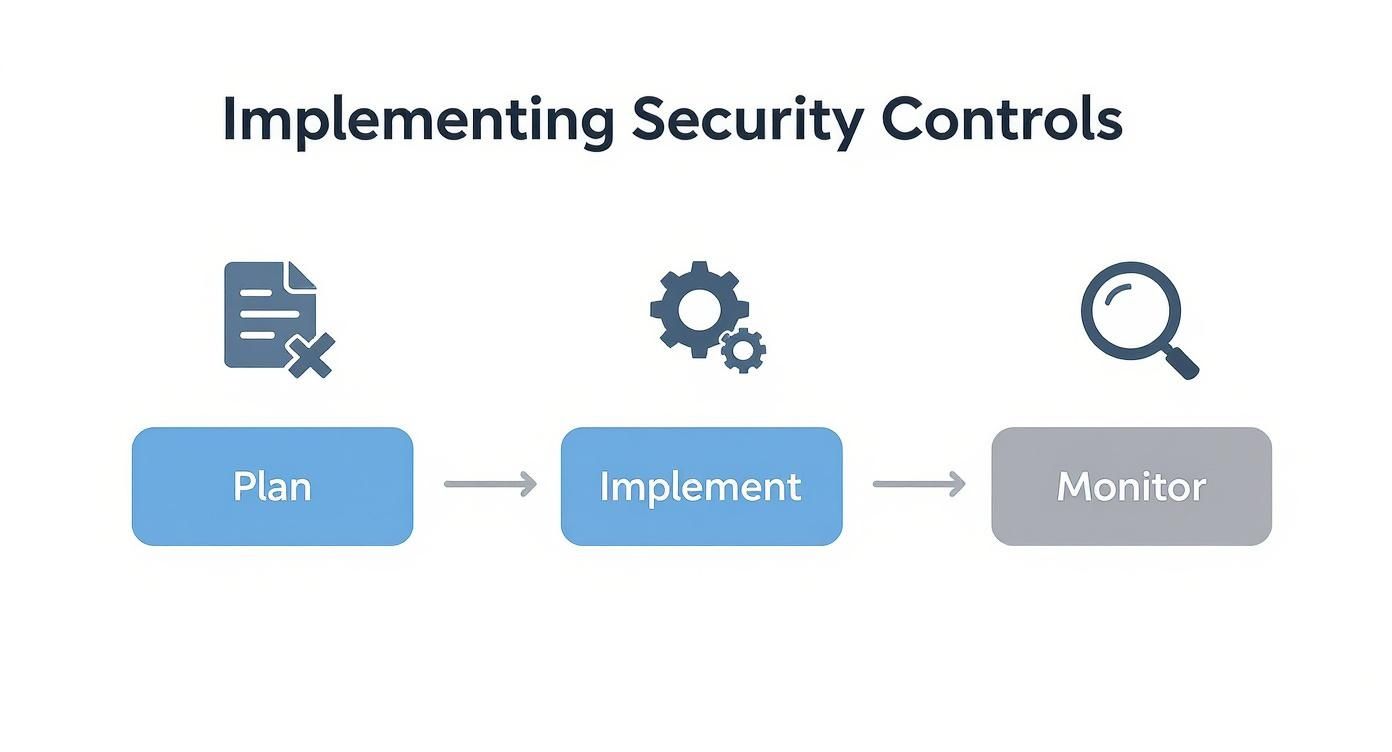
This cycle shows that getting ISO 27001 certified isn’t a one-off project. It’s about building a continuous improvement culture, and the auditor needs to see solid evidence of that in action.
The Stage 1 Audit: A Documentation Deep Dive
Think of Stage 1 as a readiness check. It’s almost entirely a desk-based review of your paperwork. The auditor will meticulously go through your ISMS policies, procedures, scope statement, risk assessment, and that all-important Statement of Applicability (SoA).
Their goal is simple: does your ISMS, on paper, look like it meets the ISO 27001 requirements? They're checking for completeness, logic, and ensuring the documentation is genuinely tailored to your business, not just a generic template.
At the end of Stage 1, you'll get a report. This is invaluable. It will point out any gaps or potential issues, giving you a clear to-do list before the much more intense Stage 2 audit kicks off.
The Stage 2 Audit: Putting Your ISMS to the Test
If Stage 1 was the theory, Stage 2 is the practical exam. This is the main event, usually happening a few weeks after you’ve had time to act on the Stage 1 feedback. The auditor will come on-site (or conduct a thorough remote review) to confirm your ISMS isn’t just good on paper—it’s actually working.
They’ll be hunting for real-world evidence. This means:
- Chatting with your team: They'll talk to people in different roles, from the C-suite to the front line, to gauge their understanding of the security policies that affect them.
- Observing processes in action: Don’t be surprised if they ask to watch someone follow the procedure for setting up a new laptop or granting access to a sensitive shared drive.
- Reviewing your records: This is crucial. They will ask to see logs, reports, and signed-off forms. Think access control reviews, completed security awareness training records, or minutes from management review meetings.
This is where being organised really pays off. Having your evidence ready and easy to find makes a fantastic impression and shows your ISMS is well-managed.
Handling Non-Conformities Like a Pro
It's perfectly normal for an auditor to find a "non-conformity"—an area where you don’t quite meet a requirement. Don't panic. This isn't a fail; it's a chance to get even better.
They generally fall into two categories:
- Minor Non-Conformity: A small slip-up or a one-off incident. Maybe a new starter missed their induction security training because of a scheduling mix-up.
- Major Non-Conformity: A more systemic problem, like discovering you haven't conducted an internal audit or a risk assessment at all.
For any finding, you’ll need to create a corrective action plan. This just means explaining how you'll fix the problem and stop it from happening again. Auditors are almost always reasonable and will award your certificate once they’re happy with your plan, especially for minor issues.
Treat every finding from your auditor not as a criticism, but as free consulting. You’re getting expert advice on how to make your business more secure.
For many small and medium Aussie businesses, this certification is a massive competitive advantage. It's often the key to unlocking bigger contracts, as many corporations and government bodies now mandate that their suppliers be ISO 27001 certified. You can learn more about what Australian businesses need to know about ISO 27001 on iqcglobal.com.au. Getting through the audit is the final hurdle to claiming these significant commercial benefits.
Life After Certification: Keeping Your ISMS Alive and Kicking
Getting that ISO 27001 certificate in your hands is a massive win. It’s a powerful signal to clients and partners that you're serious about security. But many companies celebrate and then treat certification as the finish line. In reality, it’s just the start of the race.
The real value isn't in the piece of paper you hang on the wall. It comes from the day-to-day discipline of maintaining and improving your Information Security Management System (ISMS). This is the point where you shift from just being compliant to building a genuine, rock-solid culture of security.
This Isn’t Just an Annual Chore
Your certification is valid for three years, but you’ll have a surveillance audit every year. Don't fall into the trap of thinking these are just a formality. They're your chance to prove your ISMS is a living, breathing part of your business, not some dusty folder you pull out once a year.
Businesses that scramble weeks before an audit can be contrasted with others that sail through without breaking a sweat. The difference? The ones who succeed see these audits as a driver for constant improvement, not a box to tick. The aim is to weave your ISMS so tightly into your daily operations that an audit feels like just another Tuesday.
Making Internal Audits Actually Mean Something
Your most powerful weapon for staying on track is the internal audit. This can't be a simple checklist exercise. A good internal audit is like a health check-up for your ISMS, helping you find and fix problems long before an external auditor shows up.
To get real value from them, try a few of these approaches:
- Bring in fresh eyes. Never have the person who wrote the policy be the one to audit it. Pulling someone in from a different department can uncover blind spots you never knew you had.
- Focus on what matters most. Don’t try to audit everything at once. Zero in on the high-risk areas you identified way back in your initial assessment. Is your incident response plan still up to scratch? Are new hires really getting their security training?
- Look for proof of progress. A great audit doesn't just check for compliance; it looks for evidence that you're getting better. Have you cut the time it takes to patch critical vulnerabilities? Are fewer people clicking on your phishing simulations since you beefed up training?
A great internal audit boils down to one question, asked over and over: "Are we actually doing what we said we would do, and is it still working?" Answering that honestly is the secret to a strong ISMS.
Management Reviews That Genuinely Drive Change
Just as important are your management reviews. This is where your leadership team gets in the weeds to make sure the ISMS still aligns with the company’s big-picture goals. The biggest mistake here is turning these into dry, technical presentations that make executives’ eyes glaze over.
If you want your management reviews to make a difference, you have to speak their language.
Instead of saying, "We patched 95% of critical vulnerabilities," try reframing it. Say something like, "We successfully neutralised 95% of the most severe threats to our client data, directly protecting our most important revenue streams." See the difference? That simple shift connects security work to business results, which is exactly what leaders need to hear to keep investing in it.
This whole process ensures your ISMS doesn't get stale. It needs to evolve as your business grows and new threats pop up. Becoming ISO 27001 certified isn't a one-and-done deal; it's a commitment to this ongoing cycle of checking, learning, and improving. That's what builds real, lasting security and keeps your business safe for the long haul.
Your Top ISO 27001 Certification Questions Answered
When businesses in Australia start looking into ISO 27001, the conversation always turns to the big three: cost, time, and what happens next. It's completely understandable. Let's cut through the noise and get straight to the practical answers you need to plan your certification journey.
How Much Will Certification Cost?
There’s no one-size-fits-all price for getting ISO 27001 certified. The final figure really depends on the size of your business, how complex your operations are, and frankly, how good (or bad) your security is right now. A small startup that’s already security-conscious will have a very different bill than a larger company with older systems and processes.
You’ll generally need to budget for three key things:
- Expert Help: Fees for a consultant to guide you and save you from common pitfalls.
- The Audit Itself: Costs for the certification body to conduct the Stage 1 and Stage 2 audits.
- New Tech: Any software or tools you need to buy to plug security gaps.
For a small to medium-sized business here in Australia, a budget between $20,000 to over $60,000 for the first year of certification is a realistic starting point.
What Is a Realistic Project Timeline?
Just like cost, the timeline can vary. It all comes down to the scope of your information security management system (ISMS) and how much time your team can actually dedicate to the project.
If you’re a smaller outfit and everyone is on board, you could realistically get certified in 6 to 9 months.
But for most businesses, especially if you’re larger or have more moving parts, it’s much safer to plan for a 12 to 18-month timeframe. Trying to rush it is a false economy—you’ll just end up making mistakes that will cost you time and money down the track.
What Happens After We Get the Certificate?
Getting that certificate on the wall is a fantastic achievement, but it’s the start of a new chapter, not the end of the book. Your ISO 27001 certification is valid for three years, but you have to prove you’re keeping up the good work.
This isn't a "set and forget" exercise. You'll have annual surveillance audits to make sure your ISMS is still effective and you're continuously improving it.
This means you’ll be running internal audits, holding management reviews, and tweaking your security controls as new threats emerge. It’s this ongoing commitment that truly builds a strong security culture and keeps your certificate valid. It’s also why the demand for certification is booming worldwide—the market is projected to hit USD 74.56 billion by 2035 as cyber threats keep climbing. You can read more about this market growth on businessresearchinsights.com.
Expert guidance can help Australian businesses navigate this exact process, ensuring you not only get certified, but also become a genuinely more secure and resilient organisation. Learn how our ISO 27001 consulting services can help you achieve certification with confidence.
Recent Comments