

Being ISO 27001 certified isn't just about getting a certificate for the wall. It means an independent, accredited body has confirmed your organisation's information security management system (ISMS) meets a rigorous global standard. Think of it as a formal declaration that you're not just ticking boxes; you're actively and systematically managing your information security risks.
Why ISO 27001 Certification Is No Longer Optional
In Australia, ISO 27001 certification has shifted from a 'nice-to-have' to a core requirement for doing business. This isn't just about compliance. It’s about building a fundamentally resilient and trustworthy company, one that can genuinely protect its most critical assets: its data, its reputation, and its clients' confidence.
For small and medium businesses, this certification sends a powerful message. It shows a level of security maturity that instantly puts you in a different league and proves you’re serious about protecting sensitive information—a quality that big clients and government agencies now demand.
Building Unbreakable Client Trust
Trust is the currency of modern business. When a client gives you their data, they're placing their faith in your ability to keep it safe. ISO 27001 certification is the ultimate proof that you’ve earned that trust.
It’s an independent verification that goes far beyond a simple verbal promise. It demonstrates you have a proper system in place to:
- Pinpoint potential security risks that could affect client data.
- Put strong, effective controls in place to manage those risks.
- Keep a constant watch on your security posture and make it better over time.
This structured approach gives clients incredible peace of mind, reassuring them that their data is in safe hands. It’s a powerful differentiator that can easily be the reason a client picks you over a competitor.
Unlocking High-Value Contracts
Winning contracts with large enterprises and government departments is how many Aussie businesses fuel their growth. The catch? These organisations almost always make ISO 27001 certification a mandatory part of their tender process. If you don't have it, you're not even in the running.
Becoming ISO 27001 certified is often the price of admission for playing in the big leagues. It signals that your security processes are mature enough to handle the stringent requirements of enterprise and public sector clients, opening doors to opportunities that would otherwise remain closed.
Why are they so strict? It's all about securing their supply chain. A major corporation can't afford to have its own security compromised by a partner with weak data protection. Certification takes that risk off the table for them, making you a much safer bet. When you weigh up the costs, it’s worth thinking about the ROI of cyber security.
Future-Proofing Your Business Against Evolving Threats
Cyber attacks aren't a far-off possibility; they are a clear and present danger for Australian businesses. The Australian Cyber Security Centre recorded over 94,000 cybercrime reports in the year leading up to 2023, which is a massive 23% jump from the year before.
Going through the certification process forces you to build a security-first culture right across your company. Security stops being an "IT problem" and becomes everyone's responsibility. To see what this looks like in practice, it’s often helpful for understanding a company's Security page, where they usually outline their commitment and the measures they take.
This deep-rooted security culture is your single best defence against a threat landscape that’s always changing, ensuring your business stays strong and ready for whatever comes next.
Building Your Foundation for Certification
Getting ISO 27001 certified isn't a race; it's about building something solid that will last. Your success really depends on how well you prepare. This is where you turn the big idea of 'getting certified' into a real, step-by-step plan that actually works for your business.
Think of it like drawing up blueprints for a new office. You wouldn't just start knocking down walls without knowing where the new meeting rooms are going or what the IT setup looks like. It’s the same with your security. Before you dive into implementing controls, you need to decide what you're protecting, get your leadership team truly on board, and pull together the right people for the job.
Defining Your Scope
First things first, you need to draw a line around what your Information Security Management System (ISMS) will cover. This is a huge decision because it sets the boundaries for your certification. A classic mistake smaller businesses make is trying to protect everything all at once—it's a recipe for burnout and failure.
Be smart about it. Ask yourself: what are our absolute crown jewels?
- Is it the personal data we hold in our customer database?
- Is it the unique source code for our main product?
- Could it be the sensitive financial records on our local servers?
- Do we need to cover the whole company, or just our dev team?
Your scope could be as narrow as a single department, a specific service you deliver, or even just one physical location. For instance, a small fintech company might decide to only scope its ISMS around the systems, people, and processes that handle its payment application. Why? Because that’s where the biggest risk is. A focused approach like this makes the journey to becoming ISO 27001 certified much, much easier to manage.
Securing Genuine Leadership Buy-In
Getting your budget approved is one thing, but that’s just the start. For this to really work, you need your senior managers to be active champions, not just silent partners. They need to understand that this isn’t just an 'IT thing'—it’s a fundamental business responsibility.
Your leaders have to drive a culture of security from the top down. This is more than just signing cheques; it means they’re visibly backing the new policies and telling everyone in the company why it matters. When your team sees the boss taking security seriously, they will too.
An ISMS without real leadership commitment is like an engine without fuel. It might look impressive on paper, but it's not going anywhere. Leaders must provide the resources, the authority, and the consistent support to make security a part of your company's DNA.
To get this level of buy-in, you have to speak their language. Don't get bogged down in technical jargon about security controls. Instead, talk about reducing business risk, meeting the security demands of big clients, and unlocking new growth opportunities. That’s what resonates in the boardroom.
The infographic below nails down the core business benefits that come from a well-supported ISMS—it’s all about building trust, winning bigger contracts, and making your business more resilient.
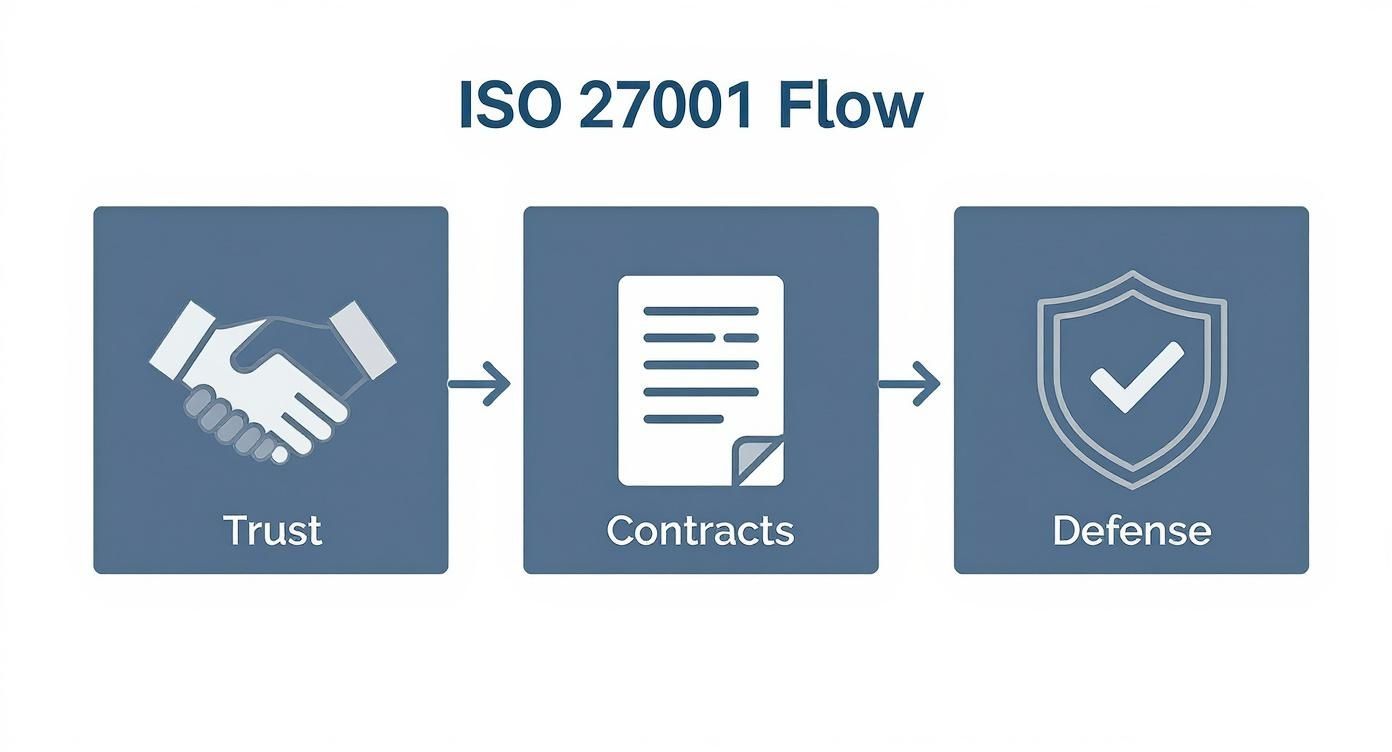
As you can see, certification isn't just a compliance task; it's a strategic move that delivers real, tangible value.
Assembling Your Project Team
You don't need an army, but you do need the right people in the right seats. Getting ISO 27001 certified is a team effort that needs input from across the business. For a small to medium-sized business, you can keep this team lean and mean.
Putting together a small, dedicated project team is the way to go, especially one with people from different departments who can offer unique perspectives. If you want to get into the nuts and bolts, you can learn more about what an information security management system entails and how it serves as the heart of your certification project.
To get this off the ground, you'll need to define who's doing what. Having clear roles from day one prevents confusion and keeps the momentum going.
Your ISO 27001 Project Team Roles and Responsibilities
| Role | Primary Responsibility | Example Tasks |
|---|---|---|
| Project Lead/Manager | Owns the project from start to finish, keeping everything on track and on budget. | Creating the project plan, coordinating meetings, reporting progress to leadership. |
| Technical Expert | The go-to person for all things IT. Implements the technical security controls. | Configuring firewalls, setting up access controls, managing endpoint security. |
| Department Reps (HR, Ops) | Provide insight into business processes and help integrate security into daily workflows. | Reviewing HR policies for secure onboarding/offboarding, updating operational procedures. |
With these key players in place, you’ve built a cross-functional team that has the expertise and influence to drive the project to success.
Conducting an Initial Gap Analysis
Before you can map out your journey, you need to know exactly where you're starting from. A gap analysis is basically a pre-audit. You compare what you’re doing right now with what the ISO 27001 standard actually requires.
This process is a real eye-opener. It highlights what you’re already doing well (and you’ll be surprised!), but more importantly, it shows you exactly where the holes are. It definitively answers the question, "How far off are we?"
The result is a simple, prioritised to-do list. For instance, you might find out that:
- Your password policies are rock-solid (a strength).
- You don't have a formal risk assessment process at all (a major gap).
- Your staff security training is a bit ad-hoc and inconsistent (a medium-priority gap).
This analysis gives you the hard data needed to build a realistic project plan. It stops you from wasting time on things that are already fine and helps you pour your limited resources into the gaps that truly matter, creating a much clearer and more direct path to certification.
The ISMS Deep Dive: From Theory to Practice
Alright, you've got your foundation laid and the leadership team is backing you. Now it's time to roll up our sleeves and get into the real work: building your Information Security Management System (ISMS).
Don't let the formal name throw you. At its core, an ISMS is simply the framework of policies, procedures, and controls that you put in place to protect your company's information. It's the central nervous system for your security, connecting everything from how you manage employee access to how you handle a crisis.
Building a solid ISMS is, without a doubt, the biggest part of the journey to becoming iso27001 certified. This is where the theory becomes practice.
Uncovering Your Real Risks
The heart and soul of any good ISMS is a thorough, honest risk assessment. This isn't just about making a long list of things that could go wrong. It’s a proper process to identify, analyse, and evaluate what could genuinely threaten the confidentiality, integrity, and availability of your information.
Let's say you're an online retailer here in Australia. Your customer database is your crown jewel. A risk assessment would dig into the real threats to that database.
- Threat: A disgruntled ex-employee still has their login credentials.
- Vulnerability: Your offboarding process is a bit loose and doesn't always revoke access immediately.
- Risk: Unauthorised access to sensitive customer data, which could quickly turn into a headline-making data breach.
Once you’ve identified risks like this, you need to score them based on how likely they are to happen and the damage they could cause. This is crucial—it helps you focus your limited time and money on the fires that could actually burn your house down.
Creating a Sensible Risk Treatment Plan
After pinpointing your biggest risks, you need a game plan. That's your risk treatment plan. For every significant risk you've found, you really only have four choices:
- Treat it: Put a control in place to reduce the risk. For our online retailer, this means creating a rock-solid offboarding checklist that ensures all system access is cut off on an employee's last day. No exceptions.
- Tolerate it: Sometimes, you just accept the risk. You’d do this if the cost of fixing it is astronomical compared to the potential damage. For instance, the risk of a meteor hitting your office is real, but you're probably not going to build a reinforced bunker to deal with it.
- Terminate it: Get rid of the risk by stopping the activity causing it. If you realise that collecting a certain type of non-essential customer data is creating a massive liability, you might just decide to stop collecting it altogether.
- Transfer it: Share the burden with someone else. The most common example is getting cyber insurance to handle the financial fallout from a data breach.
Your risk treatment plan is the document that lays all this out, giving your team a clear roadmap for action.
Getting Your ISMS Documentation in Order
Let's be blunt: documentation is a non-negotiable part of becoming iso27001 certified. It’s the proof that your ISMS isn't just an idea, but a real, functioning system. It can feel like a mountain of paperwork, but try to think of it as your security playbook.
The point of documentation isn't just to tick a box for an auditor. It's to create a living, breathing set of guidelines that your team can actually understand and use. Keep your documents clear, concise, and easy to find. If they’re buried in a folder no one knows about, they’re worthless.
As you build out your ISMS, an AI documentation agent can be a huge help in creating and managing the sheer volume of documents needed for ISO 27001.
One of the most important documents you'll produce is the Statement of Applicability (SoA). The SoA is essentially a master checklist against the 114 controls in ISO 27001's Annex A. For every single control, you have to state:
- If it applies to your business.
- If it does, how you've implemented it.
- If it doesn't, you need a solid reason why you've excluded it.
For example, if your company is 100% cloud-based with a remote workforce, you could reasonably exclude controls related to physical security for delivery and loading areas.
Putting Key Annex A Controls into Action
With your risk assessment and SoA as your guides, you can now start implementing the specific security controls from Annex A. These are the practical, on-the-ground measures that make your ISMS a reality.
Let's look at a couple of real-world examples for a small-to-medium business.
Access Control Policies
- The Scenario: Your dev team uses a cloud platform like AWS or Azure.
- The Control (A.9.4.1): You must have a formal access control policy.
- The Implementation: This means writing down exactly who gets access to what, and why. You'd set up role-based access control (RBAC) so developers can only touch the development environments, while the finance team can only see the billing info. Critically, it also means mandating multi-factor authentication (MFA) for everyone.
Incident Response Planning
- The Scenario: Someone on the marketing team clicks a phishing link and may have compromised their computer. It happens.
- The Control (A.16.1.7): You need a defined process for handling security incidents.
- The Implementation: You create a simple, step-by-step incident response plan. It outlines what to do immediately: disconnect the machine from the network, report it to the designated person (your IT lead, for example), and kick off an investigation. The plan also needs to cover how you'll communicate with clients if it turns out to be a data breach.
The push for this kind of structured security is only getting stronger. The global market for ISO 27001 certification is booming, with some analysts projecting it will hit USD 74.56 billion by 2035. This isn't surprising given the constant rise of cyber threats. In fact, consulting and certification services make up a combined 95% of this market, which shows just how much businesses value expert guidance in getting this right.
By grounding your ISMS in a realistic assessment of your risks and bringing it to life with practical controls, you're building a system that actively defends your business. This isn't about paperwork for its own sake; it's about creating real, tangible security that protects your assets and, most importantly, earns the trust of your customers.
Navigating the Audit Gauntlet
You’ve done the heavy lifting—the planning, the documenting, the implementing. Now, it’s time for the audit. For many, this part feels like a final exam, but that’s the wrong way to look at it. The audit is simply a chance to prove all your hard work has paid off. Shifting your mindset here is key; it turns a potentially stressful hurdle into a valuable step toward becoming iso27001 certified.
Think of the audit process as a dress rehearsal followed by the opening night performance. First, you have the internal audit, where you get to find and fix any wrinkles on your own terms. Then comes the external audit, where an accredited body gives your Information Security Management System (ISMS) the official seal of approval. With the right preparation, you can walk into both with confidence.
The Internal Audit: Your Crucial Dress Rehearsal
Before an external auditor even looks at your paperwork, you have to conduct an internal audit. This isn't just a suggestion; it's a mandatory part of the ISO 27001 standard, and for a very good reason. It’s your chance to kick the tyres and test your ISMS in a safe, low-stakes environment.
The internal audit is basically a friendly version of the real thing. It can be carried out by someone in your own team (if they're qualified) or a consultant you bring in. The whole point is to hunt down any "non-conformities"—those little gaps where what you're actually doing doesn't quite match your policies or the standard itself. You want to find these before the certification auditor does.
Let's picture a small Aussie tech company, "Innovate & Secure." During their internal audit, they found that while their policy for revoking access for departing staff was rock-solid, a couple of former contractors still had live accounts in an old system. Ouch.
The internal audit is your single best opportunity to find and fix weaknesses before they become official non-conformities. It’s a constructive exercise designed to strengthen your ISMS, not to assign blame. Embrace it as a vital part of the continuous improvement cycle.
Finding this gap was a win for Innovate & Secure. It let them immediately fix the issue and, more importantly, tighten up their offboarding process with a final checklist for all systems. That’s the real value of the internal audit: it makes you genuinely more secure, long before the final assessment.

Demystifying the Two-Stage External Audit
So, your internal audit is done, and you’ve tidied up any issues you found. Now it’s time for the main event: the certification audit. This is always handled by an accredited, third-party certification body and it’s split into two distinct stages.
The Stage 1 Audit: The Documentation Review
The first stage is all about the paperwork. Think of it as a desktop review where the auditor focuses entirely on your ISMS documentation. They’re making sure you have all the required policies, procedures, and records in place, just as the standard demands.
They'll be going through your key documents with a fine-tooth comb, including:
- Your ISMS Scope document
- The Information Security Policy
- Your Risk Assessment and Risk Treatment Plan
- The Statement of Applicability (SoA)
The auditor’s goal here is to confirm that, on paper, your ISMS looks complete and ready for certification. They’ll likely give you a heads-up on any potential weak spots in your documentation, giving you a valuable window to make improvements before Stage 2. For a deeper look into what auditors look for, this guide on the ISO 27001 audit process is a great resource.
The Stage 2 Audit: The On-Site Assessment
A few weeks or maybe a month or two after Stage 1, the auditor is back for the main assessment. This is where things get real. The Stage 2 audit is a much more hands-on, detailed review. The auditor is now looking for hard evidence that your ISMS isn’t just a nice set of documents, but is a living, breathing part of how your business operates.
They’ll be talking to your people—from the CEO down to your junior developers—to see if they actually understand and follow the security policies. They’ll also want to see your systems in action. For instance, they might ask you to pull up the logs proving that user access rights are reviewed regularly, or show them the records from your last security incident drill.
For our friends at Innovate & Secure, this meant showing the auditor their new, documented offboarding checklist. They also showed the logs that confirmed the two contractors' accounts were shut down on their last day. This kind of tangible proof is gold—it shows you not only found a weakness but also fixed it properly.
Internal Audit vs External Audit Unpacked
It's easy to get the two audits confused, but they serve very different purposes on your path to certification. Here’s a simple breakdown of what to expect from each.
| Aspect | Internal Audit (Stage 1 Prep) | External Audit (Certification) |
|---|---|---|
| Purpose | To find and fix issues internally before the official audit. A self-check and improvement tool. | To independently verify that your ISMS meets the ISO 27001 standard for official certification. |
| Who Performs It? | An internal employee (if qualified and independent) or a hired consultant. | An accredited, third-party Certification Body (CB) auditor. Completely independent. |
| Timing | Must be completed before your Stage 1 external audit. | Happens in two stages (Stage 1 and Stage 2) after you feel your ISMS is ready. |
| Outcome | A list of findings (non-conformities and opportunities for improvement) for your team to address. | A formal audit report. If successful, you receive your ISO 27001 certificate. |
| Mindset | Collaborative and constructive. It’s about making your system stronger. | Formal and objective. It’s about verification and compliance. |
Essentially, the internal audit is for you, while the external audit is for the world. Both are absolutely crucial for a successful certification.
Preparing Your Team for Success
Your team is your biggest asset during an audit, but if they’re unprepared, they can quickly become a liability. It's so important to brief your staff on how to talk to an auditor. This isn't about feeding them lines; it's about making them feel comfortable and confident.
A few practical tips to share with everyone are:
- Answer Only What Is Asked: Don’t volunteer extra information. Just stick to the question.
- It's Okay to Say "I Don't Know": It is far better to say, "I'm not sure, but I can find the right person for you" than to guess and get it wrong.
- Be Honest and Professional: Auditors aren't there to catch you out. A straightforward, professional attitude builds trust.
- Show, Don't Just Tell: If you can back up an answer with a document, a system log, or a meeting record, do it. Evidence is everything.
Handling Non-Conformities Like a Pro
Even with the best preparation, it's not unusual for an auditor to find a non-conformity. Don't panic. These findings are typically classified as either major or minor.
A major non-conformity points to a serious breakdown in your ISMS, like not having a mandatory process in place at all (e.g., you never did an internal audit). This is a showstopper—you won't get certified until it’s fixed and checked again.
A minor non-conformity is a smaller slip-up, maybe an isolated case where a procedure wasn't followed to the letter. You'll need to provide a plan to fix it, but it usually won't stop you from getting certified.
When an auditor raises a non-conformity, your response is what matters most. You need to formally document a plan that gets to the root cause of the issue, outlines how you’ll fix it, and explains what you'll do to stop it from happening again. A prompt, thorough response shows the auditor you’re serious, reinforcing that your business is ready to become iso27001 certified.
Life After Certification: Keeping Your ISMS Alive and Kicking
So, you did it. You’re officially ISO 27001 certified. That’s a huge milestone, and you should absolutely pop the champagne and celebrate the hard work. But now that the certificate is on the wall, the real journey begins.
Think of it this way: getting certified was a project with a deadline. Now, you’re shifting gears into the day-to-day practice of being certified. This is where your Information Security Management System (ISMS) stops being a pile of documents and becomes a living, breathing part of your business culture—the very thing that keeps you protected long-term.
From Project to Practice: The Continuous Improvement Mindset
The single biggest mistake I see newly certified businesses make is sticking their ISMS binder on a shelf to gather dust until the next audit looms. An ISMS isn't a "set and forget" system. It has to evolve with you. New threats pop up, your business goals change, and technology moves on.
This is all about cultivating a mindset of continuous improvement. True security isn't about ticking boxes once a year; it’s about constantly asking, "How can we make this better? Is this process still working for us? What new risks are on the horizon?" It’s a proactive stance that ensures your security posture isn't just compliant, but genuinely resilient.
Your ISO 27001 certificate proves you had a great security system on the day of the audit. What you do every day after that proves you have a great security culture. Maintaining that standard is what keeps your business truly secure.
This ongoing commitment is what separates businesses that are merely compliant from those that are genuinely protected.
The Rhythm of Management Reviews
A critical part of keeping your ISMS effective is the management review. This isn't just another tedious meeting; it’s a mandatory and incredibly valuable check-in where your leadership team gets a formal, structured look at how the ISMS is performing.
Think of it as a regular health check for your entire security program. You should be holding these at planned intervals—at least annually—and they need a proper agenda to be effective.
For a productive session, your review needs to cover key inputs like:
- Hard Numbers: How are your security controls tracking against your objectives? Are you hitting your targets for incident response times or security training completion rates?
- Audit Findings: What came out of your latest internal and surveillance audits? Are there any non-conformities that need to be addressed?
- The Latest Risks: Have new risks surfaced since your last review? How has the threat landscape shifted?
- Feedback from the Ground: Are clients asking new security questions? Is your team giving you feedback on security policies or procedures?
The outputs are just as vital. The meeting must end with clear, actionable decisions on how to improve the ISMS, where to allocate resources, and what security objectives to set for the next period. This documented process is precisely what auditors will want to see.
Navigating Your Annual Surveillance Audits
Your three-year certification cycle includes annual surveillance audits. These are a little less intense than the initial Stage 2 audit, but they are every bit as important. It’s the certification body’s way of making sure you haven't let things slide.
Each year, the auditor will look at a different sample of your ISMS, ensuring that over the three-year cycle, the entire system gets a once-over. They need to see cold, hard evidence that you're maintaining and continually improving your ISMS.
Getting ready is pretty straightforward if you’re doing the right things year-round:
- Keep Your Docs Alive: Make sure your policies, risk assessments, and procedures actually reflect what you do today, not what you did a year ago.
- Audit Yourself First: Don't wait for the external auditor to find your problems. Your own internal audit program should be your first line of defence, constantly finding and fixing issues.
- Have Your Minutes Ready: Your management review minutes are gold. They prove to the auditor that leadership is engaged and committed.
- Show Your Metrics: Be ready to present the data that shows how your ISMS is performing.
If you’ve truly embraced the mindset of "being certified," these audits become a simple exercise in showing off the great work you've been doing all along.
Keeping Pace with an Evolving Standard
The security world never sits still, and neither does the ISO 27001 standard. We saw this firsthand with the update from the 2013 version to the 2022 version. The changes were a direct response to the modern security environment, adding new controls for things like threat intelligence, cloud security, and data leakage prevention.
For businesses in Australia, staying on top of these updates is non-negotiable. The transition to ISO 27001:2022 has been a major focus. After the new framework was released in October 2022, organisations were given a hard deadline of October 31, 2025, to make the switch or risk losing their certification. As you can imagine, this prompted a flurry of recertification activity. You can learn more about what this means for Australian businesses on iqcglobal.com.au.
It’s a perfect example of a fundamental truth: maintaining your iso27001 certified status demands vigilance. You have to keep an eye on changes to the standard and be prepared to adapt. It’s the only way to ensure your security practices stay relevant, effective, and compliant.
Your Top ISO 27001 Certification Questions Answered
Taking the leap toward ISO 27001 certification can feel like a big step, and it’s natural to have a tonne of questions. Getting clear, practical answers is the best way to move forward with confidence. Let's tackle some of the most common queries we hear from Australian businesses looking to get certified.
How Long Does It Take to Get Certified?
This is always the first question, and the honest answer is: it depends. Your timeline for getting ISO 27001 certified hinges on your company's size, complexity, and, most importantly, where your security stands right now.
For a typical small to medium-sized business in Australia starting from a relatively fresh slate, you should realistically set aside 6 to 12 months. That might sound like a long time, but it’s a period packed with essential activity.
This timeframe covers everything from the initial gap analysis to see what you're working with, right through to documenting your entire Information Security Management System (ISMS). It also includes rolling out new security controls, running the system for a few months to gather real-world evidence, conducting your own internal audit, and finally, undergoing the formal two-stage certification audit.
Of course, if you’ve already got solid security practices and decent documentation, you might be able to speed things up. On the flip side, larger or more complex organisations could find their journey stretching beyond the one-year mark.
What Is the Typical Cost of Certification in Australia?
The total investment for ISO 27001 certification is a mix of different costs, not just the final auditor's bill. It’s best to think about it in a couple of distinct buckets.
First, you've got the implementation costs. These are the most variable and really depend on what your initial gap analysis uncovers. This could involve:
- Consultancy Fees: If you decide to bring in an expert to steer the ship.
- New Security Tools: You might need to invest in new software or hardware, like better endpoint protection or a beefier firewall.
- Staff Training: Getting everyone up to speed with security awareness training takes time and resources.
These internal setup costs can vary wildly, from a few thousand dollars to tens of thousands.
It's helpful to see this not as a pure cost, but as an investment in your business’s resilience and reputation. The price of getting certified is often tiny compared to the financial and reputational damage of a single data breach, or the value of a major contract you win because you have it.
Then you have the direct certification fees paid to the external auditing body. For a small to medium Aussie business, the initial two-stage audit usually lands somewhere between $5,000 and $15,000. Don't forget to also factor in the ongoing costs for your annual surveillance audits and a full recertification audit every three years to keep your certificate valid.
Can We Achieve Certification Without a Consultant?
The short answer is yes, you absolutely can. But—and it's a big but—it’s not the right path for everyone.
Going it alone requires a massive commitment of your team's time and energy. You need someone internally who can dedicate themselves to leading the project, someone who has the time and the genuine expertise to get deep into the standard's requirements. This person will be in charge of everything from creating all the documentation from scratch to driving the changes across the whole company.
While this DIY route saves on consultant fees, it almost always takes much longer. There's also a much higher risk of misinterpreting what the standard asks for, which could lead to failing the certification audit—a frustrating and expensive setback. For most small businesses, the guidance of an experienced consultant is an investment that pays for itself by making the process smoother, avoiding common mistakes, and getting it right the first time.
What Is the Biggest Challenge Businesses Face?
You might be surprised to hear that the biggest hurdle usually isn't technical; it's cultural. The single greatest challenge we see businesses face is getting genuine, lasting buy-in from their employees.
Information security isn't just an IT problem. A truly effective security system is built on a foundation of shared responsibility, where every single person in the company understands the part they play in protecting information.
The real challenge is weaving security awareness into the fabric of everyone's daily work, from the CEO to the newest team member. It's about explaining the 'why' behind the new rules so they don't just feel like more red tape. When your team truly gets that good security protects the business, their jobs, and your customers' trust, it stops being a chore and becomes a shared mission. That cultural shift is the real sign of a strong and successful ISMS.
Navigating the path to becoming ISO 27001 certified can feel daunting, but you don't have to do it alone. At Anitech, we specialise in simplifying this process for Australian businesses, ensuring you not only achieve certification but build a stronger, more secure organisation. Let us help you turn compliance into your competitive advantage.
Recent Comments