

When you're running a business, the last thing you want to worry about is whether your data is truly safe. ISO 27001 consulting services are designed to take that weight off your shoulders. Think of it as bringing in a seasoned expert to help you build, implement, and ultimately certify your Information Security Management System (ISMS).
These services translate the dense, complex language of the ISO 27001 standard into a practical, real-world framework. It’s not just about ticking compliance boxes; it’s a strategic move to build a rock-solid defence against cyber threats, earn unbreakable customer trust, and give yourself a serious edge over the competition.
Why Smart Businesses Invest in ISO 27001 Consulting
In a world powered by data, just saying you're secure isn't enough anymore. You have to prove it. Australian businesses are quickly learning that while having security measures is good, having them validated by an internationally recognised standard is what truly builds confidence with clients, partners, and stakeholders.
This is exactly where ISO 27001 consulting services stop being a cost and become a powerful strategic investment. It’s like hiring a specialist architect to design and construct a digital fortress around your most valuable asset: your information. An expert consultant demystifies the ISO 27001 standard, turning a daunting set of rules into a practical, tailor-made framework that genuinely strengthens your entire operation.
Moving Beyond Compliance to Strategic Advantage
Getting that ISO 27001 certificate isn't the finish line. It's the beginning of embedding a security-first culture that fuels resilience and growth. A consultant is your guide on this journey, making the process efficient and ensuring the end result is a system that actually works for your business, not against it.
They help you:
- Strengthen Your Security Posture: A consultant dives deep to find your vulnerabilities and helps you implement robust controls, fortifying your defences against constantly evolving cyber threats.
- Build Unshakeable Customer Trust: The certification is independent proof of your commitment to protecting client data. In a crowded market, that’s a massive differentiator.
- Unlock New Market Opportunities: Increasingly, government tenders and large corporate contracts list ISO 27001 certification as a non-negotiable requirement for suppliers.
- Improve Operational Efficiency: The process forces you to define security roles and responsibilities, which often has the side effect of streamlining workflows and cutting out redundant processes.
This strategic view is backed by hard numbers. The global ISO 27001 certification market is projected to skyrocket from USD 16.14 billion in 2024 to an incredible USD 56.18 billion by 2033, growing at a rate of around 15.2% each year. This isn't just a global trend; it’s happening right here in Australia, with sectors like IT, finance, and healthcare leading the charge.
An Expert Guide Through a Complex Process
Going it alone with ISO 27001 can be a slow, frustrating, and expensive mistake. The standard is detailed, the language is dense, and it’s all too easy to misinterpret a key requirement, leading to a failed audit and wasted effort.
An ISO 27001 consultant brings clarity and efficiency to the certification journey. Their job is to translate complex clauses into actionable tasks, steer you clear of common pitfalls, and ensure your Information Security Management System (ISMS) is both compliant and practical for your day-to-day operations.
Their expertise really shines in a few key areas. They can manage the project from start to finish, keeping your team on track and making sure deadlines are met. They also provide crucial training, helping your employees understand their security responsibilities and nurturing a security-aware culture across the entire organisation.
Navigating Broader Regulatory Frameworks
What’s more, a well-built ISMS often helps you tick off other regulatory requirements without even trying. By establishing a systematic way to manage risk and protect data, you’re creating a strong foundation that can satisfy a whole range of compliance demands.
Beyond just security, this process helps businesses get a handle on the wider world of regulations. To get a sense of the bigger picture, it’s worth exploring various Top Compliance Management Solutions. This ensures your security efforts are fully integrated and aligned with all your business obligations.
Ultimately, bringing in an ISO 27001 consultant is a proactive decision to safeguard your business, earn the lasting trust of your customers, and set your organisation up for sustainable growth. It’s a clear, structured path to not only achieving a valuable certification but building a lasting culture of security that becomes a core part of your identity.
What an ISO 27001 Consultant Actually Does
So, what do you really get when you hire an ISO 27001 consultant? It's easy to pigeonhole them as just compliance box-tickers, but that's selling them way short. Think of it like building a secure vault for your most valuable assets; the consultant is your head architect, your security strategist, and your project manager all rolled into one.
They don't just dump a hefty manual on your desk and walk away. Their real job is to take the dense, often intimidating language of the ISO 27001 standard and turn it into practical, easy-to-follow policies that your team can actually use. They’re the translator between the complex world of information security standards and the day-to-day reality of running your business.
The Strategic Architect of Your Security Framework
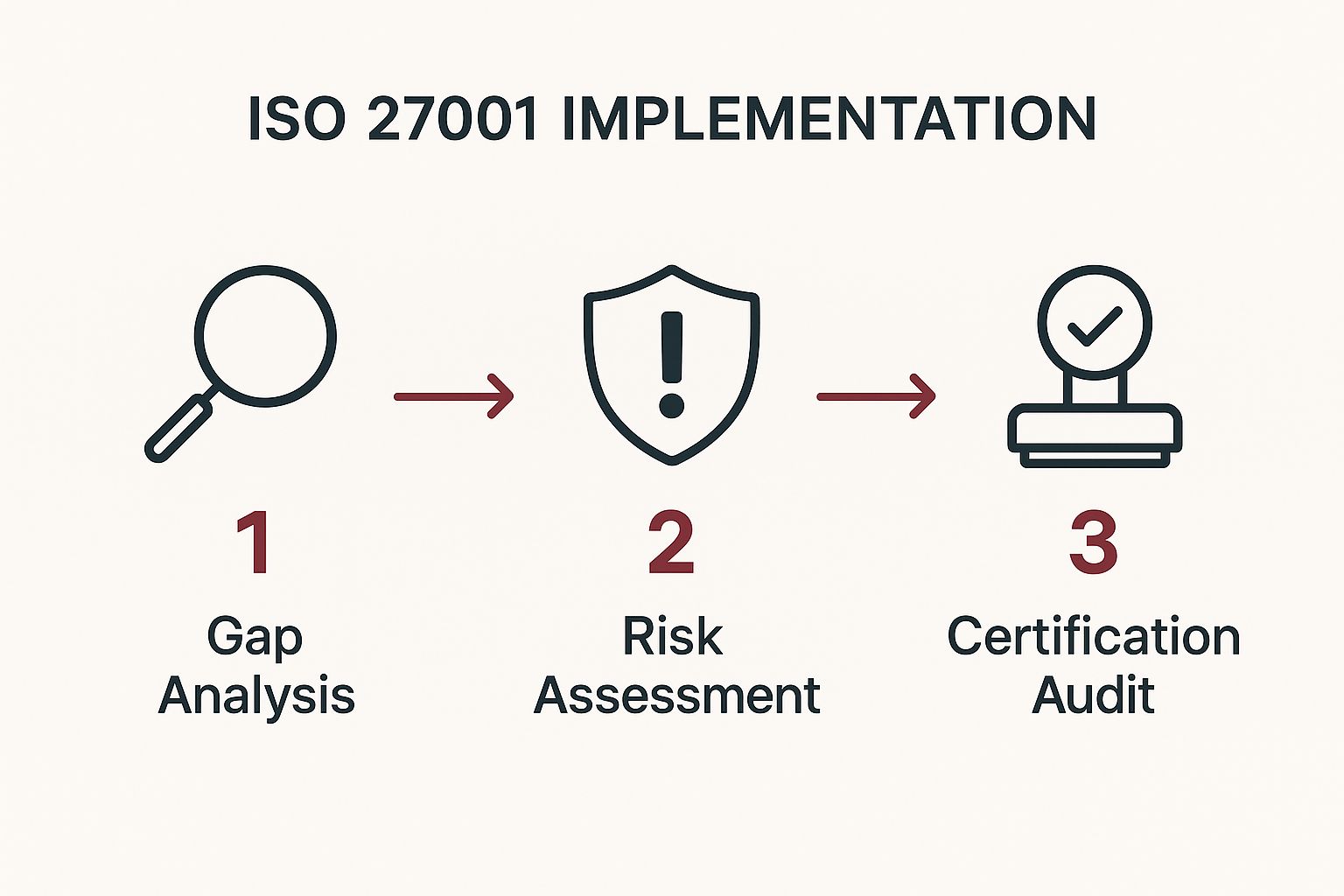
The whole journey kicks off with a gap analysis. This is basically a deep dive into your current security setup to see how it stacks up against the ISO standard. It’s a bit like a doctor running a full set of diagnostics before even thinking about a treatment plan.
This first step is absolutely crucial. It gives you an honest, clear-eyed look at where your security is strong and, more importantly, where the cracks are. The findings from this analysis become the blueprint for everything that follows, making sure all your efforts are focused where they'll make the biggest impact.
From there, they get to work designing a custom Information Security Management System (ISMS). This is no off-the-shelf product. A good consultant tailors the ISMS to fit your specific business operations, your company culture, and how much risk you're willing to take on. They’ll get to know how you work, what data you can't afford to lose, and what threats keep you up at night.
From Policy to Practice: The Implementation Guide
With the ISMS blueprint in hand, the consultant switches hats from architect to on-the-ground guide. They'll help you pull together all the necessary paperwork, like security policies, risk assessment reports, and the all-important statement of applicability. But it's not just about creating documents; it’s about making them live and breathe within your organisation.
Their work here usually involves a few key things:
- Risk Assessment and Treatment: They'll walk you through identifying potential threats to your information, figuring out how likely they are to happen and what the damage would be, and then deciding the smartest way to handle them.
- Control Implementation: The consultant will advise you on putting the right security controls in place from the standard's list of 114 options in Annex A, making sure they match the risks you’ve identified.
- Staff Training and Awareness: A security system is only ever as strong as the people using it. The consultant helps create and run training programs so your team is alert, understands their role in protecting data, and knows exactly what to do if something goes wrong.
They ensure the ISMS isn't just a binder collecting dust on a shelf, but a core part of how you operate. An ISO 27001 consultant operates within the broader field of cybersecurity consulting, providing specialised guidance to establish, maintain, and continually improve an organisation's Information Security Management System. This expertise ensures your security is both compliant and genuinely effective.
Your Advocate and Coach for the Final Audit
When it’s time for the official certification audit, the consultant becomes your coach. They're there to get you across the finish line, making sure all your evidence is lined up, the documentation is spotless, and your team is prepped and ready for the auditor's questions.
A massive part of this is running internal audits. These are essentially full-scale dress rehearsals for the real thing, designed to find and fix any issues before the external auditors show up. To get a better handle on this vital stage, you can find out more about what is an ISO internal audit and see why it’s a non-negotiable for success.
A consultant’s true value is realised during the audit preparation phase. They know what auditors look for, understand the common pitfalls, and can coach your team to navigate the audit process with confidence, dramatically increasing the likelihood of first-time certification.
Their job isn't done when the auditors walk in, either. They'll often be right there with you during the audit, ready to clarify points, dig up evidence, and make sure the whole process runs smoothly. That kind of hands-on support is priceless, cutting down the stress and helping you show off your ISMS at its best.
By bringing in expert ISO 27001 consulting services, you’re not just buying a skillset; you’re bringing on a strategic partner who is invested in building a more secure and resilient future for your business. They turn a daunting compliance project into a clear, manageable journey that delivers real, lasting protection.
Your Step-By-Step Journey to ISO 27001 Certification
Thinking about ISO 27001 certification can feel like planning a major expedition into unknown territory. It seems complex, daunting, and full of potential wrong turns. But when you bring in an expert ISO 27001 consultant, that journey suddenly transforms. It becomes a structured, well-mapped project with clear milestones and a predictable finish line.
Your consultant is your experienced guide, breaking down the entire process into logical phases. Each step builds on the last, ensuring nothing gets missed and your organisation moves steadily towards its goal. This methodical approach is what turns a potentially chaotic project into a smooth, manageable process, dramatically boosting your chances of passing the audit on the first go.
Let's walk through how they do it.
Phase 1: Initial Scoping and Gap Analysis
The first thing a good consultant does is listen. They don't show up with a pre-packaged solution; they start by getting to know your business inside and out. The first order of business is defining the scope of your Information Security Management System (ISMS). In plain English, this means deciding exactly which parts of your organisation, which data, and which processes will be covered by the certification.
Once the boundaries are set, they roll up their sleeves for a thorough gap analysis. Think of it as a complete health check for your security. The consultant meticulously compares everything you're currently doing—your policies, procedures, and tech controls—against the strict requirements of the ISO 27001 standard. You’re left with a crystal-clear report that shows you exactly where you stand and, more importantly, what needs to be done to close the gaps.
This first phase is the bedrock of the whole project. It creates the strategic roadmap that makes sure every subsequent effort is targeted and effective.
Phase 2: Risk Assessment and Treatment
With the gaps identified, we move into one of the most crucial stages: assessing your risks. Your consultant will lead a structured process to pinpoint potential threats to your information assets. This isn't just about hackers and viruses; it covers everything from human error and equipment failure to natural disasters. They’ll help you figure out the likelihood of these things happening and the potential impact on your business.
After identifying and prioritising the risks, the next step is building a Risk Treatment Plan. This is the game plan for how your organisation will handle each risk. You generally have four options:
- Mitigate: Put security controls in place to reduce the risk.
- Avoid: Change a process or system to sidestep the risk entirely.
- Transfer: Shift the financial burden of a risk to someone else, like an insurance company.
- Accept: Formally acknowledge the risk, usually when the cost of fixing it is far greater than the potential damage.
A consultant’s experience here is priceless. They help you make smart, pragmatic decisions that protect the business without getting in the way of your goals.
Phase 3: ISMS Documentation and Control Implementation
Now that you have a clear plan for managing risks, it's time to build the formal ISMS. This is where you create the necessary paperwork and implement the security controls listed in Annex A of the standard. Your consultant will work with you to develop policies and procedures that are not just compliant on paper, but are also practical for your team to actually use.
This documentation becomes the official rulebook for your security program. Key documents you'll create include:
- Information Security Policy: The high-level document showing everyone that management is serious about security.
- Statement of Applicability (SoA): A critical document that lists which ISO 27001 controls you’ve used and why.
- Specific Procedures: The nitty-gritty documents for things like access control, managing security incidents, and data backups.
At the same time, your consultant helps you put the technical and organisational controls into practice. This could be anything from setting up new software to formalising how you bring on new staff and manage leavers.
Phase 4: Training and Internal Audit
An ISMS is only as strong as the people who use it. Your consultant will develop and run training sessions to make sure every employee understands the new security policies and knows their role in protecting company information. This is how you build a security-conscious culture, which is essential for making this stick in the long run.
Then, before you face the real auditors, your consultant will conduct a full-scale internal audit. This is the dress rehearsal. They will test your entire ISMS against the standard, just like a real auditor would. They’ll find any weak spots or non-conformities and help you fix them. This internal check-up is non-negotiable; it builds immense confidence and ensures there are no nasty surprises on audit day.
To get a better feel for how all these pieces fit together, you can learn more about the complete ISO certification process and see how each stage prepares you for the next.
Phase 5: Certification Audit Support
This is the home stretch: the formal certification audit conducted by an accredited external auditor. It happens in two stages. Stage 1 is a review of your documentation to make sure your ISMS is designed correctly. Stage 2 is the main event, where the auditor comes on-site to test that your ISMS is actually working in practice.
Your consultant is right there with you the whole time. They help you gather all the evidence, coach your team on how to answer the auditor's questions, and act as your expert advocate. Having them in your corner provides huge reassurance and helps the audit run as smoothly as possible, guiding you confidently across the finish line to achieve your ISO 27001 certification.
It's Time: Making the Essential Jump to ISO 27001:2022
The world of information security doesn't sit still, and neither does the gold standard for protecting it. ISO 27001 has caught up with the modern world, leading to the updated ISO 27001:2022 version. This isn't just a fresh coat of paint; it's a mandatory update that gets real about the new threats we face and the way we work today.
If your business is already certified under the old 2013 version, this transition isn't just a good idea—it's non-negotiable. Think of it as a crucial tune-up, ensuring your security engine is powerful enough to handle today's sophisticated threats, from complex cloud setups to the risks that come with a remote workforce.
An expert in ISO 27001 consulting services becomes your indispensable co-pilot here. They can turn what feels like a compliance headache into a genuine opportunity to modernise and seriously strengthen your defences.
Why This 2022 Update Is a Big Deal
The changes in ISO 27001:2022 weren't made just for the sake of it. The security landscape has completely transformed since 2013. This new version speaks directly to the challenges of right now, like the massive shift to cloud services, our growing reliance on suppliers, and the ever-increasing pressure around data privacy.
The update rolls out a reorganised set of controls and adds several new ones designed to tackle today's threats head-on. The goal is to make sure your Information Security Management System (ISMS) is equipped for the challenges of this decade, not the last one. It’s all about getting ahead of threats, not just cleaning up after them.
The Key Changes You Need to Get Your Head Around
While the heart and soul of ISO 27001 are the same, the 2022 version shakes things up with some big structural changes and new controls. The familiar 114 controls spread across 14 domains have been smartly reorganised into 93 controls under just 4 themes.
This new structure is far more intuitive:
- Organisational Controls (37): This is the high-level stuff—your policies, procedures, and governance.
- People Controls (8): All about the human element, from background checks to security awareness.
- Physical Controls (14): Protecting your tangible assets, like servers and offices.
- Technological Controls (34): The nuts and bolts of the tech measures protecting your systems and data.
This new layout just makes more sense. It helps you connect your security controls directly to your business strategy. A good consultant will help you map your old controls to this new framework, ensuring nothing gets lost in translation.
The transition to ISO 27001:2022 is more than a box-ticking exercise. It’s a chance to take a hard look at your risk landscape, bring your security into the modern era, and prove to clients that your commitment to data protection is rock-solid and up-to-date.
New Defences for New Threats
The most talked-about change is the addition of 11 brand-new controls. These aren't random; each one zeroes in on a specific, modern security headache that has become a major issue in recent years.
Here are a few of the most important new additions a consultant will help you nail:
- Threat Intelligence: You can't just wait for threats to find you anymore. This requires you to actively gather and analyse intel on emerging threats to make smarter security decisions.
- Information Security for Use of Cloud Services: Finally, a control that formalises the need for specific rules and procedures to lock down the data you keep in the cloud.
- Data Leakage Prevention: This is all about putting technical measures in place to spot and stop sensitive information from walking out the digital door.
These new controls signal a clear move toward a more proactive, preventative approach to security. Working with an ISO 27001 consultant ensures you don't just implement these controls, but you understand why they exist and how to make them genuinely protect your business.
How a Consultant Makes This Transition Painless
Trying to navigate the leap to ISO 27001:2022 on your own is a gamble. A simple misinterpretation of a new control or a documentation slip-up could mean a non-conformity at your next audit. This is where a consultant's experience becomes priceless.
They'll run the entire project, making sure every 'i' is dotted and 't' is crossed. Their process usually starts with a sharp gap analysis against the 2022 standard, followed by updating your critical documents like the Statement of Applicability (SoA) and risk treatment plan, and getting your team up to speed on the new requirements.
This structured approach takes the guesswork out of it, saves a huge amount of time, and gives you the confidence that you'll sail through your next audit.
And time is of the essence. The clock is ticking—the old ISO 27001:2013 standard is being retired. The hard deadline is 31 October 2025, when all certificates based on the 2013 version will expire in Australia. This means every certified organisation must transition to the ISO 27001:2022 standard. You can read more about the deadline and its implications to understand why the time to act is now.
At the end of the day, moving to ISO 27001:2022 is simply essential. With an expert consultant in your corner, you can handle this mandatory update smoothly, fortify your business against modern threats, and send a clear message that you take protecting your information seriously.
The Real Business Payoff of Expert ISO 27001 Consulting

It’s tempting to look at ISO 27001 as just another compliance box to tick—a costly exercise that ends with a certificate for the wall. But what’s the real, tangible return on your investment when you bring in expert ISO 27001 consulting services?
The payoff goes so much deeper than simply passing an audit. It’s about fundamentally transforming your business into a more competitive, resilient, and trusted organisation. This is where the conversation flips from a compliance cost to a strategic investment in growth.
Think of the certificate as a key. A great consultant doesn't just hand you the key; they help you build the robust, secure, and efficient business that can use it to unlock some seriously valuable doors.
Unlocking High-Value Contracts and Enterprise Clients
In the B2B world, especially when dealing with large enterprises or government departments, trust is everything. These big players can't afford to gamble with their supply chain. They demand absolute proof that their partners can protect sensitive data, and increasingly, ISO 27001 certification is their non-negotiable standard.
Without that certification, your business might be automatically knocked out of the running for lucrative tenders before you even get a word in. It’s a harsh reality.
An expert consultant gets this. They don't just build a system that ticks the boxes; they engineer an Information Security Management System (ISMS) that can withstand the intense scrutiny of enterprise-level due diligence. This gives you a massive competitive edge. While others are scrambling to fill out endless security questionnaires, your ISO 27001 certification does the talking for you, signalling that you're a mature, secure, and reliable partner ready to do business.
From Security Framework to Operational Excellence
One of the most powerful, yet often overlooked, benefits of a professionally implemented ISMS is the positive ripple effect it has on your daily operations. When guided by a skilled consultant, the process forces you to put your internal processes under the microscope, clarifying exactly who is responsible for what when it comes to information.
This almost always uncovers hidden inefficiencies and operational bottlenecks you never knew you had. For example, defining clear access control policies doesn't just boost security—it ensures your team has precisely the tools they need to do their jobs, no more and no less. That alone reduces confusion and streamlines workflows.
A well-designed ISMS does more than just stop security incidents; it brings order, clarity, and efficiency to your entire operation. By mapping out how information flows through your business, you inevitably find smarter ways to work.
Ultimately, this methodical approach cuts down on waste, minimises human error, and creates a far more organised work environment. While security is the main goal, the gains in efficiency are a huge bonus that directly impacts your bottom line. To see just how this works, it’s worth exploring the direct ROI of cyber security and how smart protection benefits your business.
Securing Investor Confidence and Market Credibility
For any startup or growing business in Australia, getting funding is a make-or-break moment. Investors aren't just backing an idea; they're putting their money into a sustainable, well-managed company. In an era of almost daily data breach headlines, a real commitment to information security has become a massive factor in their decisions.
Having that ISO 27001 certification acts as a powerful signal to investors that you've proactively managed a huge business risk. It demonstrates that you’re not just a startup with a cool concept, but a professional organisation with the right structures in place to protect your most valuable assets: your data and your reputation.
This can be the very thing that sets you apart and secures the funding you need to scale.
The benefits of a professionally guided ISO 27001 journey are clear, compelling, and translate directly into measurable business outcomes that drive real growth.
- Enhanced Reputation: The certification mark builds immediate trust with customers, partners, and stakeholders.
- Reduced Incident Costs: A solid ISMS dramatically lowers the chances—and potential financial fallout—of a security breach.
- Improved Resilience: Your business is far better prepared to handle disruptions, ensuring you can keep operating and protecting your revenue.
Bringing in an expert consultant isn't about buying a certificate. It's about investing in a more secure, efficient, and credible business that’s built for long-term success.
How to Choose the Right ISO 27001 Consulting Partner
Picking the right consultant is probably the single most important decision you'll make on your ISO 27001 journey. This isn't just about hiring a contractor; you're choosing a strategic partner who will directly shape the success of your project, the quality of your security system, and the real-world value you get from your investment.
The goal is to find someone who meshes with your team, truly gets what your business is trying to achieve, and builds a security framework that lasts. This means you've got to look past the slick sales pitch and dig into their actual experience, their process, and what their past clients have to say.
Look for Deep Industry Experience
Let's be honest, a security plan for a hospital looks very different from one for a fintech startup. Your consultant needs to understand the specific threats, regulations, and pressures that exist in your world. Someone with a long history in your sector—be it finance, healthcare, or tech—walks in the door already speaking your language.
This kind of specialised knowledge is a massive head start. It means they're not going to waste your time on generic advice that doesn't apply. Instead, they can jump straight to targeted, practical recommendations that tick the compliance boxes and actually work for your day-to-day operations. It just makes everything run that much smoother.
Verify Their Track Record and Client Success
Talk is cheap. A proven track record is gold. Don't just take a consultant’s word for it; ask for proof. Any reputable provider of ISO 27001 consulting services will be more than happy to show you case studies or put you in touch with past clients.
When you're digging into their history, look for a few key things:
- Success Rate: What’s their track record for getting clients through the audit on the first try? A high success rate points to a solid, well-honed methodology.
- Client Similarity: Have they worked with businesses like yours in terms of size and complexity? What works for a massive enterprise might be overkill and unnecessarily expensive for a smaller business.
- Long-Term Partnerships: Do clients stick around for ongoing support? That’s a huge vote of confidence. It shows they deliver real value long after the certificate is hanging on the wall.
Doing this homework upfront helps ensure you’re teaming up with someone who delivers results, not just promises.
Assess Their Methodology and Approach
A great consultant doesn’t show up with a rigid, one-size-fits-all binder. They should have a clear, collaborative process that they can adapt to fit your company's culture and goals. The whole thing should feel like a partnership, not like they're just telling you what to do.
The best consultants act as mentors, not just implementers. They focus on transferring knowledge to your team, empowering you to own and manage the ISMS effectively long after the certification audit is complete.
You're looking for a partner who communicates well and is focused on building up your team's skills. This is how you create a security culture that sticks, becoming a genuine part of how you do business instead of something that fades away once the project is over.
Ask the Right Questions Before You Commit
The interview stage is your best chance to get a real feel for a consultant's expertise and see if they'll be a good fit for your team. Coming prepared with a few sharp questions can tell you everything you need to know.
Here's a quick checklist of questions you should definitely ask:
- How will you connect our security system to our actual business goals, not just the standard's requirements? This tests if they think strategically or are just a box-ticker.
- What does your support look like after we’re certified? This reveals if they're in it for a long-term relationship or just a quick win.
- Can you walk me through your process for teaching our team to run this system ourselves? This is absolutely critical for making sure you're not dependent on them forever.
- How do you handle curveballs or scope changes mid-project? Their answer will show you how flexible and resourceful they really are.
Asking these tough but fair questions will help you cut through the noise and find a true partner who will guide you to a successful—and meaningful—ISO 27001 certification.
Answering Your Top Questions About ISO 27001 Consulting
When you start looking into getting professional help for your information security, a few key questions always pop up. It’s completely normal. Making the right decision for your business is a big deal, so let's get you some clear answers on the big three: cost, timeline, and whether you really need a consultant.
How Much Do ISO 27001 Consulting Services Cost in Australia?
The honest answer? It really depends. The price tag for ISO 27001 consulting is shaped by your business's size, how complex your operations are, and what security measures you already have in place. A small company with a few good policies will have a very different quote compared to a larger organisation building its security system from the ground up.
Most consultants offer a couple of ways to pay. You might see a fixed price for the whole project or a daily rate for more flexible support. The most important thing is to get a detailed quote that breaks down exactly what you're paying for—from the initial gap analysis and documentation right through to staff training and being there with you during the audit. Think of it less as a compliance cost and more as a direct investment in protecting your business from risk.
How Long Does the Certification Process Take with a Consultant?
For a typical small to medium-sized business in Australia, you're generally looking at a six to twelve-month journey with a consultant by your side. Of course, this can change based on how much time your own team can dedicate to the project and the intricacies of your business.
This is where a good consultant really earns their keep. They bring tried-and-tested templates and a clear project plan, helping you sidestep the common hurdles that can cause major delays. With their expert guidance, you’ll reach the certification finish line far quicker and with fewer headaches than if you tried to navigate it alone.
Can We Get ISO 27001 Certified Without a Consultant?
Technically, yes, you can try. But I'll be blunt: it’s a risky path that often ends up costing more in both time and money. The ISO 27001 standard is dense and notoriously tricky to interpret. One small misstep or misunderstanding of a clause can lead to a failed audit, sending you right back to the beginning.
A consultant’s value lies in their experience. They know exactly what auditors are looking for and, more importantly, how to translate the standard's formal language into practical, real-world security controls that actually work for your business.
For almost every business out there, bringing in a consultant is the smartest and most direct route to a successful certification on the first try. They transform what feels like an overwhelming challenge into a clear, structured project, ensuring your hard work results in a genuinely strong security posture.
Achieving ISO 27001 certification is a game-changer for protecting your business and earning customer trust. With over 20 years of experience and a 100% success rate, Anitech makes the process straightforward for Australian small businesses. Our experts will be with you every step of the way, from the first document to your final audit.
Secure Your Business with Anitech’s ISO 27001 Consulting Services
Recent Comments