

So, what exactly is ISO 27001 consulting?
Think of it as bringing in a master architect to help you build a digital fortress. An expert consultant provides the blueprint, specialised knowledge, and project management you need to design, implement, and ultimately certify your Information Security Management System (ISMS). This partnership transforms the complex, often intimidating ISO 27001 standard into a clear, manageable journey from start to finish.
This comprehensive guide will explore every facet of ISO 27001 consulting, providing a deep dive into why it's a strategic necessity for modern businesses. We will cover the tangible business benefits, the detailed step-by-step certification process, how to select the ideal consulting partner, and what life looks like after you've achieved certification. By the end, you'll have a thorough understanding of how expert guidance not only simplifies compliance but also turns information security into a powerful engine for growth and trust.
Why ISO 27001 Consulting Is Your Strategic Advantage
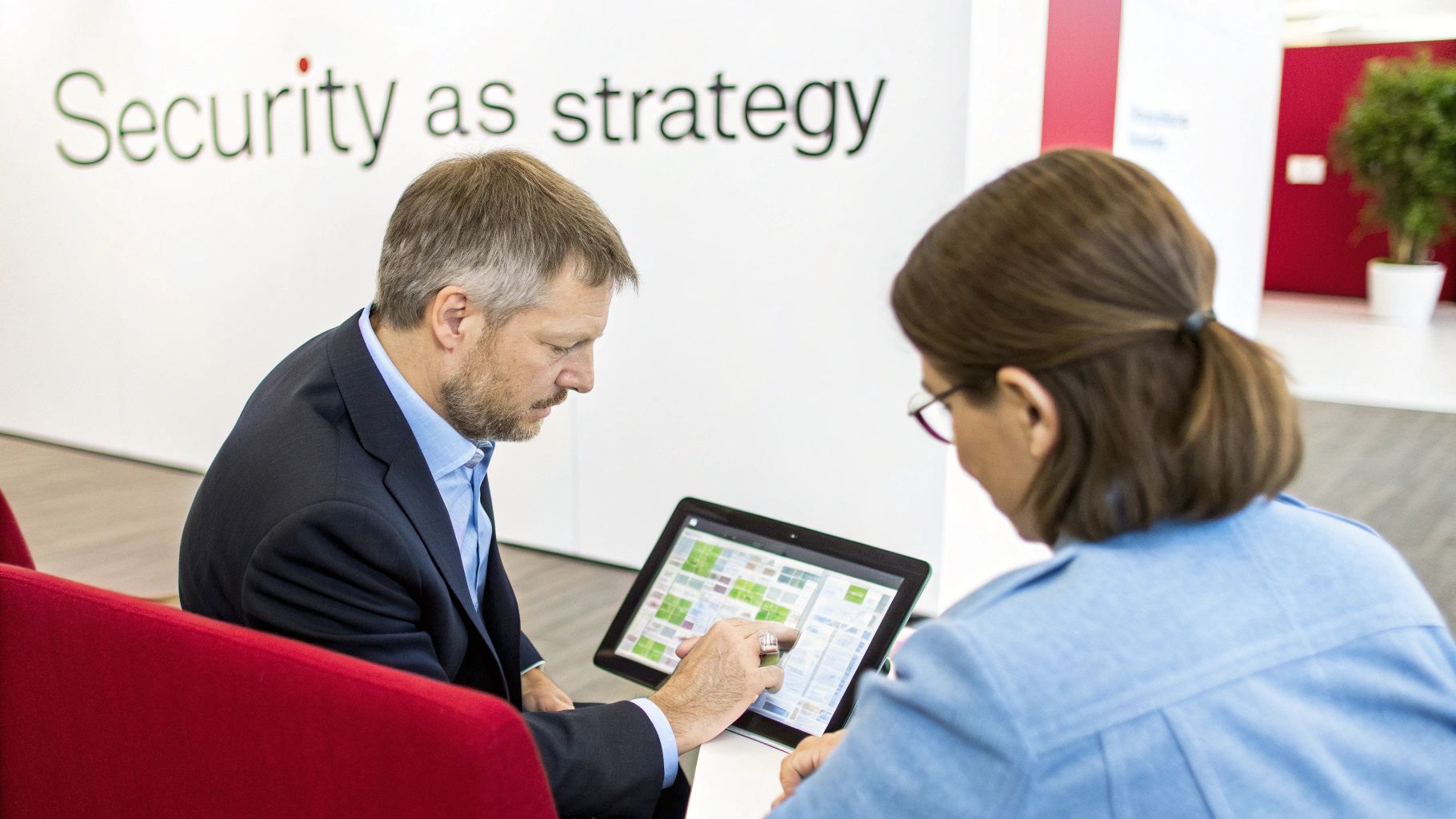
Attempting to achieve ISO 27001 certification independently is analogous to navigating a complex legal battle without a lawyer. While it's technically possible, the path is fraught with potential missteps, costly delays, and a significant risk of not achieving the desired outcome. An ISO 27001 consultant serves as your dedicated guide, translating the dense, technical language of the standard into practical, actionable steps that are tailored to your specific business context.
This partnership extends far beyond merely ticking compliance boxes. It is fundamentally about weaving a robust security culture into the very fabric of your organisation. The ultimate goal isn't just to pass an audit; it's to build a resilient, secure, and trustworthy business from the inside out. This proactive approach to information security management provides a solid foundation for sustainable growth, enhanced client confidence, and a significant competitive advantage in a market where data protection is paramount.
Bridging the Knowledge and Resource Gap
Realistically, most organisations—especially small and medium-sized businesses in Australia—do not have a dedicated ISO 27001 expert on their payroll. The standard is incredibly detailed and multifaceted, demanding a deep and nuanced understanding of risk management principles, policy development, technical security controls, and audit procedures. This creates a significant knowledge and resource gap that can be difficult to fill internally without substantial investment in training and personnel.
This is precisely where consultants provide immediate and substantial value. A primary reason businesses seek their expertise is for addressing the IT skills gap through outsourcing, which effectively transforms a potential weakness into a strategic strength. Consultants bring years of real-world, hands-on experience gained from numerous successful implementation projects across a diverse range of industries. They have encountered and solved a wide array of challenges, giving them a unique perspective on what strategies work in practice.
They’ve seen what works, what doesn’t, and how to sidestep the common traps that can completely derail a certification project. That kind of experience is priceless, saving you time, money, and a whole lot of frustration.
Furthermore, an external perspective is crucial for an objective assessment. An expert consultant can evaluate your existing security posture without the influence of internal politics, departmental biases, or historical inertia that can often cloud judgment. This impartiality ensures that the resulting Information Security Management System (ISMS) is genuinely robust, effective, and aligned with international best practices, rather than just reinforcing existing, potentially flawed, processes.
Translating Complexity into a Clear Roadmap
At first glance, the ISO 27001 standard can appear overwhelming. It contains a comprehensive framework of clauses and a list of 114 potential controls in Annex A, all of which must be carefully interpreted and applied to your unique business context. The complexity lies not just in understanding each requirement but in knowing how they interrelate and how to implement them in a way that is both compliant and practical for your operations.
A skilled consultant's primary function is to demystify this complexity. They begin by working closely with your team to define a clear and appropriate scope for your ISMS. This critical initial step ensures that the system protects the most vital parts of your business—the "crown jewels" of your information assets—without becoming an unwieldy administrative burden. Many DIY certification attempts falter at this stage by either defining a scope that is too broad and unmanageable or too narrow and irrelevant.
From this well-defined scope, the consultant develops a structured, phase-by-phase implementation plan. This roadmap provides clarity and direction, breaking down the monolithic task of certification into a series of logical, achievable milestones. A typical project plan will include:
- Gap Analysis: A meticulous deep-dive into your current security practices to benchmark them against the standard's requirements. This initial assessment provides a clear baseline, identifying existing strengths to build upon and specific weaknesses that need to be addressed.
- Risk Assessment and Treatment: A guided, collaborative process to identify, analyse, and evaluate information security risks. The consultant facilitates workshops to ensure all relevant threats are considered and helps create a practical Risk Treatment Plan to manage them effectively.
- Policy and Documentation Development: Assisting in the creation of clear, concise, and workable security policies and procedures. This goes beyond generic templates, ensuring the documentation is tailored to your organisational culture and easily understood by the employees who must follow it.
- Implementation Support: Providing hands-on assistance and project management to roll out new security controls and processes across the organisation. This ensures a smooth transition and helps overcome any resistance to change.
- Audit Preparation: Conducting comprehensive internal audits and readiness checks to simulate the final certification audit. This "dress rehearsal" identifies and resolves any remaining non-conformities, ensuring you are fully prepared and confident for the external assessment, leaving no room for surprises.
A Powerful Investment in Trust and Growth
It is essential to reframe the cost of ISO 27001 consulting not as an expense, but as a strategic investment in your business's future. In Australia's highly competitive marketplace, ISO 27001 certification serves as a powerful differentiator. It provides verified, independent proof of your commitment to protecting sensitive client data, which builds immediate and lasting trust with customers, partners, and stakeholders.
This trust has a direct and measurable impact on your bottom line. An increasing number of large corporations and government bodies now mandate that their suppliers and partners be ISO 27001 certified as a prerequisite for doing business. Achieving the standard can therefore unlock lucrative contracts and open doors to new markets and enterprise clients that would otherwise have remained inaccessible. It moves security from a cost centre to a business enabler.
The demand for ISO 27001 consulting in Australia is experiencing explosive growth, reflecting a global trend driven by escalating cyber threats, stricter data privacy regulations, and greater public awareness of security risks. In fact, the Asia-Pacific region, with Australia as a key player, now accounts for approximately 25% of all ISO 27001 certifications issued worldwide. By engaging an expert consultant, you are not merely purchasing a service; you are investing in organisational resilience, a sterling reputation, and a powerful, sustainable competitive edge in a global market.
More Than Just a Certificate: The Real Business Case for Expert Guidance
Bringing in an ISO 27001 consultant isn't just a box-ticking exercise for your security team; it's a strategic business move that pays for itself. The real value isn't buried in technical manuals or compliance jargon. It’s found in getting to the finish line faster, running a tighter ship, and ultimately, winning more business. Think of it as turning a security headache into a genuine asset that helps you grow.
An experienced guide knows the terrain intimately. They have navigated the certification process countless times and can help you sidestep the costly rabbit holes and resource-draining mistakes that plague so many DIY certification attempts. By adhering to a proven, battle-tested methodology, a consultant ensures that your investment of time, money, and internal resources delivers tangible results, effectively transforming the compliance journey from a perceived burden into a powerful competitive advantage that drives business success.
Slash Your Time to Certification
One of the most immediate and significant advantages of hiring an expert is the acceleration of the certification timeline. Attempting to decipher and implement the ISO 27001 standard from scratch is a surefire way to get bogged down in analysis paralysis, internal debates, and costly delays. A proficient consultant arrives on day one with a clear, structured, and battle-tested methodology that eliminates guesswork and fast-tracks the entire project from initiation to completion.
Consider a common scenario: your internal team could spend months debating the appropriate scope for your Information Security Management System (ISMS). This is a foundational decision with far-reaching implications, and getting it wrong can be disastrous. A seasoned consultant, leveraging their experience, can facilitate this crucial decision-making process and help you define a practical and compliant scope within the first week. This simple act of expert guidance can prevent a classic mistake that could easily add six months or more to your project timeline. This isn't merely about being efficient; it’s about conserving a massive amount of internal resources and preventing the project from losing critical momentum.
By steering you clear of common blunders and providing a structured roadmap, an ISO 27001 consultant can often cut the certification journey from a potential 18-24 months down to a more manageable 6-12 months.
Achieving certification faster means you begin to realize the commercial benefits sooner. Instead of being mired in a seemingly endless internal project that drains morale and resources, you can quickly move to leveraging your new credentials in the marketplace. This allows you to proactively bid on contracts that require certification, build rock-solid trust with prospective clients, and solidify your reputation as a secure and reliable business partner.
Streamline Operations and Bolster Compliance
A common misconception is that implementing ISO 27001 will inevitably lead to more bureaucracy, cumbersome processes, and a general slowdown of business operations. However, when implemented correctly with an expert at the helm, the opposite is true. A skilled consultant helps you build a practical, pragmatic ISMS that is tailored to and integrated with how your business actually functions, rather than attempting to force a generic, one-size-fits-all template onto your daily operations.
This tailored approach yields significant operational efficiencies. For instance, a consultant will help you:
- Clarify Roles and Responsibilities: The ISMS clearly defines who is accountable for specific security tasks, eliminating confusion, ambiguity, and the risk of critical duties being overlooked or "dropped between the cracks."
- Standardise Processes: Implementing consistent, documented procedures for critical activities—such as employee onboarding, access control management, incident response, and change management—results in fewer errors, less time wasted on ad-hoc problem-solving, and more predictable outcomes.
- Optimise Your Spend: The standard's risk-based approach, guided by a consultant, ensures that your security budget and resources are allocated where they are needed most. This prevents you from over-investing in controls for low-risk areas and under-investing in those that protect your most critical assets.
Furthermore, a well-constructed ISMS becomes the central pillar of your broader regulatory compliance strategy. Many of the controls and processes you implement for ISO 27001 directly support your obligations under Australian data privacy laws, most notably the Privacy Act 1988. This means your certification efforts are simultaneously strengthening your overall compliance posture, significantly reducing the risk of painful regulatory fines and reputational damage that can result from data breaches.
Unlock New Doors and Win Bigger Deals
Ultimately, ISO 27001 certification is a powerful sales and marketing asset. It provides independent, internationally recognised verification that your organisation takes information security seriously and has implemented a robust management system to protect sensitive data. For a rapidly growing number of clients, particularly in the enterprise and government sectors, this is no longer a "nice-to-have" quality; it is a non-negotiable, deal-breaking requirement.
Possessing that certificate can immediately open up business opportunities that were previously completely out of reach. It allows you to enter procurement processes and tender for contracts that have ISO 27001 as a mandatory prerequisite, instantly expanding your addressable market.
Key Commercial Benefits:
| Benefit Category | Tangible Outcome |
|---|---|
| Enterprise Sales | Get your foot in the door for lucrative tenders with large corporations and government agencies that require ISO 27001 from their suppliers. |
| Customer Trust | Give potential and current clients undeniable proof that you protect their sensitive data, making the sales process smoother. |
| Competitive Edge | Stand out from the crowd. When a prospect is weighing you up against a non-certified competitor, you already have a clear advantage. |
This certification fundamentally changes the nature of the conversation with potential customers. You are no longer just claiming that you are secure; you can prove it with a globally respected credential. In a world where data breaches are a constant feature in front-page news, this kind of verified trust is priceless. It becomes a core component of your value proposition, demonstrating a level of professionalism, maturity, and commitment that builds lasting customer loyalty and fuels sustainable, long-term growth.
Your Step-By-Step Journey to ISO 27001 Certification
Embarking on the ISO 27001 certification process can feel like preparing to climb a formidable mountain without a map or a guide. That is where an ISO 27001 consulting partner becomes indispensable. Think of them as your expert guide, or sherpa, who not only knows the terrain intimately but has a proven, reliable route to the summit. They transform what can be a complex, overwhelming, and resource-intensive project into a structured, manageable, and predictable journey.
This is not a passive engagement where a consultant simply hands you a list of tasks. It is a deeply collaborative, hands-on partnership. Your consultant works side-by-side with your internal team, contributing their deep expertise, robust project management skills, and crucial objective perspective to get you fully prepared for the audit—and, more importantly, to genuinely enhance your organisation's security posture. Let's walk through what this collaborative process actually looks like in practice.
The graphic below illustrates how this guided approach does more than just tick a compliance box; it delivers real, tangible business value by enabling faster certification, improving operational efficiency, and creating new opportunities for business growth.

As you can see, the right guidance helps turn a compliance hurdle into a strategic advantage that actually helps your business succeed.
To provide a clearer understanding of this journey, let's explore the typical stages of an ISO 27001 consulting project. The table below breaks down each distinct phase, detailing the key activities involved and the specific, value-adding role your consultant plays in guiding you successfully to the finish line.
Phases of an ISO 27001 Consulting Engagement
| Phase | Key Activities | Consultant's Role |
|---|---|---|
| 1. Discovery & Gap Analysis | Reviewing existing security policies, procedures, and controls. Interviewing key staff. Comparing current state against ISO 27001 requirements. | To perform a detailed diagnostic, pinpointing specific gaps and creating a clear, prioritised roadmap for the project. |
| 2. Scoping & Risk Assessment | Defining the ISMS boundaries (departments, locations, assets). Identifying, analysing, and evaluating information security risks. Creating a Risk Treatment Plan. | To guide strategic scoping decisions, facilitate structured risk workshops, and ensure the risk assessment is practical and relevant to the business. |
| 3. ISMS Documentation | Developing policies, procedures, and work instructions. Crafting the Statement of Applicability (SoA) and other mandatory documents. | To co-create customised, user-friendly documentation that fits the company culture, avoiding generic templates and ensuring practicality. |
| 4. Implementation & Training | Rolling out new security processes. Configuring technical controls. Conducting staff security awareness training. | To act as a project manager and technical advisor, providing hands-on support, keeping the implementation on track, and empowering the team. |
| 5. Internal Audit & Readiness | Performing a full internal audit of the new ISMS. Facilitating a management review. Assisting with the selection of a certification body. | To conduct an impartial "dress rehearsal" audit, identify any last-minute issues, and provide support during the external audit to ensure a smooth certification. |
This structured, methodical approach ensures that no requirement is overlooked and builds positive momentum from one phase to the next, making the entire certification process predictable, efficient, and ultimately successful.
Phase 1: The Discovery and Gap Analysis
Every successful journey begins with a precise understanding of your starting point. Consequently, the first action your consultant will undertake is a comprehensive gap analysis. This process is essentially a full diagnostic of your current information security posture, measured directly against the rigorous benchmark of the ISO 27001 standard. It involves a detailed review of your existing policies, procedures, technical configurations, and employee practices.
This initial phase is absolutely critical as it establishes the baseline for the entire project. The consultant will delve into your operational realities, interviewing key personnel and examining documentation to determine what you are already doing well—these are strengths to be leveraged—and, more importantly, where the gaps lie between your current state and the standard's requirements.
The output of this phase is a clear, prioritised report that serves as the project's roadmap. It details exactly what needs to be done, in what order, to achieve compliance. This prevents you from wasting valuable time and resources on areas that are already sufficient and allows you to focus your efforts where they will have the most significant impact on both security and compliance.
Phase 2: Scoping and Strategic Risk Assessment
Once the gaps have been identified, the next logical step is to draw the precise boundaries of the project. This involves defining the scope of your Information Security Management System (ISMS) in a process known as scoping. Your consultant will facilitate strategic discussions to help you decide which parts of your business—such as specific departments, physical locations, key data assets, or critical services—will be included within the certification's scope.
Getting the scope right is a vital strategic decision. If the scope is defined too broadly, the project can become excessively complex, costly, and difficult to manage. Conversely, if it is defined too narrowly, you might fail to cover key business risks or meet the expectations of your most important clients. A great consultant ensures this is a strategic decision that aligns perfectly with your overarching business goals and risk appetite.
With the scope defined, you move into the core principle of ISO 27001: the risk assessment. This is a methodical and structured process where your consultant guides your team to:
- Pinpoint the specific information security risks that could threaten the confidentiality, integrity, and availability of your most important assets.
- Analyse and evaluate the likelihood of these risks occurring and the potential business impact if they were to materialize.
- Build a Risk Treatment Plan that systematically details how you will manage, reduce, transfer, or accept each identified risk in a practical and cost-effective manner.
This risk-based approach is what makes the standard so powerful and flexible. It ensures that your security efforts are not arbitrary but are practical, proportional, and aimed squarely at mitigating the threats that matter most to your specific organisation.
Phase 3: Building Your ISMS Documentation
With a solid understanding of your risks and a clear plan to treat them, it’s time to construct the formal framework of your ISMS. This involves creating the necessary documentation—the policies, procedures, guidelines, and records that form the operational backbone of your security system. A classic mistake made by organisations attempting a DIY approach is creating documentation that is either so generic that it's practically useless or so convoluted and academic that no one in the organisation can understand or follow it.
Your consultant helps you avoid this common trap entirely. They work collaboratively with your subject matter experts to craft documentation that is clear, practical, and, most importantly, tailored to how your business actually operates. They ensure that your policies become living, breathing documents that your team can understand and use in their daily work, not just static files collecting digital dust on a server.
A top-tier consultant doesn’t just dump a pile of templates on your desk. They co-create an ISMS that fits your company culture, matches your risk appetite, and genuinely makes you more secure. That custom fit is the secret to long-term success.
This phase also includes the critical task of compiling the Statement of Applicability (SoA). This is a mandatory document that lists all 114 security controls from ISO 27001's Annex A. For each control, the SoA must state whether it is applicable to your ISMS, provide a justification for its inclusion or exclusion, and describe how it has been implemented.
Phase 4: Implementation and Team Empowerment
With the plans, policies, and procedures formally documented, the project's focus shifts from planning to execution. The implementation phase is where the "rubber meets the road"—new security processes are rolled out across the organisation, necessary technical controls are configured and deployed, and your staff are trained on their new security responsibilities and the importance of the ISMS.
During this phase, your consultant often steps into the role of a project manager and subject matter expert, offering hands-on support and guidance to ensure that the implementation goes smoothly and stays on schedule. They can provide invaluable assistance with a wide range of tasks, from helping you select appropriate security tools to designing and delivering engaging security awareness training programs for your employees.
In Australia, the best ISO 27001 consulting firms are known for adding extra value during this phase. Leading consultants frequently leverage their own proprietary automation tools and platforms to help clients streamline compliance tasks, which can reduce the manual effort required by as much as 40%. This is a massive benefit for businesses concerned about the high costs and lengthy timelines often associated with certification projects.
This level of expert support is crucial for maintaining project momentum, overcoming implementation hurdles, and ensuring that the new security habits and processes become firmly embedded in your organisational culture.
Phase 5: Internal Audit and Certification Readiness
Before you face the scrutiny of the external auditors from a certification body, it is essential to verify that your newly implemented ISMS is actually working as intended. This is the purpose of the internal audit. Your consultant will conduct a full, impartial audit of your entire ISMS, simulating the conditions and rigor of the real certification audit.
Think of this as a final dress rehearsal. The internal audit is designed to identify any lingering non-conformities, weaknesses, or areas for improvement in a safe, low-pressure environment. This gives you the invaluable opportunity to correct any issues before the official auditors arrive, which dramatically increases your chances of passing the certification audit on the first attempt. For a more detailed look at this crucial step, you can review our comprehensive guide on the ISO 27001 audit process.
Following the internal audit and a formal management review meeting (another mandatory requirement), your consultant will give you the green light to proceed with the external audit. They will typically assist you in selecting an accredited certification body and will be present to support you throughout the two-stage external audit process, ensuring your team can answer every question with confidence and effectively demonstrate that your ISMS is fully compliant and effective.
How to Choose the Right Australian Consulting Partner

Choosing the right partner for your ISO 27001 consulting journey is arguably the single most critical decision you will make in the entire certification process. This one choice will profoundly influence the smoothness of the implementation, the practicality and effectiveness of your final Information Security Management System (ISMS), and, ultimately, your likelihood of achieving certification on the first attempt without costly delays or setbacks.
This is not merely about hiring a service provider; it is about finding a genuine, trusted ally for your security program. The analogy of picking a co-pilot for a long-haul flight is apt: you need someone with proven experience, a calm and methodical approach under pressure, and a crystal-clear understanding of your destination and objectives. The right choice will empower you to navigate the complexities of the standard with confidence, while the wrong one can lead to frustrating detours, wasted resources, and a failed audit.
This section is designed to be your playbook for making that critical decision. We will provide you with the essential questions to ask, the key qualifications to look for, and the insights needed to vet potential partners like a seasoned professional, ensuring you select a consultant who is a perfect fit for your organisation.
Look Beyond the Sales Pitch
Every consulting firm you speak with will promise a seamless, efficient path to certification. That is a given in any sales conversation. Your responsibility is to dig deeper and critically assess what that promise is actually built on. The most effective starting point is to zero in on their real-world, demonstrable experience, particularly within your specific industry or sector.
A consultant who has spent years working with financial services firms will intrinsically understand the specific regulatory pressures and compliance obligations you face. Similarly, a consultant with a deep background in the healthcare sector will be acutely aware of the nuances of patient data privacy and confidentiality requirements. This industry-specific knowledge is invaluable because it ensures that the ISMS they help you build is not just compliant with ISO 27001, but is also relevant, practical, and aligned with the unique operational realities and risks of your business.
The key is to find a partner who sees your business, not just a set of ISO controls. A great consultant builds an ISMS that aligns with your commercial goals and operational realities, rather than forcing a rigid, one-size-fits-all template onto your organisation.
When you are interviewing potential partners, be direct and specific in your inquiries. Ask them to provide detailed case studies or, even better, to connect you with references from companies that are similar to yours in size, industry, and complexity. Speaking with past clients is the most reliable way to validate their claims, understand their working style, and get a genuine feel for their approach to partnership and problem-solving.
Key Questions to Ask Potential Partners
To properly vet a potential consultant, you must enter the conversation prepared with insightful questions that go beyond surface-level claims. Here is a list of critical questions that will help you separate the true experts from those who are less experienced:
- What is your first-time audit success rate? This is a direct and powerful metric of their effectiveness. A consistently high success rate is a strong indicator that they possess a deep understanding of the standard and know precisely how to prepare clients for the rigors of the final audit.
- Can you describe your methodology? Ask them to walk you through their end-to-end process in detail, from the initial gap analysis and scoping exercises right through to post-certification support and maintenance. You are looking for a structured, transparent, and collaborative approach, not a vague or "black box" process.
- How do you customise an ISMS for a business like ours? Their answer to this question is extremely telling. A top-tier consultant will talk about aligning the ISMS with business objectives, tailoring policies to your company culture, and creating practical, user-friendly procedures, rather than just relying on ticking boxes with generic templates.
- Who will be our primary point of contact? It is crucial to ensure that you will be working directly with an experienced senior consultant, not handed off to a junior team member as soon as the contract is signed. Ask about the specific individual who will be leading your project and inquire about their qualifications and experience.
- What kind of support do you provide during the external audit? The best partners will be right there with you during the audit, acting as a supportive advisor. They should offer guidance, help you interpret auditor questions, and provide the confidence your team needs to navigate the audit process successfully.
These questions shift the dynamic of the conversation from a simple sales pitch to a substantive discussion, compelling potential partners to demonstrate their capability, prove their experience, and articulate their value proposition clearly. For a deeper dive into what to look for, our guide on selecting an ISO 27001 consultant has even more valuable insights.
Essential Qualifications and Certifications
While hands-on experience is paramount, you must also verify that your potential consultant holds the right professional credentials. Industry certifications serve as a solid, independent validation of a consultant’s knowledge, their commitment to the information security profession, and their dedication to continuous learning.
Look for consultants who hold respected, up-to-date industry certifications. These are not just acronyms to add to a business card; they represent a verified level of expertise and a commitment to staying current with the ever-evolving landscape of security best practices, threats, and technologies.
Top Certifications to Look For:
| Certification | What It Signifies |
|---|---|
| CISSP (Certified Information Systems Security Professional) | A globally recognised standard of achievement that covers a broad range of security principles and practices. |
| CISM (Certified Information Security Manager) | Focuses on the management side of information security, including governance, risk management, and incident response. |
| ISO 27001 Lead Implementer | A specific certification showing expertise in implementing an ISO 27001-compliant ISMS from beginning to end. |
| ISO 27001 Lead Auditor | Provides deep insight into how an auditor thinks and what they look for—incredibly valuable for audit preparation. |
Having these qualifications provides assurance that your partner possesses the necessary technical and managerial depth to guide your project effectively. It is a clear and unambiguous sign that you are working with a dedicated professional who has truly invested in mastering their craft.
Boutique Specialist vs Large Firm
Another key strategic decision you will face is whether to engage a smaller, specialized boutique consultancy or a large, multi-disciplinary firm. Both models have distinct advantages and disadvantages, and the right choice really depends on your company's specific culture, budget, complexity, and desired level of engagement.
A boutique firm typically delivers a more personalized, hands-on, and high-touch service. You are far more likely to work directly with the firm's senior experts or principals, who will be deeply involved in every aspect of your project from start to finish. This model can be a perfect fit for small to medium-sized businesses that are looking for a highly collaborative, agile, and responsive partnership.
On the other hand, a large consulting firm can bring an extensive array of resources, a broader range of specialized expertise, and a global footprint to the table. They might have in-house specialists in very niche technical areas, such as cloud security or digital forensics, or deep expertise in legal and regulatory compliance, which can be a significant advantage for complex, multi-national, enterprise-level projects.
In the Australian market, the demand for ISO 27001 consulting is particularly strong in major business hubs like New South Wales, Queensland, and Victoria. Furthermore, recent government actions, such as reforms to the Privacy Act that introduce penalties of up to AUD 3.3 million for data breaches, significantly raise the stakes and underscore the critical need for expert guidance. This regulatory context makes your choice of partner—whether a focused boutique or a large-scale firm—even more crucial for effectively managing your information security risk.
Ultimately, the best fit comes down to what your organization values most. Do you prefer the agility, personal attention, and deep specialization of a boutique firm, or the scale, brand recognition, and comprehensive resources of a larger player? Carefully consider your team’s working style, the complexity of your security needs, and your budget to make the most informed and strategic decision.
Life After Certification: Keeping Your ISMS Strong
Achieving your ISO 27001 certificate is a momentous accomplishment, but it is not the finish line. In fact, it's more accurate to think of it as the starting whistle for a new, more secure, and more disciplined way of operating your business. The certificate hanging on your wall is not a static trophy to be admired; it is a living commitment to the ongoing protection of information—a promise that you must actively and continuously keep.
A common and critical mistake many organisations make is to treat certification as a one-and-done project. They invest a tremendous amount of effort, time, and resources into passing the initial audit, breathe a collective sigh of relief once the certificate is issued, and then inadvertently allow their meticulously crafted security practices to slowly erode back to the old, less secure ways of working. This mindset is not just risky; it completely undermines the entire purpose of the standard. Any seasoned expert in ISO 27001 consulting will emphasize that the real work of information security management begins after you are certified.
The Rhythm of Annual Surveillance Audits
Your ISO 27001 certificate is valid for a three-year cycle, but this does not mean you get a free pass until the recertification audit. To maintain the validity of that certification, your organisation will be subject to annual surveillance audits. These are smaller, less intensive check-ups conducted by your certification body during the first and second years following your initial certification.
This process can be compared to a regular health check-up. The initial certification audit is the full, comprehensive, head-to-toe diagnostic. The subsequent surveillance audits are the follow-up appointments designed to ensure that the system is being maintained and that everything is still functioning as it should be. During a surveillance audit, the auditor will examine a specific subset of your Information Security Management System (ISMS) to confirm that you are adhering to the standard, actively maintaining your security controls, and following your own documented processes.
To prepare effectively for these audits, you will need to demonstrate that you are:
- Keeping all of your ISMS documentation, including policies, procedures, and risk assessments, up to date and ensuring it accurately reflects your current business operations.
- Maintaining clear and accessible records that provide evidence of the execution of key ISMS processes, such as internal audits, management reviews, and corrective actions.
- Actively addressing any issues or non-conformities identified and acting upon opportunities for improvement that have been raised since the last audit.
These audits are mandatory and non-negotiable. Failing a surveillance audit can lead to the suspension or, in serious cases, the complete withdrawal of your certification, which would mean all of that hard work and financial investment would be rendered worthless.
Continuous Improvement: The Heart of ISO 27001
At its very core, ISO 27001 is not about achieving a perfect, static state of security and then freezing everything in place. The entire standard is built upon the foundational principle of continuous improvement, often referred to as the Plan-Do-Check-Act (PDCA) cycle. Your ISMS is intended to be a dynamic, living framework that grows, evolves, and adapts in lockstep with your business and the constantly shifting threat landscape.
This philosophy means that the task of securing your business is never truly "done." It requires constant care, attention, and refinement. The role of a good consultant often extends well beyond the initial certification, providing ongoing guidance and support to help embed this mindset of continuous improvement deep into your company's culture until it becomes second nature.
Your ISMS should grow with you. As your business expands, adopts new technologies, or faces emerging cyber threats, your security controls and risk assessments must be updated to match. A static ISMS is an ineffective ISMS.
This is all about establishing a regular operational rhythm: planning your security activities, executing them (doing), checking the results to see if they were effective, and then acting on those results to make adjustments and improvements. It’s about learning from security incidents, monitoring key performance indicators, and always being on the lookout for smarter, more efficient ways to manage information security risk.
Evolving Your ISMS for New Challenges
Your business does not operate in a vacuum, and neither do the threats you face. Significant business changes—such as rolling out a new enterprise software platform, making a major strategic shift to a remote or hybrid working model, or expanding into a new geographical market—can introduce a host of new security risks that simply did not exist when you first achieved your certification.
Maintaining the robustness and relevance of your ISMS after certification means staying vigilant and proactive, especially when it comes to your supply chain. A security vulnerability in a third-party vendor’s system can quickly escalate into your own full-blown crisis, which is why a solid third-party risk management process is absolutely non-negotiable. You need to be regularly reviewing the security posture of your critical suppliers to ensure they continue to meet your security standards and contractual obligations.
To keep your ISMS strong, effective, and relevant, you must regularly carry out a series of key activities:
| Activity | Description | Frequency |
|---|---|---|
| Internal Audits | A systematic, evidence-based review of your ISMS to verify that it remains effective and compliant with the standard. This is your opportunity to find and fix problems before the external auditor does. | At least annually |
| Management Reviews | A formal meeting where top management reviews the overall performance of the ISMS, examines security incidents and trends, and makes strategic decisions on resource allocation for improvements. | At least annually |
| Risk Re-assessments | A formal process of re-evaluating your information security risks to account for changes in business processes, the adoption of new technologies, or the emergence of new and evolving threats. | Annually or when significant changes occur |
These essential activities ensure that your ISMS does not become a relic—a dusty binder on a shelf that no one uses. They force your organisation to be proactive, constantly adapting its defenses to maintain resilience against an ever-changing risk environment. To gain a better understanding of this critical process, you can explore our detailed guide on what an ISO internal audit entails.
From Project to Business as Usual
Ultimately, the goal is to orchestrate a fundamental shift in your company's mindset. The ISO 27001 implementation should not be remembered as "that big security project we did last year." It needs to become seamlessly integrated into the very fabric of your daily operations—it must simply become "the way we do business here."
When this crucial cultural shift occurs, information security ceases to be a checklist-driven task owned exclusively by the IT department. It evolves into a shared responsibility, where every single employee, from the C-suite to the front line, understands their individual role in protecting the organisation's information assets. This is the point at which you unlock the real, lasting, and transformative value of your ISO 27001 certification.
An ISMS that is deeply woven into your company culture delivers benefits that extend far beyond simply passing an annual audit. It builds operational excellence, strengthens the bonds of trust with clients and partners, enhances your brand reputation, and provides you with a powerful, sustainable, long-term competitive advantage in the marketplace. Your initial investment in ISO 27001 consulting gets you over the certification line; embracing its principles as a daily practice is what keeps you secure and successful for the long haul.
Got Questions About ISO 27001 Consulting?
Deciding to pursue ISO 27001 certification is a significant strategic undertaking for any business, so it is entirely natural to have a multitude of questions. When you begin to consider bringing in an external expert to guide the process, the situation can feel even more complex. Questions surrounding the potential cost, the expected timeline for completion, and whether you really need a consultant are typically the first and most pressing concerns that come to mind.
We understand these concerns completely. This section is dedicated to cutting through the noise and providing you with straight, practical, and transparent answers to the most common questions we hear from Australian businesses that are considering engaging ISO 27001 consulting services. Our goal is to provide you with the clarity and confidence you need to make the right, well-informed decision for your company's future.
How Much Does ISO 27001 Consulting Cost in Australia?
There is no simple, one-size-fits-all price tag for ISO 27001 consulting in Australia, as the total investment is highly dependent on the unique characteristics of your business. The final cost is determined by a combination of key factors, including the size of your company, the complexity of your operations and data flows, and the maturity of the security measures you already have in place.
As a general guideline, a smaller business with a relatively straightforward operational setup might be looking at a total investment in the range of $20,000 to $40,000. For a larger, more complex organisation with multiple office locations, intricate data systems, or significant regulatory obligations, the cost could easily exceed $100,000.
Most consulting firms in Australia offer one of two primary pricing models. Some will provide a fixed project fee after conducting an initial scope assessment, which is highly beneficial for accurate budgeting and financial planning. Others work on a time-and-materials basis, typically using a day rate, which can offer more flexibility but requires careful project management to control costs effectively.
The only real way to know what your investment will be is to get a few detailed, itemised quotes from reputable consultants. This lets you compare what’s actually being offered, not just the final number, so you can see where the real value lies.
At the end of the day, it is crucial to view this cost not as an expense, but as a strategic investment in your business’s reputation, its operational resilience, and its enhanced ability to win and retain high-value new work.
How Long Does the Certification Process Take with a Consultant?
This is where one of the most significant benefits of expert guidance becomes apparent: bringing in an experienced consultant can dramatically accelerate the certification process. They have navigated this journey countless times, and their established methodologies are specifically designed to avoid the common pitfalls, delays, and rework that can derail an internal project.
For a typical small-to-medium-sized business in Australia, working collaboratively with a consultant usually means you can progress from the initial project kickoff to your final certification audit in approximately 6 to 12 months. Their structured approach, project management discipline, and expert knowledge keep everything moving forward at a steady and predictable pace.
In contrast, attempting to go it alone tells a very different story. The timeline for a DIY certification project can easily extend to 18-24 months or even longer.
Why do DIY projects take so long?
- Scope Creep: Without a clear, expert-guided plan, the project's boundaries can become blurred, leading teams to waste significant time and resources on activities that are not essential for the audit.
- Wasted Resources: Your internal team often ends up spending an inordinate amount of time researching and trying to figure out complex tasks that a seasoned consultant could complete efficiently in a fraction of the time.
- Audit Failures: This is the most significant risk. Reaching the end of a long and arduous process only to fail the certification audit due to a missed requirement or incorrect implementation is not only costly but also extremely demoralizing, forcing you back to the drawing board.
A good consultant provides you with a proven, efficient roadmap, helping you achieve certification and begin realizing the commercial benefits much, much faster.
Can We Get Certified Without Using a Consultant?
Technically, yes, it is possible for an organisation to achieve ISO 27001 certification without external assistance. However, for the vast majority of organisations, this represents an incredibly difficult and high-risk path, laden with challenges that often make it impractical and ill-advised.
To succeed with a purely DIY approach, you would need a dedicated internal team that possesses deep, specialist knowledge in two distinct and demanding areas: the intricate details of the ISO 27001 standard itself, and the complexities of formal project management. For most businesses, pulling these key individuals away from their core, revenue-generating responsibilities for such an extended period is simply not a realistic or sustainable option.
A consultant brings several critical advantages to the table that are almost impossible to replicate internally.
- An Outside Perspective: They can provide an honest, objective, and unbiased assessment of your security posture, free from the influence of internal politics, departmental silos, or the "we've always done it this way" mentality that can stifle progress.
- Filling the Gaps: They instantly bring the specialized expertise that your team may lack, whether that's in the nuanced art of writing effective security policies, the technical complexities of implementing specific controls, or the formal process of risk assessment.
- Audit Know-How: They have been in the audit room dozens, if not hundreds, of times. They know exactly what auditors look for, the types of tricky questions they are likely to ask, and how to thoroughly prepare your team to face the audit with confidence.
Ultimately, engaging a professional consultant dramatically increases your chances of passing the certification audit on the first attempt, thereby saving your organisation a significant amount of time, money, and internal frustration.
What Is the Difference Between a Consultant and an Auditor?
This is a crucial distinction to understand, as it goes to the heart of the integrity of the certification process. A consultant and an auditor have two completely different and mutually exclusive roles, and they must be kept separate to ensure that your certification is legitimate and credible.
Your consultant is your guide and partner. They are on your team, working for you. Their primary job is to help you design, build, and implement an Information Security Management System (ISMS) that not only works effectively for your business but also meets all the mandatory requirements of the ISO 27001 standard.
Think of your consultant as the architect who helps you design a fortress. They draw up the blueprints, guide the construction, and make sure every wall is strong and ready for inspection.
The auditor, on the other hand, is the independent inspector. They work for an accredited, third-party certification body, and their sole role is to impartially assess your completed ISMS to determine whether or not it conforms to the standard. They are objective and neutral; their only job is to provide a pass or fail judgment based on the evidence presented.
To avoid any potential conflict of interest and to maintain the integrity of the scheme, the same company is strictly forbidden from providing both consulting services and auditing services for the same certification project. This fundamental separation is what gives the entire ISO certification process its global credibility and value. In short, your consultant gets you ready for the exam; the auditor is the one who marks it.
Ready to build a resilient and certified security framework with a partner you can trust? Anitech offers expert ISO 27001 consulting with a proven 100% success rate, specialising in guiding Australian businesses through every step of the certification process. Secure your consultation today and take the first step towards certification.
Recent Comments