

So, what exactly are ISO 27001 controls? Think of them less as a rigid checklist and more as a strategic toolkit for building a digital fortress around your most valuable information. They are the practical, hands-on measures you put in place to protect your sensitive data and ensure its confidentiality, integrity, and availability. These controls are not just abstract concepts; they are the tangible actions, policies, and technologies that form the backbone of a robust Information Security Management System (ISMS). By implementing them, you're not just aiming for compliance; you're actively embedding security into the DNA of your organisation, creating a culture of vigilance that safeguards your business from the ground up. This comprehensive approach is what transforms security from a reactive, technical chore into a proactive, strategic advantage that builds trust and enables growth.
Why ISO 27001 Controls Are Your First Line of Defence
Imagine your most critical business information—your client lists, financial records, the secret sauce behind your product—is locked inside a high-security vault. The ISO 27001 controls are the multi-layered security system protecting that vault. They’re not just about ticking a box for compliance; they are the concrete, actionable steps that form your company's first and most crucial line of defence against ever-present threats. From sophisticated cyber attacks to simple human error, these controls provide a structured framework to identify, assess, and mitigate risks before they can cause significant damage.
This system goes far beyond just installing firewalls and antivirus software. It’s a complete framework designed to build genuine security resilience from the ground up. It compels an organisation to think holistically about information security, integrating it into every facet of the business, from human resources and operations to IT and supplier management. This comprehensive perspective ensures that security isn't just an IT department problem but a collective responsibility shared by everyone, fostering a resilient security culture that is far more effective than any single piece of technology.
A Blueprint for Your Digital Fortress
The real strength of these controls is how comprehensive they are. They force you to look at security from every possible angle, just like a real-world fortress has different layers of protection—from the guards at the gate to the vault door itself. This layered defence, often referred to as 'defence in depth', is a core principle of modern cybersecurity. It ensures that if one layer of security fails, another is in place to stop or slow down an attacker, significantly reducing the likelihood of a successful breach. The ISO 27001 framework organises these layers into logical groups, making them easier to understand, implement, and manage.
- Organisational Controls: These are your high-level strategic plans and policies. Think of them as the rulebook for your security guards, clearly defining everyone's security roles and responsibilities. They establish the governance structure for your entire security program, ensuring it has direction, authority, and is aligned with the overall business objectives. This includes everything from defining information security policies to managing supplier relationships and classifying information assets.
- People Controls: Your employees are the guards themselves. These controls are all about making sure your team is a security asset, not a weak link, through things like security awareness training and proper background checks. Since human error is a factor in the vast majority of security incidents, this set of controls is critically important for building a resilient defence. They cover the entire employee lifecycle, from secure onboarding and ongoing training to a formal offboarding process.
- Physical Controls: These are the reinforced walls and secure entry points of your fortress. This is about protecting the physical stuff—servers, equipment, and sensitive documents—from anyone who shouldn't have access. In an increasingly digital world, it's easy to overlook physical threats, but a stolen laptop or unauthorised access to a server room can be just as devastating as a cyberattack. These controls address environmental threats, equipment security, and access to secure areas.
- Technological Controls: This is your high-tech gear. We're talking about the network of biometric scanners, encryption, and access systems—the digital safeguards like robust access control policies and cryptography that protect your data. This is the domain most people associate with cybersecurity, covering everything from malware protection and network security to data backup and secure software development. These controls provide the technical enforcement for the policies defined in the other categories.
When you look at it this way, security stops being a niche IT problem and becomes a central part of your business strategy. It becomes a proactive discipline focused on risk management, resilience, and continuous improvement, rather than a reactive scramble to fix problems after they occur. This strategic integration is what separates a truly secure organisation from one that is merely compliant on paper.
Introducing Annex A: The Security Catalogue
The official list of all these protective measures lives in Annex A of the ISO 27001 standard. It’s a catalogue of 93 potential controls you can draw from. Now, here’s where a lot of people get it wrong: you are not expected to implement all of them. That's a common and costly myth. The standard is designed to be flexible and adaptable to your unique business needs, risks, and operational context. Blindly implementing every control without considering its relevance would be inefficient and ineffective.
The goal is not to implement every control in the book. It’s to select the right controls that directly address the specific risks you have identified. This is what makes your security efforts both efficient and effective.
So how do you choose? It all starts with a formal risk assessment. This process is where you identify your most critical assets, figure out what threats they face, and then cherry-pick the Annex A controls that will best neutralise those risks. This tailored approach means you’re putting your time and money where they’ll have the biggest impact, building a defence that’s a perfect fit for your organisation. This risk-based approach is the heart of ISO 27001 and ensures that your security investments are directly proportional to your risk exposure.
For Australian businesses, getting this right has never been more important. We’re seeing a massive uptake in ISO 27001 here, with a year-on-year growth rate of around 21%. That’s no surprise, given the surge in cyber threats and the increasing pressure from regulations like the Privacy Act. You can discover more insights about ISO 27001 implementation in Australia and see why so many local businesses are making it a priority. By truly understanding this framework, you can shift security from being a cost centre to a powerful competitive advantage that builds lasting trust with your clients and partners, opening doors to new markets and enterprise-level contracts that demand proven security credentials.
Breaking Down the Four Pillars of Annex A Controls
When you first look at the 93 controls in ISO 27001's Annex A, it can feel a bit overwhelming. It’s a dense document, no doubt. But the secret to making sense of it all lies in its structure. These controls aren’t just a random checklist; they're intelligently grouped into four distinct themes that work together to build a complete security posture. This thematic organisation helps to simplify the standard, allowing you to focus on specific areas of security while understanding how they interrelate to form a cohesive whole.
Think of it like building a secure vault. You wouldn't just install a high-tech lock on the door and call it a day. You'd also need operational rules, trained guards who know what to do, and physical walls to protect it. ISO 27001 takes the exact same approach, organising its controls to cover every angle. This multi-faceted strategy ensures that there are no gaps in your defences and that your security measures are mutually reinforcing.
These four pillars are Organisational, People, Physical, and Technological. Once you grasp the role each one plays, the entire framework suddenly clicks into place and becomes far less intimidating. Understanding this structure is the key to a successful implementation, as it allows for a more methodical and manageable approach to building your ISMS.
This diagram shows how these four themes create a simple but powerful hierarchy, forming the foundation for protecting your organisation's information.

As you can see, each pillar targets a unique area of risk. This ensures your defences are balanced and robust enough to handle a wide range of threats. A weakness in one pillar can undermine the strength of the others, which is why a holistic approach is essential. For example, the best technological controls can be rendered useless by an untrained employee (a failure in the People pillar) or a physically insecure server room (a failure in the Physical pillar).
To give you a clearer picture, let's break down these themes and what they cover.
The Four Core Themes of ISO 27001 Annex A Controls
| Control Theme | Primary Focus | Example Controls |
|---|---|---|
| Organisational | Governance, policies, and the strategic direction of your ISMS. This is the "why" and "how" of your security program. | Information security policies (A.5.1), roles and responsibilities (A.5.2), supplier security (A.5.19). |
| People | Securing the human element by managing behaviour, awareness, and responsibilities throughout the employee lifecycle. | Security awareness training (A.6.3), screening (A.6.1), disciplinary process (A.6.5). |
| Physical | Protecting the physical environment and tangible assets, from server rooms to laptops and paper documents. | Secure areas (A.7.2), clear desk and clear screen policy (A.7.7), equipment maintenance (A.7.5). |
| Technological | The hardware and software used to safeguard systems and data, covering access, networks, and data protection. | Access control (A.8.1), use of cryptography (A.8.24), protection against malware (A.8.7). |
Understanding these four themes is the first step toward effectively implementing the standard and building a truly resilient security program. Each theme represents a critical component of a comprehensive security strategy, and neglecting any one of them leaves your organisation exposed to significant risk.
Organisational Controls: The Strategic Foundation
First up, Organisational controls. These form the strategic brain of your entire Information Security Management System (ISMS). They aren’t about specific software or hardware; they're all about governance, policy, and procedure. Essentially, they set the rules of the game for information security within your business. They provide the overarching framework that gives your security efforts purpose, direction, and consistency.
This is where you’ll define your high-level information security policies, assign clear roles and responsibilities, and manage how you securely work with suppliers. For instance, Control A.5.1, "Policies for information security," is the keystone document that demonstrates your organisation's commitment from the very top. This policy should be approved by senior management and communicated to all relevant personnel, establishing the official stance on information security.
Without this strategic foundation, any technical measures you put in place will lack purpose and direction. You might have the best firewall on the market, but without a clear policy on what traffic is allowed, it's not being used effectively. Organisational controls ensure that technology serves a specific, risk-driven purpose.
Think of Organisational controls as the constitution for your security program. They establish the laws and principles that everything else must follow, ensuring consistency, accountability, and clear direction.
These controls make sure your security efforts are actually aligned with your business goals and are applied consistently across the whole company. They provide the framework that supports and directs every other security activity. For example, controls in this category also cover critical areas like information classification (determining which data is most sensitive) and managing the security of your supply chain, ensuring your partners don't become a weak link in your security chain.
People Controls: Securing The Human Element
Next, we have People controls. This pillar tackles what is so often called the weakest link in any security chain: us humans. The most sophisticated security tech in the world can be brought down by one person clicking a phishing link or sharing a password. These controls recognise that people are not just a risk to be managed, but also a crucial line of defence when properly trained and empowered.
These controls are all about minimising human error and preventing malicious insider activity. They cover the entire employee journey, from pre-employment screening and ongoing security awareness training right through to what happens when someone leaves the company. A comprehensive approach to the human element is fundamental to building a resilient security culture.
A classic example here is A.6.3, "Information security awareness, education, and training." This isn't just a once-a-year, tick-a-box presentation. It’s about building a continuous culture of security where every single person understands their role in protecting the company’s data. Effective training should be ongoing, relevant to employees' roles, and tested regularly through exercises like phishing simulations.
Here’s how People controls strengthen your defences at key stages:
- During Onboarding: Proper screening (A.6.1) ensures you’re hiring trustworthy people and verifying their credentials from the start. This is supplemented by formal onboarding processes where new hires are made aware of their information security responsibilities as defined in the organisational policies.
- Throughout Employment: Regular training (A.6.3) keeps security top-of-mind and updates staff on new and emerging threats they need to watch out for. This is complemented by a formal disciplinary process (A.6.5) to address security policy violations, reinforcing the seriousness of these responsibilities.
- Upon Exit: A formal offboarding process (A.6.6) guarantees access rights are revoked immediately, preventing ex-employees from retaining a digital key to the building. This includes the return of all company assets and the secure termination of all physical and logical access.
By investing in these controls, you turn your team from a potential liability into your most active and vigilant line of defence. An aware and educated workforce can spot and report threats that technology might miss, creating a powerful human firewall.
Physical Controls: Protecting Tangible Assets
The third pillar is Physical controls. This is all about securing the physical environment where your information and systems live. We're talking about everything from the office building and server rooms to individual laptops and even paper documents. It’s a crucial layer that prevents unauthorised physical access, damage, or interference to your information and information processing facilities.
It’s easy to get caught up in digital threats and forget that physical security is just as crucial. A stolen laptop or an unauthorised person wandering into your server room can be every bit as devastating as a ransomware attack. Physical controls provide the tangible barriers and procedures needed to protect your most critical infrastructure and assets from real-world threats.
These controls cover measures like securing your premises, protecting equipment from fire or flood, and implementing common-sense policies for a secure workspace. The scope is broad, encompassing everything from perimeter security like fences and gates to controls within the building like locks and access card systems.
Consider these practical examples:
- Secure Areas (A.7.2): This means using physical entry controls like key cards or biometric scanners to ensure only authorised staff can get into sensitive areas like server rooms. This is often supplemented by visitor logs and surveillance systems to monitor who is coming and going.
- Clear Desk and Clear Screen Policy (A.7.7): A simple but incredibly effective control. It just requires employees to lock their screens when they step away and to put away sensitive documents, slashing the risk of opportunistic data theft from prying eyes or "shoulder surfing."
- Equipment Security (A.7.1): This covers everything from physically bolting down servers in a rack to ensuring laptops and phones are protected against theft when used outside the office. It also includes controls for equipment maintenance and the secure disposal of media to prevent data leakage from discarded devices.
These measures create the essential physical barrier that protects the hardware and infrastructure your entire digital operation depends on. They are the foundation upon which your technological controls are built.
Technological Controls: The Digital Safeguards
Finally, we have Technological controls. This is the pillar that most people immediately think of when they hear "cybersecurity." It covers all the hardware and software you use to protect your digital information and systems. These are the tools that enforce security policies in the digital realm, providing protection against a vast array of cyber threats.
These are the digital locks, alarms, and surveillance cameras of your security fortress. They include everything from access control systems and encryption to malware protection and network security. This category is the most dynamic, constantly evolving to counter new threats and leverage new technologies for better protection.
For instance, Control A.8.2, "Privileged access rights," ensures that only a small, trusted group of users have powerful administrator permissions, minimising the potential damage if an account is ever compromised. This principle of 'least privilege' is a cornerstone of effective access control. Another vital one, A.8.24, "Use of cryptography," dictates how you use encryption to protect data both when it's stored on a drive (at rest) and when it's being sent over the internet (in transit).
It's important to remember that these four pillars aren't independent silos. They are deeply interconnected, and the strength of your ISMS depends on how well they are woven together. A strong physical control (a locked server room) supports a strong technological control (the server's data encryption). A strong people control (security training) reinforces the effectiveness of technological controls (preventing users from falling for phishing attacks that bypass firewalls). The goal is to create a layered defence that is resilient, comprehensive, and perfectly suited to your business needs.
How to Select and Implement the Right Controls for Your Business
One of the biggest myths I see trip people up with ISO 27001 is the idea that you have to implement all 93 controls listed in Annex A. That’s not just wrong; it’s a recipe for wasting time, money, and sanity on security measures you probably don’t even need. The standard is not a one-size-fits-all prescription; it is a flexible framework that must be adapted to the specific context of your organisation.
The real strength of the standard is its flexibility. It's meant to be moulded to fit your business, not the other way around. This adaptability is what makes ISO 27001 applicable to organisations of all sizes and industries, from small tech startups to large multinational corporations. The key is to understand your unique risk landscape and select controls accordingly.
So, how do you decide what to implement? The entire selection process comes down to one core activity: risk assessment. You don't pick controls because they sound impressive or because a competitor is using them. You choose them because they directly address a specific, identified risk to your business. This approach ensures your security efforts are sharp, efficient, and perfectly aligned with what you actually need to protect. It prevents over-investing in controls for low-risk areas and under-investing in those that are critical to your operations.
Starting with a Risk-Based Mindset
Before you can pick the right tools from the Annex A toolkit, you first need a clear picture of what you’re trying to fix. This means taking a step back and looking at your business through the lens of risk. You can streamline this process with tools like an AI-generated risk assessment form template, but the thinking behind it is what truly matters. A formal, documented risk assessment methodology is a mandatory requirement of the standard itself (Clause 6.1.2).
It really isn't as intimidating as it sounds. At its heart, the process is about answering three straightforward questions:
- What are our most valuable information assets? (Think customer data, intellectual property, financial records.) This step involves creating an inventory of your information assets and understanding their value to the business.
- What bad things could happen to these assets? (Things like a data breach, ransomware attack, or even accidental deletion.) This involves identifying threats (the cause of a potential incident) and vulnerabilities (weaknesses that could be exploited by a threat).
- How likely is it to happen, and what would the damage be? (For example, a high chance of a phishing attack could lead to a catastrophic financial loss.) This is the risk analysis phase, where you evaluate the likelihood and impact of each identified risk scenario to determine a risk level.
Only once you have solid answers to these questions can you start choosing the ISO 27001 controls that will genuinely reduce those risks to a level you’re comfortable with. This level is known as your 'risk appetite', and the goal of risk treatment is to bring unacceptable risks down to an acceptable level.
A Practical Example: A Fintech Startup
Let's make this real. Imagine a growing Australian fintech startup we’ll call "PayWise." They process highly sensitive customer financial data, and their entire reputation—not to mention their legal standing—depends on keeping it secure. A data breach would be an extinction-level event for them. Their regulatory obligations and customer expectations create a very low tolerance for security failures.
The PayWise team kicks off their risk assessment. They quickly identify their crown jewel: the customer transaction database. This asset is critical to their business operations and holds highly sensitive information, making it a prime target for attackers.
Next, they brainstorm threats. A major risk immediately surfaces: "Unauthorised access to customer financial data by an external attacker." They give this risk a high score because the impact would be devastating (huge fines, customer exodus), and the likelihood is very real, given how attractive that data is to criminals. This becomes a high-priority risk that requires immediate treatment.
This is the lightbulb moment in the process. The identified risk—unauthorised access—now acts as a signpost, pointing them directly to the specific Annex A controls they need.
With this crystal-clear risk in mind, the PayWise team can now look at Annex A with purpose. They’re no longer staring at a confusing list of 93 generic controls; they’re hunting for targeted solutions to their most urgent problem. This targeted approach is far more effective than trying to apply controls without a clear understanding of the problem they are meant to solve.
Connecting Risks to Specific Controls
Now, the PayWise team searches for controls that directly counter the threat of a data breach. They quickly find several highly relevant options across the different control families, demonstrating the principle of layered defence.
Here’s how they map their specific risk to specific ISO 27001 controls:
- Technological Control (A.8.24 – Use of Cryptography): To protect the data itself, they decide to encrypt the entire customer database. This is a game-changer. Even if an attacker gets past the network firewall, the data they steal will be unreadable gibberish. This control mitigates the impact of a breach.
- Technological Control (A.5.15 – Access Control): They need to lock the virtual doors. This control guides them to build a robust system with unique user IDs, strong passwords, and multi-factor authentication (MFA). No MFA, no entry. This control reduces the likelihood of unauthorised access.
- Organisational Control (A.5.16 – Identity Management): This formalises the process of who gets access and when. A new developer can’t just get the keys to the kingdom; they must be formally approved. The second a person leaves the company, their access is immediately cut off. This control provides the governance framework for access control.
- People Control (A.6.3 – Information Security Awareness): They know that technology alone isn't enough. They commit to mandatory security training for all staff, hammering home how to spot phishing emails and use secure passwords. They’re building a human firewall. This control addresses the human vulnerability to social engineering attacks that could lead to credential theft.
This simple exercise shows how one well-defined risk naturally leads to a handful of interconnected controls that create a powerful, layered defence. For a deeper dive, our guide on conducting a formal risk assessment for cyber security offers a more structured framework.
Documenting Your Decisions: The Statement of Applicability
Once you’ve selected your controls, the next step is to document everything in a critical document called the Statement of Applicability (SoA). The SoA is non-negotiable; it’s one of the most important mandatory documents for ISO 27001 certification. It serves as the central reference point for your control implementation.
Think of the SoA as the master blueprint for your security program. It’s a formal record that lists all 93 Annex A controls and, for each one, states three things:
- Whether you’ve chosen to implement it. (Included or Excluded)
- Why you made that decision. (The justification, which must be tied to your risk assessment)
- The control's current implementation status. (e.g., Implemented, Not Implemented, In Progress)
For our fintech, PayWise, their SoA entry for the cryptography control might look like this:
| Control Ref. | Control Title | Included? | Justification for Inclusion/Exclusion |
|---|---|---|---|
| A.8.24 | Use of Cryptography | Yes | Included to mitigate the high risk of unauthorised access to sensitive customer financial data. Encryption protects data confidentiality both at rest in the database and in transit over the network. |
On the flip side, they might decide to exclude a control like A.7.4 (Physical Security Monitoring). Why? Because they use a major cloud provider like AWS or Azure, whose data centres already have world-class physical security. Their justification would simply state that this risk is already managed by their cloud provider. This is a perfectly valid reason for exclusion, as it demonstrates that the risk has been considered and addressed, albeit through a third party.
The SoA is your proof that you’ve done the work. It shows an auditor that your security measures aren't just a random collection of good ideas but are the direct result of a thoughtful, risk-based analysis. It proves you’ve built an information security management system that is perfectly suited to your business.
Bringing Organisational and People Controls to Life

While firewalls and encryption get a lot of attention, they’re only half the story. The true strength of your security doesn't just come from technology; it’s built on a bedrock of smart governance and a security-aware culture. This is exactly where Organisational and People controls come in. These controls are often referred to as the 'soft' controls, but their impact on overall security posture is immense and foundational.
Think of these controls less like software and more like the essential guardrails for your business. They’re the policies, procedures, and human behaviours that guide your team to make secure decisions day in and day out. Without them, even the most expensive tech can be brought down by a simple human mistake or a sloppy process. They provide the context, direction, and motivation for secure behaviour across the entire organisation.
So, let's get practical and explore how to make these vital ISO 27001 controls a real, working part of your business.
Crafting an Information Security Policy That Actually Works
One of the first Organisational controls you’ll encounter is A.5.1 Policies for information security. At first glance, this sounds like writing a long, boring document that nobody will ever read. But its real purpose is to set the tone for security right from the top. It is the formal statement from management that establishes the organisation's intent, direction, and principles in relation to information security.
A great security policy isn't a rulebook; it's a statement of intent. It needs to be clear, concise, and show everyone that you’re serious about protecting information. It should be the foundation upon which more detailed topic-specific policies (like access control or cryptography policies) are built.
To create a policy that your team will actually follow, try this:
- Keep it simple. Ditch the technical jargon. Everyone from the CEO to a new intern should be able to understand it. The goal is communication, not confusion.
- Explain the ‘why’. Don’t just list rules. Explain why they matter—to protect customers, the business’s reputation, and even their own jobs. Connecting policy to purpose drives better adoption.
- Make it visible. Don’t bury it on a forgotten server. Talk about it during onboarding, mention it in team meetings, and make sure it’s easy for anyone to find on the company intranet. Regular communication reinforces its importance.
Your policy is like your security constitution. It doesn’t need to cover every tiny detail, but it absolutely must establish the core principles that guide everything else. It must also be formally approved by top management and reviewed at planned intervals to ensure its continued suitability and effectiveness.
Managing Supplier Security to Protect Your Perimeter
Your security is only as strong as your weakest link, and that link often lies outside your own building. A.5.19 Information security in supplier relationships is a critical Organisational control that tackles this vulnerability head-on. Every contractor, partner, or cloud service you use is a potential doorway into your network. This control requires you to manage the information security risks associated with your supply chain.
Managing this isn't about being suspicious of your partners; it's about setting clear expectations from the start. This means embedding security requirements directly into your contracts and doing your homework before you sign anything. Due diligence is key.
Your suppliers are an extension of your own organisation. You must hold them to the same security standards you hold yourself to, ensuring your security perimeter extends beyond your own four walls.
For instance, if you hire a managed service provider (MSP), your contract should spell out their duties for patching systems, monitoring for threats, and responding to incidents. If they’re handling your customer data, you need proof they have the right protections, like encryption and solid access controls. This control pushes you to manage your supply chain risk proactively, not just react when a third-party breach happens. It involves defining security requirements for suppliers, monitoring their performance, and managing any changes to the services they provide.
Strengthening Your Human Firewall with People Controls
Now, let's turn to the most important part of your defence: your people. People controls are all about turning your employees from a potential risk into your greatest security asset. And that journey starts before they even have a job offer. The controls in this section are designed to mitigate risks associated with human actions, both intentional and unintentional.
A.6.1 Screening is a non-negotiable first step. Checking a candidate’s background isn’t just good HR; it’s a foundational security measure. It helps ensure you’re bringing trustworthy people into your business, especially for roles that handle sensitive information.
This doesn't mean you need to launch a full-scale investigation for every new hire. The level of screening should match the role. An accountant with access to company financials will naturally need a more thorough check than a temporary marketing assistant. The key is to define and document your screening requirements based on the classification of the information the employee will access and the business risks involved.
Building a Security Culture with Effective Training
Once someone is on the team, the real work begins. A.6.3 Information security awareness, education, and training is arguably one of the most important ISO 27001 controls. A team that truly understands the threats and knows how to spot them is your best defence against phishing, social engineering, and countless other attacks. This control is about more than just knowledge; it's about influencing behaviour.
But a one-off training session won't cut it. Effective training is an ongoing program that keeps security at the front of everyone's mind. It should be a continuous cycle of education, reinforcement, and assessment.
- Make it relevant. Use real-world examples that apply to their specific roles. Your sales team needs to know the dangers of public Wi-Fi, while your developers need training on writing secure code. Tailored content is far more effective than generic presentations.
- Make it engaging. Nobody learns from boring slideshows. Use interactive quizzes, phishing simulations, and even games to make the lessons stick. Active participation leads to better retention.
- Make it continuous. Threats change, so your training has to keep up. Provide regular updates, quick refreshers, and immediate alerts about new scams making the rounds. A security-aware culture is built through consistent, repeated messaging.
When you invest in quality education, you empower your staff to become a vigilant "human firewall." For businesses looking to build a strong program, understanding the core elements of cybersecurity training for employees is the perfect place to start.
Beyond just preventing breaches, these controls are crucial for meeting legal requirements like data privacy laws. A practical AI GDPR compliance guide can offer valuable insights into how these principles apply in specific regulatory contexts, showing how policy and people intersect.
Enforcing Accountability with a Clear Disciplinary Process
Finally, for security policies to mean anything, there have to be clear consequences for ignoring them. A.6.5 Disciplinary process ensures everyone understands that their security responsibilities are a serious part of their job. This control requires you to have a formal, well-communicated process for dealing with security slip-ups, whether they’re accidental or intentional.
This isn't about creating a culture of fear; it's about building a culture of accountability. The process should be designed to be corrective and fair, not purely punitive. It should be integrated with your existing HR disciplinary procedures.
The process must be fair, consistent, and written down. It should clearly outline the steps taken after a policy violation, from a simple verbal warning for a minor first-time mistake to more serious action for repeated or malicious breaches. Having this framework in place sends a clear message: security is everyone's responsibility, and adherence to security policies is a condition of employment.
Securing Your Digital and Physical Environments
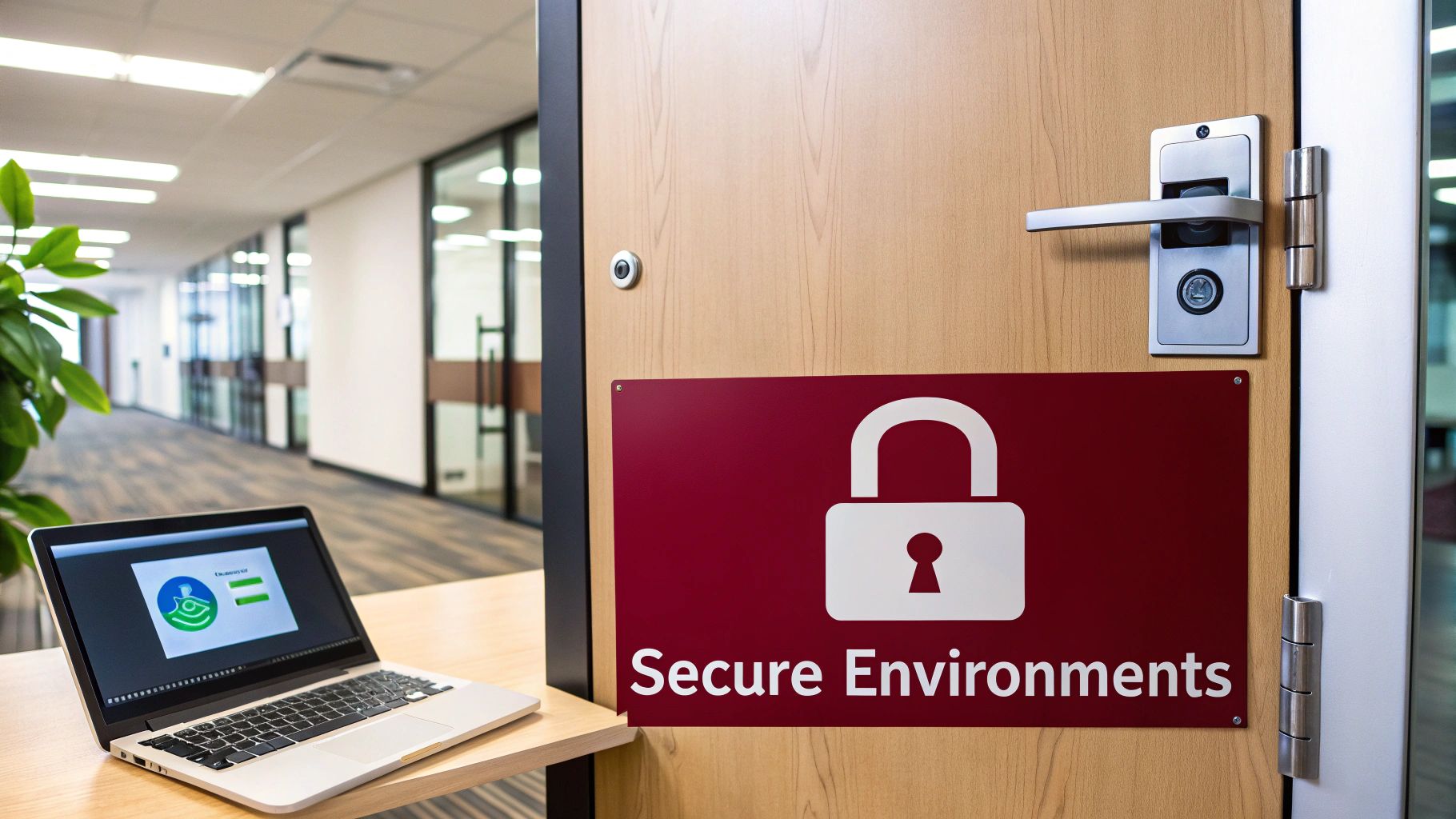
Once you’ve got your security policies and people sorted, it's time to protect the actual hardware and software they use every day. This is where Physical and Technological controls step in. Think of them as the practical safeguards for your servers, laptops, networks, and all the sensitive data floating around on them. These controls provide the tangible security measures that protect your assets from both real-world and virtual threats.
When most people hear "security," this is what comes to mind: locked doors, encrypted files, and complicated passwords. And they're not wrong. But getting these controls right involves more than just locking down the server room; it’s about securing every desk, device, and digital connection in your entire organisation. A holistic approach is necessary to cover all potential attack vectors.
Let's unpack these crucial ISO 27001 controls and turn the abstract rules into real-world actions that actually protect your business.
Reinforcing Your Physical Defences
Physical security is about more than just stopping someone from walking out the door with a server. It’s about controlling the entire environment where your information lives and breathes. In today’s world of hybrid work, that "environment" has stretched from the office to include people's homes, making these controls more vital than ever. The scope of physical security must now extend to wherever company assets are located and used.
A simple but powerful control is A.7.7 Clear Desk and Clear Screen. This isn’t about being a neat freak; it’s a brilliant defence against someone simply walking by and stealing data. It reduces the risk of unauthorised access, loss, and damage to information on desks, on screens, and in other accessible places.
Picture a consultant visiting your office or a delivery driver passing an empty desk. An unlocked screen showing customer details or a sensitive document left on the printer is a data breach waiting to happen. This control is all about getting employees into the habit of locking their screens when they leave their desks and stowing away sensitive papers when they're not being used. It's a behavioral control that has a direct impact on physical security.
Securing Modern Work Environments
The clear desk and screen policy isn't just for the office. While you can’t put a keycard reader on an employee’s home office door, you can absolutely enforce rules to protect company gear wherever it is. This requires adapting physical security principles to the remote work context.
This means putting a few simple things in place:
- Mandatory screen locking on all company devices after a short burst of inactivity. This can be enforced centrally through mobile device management (MDM) or group policy.
- A ban on printing sensitive information at home, unless it’s absolutely essential and can be securely shredded afterwards. This reduces the risk of sensitive paper documents being lost or improperly disposed of.
- Clear guidelines on setting up secure home Wi-Fi with strong passwords and WPA2/3 encryption. This extends your network security perimeter to the employee's home.
These small steps effectively extend your security perimeter right into your team's homes, making sure your defences are always on, no matter where people are working. This demonstrates a modern understanding of physical security in a distributed workforce.
Physical controls are your first line of defence against threats you can literally touch. They protect the hardware that your entire digital operation relies on, ensuring a stolen laptop doesn't instantly escalate into a catastrophic data breach.
Demystifying Technological Controls
Technological controls are the digital locks, alarms, and keys that protect your data. They are the software and hardware tools you use to enforce the security policies you’ve already written down. These are often the most complex and costly controls to implement, but they are essential for protecting against the ever-evolving landscape of cyber threats.
One of the most critical controls here is A.8.2 Privileged Access Rights. Think of your IT system like a high-security building. Most employees have a keycard that only gets them through the front door and into their own office.
Privileged users, like your IT administrators, have a master key that opens every single door—including the server room and the CEO’s office. This control is all about making sure these "master keys" are handed out very carefully, meticulously tracked, and only used by people who genuinely need that level of access. Why? Because a compromised admin account is a worst-case scenario, giving an attacker the keys to your entire kingdom. Implementing the principle of least privilege is paramount.
Authentication vs Authorisation: A Simple Analogy
To get access control right, you have to nail the difference between two fundamental concepts: authentication and authorisation. These are the twin pillars of any access control system.
- Authentication is proving you are who you claim to be. It’s like showing your driver's licence at a security desk. This is usually done with a password, a fingerprint scan, or a code from an authenticator app. Modern best practice strongly recommends multi-factor authentication (MFA) to strengthen this process.
- Authorisation is what you're allowed to do after you've proven who you are. The security guard checks your ID against a list to see which floors or rooms you have permission to enter. This is about defining and enforcing access rights and permissions.
An employee in your marketing team might be authenticated to log in to the network, but they should only be authorised to access the marketing drive—not the finance or HR folders. A robust access control system manages both of these pieces flawlessly, ensuring users only have access to the information and systems they need to perform their jobs.
For Australian businesses, the principles of the ACSC Essential Eight offer a fantastic, practical framework for beefing up technical defences, especially around access control. Aligning your technical controls with such frameworks can provide a strong, risk-based approach to implementation.
The Critical Role of Cryptography
Another absolute cornerstone of your technical toolkit is A.8.24 Use of Cryptography. Simply put, cryptography is the art of scrambling data so it's unreadable to anyone without the right "key." It's the ultimate safety net for your information, providing confidentiality and integrity.
If a hacker somehow gets past all your other defences and steals a file, good encryption means all they have is a useless jumble of gibberish. This control requires you to use cryptography to protect data in two states:
- Data at Rest: This is data just sitting on a device—a file on a server, a database on a hard drive, or a document saved to a laptop. Encrypting the entire hard drive on company laptops is a classic example. This protects against data theft from lost or stolen devices.
- Data in Transit: This is data on the move across a network, like an email being sent, a file being uploaded to the cloud, or a customer typing their credit card details into your website. That little padlock icon (HTTPS) in your web browser is encryption protecting data in transit using protocols like TLS (Transport Layer Security).
Implementing cryptography properly means figuring out what your most sensitive data is, where it lives, and wrapping it in the right level of encryption to protect it, no matter what. This also involves managing the cryptographic keys securely, as compromised keys render the encryption useless. It turns your data from a vulnerable target into a locked safe.
Why Bother With ISO 27001 Controls? The Real Business Case
We've talked a lot about the 'what' and 'how' of ISO 27001 controls. Now, let's get to the question that really matters, the one you'll need to answer to get the budget and the green light from the people upstairs: "Why should we do this?" It’s time to shift gears from the technical weeds to the powerful business arguments that frame these controls not as a cost, but as a strategic investment that pays for itself. The justification for implementing an ISMS must be articulated in terms of business value, risk reduction, and competitive advantage.
Look, for any CFO or CEO, it all comes down to the numbers. Pouring resources into a proper Information Security Management System (ISMS) isn't just about ticking boxes; it's a smart financial move that directly protects your bottom line. It’s about choosing a predictable, manageable cost today over a potentially catastrophic, unplannable one tomorrow. It's about moving from a reactive, unpredictable expenditure on incident response to a proactive, budgeted investment in prevention and resilience.
The Financial Argument: A Calculated Investment vs. a Devastating Gamble
The most convincing argument is usually the simplest one: what it costs versus what it saves. Yes, implementing and maintaining ISO 27001 controls has a price tag. But that figure is a drop in the ocean compared to the financial devastation of a data breach. The numbers don't lie. The cost of non-compliance and security failures far outweighs the investment in a robust security program.
Let's look at the reality here in Australia. The average cost of falling out of compliance is a staggering AUD $14.8 million per incident. That’s nearly three times the AUD $5.47 million it typically costs to stay compliant. Breaches linked to non-compliance tack on an extra AUD $174,000 per event, pushing the average total cost of a breach to AUD $4.61 million. You can read more about the financial implications of ISO 27001 compliance in Australia to really understand what's at stake.
Think of ISO 27001 as your business’s insurance policy. The premium might feel like an expense now, but it’s what saves you from a bankruptcy-level event down the road. The financial risk of doing nothing is just too high to ignore.
This isn’t just about dodging fines from the regulators. It's about preventing the kind of operational chaos, crippling legal fees, and reputational freefall that can bring a business to its knees. The hidden costs of a breach, such as lost business, customer churn, and damage to brand value, can often exceed the direct costs of remediation and fines. A proactive ISMS mitigates all of these financial risks.
Unlocking New Doors to Revenue and Trust
But this isn't all just about defence. ISO 27001 certification is a powerful tool for growth. It’s the key that unlocks high-value opportunities that would otherwise be completely off-limits. It serves as a powerful market differentiator, demonstrating a commitment to security that many competitors cannot match.
Many organisations, especially in government and the enterprise space, now flat-out require ISO 27001 certification from their suppliers. It's non-negotiable. It has become a standard procurement requirement for any contract involving the handling of sensitive information.
- Winning Government Tenders: In Australia, federal and state government contracts often make a certified ISMS a must-have for any supplier handling sensitive public data. No certificate, no contract. Lacking certification can get you disqualified from the bidding process before you even start.
- Securing Enterprise Clients: Big corporations are paranoid about their supply chain risks, and for good reason. Your certification is the verifiable proof they need to see you as a secure, trustworthy partner, not a liability. It accelerates their due diligence process and gives them confidence in your security posture.
- Expanding Internationally: As a globally recognised standard, ISO 27001 tells international clients you play by the rules and meet a world-class security benchmark, right out of the gate. It removes barriers to entry in markets where security and privacy are paramount, like the European Union with its GDPR regulations.
In this light, certification isn't just a shiny badge; it’s a serious competitive advantage. It tells potential clients you're not messing around with security, building the kind of deep trust that closes deals and keeps them coming back. It transforms security from a cost centre into a revenue enabler.
Bolstering Your Brand and Winning Over Customers
In a world where data breaches are front-page news, trust is everything. Customers are smarter and more sceptical than ever about who they give their personal information to. Implementing ISO 27001 controls is one of the clearest, most credible signals you can send that you're committed to protecting them. It is a tangible demonstration of your due diligence and corporate responsibility.
This commitment has a real, tangible impact on your brand. It takes security out of the backroom IT closet and makes it a core part of what you offer. When you can confidently state that your systems are certified to the highest international standard for information security, you build a powerful reputation for being reliable and having integrity.
This creates a positive feedback loop. Stronger security builds customer trust, which drives loyalty and makes your brand more resilient. In today's market, proving your business is a safe harbour for customer data isn't a "nice-to-have"—it's an absolute must for survival and growth. It can become a key part of your brand identity and a cornerstone of your customer value proposition.
Got Questions About ISO 27001 Controls? We’ve Got Answers.
When you're deep in the weeds of an ISO 27001 project, questions are going to pop up. It's only natural. The standard is detailed and can be complex to interpret. To help you navigate the process, we've heard just about all of them, so we’ve put together some straight-talking answers to the most common queries we get from businesses just like yours.
Do I Really Have to Implement All 93 Annex A Controls?
Nope, and anyone who tells you otherwise is mistaken. This is probably the biggest myth out there about ISO 27001. The standard isn't a rigid checklist; it’s a framework designed to fit your business, not the other way around. The core principle is risk-based selection, not mandatory implementation of every control.
Your job is to go through all 93 controls, look at them through the lens of your own risk assessment, and decide which ones make sense for you. The crucial part is documenting these decisions in your Statement of Applicability (SoA), explaining why you’ve included a control and why you’ve left one out. For excluded controls, the justification must be sound and demonstrate that the corresponding risk is not applicable or is accepted.
How Do the Main Clauses and Annex A Controls Fit Together?
It's a great question, and the relationship is pretty simple when you break it down. Think of it like this: the main clauses (4 through 10) are the "what," and Annex A is the "how."
The main clauses lay out the requirements for building and running a proper Information Security Management System (ISMS). For example, Clause 6.1.3 explicitly tells you that you need a process to treat your risks. This clause requires you to select appropriate information security controls to address the risks identified in your assessment. To do that, you need to pick the right security controls. And where do you find that big list of potential controls? You guessed it—Annex A. It's your go-to catalogue for solving the problems you identify. The SoA is the document that formally links the risk treatment decisions made under Clause 6 to the controls listed in Annex A.
What’s the Difference Between ISO 27001 and NIST?
We hear this one a lot. It's easy to see why they get confused, as both are heavyweights in the security world. The real difference comes down to their core purpose and structure.
- ISO 27001 is all about the big picture. It’s an international standard for building a complete management system (your ISMS). The focus is on governance, risk, and making sure you're always improving. Getting certified is a huge part of its value—it's independent proof that your whole system works. It specifies the requirements for establishing, implementing, maintaining and continually improving an ISMS.
- NIST Frameworks, like the popular Cybersecurity Framework (CSF), are more like a massive technical library. They offer incredibly detailed lists of security and privacy controls and best practices. While they started life in the U.S. government, they’re now used everywhere. They tell you exactly what to do on a technical level but don't have a formal certification process like ISO 27001.
You can think of ISO 27001 as the blueprint for your security house, and NIST as the detailed construction manual for the wiring and plumbing. In fact, they work brilliantly together. Many organisations use the NIST CSF as a detailed guide for implementing the technical controls selected through their ISO 27001 risk assessment process.
How Much Paperwork Do I Need for Each Control?
You need enough to prove the control is real and working, but not so much that you've created a bureaucratic nightmare. The goal is clarity and consistency. An auditor needs to see that your controls aren't just ideas on a spreadsheet; they are living, breathing parts of your daily operations. The amount of documentation should be appropriate for the size and complexity of your organisation.
For any given control, you should be able to show:
- What the control is supposed to achieve (its objective).
- The policy or procedure that guides how people should follow it. For example, an access control policy or a backup procedure.
- Hard evidence that it's actually running (think access logs, training completion records, or server maintenance reports). These are the records that demonstrate the control is operating effectively.
Here's a good rule of thumb: could a new person join your team, read your documentation, and understand exactly what the control is and how to manage it? If not, you probably need a bit more detail. Documentation should enable consistent and repeatable execution of the control.
Can I Get Certified if I Skip a Control?
Absolutely. If your risk assessment shows that a particular control just isn't relevant to your business, you can officially exclude it. This is a fundamental part of the standard's flexibility.
A classic example is a company that operates 100% remotely with all its data in the cloud. They have no physical office or on-site servers. For them, excluding controls related to securing physical areas or protecting network cabling makes perfect sense. The trick is that your reasoning has to be solid, logical, and clearly tied back to your risk assessment. This justification must be documented in your Statement of Applicability for the auditor to review.
Getting your head around the ISO 27001 controls can feel like a huge task, but you don't have to tackle it alone. At Anitech, our experts specialise in walking Australian small businesses through every single step, making the path to certification as smooth as possible.
Discover our proven ISO 27001 consulting services and let's build a security program that doesn't just tick boxes, but actually protects your business and helps you win bigger contracts.
Recent Comments