

Quick Summary: This guide details how Australian businesses can build a "technical moat" by aligning ISO 27001 Annex A controls with the ASD Essential Eight. We provide a practical roadmap for implementation, focusing on translating ISO requirements into concrete technical actions that enhance cybersecurity, win enterprise contracts, and achieve certification efficiently.
Let's be blunt: for a small Australian business, navigating cybersecurity compliance can feel like you're lost in the bush without a compass. Framing ISO 27001 as just a compliance headache is a huge mistake. The real value lies in ISO 27001 engineering the technical moat: Annex A controls in Australia, a strategy that turns security into a powerful competitive advantage.
Think of it as building a certified defence around your business that helps you win bigger contracts, especially with government and enterprise clients. This guide cuts through the theory. We connect the high-level ISO 27001 framework, the specific Annex A technical controls, and Australia's own cybersecurity benchmarks like the ASD Essential Eight. You'll get a practical roadmap for turning your security from a cost centre into a genuine asset.
Building Your Cybersecurity Fortress with ISO 27001 and ASD Essential Eight
The core idea behind ISO 27001 engineering the technical moat: annex a controls in australia is to build a security posture that stands up to real-world attacks, not just pass an audit. Your data and systems are the crown jewels, and Annex A gives you the architectural plans for the walls, towers, and gates that protect them.
This means translating the often-vague requirements of ISO 27001 into concrete technical actions. For anyone operating in Australia, that translation absolutely must include local best practices, particularly the Australian Cyber Security Centre's (ACSC) Essential Eight. Marrying the two frameworks is the most efficient and effective path to robust cybersecurity.
Why a Technical Moat Actually Matters
A properly built technical moat isn't just a fancy term; it's the tangible, hands-on application of your overarching information security management system, creating real barriers that stop threats in their tracks.
Here’s what it really delivers:
- You Win More Work: Demonstrates a serious commitment to security, a non-negotiable for most enterprise and government tenders.
- You Genuinely Lower Your Risk: By systematically plugging security holes, you drastically reduce the odds and potential fallout of a cyber breach.
- You Stop Wasting Money: Focuses your security spending and effort, moving you away from a scattergun approach where you're never quite sure what's working.
The uptake of ISO 27001 in Australia has been climbing steadily. It's breaking out of the IT department and being recognised for what it is: a core business function essential for growth and resilience.
From Compliance Burden to Competitive Edge
The goal is a security framework that's both compliant and genuinely effective. This takes more than just knowing what the Annex A controls are. You must understand how to implement them in a way that makes sense for your specific tech stack, your team, and your risk appetite.
To build a truly resilient cybersecurity fortress, you also need to grasp the bigger picture. This is where understanding information governance comes in. Getting this right ensures your technical moat is built on a solid foundation of smart data management and clear policies. When you view Annex A through that lens, you shift from a reactive, box-ticking exercise to proactively building a powerful and sustainable advantage.
Aligning Annex A Controls With the ASD Essential Eight
For many Australian businesses, ISO 27001 certification and compliance with the Australian Cyber Security Centre's (ACSC) Essential Eight can feel like two separate mountains to climb. This is a huge missed opportunity.
The smartest approach is to merge these frameworks to build a single, cohesive security posture. By implementing one technical solution that satisfies the requirements of both, you’re not just saving time and effort—you're building a layered defence that’s both certifiable and perfectly tuned to Australian government best practices. This transforms compliance into a strategic project that builds a powerful, certified defence system designed for the local threat landscape.
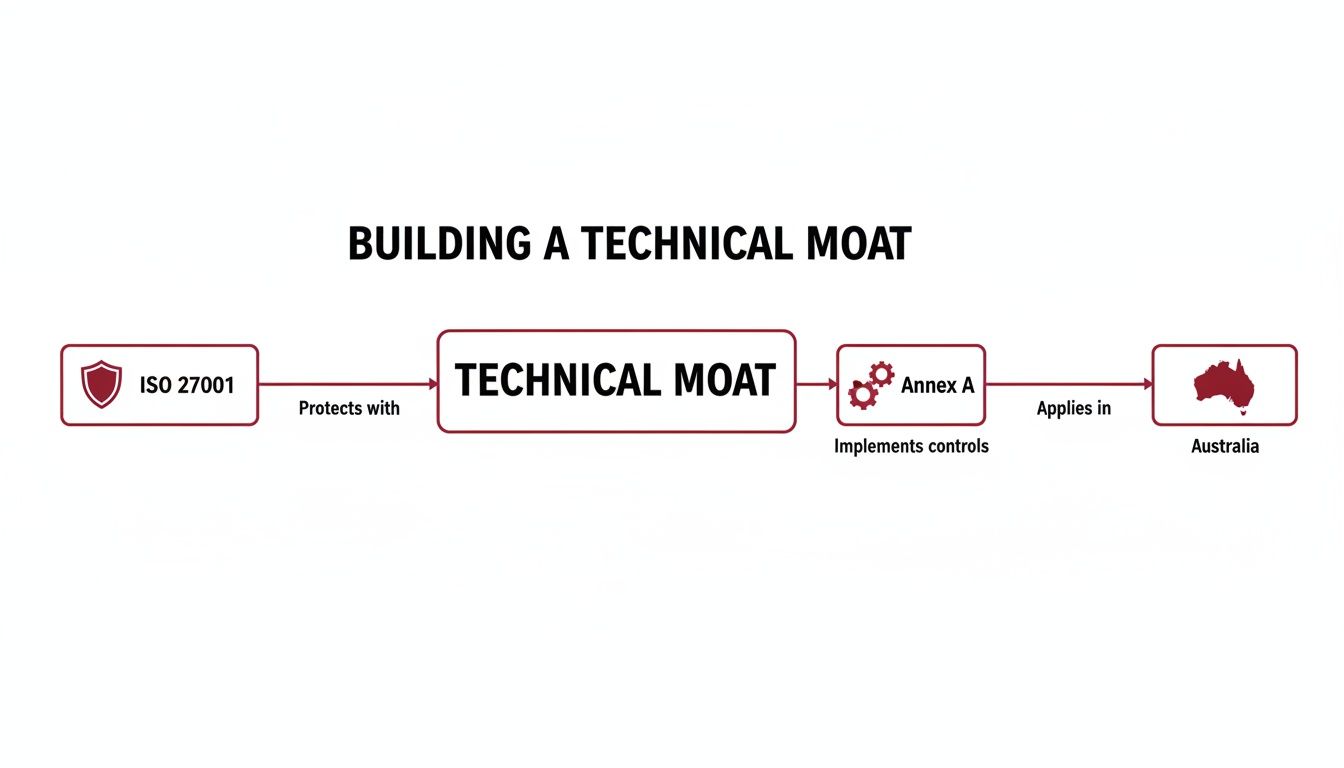
As you can see, there’s a direct line from the high-level ISO 27001 standard down to the specific Annex A controls, all reinforced by the practical, Australia-specific actions of the Essential Eight. This is how you engineer a genuine technical moat.
The Power of Synergy
Think about it this way: ISO 27001 Annex A tells you what you need to achieve—the high-level control objectives. The Essential Eight, in contrast, gives you the prescriptive how—the specific, hands-on mitigation strategies proven to work against the most common cyber threats in Australia.
When you map these two together, everything clicks into place. You can focus your energy on technical work that delivers the biggest security bang for your buck, all while gathering the exact evidence your ISO 27001 auditor will want to see.
Mapping Annex A Controls to the Essential Eight
You'd be surprised how often a single action satisfies controls from both frameworks. The table below shows how neatly some of the 93 Annex A controls map directly to the technical strategies of the Essential Eight.
| ISO 27001 Annex A Control | ASD Essential Eight Strategy | Practical Implementation Example (for SMBs) |
|---|---|---|
| A.5.15 Access control | Restrict Administrative Privileges | Create separate, non-email enabled admin accounts. Use a Password Manager and enforce multi-factor authentication (MFA) on all admin access. |
| A.8.23 Web filtering | User Application Hardening | Configure web browser settings to block Flash, ads, and Java. Use a DNS filtering service to block access to malicious domains. |
| A.8.7 Protection against malware | Application Control | Use Microsoft AppLocker or a similar tool to create a whitelist of approved applications, preventing any unauthorised software from running. |
| A.8.8 Vulnerability management | Patch Applications & Patch Operating Systems | Implement a formal patching schedule using automated tools. Prioritise critical vulnerabilities and document all updates within a register. |
| A.5.17 Authentication information | Multi-factor Authentication | Enforce MFA across all remote access points, critical systems, and cloud services (e.g., Microsoft 365, Xero). |
| A.8.28 Secure coding | User Application Hardening | Block or disable scripting languages and macros within productivity software like Microsoft Office. |
| A.8.16 Monitoring activities | Regular Backups | Schedule daily automated backups of important data. Crucially, test your restoration process quarterly to ensure the backups actually work. |
This mapping isn't just an academic exercise. It's a roadmap for efficient, risk-based security.
By focusing on the intersection of Annex A and the Essential Eight, you ensure your resources are channelled into controls that are not only required for certification but are also deemed most critical for defending against prevalent threats in Australia.
A Scenario for a Small Australian Business
Imagine a small consulting firm in Sydney that holds sensitive client project data. They need to get ISO 27001 certified to land a major government contract, but they have a lean IT team and an even leaner budget. Instead of getting overwhelmed by the 93 Annex A controls, they start with the Essential Eight as their technical guide.
Their first project is implementing robust application control using Microsoft AppLocker. This single, focused project achieves several goals at once:
- They immediately meet a critical Essential Eight requirement, significantly hardening their systems against ransomware and malware.
- They generate tangible evidence for Annex A.8.7 (Protection against malware), showing auditors a concrete, documented measure.
- They also address parts of Annex A.5.19 (Installation of software on operational systems) by creating a formal process for approving and installing new software.
This pragmatic approach works. By prioritising the technical controls prescribed by the ACSC, they build their security moat brick by brick. For a deeper look at this strategy, our guide to the ACSC Essential 8 has all the details. Harmonising these frameworks makes your business more resilient and far more attractive to the high-value clients you're targeting.
Designing Your Technical Defence Blueprint
Let's get down to brass tacks. It's time to turn those control mappings into a real, working architecture. This is where we draw up the blueprint for your 'technical moat'—making smart technology choices that breathe life into your Annex A controls, specifically for a small Aussie business.
This isn't about rushing out to buy expensive, enterprise-grade hardware. It’s about leveraging cloud platforms like AWS or Azure, and translating high-level security goals into nuts-and-bolts configurations.
The goal is to provide actionable advice for choosing, setting up, and integrating technology that not only builds your defences but also produces the exact evidence your ISO 27001 auditor will be looking for.
Core Architectural Patterns for Annex A
A solid technical moat is built on a few timeless architectural patterns. They provide the bedrock for many of the Annex A controls you need to implement.
-
Network Segmentation (A.8.22): Imagine your network is a ship with watertight compartments. For a small business, this might be a separate Wi-Fi network for guests. In the cloud, this means using AWS Virtual Private Clouds (VPCs) or Azure Virtual Networks (VNets) to properly isolate your development, testing, and production environments.
-
Least Privilege Access (A.5.15 & A.8.2): This is the golden rule of security. People and systems should only have the absolute bare minimum permissions needed to do their job. Use role-based access control (RBAC) to create specific permission sets for different roles in your business.
-
Defence-in-Depth: Layer different security controls. A single server should be protected by a firewall (network layer), anti-malware software (machine layer), and tight access controls (application layer). If one layer fails, the next one is there to catch it.
Leveraging Cloud-Native Tools for Compliance
For most small businesses in Australia, the cloud is the most efficient way to build a secure, compliant environment. The big players like AWS, Azure, and Google Cloud have invested billions in security, and you can leverage that without the massive upfront cost. Instead of buying a physical firewall, you configure network security groups. This approach lowers the barrier to entry for achieving a robust security posture.
A Practical Example: Azure for Access Control
Let's make this real. Take Annex A.5.15 (Access control). If you're a small business using Microsoft 365, here's how you can nail this with Azure:
- Identity Management: Use Azure Active Directory (Azure AD) as your single source of truth for all user accounts.
- Authentication: Switch on Multi-Factor Authentication (MFA) for everyone. This is a baseline control and a core part of the ASD Essential Eight.
- Authorisation: Set up Conditional Access Policies. These are your digital bouncers, allowing you to create rules like blocking logins from outside Australia or forcing MFA for sensitive apps.
- Auditing: Azure AD automatically keeps detailed logs of every sign-in. These logs are pure gold for your auditor—proof that your access controls are working.
This layered, cloud-native approach gives you an incredibly robust solution for access control. It’s cost-effective, scales as you grow, and automatically generates the audit trails you need, making the process of iso27001 engineering the technical moat: annex a controls in australia far less daunting.
Selecting the Right Encryption for Your Data
Encryption is another cornerstone, covered in A.8.24 (Use of cryptography). You need to protect sensitive data whether it's sitting still or on the move.
- Data in Transit: This is data travelling over a network. The standard is TLS (Transport Layer Security). Ensure your websites and APIs all use HTTPS.
- Data at Rest: This is data on a hard drive, in a database, or in cloud storage. All major cloud providers offer simple encryption for services like AWS S3 or Azure Blob Storage. For databases, Transparent Data Encryption (TDE) can lock down your data without rewriting applications.
The global push for ISO 27001 is accelerating, fuelled by tighter regulations and client demands. You can get a sense of this from reports on the growth of the ISO 27001 certification market. This new reality makes designing a smart, cost-effective technical blueprint more critical than ever before.
Your Phased Implementation Roadmap
Looking at the full list of 93 Annex A controls can feel like staring up at Mount Everest. The secret is to break it down. A phased roadmap turns a daunting mountain into a series of manageable hills, starting with foundational work that gives you the biggest security bang for your buck and aligns with the ASD Essential Eight.
Phase 1: Laying the Foundation (Months 1-3)
The first three months are about getting your house in order. You need to figure out what you have and who can touch it. Rushing this part is a classic mistake.
Your primary focus should be on two core areas of Annex A:
- Asset Management (A.5.9 – A.5.14): You can't protect what you don't know you have. Create a complete inventory of everything that holds value—laptops, servers, software, critical data, cloud services. A detailed spreadsheet can work just fine to start.
- Access Control (A.5.15 – A.5.18): Once you know your assets, lock them down. This means enforcing strong password policies, rolling out multi-factor authentication (MFA) on every service, and setting up a clear process for user lifecycle management.
By getting a handle on your assets and access first, you’re tackling some of the highest-risk areas of your business straight away.
Phase 2: Building the Technical Walls (Months 4-6)
With a solid foundation, it's time to build the walls of your technical moat. This is where you shift from organising to actively defending by implementing preventative controls.
Key controls to zero in on at this stage include:
- Operations Security (A.8): This is a big one. Start with the essentials: implementing protection against malware (A.8.7), getting on top of technical vulnerabilities with a formal patching schedule (A.8.8), and ensuring you have a reliable backup and recovery process (A.8.13).
- Communications Security (A.8.20 – A.8.22): This is your network defence. It means getting your firewalls configured correctly and looking at network segmentation.
This is where the overlap with the ASD Essential Eight becomes crystal clear. Things like patching, application control, and backups are central pillars of both frameworks.
Phase 3: Maturing Your Processes (Months 7-12)
The final push is about weaving security into the fabric of your business, proving your security program is a mature, ongoing function.
This is where you'll tackle:
- Supplier Relationships (A.5.19 – A.5.22): Formalise how you manage security with your vendors and service providers.
- Business Continuity (A.5.29 – A.5.30): Have a tested plan to keep your critical business functions running during a major disruption.
- Information Security Incident Management (A.5.24 – A.5.28): Create a formal process for how you detect, respond to, and learn from security incidents.
Unfortunately, many Australian small businesses are falling behind. Recent data shows just 35.3% reviewed their cybersecurity protections in the last six months and 35.1% made zero technology investment in 2021. You can read more about these findings on Australian business adoption. A phased roadmap for ISO 27001 Annex A controls in Australia is the perfect antidote, giving you a structured path to close these critical gaps.
Gathering Evidence and Preparing for Your Audit
You’ve designed and built your technical moat; now comes the real test. The ISO 27001 certification audit is where you prove your defences are as solid in practice as they are on paper. Success is about methodically collecting clear, compelling evidence that your Annex A controls are alive and working every day.
With the right preparation, the audit shifts from a nerve-wracking exam to a simple validation of all your hard work.

Thinking Like an Auditor
Auditors live by a simple mantra: "If it's not documented, it didn't happen." An auditor is looking for objective, verifiable proof that your controls are consistently applied over time. Your job is to make the evidence trail incredibly easy for them to follow.
Key Types of Evidence to Collect
For your technical Annex A controls, you’ll want to start gathering these items well ahead of time.
- System Configuration Screenshots: For a control like A.8.9 (Configuration management), a clear screenshot of a server's security policy or a cloud service’s configuration dashboard is direct, irrefutable proof.
- Log Files and Reports: Firewall logs, intrusion detection alerts, and anti-malware scan reports are crucial for controls like A.8.7 (Protection against malware) and A.8.16 (Monitoring activities).
- Vulnerability Scan Results: Reports from tools like Nessus or Qualys are vital for proving you’re managing technical vulnerabilities (A.8.8).
- Access Control Lists: For A.5.15 (Access control), you can export user permission lists from key systems like Microsoft 365 or AWS IAM.
Pro Tip: Aim to show consistency, not just a single point of perfection. An auditor will be far more impressed by six months of regular, clean vulnerability scan reports than a single flawless one generated the day before they arrive.
Organising Your Evidence for a Smooth Audit
There's nothing an auditor dislikes more than a disorganised mess of files. Set up a dedicated evidence repository—a secure, well-named folder structure on SharePoint is perfect. Organise your folders by the Annex A control numbers (e.g., "A.8.8 Management of technical vulnerabilities"). This simple bit of organisation shows the auditor that your approach is methodical and professional. Getting a clear picture of what's involved in an ISO 27001 audit helps demystify the requirements and builds confidence.
The Power of Internal Audits
Don't let the external audit be the first time your Information Security Management System (ISMS) gets a proper shakedown. Conducting your own internal audits is a mandatory part of the standard for good reason—it’s your best chance to find and fix the cracks before someone else does. Treat your internal audit just as seriously as the real thing. For more pointers, checking out a practical guide to passing ISO 27001 audits can be incredibly helpful.
Audit preparation is the final, crucial step. It’s the moment you prove that your technical moat isn’t just a nice idea—it’s a fully operational, documented, and effective defence system ready to pass inspection.
Got Questions About ISO 27001? We've Got Answers
Stepping into the world of ISO 27001 can feel like navigating a minefield. Let's cut through the confusion with straight-up answers to the most common questions we get from businesses looking to build their technical moat and get certified.
What's the Real Cost of ISO 27001 Certification for a Small Aussie Business?
This is always the first question, and the honest answer is: it depends. The final cost for a small Australian business hinges on your size, complexity, and current security posture.
Think about the investment in three parts:
- Expert Guidance & Implementation: This is for bringing in specialists to steer the ship. For a small business, you're likely looking at a range of $15,000 to over $40,000.
- The Official Audits: These are non-negotiable fees paid to an accredited certification body. Budget between $10,000 and $20,000 for the initial three-year certification cycle.
- Your Tech Stack: You might need to invest in new security tools, or you might find that the tech you already have can be configured to meet the requirements.
Ultimately, see this as an investment in de-risking your business and opening doors to new contracts, not just an expense.
Do We Really Have to Implement All 93 Annex A Controls?
No, absolutely not. Annex A is a catalogue of 93 potential controls, not a rigid checklist. The key is your Statement of Applicability (SoA). This is a critical document where you justify whether each control applies to your business or not. For instance, a fully remote, cloud-based business would likely exclude several physical security controls (from the A.7 family), but you have to document why they don't apply.
It's not about 100% implementation; it's about 100% justification. Your risk assessment dictates your control selection, ensuring you put your time and money where it truly matters.
Is Following the Essential Eight Enough to Pass the Audit?
Tackling the ASD's Essential Eight is a fantastic move for any Australian organisation. It provides an incredibly strong technical foundation and covers a huge chunk of the controls required by Annex A, especially in the A.5 (Organisational) and A.8 (Technological) domains.
But—it’s not enough on its own to get you ISO 27001 certified.
The Essential Eight helps you build the strong technical walls of your security moat. ISO 27001 is the entire management system governing that moat. It demands comprehensive documentation, a formal risk management framework, internal audits, and regular management reviews that sit outside the purely technical focus of the Essential Eight. The smartest approach is to marry the two. This is how you successfully engineer a technical moat with Annex A controls in Australia—one that is both technically sound and genuinely certifiable.
At Anitech, we make the ISO 27001 journey straightforward for Australian businesses. Our seasoned consultants have a 100% success rate in guiding clients through the process, helping them build a robust technical moat and achieve certification without the headache. Learn how we can help your business get certified.
Recent Comments