

Implementing ISO 27001 means creating, running, and continuously improving an Information Security Management System (ISMS). Think of it as the strategic framework your business uses to manage and protect its most sensitive information. It's a structured way to show clients, partners, and regulators that you are serious about data security, building a solid foundation of trust and resilience.
Getting Started on Your ISO 27001 Journey
Embarking on ISO 27001 implementation is much more than ticking a compliance box; it's a powerful strategic move that strengthens your business's reputation and operational backbone. All too often, I see companies treat this as a purely technical IT project, getting bogged down in controls and paperwork. The real key to getting it right is to approach it as a core business initiative from the get-go.
That single shift in mindset changes everything.
Instead of being just another expense, the implementation process becomes a genuine value-creator. For Australian businesses, a well-built ISMS is a massive asset, delivering tangible benefits that ripple out far beyond the server room.
Why Bother? The Real-World Payoff of a Strong ISMS
So, why go through all the effort? Because the rewards are substantial and directly boost your bottom line and standing in the market. A properly executed ISMS will help your business:
- Win More Business: In a competitive market, being able to prove your security credentials is a huge differentiator. Many larger clients and government tenders now make ISO 27001 certification a non-negotiable requirement.
- Meet Client Expectations: Customers are smarter and more concerned about data security than ever. Certification gives them the confidence they need to trust you with their data, which helps smooth out the sales process.
- Slash Business Risk: By methodically identifying and dealing with information security risks, you drastically lower the chances of a costly data breach, operational outages, and the kind of reputational damage that can be hard to recover from.
- Build a Security-First Culture: The process itself forces a company-wide conversation about security. It stops being some abstract IT problem and becomes a shared responsibility that everyone understands and contributes to.
The momentum behind this standard is undeniable. The adoption of ISO 27001 in Australia has been growing rapidly, mirroring a global trend with year-on-year expansion rates hitting around 21%. This shows that Australian organisations are increasingly recognising the value here, pushed by tougher regulations, client demands, and a pretty scary threat landscape.
How to Get Genuine Buy-In From the Top
Let me be blunt: the single most critical success factor for any ISO 27001 project is active, genuine support from your senior leadership. This is not just about getting a signature on a budget request. It's about having champions at the top who understand the strategic value and will back the project publicly.
Your job is to translate the technical jargon into the language of business value. Don't talk about "Annex A controls"; talk about "protecting our intellectual property from competitors." Don't get lost in "risk assessments"; frame it as "getting ahead of threats that could take down our services and ruin our reputation." If you need more background, we have a helpful guide on what ISO 27001 certification truly means.
The trick is to tie information security directly to what the business is trying to achieve. When your leadership sees the ISMS as a tool for driving growth, cutting liability, and landing bigger contracts, getting the resources you need becomes a much easier conversation.
To give you a clearer picture, here’s a quick overview of the key phases you'll navigate.
Key Phases of Your ISO 27001 Implementation
| Phase | Strategic Objective | Core Activities |
|---|---|---|
| 1. Scoping & Buy-In | Secure leadership commitment and define the ISMS boundaries. | Present business case, define scope, identify stakeholders. |
| 2. Risk Assessment | Identify, analyse, and evaluate information security risks. | Asset identification, threat/vulnerability analysis, risk evaluation. |
| 3. Risk Treatment | Select and implement controls to mitigate identified risks. | Develop Risk Treatment Plan, apply Annex A controls. |
| 4. Documentation | Create the necessary policies, procedures, and records for the ISMS. | Write security policies, document procedures, maintain records. |
| 5. Internal Audit | Verify that the ISMS conforms to ISO 27001 requirements. | Plan and conduct internal audits, report findings to management. |
| 6. Certification | Achieve external validation from an accredited certification body. | Stage 1 (documentation review) and Stage 2 (implementation) audits. |
This roadmap shows that success starts with strategy and people, not just tech.
The infographic below visualises these crucial first steps: securing that all-important buy-in, clearly defining your project's scope, and kicking off your initial risk assessment.
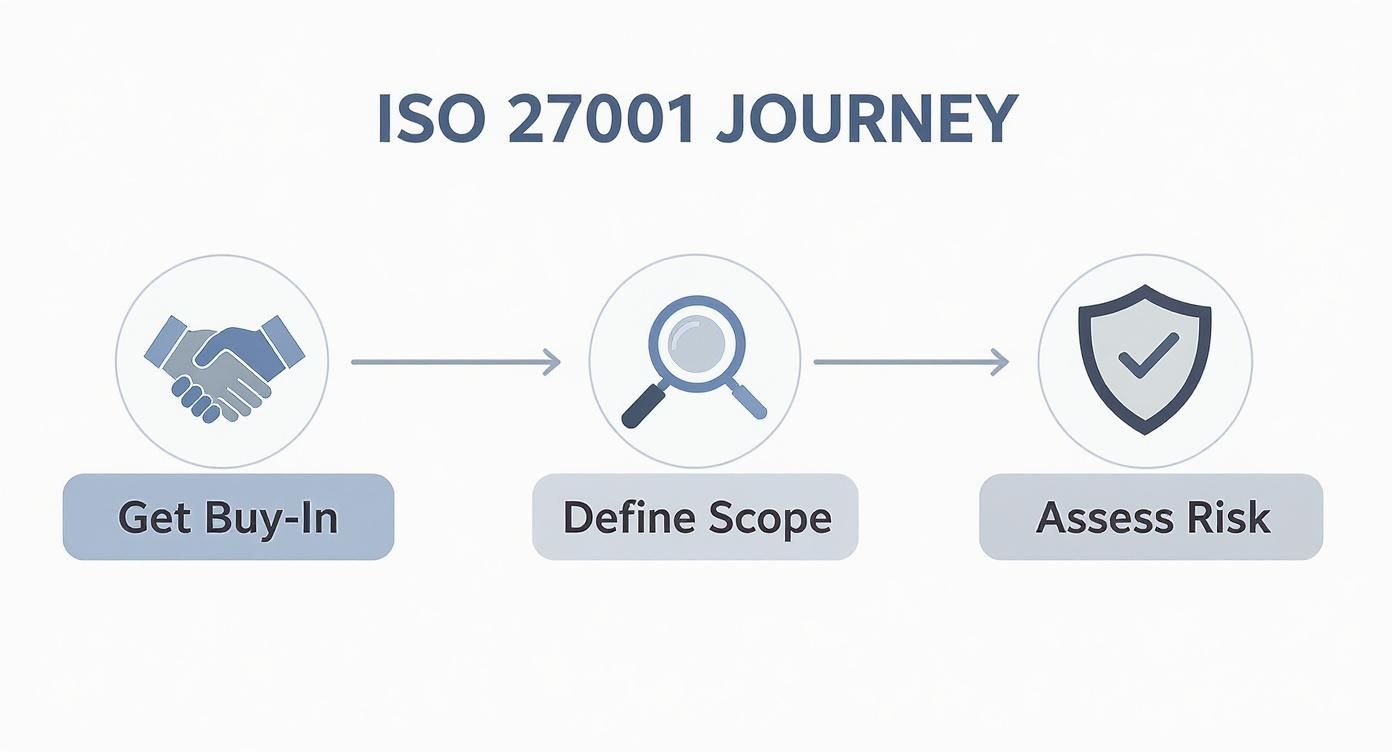
This flow really drives home the point that the journey begins with people and strategy, which sets the stage for everything that follows.
This initial phase sets the tone for the entire project. When your leadership team is visibly on board, it sends a clear message to everyone that information security is a top priority. For a more detailed walkthrough, check out this complete guide on how to get ISO 27001 certified. It can help you start with confidence and a clear plan. By positioning the project correctly right from the start, you build a foundation not just for certification, but for a stronger, more resilient business.
Defining a Smart Scope and Foundational Policies
The success of your entire ISO 27001 implementation really comes down to one of the very first decisions you'll make: defining the scope of your Information Security Management System (ISMS). This isn't just a box-ticking exercise; it's the strategic fence you build around the parts of your business you’re going to protect.
Get it wrong, and you're in for a world of pain.
A scope that’s too narrow might get you the certificate, but it leaves massive holes in your defences and critical parts of your business exposed. On the flip side, a scope that’s too broad becomes an unmanageable monster. It will chew through your resources, time, and budget for very little real-world benefit. The sweet spot is a scope that’s comprehensive enough to be meaningful but focused enough to be achievable.
Drawing Clear Boundaries for Your ISMS
Think of your scope statement as the blueprint for your ISMS. It needs to spell out exactly which people, processes, locations, and technologies are in the game. This isn’t a time for vague, sweeping statements. You need to get specific.
For instance, a small software development company in Melbourne might instinctively say their scope is "the whole company." This is a classic mistake and almost always inefficient. A much smarter move is to zero in on what actually needs protecting to keep your clients and the regulators happy.
Here's a practical way I tell clients to break it down:
- People: Which teams or specific roles handle the sensitive stuff? This is probably your development team, customer support, and the finance department. But maybe not your internal marketing team if they never touch client data.
- Processes: What are the key business activities that involve this information? Think about your software development lifecycle, customer data handling procedures, and how you respond to incidents.
- Technology: What systems and applications make these processes tick? This will cover your production servers, dev environments, key SaaS platforms like your CRM, and the specific databases holding that sensitive data.
- Locations: Where is all this happening? It could be your physical office in Sydney, your data centres, or even a specific cloud environment like your AWS instance in
ap-southeast-2.
By getting this granular, you create a scope that is both manageable and defensible. You're not trying to boil the ocean; you're just securing the crown jewels of your business—the parts that truly matter to your stakeholders.
Real-World Scoping Scenarios
Let's look at how this plays out. Imagine a managed IT service provider in Brisbane chasing a major government contract. Their most critical asset is the infrastructure they use to manage their clients' systems.
Their scope statement might read something like this: "The ISMS applies to all activities, personnel, and technologies involved in the provision of managed IT support services to our Australian clients, managed from our Brisbane head office and supported by our cloud infrastructure hosted in AWS ap-southeast-2."
This statement is brilliant because it's so precise. It cleverly excludes internal functions like HR and finance if they don't directly touch service delivery, which instantly makes the project more focused and affordable.
Here’s another one: a FinTech startup that needs to give investors and banking partners peace of mind. Their scope might be tightly focused on the platform that processes financial transactions, the dev team building it, and the support staff handling related queries.
The real secret is to tie your scope directly back to your business goals. Always ask yourself: "Why are we really doing this?" The answer—whether it's to land a specific client, meet a regulatory deadline, or just build trust—should be the North Star for all your scoping decisions.
Crafting Your Foundational Security Policies
Once your scope is locked in, it’s time to create the high-level policies that form the constitution of your ISMS. Don't panic—these aren't supposed to be hundred-page technical manuals. They should be concise, authoritative statements from management that set the tone for information security across the organisation.
The absolute cornerstone here is the Information Security Policy. This is probably the single most important document you’ll create at this stage. It’s the anchor for everything else you do and, importantly, a mandatory requirement of the ISO 27001 standard.
At a minimum, this policy needs to clearly state:
- Management’s commitment to keeping information secure.
- The main security objectives the business is trying to achieve.
- A clear outline of roles and responsibilities for security.
This document proves to auditors, clients, and your own people that security starts at the top. It signals that security is everyone's job, not just a problem for the IT department. And the process of creating it is invaluable; allocating time now to developing an information security policy saves a lot of time later.
Essential Supporting Policies to Establish
While the main Information Security Policy sets the vision, you'll need a few other key policies to give your ISMS some structure. These usually cover the most critical areas.
| Policy Type | Core Purpose | Example Focus Area |
|---|---|---|
| Acceptable Use Policy | Sets the ground rules for how employees use company tech and data. | Banning the use of personal Dropbox for company documents. |
| Access Control Policy | Outlines who can access what information and under which conditions. | Enforcing the "principle of least privilege" so staff only get access to what they need for their job. |
| Information Classification Policy | Creates a system for labelling data based on its sensitivity level. | Defining data categories like Public, Internal, Confidential, and Restricted. |
Again, these documents don’t need to be novels. They should be clear, practical, and easy for every single employee to understand. Their purpose is simple: to guide behaviour and give people a clear framework for making smart, security-conscious decisions every day.
By nailing down a smart scope and these foundational policies early on, you build a solid and logical base for your entire ISO 27001 project. Trust me, it sets you up for a much smoother and more successful journey to certification.
Mastering Your Risk Assessment and Treatment
Let’s be honest, the risk assessment is where most ISO 27001 projects either gain serious momentum or grind to a halt. It's the real engine of your ISMS, the part where theory gets real. It’s how you make sure every dollar and hour you spend on security is aimed at the threats that could actually hurt your Australian business.
Forget trying to map out every single hypothetical threat. That’s a surefire way to get bogged down. The real goal is to pinpoint the risks that genuinely matter—the ones that could stop you from operating, tarnish your reputation, or hit you with a massive financial blow. Get this right, and your entire ISO 27001 implementation gains real power and credibility.
First, Know What You’re Protecting
You can't protect what you don't know you have. So, the first order of business is to take stock of your critical information assets. We're talking about the things that, if they were stolen, leaked, or unavailable, would cause serious pain for your business.
And think broader than just servers and software. An "asset" is anything that holds or handles information your business can't live without.
- Your Data: This is the obvious one. Think customer databases, financial records, intellectual property like your unique source code, and any personally identifiable information (PII) you hold on employees or clients.
- The Software You Run On: Your CRM, accounting software, or any custom-built platforms that are central to your operations are all critical assets.
- The Physical Kit: Don't overlook the hardware. Laptops, servers, and networking gear are all in scope, especially if they’re processing sensitive information.
- Your People: Sounds a bit strange, but key people with specialised knowledge or high-level system access are absolutely assets. The risk of losing them or having their credentials compromised needs to be on your radar.
For a small e-commerce business in Perth, their crown jewels might be the customer database, their Shopify platform, and the payment gateway that makes it all work. A B2B consultant, on the other hand, would be more focused on client contracts and project files sitting in a shared drive.
Pinpointing Your Real-World Threats and Weaknesses
Okay, you've got your list of critical assets. Now, what are you protecting them from? This is all about identifying the relevant threats and the vulnerabilities they could exploit.
A threat is the bad thing that could happen—a ransomware attack, a hardware failure, or even something as mundane as a burst pipe flooding your server room. A vulnerability is the weak spot that lets the threat in, like unpatched software, staff who haven't been trained to spot phishing emails, or a lack of off-site backups.
Put them together, and you have a risk. The threat of ransomware, for example, becomes a five-alarm fire if your team has a vulnerability—like a habit of clicking on suspicious links.
You don’t need a crystal ball for this. Focus on what’s plausible for your business. A healthcare provider in Australia has a completely different threat profile to a local manufacturing plant. Keep it grounded in reality.
A No-Headache Way to Evaluate Risk
This is where so many businesses tie themselves in knots with convoluted scoring systems. Let me tell you, for most small to medium-sized businesses, a simple, qualitative approach is all you need. It’s effective and it keeps things moving.
Just look at each risk you’ve identified and assess two simple things:
- Likelihood: How likely is this to actually happen? A simple scale like Low, Medium, or High works wonders.
- Impact: If it does happen, how bad is the damage? Again, Low, Medium, or High is usually enough to get the clarity you need.
A risk with a High likelihood and High impact (like your main customer database getting breached) is obviously your top priority. A Low likelihood, Low impact risk (say, a temporary outage of an internal marketing tool) can wait. This simple matrix helps you pour your limited resources where they’ll make a real difference.
To make this even easier, you need a way to keep your findings organised. For a solid head start, check out our guide and download a professional cybersecurity risk assessment template.
Crafting a Risk Treatment Plan That Actually Works
Finding the risks is only half the job. Now you have to decide what you’re going to do about them. That’s your Risk Treatment Plan (RTP), and it’s one of the most important documents you’ll create. It’s your game plan for tackling each significant risk.
For every high-priority risk, you’ll choose one of four strategies. This is a critical decision that will guide your actions and budget.
Let's use a real-world example. Imagine a small financial advisory firm identifies a major risk: a stolen laptop containing unencrypted client financial data.
| Treatment Strategy | Description | Example in Action |
|---|---|---|
| Mitigate (Reduce) | Put controls in place to lower the risk's likelihood or impact. | The firm makes full-disk encryption mandatory on all laptops (Annex A control A.8.23) and runs security training on protecting devices (A.7.7). |
| Accept (Tolerate) | Knowingly accept the risk, usually because the fix would cost more than the potential damage. | The firm might accept the small risk of a short power cut at their office, since staff can work from home and all critical systems are in the cloud. |
| Transfer (Share) | Offload some or all of the financial risk to someone else. | The firm takes out a comprehensive cyber insurance policy to cover the clean-up costs and fines from a potential data breach. |
| Avoid (Terminate) | Completely stop the activity that's creating the risk. | If the risk of staff using their personal, unsecured cloud accounts is deemed too high, the firm might block those services entirely on the company network. |
Your RTP needs to document these choices. For every risk you decide to mitigate, you’ll link it directly to one or more of the security controls listed in ISO 27001's Annex A. This is what connects the dots, creating a clear, auditable trail that proves your security measures are directly addressing your biggest risks. Suddenly, your risk assessment isn't just a document—it's your roadmap for building a truly secure business.
Weaving Controls and Lean Documentation into Your Business
With your Risk Treatment Plan locked in, it’s time to roll up your sleeves and get to work. This is where the rubber meets the road—the point where your ISO 27001 implementation stops being a plan on paper and starts becoming a real, tangible part of how you operate every day.
This is also where many businesses get bogged down. It's easy to either over-engineer your security measures or drown in a sea of paperwork. The secret is to keep everything practical and focused. You’re not trying to build Fort Knox; you’re implementing smart, effective controls that directly counter the risks you’ve already identified.
From Plan to Practice: Bringing Annex A to Life
ISO 27001's Annex A is your menu of 93 potential security controls. The key word here is potential. You absolutely do not need to implement every single one. In fact, you shouldn't. Your choices must be driven entirely by your risk assessment, which is why all that hard work you did earlier is about to pay off.
Let's break down a couple of key areas where I see small businesses make the biggest, quickest improvements.
Mastering Access Control
One of the most powerful security concepts is beautifully simple: people should only have access to the information they absolutely need to do their job. It's called the 'principle of least privilege', and it’s a cornerstone of any solid information security management system (ISMS).
Imagine a small marketing agency. Here’s what this principle looks like for them:
- Locking down finances: The client billing folder on their shared drive? That’s restricted to just the accounts team and the directors. No one else needs to see it.
- Segmenting platform access: They use a social media management tool. The junior content creator has a user account that lets them draft and schedule posts, but it doesn't give them the ability to change billing details or delete the entire account.
- Creating a smooth onboarding process: When a new person starts, there's a formal process. Their manager approves their access needs, and IT has it all set up before day one. No more last-minute scrambling.
See? These aren't complicated or expensive technical fixes. They are simple, process-driven controls that drastically cut down the risk of both accidental data leaks and intentional mischief.
Getting Cryptography Right
Cryptography sounds like something for spies and massive corporations, but for most of us, it boils down to a few essential habits. The aim is simple: make your data unreadable and useless to anyone who gets their hands on it when they shouldn't. This is especially crucial for data on laptops or data being sent across the internet.
Think about a consultancy that handles sensitive client strategies. Their approach to cryptography could be as straightforward as:
- Enforcing full-disk encryption on every company laptop. Tools like BitLocker for Windows or FileVault for Mac are built-in. You just have to turn them on. It's a "set-and-forget" control that's a lifesaver if a laptop is ever lost or stolen.
- Using encrypted email as standard practice when sending confidential reports.
- Choosing a cloud storage provider that encrypts all their data, both while it's being uploaded (in transit) and while it's sitting on their servers (at rest).
Often, implementing these controls is just about flicking a switch on the software and hardware you already own.
The most effective controls are often the simplest ones applied consistently. Don't chase complex, expensive solutions when a well-enforced policy using your existing technology will solve 80% of the problem.
Creating Lean, Useful Documentation
Alright, let's talk about the paperwork. An auditor needs to see your proof, and that means documentation is non-negotiable. But please, avoid the number one mistake I see: creating monstrous, 100-page policy documents that just gather dust. That helps no one. Your documentation should be a living, useful guide for your team.
The single most important document you’ll create at this stage is the Statement of Applicability (SoA). It’s essentially a master list of all 93 Annex A controls, and for each one, you must record three things:
- Whether you have implemented it.
- Your reason for implementing it (which should link directly back to a risk you identified).
- If you haven't implemented it, a clear justification for why it's not applicable.
The SoA is the Rosetta Stone of your ISMS. It’s the document that connects your risk assessment to your real-world security, and it's the first thing an auditor will ask for.
Building Your Statement of Applicability
Let’s go back to that remote financial advisory firm. Here’s how a few lines of their SoA might look:
| Control ID | Control Name | Implemented? | Justification for Inclusion / Exclusion |
|---|---|---|---|
| A.5.15 | Access Control | Yes | Implemented to mitigate the risk of unauthorised access to client financial data, as identified in risk ID R-004. |
| A.5.23 | Information security for use of cloud services | Yes | Implemented to address risks associated with storing sensitive client information in our cloud-based CRM, as per risk ID R-011. |
| A.7.4 | Physical security monitoring | No | Not applicable. As a fully remote company with no physical office or data centre, this control is not relevant to our operations. |
This simple table tells an auditor everything they need to know. It shows your decisions were deliberate and based on actual risk, not just guesswork.
Beyond the SoA, you just need simple, clear procedures. A one-page "New Employee Onboarding Checklist" or a short "Laptop Security Standard" outlining encryption and password rules is far more effective than a giant manual.
Use checklists, bullet points, and plain English. If a procedure is too complicated for people to follow, it’s not just useless—it's a liability. By keeping your controls and documentation lean and practical, you build an ISMS that doesn't just pass an audit, but genuinely makes your business safer.
Navigating Audits and Driving Continuous Improvement
Getting that ISO 27001 certificate isn't the finish line. Far from it. In my experience, it’s really the starting gun for your ongoing commitment to information security. The audit process shouldn’t be something you dread; instead, think of it as a powerful tool that validates all your hard work and kicks off a cycle of continuous improvement.
This is the mindset that separates businesses that simply have a certificate from those that genuinely live security. It’s all about building a resilient security culture that makes your certification journey smoother and, more importantly, helps you adapt to new threats and changing client expectations.
Cracking the Code of the Audit Process
The path to certification has two distinct audit stages. I like to think of them as a dress rehearsal followed by the main performance.
First up is your internal audit. This is your chance to really put your Information Security Management System (ISMS) through its paces before an external auditor ever sees it. It’s a self-check, designed to find any weak spots so you can fix them quietly, without the pressure of a certification body looking over your shoulder.
Next is the external audit—the formal certification itself. This is handled by an accredited third-party body and is usually split into two parts.
- Stage 1 Audit: Think of this as a paperwork check. The auditor will review your documentation to make sure you have all the essential policies and procedures in place, like your scope statement, risk assessment, and Statement of Applicability (SoA). They're confirming your ISMS is designed correctly on paper.
- Stage 2 Audit: This is the main event. The auditor digs deeper to verify that you’re actually doing what your documentation says you are. They'll interview staff, observe your processes in action, and review records to see that your ISMS is fully implemented and working effectively.
Knowing this sequence helps you prepare methodically, building the evidence and confidence you need for each step.
Conducting Internal Audits That Add Real Value
So many businesses treat the internal audit as just another box to tick. That’s a huge missed opportunity. A properly executed internal audit is your single best tool for finding non-conformities before they become a real headache in your certification audit.
The key here is objectivity. The person doing the audit can't be marking their own homework. For a small business, I know this can be tricky. You could assign a manager from a different department (after some training, of course) or even bring in a consultant for a truly independent perspective.
A great internal audit asks the hard questions.
- Is it effective? Sure, you’ve got a password policy, but are people actually following it?
- Is it understood? Does the team get why the clean desk policy exists, or do they just see it as an annoyance?
- Is there proof? Can you pull up records proving you’ve conducted access reviews every quarter for the last six months?
To keep your implementation on track and get ready for the real deal, using a comprehensive cybersecurity audit checklist can be a game-changer. It gives your internal review structure and makes sure you don’t miss any critical details.
The goal of an internal audit isn’t to find fault; it’s to find opportunities for improvement. Frame it as a collaborative health check for your ISMS, and you'll get far more engagement and honesty from your team.
From Non-Conformity to Corrective Action
Let's be realistic: your internal audits are going to find problems. In ISO 27001 speak, these are called non-conformities. Finding them isn't a failure; it’s proof your system is working. What really matters is what you do next.
For every issue you find, you need a structured corrective action process.
- Dig for the Root Cause: Don't just slap a band-aid on the symptom. If a laptop is found without encryption, the problem isn't just that one device. The root cause might be a flimsy onboarding process or a breakdown in your IT asset management.
- Plan Your Fix: Outline the specific steps, who's responsible, and the timeline for fixing the root cause. This could mean updating a procedure, running a new training session, or deploying a new tool.
- Implement and Verify: Put the plan into action and—this is the part people often forget—circle back to confirm it actually worked. This verification step closes the loop and shows an auditor you’re serious about improvement.
This disciplined approach demonstrates that you have a mature, living ISMS, not just a dusty set of documents.
The Strategic Role of Management Reviews
The final piece of this continuous improvement puzzle is the management review. This is a formal, high-level meeting where your senior leadership team assesses the performance of the entire ISMS. It’s not a technical deep-dive; it’s a strategic check-in.
The agenda should cover your security performance metrics, the outcomes of recent audits, the status of any corrective actions, and shifts in the threat landscape. This meeting is critical for ensuring the ISMS stays aligned with the company’s goals.
For Australian businesses, this proactive oversight is more important than ever. Anyone transitioning to the newer ISO 27001:2022 standard is facing a hard compliance deadline of 31 October 2025. Making the switch involves a detailed gap analysis, updating documents, and training staff on the new controls. Regular management reviews are essential to keep this on track.
By embedding this rhythm of auditing, correcting, and reviewing into your business, you turn your ISMS from a one-off project into a dynamic system that makes your business stronger and more secure every single day.
Your Top ISO 27001 Questions Answered for Aussie Businesses
Starting the ISO 27001 implementation journey always kicks up a lot of questions. For Australian business owners and managers, they usually boil down to the practical stuff—how much time, how much money, and do we really have to do this? Getting straight answers is the only way to make good decisions and set your project up for success.
Let's dive into some of the most common questions I hear from Aussie businesses, with the kind of direct insights you need to move forward.
How Long Does This Actually Take in Australia?
This is always the first question, and the only honest answer is: it depends. But let's get more specific. For a typical small to medium-sized Australian business that already has some decent security habits, you should realistically budget for 6 to 12 months.
Of course, several things can stretch or shrink that timeline:
- Size and Complexity: A larger company with multiple offices and tangled processes is a different beast to a small startup in a single location. More moving parts means more time.
- The Scope You Choose: Are you certifying one critical service or the whole shebang? A laser-focused scope is much faster to lock down.
- Who's Driving It: Do you have a dedicated person or team on this? If everyone’s trying to squeeze it in between their day jobs, things will inevitably drag out.
- Your Starting Point: If you've got a solid foundation of security policies and controls, you're already halfway there. If you're starting from scratch, you've got a longer road ahead.
It can be tempting to rush things to land a big client, but I've seen that go wrong too many times. A rushed job leads to sloppy controls and documentation gaps that will get you tripped up in the audit. It's so much better to plan a steady, thorough project that builds an Information Security Management System (ISMS) that actually works.
What’s the Single Biggest Hurdle We’ll Face?
While the paperwork and risk assessments can feel like a mountain to climb, the biggest challenge isn’t technical—it's cultural. The hardest part is weaving information security into the very DNA of your company.
Too many businesses treat security as "the IT guy's problem" or a one-off project. That mindset is a dead end. For ISO 27001 to truly work, it needs to be a shared responsibility. Everyone, from the CEO down to the new intern, has to get on board.
This isn't about buying fancy new software. It’s about leadership and communication. It’s about running training that people don't fall asleep in, clearly explaining why a new process is important, and having management constantly show that security is a core value, not just a box to tick.
You'll know you've cracked it when your team members start proactively pointing out potential security issues or suggesting better ways of doing things. That's when your ISMS stops being a folder of rules and becomes a living, breathing part of how you operate.
Is ISO 27001 a Legal Thing for Australian Companies?
This is a really common point of confusion. The short answer is no, ISO 27001 isn't legally mandatory for every business in Australia, not in the same way tax laws are. There’s no federal law stating every company must be certified.
But that answer doesn't tell the whole story. In the real world, it’s fast becoming a de facto requirement to do business in many industries.
Here’s the reality on the ground for Australian businesses:
- It's a Deal-Breaker for Contracts: More and more, it’s a non-negotiable for winning work. Government departments, finance, healthcare, and big corporates all use it as a yardstick to make sure their suppliers aren't a security risk.
- It Shows You've Done Your Homework: The standard is your best friend when it comes to demonstrating due diligence under Australian laws like the Privacy Act 1988 and the Notifiable Data Breaches (NDB) scheme. If a breach happens, having a certified ISMS is powerful proof that you took reasonable steps to protect your data.
So, while the law might not force you to get certified, the market probably will. You might find it impossible to grow or even operate without it.
What Are the Real Costs of Getting Certified in Australia?
The total investment to get ISO 27001 certified can vary quite a bit. The key is to see it as a long-term investment in your business's reputation and resilience, not just another expense.
For a small to medium-sized enterprise (SME) in Australia, you can expect the total cost to land somewhere between $25,000 to over $75,000 for the first year. That figure is made up of a few key parts.
| Cost Component | Description | Typical Australian SME Range |
|---|---|---|
| Certification Body Fees | This covers the Stage 1 and Stage 2 audits, plus the yearly check-ups. | $8,000 – $15,000 |
| Consulting Fees | The cost if you bring in an expert to guide you through the process. | $10,000 – $50,000+ |
| Technology & Tools | You might need new software (like password managers or endpoint security) or hardware. | $2,000 – $10,000+ |
| Internal Staff Time | This is the "hidden" cost of your own team's time spent on the project. It's often the biggest piece of the pie. | Varies significantly |
My best advice is to budget properly from the start. Trying to cheap out by not getting expert help when your team is green, for example, often leads to failed audits, which ends up costing you more time and money anyway. When you see these costs as an investment in winning trust and protecting your future, the value is crystal clear.
Ready to navigate the complexities of ISO 27001 with a trusted partner? Anitech has over 20 years of experience and a 100% success rate in guiding Australian businesses to certification. Let us simplify the process so you can focus on growth. Learn more about our ISO 27001 consulting services.
Recent Comments