

Let's be honest, the term "ISO 27001" can sound a bit intimidating. It sounds like something only massive corporations with entire floors dedicated to compliance need to worry about. But in reality, it's the internationally recognised standard for managing information security, and it's more straightforward—and more crucial—than you might think.
At its core, ISO 27001 gives you a complete framework to manage and protect your business's most valuable information. We're talking about everything from sensitive client data and financial records to your unique intellectual property. The whole point is to keep that information safe by ensuring its confidentiality, integrity, and availability. This isn't just an IT checklist; it's a strategic way to handle information security risks across your entire business.
What ISO 27001 Really Means for Your Business
Let's cut through the jargon for a moment. Think of ISO 27001 as the architectural blueprint for a secure business. You wouldn't build a house without a solid plan, right? In the same way, you can't run a modern business without a structured framework to protect its most critical asset: information.
This standard provides that framework. It helps you pour a strong foundation for your security, build secure walls around your data, and make sure your operational roof can handle the storm of today’s cyber threats.
Moving Beyond the IT Department
One of the biggest mistakes people make is thinking ISO 27001 is just an "IT thing." While your tech team will definitely be involved, its true power comes to life when the whole company gets on board. It’s a strategic initiative that touches every single department.
Suddenly, HR, finance, sales, and operations all start thinking about their role in protecting information. This approach flips information security from a technical chore into a core business value. It builds a culture of security awareness, where every employee understands they have a part to play in keeping sensitive data safe. For Australian businesses, this is quickly becoming non-negotiable.
The uptake of ISO 27001 in Australia has been growing steadily, with year-on-year increases of around 21%. While we might not have the same volume of certifications as some global giants, this growth rate shows a serious national focus on building robust security systems.
The Three Pillars of Information Security
ISO 27001 is built on three simple but powerful principles, often called the "CIA Triad." Getting your head around these is the first step to understanding what the standard is all about.
- Confidentiality: This is all about keeping secrets. It means making sure information is only seen by the right people. A perfect example is ensuring only authorised payroll staff can see employee salary details.
- Integrity: This guarantees your information is accurate and complete. It’s about preventing data from being changed without permission, whether it’s on purpose or by accident. Think about protecting client financial records from being tampered with.
- Availability: This ensures authorised people can get to the information they need, when they need it. It’s about keeping your systems up and running. A classic case is stopping a cyberattack from knocking your website offline.
To help break this down, here's a quick look at the core concepts of an Information Security Management System (ISMS) under ISO 27001.
| Concept | What It Means for Your Business |
|---|---|
| Information Security Management System (ISMS) | Your central "command centre" for all security policies, procedures, and controls. It's the documented system that proves you're managing security properly. |
| Risk Assessment & Treatment | The process of finding out where your security weaknesses are (the risks) and then deciding how to fix them (the treatment). |
| Statement of Applicability (SoA) | A document that lists all the security controls from ISO 27001 and explains which ones you've chosen to implement and why. It's your security "game plan." |
| Continual Improvement | The idea that security isn't a one-time project. Your ISMS needs to be constantly reviewed, updated, and improved to keep up with new threats. |
This table shows that an ISMS isn't just a set of rules, but a living, breathing part of your business operations designed to keep you resilient.
The real value of ISO 27001 isn't just about preventing breaches; it's about building a resilient organisation. It creates a proactive system that helps you identify risks before they become incidents, ensuring business continuity and preserving stakeholder trust.
Why This Matters for Small Australian Businesses
If you're running a small or medium-sized business in Australia, it’s easy to think ISO 27001 is overkill. But the hard truth is that smaller businesses are often seen as easier targets by cybercriminals—in fact, about 43% of all cyberattacks are aimed at them. Without the deep pockets of a big corporation, a single data breach can be a business-ending event.
Implementing an ISMS based on ISO 27001 gives you a structured, affordable way to defend your business. It's not a one-size-fits-all solution; it's a scalable framework that lets you put security controls in place that make sense for your specific risks and budget.
Even better, it's a massive tool for growth. These days, many government and large corporate tenders list ISO 27001 certification as a must-have. Getting certified can instantly put you in the running for high-value contracts that your competitors can't even touch. Exploring the benefits of an ISO 27001 certification for your business shows just how much of a competitive edge it delivers, turning a security investment into a genuine revenue driver.
Unlocking Your Competitive Edge with Certification

Let’s be honest. For a small Australian business, going for ISO 27001 certification can feel like a mountain to climb. But it’s crucial to see it for what it really is: not just a compliance checkbox, but a powerful key that unlocks doors you might not even know are closed.
Think of it as a signal you send to the market. It tells everyone—from potential clients to big-name partners—that you’re not just good at what you do, but you’re also a mature, responsible custodian of the information you handle. In today’s world, that’s not a nice-to-have; it's a deal-maker.
Gaining Access to High-Value Contracts
Ever noticed how the most lucrative contracts, especially with government bodies or large corporations, seem to have a velvet rope around them? That rope is often ISO 27001 certification. These organisations simply can't risk a security breach in their supply chain, so they make it a non-negotiable requirement in their tenders.
Without that certificate, your proposal gets filtered out before a human even reads it. It’s a harsh reality.
But once you’re certified? You're instantly on the shortlist. You’re no longer just another small business competing on price; you're a trusted supplier competing on security and resilience. And often, that’s the a deciding factor that wins the work.
Building Unshakeable Client Trust
Trust is the real currency in business today. When a client gives you their sensitive data, they’re taking a leap of faith. Any business can say they take security seriously, but an ISO 27001 certified business can prove it with a globally recognised, independently verified standard.
That piece of paper tells your clients:
- We don't wait for problems: We manage security proactively with a structured, world-class system.
- Your data is our priority: We have rock-solid policies and controls to protect your information's confidentiality, integrity, and availability.
- We never stand still: Our security is constantly audited and improved to stay ahead of new threats.
This completely changes the sales conversation. You spend less time filling out exhaustive security questionnaires and more time focusing on how you can help them, because you’ve already answered their biggest unspoken question.
The Financial Logic of Certification
Beyond winning new business, ISO 27001 acts as a powerful financial shield. The fallout from a data breach is brutal for a small business—we’re talking regulatory fines, legal bills, and a shattered reputation that can take years to rebuild.
The risk assessment process at the heart of the standard forces you to find and fix your weak spots before they become a catastrophe. It’s a classic case of prevention being infinitely cheaper than the cure.
By systematically tackling your information security risks, you stop treating security as just another overhead. Instead, it becomes a strategic investment that protects your bottom line and keeps the lights on for the long haul.
There’s another direct financial upside, too. Cybersecurity insurance providers love to see an ISO 27001 certificate. It demonstrates a serious commitment to risk management, which can often lead to better policy terms and lower premiums. You can explore more about the value of ISO 27001 certification to see how the numbers really stack up.
A Powerful Market Differentiator
In a crowded market, you need something that makes you stand out. When a potential client has two or three similar proposals on their desk, your ISO 27001 certification is the tie-breaker. It’s a tangible, credible asset that separates you from competitors who can only offer vague promises.
Picture it: two software companies are pitching to a major financial firm. One talks about their great security. The other presents their ISO 27001 certificate. Who do you think has the edge? The one who has replaced uncertainty with undeniable proof.
This differentiation gives you a real commercial advantage:
- Justifies Premium Pricing: Proven security is a premium feature, and clients are often willing to pay more for peace of mind.
- Strengthens Brand Reputation: It positions you as a trustworthy leader in your field, not just another player.
- Attracts Better Partnerships: Other secure, mature businesses will see you as a safe pair of hands, opening up a world of new collaborative opportunities.
At the end of the day, getting certified is a strategic decision that fundamentally changes how clients, partners, and even regulators see your business. It's an investment that pays for itself over and over again by driving growth, cutting risk, and building a truly resilient company.
Making Sense of the Annex A Controls
Let's be honest, when most people first see Annex A of ISO 27001, their eyes glaze over. With a list of 93 controls, it looks like a dense, technical checklist meant only for the IT department. But viewing it that way misses the point entirely.
Think of Annex A less like a strict rulebook and more like a catalogue of security tools. Each control is a specific defence—a high-security lock, a CCTV camera, a reinforced door—designed to counter a particular threat. Your job isn’t to install every single one; it's to strategically choose the right tools for the specific risks your business faces.
This section is all about demystifying that toolkit. We'll group the controls into logical, easy-to-understand categories, explain the 'why' behind them with real-world examples, and turn Annex A from a daunting manual into a practical guide for protecting what matters most.
This infographic helps break it all down, showing how to make Annex A manageable by grouping controls and focusing on what they're actually trying to achieve.
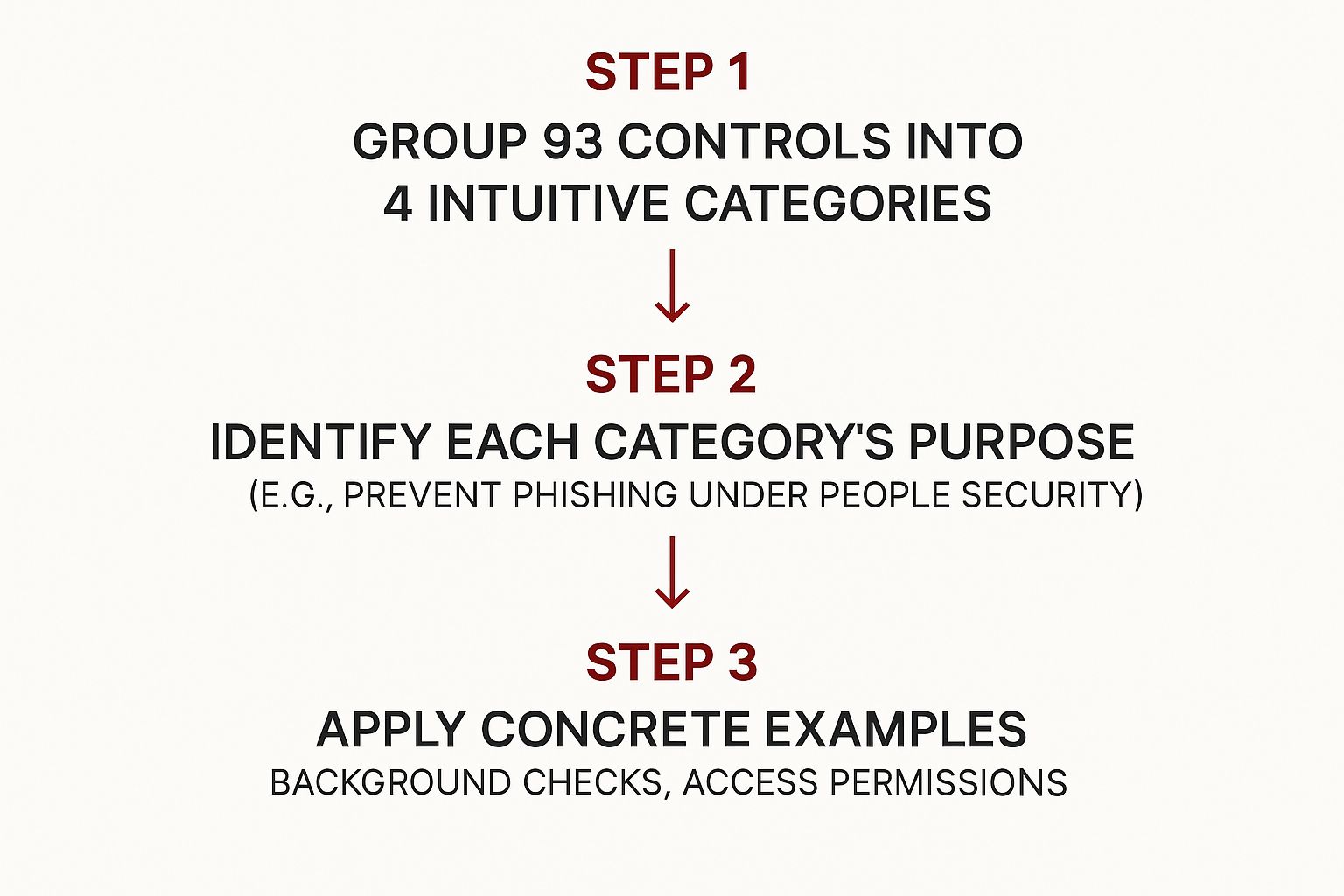
By clustering the 93 controls into these themes, you can get a handle on the bigger picture instead of getting bogged down in the technical weeds.
People Security: Your First Line of Defence
You can have the best security tech in the world, but at the end of the day, your people are the real gatekeepers of your information. The ISO 27001 controls for people are all about turning your team from a potential weak link into your strongest security asset.
These controls cover the whole journey an employee takes with your company, from their first day to their last. For a small Aussie business, this means putting practical steps in place, like running background checks on new hires who’ll be handling sensitive client data. It’s not about being suspicious; it’s just good business practice.
It also means having clearly defined roles so everyone knows exactly what information they're responsible for protecting. And when someone leaves, you need a rock-solid offboarding process to instantly revoke their access to everything, shutting the door on any potential mischief from a disgruntled ex-employee.
A security-savvy employee is your best defence. Firewalls and antivirus can stop a lot of attacks, but it’s a well-trained person who will spot the clever phishing email that slips through the cracks.
A critical piece of this puzzle, and a direct requirement in Annex A, is providing solid information security awareness training for everyone. This isn’t just a one-off presentation during induction week. It has to be an ongoing conversation that keeps your team sharp and aware of the latest scams and their role in keeping the business secure.
Asset Management: Knowing What to Protect
It sounds obvious, but you can't protect what you don't know you have. That’s the entire philosophy behind the asset management controls in Annex A. It’s all about getting your head around what your information assets are and which ones are most important.
And when we say "asset," we're not just talking about laptops and servers. The information itself is the real prize. This includes things like:
- Client databases: All those valuable customer names, contact details, and order histories.
- Financial records: Your invoices, payroll data, and company accounts.
- Intellectual property: The unique source code, product designs, or marketing plans that give you an edge.
- Physical hardware: Laptops, phones, servers—the gear that holds and processes the data.
Once you’ve got a list, you need to classify everything based on how sensitive it is. Your public marketing flyers are low risk, but a spreadsheet with your clients' credit card details is pure gold. This simple act of classification tells you where to focus your security efforts, making sure you’re protecting your crown jewels properly.
Access Control: The Right People, The Right Access
Think of access control as the digital bouncer for your data. Its job is to make sure people can only get to the information and systems they absolutely need to do their jobs, and no more. This is often called the "principle of least privilege."
For an Australian small business, this plays out in very practical ways. Someone on your marketing team definitely needs access to the company’s social media accounts, but they have no business poking around in the accounting software or staff HR files.
These ISO 27001 controls push you to set up formal processes for managing who gets access to what. This includes:
- User Registration: A proper, documented process for setting up a new user.
- Privilege Management: Giving people permissions based on their specific role, not just handing out admin rights to everyone.
- Regular Reviews: Periodically checking access lists to make sure old permissions are removed when people change roles or leave.
- Password Policies: Enforcing strong, unique passwords and, critically, multi-factor authentication (MFA) to stop criminals from just walking in the front door.
Nailing access control massively shrinks the area a hacker can attack. If a marketer's account gets compromised, the damage is contained because that account can’t be used to steal financial data.
Physical Security: Protecting Your Tangible Assets
With so much talk about cyber threats, it’s easy to forget about old-school physical security. But it’s still a massive part of ISO 27001. It’s all about securing the buildings, rooms, and devices where your important information lives.
Take a look around your own office. Is the server room locked, with access limited to just a couple of authorised people? Do you have a "clear desk, clear screen" policy so staff lock their computers when they walk away and put sensitive papers away at night?
These controls also cover gear that leaves the office. With so many people working remotely, you need rules for securing company laptops at home or in cafes. This could mean using privacy screens on public transport, never leaving a device in a parked car, and having a clear plan for what to do if a laptop is lost or stolen.
Ultimately, by breaking the Annex A controls into these logical groups—people, assets, access, and physical security—you can tackle your ISO 27001 project strategically. It stops being about ticking 93 boxes and starts being about building a smart, layered defence system that’s actually right for your business.
Your Step-By-Step Implementation Roadmap

Starting the ISO 27001 journey can feel a bit like planning a major expedition. You need a clear map, a dedicated team, and a solid plan to navigate the path ahead. This is your practical playbook, breaking down what can seem like a huge undertaking into a clear, phased roadmap built for Australian businesses.
The aim here is simple: turn a monumental project into a series of manageable, achievable wins. By following these steps, you’ll see that while the process is thorough, it’s absolutely within reach for any organisation serious about locking down its information security.
Phase 1: Laying the Foundation
Before you can build anything lasting, you need a solid foundation. This first phase is all about getting everyone on the same page and setting the stage for a successful ISO 27001 project. Trying to skip these early steps is like building a house on sand—it just won’t stand up to scrutiny.
First things first: you absolutely must get genuine buy-in from your leadership team. This is more than just getting a signature on a budget request. It’s about making sure your execs understand that ISO 27001 is a strategic business move, not just another IT headache. Frame it in their terms: reducing risk, gaining a competitive edge, and opening doors to new clients.
Once leadership is on board, you need to define the scope of your Information Security Management System (ISMS). In plain English, you need to ask: what are we actually protecting? It could be a specific department, a key service, or the whole organisation. A well-defined scope keeps your project focused and stops it from spiralling out of control.
Phase 2: Planning and Scoping
With the groundwork in place, it’s time to get into the details of your ISMS. This phase is all about understanding where you are right now and what you need to protect. Think of it as the diagnostic stage that will shape the rest of your implementation.
A crucial first step is to figure out who your 'interested parties' are and what they need from you. This includes your customers, regulators, employees, and suppliers. What are their expectations when it comes to information security? Getting this context right is a core requirement of ISO 27001.
To kick things off properly, you need to conduct a gap analysis. This is where you compare your current security setup against the standard's requirements, which instantly shows you where the holes are. The results give you a clear project plan, highlighting exactly where to focus your time and money.
Defining your ISMS isn’t just a technical task; it's a strategic decision. It forces you to pinpoint your most valuable information assets—the 'crown jewels' of your business—and build your security fortress around them.
Finally, you have to create an inventory of all your information assets within your scope. This means everything from customer databases and financial records to the servers and laptops that hold them. After all, you can't protect what you don't know you have.
Phase 3: Risk Assessment and Treatment
This is the absolute heart of the ISO 27001 process. Here, you’ll systematically find, analyse, and evaluate the information security risks your business faces. It’s about moving from simply reacting to incidents to actively preventing them from ever happening.
The risk assessment involves looking at each of your assets and asking, "what could go wrong?" We’re talking about everything from a ransomware attack locking up your files to an employee accidentally emailing sensitive data to the wrong person.
Once you have a list of potential risks, you need a simple way to score them. You don't need fancy software for this. For a small business, a basic matrix that rates risks on likelihood (how likely is this to happen?) and impact (how bad would it be if it did?) works perfectly.
With your risks identified and prioritised, the next step is to create a Risk Treatment Plan (RTP). This document spells out exactly how you'll handle each significant risk. You have four main options:
- Treat: Put security controls in place (from Annex A) to reduce the risk.
- Tolerate: Formally accept low-level risks where the fix would cost more than the potential damage.
- Transfer: Shift the risk to someone else, like getting a cybersecurity insurance policy.
- Terminate: Get rid of the risk completely by stopping the activity that causes it.
This plan becomes your practical to-do list for putting the right security controls in place. For a more detailed look at the entire process, our guide on how to get ISO certified offers some great additional insights.
Phase 4: Implementation and Documentation
Now that you have a plan, it's time to roll up your sleeves and bring your security controls to life. This phase is all about turning policies on paper into everyday reality. It’s also where you’ll create the documentation that proves you’re doing what you say you’re doing.
You’ll need to develop the mandatory policies and procedures ISO 27001 requires, like an Information Security Policy, Access Control Policy, and Incident Management Procedure. It's crucial that these aren't just generic templates you downloaded—they must be tailored to how your business actually works.
One of the most important documents you'll create is the Statement of Applicability (SoA). This lists all 93 controls from Annex A and explains your decision to either implement or exclude each one, based on your risk assessment. Your auditor will scrutinise this document, so it needs to be spot on.
Alongside this, you have to run an employee awareness training program. Your people are your number one security asset, but they can also be your biggest weakness. They need to understand their role in protecting the company’s information.
Phase 5: Monitoring and Auditing
An ISMS isn't a "set and forget" project. ISO 27001 demands that you constantly monitor, review, and improve your security. This final phase before the external audit is about making sure everything is working as intended.
You will need to run regular internal audits. Think of this as a dress rehearsal for the main event. An impartial internal person (or an external consultant) will check your ISMS against the standard to find any gaps or "non-conformities" before the official auditor does.
After the internal audit, you must hold a formal Management Review meeting. This is where your leadership team reviews the ISMS performance, audit results, and any remaining risks. They’ll make key decisions to ensure the system stays effective.
Finally, you bring in an accredited certification body to conduct the two-stage external audit. Stage 1 is a review of your documentation, and Stage 2 is a deep dive into your implementation. Pass both, and you'll earn your ISO 27001 certification.
Here’s a quick summary of the journey you’ll take:
ISO 27001 Implementation Phases
| Phase | Primary Goal | Key Activities |
|---|---|---|
| 1. Foundation | Secure commitment and define project boundaries. | Get leadership buy-in, define the ISMS scope, and establish the core policy. |
| 2. Planning | Understand your current security posture and obligations. | Conduct a gap analysis, identify assets, and define interested parties. |
| 3. Risk | Identify, evaluate, and plan how to manage security risks. | Conduct a risk assessment, create a Risk Treatment Plan (RTP), and select controls. |
| 4. Implementation | Put the planned security controls and policies into action. | Develop policies, create the Statement of Applicability (SoA), and train staff. |
| 5. Monitoring | Verify the ISMS is working effectively and continuously improving. | Conduct internal audits, hold a Management Review, and prepare for external audit. |
This roadmap provides a clear, structured path, breaking the process down into logical stages to guide your business toward successful certification.
Dodging the Common Roadblocks on Your ISO 27001 Journey
Alright, let's get real for a moment. Kicking off an ISO 27001 project is a brilliant move for your business, but it's not always a walk in the park. Every business, especially a smaller one here in Australia, is going to hit a few bumps in the road. Knowing what these hurdles look like ahead of time is the secret to clearing them smoothly instead of letting them derail your hard work.
This section is a frank chat about the real-world obstacles you're likely to face. We'll cover everything from getting the leadership team genuinely on board and dealing with staff pushback, to tackling the standard's complexity with a small, already-stretched team. More importantly, for every challenge, I'll give you a practical, proactive solution to keep things moving forward.
Getting More Than a Nod from the Top
One of the first—and biggest—hurdles is getting genuine, unwavering support from your leadership team. A simple nod of approval isn't enough. Without their active backing, you'll struggle to get the time, budget, and authority you need, and the whole project can fizzle out before it even gets going.
So, what's the problem? It often comes down to a simple disconnect. Your execs are thinking about ROI, growth, and keeping the business running efficiently. To them, a security standard can easily look like a pure cost—an expensive compliance exercise that slows everyone down without delivering an immediate, tangible benefit.
It's one of the biggest pitfalls for Aussie organisations. As highlighted in insights about common business hurdles during ISO 27001 implementation, a successful project needs more than just funding; it needs visible champions at the top to drive it across the entire business.
Solution: Build a Business Case They Can't Ignore
To win them over, you have to speak their language. Stop talking about compliance and start talking about business strategy. Frame ISO 27001 not as a cost, but as an investment that fuels growth.
Your business case needs to stand on three strong pillars:
- Risk Mitigation: Put a dollar figure on the potential damage of a data breach. Use real-world stats on the average cost for Australian small businesses to make the threat feel immediate and concrete.
- Revenue Generation: Pinpoint the exact high-value contracts or government tenders you're currently locked out of because you're not certified. Show them the actual money you're leaving on the table.
- Competitive Advantage: Position ISO 27001 as a powerful way to build trust with clients and stand out from your competitors who are still winging it on security.
Winning Over the Team (and Managing the Groans)
Once you've got the bosses on board, your next challenge is the team on the ground. Let's face it, introducing new security rules means changing how people work. You're asking them to use more complex passwords, adopt multi-factor authentication, or follow new data-handling steps—all things that can feel like annoying roadblocks to getting their actual job done.
This resistance usually isn't malicious. It comes from a lack of understanding. If your team sees security as just another hurdle, they'll naturally look for ways around it, completely undermining the very controls you’re trying to put in place.
Security isn't just the IT department's problem—it's everyone's responsibility. The goal is to shift your team's mindset from seeing security as a restrictive 'no' to understanding it as a collective 'yes' to protecting the business, their clients, and their own jobs.
Solution: Make Security a Shared Mission
Clear, consistent communication is your best friend here. Don't just fire off a memo announcing a bunch of new rules. Instead, launch an internal campaign that sells the "why" behind the "what."
Use real-world stories and examples they can actually relate to. Explain how one careless click on a phishing email could expose client data, tarnish the company’s reputation, and ultimately put their jobs on the line.
Your communication plan should include a few key things:
- Town Hall Meetings: Get leaders in front of the team to explain why this matters and to answer questions honestly.
- Ongoing Training: Make it engaging and practical. Show people how to follow the new procedures easily, without the jargon.
- Appoint Security Champions: Find enthusiastic people in different departments to act as go-to advocates and offer peer support.
- Celebrate the Wins: Publicly recognise people and teams who are doing a great job with security. A little positive reinforcement goes a long way.
Tackling the Complexity with a Small Crew
For a small business, the sheer size of ISO 27001 can feel seriously intimidating. You probably don't have a dedicated compliance team or a legion of IT staff. The responsibility often lands on one or two people who are already wearing multiple hats.
This is a recipe for burnout, missed deadlines, and a rushed implementation that won't pass an audit. The key is to stop trying to do everything at once. You need a methodical, bite-sized approach.
Solution: Phase Your Rollout and Use Smart Tools
Break the project down into smaller, manageable chunks, just like we outlined in our implementation roadmap. Don't try to boil the ocean. Start with a tightly defined scope—just your most critical information and systems—and then expand from there over time.
And please, let technology do some of the heavy lifting for you:
- Project Management Software: Use a simple tool to assign tasks, see who's doing what, and keep the project on track.
- Compliance Automation Platforms: Look into platforms built specifically for ISO 27001. They offer templates, automate evidence collection, and make audit prep a thousand times easier.
- Ask for Help: Don't be a hero. Bringing in an external consultant for a day or two to help with the really tricky bits, like the risk assessment, is a smart move. A small investment here can save you weeks of headaches and prevent costly mistakes down the line.
Your Top Questions About ISO 27001 Answered
Getting started with ISO 27001 always brings up a bunch of practical questions. As a business owner, you need straight answers on time, cost, and what this all really means for the long haul.
Let's cut through the noise and tackle the most common questions we hear from Australian businesses. The goal here is to give you the clarity you need to move forward with confidence.
How Long Does Certification Actually Take?
This is usually the first question on everyone's mind. The short answer? The journey to ISO 27001 certification is a marathon, not a sprint.
For a small or medium-sized Aussie business, a realistic timeline is anywhere between 6 to 12 months. But that's not a hard and fast rule; a few things can really change the clock.
- Your Size and Complexity: A larger company with multiple offices and tangled processes will naturally take longer than a small, single-location business.
- Your Starting Point: If you've already got some solid security policies and practices, you're well ahead. If you're starting from scratch, you'll need more time to build that foundation.
- Who's Driving?: How much time can your team actually dedicate to this? Having a dedicated project manager can seriously speed things up.
- The Scope: Are you certifying your entire business or just one critical service? A smaller, well-defined scope is much faster to get across the line.
Rushing the process is a huge mistake. A hurried implementation just means you’ll have gaps that the auditor will find, leading to frustrating delays and extra costs. It’s far better to plan for a realistic timeline and build a system that actually works and will last.
At the end of the day, building an effective and sustainable Information Security Management System (ISMS) is what matters most—not just ticking a box as fast as you can.
What's the Real Cost of ISO 27001?
Let's talk money. The cost of getting certified is more than just the auditor's final invoice. To get a clear picture, it helps to break the investment down into a few key areas.
Think of it as two buckets of costs: the money you pay out and the time you put in.
1. External Costs (The Hard Cash)
These are the direct, out-of-pocket expenses you'll pay to others.
- Certification Body Fees: The official two-stage audit can run anywhere from $15,000 to $30,000 for a smaller business. You'll also have annual fees for surveillance audits.
- Consulting Help (Optional): Bringing in an expert can save you from costly mistakes and speed things up dramatically. This could be a few grand for some targeted advice or a bigger investment for full project management.
- Tools and Tech (Optional): You might need to invest in new security software (like better firewalls or antivirus), compliance management platforms, or risk assessment tools.
2. Internal Costs (The "Soft" Investment)
This is all about your team's time and effort—often the biggest hidden cost.
- Your Team's Time: This is a big one. Your people will spend a lot of hours creating policies, running risk assessments, putting controls in place, and generally managing the whole project.
- Training: You'll need to get everyone in the business up to speed with security awareness training. It's a non-negotiable part of the standard.
While that initial figure might make you pause, you have to weigh it against the cost of doing nothing. A single data breach can easily cost a small business hundreds of thousands in fines, clean-up, and a shattered reputation.
Do I Need to Hire an External Consultant?
This is a crossroads many businesses face. Can you DIY it? Absolutely. But bringing in an external consultant can be a game-changer.
A good consultant has been through this exact process dozens of times. They know the common traps, they know what auditors really look for, and they bring templates and frameworks that can save your team hundreds of hours of guesswork.
Think of them as a mix of a guide and a project manager. They'll help you define a smart scope for your ISMS, run a proper risk assessment, and make sure all your paperwork is ready for the auditor's scrutiny. For a small team that's already stretched thin, that kind of expertise is priceless.
But it all comes down to what you have in-house. If you have someone on your team with a strong compliance and project management background who can dedicate serious time to this, you might be fine. For most small businesses, though, a consultant is a smart investment that gets you certified faster and with a much higher chance of passing the first time.
We Got Certified! Now What?
Passing your audit and getting that ISO 27001 certificate is a massive achievement—but it's not the finish line. Think of it as the start of a new chapter. The whole point of the standard is continual improvement, meaning your ISMS needs to be a living, breathing part of how you do business.
Once the confetti settles, your focus shifts from building to maintaining.
Here’s a glimpse into your post-certification life:
- Annual Check-ups: Your certification body will come back every year for a "surveillance audit." It's less intense than the initial one, but they'll check that you're keeping the system running and making improvements.
- Eyes on the Ball: You need to keep monitoring your security controls, tracking how you're performing, and staying on top of new and emerging cyber threats.
- Marking Your Own Homework: You'll have to keep doing your own internal audits to find and fix problems before the external auditor does.
- Leadership Stays Involved: Your management team needs to keep meeting regularly to review how the ISMS is working and make strategic decisions to keep it on track.
- The Three-Year Renewal: Your certificate is valid for three years. In year three, you'll go through a full recertification audit—similar to your first big audit—to renew your certificate for another three years.
This ongoing commitment is what ensures your investment in ISO 27001 keeps paying off. It keeps your security sharp and your business resilient, proving to clients that for you, security isn't just a one-off project; it’s part of your DNA.
Ready to build a resilient, trustworthy business with a globally recognised security standard? At Anitech, we specialise in guiding Australian businesses through every step of the ISO 27001 certification process. Our expert consultants remove the complexity, ensuring you achieve compliance efficiently and build a security framework that drives real business growth. Learn more about our ISO 27001 consulting services and start your journey to certification today.
Recent Comments