

Trying to get ahead in Australia’s cut-throat market? Think of ISO certification as your secret weapon. It’s not just another piece of paper for the wall or a box to tick; it’s a powerful signal to the entire industry that your business operates at a higher standard.
What ISO Certification Can Really Do for Your Business
In Australia, just saying you're committed to quality or security doesn't cut it anymore. You have to prove it. ISO certification gives you a globally respected framework to do just that, taking you from making claims to showing cold, hard proof.
Think of an ISO standard as a proven recipe for running a great business. It lays out the best practices for everything from delivering consistent quality and protecting client data to keeping your workplace safe. Getting certified isn’t about drowning in red tape; it's about looking at what you already do and making it smarter, more consistent, and a whole lot more resilient.
Why Is Everyone Talking About ISO in Australia?
The buzz around ISO certification in Australia isn't just a passing fad. It’s a real shift in how businesses build trust. Increasingly, government departments and major corporations won't even look at a tender unless you have specific ISO certifications.
If you’re not certified, you could be missing out on the most valuable contracts before you even get a chance to bid. It shows a clear trend: businesses with certified, reliable processes are seen as a much safer bet.
The numbers back this up. The Australian ISO certification market is booming, with forecasts pointing to a compounded annual growth rate (CAGR) of 16.7% through 2033. The market is expected to hit a staggering USD 122.7 million in 2025 alone, all because more Aussie businesses need to meet international standards. For a deeper dive, you can explore the Asia-Pacific ISO certification market trends and see the data for yourself.
It’s More Than Just a Certificate
It’s easy to get fixated on the certificate as the end goal, but the real value is in the journey to get there. The certification process forces you to put your own business under the microscope. You’ll find inefficiencies you never knew existed and build stronger, more logical ways of working.
"ISO certification is the universal language of quality and trust. It tells potential clients, partners, and regulators that your business adheres to the same high standards they expect, no matter where in the world they are."
This internal tune-up delivers real, tangible benefits. By systemising your operations, you build a culture of always getting better, which empowers your team and pays dividends for years to come.
So, What's in It for You?
Getting certified is a proactive investment in your company's future. It’s a strategic move that sets you up for success by delivering clear advantages that hit your bottom line and boost your reputation.
Here’s what you stand to gain:
- Rock-Solid Credibility: Instantly show customers and competitors that you're serious about international best practices.
- Open Doors to Bigger Deals: Tick the box for government tenders and corporate supply chains that were previously out of reach.
- A Smoother Operation: Fine-tune your processes to cut waste, reduce mistakes, and get more done.
- Happier Customers: Consistently deliver high-quality work that builds real loyalty and trust.
- Smarter Risk Management: Build robust systems to spot, manage, and minimise risks to your operations, data, and staff.
Ultimately, getting an ISO certification in Australia is about building a tougher, more competitive, and far more successful business from the inside out.
Cracking the Code: The Most Common ISO Standards in Australia
Diving into the world of ISO can feel a bit like trying to read an alphabet soup of acronyms and technical jargon. But don't let that put you off. Choosing the right standard is really just about matching your biggest business goals to a globally respected framework. For Aussie businesses, there are a handful of standards that consistently deliver the biggest bang for your buck.
The best way to think about an ISO standard is not as a rigid rulebook, but as a strategic blueprint designed to solve a specific problem. Whether you're aiming to keep your customers happy, create a safer workplace, lock down your sensitive data, or show you're serious about your environmental impact, there’s an ISO standard built for the job.
ISO 9001: The Blueprint for Quality and Happy Customers
At its heart, ISO 9001 is all about one thing: quality. It’s the world's most popular standard for a very good reason—it gives you a proven playbook for building a Quality Management System (QMS). Putting ISO 9001 in place means you’re setting up your business to consistently meet, and even exceed, your customers' expectations every single time.
Think of it as the ultimate recipe for customer satisfaction. It prompts you to map out your processes, measure how well they’re working, and constantly hunt for ways to make them better. This disciplined approach slashes errors, cuts down on waste, and helps you build a rock-solid reputation for reliability.
ISO 45001: Your Commitment to a Safe Workplace
Looking after your team is non-negotiable, and ISO 45001 is the gold standard for occupational health and safety (OH&S). It provides a solid framework to get on the front foot—proactively spotting and managing workplace hazards to reduce the risk of accidents and injuries.
Here in Australia, with our strict Work Health and Safety (WHS) laws, adopting ISO 45001 isn't just a 'nice to have'. It's a powerful signal to your staff, your customers, and regulators that you take their wellbeing seriously. It helps embed a culture where safety is everyone’s job, which often leads to better morale, lower insurance premiums, and a more productive team.
A strong commitment to quality and safety is fast becoming a key differentiator in the Australian market. Businesses aren't just adopting these standards for a tick-box compliance exercise; they're using them to build more resilient and trusted operations from the ground up.
The numbers back this up. The latest global ISO survey showed a huge jump in Australian businesses getting certified. For example, Australia now has 9,467 ISO 45001 certificates—that's an increase of 3,310 in just one year. ISO 9001 saw a similar surge, with 2,842 new certificates bringing the total to 8,575. It's clear that Aussie businesses are doubling down on quality and safety.
ISO 27001: The Digital Fortress for Your Data
In a world of constant cyber threats, protecting your information has never been more critical. This is where ISO 27001 comes in. It’s the top-tier standard for an Information Security Management System (ISMS), giving you a methodical way to manage and protect your company’s most sensitive data—from client lists and financial records to your valuable intellectual property.
You can think of ISO 27001 as the architectural plan for building a digital fortress around your business. For many companies, especially those hoping to win government tenders or work with big corporates, this certification is a must-have. It’s the proof they need that you have rigorous security controls in place.
ISO 14001: Your Pledge to the Planet
Showing you're a responsible corporate citizen is a bigger deal than ever. Customers, investors, and the community want to see that you care, and ISO 14001 is the framework that helps you manage your environmental footprint through an Environmental Management System (EMS).
This standard guides you through identifying your environmental impacts, setting real targets to reduce them, and making sure you’re complying with all the relevant laws. It's a powerful way to walk the talk on sustainability, which can seriously boost your brand image and open doors to new, eco-conscious customers. Beyond these core standards, some businesses may need to look at various industry certification standards, like those for managing e-waste.
Which ISO Standard Is Right for Your Business?
So, how do you pick the right one? It all comes down to your strategic priorities. This table breaks down the most common standards to help you see which one aligns best with where you want to take your business.
| ISO Standard | Primary Focus | Ideal For Businesses That Want To… | Key Australian Industries |
|---|---|---|---|
| ISO 9001 | Quality Management | Consistently deliver high-quality products/services and increase customer satisfaction. | Construction, Manufacturing, IT Services, Professional Services |
| ISO 45001 | Occupational Health & Safety | Reduce workplace incidents, ensure WHS compliance, and protect employee wellbeing. | Mining, Logistics, Healthcare, Building & Construction |
| ISO 27001 | Information Security | Protect sensitive data, prevent cyber threats, and win data-sensitive government contracts. | Technology, Finance, Defence, Government Contractors, Healthcare |
| ISO 14001 | Environmental Management | Reduce environmental impact, ensure regulatory compliance, and build a sustainable brand. | Resources, Manufacturing, Agriculture, Waste Management |
Ultimately, choosing an ISO standard is a business decision. It's about taking a hard look at your biggest opportunities for growth or your most pressing risks and then picking the internationally recognised blueprint that will help you nail it.
Your Step-by-Step Roadmap to Achieving ISO Certification
Getting ISO certification in Australia isn’t some confusing, bureaucratic nightmare. It’s a well-defined project. When you break it down into clear, manageable phases, you can confidently navigate the path from where you are now to having a fully certified management system.
Think of it like building a house. You wouldn't just start throwing up walls without a solid blueprint. ISO certification is the same—it requires a structured approach to build a system that’s robust, effective, and ready for inspection. Let's walk through that blueprint.
Phase 1: The Gap Analysis
Before you can build anything, you need to survey the land. This is why the first and most critical step is the gap analysis. It’s essentially an honest look at your current business processes, measured against the specific requirements of the ISO standard you're aiming for. It’s all about answering one simple question: "Where are we now, and where do we need to be?"
A thorough gap analysis shows you where you already meet the standard (no need to reinvent the wheel!) and, more importantly, pinpoints the exact gaps you need to address. This saves you from wasting time and lets you focus your energy precisely where it’s needed most.
Phase 2: System Development and Documentation
Once you know where the gaps are, it's time to start building. This phase involves creating the policies, procedures, and controls to meet the standard's requirements. This can feel like the most intensive part of the journey, but it doesn't have to be a headache.
The key is to create documentation that is actually practical and reflects how your business truly operates. Forget downloading generic templates that don’t fit your workflow. Your management system should be a living tool that adds real value, not a binder of documents collecting dust on a shelf.
The goal isn’t to create a mountain of paperwork. It’s to establish clear, consistent processes that your team can actually understand and follow. A well-designed system makes work easier, not harder.
This is also where you need to get your team on board. Explain the "why" behind the changes and involve them in designing the new processes. When your team understands the benefits and feels a sense of ownership, putting it all into practice becomes so much smoother.
This visual gives you a quick overview of the most common ISO standards Australian businesses go for, each one representing a different pillar of operational excellence.
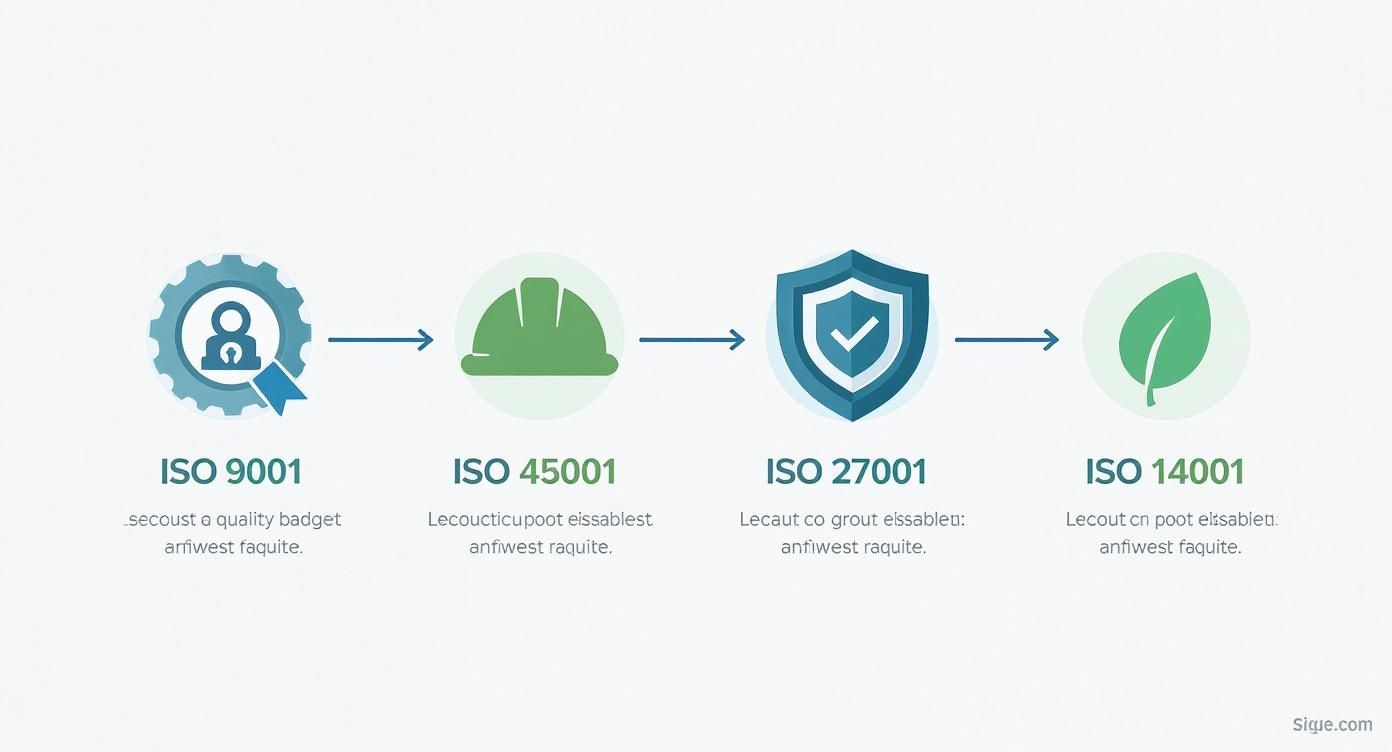
From quality and safety to security and environmental management, each one provides a framework to help you improve.
Phase 3: Implementation and Team Training
With your new system designed, it’s time to bring it to life. Implementation is all about rolling out the new procedures across the business and making sure everyone understands their part. This is where your planning and paperwork become real-world action.
Effective training is the absolute cornerstone of this phase. Your team needs to understand not just what to do, but why it matters. This is how you embed the new processes into your company culture, turning them from a "certification requirement" into "just the way we do things here."
Here are a few tips for a smooth rollout:
- Start Small: Test new procedures in a single department first before a company-wide launch.
- Keep Talking: Use meetings, emails, and training sessions to keep everyone in the loop.
- Listen Up: Create easy ways for employees to ask questions and give feedback on what’s working and what isn’t.
Phase 4: The Internal Audit
Before you call in the external auditors for the final exam, you need to do a practice run. The internal audit is your dress rehearsal. It’s a chance to test your new system to make sure it’s working as intended and hitting every requirement of the standard.
An internal audit is usually done by a trained team member or an external consultant. Its whole purpose is to find any "non-conformities"—areas where you’re falling short—so you can fix them before the official audit. This step isn't just a good idea; it's mandatory and will save you a world of pain later. For a deeper dive, our guide on how to get ISO certified offers more detailed insights into audit preparation.
Phase 5: The Final Certification Audit
This is the moment of truth. An independent, accredited certification body sends an auditor to conduct a formal, two-stage audit to verify that your management system is fully compliant.
- Stage 1 Audit (The Paperwork Check): First, the auditor reviews all your documentation. They're making sure you have a complete and compliant system on paper, with all the necessary policies and procedures in place.
- Stage 2 Audit (The "In-Action" Review): Next, they get hands-on. The auditor visits your site (or connects remotely) to see your system in action. They’ll chat with staff, watch processes, and check records to confirm you’re actually doing what your paperwork says you do.
If you pass the Stage 2 audit with flying colours, you’ll be recommended for certification. The certification body then issues your official certificate, which is typically valid for three years. You’ve done it
Budgeting for ISO and Choosing the Right Certification Body

Let's talk about the practical side of getting ISO certification in Australia: the money and the partners. Getting certified is a serious investment in your business’s future, and like any big project, it needs a realistic budget and the right people on your team.
Sorting out the costs and picking a great certification body from the get-go are two of the most important decisions you'll make. Get this right, and you'll not only save money but also end up with a certificate that actually means something to your clients and competitors.
What Does ISO Certification Really Cost?
First things first: there's no single price tag for ISO certification. The final cost is a mix of a few key factors, all depending on your business's size, complexity, and how much work you’ve already done on your internal processes. It’s a mistake to see this as just another expense; it’s an investment in becoming a better, more efficient business.
Here's what you'll need to account for in your budget:
- Consultancy and Setup: Many businesses bring in an external consultant to build and roll out their management system. If you don't have an ISO guru on staff, this is a smart move. It speeds things up and helps you sidestep common pitfalls.
- Your Team's Time: Even with a consultant, your own people will need to be involved. Their time spent in meetings, on documentation, and in training is a real cost to the business.
- Training: Your team needs to understand the new system and what their role is. This might mean formal courses or just a series of hands-on internal workshops.
- The Audit Fees: This is the fee you pay the certification body to conduct the official audits (Stage 1 and Stage 2) and issue your certificate. These fees usually cover a three-year cycle, which includes the main audit plus annual check-ups.
Realistic Investment Ranges for Australian Businesses
So, what should you realistically expect to spend? While every situation is different, we can give you some ballpark figures. For a small Aussie business with straightforward operations, the total investment for initial certification usually lands somewhere between $5,000 and $15,000.
If you’re a medium-sized business or have more complex systems, you're more likely looking at the $15,000 to $30,000+ range. Remember, these aren't just costs—this is money you'll often make back through new contracts, better efficiency, and fewer costly mistakes. The only way to know for sure is to get detailed proposals. To make this easier, you can get 3 ISO certification quotes from reputable bodies through a single service, which saves a lot of legwork.
The Critical Choice: Your Certification Body
Picking your certification body is probably the single biggest decision you’ll make on this journey. This organisation isn’t just an auditor; they’re a long-term partner. A good one adds real value with sharp insights. A bad one can turn the whole process into a nightmare.
Think of it this way: the credibility of your ISO certificate is directly tied to the credibility of the body that issues it. An unaccredited certificate is like a degree from a dodgy, unaccredited university—it just doesn't carry any weight.
In Australia, there's one thing you absolutely must look for: JAS-ANZ accreditation. The Joint Accreditation System of Australia and New Zealand (JAS-ANZ) is the government-appointed body that gives certification bodies their official seal of approval. A certificate from a JAS-ANZ accredited body is your guarantee of legitimacy. It's recognised by government, big business, and global partners.
Accredited vs. Unaccredited: The Real Difference
You’ll almost certainly come across outfits offering "fast" or "cheap" certification. These are nearly always unaccredited bodies, and frankly, their certificates are often worthless.
Here's why sticking with a JAS-ANZ accredited partner is non-negotiable:
- Real Credibility: A JAS-ANZ accredited certificate is instantly recognised and respected. It’s the one that gets you past the gatekeepers for government tenders and corporate supply chains.
- Proven Competence: Accreditation ensures the auditors know their stuff. They're properly trained, impartial, and conduct fair assessments.
- Global Recognition: JAS-ANZ is part of a global network, so your certificate is just as valid in London or Los Angeles as it is in Sydney.
Choosing an unaccredited provider to save a few bucks is a terrible business decision. You risk being booted from a tender process or damaging your reputation when a sharp client realises your certificate isn't legitimate.
Your Checklist for Choosing the Right Partner
Before you sign on the dotted line, run every potential certification body through this checklist. Ask them these questions directly.
-
Are you JAS-ANZ accredited for our specific standard?
This is the first and most critical question. Get their accreditation number and check it yourself on the JAS-ANZ website. No excuses. -
Do you have auditors who know our industry?
An auditor who understands your world can offer far more valuable feedback than a generalist just going through the motions. -
Can you give us a clear, all-inclusive quote?
Demand a transparent fee structure for the full three-year cycle. This should cover all audit days, travel, and admin fees. Watch out for hidden costs. -
What’s your approach to auditing?
You want a partner who sees audits as a chance to help you improve, not just a pass/fail test. Their job is to make your business stronger.
Making the right choices on your budget and your certification partner will set you up for a smooth and genuinely valuable ISO certification Australia journey.
How ISO Certification Gives You a Serious Competitive Edge
Let’s be honest. Getting ISO certification in Australia isn’t just about ticking a box or hanging a fancy certificate on the wall. It’s a strategic power play. It’s how you move from simply saying you’re committed to quality and security to proving it with a globally respected benchmark.
While your competitors are making promises, you’ll have the proof. This is where your investment starts paying real dividends, turning your operational processes into one of your most powerful marketing tools. Think of it less as a cost and more as an engine for growth that opens doors, builds deep trust, and fortifies your business from the inside out.
Unlock New Markets and Win Bigger Contracts
For many Australian businesses, the most immediate and game-changing benefit is gaining access to work that was previously off-limits. Government tenders—whether federal, state, or local—and major corporations in sectors like defence, tech, and construction often list ISO certification as a non-negotiable prerequisite.
No certificate? You don't even get a seat at the table.
Holding a certification like ISO 9001 for quality or ISO 27001 for information security is like having a master key. It unlocks lucrative opportunities that can completely reshape your company's future. It’s a clear signal to procurement managers that you have solid, audited processes in place, immediately positioning you as a low-risk, high-value partner.
ISO certification elevates your business from the pool of hopefuls to the shortlist of contenders. It’s the formal proof that you operate at the same elite level as the industry leaders you want to work with.
This is especially powerful for small and medium-sized businesses (SMEs). Certification levels the playing field, allowing you to go head-to-head with larger competitors by demonstrating your professionalism and capability in a way that words alone never could.
Drive Operational Efficiency and Boost Your Bottom Line
A true competitive advantage is built from the inside. The journey to certification forces you to put every part of your operation under the microscope, which almost always leads to significant improvements in efficiency and, ultimately, your bottom line.
Take ISO 9001 (Quality Management), for example. Implementing it helps you:
- Slash Waste: Standardising how you do things means fewer errors, less rework, and less wasted material. The savings add up fast.
- Improve Consistency: You deliver a predictable, high-quality result for your customers every single time. That builds fierce loyalty and cuts down on costly complaints.
- Make Smarter Decisions: The standard pushes you to measure your performance, giving you the hard data you need to make intelligent business moves instead of just guessing.
It’s the same story with ISO 45001 for workplace safety. It can drastically lower the costs tied to workplace incidents, reduce downtime, and even lead to lower insurance premiums. All these savings free up cash that you can pump back into innovation, marketing, and growth.
Build an Unshakeable Brand Reputation
In a crowded marketplace, trust is your most valuable currency. ISO certification is one of the fastest and most credible ways to earn it. It acts as an independent, third-party stamp of approval on your commitment to excellence—and that speaks volumes to customers, partners, and investors.
When a potential client sees you’re ISO certified, it instantly answers their unspoken questions:
- Are they professional and reliable?
- Do they genuinely care about quality and safety?
- Can we trust them with our sensitive information?
This foundation of trust leads to a stronger brand and keeps customers coming back. When people know they can count on you, they’re far less likely to be tempted away by a slightly lower price. You can dive deeper into this in our article exploring the benefits of ISO certification.
Future-Proof Your Business with Enhanced Resilience
Business today is anything but predictable. ISO standards give you battle-tested frameworks for managing risk and building the kind of resilience that helps you weather any storm. This proactive strength is a massive competitive differentiator.
For instance, a disruptive event might paralyse a competitor, but because you have certified systems in place—like ISO 22301 for Business Continuity or ISO 27001 for Information Security—you can adapt, recover, and keep operating. You can even turn a crisis into an opportunity to gain market share while others are struggling. An often-overlooked area for boosting this resilience is mastering contracting with suppliers, which solidifies your supply chain.
Ultimately, the competitive advantage from ISO certification Australia isn’t just one thing. It's the ability to win bigger deals, run a leaner operation, build a brand people trust, and stand firm when the market gets shaky. It’s a declaration to the world that your business is built on a foundation of excellence, ready for whatever comes next.
Maintaining Momentum After Your Certification
Getting your ISO certification in Australia is a massive achievement. It's the moment all that planning, hard work, and commitment to being better finally pays off. Pop the champagne, absolutely—but remember, this isn’t the finish line. It’s the starting line.
The real power of ISO isn't in the piece of paper you hang on the wall. It's in the culture of continuous improvement it builds. The trick now is to keep that momentum going, making sure your investment delivers returns long after the final audit is done and dusted.
Understanding the Three-Year Certification Cycle
Your ISO certificate is generally valid for three years. This isn't just an arbitrary expiry date; it’s a structured cycle designed to ensure your management system is a living, breathing part of your business, not just a folder gathering dust on a shelf.
This cycle is built around regular check-ins to keep your systems sharp and your business on track. A classic mistake is to get certified and then forget all about it until the renewal notice lands in your inbox. That’s a surefire way to undo all your good work.
"The moment you receive your certificate is not the end of the process, but the beginning of a continuous improvement journey. A successful management system is one that is actively used, monitored, and refined every single day."
Instead of dreading these check-ins, think of them as an opportunity. They’re a chance to get an expert, third-party set of eyes on your operations, helping you find new efficiencies and spot risks before they blow up into real problems.
What to Expect from Annual Surveillance Audits
To keep your certification active over those three years, your business will have annual surveillance audits. Think of them as a scaled-down version of your initial certification audit, carried out by your certification body once every 12 months.
The point of a surveillance audit is simple: to confirm that your management system is still being properly maintained, that your team is actually following it, and that it's delivering the results it's supposed to. It’s basically a health check to make sure things haven't slipped.
During a surveillance audit, the auditor will usually look at a few key things:
- Key Processes: They’ll check a sample of your core business processes to make sure they still align with the ISO standard.
- Internal Audits: The auditor will want to see that you've been doing your own internal audits as planned and, crucially, acting on what you find.
- Management Reviews: They'll look for evidence that your leadership team is regularly reviewing how the system is performing.
- Corrective Actions: They'll check how you’ve handled any issues or non-conformities that have popped up since the last audit.
These audits aren't meant to be confrontational; they're designed to be helpful. They give you the perfect reason to keep your systems in great shape and ensure the principles of the standard are truly embedded in how you do business.
Embedding the ISO Mindset into Your Company Culture
Ultimately, you want to get past the idea of simply "maintaining compliance." The real goal is to create a culture where the principles of quality, safety, or security are just second nature—it's just "how we do things around here." This is when your management system stops being a set of rules and becomes a genuine engine for growth.
Making that happen takes a real, conscious effort from the top down. It's all about building a workplace where every single person on your team feels empowered to spot a problem and suggest a better way.
Here are a few practical ways to make that a reality:
- Communicate Constantly: Don't stop talking about the "why" behind your ISO system. Regularly share wins, highlight improvements that have come directly from the system, and give a shout-out to team members who are championing the new processes.
- Make Training an Ongoing Thing: A one-off training session during implementation isn't enough. Offer quick refresher courses, create simple guides for new procedures, and build the ISO principles right into your onboarding for every new hire.
- Link It to Performance: Tie adherence to the management system into individual and team performance goals. When people see that following the system is part of how their success is measured, it suddenly becomes a much bigger priority.
- Simplify and Refine: Your system should never be set in stone. Actively ask your team for feedback on what’s working and what’s a bureaucratic nightmare. If a process is clunky, find a smarter, leaner way to get the same result.
By focusing on these strategies, you’ll ensure your ISO certification in Australia becomes so much more than a credential. It will become a fundamental part of your company's DNA, driving efficiency, slashing risk, and giving you a real, sustainable edge for years to come.
Got Questions? Here Are the Answers Most Aussie Businesses Ask
Even with a plan in hand, it’s natural to have a few lingering questions before diving into the world of ISO certification. It’s a big step. Getting straight answers to these common queries is often the final piece of the puzzle needed to move forward with confidence. Let's tackle the questions we hear most often from Australian business owners just like you.
How Long Does This Whole Process Actually Take?
It’s one of the first things everyone wants to know: what’s the timeline? The journey to getting ISO certified isn't a one-size-fits-all deal. The final timeframe really comes down to the size of your business, the complexity of what you do, and how much of a head start you have with your existing processes.
For a small or medium-sized business that’s already got some good systems in place, you could be looking at a timeframe of 3 to 6 months. That’s a pretty realistic target if you're committed and your team is on board.
On the other hand, if you're a larger organisation or you're essentially building your management systems from the ground up, it's smarter to budget for 6 to 12 months. This gives you enough breathing room to do a proper gap analysis, develop your systems thoughtfully, train your people properly, and get through the audit without cutting corners.
Is ISO Certification a Legal Thing I Have to Do?
This is a really common source of confusion. The short answer is no—for most industries in Australia, holding an ISO certificate is not a direct legal requirement. You aren't going to get a fine from the government for not having one.
But here’s the catch: it quickly becomes a commercial requirement. If you want to throw your hat in the ring for government contracts or supply to big players in sectors like defence, IT, or construction, you’ll find that certain ISO certifications are listed as non-negotiable.
So while it’s not technically a law, it’s a rule set by the market. In many high-value sectors, it’s your ticket to entry.
Can My Small Business Really Afford This?
Absolutely. It’s true that getting certified is an investment, not just a small expense. But smart business owners see it as a strategic investment in efficiency, better risk management, and long-term growth—not just another cost. The return nearly always outweighs the initial outlay.
You can manage the costs by being clever about it:
- Take a phased approach. You don't have to do everything at once; spread the investment out.
- Use your in-house talent. Get your team involved in building the system where it makes sense.
- Shop around for your certification body. Look for one with transparent, competitive pricing that suits your budget.
Think about it this way: landing just a single new contract because you have the right certification can often pay for the entire process. It's a financial decision that can pay for itself many times over.
What’s the Difference Between "Certification" and "Accreditation"?
Getting this right is crucial if you want a certificate that actually means something. People often use these words interchangeably, but they represent two very different things in the world of compliance.
Certification is what your business gets. An independent company (the certification body) audits your systems against an ISO standard and, if you pass, issues you a certificate.
Accreditation is what the certification body gets. A higher authority, like JAS-ANZ in Australia, formally checks out the certifier to make sure they are competent, impartial, and qualified to do the audits.
Here’s an analogy: the certification body is like a university handing out degrees. The accreditation body (JAS-ANZ) is like the government department that ensures the university is legitimate and its degrees are worth the paper they're printed on. Always choose a JAS-ANZ accredited certification body to ensure your certificate is credible and respected, both here and overseas.
Can I Get Certified for More Than One Standard at a Time?
Yes, and it’s a brilliant way to be efficient. Many Aussie businesses discover they need a trifecta of certifications: one for quality (ISO 9001), one for safety (ISO 45001), and another for environmental management (ISO 14001).
Rather than tackling them one by one, you can bundle them into a single Integrated Management System (IMS). This approach makes everything much smoother, cuts down on duplicated paperwork, and is almost always more cost-effective. An IMS gives you one unified framework to manage all your compliance needs, which simplifies things enormously day-to-day.
Ready to build a more secure and competitive business? Anitech has over 20 years of experience and a 100% success rate in guiding Australian small businesses through the complexities of ISO 27001 certification. We simplify the entire process, from documentation to final audit, so you can focus on growth. https://iso-27001.com.au
Recent Comments