

Think of an ISO certification consultant as your expert guide through the maze of achieving and maintaining an ISO standard. They're not just auditors; they're strategic partners who translate dense, technical requirements into a clear, manageable roadmap, making sure you ace your certification audit.
What Does an ISO Certification Consultant Actually Do?

Let's be honest, opening an ISO standard document for the first time can be a bit of a shock. It's a wall of text filled with clauses, sub-clauses, and terminology that can make even the most seasoned manager’s head spin. This is precisely where an ISO certification consultant comes in, not as a box-ticking enforcer, but as your navigator.
Picture them as a seasoned sherpa guiding you up a mountain. They know the terrain, the pitfalls, and the most efficient path to the summit. Their job is to take that complex map of ISO standards and create a clear, step-by-step trail tailored specifically for your business. They don’t just hand you a generic checklist; they get into the trenches with you to understand how your business really works.
This deep dive is crucial. It lets them pinpoint the gaps between what you're currently doing and what the standard demands. From there, they help you build a management system that’s genuinely useful for your team—not just a dusty binder of procedures that gets forgotten on a shelf.
Turning Jargon into Everyday Processes
One of the biggest wins of hiring an ISO consultant is their ability to demystify the entire journey. They have a knack for taking abstract concepts and turning them into practical, day-to-day work instructions that make sense to everyone. After all, an ISO system only works if your people on the ground understand it and buy into it.
A great consultant doesn't just get you audit-ready; they help you build a framework that drives real, lasting improvement. The aim is to foster a culture of quality, not just hang a certificate on the wall.
Their work breaks down into a few key stages, all designed to weave the ISO framework into the DNA of your business:
- Initial Gap Analysis: They kick things off with a thorough review of your current systems, policies, and practices to see how you stack up against the ISO standard you’re aiming for.
- System Development: This is where they design and document a management system that not only meets every requirement but also aligns with your business objectives. Think manuals, policies, and clear work guides.
- Implementation Support: They’ll guide your team through rolling out any new processes, offering hands-on help to make the transition smooth and overcome any resistance to change.
- Employee Training: A critical step is educating your staff on their roles within the new system. They ensure everyone understands the ‘why’ behind the ‘what’, which is key for long-term success.
Your Strategic Guide Through the Audit
Beyond building the system, a consultant’s role is to get you ready for the final exam: the certification audit. They act as your coach and advocate during this nerve-wracking phase, ensuring you’re not just compliant, but genuinely confident.
This preparation is more than just a quick pep talk. The consultant will run internal audits that mimic the real thing, finding any weak spots and helping you fix them long before the external auditor shows up. This "dress rehearsal" can mean the difference between passing with flying colours and facing a costly, time-consuming failure.
They also help you choose a reputable certification body, handle the communications, and can even sit in on the audit to support you. This is a massive advantage, as they can help clarify an auditor’s questions and explain the unique context of your business. If you want to understand this partnership better, it's worth exploring the role of an ISO consultant in more detail.
Ultimately, a good consultant helps you see ISO certification not as a chore, but as a powerful tool for boosting efficiency, earning bulletproof customer trust, and driving sustainable growth. They also help businesses make sense of the wider landscape of regulatory compliance. By embedding a mindset of continuous improvement, they leave you with a system that keeps delivering value long after you’ve earned the certificate.
The Real ROI of Partnering with an Expert

When you first look at the cost of hiring an ISO certification consultant, it’s easy to see it as just another big expense. But that's the wrong way to look at it. You need to shift your mindset and see it for what it truly is: a strategic investment in your company’s future.
The real return on investment (ROI) isn't just about getting a certificate to hang on the wall. It's measured in the time you save, the costly mistakes you avoid, and the new business opportunities you unlock.
Trying to get ISO certified on your own is like navigating a minefield without a map. The standards are incredibly complex, and one small misstep can mean a failed audit. That doesn't just delay your certification; it hits your bottom line with re-audit fees and lost productivity as your team scrambles to fix everything under pressure.
An expert consultant helps you sidestep all those common, expensive pitfalls from day one. They've seen it all before, so they know what to expect. They build a compliant, robust system that’s ready for scrutiny, dramatically boosting your chances of passing the first time around.
From Compliance to Competitive Advantage
The most significant ROI comes from how a consultant transforms your entire management system. Instead of slapping together a clunky, bureaucratic process that everyone on your team hates, they help you build a lean, effective framework that genuinely improves how your business runs.
The real goal isn't just to get certified. It's to create a living, breathing system that drives a culture of continuous improvement. That's where the lasting value is found.
A good consultant helps you weave best practices into your everyday workflows. This leads to real, measurable improvements across the board—from less waste and better efficiency to higher product quality and happier customers. These are the operational gains that give you a sustainable edge over your competitors.
The Financial Upside of Expertise
Let's talk numbers. Bringing in an ISO consultant translates into direct financial benefits that, in most cases, far outweigh their fees. Better yet, these benefits compound over time, making it one of the smartest long-term investments you can make.
Here’s how they deliver a strong ROI:
- Fewer Costly Errors: A well-designed system minimises mistakes, defects, and service failures. This directly cuts down on the money you spend on rework, handling complaints, and warranty claims.
- More Efficient Operations: By optimising your processes, a consultant helps you get more done with less. Think faster production cycles, lower resource consumption, and reduced overheads.
- Avoiding Failed Audits: The cost of a failed audit can easily run into thousands of dollars in re-certification fees, not to mention the internal time and resources wasted. A consultant is your best insurance policy against this.
- Opening Doors to New Markets: Many lucrative contracts, especially with government bodies or large corporations, are only open to ISO-certified businesses. Certification isn't just a badge; it's a key that unlocks new revenue streams.
Calculating the True Return
While it’s tricky to put an exact dollar figure on it, the principle is simple. You weigh the consultant's upfront cost against the combined value of the expenses you avoid, the efficiencies you gain, and the new business you win.
For example, the ISO certification consulting market in Australia is booming because businesses realise these standards are essential for credibility. Top firms offer end-to-end support, covering everything from documentation and audit prep to ongoing compliance, which massively reduces the usual cost and headache for Australian companies.
Thinking about ROI extends beyond just ISO, of course. For a different perspective on how business investments pay off, you could even look at something like an automation ROI calculator to see how other strategic decisions are measured.
Fostering a Culture of Continuous Improvement
Perhaps the most valuable return—though the hardest to quantify—is the cultural shift an expert can inspire. They don’t just implement a system and walk away; they train your team and empower them to take ownership. This creates a proactive mindset where people are always looking for better ways to work.
This culture of continuous improvement is a powerful engine for growth. It means your organisation becomes more agile, resilient, and ready to adapt to whatever the market throws at it. Over time, this becomes a core part of your company's identity, sharpening your competitive edge and ensuring you stay ahead of the pack. The partnership pays dividends long after the certificate is issued, embedding a legacy of quality and excellence right into your business's DNA.
How to Choose the Right ISO Certification Consultant
Picking the right ISO certification consultant is hands down the most important decision you’ll make on your certification journey. This isn’t just about hiring another contractor; you’re bringing on a strategic partner who will get right into the nuts and bolts of your business. Get it right, and the process can be smooth, insightful, and genuinely add value. Get it wrong, and you’re looking at wasted time, blown budgets, and a system that just gathers dust.
So, how do you make the right call? You’ve got to look way beyond the price on the proposal. You need a practical, no-fluff way to weigh up what really matters. That means digging into their background, checking their track record, and making sure their style clicks with your company’s own culture and goals.
Ultimately, you're searching for someone who can turn complicated standards into simple, workable solutions, get your team on board, and confidently steer you through the final audit.
Evaluate Industry-Specific Experience
Let's be clear: not all ISO consultants are cut from the same cloth. While many can talk the talk about the standards, the best iso certification consultants have been there and done that in your specific industry. A consultant who’s navigated the quirks of a software development company, for example, will get your challenges in a way someone from a manufacturing background simply won’t.
This industry-specific know-how is gold. They’ll already know the common tripwires, the smartest ways to implement controls, and how to speak your team's language. It saves you from having to explain the basics of your operations and lets them offer genuinely useful advice from day one.
When you’re interviewing them, really press them on this.
- Ask for Case Studies: Get them to show you examples of work they’ve done with businesses like yours—similar in size and sector.
- Discuss Industry Challenges: See if they can talk intelligently about the specific quality or security risks that keep you up at night.
- Verify Their Background: Have a look at their professional history. Have they actually worked ‘in the trenches’ in your field?
A consultant with real experience in your niche will build a management system that feels like it belongs in your business, not some generic template you’ve been forced into.
Vet Their Track Record and References
A good consultant will have a string of happy clients behind them. But don’t just take their word for it—do your own digging. Ask for a list of recent clients you can actually talk to. Sure, written testimonials on a website are a nice start, but a real conversation gives you the unvarnished truth.
When you get a reference on the phone, don’t just ask, "Were you happy with them?" You need to get specific to build a clear picture of what it’s really like to work with them.
A consultant's true value isn't just in the certificate they help you get. It's in the real-world improvements and the positive cultural shift they leave behind. Ask references about the long-term impact on their business.
Get a few questions ready before you call:
- How was their communication throughout the project? Were they easy to get a hold of?
- Did they click with your internal team and fit in with your company culture?
- Were there any surprise costs or delays? If so, how did they handle them?
- And the big one: did the system they helped build actually make your business better?
The answers you get will tell you far more than any glossy brochure ever could.
Analyse Their Methodology and Approach
Every consultant has a process, but the best ones are flexible. Be very wary of anyone pushing a rigid, one-size-fits-all package. Your business is unique, and your ISO management system should reflect that. A great consultant starts by listening—they learn about your current processes before they even think about suggesting changes.
Their approach should be open, collaborative, and practical. They need to be able to clearly map out their process, the key milestones, and exactly what they’ll need from your team at each step. This kind of clarity sets realistic expectations and gets everyone on the same page from the start. A comprehensive suite of ISO consulting services should always deliver a customised plan, never a cookie-cutter solution.
Look for a consultant who is focused on empowering your people. Their real goal should be to build up your team's skills, leaving you with a system you can confidently manage and improve on your own, long after they're gone.
Assess Communication and Cultural Fit
This might sound like a ‘soft skill’, but it is absolutely critical. This consultant is going to be working very closely with your leadership and your staff, often during a time of big change. You need someone who is a brilliant communicator, a good motivator, and a person who genuinely fits with your company culture.
Think about it. If your team is informal and collaborative, a super-corporate, rigid consultant might just rub everyone the wrong way. That friction can create resistance and sink the whole project. The consultant has to be able to build trust and rapport with everyone, from the CEO down to the frontline staff.
During your first few conversations, pay close attention to how they interact. Are they clear and direct? Do they listen more than they talk? Do they seem genuinely invested in helping your business succeed? A good cultural fit is the glue that holds a successful partnership together.
Red Flags to Watch Out For
Knowing what to look for is only half the battle; you also need to know what to avoid. Certain promises and behaviours should set off alarm bells immediately, telling you to walk away. To protect your investment, you have to be on the lookout for consultants who promise the world but can’t deliver.
Here's what to watch out for:
- Iron-Clad 'Guarantees' of Certification: No legitimate consultant can guarantee you'll be certified. That final decision always lies with the independent, third-party auditor. A consultant can guarantee the quality of their work and your readiness for the audit, but guaranteeing the outcome is unethical and a major red flag.
- Vague or Opaque Pricing: You should always get a clear, itemised proposal that breaks down all the costs. Be cautious if they’re cagey about their fees or use fuzzy language that could hide extra expenses down the track.
- High-Pressure Sales Tactics: A confident professional will give you the time and space you need to make a smart decision. If you feel like you're being rushed into signing a contract, it’s a good sign their focus is more on their sales targets than on your success.
- Lack of Customisation: If their proposal looks like a generic template and they don’t seem interested in your specific operational needs, they’re probably just selling a pre-packaged product. That’s not going to serve you well in the long run.
To help you stay organised during your search, use this checklist to compare your options and make a confident choice.
ISO Consultant Evaluation Checklist
Use this checklist to systematically vet potential ISO consultants. The goal is to go beyond their sales pitch and uncover how they truly operate, ensuring you find a partner who is the right fit for your specific needs.
| Evaluation Area | Key Questions to Ask | Ideal Response Indicators |
|---|---|---|
| Industry Experience | Can you provide case studies from our industry? What are the biggest compliance challenges you see for a business like ours? | They provide relevant, specific examples. They speak fluently about your industry's unique risks and operational realities. |
| Track Record | Could we speak to 2-3 recent clients? What is your audit success rate on the first attempt? | They readily provide references. They are transparent about their success rate and can explain any instances where clients needed a second try. |
| Methodology | What does your process look like from start to finish? How do you tailor your approach to our specific business needs? | They outline a clear, collaborative process. They emphasise understanding your business first before implementing solutions. |
| Team Involvement | Who from our team will you need access to, and for how long? How will you help get our employees on board with these new processes? | They provide a realistic estimate of time commitment. They talk about training, communication, and making the system user-friendly. |
| Cultural Fit | How would you describe your working style? How do you handle disagreements or pushback from a client's team? | Their style aligns with your company culture (e.g., collaborative vs. formal). They show emotional intelligence and a focus on partnership. |
| Pricing & Scope | Can you provide a detailed, itemised quote? What is explicitly not included in this price? Are there any potential additional costs? | You receive a transparent, all-inclusive quote with no hidden fees. They are upfront about what constitutes out-of-scope work. |
| Long-Term Value | How do you ensure we can manage this system ourselves after you leave? What kind of post-certification support do you offer? | They talk about knowledge transfer and empowering your team. They offer ongoing support options but don't create dependency. |
After running your top candidates through this checklist, you should have a much clearer picture of who can deliver not just a certificate, but a management system that strengthens your business from the inside out.
Choosing the right ISO certification consultant really does set the tone for the entire project. By methodically checking their experience, their process, and their cultural fit, you give yourself the best shot at finding a true partner who will guide you to a successful and valuable certification.
Understanding Consultant Services and Pricing
When you start getting proposals from ISO certification consultants, it can feel like you're trying to compare apples and oranges. Each quote will look a little different, highlighting various services and using its own pricing model. The key is to decode these proposals so you can make a smart, financially sound decision for your business.
The real goal is to look past the top-line number and see the true value on offer. A cheaper quote isn't always better, especially if it leaves out critical support that you'll just end up paying for later. This section will give you a transparent breakdown of what to expect, helping you read between the lines and budget with confidence.
The Core Spectrum of Consultant Services
Most reputable consultants offer a suite of services designed to get you from square one to successful certification and beyond. While they might package them differently, the core offerings generally fall into a few key categories. Knowing these helps you figure out what’s essential for your project versus what might just be a nice-to-have.
Here’s what you should typically expect to see in a proposal:
- Initial Gap Analysis: This is always the first step. The consultant dives deep into your current processes, paperwork, and systems to see how they stack up against the ISO standard. You'll get a detailed report that clearly outlines your strengths, weaknesses, and a solid action plan.
- Documentation Development: Let's be honest, this is one of the most labour-intensive parts of getting certified. A consultant will work with you to draft the necessary policies, procedures, and records that are not only compliant but actually practical for your team to use day-to-day.
- Implementation and Training: A good consultant doesn’t just hand you a stack of documents and walk away. They help you roll out the new system. This means training your staff on the new processes and their roles, which is absolutely crucial for getting everyone on board.
- Internal Audit: Think of this as a dress rehearsal before the final exam. The consultant performs an internal audit to mimic the real thing, sniffing out any non-conformities so you can fix them before the official auditor shows up.
- Certification Body Liaison: A seasoned consultant can help you choose an accredited certification body and will often manage the communication for you. They can even be present during the external audit to provide support and help answer any tricky questions the auditor might have.
Decoding Common Pricing Models
Once you know what services you need, the next puzzle is figuring out how they’re priced. Consultants usually use one of three main models, each with pros and cons depending on your project's scope. Getting your head around these will help you compare quotes fairly and choose the model that best suits your budget.
The right pricing model gives you clarity and predictability. You’re looking for a structure that reflects the consultant’s value, not just their time, so there are no nasty financial surprises down the track.
Let's break down the most common structures you'll come across.
Fixed-Project Fees
This is often the go-to model for businesses seeking certification. The consultant gives you a single, all-in price for the entire project, from the initial gap analysis right through to celebrating your successful certification.
- Pros: It offers complete budget certainty. You know the total cost upfront, which makes financial planning a breeze and removes the risk of costs spiralling out of control.
- Cons: The consultant has to price in a buffer for any unexpected issues, so the upfront cost might seem a bit higher. It also offers less flexibility if your project needs a major change of direction halfway through.
Daily or Hourly Rates
With this model, you're paying for the consultant's time, usually at a set daily or hourly rate. It’s pretty common for smaller, well-defined jobs, like a standalone gap analysis or providing some quick advice.
- Pros: It can be very cost-effective for short-term tasks where you know exactly what needs to be done. You only pay for the time used, which is great.
- Cons: This model comes with a big risk of unpredictable costs. Without a firm cap, the total bill can easily blow your budget if the project drags on longer than expected.
Ongoing Retainers
A retainer model means you pay a fixed monthly fee for ongoing access to the consultant’s expertise. This is most common for post-certification support, like managing internal audits, helping with management reviews, or just keeping the system up-to-date.
- Pros: It ensures you have continuous expert support to maintain and improve your management system. This is essential for keeping your certification and getting long-term value from it.
- Cons: It's not really designed for the initial certification project itself and can become an unnecessary expense if you don't actually use the consultant's time each month.
Understanding the Market Value
The investment in an ISO consultant makes sense when you see the growing demand for quality and security standards across Australia. The Australian corner of the ISO certification market recently hit an estimated value of USD 122.7 million, with massive growth driven by standards like ISO 9001 and ISO 27001.
This is all part of a bigger trend across the Asia Pacific region, which is expected to see market revenue climb from USD 2.1 billion in 2021 to over USD 3.6 billion by 2025. This demand, fuelled by customer expectations and new regulations, is what underpins the value expert ISO certification consultants bring to the table.
When you're looking at a proposal, think beyond the price tag. Consider the depth of service and the expertise being offered. For a more detailed breakdown of all the costs involved, our guide on the ISO 27001 certification cost has some valuable insights to help you budget accurately. By understanding both the services and the pricing, you'll be in a great position to choose a partner who delivers real, lasting value.
Your Step-by-Step Certification Journey with a Consultant
Thinking about getting ISO certified? It can feel a bit like you’re about to climb a mountain. You know where you want to end up—at the summit, with your certificate in hand—but the path ahead looks steep, rocky, and full of technical jargon. This is precisely where a good ISO consultant steps in. They’re not just a guide; they’re an experienced sherpa who turns an intimidating expedition into a clear, manageable climb.
Instead of seeing it as one massive project, we break it down into a series of logical stages. With a consultant leading the way, each step has a clear goal, defined tasks for your team, and real milestones to track your progress. It’s a structured approach that takes all the guesswork out of the equation, giving you a reliable roadmap from your starting point to a successful audit.
Phase 1: Discovery and Gap Analysis
First things first: you can't plan a route until you know exactly where you are on the map. The journey always begins with a deep-dive diagnostic of your business, what we call the Discovery and Gap Analysis.
Your consultant will roll up their sleeves and get to know your organisation inside and out. They'll review your current processes, sift through your documentation, and observe your day-to-day operations. Then, they’ll meticulously compare everything you do against the specific clauses of the ISO standard you're aiming for. This isn't just a quick once-over; it's a forensic examination to find every single gap between your current state and what the auditor will be looking for.
The main outcome of this phase is a detailed gap analysis report. Think of this document as the architectural blueprint for your entire project. It will clearly show you:
- What you're already doing right: The areas where your systems already tick the box for compliance.
- Where the gaps are: The specific processes or documents that fall short and need work.
- A clear action plan: A high-level strategy outlining exactly how you’ll close those gaps.
During this stage, your team's job is simple: be open. The more information and access you provide, the more accurate the analysis will be, which sets everyone up for a much smoother ride later on.
This visual shows the typical high-level process flow an ISO certification consultant follows, starting with analysis and moving through development and training.
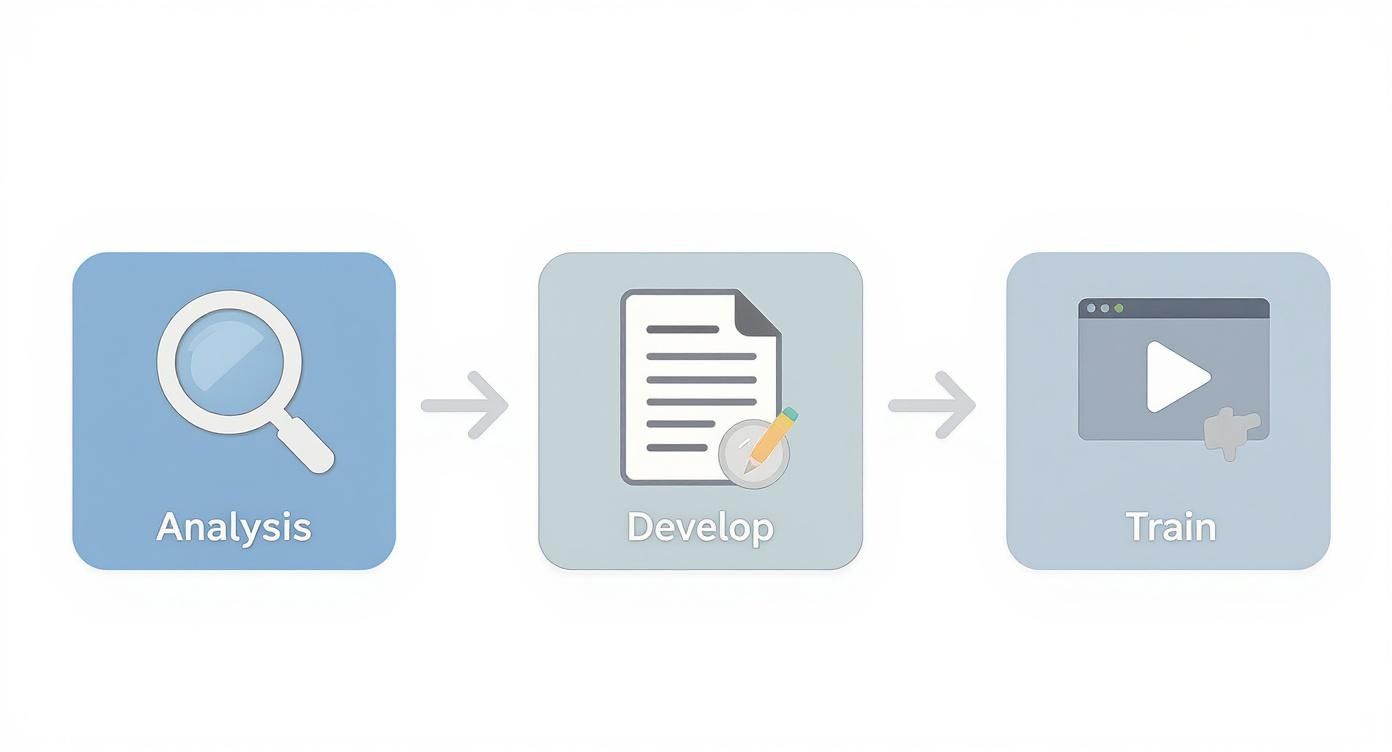
As you can see, it’s all about logical progression. A solid foundation is built first, which makes the implementation phase so much more effective.
Phase 2: System Design and Implementation
Once we know where all the gaps are, it’s time to start building the bridges. In the System Design and Implementation phase, your consultant switches hats from analyst to architect. Together, you'll design and build a management system that's not only compliant but also practical for your business.
This is where much of the heavy lifting takes place. Guided by the gap analysis report, the consultant will help you create and document the policies, procedures, and records you need. A truly skilled consultant won’t just hand you a stack of templates; they’ll work with you to weave these new processes into the fabric of your existing operations, so it feels like a natural improvement, not a bureaucratic burden.
The real aim here isn't just to create a system that will pass an audit. It's to build a framework that genuinely makes your business better—more efficient, more consistent, and ultimately, more resilient.
Your team’s input here is absolutely vital. The consultant brings the ISO expertise, but your people bring the on-the-ground knowledge of how things really get done. It's this collaboration that ensures the final system is practical, user-friendly, and something your staff will actually use. Key wins in this phase include getting the core documentation drafted, rolling out new ways of working, and kicking off the initial training.
Phase 3: Internal Audits and Management Review
Before you step into the ring for the main event, you need a full dress rehearsal. That's what the Internal Audits and Management Review phase is all about. It’s your chance to pressure-test the new system, find any weak spots, and fix them before the external auditor shows up.
Your consultant will usually lead the first internal audit, acting as a friendly but firm assessor. They'll put your system through its paces to see if it holds up against the standard. This involves:
- Planning the audit: Deciding what to check and how, ensuring all critical parts of the business are covered.
- Conducting the audit: Talking to staff, checking records, and watching processes in action to see if people are doing what the procedures say they should be doing.
- Reporting the findings: Creating a clear report that highlights any non-conformances (a fancy word for problems) or opportunities for improvement.
After the audit, your consultant will guide you through the Management Review. This is a formal meeting where the leadership team gets together to look at the audit results and the overall health of the management system. It's a mandatory part of any ISO standard, proving that management is actively involved and committed. It’s the perfect opportunity to make any final tweaks and ensure the system is truly working for the business.
Phase 4: The External Certification Audit
This is it—the final hurdle. The External Certification Audit is where you prove to an independent, accredited certification body that your system is the real deal. After all the preparation with your consultant, you and your team will be more than ready for this two-stage event.
Stage 1 Audit: Think of this as a readiness check. The auditor will mostly review your documentation to make sure you have a complete system on paper that covers all the requirements of the standard. It’s their way of confirming you’re ready for the main audit.
Stage 2 Audit: This is the big one. The auditor will visit you (either on-site or remotely) and do a deep dive into your operations. They’ll interview your team, review records, and observe your processes to verify that your system is a living, breathing part of your company culture—not just a folder on a shelf.
Your consultant's value here is immense. They can help you choose the right certification body, get all your ducks in a row for the auditor, and can even be there on the day to offer support and guidance. Their expert preparation ensures your team feels confident and knows exactly how to showcase the great work they've done.
Once you pass, you’re officially awarded your ISO certification—a powerful statement of your organisation's commitment to quality and excellence.
Your Top Questions About ISO Certification Consultants, Answered
Stepping into the world of ISO certification naturally brings up a lot of questions. As a business owner, you need straight answers to feel confident about where you're putting your time and money. This section cuts through the noise to tackle the most common queries we hear from leaders just like you.
Think of this as the final piece of the puzzle. We’ll cover everything from realistic timelines to the nitty-gritty of what resources you'll need on your end. The goal is to give you a clear, honest picture of the journey ahead so you can move forward with a solid plan.
How Long Does ISO Certification Take with a Consultant?
It’s the first question on everyone's mind: "So, how long is this actually going to take?" The honest answer is, it varies. The timeline really depends on the size of your business, how complex your operations are, the specific ISO standard you’re after, and frankly, how organised your current systems are.
But here’s the good news: bringing an experienced ISO certification consultant on board dramatically speeds things up. They provide a clear roadmap and expert navigation, helping you sidestep the common pitfalls and delays that trip up businesses trying to go it alone.
As a general rule of thumb, a small to medium-sized business is usually looking at a timeline of 6 to 12 months.
- Smaller companies with fairly straightforward processes might land on the faster end of that scale, often around 6-8 months.
- Larger organisations, especially those with multiple locations or intricate operations, should probably budget for 9-12 months, maybe even a bit longer.
A great consultant keeps the momentum going. They manage the initial gap analysis, documentation, and implementation phases with an efficiency that’s hard to replicate internally. Without that expert hand on the tiller, it's easy for these projects to drift and drag on for much longer than necessary.
What Internal Resources Will We Need to Dedicate?
While a consultant handles the heavy lifting when it comes to ISO expertise and project management, getting certified is always a team sport. You’ll definitely need to dedicate some of your own team's time to the project. Your consultant is there to make the process efficient, not to do it all in a vacuum.
The single most important internal resource is a dedicated project champion. This is your go-to person on the inside—often a manager or department head—who will work hand-in-glove with the consultant, coordinate tasks, and make sure the project gets the internal attention it deserves.
Beyond that, you should plan for:
- Management Commitment: Your leadership team needs to be visibly involved, especially when it comes to the crucial management review meetings.
- Staff Time: Different team members will need to be available for interviews, give their input on new procedures, and take part in training.
- Implementation Effort: Ultimately, your team is responsible for weaving the new processes into their day-to-day work.
A great consultant knows you still have a business to run. They work hard to minimise disruption, skilfully integrating the ISO project into your existing workflows so it feels like an upgrade, not an interruption.
What Is the Difference Between ISO 9001 and ISO 27001?
It’s common for businesses new to certification to get a bit tangled up in the different standards, especially the two big ones: ISO 9001 and ISO 27001. While they’re both frameworks for managing your business better, they focus on completely different things. Getting this distinction right is crucial for picking the standard that actually helps your business.
Here’s a simple way to think about it: ISO 9001 is about the quality of what you deliver, while ISO 27001 is about the security of how you deliver it.
ISO 9001 Quality Management
ISO 9001 is the global benchmark for a Quality Management System (QMS). At its heart, it’s all about helping your organisation consistently deliver products and services that make customers happy and meet all the necessary regulations.
- Focus: Customer satisfaction, making processes more efficient, and always looking for ways to improve.
- Who needs it: Any business wanting to elevate its operational quality, win tenders that list it as a requirement, or simply prove its commitment to being the best. For instance, manufacturers use it to guarantee product consistency and safety.
ISO 27001 Information Security Management
ISO 27001, on the other hand, is the standard for an Information Security Management System (ISMS). Its entire purpose is to help organisations lock down their information and protect it from threats.
- Focus: Safeguarding the confidentiality, integrity, and availability of data through a smart risk management approach.
- Who needs it: Any business that handles sensitive information—think tech companies, financial services, healthcare providers, and government contractors. It’s about earning trust by proving you can keep their data safe.
The right choice comes down to your priorities. Are you laser-focused on improving your product and delighting customers? ISO 9001 is your ticket. Is protecting client data your number one concern? Then ISO 27001 is the one you need. A good consultant will help you figure out which standard—or even a combination of them—will give you the biggest bang for your buck.
Can a Consultant Guarantee We Will Pass the Audit?
This is a big one, and the answer is a straight-up no—and you should be very cautious of any consultant who tells you otherwise. No professional, ethical ISO certification consultant can ever guarantee you’ll pass.
Why? Because the final call is always made by an independent, third-party auditor. They are the impartial judge who decides if your system truly meets every single requirement of the standard.
What a top-tier consultant can guarantee is the quality of their work. They’ll guarantee that they will build a fully compliant system, prepare your team inside and out for the audit, and give you the absolute best possible chance of passing the first time. The best firms have a 100% success rate, meaning every single one of their clients achieves certification. That track record is the closest thing to a guarantee you’ll ever find.
What Happens After We Achieve Certification?
Getting that ISO certificate is a huge milestone, but it’s not the finish line. It’s the start of an ongoing commitment to being a better business. Your certificate is usually valid for three years, and keeping it requires a bit of upkeep. An ISO system isn't something you can just "set and forget."
Once you’re certified, you’ll need to:
- Conduct Regular Internal Audits: You have to keep checking your own system to make sure it’s still working effectively and staying compliant.
- Hold Management Reviews: Your leadership team must meet regularly to review how the system is performing and spot opportunities for improvement.
- Undergo Surveillance Audits: The certification body will pop in for annual (or semi-annual) "surveillance audits" to ensure you're maintaining the standard. They’re less intense than the initial audit.
- Recertification Audit: At the end of the three-year cycle, you'll have a full recertification audit to renew your certificate for another three years.
This cycle is where continuous improvement truly comes to life. Your consultant can help you build a simple, sustainable plan to manage all this, often through an ongoing support service. This ensures your system doesn't just stay compliant, but keeps evolving and adding real value to your business long after you’ve hung the certificate on the wall.
At Anitech, we specialise in making the ISO certification process straightforward and successful for Australian businesses. With a proven 100% success rate, our experienced consultants provide the expert guidance you need to not only achieve certification but also build a stronger, more resilient organisation. Ready to take the next step? Visit us at https://iso-27001.com.au to learn more.
Recent Comments