

Finding the right ISO certification experts isn’t about passing a test. Think of it as a strategic investment in your business’s long-term resilience and hard-won reputation. The best experts become true partners, weaving robust security practices into the very fabric of your operations. This turns a simple compliance task into a powerful competitive edge.
Why an ISO Partner Is More Than Just an Auditor
Before you even start looking for an ISO 27001 expert, you need to get your head in the right space. Too many businesses see this as a box-ticking exercise to keep a client happy or satisfy a regulation. This mindset inevitably leads them down the path of finding the cheapest or quickest option, which often results in a flimsy, paper-thin implementation that offers zero real-world protection.
The reality is completely different. Bringing in genuine ISO certification experts is a strategic move to strengthen your business from the inside out. They aren't just auditors who turn up with a checklist; they're the architects of your entire information security framework.
A true ISO partner doesn't just get you a certificate for the wall. They help you build a lasting culture of security that protects your assets, deepens client trust, and ultimately fuels your growth.
This distinction is everything. Imagine a consultant who just gets you over the line for an audit. Your systems might look okay on paper, but they’re brittle, leaving you wide open to the very risks you thought you were managing.
Now, picture a strategic partner. This expert gets in the trenches with your team. They take the time to understand your specific operational risks, genuinely bolster your defences against threats, and help you build unshakeable trust with your clients.
The Strategic Value in High-Stakes Industries
Let’s look at what this means in sectors where data is gold. For a fintech startup, a properly implemented ISO 27001 system isn't about compliance—it's the very foundation of customer trust. A single data breach could be fatal, not just financially, but to their reputation.
A strategic partner helps this startup to:
- Embed Security into Development: They make sure security protocols are baked into the software development lifecycle from day one, not bolted on as an afterthought.
- Navigate Complex Regulations: They bring clarity to the tangled web of financial regulations, ensuring the information security management system (ISMS) covers every requirement.
- Prove Due Diligence: The certification becomes a potent sales tool, demonstrating to big enterprise clients and investors that their data is in the safest possible hands.
It's a similar story for a SaaS company handling sensitive user data. Working with seasoned ISO certification experts gives them a huge competitive advantage. They can breeze through security questionnaires from potential clients, which shortens sales cycles and opens doors to new markets. Suddenly, the certification is no longer a cost centre; it's a revenue driver.
A Growing Priority in Australia
This strategic approach is becoming essential for businesses right across Australia. We’re all navigating a complex world of increasing regulatory pressure and sky-high customer expectations around data protection. For financial institutions and tech companies, ISO/IEC 27001:2022 certification is a top priority because they know it’s about more than just firewalls.
It’s about creating comprehensive policies, solid processes, and ongoing staff training to protect all information, from digital files to paper documents. You can learn more about the growing emphasis on ISO certification in Australia and see how it’s shaping different sectors.
Ultimately, the aim is to shift your security posture from a reactive defence to a proactive asset. The right partner will help you embed security so deeply into your company’s DNA that it becomes second nature. This proactive stance doesn't just manage risk—it builds a resilient organisation ready to face whatever comes next with complete confidence.
What Real ISO Expertise Actually Looks Like
It's easy to feel lost in a sea of consultants all claiming to be the best. Their websites look slick, their promises are big, but how do you tell the genuine ISO certification experts from the polished salespeople?
The secret is to look past the marketing spiel and focus on hard, verifiable proof of their skills.
Real expertise isn't about a generic PowerPoint deck. It's about deep, industry-specific knowledge that translates into practical, battle-tested advice. A true expert has lived through the messy realities of an ISO 27001 implementation and can steer you around the pitfalls you don't even see coming.
Beyond the Certificate: The Mark of a True Partner
The first sign of a genuine expert is their focus on what happens after the audit. Anyone can help you cram for an exam, but a real partner wants to build a resilient security posture that will actually protect your business for the long haul.
They get that ISO 27001 is a cycle of continuous improvement, not a one-and-done project.
Their conversation will quickly move beyond just passing the audit. They'll start talking about building a security-aware culture, weaving the Information Security Management System (ISMS) into your daily operations, and making sure your team can maintain compliance long after the certificate is on the wall. A truly competent ISO partner will have a deep understanding of core areas like cyber security risk management strategies, which are the absolute foundation of ISO 27001.
A genuine expert prepares you for the journey, not just the destination. Their goal is to make themselves redundant by empowering your team to own the security framework long-term.
This forward-thinking approach is a dead giveaway. It shows they see your business as a long-term relationship, not just another project to tick off their list.
Asking Questions That Cut Through the Noise
Your initial calls with potential consultants are your chance to dig beneath the surface. Forget asking about their 'process'. It's time to ask tough, situational questions that force them to draw on actual, hands-on experience.
Here are a few powerful questions to get you started:
- Industry Scenarios: "We're a SaaS company handling sensitive healthcare data. What are the top three ISO 27001 controls you see firms like ours really struggle with, and how would you guide us through them?"
- Problem-Solving Skills: "Tell me about a time an ISO 27001 implementation you were leading went off-track. What was the root cause, what specific steps did you take to fix it, and what was the final outcome?"
- Life After Certification: "How do you help our team maintain momentum and compliance in the year after we get certified? What does that support actually look like in practice?"
- Auditor Relationships: "Can you describe your experience with certification bodies? How do you prepare a client for the Stage 1 and Stage 2 audits to make sure it's a smooth process?"
Their answers will tell you everything. Vague, textbook responses are a massive red flag. You're listening for specific stories, detailed explanations, and clear proof that they've been in the trenches and know how to handle real-world challenges.
Verifying Their Niche Experience
General ISO 27001 knowledge just doesn't cut it. The risks facing a financial services firm are worlds apart from those facing a logistics company. You need an expert who speaks your language and understands the unique pressures and regulatory landscape of your specific industry.
Don't be shy about digging into their client history:
- Have they worked with other businesses of your size and in your sector?
- Can they provide anonymous case studies that mirror your specific challenges?
- Do their testimonials come from companies you recognise and respect?
An expert with relevant experience will be able to anticipate your needs and provide tailored solutions, not a one-size-fits-all template. This is especially important in Australia, where the certification landscape is quite diverse and requires a subtle, experienced approach.
Top-tier consultants know how to navigate the ecosystem of accredited providers in Australia. The best certification bodies focus heavily on getting top management on board—a critical success factor—and they look for a holistic understanding of the ISO standards, not just box-ticking. An experienced consultant will have established relationships and know exactly what different auditors are looking for.
By focusing on these tangible indicators—their long-term vision, the specifics of their answers, and their proven industry experience—you can confidently cut through the noise. This rigorous approach helps you build a shortlist of true ISO certification experts who will deliver real, lasting value to your business.
Vetting Potential Experts: From Case Studies to Reference Calls
You’ve whittled down your options and have a shortlist of potential ISO certification experts. This is where the real detective work starts. It's time to move past the glossy brochures and confident sales pitches to figure out who can actually walk the talk.
You're looking for proof, not just promises. This means getting your hands on case studies that actually resonate with your business and making reference calls that give you the real story, not just a rehearsed speech.
This is the fork in the road. You can try to navigate the ISO maze alone, or you can bring in a guide who knows the shortcuts and the pitfalls.
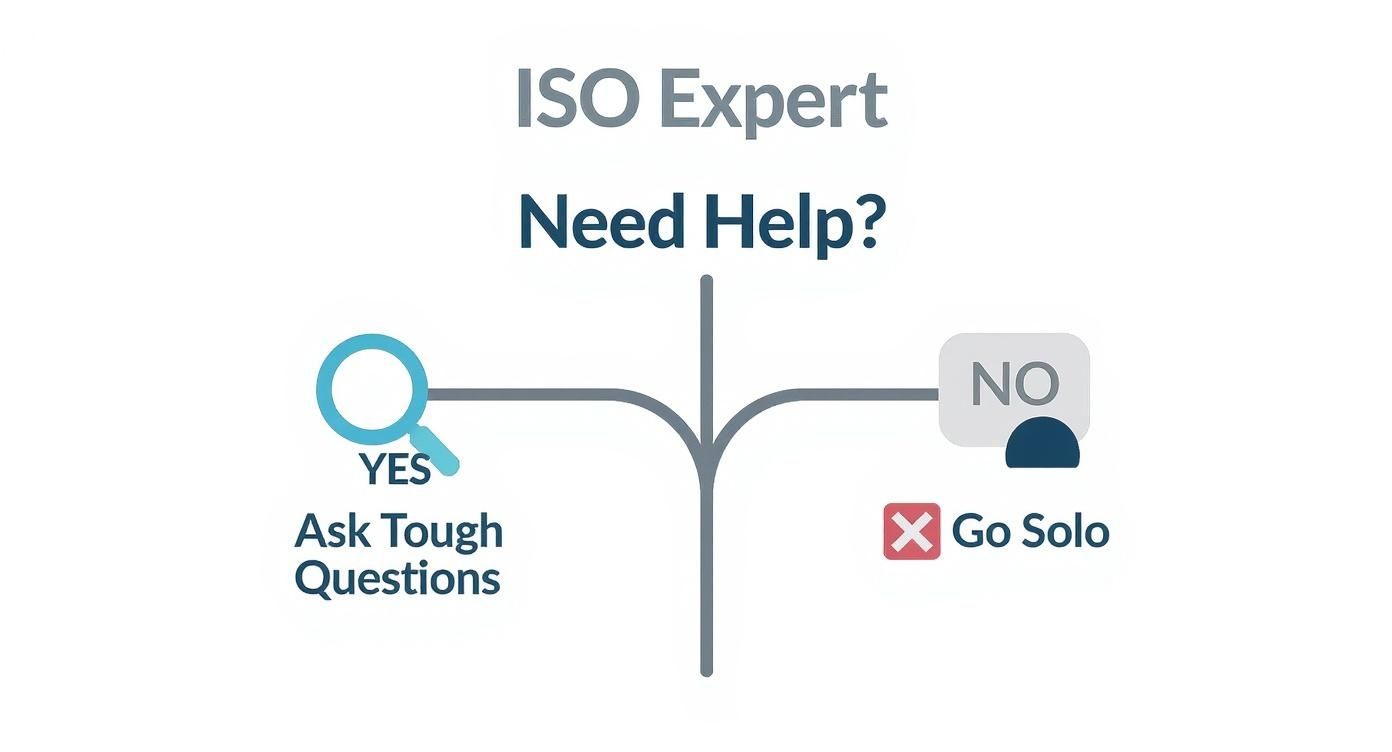
If you decide on getting help, your focus immediately shifts to asking the tough, probing questions. That’s the foundation of a great partnership.
Digging Into Their Past Work (The Right Way)
First up, ask for case studies. But don't just accept anything they send over. Be specific. You need to see examples relevant to your business size, your industry, and the specific headaches you're trying to solve. A story about how they helped a multinational bank is pretty useless if you're a growing Aussie tech start-up.
Ask for two or three solid examples of clients who were standing right where you are now. As you read through them, keep an eye out for:
- The "Before" Snapshot: Did they paint a clear picture of the client's problems? You want to see details about messy documentation, ad-hoc security processes, or maybe pressure from a huge new client demanding certification.
- Their Role in the Fix: What did they actually do? The case study should lay out their process—from the initial gap analysis and risk assessments right through to how they ran employee training. Vague descriptions are a red flag.
- The Results (with Numbers): What changed for the better? "Achieved certification" is the bare minimum. Look for real metrics like a reduction in audit findings, faster onboarding of new enterprise clients, or specific security improvements they can point to.
A great case study tells a story of genuine change. It gives you a peek into how the consultant thinks and solves problems out in the real world.
Making Reference Checks That Actually Tell You Something
Reference checks are your secret weapon, but only if you use them correctly. Don't waste your time with a lazy, "So, were you happy with them?" That just gets you a polite "yes" and you've learned nothing. You need to get to the heart of what it was really like working with them.
When you get their past clients on the phone, your questions need to be sharp and specific.
A reference check isn’t just a box to tick; it’s an interview. You’re trying to understand their process, how they communicate, and what happens when things inevitably go a bit sideways.
Forget the generic stuff. Try asking these instead:
- Getting Started: "How did the consultant fit in with your team? Did they feel like an outsider, or did they become a genuine extension of your crew?"
- Handling Bumps in the Road: "Can you tell me about a specific challenge or disagreement that came up? How did they handle it, and what was the outcome?"
- Leaving You Stronger: "What was their approach to training? Do you feel like your team is now fully capable of managing the ISMS on their own?"
- The Million-Dollar Question: "Knowing what you know now, what's the one piece of advice you’d give me before I sign on the dotted line with them?"
The answers you get here will tell you more than any polished proposal ever could. You'll get a true sense of their style, their problem-solving chops, and whether they empower your team for the long haul.
Looking Beyond the Price Tag
Finally, it’s time to weigh up the total value, not just the cost. Let’s be honest, the cheapest quote is rarely the best deal. A low initial price can easily hide future pain, like a failed audit, a flimsy security system, or processes your team can't possibly maintain on their own.
To make a smart choice, you need to compare them across several key factors. This is where a simple scorecard can be a game-changer, helping you make an objective, side-by-side comparison.
ISO Expert Evaluation Scorecard
Use this scoring framework to compare potential ISO certification experts based on key criteria beyond just the initial cost.
| Evaluation Criteria | Expert A | Expert B | Expert C |
|---|---|---|---|
| Industry-Specific Experience | |||
| Case Study Relevance & Quality | |||
| Reference Check Feedback | |||
| Proposed Methodology & Timeline | |||
| Team Training & Knowledge Transfer | |||
| Communication Style & Culture Fit | |||
| Total Cost vs. Perceived Value |
A scorecard like this helps you cut through the noise and gut feelings, allowing you to make a decision based on what really matters for your business's future. By combining what you've learned from case studies, deep-dive reference checks, and this kind of balanced evaluation, you can confidently pick the ISO certification experts who will be a true partner in your success.
Decoding the Financial Investment in Expertise

Let's get straight to the point: money. For most small businesses, the cost of bringing in an expert can feel like a massive hurdle. But looking at it as just another expense is a trap.
You need to reframe this. It's not a cost; it’s a strategic investment in the future of your business.
Hiring genuine ISO certification experts isn’t about paying someone to tick a few boxes for you. It’s an investment in your company’s resilience, its reputation, and its ability to grow. The money you spend upfront will pay you back long after the certificate is hanging on the wall.
Breaking Down the Costs You Can Expect
When you start asking for quotes, you’ll notice a few different line items. It's absolutely crucial to understand what each one covers so you can compare apples with apples. Don't just glance at the final figure—dig into the value behind it.
Most fee structures will fall into three main buckets:
- Consultancy Fees: This is the big one. It covers the expert's time, knowledge, and hands-on support through the whole process. Think gap analysis, risk assessments, policy writing, staff training, and being by your side during implementation.
- Software and Tools: A good consultant will likely recommend specific software to manage your documentation, track risks, or monitor compliance. While these are often separate costs, they are vital for keeping your system running smoothly long-term.
- Certification Audit Fees: This fee is paid directly to an accredited, third-party certification body. Your consultant gets you ready for the audit, but the auditor has to be independent to keep things impartial.
Getting your head around this breakdown is the first step toward a smart decision. It clarifies where the real value is and helps ensure there are no nasty surprises down the track. If you're building a budget, it's also worth exploring a detailed breakdown of what contributes to the final ISO 27001 certification cost to get a clearer picture.
Connecting the Investment to Tangible ROI
So, where's the return on this investment? It’s not just about getting a shiny certificate. The real payoff comes from slashing risks, boosting efficiency, and unlocking new business opportunities.
Just think about the potential cost of a single data breach. You’ve got the immediate financial penalties, sure, but the damage to your reputation can be catastrophic, costing you major clients and future revenue for years to come. An expertly implemented Information Security Management System (ISMS) drastically lowers this risk.
The cost of expert guidance is a fraction of the cost of a single, preventable security incident. It's proactive protection versus reactive panic.
This kind of proactive investment is becoming a huge deal in the Australian market. Projections for 2025 show the local ISO certification market is set to hit around USD 122.7 million, a significant slice of the wider Asia-Pacific region. This growth is being fuelled by businesses investing in compliance to get a competitive edge, both here at home and overseas.
Real-World Scenarios: The Payoff in Action
Let's move from theory to reality.
Picture a small software development company in Sydney. They’re bidding for a huge contract with a major bank, but the bank's procurement team won't even consider their proposal without ISO 27001 certification. By investing in an expert, they don't just get a certificate; they build a security framework that genuinely impresses the bank's due diligence team. They win the contract, and the return on their investment is almost immediate. The expert's fee is dwarfed by the value of this new, long-term client.
Here's another one. A Melbourne-based e-commerce business was drowning in inefficient, ad-hoc security processes. Their IT team spent all their time reacting to minor issues and manually managing access controls. After hiring an ISO expert, they were forced to formalise and automate many of these processes. The result? A massive jump in operational efficiency. The IT team was freed up to focus on innovation instead of firefighting, and the streamlined processes cut down on human error—a leading cause of security breaches.
In both of these cases, the investment paid for itself many times over. It wasn't an expense; it was a catalyst for growth. When you look at the numbers this way, hiring an expert isn't just justifiable—it's essential for any business serious about its future.
Getting Your Team Ready for a Winning Partnership
So, you’ve signed on the dotted line with your chosen ISO certification expert. It’s a fantastic milestone, but it’s crucial to see it for what it is: the starting gun, not the finish tape. The real work starts now, and honestly, the success of your entire ISO 27001 project rides on how well you prepare your own people for the journey ahead.
I’ve seen it happen too many times: a business hires a great consultant but then takes a hands-off approach, expecting magic. That path almost always leads to frustrating delays, blown budgets, and an information security system that feels completely alien to the people who have to use it every day.
To sidestep that mess, you need to get your own house in order before the experts even walk through the door. This isn't just about making their job easier. It's about speeding up your timeline, making sure the final Information Security Management System (ISMS) is a perfect fit for your business, and building a genuine culture of security that sticks around long after the auditors have gone home.
Build Your Internal A-Team
Your ISO expert is your guide, but your team are the ones who have to do the climbing. The very first thing you need to do is pull together a dedicated, cross-functional project team to champion this from the inside. And no, this isn't just an "IT thing."
Information security runs through every single part of your business, so your team needs to reflect that diversity. Make sure you’ve got people from:
- Senior Management: Having a sponsor from the leadership team is non-negotiable. They are there to back the project, unlock resources, and drive home its importance across the whole company.
- IT and Tech Crew: These are your hands-on implementers. They’ll be working shoulder-to-shoulder with the consultant on the nitty-gritty of technical controls and system setups.
- Human Resources: HR is absolutely vital. They’ll be involved in shaping security awareness policies, handling employee security during onboarding and offboarding, and weaving security into the very fabric of your company culture.
- Operations & Department Heads: You need people who live and breathe your daily workflows. They’re the ones who will ensure the new security processes are practical and don’t throw a spanner in the works of your operations.
This core group will be the consultant's go-to crew, responsible for making decisions on the fly, digging up information, and keeping the project’s momentum going.
Carve Out the Right Resources
A successful ISO 27001 project really boils down to two things: time and money. The budget should already be sorted from your earlier financial planning, but now it’s about making sure those funds are actually ready and accessible.
Just as critical, though, is time. Your internal champions are going to need to block out a serious chunk of their week for this, especially during the more intense phases. This is not something they can just tack onto their existing to-do list.
You have to treat this ISO 27001 implementation like a core business project, not a hobby. Be ruthless about protecting your team's time, otherwise, you risk the whole thing grinding to a halt before it even gets going.
Be brutally honest about these commitments. If you’re constantly pulling your key people off the project to fight other fires, you’re sending a clear message that security isn't really a priority. That attitude will sink the project and frustrate everyone involved.
Your Pre-Engagement Game Plan
Before your consultant even starts their first official day, you can get a huge head start. A little bit of prep work now will make the initial discovery phase incredibly smooth and productive.
Here’s a practical checklist to get you started:
- Dig Up Existing Documents: Get your hands on any and all existing policies, procedures, or documents even remotely related to information security. This could be your employee handbook, IT acceptable use policy, network diagrams, or even informal incident response notes.
- Map Out Key People: Beyond your project team, who else needs to be in the loop? Think about department heads, the owners of critical systems, or anyone with unique knowledge of how your business really runs.
- Book the Kick-Off Meeting: Get a meeting in the calendar for that first week. The aim is simple: introduce the ISO experts to your internal team, agree on the project goals and timeline, and set up clear lines of communication.
- Communicate the "Why": Get a senior leader to draft an internal announcement. This email or memo should explain what you’re doing, why it’s so important for the business, and what’s in it for everyone. This is your first and best shot at getting company-wide buy-in.
Ticking off these items sends a powerful signal to your expert partner: you're organised, you're committed, and you're ready to hit the ground running.
Start Building a Security-First Mindset
At the end of the day, ISO 27001 is as much about people as it is about technology. You can have the best security tech in the world, but it can all be brought down by one person clicking a single phishing link. A massive part of your preparation is to start laying the groundwork for a security-aware culture.
This has to start with education. Your team needs to understand the real threats your business faces and the part they personally play in defending against them. This is why making cybersecurity training for employees a priority right from the get-go is such a smart move.
This isn't just a tick-box compliance exercise; it’s about empowerment. When your staff understand the ‘why’ behind the new security rules, they are so much more likely to get on board. This cultural shift is arguably the most valuable long-term prize of the entire certification process, creating a stronger, more resilient business for years to come.
Navigating the Path From Implementation to Audit
The journey from a planned Information Security Management System (ISMS) to standing confidently before an auditor is where you really see the value of a seasoned ISO certification expert. This is the implementation phase – the heart of the project. It’s where abstract security controls get forged into tangible, everyday business processes.
This isn’t just a paper exercise. It’s the practical, often gritty, work of building a security framework that actually works in the real world. A good expert is your translator, guide, and project manager all rolled into one. They take the dense language of the ISO 27001 standard and turn it into clear, actionable steps your team can actually follow.
Their real job is to make sure the system you build is not just compliant on paper, but genuinely effective at protecting your information. This is the make-or-break stage that separates a successful certification from a frustrating and expensive dead end.
Translating Controls Into Practical Reality
Annex A of the ISO 27001 standard lists a whole catalogue of controls, covering everything from access control to cryptography and supplier relationships. An expert’s first task is to help you figure out which ones actually matter to your business, and that starts with a proper risk assessment.
They’ll walk you through identifying your most critical information assets, analysing the threats they face, and evaluating where your vulnerabilities lie. This process gives you a crystal-clear picture of your unique risk profile, so you can put your time and money where it’s needed most.
From there, the expert helps you shape the policies, procedures, and technical controls to manage those risks. For instance, instead of just telling you to "implement access control," they’ll sit down with your team to craft a practical policy. One that outlines who gets access to what information, under what circumstances, and how that access is regularly reviewed and eventually revoked.
A great consultant doesn't just hand you a stack of templates. They co-create a system with your team, ensuring every policy and procedure is a natural fit for your unique operational workflows.
This collaborative approach is everything. It makes sure the ISMS supports your business instead of slowing it down, which is the only way it will stick for the long haul.
Overcoming Common Implementation Hurdles
Even with the best plan, the road to implementation is rarely straight. Experienced ISO certification experts have seen it all before, and their guidance is invaluable for navigating the inevitable bumps.
Two of the biggest hurdles we see time and time again are:
- Employee Resistance: Let’s be honest, people don’t always love change. A new security policy might feel like an annoying new hoop to jump through. A good consultant is also a bit of a change management guru, helping you communicate the "why" behind the changes and providing practical training that gets everyone on board.
- Scope Creep: It's dangerously easy for a project like this to expand beyond its original goals, leading to blown budgets and missed deadlines. Your expert acts as a project manager, keeping everyone laser-focused on the defined scope of the ISMS and ensuring the project stays on track.
They bring an objective eye and a wealth of experience that an internal team, caught up in the day-to-day, often lacks. That outside perspective is vital for keeping things moving forward efficiently.
The Internal Audit: A Critical Dress Rehearsal
Before you face the external certification auditor, you must conduct a full internal audit of your new ISMS. Think of it as a dress rehearsal. It’s a golden opportunity to find and fix any little issues before they become big problems in the official audit.
Your expert consultant will typically take the lead here, playing the role of a "friendly" auditor. They'll meticulously go through your documentation, interview your staff, and test your controls – doing exactly what the external auditor will do later.
This process is incredibly valuable for a few reasons:
- It uncovers non-conformities: You’ll find any areas where your ISMS falls short of the standard’s requirements.
- It provides a clear fix-it list: The expert will give you straightforward, actionable advice on how to close any identified gaps.
- It builds your team's confidence: It gives everyone a realistic taste of the formal audit, which helps calm nerves and prepares them to answer questions confidently.
As you move towards the audit, establishing an efficient documentation review process is absolutely essential for keeping everything accurate and compliant. Your internal audit will put this process to the test.
Preparing for the Main Event: The Certification Audit
With a successful internal audit done and any issues ironed out, you're finally ready for the main event. The certification audit is a two-stage process run by an accredited, independent certification body.
- Stage 1 Audit: This is mostly a documentation review. The auditor checks that all your required policies and procedures are in place and that, on paper, your ISMS seems to meet the standard. Your consultant will have made sure your documentation is organised, complete, and ready for this scrutiny.
- Stage 2 Audit: This is where the rubber meets the road. The auditor comes on-site (or connects remotely) to verify that your ISMS is actually working as described. They’ll talk to your staff, watch processes in action, and look for evidence that your controls are effective.
Your expert’s role here is to be your advocate. They'll be right there with you throughout the audit, helping to answer the auditor's questions, pull up requested evidence, and keep the whole process on an even keel. To get a better sense of what to expect, you can explore the specifics of the ISO 27001 audit process ahead of time.
Having a pro in your corner during the audit provides incredible peace of mind. They know what auditors look for and can help you present your hard work in the best possible light, which dramatically increases your chances of passing with flying colours the first time. Their guidance turns a daunting test into a confident demonstration of your commitment to information security.
Common Questions About Hiring ISO 27001 Experts
Even after you've mapped out your plan, a few nagging questions can pop up when you're about to hire an ISO 27001 expert. That's completely normal. Getting straight answers to these questions is the final piece of the puzzle, giving you the confidence to move forward.
Let's tackle the most common queries we hear from businesses on the verge of starting their certification journey. Think of this as your last gut check before you sign on the dotted line.
What’s the Real Difference Between a Consultant and an Auditor?
This is a big one. Mixing these two up can cause some serious headaches and even derail your certification. They are two distinct roles, and that separation is there for a very good reason.
A consultant is your guide, your coach, your partner in crime. They’re on your side of the table, working with you to build an Information Security Management System (ISMS) that actually fits your business and meets the ISO 27001 standard. They'll help you write policies, train your team, and get you match-fit for the final audit.
An auditor, on the other hand, is the impartial referee. They work for an accredited certification body, and their sole job is to assess your finished ISMS against the standard. They can't give you advice or help you fix things; they just make the call on whether you pass or fail.
It’s a huge conflict of interest to have the same company act as both your consultant and your auditor. In fact, it’s not allowed. The auditor’s independence is what gives your certificate its credibility.
This separation ensures the ISO 27001 certificate you earn is genuinely respected by clients, partners, and regulators. Your consultant gets you ready for the big game; the auditor is the one who blows the final whistle.
How Long Does Certification Actually Take with an Expert on Board?
Ah, the classic "how long is a piece of string?" question. While there's no single answer, we can definitely give you a realistic ballpark. How long it takes to get certified really boils down to a few key things:
- Your company's size and complexity: A 20-person tech company in a single office will have a much shorter road than a 200-person manufacturing business with multiple sites. It just makes sense.
- Your starting point: If you've already got some decent security policies and procedures in place, you've got a head start. If you're starting from absolute zero, it'll naturally take longer.
- Your team's availability: The more time your own people can dedicate to the project, the faster things will move. An expert can lead the way, but they need your team's input to get it done.
All that said, for a typical small to medium-sized Australian business, working with an experienced expert usually takes somewhere between 6 to 12 months.
The real value of an expert here is speed. They’ve done this dozens of times before. They bring a proven process, stop you from getting lost in the weeds, and help you avoid common mistakes that could easily add another year to your timeline.
Can't We Just Do This Ourselves and Save the Money?
Look, technically, yes. Is it a good idea? For most businesses, absolutely not. It's a path filled with frustration and hidden costs.
The ISO 27001 standard is a framework, not a detailed instruction manual. It tells you what outcomes you need to achieve, but it's deliberately vague on how you should do it. This flexibility is great when you know what you’re doing, but it's a minefield if you don't.
We've seen many companies who tried to go it alone end up with:
- Wasted time and effort: Months spent building an ISMS that an auditor takes one look at and rejects.
- Failed audits: This isn't just a blow to morale; it's expensive. You have to pay for the audit and the re-audit.
- A monster of a system: Without practical experience, businesses often build something incredibly complicated that no one in the company can actually follow.
An expert has spent years inside this standard. They know how to interpret the clauses and, more importantly, they know what auditors are really looking for. They'll help you build an ISMS that is both compliant and genuinely useful for your business.
What Should We Actually Budget for Hiring an Expert?
This is where the rubber meets the road. The cost of hiring ISO certification experts varies quite a bit, depending on the complexity of your business and how much hands-on help you need.
Fees can range from a few thousand dollars for a very small, straightforward project to tens of thousands for larger, more involved businesses. The most important thing is to get a detailed proposal that spells out exactly what you're paying for.
Don't just look at the final number. Dig into the details and see if it includes:
- A set number of consulting days (on-site or remote).
- Help with writing all the necessary documentation.
- Security awareness training for your staff.
- Support during the internal and final certification audits.
And one final tip: remember to budget separately for the external certification audit itself. Those fees are paid directly to the certification body and are never included in your consultant's quote. A good, transparent consultant will make this crystal clear from your very first conversation.
Ready to stop wondering and start doing? The team at Anitech has over 20 years of experience and a 100% success rate in guiding Australian businesses just like yours through the ISO 27001 process. We cut through the complexity and give you the partnership you need to get certified and grow your business. Learn more about how we can help your business at iso-27001.com.au.
Recent Comments