

In a city as competitive as Melbourne, just being good at what you do isn't always enough. Getting ISO certified is far more than a box-ticking exercise; it's one of the smartest strategic moves you can make. If your business is serious about landing high-value contracts, breaking into overseas markets, or simply earning rock-solid trust with your clients, ISO certification gives you a serious competitive advantage.
Why Your Melbourne Business Can't Afford to Ignore ISO Certification
Let's be blunt: in Melbourne's crowded market, you need to stand out. While a solid reputation gets you so far, the businesses that truly pull ahead are those with proof of their excellence—verifiable, internationally recognised proof. This is exactly why getting an ISO certification in Melbourne is a critical investment, not just another business cost. It’s a powerful signal to everyone that your company is committed to the highest standards of quality, security, and operational discipline.
This isn't just a trend; it's the new standard of business. As a major commercial hub, Melbourne has seen a huge uptick in companies getting certified over the last ten years. In fact, Australia is home to over 24,466 ISO 9001 certified organisations, and a big chunk of those are right here in Victoria. This isn't happening by accident. It's a direct response to clients, partners, and even government tenders demanding proven operational excellence.
Gain a Powerful Competitive Edge
Picture this: two Melbourne tech firms are vying for the same lucrative government contract. Both have slick portfolios and talented teams. But one of them holds an ISO 27001 certification, proving they have a robust Information Security Management System (ISMS). Who do you think the procurement officer is going to favour? It's a no-brainer. The certified company has already demonstrated its commitment to protecting sensitive data, which instantly makes them the safer, more reliable choice.
This exact scenario plays out every single day across the city. Certification becomes the key thing that sets you apart, tipping the scales in your favour and opening doors that would otherwise stay firmly shut. It takes your business from being just another name on the list to the preferred partner.
Unlock New Market Opportunities
For businesses in booming sectors like finance, tech, or advanced manufacturing, real growth often means looking beyond our shores. And when you start dealing with international clients, especially from Europe or North America, they often see ISO certification as a non-negotiable prerequisite. It's the universal language of quality and trust.
By getting a certification like ISO 9001 or ISO 27001, your Melbourne business immediately shows you meet global best practices. It tells potential international partners, "we operate at your level," which removes a massive barrier and makes global expansion a very real possibility.
Think about a fintech startup in the Docklands hoping to partner with a big European bank. That bank will absolutely expect to see an ISO 27001 certificate. It's the only way they can be sure the startup's data handling processes meet the tough security standards they have to follow. This isn't just about compliance; it's about building the fundamental trust needed for those high-stakes relationships. There are plenty of other advantages, which you can explore in our guide to the wider benefits of ISO certification.
Build Unbreakable Customer Trust
In a world full of data breaches and hit-or-miss service, trust has become your most precious currency. Customers are savvier than ever and they want proof that you're a safe bet. An ISO certification is that tangible proof.
Here’s where it really makes a difference:
- Data Security (ISO 27001): This tells your clients that their sensitive information is locked down within a structured, audited, and constantly improving security system. For any business that handles client data, this is an incredibly powerful promise.
- Quality Management (ISO 9001): This shows you have solid processes in place to consistently deliver what you promise, whether it's a product or a service. It's a badge of reliability.
- Operational Resilience: Being certified proves your business is well-organised and proactive about managing risk. That gives customers huge confidence that you'll be around for the long haul.
Ultimately, getting ISO certified in Melbourne is a strategic investment in your company's resilience, growth, and reputation. You stop just claiming you’re excellent and start proving it, creating a foundation of trust that will support your success in this demanding market for years to come.
Your Practical ISO 27001 Roadmap
Getting ISO 27001 certified can feel like a mammoth task, especially when you're running a busy Melbourne SME. It's all too easy to get lost in the jargon and complex clauses. But trust me, achieving certification is far more straightforward when you break it down into a clear, logical plan. This isn't just about ticking boxes; it's about building a security framework that genuinely protects your business from the ground up.
Let's ditch the theory and map out the practical steps you'll actually take. We'll walk through this systematically, making sure you build a rock-solid Information Security Management System (ISMS) that will sail you through an audit with a local certification body.
Secure Leadership Buy-In and Define Your Scope
Before you write a single line of a policy, your first move—and the most crucial one—is getting your leadership team completely on board. An ISMS is not an IT project. It’s a full-blown business initiative that demands resources, time, and a real shift in company culture. Without solid commitment from the top, the whole thing will likely grind to a halt.
Once everyone’s committed, it’s time to define the scope of your ISMS. This simply means deciding what parts of your business the certification will actually cover.
- A small Melbourne tech startup, for instance, might decide to include everything—from software development to the servers hosting client data.
- A larger financial services firm, on the other hand, could start by scoping the ISMS to cover just the department handling sensitive client investment data.
Nailing down your scope early on stops the goalposts from moving later and keeps your efforts laser-focused on what really matters. It sets clear boundaries for your team, your consultant, and, most importantly, your future auditor.
Conduct a Thorough Risk Assessment and Treatment Plan
At its heart, ISO 27001 is all about managing risk. You can't protect your business from threats you don't even know exist. That’s why you need to get your hands dirty with thorough cybersecurity risk assessment reports to pinpoint your vulnerabilities. It's a systematic process of identifying, analysing, and evaluating anything that could compromise your information.
For your business here in Melbourne, this could mean flagging risks like:
- Someone getting unauthorised access to the client files on your server.
- An employee accidentally deleting a critical database, causing chaos.
- A ransomware attack taking your key systems offline, grinding business to a halt.
Once you’ve identified the risks, you build a Risk Treatment Plan. This is your game plan for handling each risk you've found. You generally have four options: treat it, tolerate it, terminate it, or transfer it. For example, you might "treat" a vulnerability by rolling out multi-factor authentication, or "transfer" a risk by taking out a comprehensive cyber insurance policy.
This infographic shows exactly how a clear roadmap to certification creates real commercial advantages.
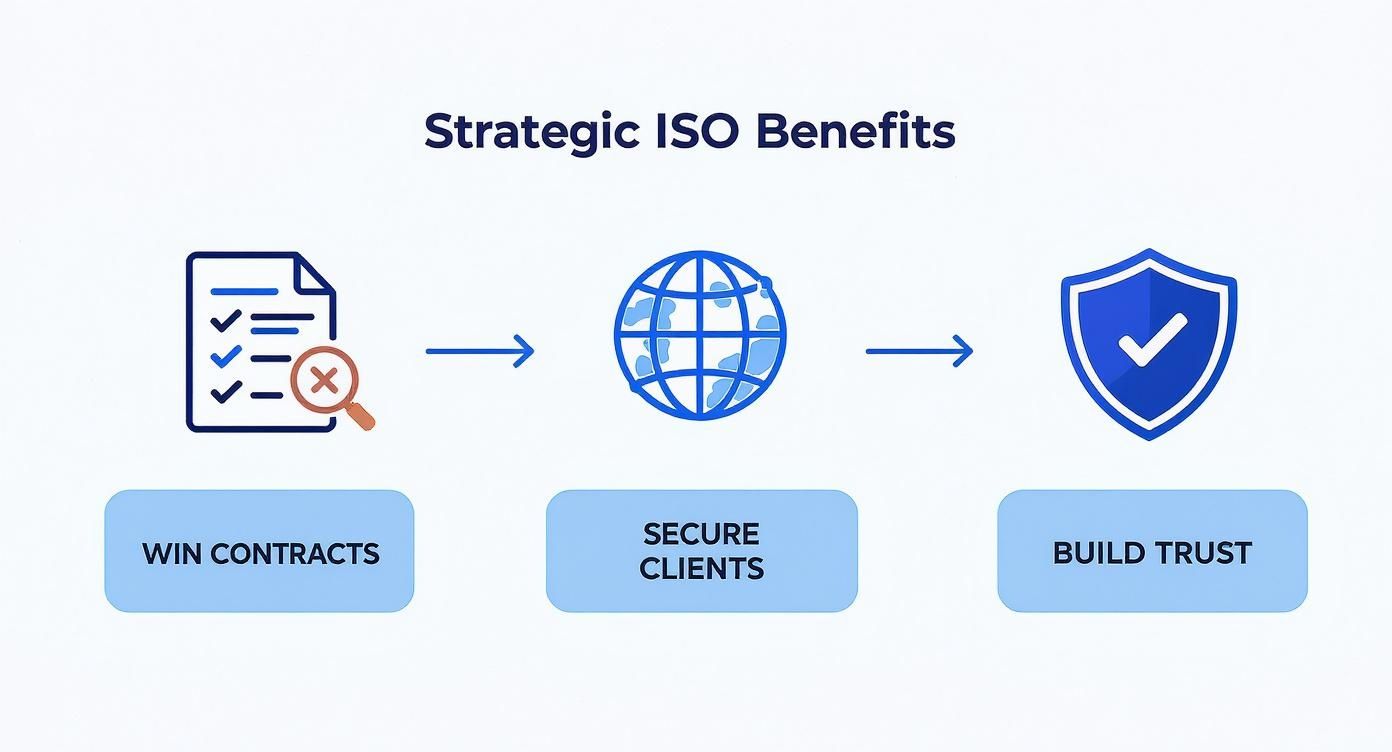
The journey from winning more contracts to locking in clients and building unshakable trust really drives home the powerful business outcomes of a well-played ISO 27001 strategy.
Select Controls and Create the Statement of Applicability
Okay, so you know your risks. Now you need to choose the right security controls to manage them. ISO 27001 gives you a big list of potential controls in a section called Annex A. These cover everything you can think of—access control, cryptography, physical security, supplier relationships, and more.
Here's the good news: you don't have to implement all 114 of them. You only pick the ones that are relevant to your business and necessary to address the risks you've already identified. This is a point many people miss—the standard is built to be flexible and adapted to your specific needs.
The main document you'll produce here is the Statement of Applicability (SoA). It’s one of the most vital documents in your entire ISMS. It lists every single Annex A control, and for each one, you have to state whether you've implemented it and—crucially—justify your decision.
For example, if your Melbourne office doesn't have a public reception area, you could easily justify not implementing a specific control about managing visitor access. The SoA becomes a go-to document for your audit, proving to the auditor that you've carefully considered every control in the context of your own business.
Develop Policies and Implement Your ISMS
With your controls selected, it’s time to get everything down on paper and put it into practice. This is where you create the core policies and procedures that form the very backbone of your ISMS. Think of them as the official rulebooks that tell your team exactly how to handle information securely.
Some of the key documents you'll be creating include:
- Information Security Policy: Your high-level commitment to security, signed off by management.
- Access Control Policy: The rules on who gets to access what information and why.
- Incident Response Plan: A clear, step-by-step guide for what to do when a breach happens.
- Acceptable Use Policy: The dos and don'ts for employees using company laptops, phones, and software.
Of course, writing these policies is only half the battle. Now you have to implement them. This means weaving them into your day-to-day operations—from configuring new security software and running staff training sessions to updating your supplier contracts with new security requirements. For a deeper dive, our guide explains in detail how to get ISO certified with a focus on these practical steps.
By following this structured roadmap, your Melbourne business can confidently navigate the path to ISO 27001, building an ISMS that doesn't just pass an audit but delivers real, lasting security value.
Building Your Information Security Management System
Alright, you’ve done the groundwork and have a solid plan. Now comes the real work: building the engine of your security program, the Information Security Management System (ISMS).

This isn’t about downloading a few generic templates and calling it a day. It’s about creating a living, breathing system that reflects how your Melbourne business actually works—the unique risks you face, the way your team operates, and the data you're sworn to protect.
The goal is to build something your team understands, uses, and believes in. When you get this right, security stops being a chore and becomes woven into your company's DNA.
Crafting Your Core Security Policies
Your ISMS stands on a foundation of clear, practical policies. These aren't just for the auditor; they are the rulebooks that guide your team's everyday decisions, protecting both them and the business.
Let’s zero in on the absolute must-haves for any Melbourne business serious about ISO 27001.
-
Information Security Policy: This is your north star. It’s a high-level, no-nonsense document, usually signed off by the CEO, declaring your company's absolute commitment to protecting its information assets. It sets the tone for everything else.
-
Access Control Policy: This answers a simple but critical question: who gets the keys to the kingdom? It defines who can access what systems, applications, and data—and just as importantly, why. It should cover everything from onboarding a new staff member to revoking access the moment they leave.
-
Incident Response Plan: Sooner or later, something will go wrong. A security incident is a matter of 'when,' not 'if.' This is your emergency playbook, detailing exactly what to do when a breach occurs. It outlines how to detect, contain, and recover from an attack, ensuring a calm, organised response instead of a headless panic.
Let me be blunt: a policy that nobody understands is a policy that nobody will follow. Write for your team, not for a compliance expert. Keep it simple, clear, and actionable.
By thoughtfully creating these documents, you move beyond just ticking a box. You start building a truly resilient security posture. A key part of this is incorporating essential data security best practices right from the start.
The Documentation You Can't Afford to Get Wrong
Getting the paperwork right is a huge part of the ISO 27001 journey. A well-organised documentation set not only shows an auditor you're serious but also serves as an invaluable guide for your own team. Here’s a checklist of the key documents your ISMS will need.
Key ISO 27001 Documentation Checklist
| Document | Purpose | Key Considerations for Melbourne SMEs |
|---|---|---|
| ISMS Scope Document | Clearly defines the boundaries of your ISMS—what parts of the business, locations, and assets are covered. | Be specific. Does it cover your Southbank office but not your remote workers? Is the customer database in-scope but HR data out-of-scope? |
| Information Security Policy | A high-level statement of intent from management, outlining the organisation's security goals. | Keep it concise and get top-level sign-off. This demonstrates genuine management commitment, which auditors love to see. |
| Risk Assessment Report | Identifies, analyses, and evaluates information security risks. | Focus on risks relevant to Melbourne—like local data privacy laws (Victorian Privacy and Data Protection Act 2014) or specific industry threats. |
| Risk Treatment Plan | Details how you will respond to the identified risks (e.g., mitigate, accept, avoid, or transfer). | Prioritise! You can't fix everything at once. Focus on the high-impact, high-likelihood risks first. |
| Statement of Applicability | Lists all 114 controls from Annex A and justifies why each is or is not applicable to your business. | This is non-negotiable and often a stumbling block. It requires a deep understanding of both the standard and your business operations. |
| Access Control Policy | Defines the rules for granting, reviewing, and revoking user access to systems and information. | Link this to your HR processes. Access should be granted on day one and revoked immediately upon termination. |
| Incident Response Plan | Provides a step-by-step guide for handling security incidents, from detection to post-incident review. | Include contact details for key personnel and external experts (like a cybersecurity lawyer) before you need them. |
This list might seem daunting, but each document plays a crucial role in creating a robust and defensible security system.
Making Security Part of Your Company Culture
Let’s be honest: you can have the best policies in the world, but if they just sit on a server gathering digital dust, they’re useless. A successful ISMS is about changing behaviour. It's about making security everyone's job.
This means embedding security into the very fabric of your company culture, making it a natural part of how things get done around here.
How to Actually Make It Happen:
-
Run engaging training sessions. Ditch the boring, text-heavy slideshows. Use real-world examples that hit home. A simulated phishing attack followed by a team debrief is far more memorable than a 50-page "dos and don'ts" guide.
-
Lead from the top. Nothing kills a security initiative faster than seeing the leadership team flout the rules. If the CEO uses multi-factor authentication and has a strong password, everyone else is far more likely to follow suit.
-
Build it into onboarding. Make security a Day One conversation. When a new person joins your team, they should learn about your acceptable use policy and data handling rules as part of their standard orientation.
-
Recognise your security champions. When an employee spots a potential phishing email or suggests a security improvement, celebrate it! Public recognition encourages others to stay vigilant and fosters a proactive security mindset across the entire organisation.
By focusing on your people and their daily processes—not just the policies—you create a culture of security. This is what transforms your ISMS from a paper-based exercise into a living, effective defence system. And that's what will not only get you certified but make your Melbourne business genuinely more secure.
Finding the Right Certification Body in Melbourne
You’ve done the hard yards. You’ve built your ISMS, polished your policies, and started weaving security into the very fabric of your business culture. Now for the final, crucial step: selecting the independent auditor, known as a Certification Body (CB), who will grant your official ISO 27001 certification.
This isn't just about finding the cheapest quote. Far from it. The right partner can transform your audit from a stressful ordeal into a genuinely valuable business exercise. The wrong one? Well, that can turn it into a frustrating, box-ticking nightmare.
Think of your auditor as a professional partner, not an adversary. Their job is to independently verify that all your hard work meets the global standard. Your choice of CB for your ISO certification in Melbourne will colour this entire final stage of the journey, so it really pays to choose wisely.
Your First Check: JAS-ANZ Accreditation
Before you even glance at a proposal or a price list, there's one thing you absolutely must confirm. Make sure any potential CB is accredited by the Joint Accreditation System of Australia and New Zealand (JAS-ANZ).
This is completely non-negotiable.
JAS-ANZ is the government-appointed body responsible for making sure certification bodies are competent, impartial, and credible. A certificate from a non-accredited body is effectively worthless—it won't be recognised by government tenders, major clients, or international partners. It's like getting a degree from a backyard university; you get a piece of paper, but it holds no real weight.
Always start your search on the JAS-ANZ register to verify a CB’s credentials.
Questions to Ask Potential Certification Bodies
Once you have a shortlist of accredited auditors, it’s time to dig in. Treat this like you’re hiring a key business partner, because that's exactly what you're doing. You need to get a feel for their process, their people, and their whole approach.
Here are a few essential questions to get the conversation started:
- What's your experience in our industry? An auditor who gets the specific risks and realities of a Melbourne tech startup or a local professional services firm will deliver a much more insightful audit than a pure generalist.
- Can you walk me through your audit process? Get them to explain exactly what happens during the Stage 1 and Stage 2 audits, who you'll be dealing with, and what the timeline looks like.
- What are all the potential costs? Insist on a detailed quote that breaks down everything: audit fees, travel, and the annual surveillance costs. Don't be shy about asking if there are any "hidden fees" for things like issuing the certificate or rescheduling.
- Who will our lead auditor be? Find out about their background and qualifications. A good, professional relationship with your auditor makes the entire process smoother.
Remember, choosing a certification body isn't a one-off transaction. You'll be working with them for the initial audit and then for surveillance audits over the next three years. Make sure it's a partnership that feels right.
For a deeper dive on this critical step, you can explore our detailed advice on how to find an ISO certification body that’s a perfect fit for your business.
Understanding the Two-Stage Audit Process
The external audit isn't one big, scary event. It’s actually a two-part process. Knowing what’s coming at each stage helps dial down the stress and lets you prepare properly.
Stage 1 Audit: The Documentation Review
Think of this as a 'desktop audit'. The auditor will meticulously review all your ISMS documentation—your scope, policies, risk assessment, Statement of Applicability, and so on. They’re checking to see if, on paper, your system has been designed to meet all the requirements of the ISO 27001 standard.
The goal here is to spot any major gaps or "nonconformities" in your paperwork before the main event. You'll get a report with their findings, giving you a chance to make corrections before Stage 2 kicks off.
Stage 2 Audit: The Implementation Audit
This is the big one, and it usually happens on-site at your Melbourne office. Now, the auditor is looking for evidence that your ISMS isn’t just a nice set of documents but is actually alive and working in your business. They’ll interview your team, watch processes in action, and check system configurations to make sure you’re following your own rules.
They're there to confirm that you "do what you say you do." A successful Stage 2 audit is what leads to the auditor recommending your organisation for certification.
The entire journey to certification in Melbourne, from starting the audit process to passing the final checks, represents a serious commitment. Most businesses find the average time to achieve certification is 6 to 9 months, with costs typically ranging from AUD 5,000 to AUD 15,000, depending on the size and complexity of your company. You can find more insights on Australia's top certification bodies and processes to benchmark your own project. By investing in a reputable, industry-savvy auditor from the start, you ensure that investment pays off with a credible and truly valuable certification.
Staying Compliant: Keeping Your ISO 27001 Certification Strong
Earning your ISO 27001 certificate is a massive achievement, a real milestone for any Melbourne business. But here’s the thing many businesses get wrong: they treat it like a finish line. The truth is, the certificate is just the beginning. Real, lasting security comes from treating your Information Security Management System (ISMS) as a living, breathing part of your business—not just a project you can tick off a list.
This is where the true value of your ISO certification in Melbourne really shines. Ongoing maintenance ensures your ISMS can handle new cyber threats and adapt as your business grows. It turns your certification from a piece of paper into a powerful asset that genuinely protects your reputation and your bottom line.
From a One-Off Project to an Everyday Process
The biggest mental shift your team needs to make is seeing ISO 27001 as a continuous process. That initial push to get certified is always intense, but what comes next is about building a rhythm and routine. It's about weaving security into the very fabric of your business.
What does this look like in practice? It means security becomes second nature. When your sales team looks at a new software vendor, they automatically check the security clauses in the contract. When a new project gets underway, a risk assessment is just a standard part of the kickoff meeting. This is the hallmark of a mature and truly effective ISMS.
Get Good at Internal Audits
Internal audits are your secret weapon for staying sharp. Let's be clear: these aren't about pointing fingers or blaming people. They are a simple health check for your ISMS. Think of them as a dress rehearsal before the external auditor's annual visit, giving you the chance to find and fix issues on your own terms.
To run a successful internal audit program, you'll want to:
- Create a Schedule: Don't try to audit the entire business at once. That's a recipe for burnout. Break it down into manageable chunks and plan your audits throughout the year, perhaps focusing on different departments or key processes each quarter.
- Use a Solid Checklist: Your checklist should be based directly on the ISO 27001 standard and your own internal policies. This keeps you focused and ensures you cover all the required ground without getting sidetracked.
- Get Different People Involved: This is a pro tip. Don’t just leave it all to the IT manager. Asking people from different departments to help audit areas outside their own brings a fresh perspective and helps spread security knowledge right across the business.
The whole point is to spot any areas where your day-to-day practices have drifted away from your documented policies. These findings, or "nonconformities," aren't failures—they're golden opportunities to get better.
Nail Your Corrective Actions and Management Reviews
Once an internal audit flags an issue, you move on to the corrective action process. This is where you dig deep to find the root cause of the problem, not just apply a quick band-aid.
For example, say an audit finds that new starters aren't signing the acceptable use policy. The quick fix is to chase them down and get them to sign it. The real corrective action is figuring out why it was missed in the first place. Maybe it's not part of the standard HR onboarding checklist? You then fix that underlying process to make sure it never happens again.
The Management Review is the capstone of your maintenance cycle. This is a formal meeting where your leadership team gets together to review the ISMS's performance, look at audit results, discuss new risks, and make sure the right resources are in place to keep the system working well.
This meeting is non-negotiable. It keeps security on the leadership team’s radar and proves their ongoing commitment—something external auditors will absolutely be looking for.
Build a Security Culture That Actually Lasts
Policies and procedures are vital, but at the end of the day, your strongest defence is your people. A culture where every single employee feels a sense of ownership over security is far more powerful than any firewall you can buy.
Here are a few practical things that genuinely work:
- Keep Training Going: Security training isn't a one-and-done video during induction. You need to keep the conversation going. Run short, engaging refresher sessions, share updates on the latest phishing scams you’re seeing, and make security a regular topic of discussion.
- Run Phishing Simulations: These are incredibly effective. Sending out safe, simulated phishing emails helps train your staff to spot the real thing in a controlled environment. It takes security awareness from a theoretical concept to a practical, hands-on skill.
- Celebrate the Wins: When an employee reports a suspicious email or points out a potential security weakness, make a point of acknowledging and thanking them. A bit of public praise goes a long way in encouraging everyone else to stay vigilant.
By building these activities into your yearly business calendar, you'll ensure you're always ready for your annual surveillance audits. But more importantly, you’ll transform your ISMS from a static certificate on the wall into a dynamic system that actively protects your Melbourne business, day in and day out.
Your ISO 27001 Questions Answered
Getting into ISO certification can feel like you're trying to learn a whole new language. There are acronyms, processes, and a mountain of requirements that seem baffling from the outside. We get it. Over the years, we've heard the same questions from business owners all across Melbourne, so we've put together some straight-up answers to help you move forward.
This isn't about jargon. It's about the practical stuff: costs, timelines, and what this all really means for your team day-to-day. Let's clear things up so you can make the right call for your business.
What Is the Realistic Cost for ISO 27001 Certification in Melbourne?
Alright, let's talk numbers. For a small to medium-sized business here in Melbourne, you're typically looking at a total investment between AUD $10,000 and $30,000+ to get ISO 27001 certified.
That's a pretty big range, and for good reason. The final figure is a combination of a few key things:
- Consulting Fees: Bringing in an expert to guide your strategy, help nail the documentation, and get you ready for the audit is often the biggest slice of the pie. But honestly, their value in getting it right the first time is immense.
- Internal Resources: Don't forget to factor in your own team's time. Your people will be on deck implementing controls, drafting procedures, and taking part in the audits. That time has a cost.
- Certification Body Fees: This is what you pay the external auditor for the formal Stage 1 and Stage 2 audits, plus the annual check-ups (surveillance audits) needed to keep your certificate valid.
Ultimately, your starting point makes all the difference. A business with solid security practices already in place will have a much smoother and less expensive ride than one building its security framework from the ground up.
How Long Does the ISO Certification Process Really Take?
You'll need a bit of patience here. While everyone wants that certificate hanging on the wall yesterday, a realistic timeline for most Melbourne businesses is anywhere from 6 to 12 months. Trying to rush it is a classic mistake. It usually results in a system that looks good on paper but doesn't actually work in practice, which auditors can spot a mile away.
That timeframe isn’t just about waiting around. It's about doing the work properly. It gives you enough breathing room to do a proper gap analysis, roll out the necessary security controls, develop genuinely useful documentation, run a full internal audit, and then get through the two-stage external audit without cutting corners.
A well-paced project ensures the new security habits become part of your company culture, not just a box-ticking exercise. That’s what true security—and what the auditors—are all about.
Is Hiring an ISO Consultant Really Necessary?
Technically, no, you're not required to hire one. But should you? For the vast majority of Melbourne SMEs we've worked with, bringing in an experienced ISO consultant is a complete game-changer. They don't just speed things up; they make the whole process far more effective and less of a headache for your team.
A good consultant has seen it all before. They know the standard inside and out, they know what makes auditors tick, and they can steer you around the common pitfalls that can cost you time and money. Think of them as an expert guide who saves your team from getting lost in the woods, leading to a much faster and more successful result.
What Is the Difference Between ISO 9001 and ISO 27001?
This is a really common question, but the difference is actually quite straightforward. Just think of them as two sides of the same coin: business excellence.
-
ISO 9001 (Quality Management): This one is all about your operational processes. It’s focused on making sure you consistently deliver a top-notch product or service that keeps your customers happy. It’s about efficiency, satisfaction, and always looking for ways to improve how you do things.
-
ISO 27001 (Information Security): This standard has one job: protecting your information. It gives you a rock-solid framework for finding, managing, and minimising risks to your company’s data, making sure it stays confidential, accurate, and available when you need it.
Many ambitious Melbourne businesses end up going for both. Having both certifications sends a powerful message that you’re serious not only about delivering quality but also about protecting the sensitive data clients and partners trust you with.
Ready to stop wondering and start doing? The expert team at Anitech has a 100% success rate helping Melbourne businesses like yours build robust Information Security Management Systems. Contact us today for a consultation and start your journey to certification.
Recent Comments