

So, what exactly is an ISO compliance certification? Think of it as an official seal of approval from an independent, third-party body, confirming your business operates according to the demanding international standards set by the International Organization for Standardization (ISO). This is far more than just a piece of paper; it’s a powerful statement to the world that your company is genuinely committed to quality, security, and efficiency.
What Is ISO Certification and Why Does It Matter

Picture this: you’re building a complex machine, but every single part comes from a different supplier. Without a shared set of rules for quality and measurement, the final product would be a complete mess. That's what ISO standards prevent. They act as that universal blueprint for business, making sure everyone is speaking the same language of excellence.
An ISO compliance certification is the formal recognition that you’re following these globally respected blueprints. It’s like earning a professional qualification, but for your entire organisation. It proves you have built, are maintaining, and are constantly improving a management system that meets a specific ISO standard.
Beyond the Certificate: A Framework for Success
Getting certified isn't about acing a one-off exam. It’s about making a fundamental, positive change to the way your business works by adopting a structured framework. You can think of it as installing a brand-new, more efficient operating system for your entire company.
This framework encourages you to take a hard look at your internal operations, document how things are really done, pinpoint weaknesses, and set clear goals for getting better. For example, if you're aiming for ISO 9001 (Quality Management), the standard pushes you to define what ‘quality’ truly means to your customers and then build reliable processes to deliver on that promise, time and time again.
The real power of ISO lies in this strategic alignment. It shifts your business from constantly putting out fires to proactively building excellence into its DNA. This creates a culture of continuous improvement that delivers value long after the certificate is hanging on the wall.
Why This Matters for Australian Businesses
Here in Australia, ISO certification isn't just a ‘nice-to-have’—it’s often a deal-breaker for any business looking to grow. Many government tenders and major corporate contracts flat-out require suppliers to hold specific ISO certifications. Without it, you can't even get a foot in the door. To properly appreciate why this is so critical, it helps to start by understanding compliance management as a whole, which covers the full spectrum of rules a business must adhere to.
This certification also acts as a powerful edge in a crowded marketplace. It provides solid, tangible proof of your commitment to excellence, which builds instant trust with clients, partners, and investors.
Here are a few game-changing benefits of ISO certification:
- Boosted Credibility and Reputation: It immediately shows that your business is serious about quality and operates at a global standard.
- Happier Customers: By focusing on consistent delivery and process refinement, you create better products and services, leading to more satisfied, loyal customers.
- Smarter Operations: The certification journey forces you to map out, streamline, and sharpen your workflows. This cuts down on waste, reduces errors, and ultimately lowers your costs.
- Access to New Markets: Certification can be your passport to new domestic and international opportunities, helping you clear regulatory hurdles and meet client requirements.
In the end, achieving an ISO compliance certification is about building a stronger, more organised, and more profitable business. It offers a proven roadmap to operational excellence, turning abstract ideas like 'quality' and 'security' into measurable, achievable results. For businesses wanting to dig into the details, exploring a guide on ISO compliance can shed more light on the specific requirements and rewards. This structured approach sets your organisation up not just for today's challenges, but for long-term success.
The Real Business Case for ISO Certification
Let's move past the theory and talk about what really matters: your bottom line. An ISO certificate isn't just a fancy piece of paper to hang on the wall. It’s a powerful commercial tool that directly fuels growth, sharpens your competitive edge, and turns compliance from a cost centre into a genuine asset.
For many Australian businesses, the most immediate impact is winning work that was previously out of reach. Think about it. How many government tenders or contracts with big-name corporations demand ISO certification as a non-negotiable? Without it, you're not even in the running for some of the most profitable projects out there.
Holding an ISO compliance certification instantly sets you apart. In a crowded market, it's a clear signal to potential clients that you’re professional, reliable, and serious about quality.
Turning Process Improvement into Profit
Getting ISO certified forces you to take a hard, honest look at how your business actually runs. This isn't about creating more red tape. It's about systematically finding and fixing all the little inefficiencies that quietly drain money from your business every single day.
This structured approach uncovers waste you didn't even know you had—in materials, in time, in duplicated effort. By standardising how things get done and making sure everyone knows their role, you dramatically cut down on costly mistakes and do-overs. That discipline is how compliance starts paying for itself.
Imagine a local manufacturing business struggling with inconsistent product quality. They decide to go for ISO 9001. This prompts them to map out their entire production line, pinpoint critical quality checks, and train their team on the new, standardised way of working.
- Result: Product defects plummet by over 30%, saving a fortune in wasted materials and labour.
- Impact: Customer satisfaction goes through the roof, leading to more repeat business and stronger relationships.
- Outcome: The company doesn't just save money; it builds a rock-solid reputation for quality, giving them the confidence to raise their prices and boost profits.
Building Trust in a Data-Driven World
In today's world, data security isn't just an IT problem—it's the bedrock of business trust. A single data breach can wreck a small business, destroying both its finances and its reputation overnight.
This is where a standard like ISO 27001 (Information Security Management) becomes absolutely essential. It gives you a proven framework to identify, manage, and shut down security risks. Achieving this certification is a powerful statement that you’re committed to protecting your clients' data.
Pursuing an ISO compliance certification like ISO 27001 tells potential clients that you take their security as seriously as you take your own. It moves the conversation from "Can we trust you?" to "How soon can we start working together?"
Picture a growing Aussie tech startup trying to land a huge contract with a major bank. The bank's number one concern? The security of its customers' sensitive financial data.
The startup wisely invests in getting ISO 27001 certified. This means implementing tight access controls, running regular risk assessments, and creating a bulletproof incident response plan. When they show that certificate to the bank, it’s undeniable proof that they're a safe pair of hands. A great real-world example of this in action is Docsbot's achievement of SOC 2 Type II Certification, which validates their security posture to enterprise clients.
This proactive move makes them the obvious choice, helps them land the lucrative contract, and builds the trust needed for a lasting partnership.
Tapping into a Growing Market Demand
The push for certification isn't just some passing fad. It’s a fundamental shift in the market. Clients, regulators, and partners all expect higher standards of quality, security, and accountability. This is creating massive opportunities for certified businesses across Australia.
The numbers tell the story. Australia's ISO certification market was valued at around USD 122.7 million in 2024. It’s a key part of the wider Asia Pacific region, which is set to grow at a Compound Annual Growth Rate (CAGR) of 16.7% through to 2033. This boom is being driven by stricter regulations and a greater awareness of business risks, making an ISO compliance certification more valuable than ever before. You can dive deeper into the data behind this regional growth in a recent market analysis.
At the end of the day, the business case for ISO certification is crystal clear. It’s an investment that pays you back in multiple ways: more revenue from bigger contracts, lower costs from smarter processes, a stronger brand, and deeper customer trust. It gives your business what it needs not just to compete, but to lead.
Your Step-by-Step Path to ISO Certification
Taking the leap towards an ISO compliance certification can feel a bit like planning a major expedition. From the outside, it looks complex and maybe a little intimidating. But once you break it down into a series of logical, manageable steps, that daunting mountain becomes a very clear and achievable path forward.
This roadmap is designed to guide you through each phase, turning what seems like a huge task into a structured project. Each stage builds on the one before it, creating a rock-solid foundation for a management system that doesn’t just pass an audit, but delivers real, lasting value to your business.
Think of it this way: this process is how you streamline your operations, cut out inefficiencies, and ultimately, put your business in the prime position to win those bigger, more valuable contracts.
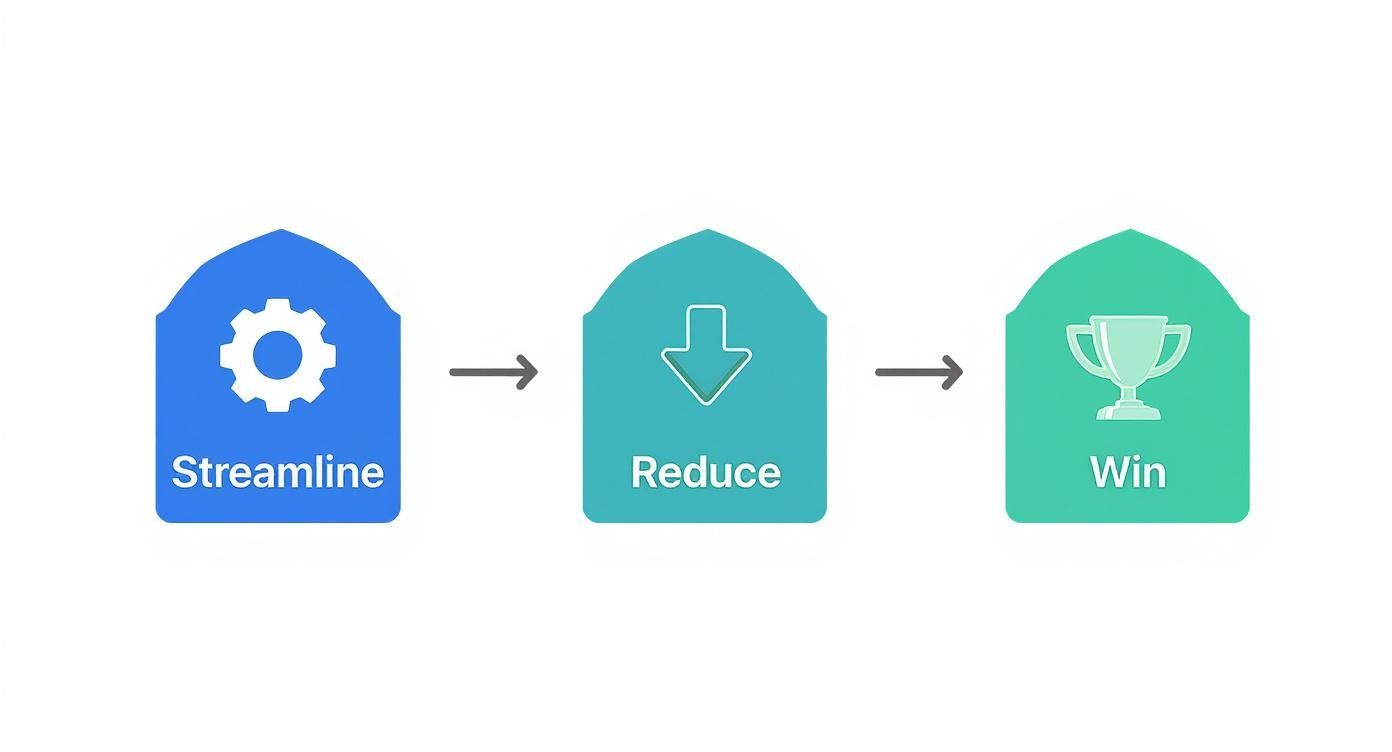
This journey isn't just about ticking boxes to meet a standard. It's about fundamentally building a more efficient, competitive, and resilient business from the inside out.
Let's walk through the five key phases of your certification journey. This table breaks down what happens at each stage, so you know exactly what to expect.
The 5 Key Phases of Your ISO Certification Journey
| Phase | Objective | Key Activities |
|---|---|---|
| 1. Gap Analysis | To pinpoint where your current systems meet and where they fall short of the ISO standard. | Reviewing existing processes, policies, and documentation; comparing them against each clause of the standard; creating a detailed action plan. |
| 2. System Development | To build and document a management system that is practical and compliant. | Writing new policies and procedures; creating forms and templates; defining roles and responsibilities to align with the standard. |
| 3. Implementation | To roll out the new system and embed it into daily operations across the company. | Training all relevant staff; communicating changes effectively; starting to use new forms and follow new procedures. |
| 4. Internal Audit | To conduct a 'dress rehearsal' audit to find and fix any issues before the external audit. | A trained auditor reviews the system's effectiveness; identifying non-conformities; implementing corrective actions. |
| 5. External Audit | To have an accredited third-party body verify your compliance and grant certification. | Stage 1 (documentation review) and Stage 2 (on-site assessment) audits; receiving the official ISO certificate upon successful completion. |
With this overview in mind, let's dive a little deeper into what each of these phases really involves.
Phase 1: The Gap Analysis
Before you can chart a course to your destination, you have to know exactly where you are right now. That's the whole point of a Gap Analysis. Think of it as putting that big, red 'You Are Here' pin on your business map. It’s a completely honest, thorough look at your current processes and policies, measured directly against the specific requirements of the ISO standard you're aiming for.
This first step is arguably the most critical of the entire project. It shows you precisely where your operations fall short, where you're already doing great, and what actions are needed to bridge the gaps. This isn't about finding fault; it's about creating a clear, no-nonsense project plan.
Trying to skip this or do a half-hearted job is a recipe for disaster. You'll end up wasting a huge amount of time and money working on the wrong things or, even worse, missing a critical requirement that trips you up at the final audit. A solid analysis gives you the blueprint for everything that follows.
Phase 2: System Development and Documentation
With the roadmap from your Gap Analysis in hand, it’s time to start building. This phase is all about translating the formal language of the ISO standard into practical policies, procedures, and instructions that actually make sense for your business.
The absolute key here is to create a system that is useful, not just bureaucratic. Your documentation needs to reflect how your team actually works, while still ticking every box of the standard. This isn't about creating a massive, dusty binder of rules that no one ever looks at.
Instead, the focus should be on clear, concise documents that genuinely guide your team and add real value. The goal is to build a living, breathing system that your people will want to use because it makes their jobs clearer and more effective.
Typically, you'll be creating a few key things:
- A System Manual: The high-level guide outlining the scope of your system and its core principles.
- Core Policies: Your company's official stance on key areas like quality, safety, or information security.
- Standard Operating Procedures (SOPs): The practical, step-by-step guides for getting critical tasks done right, every single time.
- Forms and Records: The tools you'll use to prove your system is working—things like inspection checklists or incident reports.
Phase 3: Implementation and Team Training
Having a great system on paper is one thing. Bringing it to life across your entire organisation is where the magic happens. The implementation phase is all about rolling out your new processes and making sure they stick, becoming the new 'business as usual'. Success here comes down to two things: great communication and solid training.
You need to make sure every single person on your team understands their role and responsibilities within the new system. This goes way beyond just sending out a memo with the new procedures. It means hands-on training sessions, explaining the 'why' behind the changes, and offering ongoing support as everyone gets up to speed.
A management system is only as strong as the people who use it. Investing time in proper implementation and training ensures that the system doesn't just exist on paper but is actively embraced and practiced by your entire team, forming the backbone of your company culture.
This is where theory becomes practice. As your team starts using the new procedures, you'll begin to gather the records and evidence you'll need to fly through your audit.
Phase 4: The Internal Audit
Before you call in the external auditors for the final exam, you need to run a full dress rehearsal. That's your Internal Audit. It's a crucial self-check designed to hunt down any lingering issues or weaknesses in your system before the certifiers see them.
An internal audit works just like the real thing. An impartial auditor—either a trained staff member from another department or an external consultant—will meticulously review your processes and paperwork against the ISO standard.
The goal here is to be tough on yourself. This is your chance to find and fix problems proactively, giving you the confidence that you're truly ready for the main event. It allows you to fine-tune everything and ensure the external audit is as smooth as possible. To get a better sense of the bigger picture, you can explore the stages of the complete ISO certification process and see how all these pieces fit together.
Phase 5: The External Certification Audit
This is it—the final step on your journey to achieving an ISO compliance certification. The external audit is carried out by an accredited, independent certification body. Their job is to perform an impartial assessment to verify that your management system meets every single requirement of the ISO standard.
The audit is usually done in two parts:
- Stage 1 Audit: This is mostly a desktop review. The auditor checks that all your documentation, policies, and procedures are in place and that your system looks good on paper.
- Stage 2 Audit: This is the main event. The auditor will visit your site, talk to your people, observe your processes in action, and review your records to confirm you’re not just saying what you do, but you're actually doing what you say.
If the auditor is satisfied that your system is fully compliant, they will recommend you for certification. After a final review by the certification body, you'll receive your official ISO certificate. It’s a powerful testament to your whole team's commitment to excellence.
Choosing the Right ISO Standard for Your Business
Picking the right ISO standard is like choosing the right tool for a critical job. You wouldn't use a hammer to tighten a bolt, right? In the same way, chasing an ISO compliance certification that doesn’t actually line up with your business goals is just a waste of time and money. The whole point is to match the standard to what you’re trying to achieve.
Not all ISO standards are created equal; each one is built to solve a different kind of business problem. Your choice will guide your company's focus—whether that’s delivering an amazing customer experience every time, building a fortress around your data, making sure your team goes home safe, or proving your commitment to the planet. Get this first step right, and you're on your way to turning compliance into a genuine competitive edge.
ISO 9001: The Universal Standard for Quality Management
If there’s one language every business understands, it’s quality. That’s where ISO 9001 comes in. It’s the world’s most recognised standard for Quality Management Systems (QMS), and it’s popular for a good reason: it works for any organisation, no matter the size or industry. A local café can use it just as effectively as a multinational manufacturer.
Think of ISO 9001 as the blueprint for a business that puts its customers first, always. It gives you a rock-solid framework for making sure your products and services don't just meet expectations but consistently exceed them. We're not talking about vague promises here; it’s about creating real, repeatable processes that lock in excellence.
Achieving this certification shows you’re serious about:
- Customer Focus: Building your entire operation around what your customers truly need and want.
- Process Approach: Managing everything you do as interconnected processes, which boosts efficiency and consistency.
- Continuous Improvement: Fostering a culture where everyone is always looking for ways to do things better.
For countless Australian businesses, ISO 9001 is the cornerstone ISO compliance certification. It builds the operational discipline and customer-first mindset needed to grow and stay profitable for the long haul.
ISO 27001: Protecting Your Most Valuable Asset—Data
We live in an age where a single data breach can sink a company. Protecting information isn't just an IT problem anymore; it's a fundamental business responsibility. ISO 27001 is the framework for an Information Security Management System (ISMS), giving you a structured way to manage sensitive information and keep it secure.
Implementing ISO 27001 is like installing a comprehensive security system for your entire business—not just your computers. It goes way beyond firewalls and antivirus software. It’s a top-down, risk-based approach that covers your people, your processes, and your technology, making sure every potential weakness is found and managed.
An ISO 27001 certification isn't just about stopping breaches. It’s about earning the absolute trust of your clients and partners. It’s definitive proof that you can be trusted with their most sensitive data.
This standard is a non-negotiable for any business handling personal, financial, or confidential client data. It helps you stay on the right side of tough regulations like the Australian Privacy Act and builds the robust defences needed to fight off the constant threat of cyberattacks.
The sheer number of certified businesses across Australia shows just how important these standards have become. As of 2025, ISO certification is a key part of doing business in sectors like healthcare, manufacturing, and finance. Over 24,466 organisations in Australia hold an ISO 9001 certificate, proving how deeply it’s woven into our quality practices. At the same time, demand for ISO 27001 has exploded as companies scramble to protect their data from rising cybercrime. You can get more insights about ISO 27001 in Australia and see how local businesses are strengthening their defences.
ISO 45001: Prioritising People and Safety
Your team is your greatest asset. Keeping them safe and healthy at work isn't just a legal duty—it's the right thing to do. ISO 45001 is the global standard for Occupational Health and Safety (OH&S) Management Systems. It provides a clear framework to prevent work-related injuries and illness by creating a genuinely safe workplace.
Adopting ISO 45001 helps you shift from being reactive (dealing with accidents after they happen) to proactive (spotting and removing hazards before they can cause harm). It’s about building a genuine safety culture where everyone, from the CEO down to the newest hire, has a role to play in managing risks.
Going for this ISO compliance certification helps you:
- Reduce Workplace Incidents: A systematic approach to finding hazards means fewer accidents and injuries.
- Improve Legal Compliance: It ensures you’re meeting your obligations under Australia's Work Health and Safety (WHS) laws.
- Boost Staff Morale: When you show a real commitment to safety, your team knows you genuinely care about their wellbeing.
This standard is crucial for high-risk industries like construction and manufacturing, but honestly, its principles of looking after your people are valuable for any business.
ISO 14001: Demonstrating Environmental Responsibility
More and more, customers and partners are choosing to work with businesses that share their values. They want to see that you're part of the solution to environmental challenges, not part of the problem. ISO 14001 gives you the framework for an effective Environmental Management System (EMS).
This standard helps your business systematically identify, manage, and reduce its environmental footprint. This isn't about making grand, empty gestures. It's about taking a hard look at how you use resources, how you can reduce waste, and how you can measurably improve your environmental performance.
The benefits can be surprisingly direct. For instance, by properly analysing your energy use, you might find simple ways to slash your power bills. By optimising a production process, you could cut down on wasted raw materials, saving money while doing right by the planet.
Achieving ISO 14001 sends a powerful signal to the market: you're a responsible, forward-thinking business committed to sustainability. It can strengthen your brand, attract a growing base of eco-conscious customers, and give you a real advantage in a crowded marketplace. It all comes back to aligning your actions with who you want to be as a business.
Partnering with a Consultant for Guaranteed Success

Embarking on the ISO certification journey alone can feel like trying to navigate a dense forest without a map or compass. It’s a huge undertaking that can quickly overwhelm your internal team, pulling valuable people away from their day jobs and risking costly delays and mistakes.
This is where bringing in a strategic partner doesn't just help; it transforms the entire process.
Working with an expert consultant elevates the project from a complex compliance headache into a focused, business-improving initiative. At Anitech, we don’t just hand you a stack of generic templates and wish you luck. We become a genuine extension of your team, providing the hands-on guidance needed to make your ISO compliance certification a certainty.
Think of us as your translator and project manager. We turn the dense, formal language of an ISO standard into practical, actionable steps that actually fit the way your business operates.
From Complexity to Clarity
Let's be honest—one of the biggest hurdles in any ISO project is figuring out what the standard is actually asking you to do. The language can be formal and open to interpretation, making it incredibly easy to go down the wrong path.
Our experts live and breathe these standards every single day. We cut straight through the jargon, explaining each requirement in plain English and showing you precisely how it applies to your specific workflows. This practical guidance ensures you build a system that is not only compliant but genuinely useful for your business.
We manage the entire project from start to finish—from the crucial first step of the gap analysis all the way through to your final, successful audit. This end-to-end management frees up your team to focus on what they do best, knowing the certification project is on track and in expert hands.
A great consultant doesn’t just get you certified; they empower your team. By transferring knowledge and building internal capability, they ensure your management system delivers lasting value and fosters a culture of continuous improvement long after the certificate is on the wall.
This partnership is all about helping you avoid the common pitfalls that derail certification projects, saving you countless hours of frustration and wasted resources.
A Bespoke Approach, Not a One-Size-Fits-All Solution
Every business is unique. A quality system for a software developer will look completely different from one for a manufacturing plant. This is exactly why a one-size-fits-all approach to an ISO compliance certification is doomed to fail.
We specialise in creating bespoke management systems that align perfectly with your operations.
Our process always starts with listening. We take the time to really understand your business: your goals, your challenges, and your company culture. This allows us to design and implement a system that feels like a natural fit, not some bureaucratic burden forced upon your team.
This tailored strategy is the key to our 100% success rate. We've helped countless Australian businesses not only achieve certification on their first attempt but also build stronger, more efficient, and more resilient operations in the process.
Here’s what that looks like in the real world:
- For a tech startup: We help build an ISO 27001 system that integrates smoothly with their agile development cycle, proving their security posture to big-name clients without slowing down innovation.
- For a family-owned manufacturer: We develop a practical ISO 9001 system that respects their established ways of working while introducing simple, effective quality controls that reduce waste and boost customer satisfaction.
- For a service provider: We create a streamlined management system that helps them scale operations efficiently, ensuring service quality remains exceptional even as the business grows rapidly.
The Anitech Advantage: A Proven Path to Certification
Partnering with Anitech gives you more than just expertise; it gives you certainty. Our structured, proven methodology removes the guesswork from the certification process, laying out a clear and predictable path to success.
We handle the heavy lifting, allowing you to reap the rewards. Here’s a quick breakdown of what working with us looks like:
- Detailed Gap Analysis: We conduct a thorough assessment to create a precise action plan.
- Custom System Development: We write clear, practical policies and procedures tailored to you.
- Hands-On Implementation Support: We guide your team through the rollout, providing training and support.
- Expert Internal Audits: We perform a robust pre-assessment audit to ensure you are 100% ready.
- Certification Body Liaison: We help you select the right certification body and manage the relationship.
- Audit Day Support: We are right there with you during the external audit to ensure a smooth process.
Ultimately, achieving an ISO compliance certification is a powerful strategic move. Working with the right partner ensures your investment of time and resources delivers the maximum possible return. If you're ready to see how expert guidance can guarantee your success, learn more about our dedicated ISO certification consultants and let's build a stronger, certified business together.
Your ISO Certification Questions, Answered
Deciding to go for an ISO compliance certification is a big move for any business, and it’s completely normal to have a heap of questions. For most business owners, it’s not just about the certificate on the wall; it’s about understanding the real-world commitment—how much time it will take, what the true investment looks like, and what happens after you’re certified.
This is where we cut through the jargon. We're here to give you straight, practical answers to the questions we hear most often from businesses just like yours across Australia. The goal is to give you the clarity and confidence you need to take that next step.
How Long Does It Really Take To Get ISO Certified?
This is usually the first question on everyone's mind, and the honest answer is: it depends. The path to an ISO compliance certification is definitely a marathon, not a sprint, and how long it takes can vary quite a bit.
For most small to medium-sized businesses in Australia, a realistic timeframe is somewhere between 3 and 12 months. Where you land in that range comes down to a few key things: the size of your company, how complex your day-to-day operations are, and—most importantly—how much of what you're already doing lines up with the ISO standard.
A great way to think about it is like a home renovation. If you’re just giving the kitchen a cosmetic refresh, it’s a quick job. But if you’re knocking down walls and redoing the plumbing, it’s a much bigger project. It’s the same here; a business with some solid processes already in place will get there much faster than one starting from a blank page.
So, what are the things that can speed up (or slow down) your timeline?
- Your Starting Point: If you’ve already got some formal policies or procedures documented, you’re ahead of the game. If you’re building your systems from scratch, that development phase will naturally take a bit more time.
- Your Internal Resources: A big one. How much time can your team genuinely dedicate to this? Having someone on the inside who can champion the project and keep the ball rolling makes a massive difference.
- Your Business Complexity: A small consulting firm in a single office will have a much more straightforward journey than a large manufacturing business with multiple sites and a tangled supply chain.
- Getting an Expert on Board: Bringing in an experienced consultant can seriously fast-track the whole process. They know the common pitfalls to avoid, can lay out a clear roadmap, and make sure your team’s effort is always focused on what matters most.
Understanding these factors from the get-go helps you set realistic expectations and line up the right resources for a much smoother ride.
Is ISO Certification A One-Off Thing?
This is a really common misconception. Getting your ISO compliance certification isn't a "one-and-done" deal where you pass an audit, frame the certificate, and forget about it. It’s actually about committing to a whole new way of running your business—one that’s built on the idea of always getting better.
It’s less like graduating and more like joining a gym. The real benefit doesn't come from signing the membership form; it comes from showing up consistently and putting in the work.
Your initial certification is just the starting line. To keep it, you enter what's called a three-year certification cycle. This is designed to make sure your management system isn't just a folder of documents collecting dust, but a living, breathing part of how you operate and deliver value.
This cycle involves two kinds of ongoing audits:
- Annual Surveillance Audits: For the first two years after you get certified, an external auditor will pop in annually for a sort of "health check." They’re there to verify that you’re sticking to the standard, keeping your records straight, and actively looking for ways to improve.
- Triennial Recertification Audit: Then, in the third year, you'll go through a more thorough recertification audit. It’s pretty similar to your initial audit, and once you pass, your certificate is renewed for another three years, kicking off a new cycle.
This structure is what ensures the high standards you worked so hard to achieve become truly embedded in your business, driving real, lasting improvements long after the initial push.
What Is The Real Cost Of Getting ISO Certified?
It's really important to shift your thinking here—ISO certification isn't a cost, it's a strategic investment in the future of your business. While there are definitely some upfront expenses, the return you get from it can be massive, paying you back in efficiency, reputation, and new business for years.
The total investment can be broken down into a few main parts. For a typical small to medium-sized business in Australia, you might be looking at a range from several thousand to tens of thousands of dollars, all depending on the scope and complexity of your operations.
Let's break down where that money goes:
- External Certification Body Fees: These are the fees you pay to the accredited organisation that performs your official audits (Stage 1 and Stage 2) and issues your certificate. This also covers the ongoing annual surveillance audits.
- Consultant Fees (Optional but Recommended): If you decide to work with a consultant, their fees are part of the investment. A good consultant, however, often saves you more than they cost by helping you avoid expensive mistakes and making the whole process faster and more efficient.
- Internal Resource Allocation: This is the "cost" of your own team's time spent on everything from writing documentation and attending training to being part of the audits. It’s often the most overlooked part, but it's essential for success.
- Potential System Upgrades: Sometimes, your initial gap analysis might show you need to invest in new software, tools, or training to meet the standard's requirements.
The real question isn’t, "What does ISO certification cost?" It’s, "What is the cost of not being certified?" Think about the lost tenders, the hidden costs of inefficiency, and the weaker position you have in a competitive market.
The return on this investment is where the story gets exciting. It comes from slashing waste, making fewer mistakes, and having smoother processes that lower your operating costs. It comes from being able to bid on—and win—lucrative contracts that were out of reach before. And it comes from the massive boost to your brand’s reputation, building the kind of trust that wins over and keeps high-value clients.
Can My Small Business Really Benefit From ISO Certification?
Absolutely. There's this stubborn myth that ISO compliance certification is just for big, multinational corporations with entire departments dedicated to compliance. The truth is, it’s often the small and medium-sized businesses that see the biggest and most immediate benefits.
For a growing business, an ISO standard brings much-needed structure and discipline. It helps you formalise the "way we do things around here," clarifying who does what and building a solid, scalable foundation for future growth. It’s about moving from a chaotic, reactive way of working to a proactive, systematic one.
Here’s how different standards deliver real-world benefits for small businesses:
- ISO 9001 (Quality Management): For a small manufacturing or service business, this standard is your secret weapon for ensuring quality doesn't dip as you scale. It builds rock-solid customer loyalty by making sure you deliver a consistent, high-quality experience every single time.
- ISO 27001 (Information Security): If you're a small tech company or a consultant handling sensitive client data, this certification is a total game-changer. It’s the key that unlocks doors to big corporate clients and government contracts because it’s undeniable proof that you can be trusted with their information. It levels the playing field, letting you compete on security and trust, not just on size.
- ISO 45001 (Health & Safety): For a small construction firm or trade business, this shows you’re serious about looking after your team. It helps you meet legal obligations, cuts down the risk of costly workplace accidents, and makes you the kind of employer people want to work for.
At the end of the day, ISO certification helps small businesses punch well above their weight. It gives you the systems, credibility, and market access to go toe-to-toe with the big players, proving you’re a professional, reliable, and top-quality organisation ready for whatever comes next.
Ready to build a more secure, competitive, and trusted business? At Anitech, we provide expert, hands-on guidance to make your ISO 27001 certification journey smooth and successful. Discover how we can help you achieve your compliance goals at https://iso-27001.com.au.
Recent Comments