

In a world of ever-present digital threats and tangled global supply chains, ISO compliance has become the international language of trust. It’s a powerful, verifiable signal to your customers, partners, and regulators that you operate at an elite level, committed to globally recognised best practices for quality, security, and operational excellence.
Why ISO Compliance Is Your New Competitive Edge
It’s easy to fall into the trap of seeing ISO compliance as just a tedious, box-ticking exercise—a hoop you have to jump through to keep a client happy. But that view misses the bigger picture entirely. Instead of a cost centre, smart leaders see ISO certification for what it really is: a strategic framework for building a more resilient, efficient, and profitable organisation.
Think of it like a restaurant kitchen. A chaotic kitchen might fluke a great meal now and then, but the process is stressful, wasteful, and wildly inconsistent. Now, picture a kitchen running on a world-class system for hygiene, ingredient sourcing, and recipe execution. Every single meal is exceptional, waste is practically non-existent, and customers trust the quality every time they walk in the door. That’s the kind of systematic excellence ISO brings to your business.
Building Unbreakable Trust
In business, trust is the ultimate currency. ISO certification is one of the most powerful ways to earn it. When a potential client sees you’re ISO certified, they don’t have to take your word for it that your processes are solid; it's been independently verified by an accredited third party.
This seal of approval is absolutely critical in industries that handle sensitive information. A standard like ISO 27001, which is all about Information Security Management Systems (ISMS), gives you tangible proof that you’re serious about protecting data. It's not just a marketing slogan; it’s a demonstrated commitment that instantly puts you ahead of the competition.
ISO compliance transforms your business promises into proven practices. It replaces "we take security seriously" with a verifiable, internationally recognised certificate that speaks louder than any marketing campaign.
Unlocking New Markets and Opportunities
Many of the most lucrative contracts, particularly with government bodies and large multinational corporations, have ISO certification as a non-negotiable prerequisite. Without it, your business doesn't even make it to the starting line. Achieving compliance is like getting a passport that grants you access to these exclusive, high-value markets.
For Australian businesses looking to expand overseas, ISO standards are essential. They provide a common framework that cuts across borders, ensuring your quality or security management systems line up with global expectations. This harmonisation makes trade simpler and builds immediate credibility with international partners.
Fostering a Culture of Excellence
Beyond all the external benefits, the journey to ISO compliance forces a business to take a hard look in the mirror. It demands you meticulously document your processes, pinpoint inefficiencies, and set clear benchmarks for success. This internal discipline creates a positive ripple effect throughout the entire organisation.
This structured approach leads to several key internal wins:
- Reduced Operational Waste: By standardising procedures, you eliminate redundant tasks and costly mistakes.
- Improved Consistency: Every client gets the same high standard of service, every single time.
- Enhanced Employee Engagement: Staff have clear roles and responsibilities, which cuts down on confusion and empowers them to do their best work.
The process of maintaining compliance also drives a culture of continuous improvement. For instance, the ISO/IEC 27001 standard was updated in October 2022. Australian businesses certified under the old 2013 version have until 31 October 2025 to transition—a deadline that's approaching fast. Missing this could mean losing your certification, which has become a deal-breaker for major contracts in finance, cybersecurity, and consulting where clients demand proof of up-to-date compliance. You can learn more about what Australian businesses need to know for this transition. This requirement ensures that certified businesses don't get complacent but instead keep adapting to new threats and best practices, keeping their operations sharp and secure.
Getting to Know the Key ISO Standards
Trying to figure out the world of ISO can feel a bit like decoding a secret language. There are dozens of standards, each with its own number and focus, which can easily feel overwhelming. But here’s the secret: you don't need to know all of them. The trick is to find the one or two that will genuinely make a difference to your business.
Think of each standard as a specialised blueprint for a different part of your operations. One might be the perfect guide for making sure your products are consistently brilliant, while another provides a fortress-like plan for protecting your customer data. The goal isn't to collect certifications, but to strategically pick the frameworks that align with what you want to achieve and what your customers expect.
Let’s break down the big three you’re most likely to come across.
ISO 9001: The Blueprint for Quality and Customer Happiness
If you’re looking for a tried-and-tested recipe for keeping customers happy, ISO 9001 is it. It’s all about building a Quality Management System (QMS) that helps you consistently deliver products and services that hit the mark—and then some. It doesn’t tell you what to make, but it gives you a solid framework for how to make it better, time and time again.
This standard makes you take a hard look at every single step in your process, from the first time a customer gets in touch to the moment you deliver and follow up. The whole point is to create a repeatable system that cuts down on mistakes, minimises waste, and builds a culture where everyone is always looking for ways to improve.
A great example is a local software company. They could use ISO 9001 to put formal processes around how they code, test, and handle client feedback. This means every project gets the same high level of attention, which leads to fewer bugs, much happier clients, and a stellar reputation that helps them win more work.
ISO 27001: Your Digital Shield Against Modern Threats
Where ISO 9001 is about quality, ISO 27001 is all about protection. This standard is the global benchmark for an Information Security Management System (ISMS). In plain English, it's a structured, proactive way to manage and protect your company’s most sensitive information.
Achieving ISO compliance with this standard isn't just about ticking boxes; it's a powerful statement about your commitment to cybersecurity. It forces you to identify all the ways your data could be at risk (think data breaches, ransomware, or even simple human error) and then put smart, effective controls in place to stop those things from happening. These controls cover everything from who can access what, to encryption, physical security, and having a solid plan for when things go wrong.
An ISO 27001 certificate is far more than a piece of paper. It’s a promise to your clients and partners that you are a safe pair of hands for their most valuable asset: their data. It proves your security isn't just talk—it's been independently verified against a tough global standard.
This is absolutely crucial for any business that handles personal, financial, or confidential client information. A marketing agency that manages customer databases, for example, would find ISO 27001 invaluable. It gives them undeniable proof that they have the right systems in place to prevent a costly and brand-destroying data breach.
ISO 14001: The Playbook for Environmental Responsibility
With both customers and regulators demanding more from businesses on the sustainability front, ISO 14001 is quickly becoming a serious competitive advantage. This standard lays out the framework for an Environmental Management System (EMS), giving you a practical way to manage your environmental impact.
Putting ISO 14001 into practice helps you get a clear picture of your environmental footprint and then take control of it. This could mean finding ways to reduce waste, use less energy and water, or source materials more responsibly. The payoff is twofold: you’re doing your bit for the planet while often uncovering some serious savings in your day-to-day operations.
For a manufacturing business, this could mean fine-tuning a production line to slash its energy bill or starting a recycling program that turns leftover materials into a new source of income. It’s a win-win that lowers costs and makes the brand far more appealing to eco-conscious buyers.
Choosing the Right Standard for Your Business
So, which one is right for you? It really comes down to your priorities, your industry, and the biggest challenges you're facing. And remember, it’s not always a case of picking just one; many businesses find huge value in blending multiple standards into a single, cohesive management system.
To help you decide, ask yourself a few key questions:
- What keeps me up at night? If the thought of a data breach is your biggest fear, ISO 27001 is your obvious starting point.
- What do my best customers need from me? If you’re trying to win large government or corporate contracts, ISO 9001 is often a must-have.
- Where is money leaking out of the business? If you have a feeling you're overspending on energy or wasting materials, ISO 14001 could deliver a fantastic return.
While a lot of the talk around ISO compliance in Australia focuses on cybersecurity with ISO 27001, we're seeing a definite shift. More and more small and medium businesses (SMBs) are adopting broader frameworks like ISO 9001 for quality and ISO 14001 for environmental management to get ahead in a complex market. You can dive deeper into these trends and find more insights on ISO standards for Australian SMBs.
To make it even clearer, here’s a quick snapshot of how these three main standards stack up against each other.
Key ISO Standards at a Glance
This table breaks down the primary focus, key benefits, and the ideal type of business for the three most common ISO standards we see in Australia.
| ISO Standard | Primary Focus | Key Business Benefit | Ideal For Businesses That… |
|---|---|---|---|
| ISO 9001 (Quality) | Consistently meeting customer requirements and enhancing satisfaction. | Increased customer loyalty and operational efficiency. | …want to improve service consistency, reduce errors, and qualify for tenders. |
| ISO 27001 (Security) | Protecting information assets through a systematic risk management process. | Enhanced data security and reduced risk of breaches. | …handle sensitive client or customer data, especially in tech, finance, and health. |
| ISO 14001 (Environmental) | Managing and improving environmental performance. | Reduced costs through efficiency and improved public image. | …want to reduce waste, comply with environmental regulations, and build a sustainable brand. |
At the end of the day, choosing an ISO standard is a strategic move that should back your long-term vision for the company. By taking the time to understand your needs and what each framework brings to the table, you can start a compliance journey that genuinely strengthens your business from the inside out.
The Real Pay-Off: Why ISO Certification is a Game-Changer
Too many businesses see ISO certification as a cost—a box to tick to keep a client happy or dodge a penalty. That view is incredibly short-sighted. Chasing ISO compliance isn't just about defence; it's one of the smartest offensive moves you can make. It transforms your company from a reactive outfit into a well-oiled machine that's resilient, efficient, and far more profitable.
The magic of ISO standards is that they give you a blueprint for excellence. You stop relying on guesswork or the heroic efforts of a few key people. Instead, you build solid, predictable processes that deliver quality results every single time. It’s about creating a business that works, paving the way for returns that dwarf the initial investment.
Drive Powerful Operational Efficiency
At its heart, the path to ISO certification forces you to put every part of your business under the microscope. You have to map out, question, and sharpen every critical process. This is where you get your first big win. As you document how things get done, you’ll uncover hidden inefficiencies, clumsy workarounds, and wasteful bottlenecks that have been quietly bleeding cash for years.
Putting a standard like ISO 9001 in place isn't about wrapping your team in red tape. It’s about creating total clarity. It gives everyone a single, reliable way of doing things, which leads to immediate, tangible results:
- Fewer Errors and Less Rework: When processes are clear and consistent, mistakes just don't happen as often. That saves a huge amount of time and money.
- Lower Running Costs: Optimising your workflows and how you use your resources nearly always uncovers significant savings in materials, energy, and labour.
- Rock-Solid Consistency: Every customer gets the same high-quality experience, every time. That builds a reputation for reliability that competitors can't easily match.
This whole approach naturally builds a culture of continuous improvement. Your team starts thinking like problem-solvers, always on the lookout for a smarter, better way to work.
Become the Supplier of Choice
In today's market, an ISO certificate is much more than a piece of paper for the wall—it's a seriously powerful sales tool. It’s a global language of trust, instantly telling potential clients that you’re serious about quality and security. That third-party stamp of approval cuts through the noise, answers questions before they’re even asked, and helps you close deals faster.
For many Australian businesses, this is the key that unlocks the biggest and best opportunities.
Think of ISO certification as your passport to bigger deals. It gets you in the door for major tenders with government agencies and multinational corporations where compliance isn't just nice to have—it's a hard-and-fast requirement.
Without that certificate, a whole segment of high-value clients won't even know you exist. Imagine a small Melbourne IT firm with ISO 27001 certification. They can confidently bid on a huge government contract managing sensitive data, while their uncertified competitors are automatically out of the running. That one credential can be the difference-maker that launches a business into a completely new league.
Master Proactive Risk Management
Beyond efficiency and opening up new markets, ISO standards provide a rock-solid framework for managing business risk. This is absolutely critical when a single incident can cause devastating financial and reputational damage. The business case for ISO certification becomes crystal clear when you consider risks like the rising threat of infostealer malware and data breaches, which strong security frameworks are designed to fight.
Standards like ISO 27001 force you to methodically identify, assess, and treat your information security risks. It's a proactive approach that builds a truly resilient organisation that can stand up to modern threats. The proof is in the numbers. Independent research shows that organisations with certified security frameworks suffer far fewer incidents. One report, for instance, found that businesses with a HITRUST certification—which aligns with standards like ISO 27001—had an incident rate of just 0.59%, while the industry average was languishing in the double digits.
This structured approach to risk pays off in several ways:
- Drastically Reduced Chance of a Breach: By implementing proven security controls, you make yourself a much harder target for cyberattacks.
- Lower Insurance Premiums: Insurers see certified businesses as a lower risk, and they often reward that with better rates.
- Stronger Business Continuity: ISO frameworks ensure you have a plan B, so you can keep the lights on even when things go wrong.
Ultimately, ISO certification is an investment in your company’s future. It builds a stronger, more efficient, and more trustworthy organisation from the inside out. To get a more detailed look at the advantages, you can explore the many benefits of ISO certification for Australian businesses and see how it can provide a substantial return. It’s a strategic move that shores up your defences, opens up new opportunities, and cements your reputation as a leader in your field.
Your Practical Roadmap to Achieving ISO Compliance
Getting started with ISO compliance can feel like you’re at the base of a mountain, looking up. It seems huge and complicated from the starting line, but if you have a clear map, it becomes a series of logical, manageable steps. This is your roadmap, designed specifically for Australian SMEs to navigate the process with confidence and turn a daunting challenge into a winning strategy.
Think of this less as a technical manual and more as your strategic guide. It’s here to help you put your resources in the right places, set realistic timelines, and move towards certification without getting bogged down. Remember, this is a marathon, not a sprint. Each phase builds on the last to create a management system that’s not just compliant, but genuinely effective.
The following flowchart shows how core business drivers—like boosting efficiency, opening up new markets, and managing risk—lay the groundwork for a solid business case to go after ISO certification.
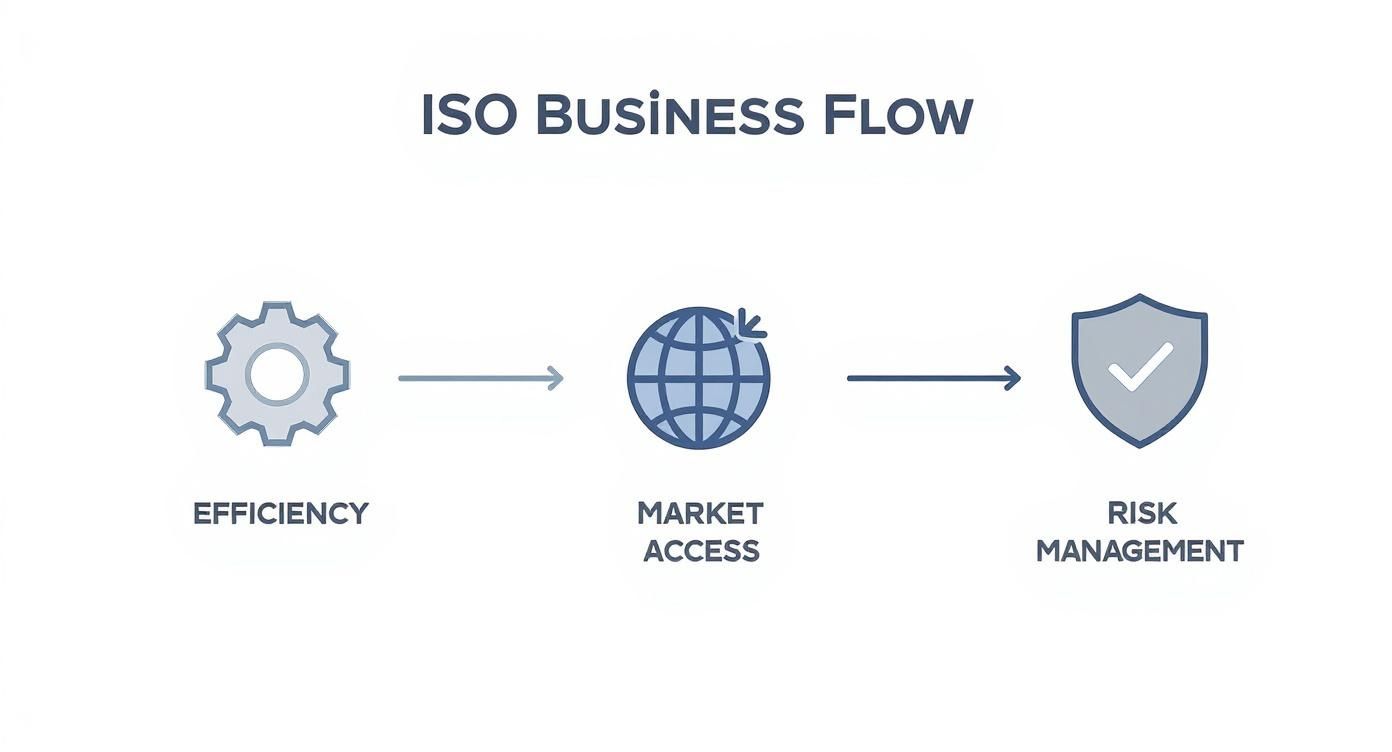
As you can see, the journey starts when you recognise clear business needs. These needs then justify the investment in a structured framework like ISO.
Phase 1: Laying the Foundation
Before you touch a single policy or tweak any process, you have to start with a solid foundation. This first phase is all about getting everyone on the same page and figuring out exactly where you stand right now. Rushing this is a classic mistake that only leads to confusion and wasted effort later on.
First things first: you absolutely must get leadership buy-in. ISO compliance can't be just an IT or quality department project; it has to be a strategic, business-wide initiative. Your leadership team needs to be the champion for this, understanding the benefits and being ready to commit the necessary time and resources.
Once the leaders are on board, you need to clearly define the scope of your management system. Are you aiming to certify the entire organisation, or just one specific department, product line, or office? For most SMEs, starting with a smaller, well-defined scope is the smart move. It allows you to get certified faster and then expand from there.
Phase 2: The Gap Analysis and Planning
With your foundation in place, it’s time to measure the distance between where your business is today and where it needs to be to meet the standard. This is where a gap analysis comes in—it’s a critical diagnostic step.
Think of it like a pre-flight checklist for your business. You’ll methodically go through every clause of your chosen ISO standard (like ISO 27001) and stack it up against your current processes, policies, and controls. The result is a straightforward list showing what’s missing, what’s partially there, and what already ticks the box.
This analysis is your most powerful planning tool. It helps you to:
- Identify Priorities: Pinpoint the most critical gaps that you need to tackle first.
- Estimate Effort: Get a real sense of the work involved, which helps build a realistic project plan.
- Allocate Resources: Assign the right tasks to the right people and budget for what’s needed.
The findings from your gap analysis become the backbone of your implementation plan, turning a vague goal into a concrete list of actions.
Phase 3: Building and Implementing Your System
Now it’s time to roll up your sleeves and get to work. Using the gap analysis as your guide, you’ll start developing the documentation and putting new processes in place to meet the ISO standard.
This usually involves creating a core set of documents that make up your management system. For businesses focusing on information security, a practical roadmap to achieving ISO compliance often means going for ISO 27001 accreditation.
Key activities in this phase include:
- Documentation Development: This is where you write the policies, procedures, and instructions that define your new way of working. The key is to keep them clear, concise, and practical—your team has to actually use them.
- Risk Assessment and Treatment: For standards like ISO 27001, this is a non-negotiable step. You must formally identify, analyse, and evaluate your information security risks, and then map out a plan to treat them.
- Implementation and Training: You’ll need to roll out the new processes across your teams. This is more than just sending a company-wide email; it requires proper training and clear communication so everyone understands their role.
The goal of documentation isn’t to create a library of binders to collect dust. It's to build a living, useful set of tools that helps your team deliver consistent, high-quality, and secure work, day in and day out.
Phase 4: Verification and Final Preparation
Once your new system is up and running, you need to check that it’s actually working the way it’s supposed to. This phase is all about checking your own work and making final tweaks before the external auditors show up.
The first major step is to conduct a full internal audit. Think of this as a dress rehearsal for the main event. An impartial internal auditor (or an external consultant) will review your entire system against the ISO standard, making sure you’re doing what your new policies say you do.
After the internal audit, you have to hold a management review meeting. This is a formal meeting where your leadership team reviews the system’s performance, the audit results, and other relevant feedback. It’s a crucial step that demonstrates leadership’s ongoing commitment.
These activities help ensure there are no nasty surprises during the certification audit. For a complete walkthrough of the entire journey, our guide on how to get ISO certified provides even more detail on each of these critical stages.
Phase 5: The Certification Audit
This is it—the final step in your initial journey. The external audit is conducted by an accredited certification body and is usually split into two parts.
- Stage 1 Audit: The auditor will mostly review your documentation. They’re checking to see if your management system, on paper, has been designed to meet all the requirements of the standard.
- Stage 2 Audit: This is a much deeper dive. The auditor will come on-site (or connect remotely) to verify that you are actually following the processes you’ve documented. They’ll interview your staff, review records, and look for real-world evidence of compliance.
If the auditor finds that you meet all the requirements, they will recommend you for certification. Earning that certificate is a massive achievement. It marks the successful end of your roadmap and the beginning of your ongoing commitment to excellence.
Using Technology for Smarter ISO Management
Trying to manage the huge task of ISO compliance with a messy mix of spreadsheets, shared folders, and never-ending email chains? It’s a bit like trying to navigate Sydney's CBD with a crumpled, hand-drawn map. You might get there in the end, but the journey will be slow, frustrating, and full of wrong turns. This manual approach is a fast track to version-control chaos, missed deadlines, and that dreaded panic when the auditor walks in.
Thankfully, there’s a much better way. Purpose-built platforms, often called Governance, Risk, and Compliance (GRC) software, are designed to bring order to this chaos. Think of them as the central nervous system for your entire management system, moving you out of the manual grind and into a world of automation and control.
Moving Beyond the Manual Mess
The biggest weakness in any manual compliance system is the lack of a single source of truth. Evidence is scattered everywhere, policies go stale without anyone realising, and tracking who needs to fix what becomes a full-time job. GRC platforms solve this by centralising every part of your ISO compliance program.
Imagine having all your policies, risk assessments, audit results, and control evidence in one secure, organised place. This isn't just about tidy file management; it's about building a living, connected system where every piece of information is linked and easy to find. It’s the difference between a shoebox full of receipts and a perfectly balanced accounting ledger.
The Power of a Real-Time Compliance Dashboard
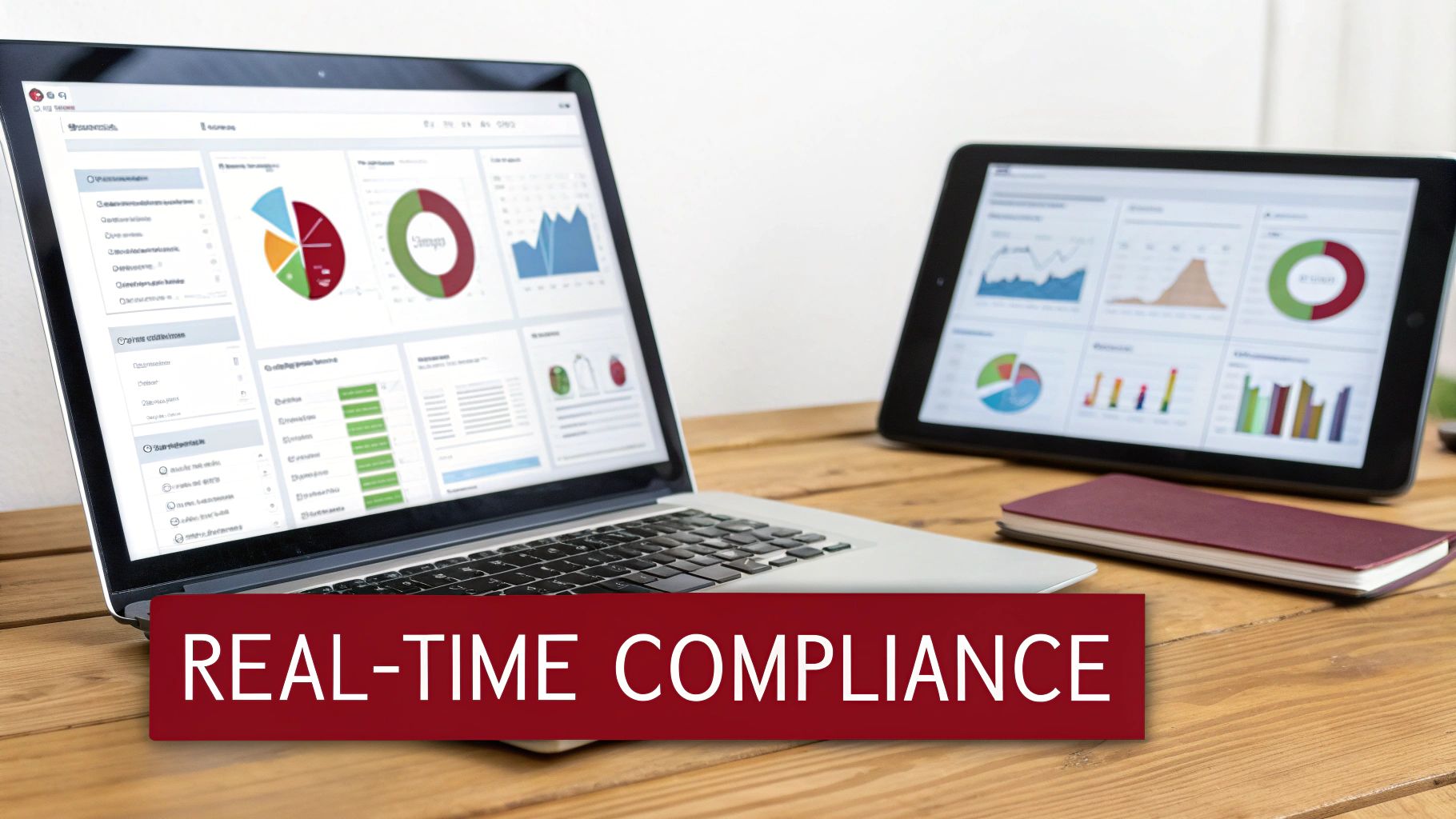
One of the best features of modern GRC software is the real-time compliance dashboard. It gives you an immediate, at-a-glance snapshot of your entire security and compliance posture. Instead of digging through folders to figure out where you stand, you get a clear, visual summary of your progress.
A typical dashboard will show you:
- Overall Compliance Score: A simple percentage showing how close you are to meeting the standard’s requirements.
- Open Tasks and Due Dates: A clear list of who is responsible for what, making sure nothing falls through the cracks.
- Risk Heat Maps: A visual map of your biggest risks, helping you focus your efforts where they matter most.
- Control Implementation Status: See which security controls are in place, which are in progress, and which need attention.
This level of visibility is a game-changer. It lets managers make smart decisions quickly and gives the whole team a clear picture of their progress towards certification.
A GRC dashboard turns ISO compliance from a mysterious, once-a-year scramble into a transparent, day-to-day part of your operations. It helps you manage compliance proactively, not just react when something goes wrong.
Automating Evidence Collection and Audits
One of the most painful parts of maintaining ISO compliance is gathering and organising all the evidence to prove your controls are actually working. Manually, this means taking screenshots, saving log files, and constantly chasing colleagues for documents. It’s tedious. GRC platforms can automate most of this grunt work.
By connecting to your existing IT systems—like your cloud provider, antivirus software, or HR platform—a GRC tool can automatically pull in the evidence needed for an audit. For instance, it can check that all company laptops have encryption turned on or confirm that new hires have completed their security awareness training.
This automation makes preparing for an audit so much faster and more accurate. When the external auditor arrives, you can simply give them access to the platform, where all the evidence is neatly organised and linked back to the specific ISO controls. It’s a smooth, professional process that shows you're on top of your game.
Why Cloud-Based GRC Tools Are the Smart Choice
For most small and medium-sized Australian businesses, cloud-based GRC platforms are the way to go. They offer some serious advantages over old-school, on-premise software.
- Pre-Built Templates: Many cloud GRC tools come with ready-made templates for popular standards like ISO 27001. This gives you a massive head start with a pre-built structure for your policies, controls, and risk assessments.
- Scalability: You can start with just the features you need and easily add more as your business grows or as you decide to tackle other certifications.
- Accessibility: Your team can securely access the platform from anywhere, which is perfect for businesses with remote or hybrid work models.
- Lower Upfront Costs: A subscription model means you avoid a huge capital outlay for hardware and software licences.
By adopting the right technology, you can make your journey to ISO compliance far more efficient, accurate, and sustainable. It’s all about working smarter, not harder, and building a management system that actually helps your business. For those focused on information security, understanding the system's structure is the first critical step. You can learn more in our detailed explanation of an Information Security Management System. The right tools will help you escape the manual chaos and embrace a system that drives real, continuous improvement.
Maintaining and Improving Your ISO Compliance Over Time
Right, so you’ve got the certificate framed on the wall. That’s a massive win, but it’s really just the beginning of the journey, not the finish line. The real power of ISO compliance isn’t in the piece of paper; it’s in weaving these principles into the very fabric of your business culture.
Think of it less like a one-off project and more like a commitment to getting better every single day. True compliance means your management system isn’t a dusty binder on a shelf. It’s alive, adapting to new business hurdles, changing customer needs, and whatever new security threats pop up. This is what turns your certification into a long-term asset that builds real resilience.
The Never-Ending Cycle of Improvement
Keeping your hard-earned certification comes down to a simple but incredibly effective loop: Plan-Do-Check-Act (PDCA). This isn't just some business school jargon; it’s the engine at the heart of every ISO standard, giving you a clear roadmap for continuous improvement.
The trick is to make this cycle part of your everyday routine. When you do that, compliance stops being a frantic, last-minute rush before an auditor shows up. Instead, it becomes a natural habit, a reflex for excellence.
Your ongoing efforts will generally focus on three key activities:
- Internal Audits: Think of these as regular self-checks to make sure you're actually doing what you say you do.
- Management Reviews: This is when the leadership team gets together to review performance and steer the ship.
- Surveillance Audits: These are the annual check-ins from your external certification body to keep you on track.
Conducting Regular Internal Audits
Internal audits are your early warning system. They’re like a routine health check-up for your management system, helping you catch small hiccups before they snowball into major non-conformities that could jeopardise your certification.
A smart internal audit program is spread out across the year, not jammed into the weeks before the external auditor arrives. This systematic approach ensures every part of your system gets a regular look-over. Remember, the point isn’t to play "gotcha" and find fault; it's about uncovering opportunities to improve and confirming your processes are working the way they should.
Leading with Management Reviews
Management reviews are where your leadership team takes the helm. These aren’t just boring status meetings; they're strategic sessions to ask the big questions: Is our system still doing its job? Is it still aligned with where the business is heading?
Maintaining ISO compliance is about cultivating a culture where every team member champions the standards. It requires ongoing commitment from leadership to ensure the system drives sustained success rather than becoming a forgotten relic.
During these reviews, leaders need to dig into performance data, customer feedback, and the findings from internal audits. They also need to consider any shifts in the business landscape. This high-level oversight ensures that your commitment to ISO compliance stays a priority, driving real business decisions and getting the resources it needs to thrive.
Navigating Surveillance Audits
After you’re certified, your certification body will pop in for regular check-ups called surveillance audits, usually once a year. They aren’t as full-on as the initial certification audit, but they’re every bit as important. The auditor is there to confirm that your system is still up and running effectively and that you're genuinely committed to improving it.
Getting through these audits smoothly is all about being prepared. Have your internal audit reports, management review meeting minutes, and proof of any corrective actions ready to go. This shows the auditor you’re on top of things and actively managing your system. Passing these annual checks is what keeps your certificate valid and proves your ongoing dedication to being the best in your field.
Frequently Asked Questions
Jumping into the world of ISO compliance can feel like learning a new language, and it's only natural to have a few questions. We've gathered the most common queries from Australian business owners to give you the straight answers you need to move forward.
How Much Will ISO Certification Cost in Australia?
There's no one-size-fits-all answer here. The final cost of getting ISO certified really depends on the size of your business, how complex your operations are, and which standard you're aiming for.
Think of the total cost as having a few different parts. You'll have fees for the certification body that performs the audits (both Stage 1 and Stage 2). If you bring in a consultant to help, that's another piece. You might also need to invest in new software or systems, and of course, there's the time your team will spend on training and putting everything into practice. For a small to medium-sized business, this can add up to anywhere from a few thousand to tens of thousands of dollars.
But it’s important to see this as a strategic investment, not just a line item on an expense report. The real payoff comes from smarter risk management, smoother operations, and the ability to win bigger contracts with clients who won't work with anyone less.
How Long Does the ISO Certification Process Take?
Again, this really hinges on where you're starting from. If your business already has some solid processes and good documentation, you're well ahead of the game and the timeline will be shorter.
A well-prepared small or medium business can often get certified in about six to nine months. On the other hand, if you're a larger organisation or a company starting from square one, it's more realistic to expect the process to take 12 to 18 months. Things like the scope of the certification, how much time your team can dedicate, and whether leadership is driving the project all play a huge role in how quickly you get there.
Can a Small Business Really Get ISO Certified?
Yes, absolutely. This is one of the biggest myths out there—that ISO is just for the big players. The standards are actually built to be flexible and scalable, which makes them a perfect fit for small businesses too.
The trick for a smaller company is to be smart and practical. You don't need a sprawling, enterprise-level software suite; well-organised cloud folders, simple GRC tools, and good templates can work just as well. The fundamental ideas of assessing risks, writing down how you do things, and always looking for ways to get better are what matter. Those principles are just as powerful for a five-person team as they are for a global giant.
Ready to take the mystery out of ISO 27001 and make your business more secure and competitive? Expert, hands-on consulting designed specifically for Australian small businesses can make all the difference, providing a clear path to certification success. Start your journey to ISO compliance today.
Recent Comments