

Let's be honest, diving into the world of ISO standards can feel overwhelming. It’s like being handed a 500-page technical manual for something you need to build, but you don't even know where to start. You know the end result will be a stronger, more reliable business, but the journey to get there looks incredibly complicated.
This is exactly where an ISO consultant steps in. Think of them less as an auditor and more as a seasoned guide or a specialised coach for your business. Their job is to take those dense, jargon-filled standards and translate them into a clear, practical roadmap that actually makes sense for your company.
So, What Exactly Do ISO Consultants Do?
An ISO consultant isn't there to just tick boxes on a checklist. They're there to help you fundamentally improve how your business operates. They roll up their sleeves and work with your team to build and implement systems that don't just meet international benchmarks, but also make your business more efficient and resilient.
It’s About Real Improvement, Not Just a Certificate on the Wall
It’s easy to fall into the trap of seeing ISO certification as just another administrative hurdle. But a good consultant shifts that perspective entirely. They help you see it as a strategic investment in your company's future.
The goal isn't to create a thick binder of policies that no one ever reads. It's about weaving best practices into the very fabric of your daily operations—embedding a culture of excellence that delivers real, tangible benefits long after the certificate is hung.
Turning Complex Rules into Simple, Effective Actions
ISO standards cover a lot of ground, from the quality of your products to the security of your data. A consultant’s real value is their expertise across these different frameworks.
They can help you with things like:
- Quality Management (ISO 9001): Putting systems in place to make sure your customers are consistently happy with your products and services, which is the secret sauce for loyalty and repeat business.
- Information Security (ISO 27001): Building a rock-solid defence for your sensitive data. This builds immense trust with clients, especially when you can show you’re taking proactive steps like implementing encryption at rest.
- Environmental Management (ISO 14001): Finding practical ways to manage your environmental footprint, which can improve your brand image and ensure you’re meeting your obligations.
- Occupational Health & Safety (ISO 45001): Creating a genuinely safer workplace for your team, which reduces risks and shows your people you care.
This kind of expertise is in high demand. The global market for ISO certification services is expected to hit around USD 15.25 billion by 2025—a significant jump from USD 11.85 billion in 2021. Australian businesses are right in the thick of this, increasingly investing in these standards to compete on a global stage.
At the end of the day, an ISO consultant’s job is to make a complex process simple. They take what seems like a daunting, resource-draining mountain and turn it into a series of manageable steps. This is especially crucial for smaller businesses that don’t have a dedicated compliance department. An expert guide can help you build a stronger reputation, gain a real competitive advantage, and open doors to new opportunities.
Your Roadmap to ISO Certification
Getting your business ISO certified can often feel like you've been asked to climb a mountain without a map. You know the view from the top—a more secure, compliant, and competitive company—is worth it, but the path is full of jargon and potential missteps. This is where an expert ISO consultant comes in. They’re not just a guide; they’re your experienced sherpa, turning a daunting climb into a clear, manageable ascent.
A good consultant doesn't just hand you a generic checklist. They lay out a clear, step-by-step roadmap that’s built specifically for your organisation. This journey is broken down into logical phases, with each one setting the foundation for the next, guaranteeing a smooth and successful trip to the summit.
This is all about turning complexity into clarity, and ultimately, into real business value.
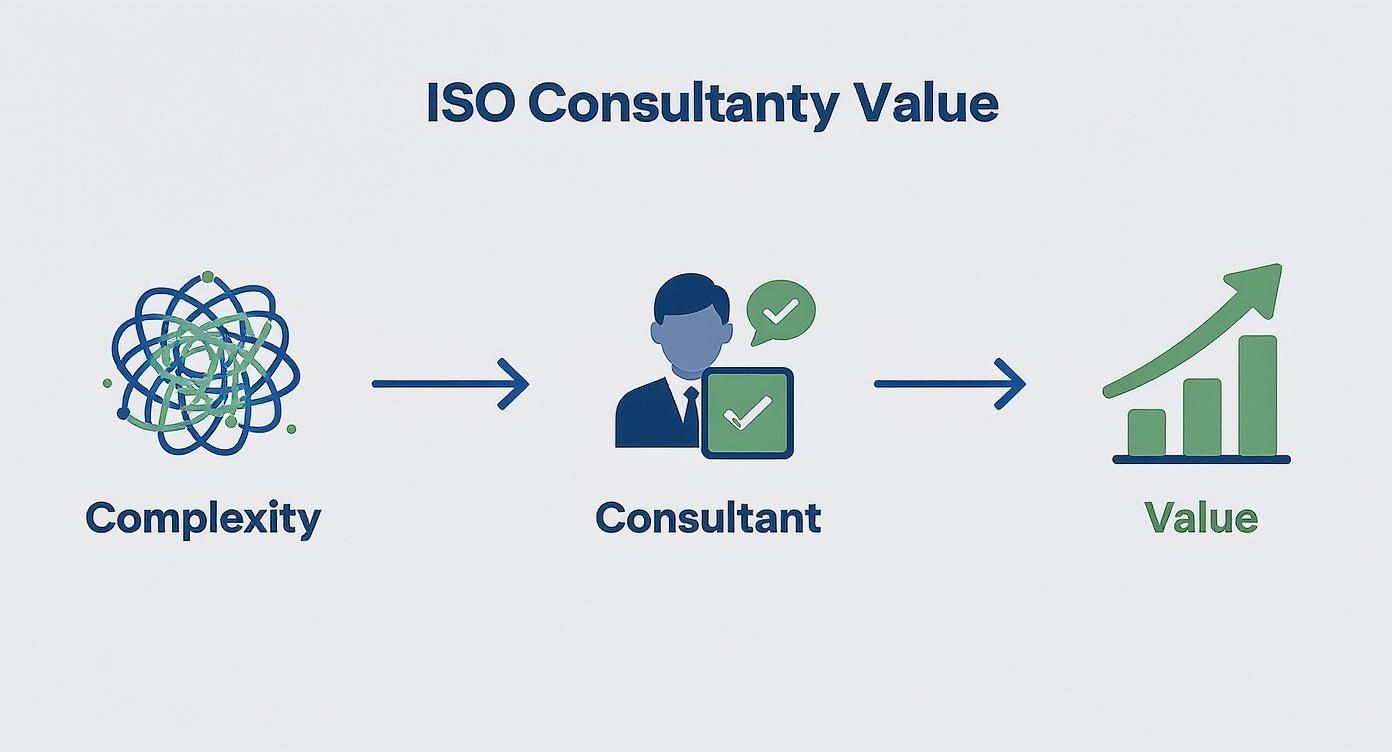
As you can see, the consultant is the bridge between the technical demands of the standard and your business goals, guiding you toward better performance and growth.
Stage 1: The Foundational Gap Analysis
The first thing any credible consultant will do is a Gap Analysis. Think of it like a full diagnostic health check for your business. The consultant takes a deep dive into your current processes, procedures, and paperwork, measuring them against the specific clauses of the ISO standard you’re aiming for.
This isn’t about pointing out flaws. It’s a collaborative effort to figure out what you’re already doing well, where the gaps are, and exactly what needs to be done to close them. This gives you a crystal-clear blueprint for the entire project, so you don’t waste a single minute or dollar on things that don’t matter.
The result is a detailed report and a prioritised action plan, giving you an honest look at the scope, timeline, and resources required.
Stage 2: Building Your Management System
With the gaps identified, it’s time to start building. This is where we develop your management system, and it’s not what you might think. A common fear is that this means creating a mountain of paperwork destined to collect dust on a shelf. A great consultant makes sure that never happens.
They'll work right alongside your team to craft practical, sensible policies and procedures that actually reflect how your business runs. The whole point is to build a system that helps you, not one that ties you up in red tape. It’s about creating a customised Management System that fits your culture and operational flow like a glove.
This stage typically involves:
- Documenting core policies: Writing down the high-level commitments that define your organisation's approach to quality or security.
- Developing practical procedures: Outlining the step-by-step “how-to” for your key processes so they’re done right, every time.
- Creating simple forms and records: Designing straightforward tools to capture the proof needed to show your system is alive and working.
The consultant’s experience is invaluable here. They know exactly what auditors are trained to look for and how to document things in a way that’s both compliant and easy for your team to use.
Stage 3: Implementation and Team Training
Once the system is designed on paper, it’s time to bring it to life. This is where your ISO consultant shifts from being an architect to a hands-on coach, guiding your team as they adopt the new ways of working.
Good training is absolutely essential. It makes sure everyone, from the CEO down to your frontline staff, understands their role and why these changes matter. The consultant will often run training sessions designed to explain not just the what, but the why.
This is how you get genuine buy-in and turn what could be resistance into active participation. The consultant helps weave these new practices into your daily routines until they become second nature.
Your Step-by-Step ISO Consultancy Roadmap
Here’s a quick summary of how a consultant-led journey typically unfolds, breaking down the entire process into clear, manageable phases.
| Phase | Key Objective | Typical Activities |
|---|---|---|
| 1. Gap Analysis | To create a clear project blueprint. | Reviewing current processes, comparing against ISO standard requirements, and creating a detailed action plan. |
| 2. System Development | To build a practical, compliant management system. | Writing policies, documenting procedures, and designing essential forms and records. |
| 3. Implementation & Training | To embed the new system into daily operations. | Conducting team training sessions, guiding process adoption, and generating initial records. |
| 4. Internal Audits | To test the system and ensure audit-readiness. | Performing a full system audit, identifying non-conformances, and implementing corrective actions. |
| 5. Certification Support | To successfully pass the external audit. | Helping select a certification body, providing support during the audit, and ensuring a smooth process. |
This structured approach removes the guesswork, ensuring every step you take is a confident one toward achieving your certification.
Stage 4: Internal Audits – The Full Dress Rehearsal
Before you face the official auditors, your consultant will run internal audits. Consider this your full dress rehearsal—a friendly but thorough check to see how well the new system holds up under pressure.
This serves two crucial functions. First, it verifies that your management system ticks all the boxes required by the ISO standard. Second, it uncovers any weak spots or opportunities for improvement before the final exam.
This gives you the chance to fix any issues in a low-stakes environment. Your consultant will give you a detailed audit report and help you put things right, making sure you walk into the final audit feeling completely prepared and confident. If you want a closer look at the whole certification timeline, you can check out our in-depth guide on how to get ISO certified.
Stage 5: Support During the Certification Audit
The final hurdle is the external audit, which is carried out by an accredited certification body. Your consultant’s job here is to be your unwavering support system. They’ll help you choose a reputable auditor, manage the application, and will often be right there with you during the audit itself.
Having your consultant in the room is a huge source of comfort. They can help translate any tricky questions from the auditor, provide extra context on your processes, and ensure the entire event runs smoothly. Their presence alone shows the auditor you’ve taken this seriously and helps you cross the finish line with confidence.
By following this structured, five-stage journey, an expert ISO consultant makes the entire process clear and achievable. They provide the know-how, the framework, and the support you need to not just get a certificate on the wall, but to build a stronger and more successful business for the long haul.
Unlocking Your Competitive Edge with ISO Certification
Think of ISO certification not as a chore you have to do, but as a powerful tool to sharpen your business. It's far more than just ticking a compliance box; it's a strategic decision that strengthens your entire operation from the ground up, giving you a serious, lasting advantage over the competition.
For many small and medium-sized businesses, this is a game-changing shift in mindset. When you stop seeing ISO as a necessary evil and start viewing it as an investment in a more resilient, efficient, and respected company, you unlock its true potential.

Gain Access to Exclusive Opportunities
One of the first things you'll notice after getting certified is that doors start to open—doors that were firmly shut before. Many large corporations and government departments won't even look at a supplier without ISO certification. It's a non-negotiable part of their procurement process.
Holding a certificate like ISO 9001 (Quality Management) is like having a global passport for quality. It tells potential clients, in a language they understand, that your business is reliable and operates to an internationally recognised standard. In a competitive tender, that credential alone can be the difference-maker that gets you shortlisted.
This is where professional iso consultancy services really prove their worth. A good consultant doesn't just get you over the certification line; they help you build the kind of robust, dependable systems these high-value clients are looking for, positioning you as a low-risk, high-quality partner.
Drive Real Operational Efficiency
While winning new business is a huge plus, the changes ISO certification drives inside your business are just as valuable. The process forces you to put your own operations under the microscope, revealing hidden inefficiencies, bottlenecks, and wasteful habits you might not even realise you had.
Take ISO 9001 again. It’s built around a "process approach," which basically means you map out, measure, and improve how you do everything. This leads to some fantastic outcomes:
- Reduced Waste: Standardising how you work cuts down on errors, rework, and wasted materials, which flows straight to your bottom line.
- Improved Consistency: With everyone following the same proven methods, your customers get the same great result, every single time. No more "good days" and "bad days."
- Increased Productivity: When workflows are clear and responsibilities are defined, your team spends less time fixing mistakes and more time creating value.
This isn't a one-off fix. It creates a culture of continuous improvement that keeps paying dividends long after the auditors have gone home.
Proactively Manage Business Risks
In a world full of unpredictability—from cyber threats to supply chain disruptions—sitting back and waiting for things to go wrong is not a strategy. ISO standards give you a structured, proven way to identify, assess, and control risks before they can do real damage.
This is particularly clear when you look at standards designed for specific risk areas.
Key Standards for Risk Management
| Standard | Focus Area | How It Protects Your Business |
|---|---|---|
| ISO 27001 | Information Security | Builds a solid defence around your sensitive data, preventing costly breaches and protecting your reputation. |
| ISO 45001 | Occupational Health & Safety | Creates a safer workplace by systematically identifying and controlling hazards, protecting your team and your business. |
| ISO 14001 | Environmental Management | Helps you manage your environmental footprint, ensuring you comply with regulations and avoid hefty fines. |
Implementing these standards means you're no longer just reacting to crises. You're building a resilient organisation that can see trouble coming and navigate it with confidence. The many benefits of ISO certification go far beyond a piece of paper; they become part of your strategic DNA.
Enhance Customer Trust and Brand Reputation
In business, trust is everything. Customers and partners want to work with organisations they know are reliable, secure, and professional. ISO certification is one of the clearest and most credible ways to demonstrate that you are exactly that.
When you display an ISO logo, you're making a public promise of quality. It's an independent, third-party endorsement that your business meets international best practices. Instantly, your brand’s credibility gets a boost, giving customers a compelling reason to choose you over a non-certified competitor.
This is especially true in the competitive Australian market. For instance, achieving ISO 27001 has become almost essential for businesses in finance or healthcare that handle sensitive data, as it's often a prerequisite for winning major contracts.
Ultimately, getting ISO certified is one of the smartest investments you can make. It makes your business more competitive, more efficient, and more trusted—building a rock-solid foundation for future growth.
How to Choose the Right ISO Consultant for Your Business
Picking the right partner for your ISO certification is probably the single most important decision you'll make on this journey. It’s the difference between a smooth, genuinely valuable process and a frustrating, expensive detour. Think of your consultant as more than just a hired gun; they're your guide, your in-house expert, and your strategic partner all in one.
Get this choice right, and you’ll end up with a management system that actually makes your business stronger, not just a certificate to hang on the wall. This guide will give you a practical way to size up potential consultants and find the perfect fit for your Australian business.
Look for a Proven Track Record of Success
First things first: you need to see a demonstrated history of getting results. You’re putting significant time and money on the table, so you need a partner who can deliver a return on that investment. Don't be afraid to ask for proof of their success.
A consultant’s success rate is a massive clue about their reliability and expertise. A high success rate shows a rock-solid, repeatable process that works for clients. It takes the guesswork out of the equation and gives you peace of mind that you're in safe hands.
Don’t be shy about asking for case studies or testimonials, especially from businesses similar to yours. A good firm will be proud to show off their wins and even connect you with past clients who can vouch for their work.
Prioritise Relevant Industry Experience
Every industry has its own set of challenges, risks, and regulatory quirks. A consultant who’s a wizard in the food manufacturing world might not be the best choice for an IT service provider, and vice versa. Generic, one-size-fits-all approaches just don't cut it.
A consultant with deep experience in your sector brings priceless context to the table. They already understand your day-to-day realities, speak your language, and know exactly how to apply the ISO standard’s clauses to your specific operations.
This specialised knowledge means they can give you sharp, practical advice that adds real value. They can see industry-specific roadblocks coming from a mile away and design solutions that are not only compliant but also make good business sense.
Evaluate Their Credentials and Expertise
Beyond just hands-on experience, you need to check a consultant's professional qualifications. This is your way of making sure they have the formal training and knowledge to guide you properly.
Look for consultants who hold relevant certifications themselves, like being a Lead Auditor for the standard you're aiming for (e.g., ISO 9001 or ISO 27001). This credential proves they've been trained to think like an auditor and know exactly what the certification bodies are looking for.
ISO Consultant Evaluation Checklist
Use this checklist to systematically compare potential consultants. It helps you look beyond the sales pitch and focus on what truly matters for a successful partnership.
| Criteria | What to Look For | Red Flags to Avoid |
|---|---|---|
| Success Rate | A documented, high success rate. Eager to share client stories and references. | Vague answers about past results or an unwillingness to provide references. |
| Industry Experience | Deep, specific experience in your sector. They understand your unique risks and processes. | A "one-size-fits-all" approach. They talk in generalities, not specifics about your industry. |
| Consultant Credentials | Lead Auditor qualifications for the relevant standard. Evidence of ongoing professional development. | No formal certifications or qualifications. The person selling isn't the person doing the work. |
| Methodology | A clear, step-by-step process (Gap Analysis, Project Plan, etc.). They explain how they'll work with you. | A "black box" process where you don't know what's happening. Overly complex or confusing explanations. |
| Approach | They ask lots of questions about your business first. Focus is on tailoring the system to you. | They immediately push a standard package or template without understanding your needs. |
| Team Engagement | A clear plan for training and involving your staff. They see your team as key to success. | The process seems to happen to you, not with you. Little mention of team training. |
By ticking these boxes, you can be confident you’re choosing a partner who will truly elevate your business, not just check a compliance box.
Insist on a Transparent Methodology
A professional ISO consultancy service should be able to walk you through their entire process in plain English. If their method seems murky, overly complicated, or like some kind of secret recipe, that's a major red flag. You should feel informed and in control every step of the way.
A clear and open process usually includes:
- A thorough initial Gap Analysis to give everyone an honest picture of where you are now.
- A detailed project plan with clear milestones, timelines, and who's responsible for what.
- A collaborative spirit when it comes to creating your documents and systems.
- A real commitment to hands-on training and support for your team.
This kind of clarity makes sure there are no nasty surprises down the road and that everyone is on the same page about the end goal.
Spot the Difference Between Custom and Generic
The whole point of ISO certification is to improve your business. This means the management system has to be built around your existing processes and culture. Some consultants lean heavily on generic, off-the-shelf templates, which often lead to a system that feels clunky, inefficient, and completely disconnected from how your team actually works.
A great consultant starts by understanding your world and then tailors the ISO framework to fit it perfectly. They bend the standard to fit your business, not the other way around. When you're talking to them, pay close attention: are they asking smart questions about your operations, or are they just talking about their standard package? For more details on finding a partner who understands your specific needs, you can explore what makes an effective ISO consultant in our dedicated guide.
Choosing the right consultant is an investment in your company’s future. By focusing on a proven track record, deep industry experience, and a transparent, customised approach, you can find a partner who will not only get you certified but also help you build a stronger, more resilient, and more competitive business.
The Anitech Advantage: Our Commitment to Your Success
Choosing an ISO consultancy isn't just a business transaction; it's an act of trust. You’re not just hiring an expert for a project—you're bringing on a partner to guide your business through a critical change. It’s why our entire approach is built on a rock-solid commitment to your success, backed by a flawless track record.
Our promise is simple but powerful: we guarantee you’ll get certified. This isn’t a flashy marketing slogan; it’s a fact supported by a 100% success rate. Every single client who has followed our proven methodology has achieved their ISO certification on the first try. That’s the kind of peace of mind you can build a business on.
A True Partnership, Not Just a Project
Plenty of consultants can hand you a project plan. We offer a genuine partnership. We go way beyond generic templates and checklists to really get inside your world. Our first step is always to listen and learn—to understand your business's unique rhythm, its specific challenges, and its biggest goals.

Think of us as an extension of your team. We learn your processes, get to know your people, and make sure our strategy fits your day-to-day reality. This deep dive lets us design and build a management system that feels like a natural evolution of your business, not some rigid framework forced on top of it.
This bespoke approach is everything. A system that works for a huge manufacturer in Sydney just won't fly for a tech startup in Melbourne. We tailor every policy, procedure, and training session to your industry, size, and culture. The result is a system that’s both practical and powerful.
Deep Expertise Across Critical Standards
Our team has years of hands-on experience across the most important ISO standards that help Australian businesses thrive. This breadth of knowledge means we can offer integrated solutions that tackle different parts of your organisation at once.
- ISO 9001 (Quality Management): We’ll help you build systems that deliver consistent quality, keeping your customers happy and making your operations more efficient.
- ISO 27001 (Information Security): We construct robust defences to protect your most valuable asset—your data—building unbreakable trust with your clients.
- ISO 14001 (Environmental Management): We’ll guide you in creating sustainable practices that strengthen your brand and keep you compliant.
- ISO 45001 (Occupational Health & Safety): We work with you to create a safer workplace, protecting your team and minimising risk.
This specialisation is crucial in sectors facing rapid growth and tighter regulations. In Australia, the IT services industry has become a major driver for ISO consultancy services, especially for standards like ISO 27001. With the local IT market tipped to rocket from USD 32.26 billion in 2025 to USD 77.77 billion by 2030, the need for certified security systems is massive. This boom, combined with a real skills shortage, makes an expert consultant an essential ally. You can learn more about the Australian IT market's expansion and what it means for consultancy needs.
More Than an Audit: We Build Lasting Value
Passing the certification audit is a huge milestone, but for us, it’s just the beginning. Our real goal is to leave you with more than a certificate on the wall. We want to embed a culture of continuous improvement that keeps delivering value long after our work is done.
We don’t just prep you to answer an auditor’s questions. We give your team the knowledge and tools to own, manage, and evolve your new system.
This commitment to empowerment is what really sets us apart. We’re not interested in making you dependent on us. We’re focused on building your team’s capability so you can confidently handle future audits and keep refining your processes on your own. We’re here to build you up, not lock you in.
Choosing a consultancy means choosing a partner dedicated to your success, armed with a proven method and a deep understanding of the Australian business environment. It’s a choice for certainty, for a solution that truly fits, and for a partnership that builds a stronger, more resilient, and more competitive business.
Your ISO Consultancy Questions, Answered
Venturing into the world of ISO certification naturally brings up a few practical questions. You can see the strategic value and you have a handle on the process, but now it’s time to get into the nuts and bolts. Here, we tackle the most common queries we hear from business owners, giving you the direct, clear answers you need to move forward.
How Long Does ISO Certification Take with a Consultant?
It’s one of the first things everyone wants to know. While there's no single magic number, a typical ISO certification journey with a consultant ranges from 3 to 9 months. That might seem like a broad window, but it’s because the timeline is shaped entirely by your business.
Think of it like building a custom piece of furniture versus assembling something from a flat-pack. The flat-pack is quick but generic; it never quite fits perfectly. A custom build takes longer, but it’s designed for your space. Your ISO management system should be a custom build.
Several key factors will influence your specific timeline:
- Your Company’s Size and Complexity: A tech startup with 15 people in one office will have a much faster journey than a manufacturing business with 100 staff across three sites. More people, processes, and locations simply mean more to document, implement, and audit.
- The Specific ISO Standard: Some standards are more intensive than others. Getting certified for ISO 9001 (Quality) is often more straightforward than implementing a complex ISO 27001 information security system, which requires deep technical controls and risk assessments.
- Your Starting Point: If you already have some formal processes and documents, your consultant can build on that foundation. If you're starting from scratch, that initial development phase will naturally take a bit longer.
- Your Team’s Availability: A consultant does the heavy lifting, but it’s still a team sport. Your team's ability to engage, provide information, and get involved in implementation plays a big role in keeping things moving.
A good consultant will give you a realistic project plan right after the initial Gap Analysis, mapping out clear milestones so you always know where you are and what’s coming next.
What’s the Typical Cost of Engaging These Services?
Let's talk money. It's essential, but it’s crucial to frame it correctly. Hiring an ISO consultant isn't just an expense; it's a direct investment in your business's resilience, efficiency, and reputation. The price reflects the expert guidance and hands-on work needed to build a valuable business asset.
ISO consultancy costs can be structured in a few different ways—often as a fixed project fee or a daily rate. The total investment will hinge on variables similar to those affecting the timeline.
Key Factors Influencing Cost:
- Scope of Work: Are you aiming for one standard like ISO 9001, or are you looking at an integrated system that covers Quality, Safety, and Environment? Integrating systems is more efficient in the long run but requires a larger initial investment.
- Number of Employees and Sites: More locations and staff mean more time is needed for auditing, training, and implementation support, which is reflected in the cost.
- The Consultant’s Role: Do you need someone to manage the whole project from start to finish, or are you just looking for guidance while your team does most of the legwork? The level of hands-on support will shape the final fee.
It's tempting to shop around for the cheapest price, but value will always trump a low price tag. A low-cost consultant using generic templates might get you a certificate, but a true partner who builds a custom, effective system will deliver a far greater return through genuine business improvement.
Ultimately, the cost of certification is small potatoes compared to the benefits. Think about the value of winning a single large contract that required ISO certification, or the savings from making your operations 20% more efficient. That's the real, long-term ROI.
Can We Get Certified with Limited Internal Resources?
This is a huge concern, especially for small and medium-sized businesses where everyone is already wearing multiple hats. The great news is, this is precisely where a consultant provides the most value. The answer is a resounding yes.
An ISO consultant acts as a powerful extension of your team. They are your project manager, technical expert, and compliance officer all rolled into one, brought in specifically to fill those resource and knowledge gaps.
Here’s how a consultant makes certification achievable, even for lean teams:
- They Do the Heavy Lifting: They take charge of the most time-consuming tasks, like writing detailed policies and procedures, conducting risk assessments, and organising all the required documentation.
- They Provide Structure and Momentum: Without an external guide, it’s easy for an ISO project to stall when day-to-day business pressures take over. A consultant keeps the project on track, managing timelines and ensuring things keep moving forward.
- They Deliver Efficient Training: Instead of you trying to figure out how to train your staff, the consultant delivers targeted, effective training that gives your team exactly what they need to know without wasting their time.
By outsourcing the specialised work, you free up your team to focus on what they do best—running the business. This makes achieving certification not just possible, but practical for even the smallest of teams.
What Happens After We Get Certified?
Getting your ISO certificate is a fantastic milestone, but it's not the finish line. Your management system is a living, breathing part of your business. To keep delivering value, it needs to be maintained and improved over time.
This is where the relationship with your consultant often evolves into a long-term partnership. The journey doesn't end when the certificate is hanging on the wall.
Keeping the Momentum Going Post-Certification:
- Annual Surveillance Audits: To keep your certification valid, your certification body will conduct annual "surveillance audits." These are smaller check-ins to make sure your system is still compliant and working well. Your consultant can help you prepare, making them a smooth, stress-free process.
- Continuous Improvement: A core principle of every ISO standard is continuous improvement. Your consultant can help you analyse data, review performance, and spot new opportunities to make your business even better.
- Staying Current: Standards evolve and new business risks pop up. A good consultant keeps you in the loop on any changes, ensuring your system remains relevant and robust.
Your consultant helps you shift your mindset from "getting certified" to "being certified." They ensure the system becomes deeply embedded in your company culture, driving ongoing improvements and maximising the return on your investment for years to come.
Ready to unlock your business's full potential with ISO certification? A consultancy service can make the process clear, straightforward, and successful for Australian businesses. A proven success rate is your guarantee of a valuable and effective partnership.
Start your journey to certification with a trusted partner today.
Recent Comments