

Think of an ISO consultant as your expert guide, a specialist who helps your business navigate the path to getting certified for international standards, like ISO 27001 for information security. They're not just advisors; they're strategic partners who take the complex, technical language of the standard and turn it into a clear, step-by-step plan. This roadmap helps you sharpen your processes, cut down on risks, and open doors to new business.
Why an ISO Consultant Is Your Strategic Growth Partner

Picture your business as a high-performance engine. You know it’s got potential, but to really leave the competition behind, every single part needs to be perfectly tuned for power and efficiency. A top-tier ISO consultant is like a master mechanic for your business—they fine-tune your processes, systems, and security, ensuring you're running at peak performance.
Their job goes way beyond a simple compliance check. For many Australian small and medium-sized businesses, bringing in an ISO consultant is a smart investment in building a stronger, more efficient, and more trustworthy company. They don't just drop a manual on your desk and walk away; they help you re-engineer your operations for long-term success.
Moving Beyond the Compliance Checklist
It's a common myth that ISO certification is just about ticking off boxes to win a contract or please a client. While meeting those requirements is certainly a benefit, a great consultant sees the bigger picture: the strategic value hidden within the standard. They help you build a solid framework that delivers real, measurable improvements to your business.
Instead of treating ISO 27001 like a strict set of rules, an expert frames it as a blueprint for operational excellence. They translate the dense clauses into practical actions that strengthen your business from the inside out. This simple shift in mindset turns what could be a regulatory headache into a powerful tool for growth.
A consultant's true value lies in their ability to integrate ISO standards into the DNA of your business, making quality and security a part of your culture, not just a certificate on the wall.
This approach means the changes you make aren't just temporary fixes; they're lasting improvements. A consultant provides the know-how to build systems that aren't only compliant today but are also ready for whatever challenges tomorrow brings. By weaving these practices into your daily operations, you create a culture of continuous improvement that keeps paying off long after the audit is done.
A Navigator for Complex Standards
Let’s be honest, trying to decipher a standard like ISO 27001 on your own can be completely overwhelming. The language is technical, and figuring out how to apply it to your business isn't always obvious. An ISO consultant is your experienced navigator, charting the most direct and efficient course to certification.
They bring clarity to the journey with a proven methodology:
- Gap Analysis: First, they'll measure your current systems against the standard's requirements to pinpoint exactly where the gaps are. This stops you from wasting time and money, focusing your efforts where they'll have the most impact.
- Actionable Roadmaps: Using what they found in the gap analysis, they create a customised project plan. It will have clear milestones and defined responsibilities, breaking a massive goal down into small, manageable steps.
- Expert Interpretation: They know how to interpret the standard's clauses in the context of your specific industry and operations, making sure the solutions are practical and relevant, not just theoretical.
This guided approach saves you an incredible amount of time and frees up your internal team. More importantly, it dramatically lowers the risk of failing the final certification audit—a setback that can be both expensive and demoralising. By exploring the wider benefits of ISO certification, you can see how this structured approach translates into tangible business advantages.
An Investment in Market Credibility
In Australia’s competitive market, trust is everything. The management consulting industry, which includes these specialised ISO consultants, has grown to include around 94,910 businesses as of 2025. This growth shows just how much demand there is for experts who can help organisations build credibility and operational strength.
Achieving a globally respected standard like ISO 27001 is a powerful signal to the market that your business operates at a higher level. An ISO consultant is the catalyst who makes that happen, helping you secure that competitive edge and win the kind of high-value contracts that might have been out of reach before.
The Real-World Business Impact of ISO Certification
Let's move beyond the boardroom theory and talk about what ISO certification actually does for a business on the ground. Deciding to go for a standard like ISO 9001 or ISO 27001 isn't just about ticking a compliance box. It’s a powerful strategic move that delivers real, measurable results—strengthening your position in the market and building the kind of resilience that helps you sleep at night. This is where a sharp ISO consultant comes in, turning the standard's framework into tangible business wins.
For many Aussie businesses, the first place they feel the impact is right on the bottom line.
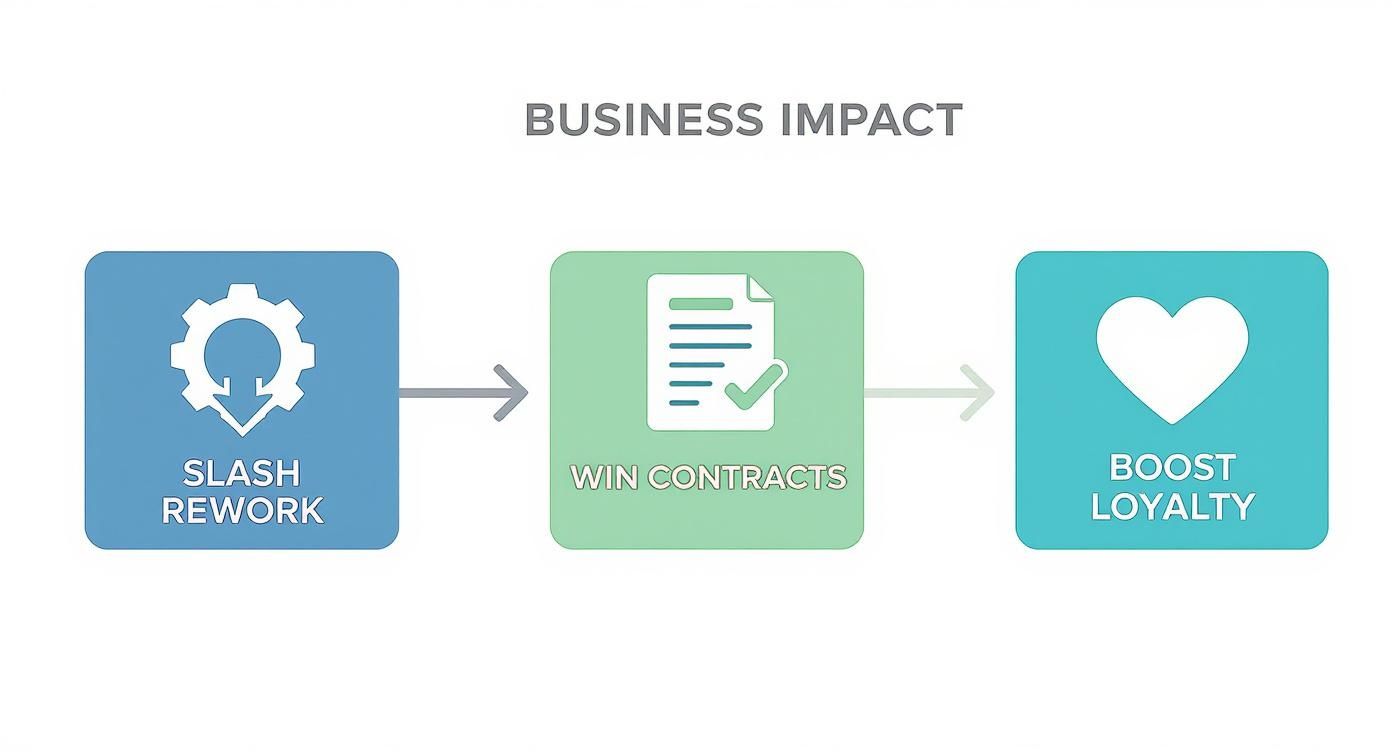
Think of a local manufacturing company that was stuck in a cycle of expensive errors and frustrating product recalls. They brought in a consultant to get them through ISO 9001. Together, they mapped out every step of their production line, pinpointed the weak spots, and built in proper quality checks. The result? A stunning 15% drop in rework in the first year alone, saving them a small fortune in wasted materials and labour.
And that’s not a one-off story. Research looking at manufacturing and service businesses across Australia and New Zealand found a clear, statistically proven link between ISO 9001 practices and better operational performance. The study pointed to things like strong organisational commitment and careful planning—exactly what a good consultant brings to the table—as key drivers for those improvements.
Unlocking New Tenders and High-Value Contracts
One of the most immediate benefits of certification is getting a foot in doors that were previously slammed shut. Here in Australia, countless government departments and big corporations now make ISO certification a non-negotiable for their suppliers. If you don't have it, your tender application often goes straight to the 'no' pile without a second glance.
Picture a growing IT firm in Sydney, trying to land a huge government contract. They had the tech skills, no doubt, but they kept getting knocked back for not having ISO 27001—the gold standard for information security. So, they partnered with an ISO consultant, built a rock-solid Information Security Management System (ISMS), and proved they could be trusted with sensitive data. Six months after getting certified, they won that government contract. It doubled their annual revenue overnight.
Certification acts as a key that unlocks a new tier of business opportunities. It’s an undeniable signal to potential clients that your organisation operates with integrity, quality, and a serious commitment to risk management.
From Risk Reduction to Enhanced Customer Loyalty
In a world full of data breaches and supply chain headaches, getting a handle on risk is everything. A great ISO consultant helps you build systems that don’t just stop problems from happening; they build deep-seated trust with your customers. When clients see that ISO certificate, they have confidence that you can deliver consistently and protect their interests.
This sharp focus on risk has direct financial upsides. For example, by putting structured security controls in place for ISO 27001, a business can seriously lower its risk profile, which can lead to better insurance premiums. More importantly, it protects your reputation—your most priceless asset. You can find out more about the ROI of cybersecurity and see how being proactive with protection pays off.
It all creates a fantastic feedback loop:
- Improved Processes: You deliver higher quality products and services.
- Consistent Quality: Your customers are happier and start to trust you more.
- Increased Trust: You build loyalty and get more repeat business.
- Strong Reputation: You start attracting new customers who are looking for a reliable partner.
At the end of the day, an ISO consultant helps you see the certification process for what it really is: a direct investment, not an expense. It's an investment in operational excellence, market credibility, and a competitive edge that keeps paying you back long after the certificate is hanging on the wall.
What Does an ISO Consultant Actually Do for You?
Think of bringing on an ISO consultant like hiring a specialist builder for a high-stakes project. You have a vision for a more secure, efficient, and reputable business, but figuring out the complex blueprint for something like ISO 27001 can feel completely overwhelming. This is where a great consultant steps in.
They don’t just dump a rulebook on your desk. Instead, they provide a clear, practical roadmap to take your business from where it is today to being fully certified and ready for an audit. Each service they offer is a critical building block, designed to create a solid information security management system (ISMS) that adds real value—not just a certificate to hang on the wall.
Stage 1: The Diagnostic Gap Analysis
The first thing any good ISO consultant will do is a gap analysis. You can think of this as a complete health check-up for your business's security posture. Before you can start fixing things, you need an honest look at what’s working and, more importantly, where your weak spots are.
The consultant dives deep into your current processes, documentation, and day-to-day practices, measuring them against the strict requirements of the ISO 27001 standard. This isn't just a quick look-around; it’s a meticulous review designed to find every gap, big or small.
What you get back is a detailed report that becomes the foundation of your entire project. It pinpoints exactly where you fall short and gives you a clear, prioritised to-do list. This simple step saves you a massive amount of time and money by focusing your energy only on what’s truly needed to get certified.
Stage 2: Risk Assessment and Treatment
Once you know where the gaps are, it’s time to tackle risk. For a standard like ISO 27001, this is the absolute heart of the matter. A consultant will guide you through a structured risk assessment to identify all the potential threats to your business's information.
They’ll help you get concrete answers to some tough questions:
- What is our most critical information?
- What could realistically compromise it (think cyber-attacks, human mistakes, or even system failures)?
- How likely is it to happen, and what would the damage be?
From there, the consultant helps you build a Risk Treatment Plan. This is your strategic game plan for dealing with every identified risk. It clearly outlines the controls—be they technical, procedural, or physical—you’ll put in place to bring those risks down to a level you’re comfortable with. For anyone serious about information security, working through a step-by-step guide on how to get ISO 27001 certified with a consultant can make this complex process far more manageable.
Stage 3: Documentation and System Development
With a solid plan in hand, you move on to the documentation. Honestly, this is where many businesses get bogged down, and where a consultant’s expertise truly shines. They don't just give you a stack of generic templates; they work alongside your team to write policies and procedures that actually fit how your business works.
A great ISO consultant knows that documentation must be practical, not just compliant. The goal is a living, breathing management system your team will actually use—not a bunch of binders collecting dust.
This involves creating key documents like your Information Security Policy and Statement of Applicability (SoA). A consultant’s experience is vital here, ensuring everything is lean, effective, and will satisfy an auditor without bogging your team down in needless red tape.
Stage 4: Training and Implementation Support
A world-class security system is useless if your people don't know how to use it. That’s why staff training and awareness is such a critical service. A good ISO consultant will develop and deliver training that’s relevant to your team, ensuring everyone understands the new security policies and their own role in upholding them.
This is much more than a box-ticking PowerPoint session. Proper training helps build a security-first culture across the entire organisation. It turns your employees into your best line of defence and makes security a shared responsibility.
The consultant will also be there to provide hands-on support as you roll out the new processes, helping your teams integrate them into their daily work. This practical guidance is what makes the transition smooth and ensures the system works in reality, not just on paper. To see how this fits into the bigger picture, you can check out this overview of the entire ISO certification process.
Stage 5: Internal Audits and Final Preparation
Before the official auditors walk through your door, you need a full dress rehearsal. The internal audit, conducted by your consultant, is exactly that—a test run to see how well your new management system holds up under pressure.
Think of this as your safety net. The consultant puts on their "auditor hat" and rigorously checks everything: reviewing documentation, interviewing staff, and verifying that your security controls are working as they should. They’ll find any last-minute issues, giving you a chance to fix them before the real, high-stakes certification audit. It’s this final polish that gives you the confidence to walk into audit day knowing you’re ready.
ISO Certification Journey with a Consultant
| Project Phase | Consultant Service | Key Business Outcome |
|---|---|---|
| Phase 1: Foundation | Gap Analysis | A clear, prioritised action plan that focuses resources where they are needed most. |
| Phase 2: Strategy | Risk Assessment & Treatment | A robust framework for proactively managing business risks and protecting key assets. |
| Phase 3: Build | Documentation Development | A practical and compliant management system tailored to your specific operations. |
| Phase 4: Integration | Staff Training & Implementation | An engaged team and a culture of continuous improvement and security awareness. |
| Phase 5: Validation | Internal Audit & Management Review | Confidence and readiness for a successful external certification audit with no surprises. |
Ultimately, partnering with a consultant isn't just about passing an audit. It’s about building a stronger, more resilient business from the inside out.
How to Select the Right ISO Consultant for Your Business
Picking an ISO consultant is easily one of the most critical decisions you'll make on your certification journey. This isn’t just about hiring another contractor; it's about finding a partner who becomes a genuine extension of your team. For small and medium-sized businesses here in Australia, getting this choice right is the difference between a smooth, valuable project and a frustrating, costly mess.
A great consultant won't just dump a pile of templates on your desk. They’ll roll up their sleeves and take the time to really understand your business—your industry, your people, and your unique challenges. From there, they build a system that actually works for you. This decision deserves real thought, and it goes far beyond just comparing quotes.
Look Beyond the Price Tag
When you first start your search for an ISO consultant, it’s so tempting to let the price guide you. But trust me, the cheapest quote is rarely the best value. An unusually low price is often a red flag, hinting at a cookie-cutter, template-heavy approach that completely misses what makes your business tick.
Sure, that kind of "off-the-shelf" consulting might get you a certificate to hang on the wall, but it won’t deliver the real-world improvements that make ISO certification so powerful in the first place. You'll miss out on better efficiency, tighter security, and that hard-earned customer trust. Instead of fixating on the upfront cost, think about the long-term return on your investment.
A top-notch consultant adds value by:
- Saving your team’s precious time: They know how to manage the project efficiently, stopping those costly internal delays before they even start.
- Preventing audit failures: Their expertise is your best insurance against a failed audit, saving you from expensive and demoralising re-audits.
- Building a practical system: They create processes your team will actually want to use, leading to lasting improvements in how you operate.
Verify Industry-Specific Experience
Let's be clear: not all consultants are created equal. ISO standards are written to be generic, but how they’re applied can look wildly different from one industry to the next. A consultant who’s spent their career in manufacturing won't necessarily grasp the specific data security risks a software company faces every day.
You need to find a consultant with a proven track record in your field. An experienced ISO consultant who speaks your language will already understand your industry’s jargon, common operational hurdles, and specific regulatory pressures. That kind of firsthand knowledge is priceless.
They can spot potential roadblocks before they become major problems and make sure the management system they help you build feels like a natural fit for your business. When you’re interviewing them, don't be shy—ask for specific examples of their work with businesses just like yours.
Choosing a consultant with deep industry expertise ensures your ISO system is a practical tool for improvement, not just a theoretical exercise in compliance. It aligns the standard's requirements with the real-world flow of your business.
Assess Their Communication and Cultural Fit
Bringing in ISO standards is a team effort. It’s a project that will touch every single part of your organisation, from the C-suite right down to your frontline staff. For this partnership to truly work, your consultant’s communication style and general vibe have to click with your company culture.
Pay close attention during those initial chats. Do they listen more than they talk? Can they break down complex, technical ideas into plain English without all the confusing jargon? You’re looking for someone who is approachable, responsive, and seems genuinely invested in seeing you succeed.
The consulting market over in New Zealand, which often mirrors Australian trends, is tipped to hit around USD 1.3 billion in 2025. A huge part of that growth is coming from small and medium businesses, who are increasingly turning to remote consulting for things like ISO certification because it’s more accessible and affordable. You can read more about these market insights on Mordor Intelligence.
This really highlights a clear trend: businesses want flexible, accessible experts who can slot right into their teams. A good cultural fit makes the whole process smoother and more effective, encouraging your people to get on board rather than pushing back.
Ask the Right Questions During Consultation
To figure out if a consultant is the real deal, you need to walk into those first meetings armed with a sharp set of questions. These aren’t just tick-a-box questions; they’re designed to properly probe their expertise, their methods, and their commitment to you.
Here’s a practical checklist to help guide the conversation:
-
Experience and Track Record:
- "Could you share some case studies or references from clients in our industry?"
- "What’s your success rate for first-time certification audits?"
- "Which certification bodies do you have the most experience working with?"
-
Methodology and Approach:
- "How will you adapt the ISO 27001 framework to fit our specific business?"
- "What level of involvement will you need from our team?"
- "How do you make sure the system is sustainable long after you've gone?"
-
Support and Deliverables:
- "What specific documents and training materials do you include in your proposal?"
- "What does your support look like after we're certified?"
- "How do you handle unexpected challenges or roadblocks during a project?"
An experienced and confident ISO consultant will welcome these questions and give you clear, straight answers. If you get vague responses or they seem hesitant to provide references, consider it a major warning sign. At the end of the day, you're not just buying a service; you're investing in a partnership and a clear path to a stronger, more resilient business.
Preparing Your Team for a Smooth ISO Implementation

Let’s be honest: successfully implementing a standard like ISO 27001 is a project driven by people, not just paperwork. You can have the most perfectly written policies in the world, but they’re completely useless if your team doesn’t understand, adopt, and champion them. This is where leadership, guided by the expertise of your ISO consultant, becomes the deciding factor between a smooth integration and a frustrating uphill battle.
Transforming your organisation’s approach to information security needs more than a top-down mandate; it demands a shared sense of purpose. Think of your consultant as the expert architect of the system. But it's your team who will build and maintain it, day in and day out. Because of this, preparing them for the journey is every bit as critical as the technical work itself.
Communicating the Why Before the How
One of the most common hurdles in any major organisational change is resistance. It's natural. Employees might see the ISO process as just another layer of bureaucracy or a set of restrictive rules that make their jobs harder. A skilled ISO consultant knows this and will stress the importance of tackling this head-on by clearly and persuasively communicating the ‘why’ behind the certification.
This isn’t about sending a single, bland company-wide email. It’s about crafting a compelling story that connects the dots between ISO 27001 and tangible benefits everyone can actually get behind.
The goal is to shift your team's perspective from "this is something we have to do" to "this is something we get to do to make our company stronger, our data safer, and our jobs more secure."
This shift is crucial for building genuine enthusiasm and avoiding what’s often called "compliance fatigue." When people understand that these new processes protect the company from real threats, secure valuable client contracts, and strengthen its market reputation, they are far more likely to become active participants rather than passive observers.
Building Ownership Through Involvement
To foster a genuine sense of ownership, you have to get key team members involved from the very beginning. Your consultant can help you identify these internal champions—people from different departments who can represent their teams, provide valuable frontline insights, and help drive the implementation forward.
Involving people gives them a stake in the outcome. When an IT manager helps shape a new access control policy or a marketing team member provides input on data handling procedures, the final system feels less like an external imposition and more like a collaborative achievement. It becomes their system.
An effective strategy for involvement includes:
- Cross-Functional Kick-off Meetings: Start the project with a meeting that includes representatives from all key departments. Your ISO consultant can lead this session, setting clear expectations and laying out the project roadmap.
- Regular Progress Updates: Keep the entire organisation in the loop about milestones and successes along the way. Celebrating small wins, like completing the risk assessment, helps maintain momentum and shows tangible progress.
- Feedback Channels: Create an open and easy way for team members to ask questions and voice concerns. This makes people feel heard and allows you to address potential roadblocks before they become major issues.
This collaborative approach turns the ISO journey into a shared mission.
A Leadership Toolkit for Championing Change
As a leader, your role is to be the number one champion for the ISO implementation. Your attitude and commitment will set the tone for the entire organisation. Your ISO consultant acts as your strategic advisor, giving you the tools and guidance you need to lead effectively through this period of change.
Think of this as your leadership toolkit for a successful implementation:
- Lead by Example: Be the first to participate in training sessions and make a point of following the new procedures yourself. When your team sees you taking the changes seriously, they will too.
- Empower Your Champions: Give your designated internal champions the authority and resources they need to support their teams. Recognise their efforts publicly to reinforce how vital their role is.
- Manage Resistance Constructively: Resistance is a natural part of any change. Instead of dismissing concerns, listen to them. Often, resistance comes from a simple misunderstanding of the process or a legitimate worry about workflow disruptions that your consultant can help you solve.
An effective kick-off meeting, facilitated by your consultant, is the perfect opportunity to set this positive tone. It’s your chance to articulate the vision, introduce the consultant as a supportive partner, and clearly define everyone’s roles and responsibilities from the get-go.
Ultimately, preparing your team is about transforming the implementation from a technical project into a cultural one. By focusing on clear communication, active involvement, and visible leadership, you create an environment where the principles of ISO 27001 become embedded in your organisation’s DNA. An expert ISO consultant provides the framework, but it's the collective effort of a well-prepared and engaged team that guarantees a smooth, successful, and truly valuable certification journey.
Got Questions About Working with an ISO Consultant? You’re Not Alone.
Taking the leap into ISO certification is a big move, and it's completely normal to have a heap of questions. Before you dive in and commit time and money, you want to know exactly what you’re getting into—the process, the costs, and who you’ll be working with. Bringing an ISO consultant on board is an investment in getting it right the first time, but you need to feel confident in your choice.
Let’s tackle the big questions we hear from Australian businesses every day. We’ll give you the straight answers you need to make a smart decision and move forward with certainty.
How Much Does an ISO Consultant Cost in Australia?
The honest answer? It varies. The cost of hiring an ISO consultant in Australia isn’t a one-size-fits-all figure. It really depends on the scope of your project, the size of your business, how complex your current systems are, and which ISO standard you’re aiming for.
For a small business, you might be looking at a few thousand dollars for a specific gap analysis, or it could be tens of thousands for a full, hands-on implementation from start to finish. Any good consultant will steer clear of giving you a fixed price without getting to know your business first. They should offer a detailed, itemised proposal only after they’ve had a proper chat and assessed your situation.
A word of caution on suspiciously cheap quotes. It’s tempting, I know, but a bargain-basement price often means you’re getting a cookie-cutter, template-based approach. This rarely delivers real value and can leave you completely unprepared for the tough questions an auditor will ask.
How Long Will It Take to Get ISO Certified with a Consultant?
For most small to medium-sized Aussie businesses, you should plan for a timeline of 6 to 12 months when working with a consultant. This is a realistic timeframe that allows for every critical step to be done properly, without rushing or cutting corners.
This journey includes:
- An initial gap analysis to see where you stand.
- Developing and documenting your new management system.
- Rolling out new policies and procedures across the business.
- Getting the team trained and up to speed.
- Running internal audits to kick the tyres on the system.
- The final external audit with an accredited certification body.
An experienced ISO consultant is your secret weapon for speeding this up. They bring a proven roadmap, expert knowledge, and ready-to-go documentation that helps you dodge the common pitfalls and delays that can drag a project out for much, much longer. Their project management alone is worth its weight in gold.
Can We Just Do It Ourselves and Skip the Consultant?
Look, you technically can. It’s possible to achieve certification on your own, but it’s a seriously tough road paved with potential headaches. The DIY approach requires someone on your team to develop a deep, almost academic understanding of the standard's dense clauses. It also means pulling them away from their day job for a huge amount of time.
Businesses that try to go it alone often find the project drags on, the team gets frustrated, and the risk of failing the final audit is significantly higher. And a failed audit isn't just a bump in the road—it costs you more money and can be a real blow to team morale.
An ISO consultant brings three crucial things you simply can't replicate internally:
- Deep Expertise: They’ve walked this path with dozens, sometimes hundreds, of companies just like yours.
- An Outside Eye: They see the gaps and weaknesses that your internal team is too close to notice.
- Proven Efficiency: They have a refined process that gets the job done right, on time, and with far less stress.
What’s the Difference Between a Consultant and a Certification Body?
This is a really important one to get your head around. An ISO consultant and a certification body (sometimes called a registrar) have completely separate jobs. This division is deliberate, designed to keep the process fair and impartial.
Here’s a simple way to think about it: your consultant is your coach, getting you match-fit. The certification body is the independent referee who makes the final call.
-
The ISO Consultant: This is your guide and partner. Their job is to get you ready. They work with you to build, document, and implement a management system that ticks all the boxes of the standard. Their entire goal is to make sure you are "audit-ready."
-
The Certification Body: This is the accredited, third-party organisation that performs the official audit. Their role is to independently verify that your system does what it's supposed to do according to the ISO standard. If you pass, they issue your certificate.
To keep everything above board, the consultant who helps you build your system can never be the same organisation that certifies it. It's a fundamental rule of the ISO framework that guarantees the audit is unbiased, credible, and truly worth the paper it’s printed on.
Anitech specialises in guiding Australian small businesses through the complexities of ISO 27001 certification. With a strong track record built over many years, we provide the expert partnership you need to strengthen your security, win new business, and achieve your goals with confidence. Learn more about our ISO consulting services.
Recent Comments