

When you're looking for a partner to guide you through certification, checking out ISO consulting services reviews is more than just due diligence—it’s the first step in turning a complex compliance hurdle into a serious strategic advantage. For Australian businesses, ISO certification has become a crucial key to unlocking new markets, winning major contracts, and cementing customer trust.
Why Australian Businesses Now Demand Expert ISO Consulting
In Australia's tough, competitive market, having an ISO certification is no longer just a 'nice-to-have' badge. It's an absolute must-have for survival and growth. The pressure is on for organisations to get certified in internationally recognised standards like ISO 9001 for quality management, ISO 27001 for information security, and ISO 14001 for environmental management.
It's not just about ticking a box. Without these certifications, businesses can find themselves locked out of lucrative supply chains, government tenders, and global partnerships that demand compliance. The stakes are incredibly high. A failed audit or a delayed certificate can mean lost revenue and a serious blow to your reputation.
This guide is here to cut through the jargon and the sales pitches. My goal is to give you clear, honest, and comparative reviews of ISO consulting services so you can find a partner that genuinely fits your business goals, budget, and where you want to be in the future.
The Growing Market for ISO Expertise
The surge in demand for specialised consulting is plain to see in the market's growth. The Australian consulting services market, which includes ISO expertise, is expanding quickly as more businesses realise they need professional guidance.
This chart from IMARC Group paints a clear picture of the projected growth.

The data shows a clear upward trend, which tells us that more businesses are investing in professional help to navigate complex standards and get a real competitive edge.
The Australian consulting services market was valued at around USD 5.7 billion in 2025 and is tipped to hit USD 10.2 billion by 2034. That’s a compound annual growth rate (CAGR) of about 6.58% from 2026 to 2034. This boom is being driven by the need for digital transformation, major government infrastructure projects, and a bigger focus on sustainability—all areas where ISO standards are essential.
Choosing the right consultant isn’t just about passing an audit. It’s about embedding a culture of excellence and resilience deep into your organisation's DNA, turning compliance into a continuous source of value.
From Compliance Burden to Strategic Advantage
Let's be honest. For many businesses, the road to ISO certification looks like a massive, resource-draining headache. It’s often seen as a mountain of paperwork, disruptive procedural changes, and endless staff training. Trying to tackle it alone often leads to frustration, wasted time, and a system that feels forced on your team rather than a natural part of how you work.
This is where a great ISO consultant completely changes the game. They shift the entire process from a tedious project into a strategic move that delivers real, measurable returns. A good consultant doesn't just drop a folder of templates on your desk; they take the time to understand your business and skilfully weave the ISO principles into your existing workflows.
This approach delivers some powerful benefits:
- Operational Excellence: By digging into your processes, a consultant can pinpoint inefficiencies and find opportunities for improvement. This means less waste, lower costs, and a more productive team.
- Enhanced Customer Trust: Getting certified proves your commitment to quality and security. It’s a powerful signal to clients and stakeholders that you’re a business they can rely on.
- Market Access: ISO certification can be your ticket to new markets and bigger clients, especially in sectors like government, defence, and international trade where it’s often a non-negotiable requirement.
- Risk Mitigation: Standards like ISO 27001 give you a solid framework for managing information security risks, protecting your business from costly data breaches and regulatory fines.
Ultimately, the right consulting partner ensures your investment in ISO certification keeps paying off long after you've framed the certificate. They help you build a management system that supports sustainable growth, adapts to new challenges, and drives continuous improvement across your entire organisation. The detailed ISO consulting services reviews in this guide will help you find that perfect partner.
The Core Criteria for Evaluating ISO Consulting Services
Choosing the right ISO consultant is about more than just ticking boxes or comparing quotes. Before you even start looking at proposals, you need a clear framework for what a great partner actually looks like. It’s about cutting through the sales pitches and focusing on what truly matters for your business.
A top-notch consultant doesn’t just get a certificate on your wall; they weave world-class standards into the very fabric of your operations, creating real, lasting value. To find that partner, you need to analyse their capabilities objectively and see if they’re the right fit for your organisation's unique goals.
Beyond the Brochure: Industry-Specific Expertise
The very first filter you should apply is industry-specific experience. An ISO standard is a flexible framework, but how it's applied in IT is worlds apart from manufacturing, healthcare, or construction. A consultant who’s been in the trenches of your industry already knows your specific operational risks, regulatory hurdles, and customer expectations.
Don't be afraid to ask the hard questions:
- Have they worked with Australian businesses of your size and complexity before?
- Can they show you case studies or put you in touch with clients who faced similar challenges?
- Do their consultants have a background working in your industry, not just auditing it from the outside?
Someone who speaks your language will tailor the ISO framework to your existing workflows. The alternative is a consultant who imposes generic templates that just get in the way.
Assessing the Depth of Services Offered
The best ISO consulting firms offer a genuine partnership, not just a one-off project. A comprehensive service list is a strong signal of a mature, well-resourced company that can support you from start to finish. This is a crucial area to investigate when you’re digging into ISO consulting services reviews.
Look for a complete service portfolio that includes:
- Initial Gap Analysis: A deep dive into your current systems to find every gap against the ISO standard’s requirements.
- Implementation Support: Hands-on help to develop documentation, fine-tune processes, and integrate new controls seamlessly.
- Internal Audit Training: Giving your own team the skills to conduct internal audits, which builds a culture of continuous improvement from within.
- Post-Certification Support: Ongoing help to make sure you maintain compliance, navigate annual surveillance audits, and adapt to any changes in the standards.
A consultant’s real value isn’t just in getting you certified. It’s in their commitment to making sure your management system stays effective and adds value long after the auditor has left.
Evaluating Their Methodology and Approach
How a consultant gets the job done is just as important as what they do. The best ones work with you, not against you, integrating ISO principles to strengthen what you already have. When you're weighing up potential ISO consulting services, a key thing to look for is their skill in using essential business process mapping techniques.
This shows they can visualise and streamline your operations before adding controls. It’s how you avoid the classic pitfall of ending up with a clunky, bureaucratic system that your team hates using. You want a partner, not a dictator forcing pre-baked solutions onto your business.
This kind of expertise is in high demand. The ISO certification market in Australia alone is tipped to hit around USD 122.7 million in 2025, growing at an expected 16.7% CAGR. This boom reflects a clear shift towards consultants who deliver tangible operational wins, with most Australian businesses achieving certification in just three to six months.
Verifying Client Success and Transparency
Finally, you need proof. Any consultant worth their salt should be open about their success rates and happy to share client feedback. While a 100% success rate sounds great on a website, you need to dig a little deeper to find out what that really means.
Make sure you ask for:
- Hard Numbers: How many clients have they successfully guided to certification in the last year?
- Real-World Feedback: Can they provide verified testimonials that talk about their process, communication, and the long-term impact on the business?
- Clear Metrics: How do they measure success beyond just passing the final audit? Do they track improvements in efficiency or risk reduction for their clients?
This level of transparency is what separates the true experts from the slick salespeople. It gives you the confidence you need to choose a partner who won’t just get you certified, but will act as a catalyst for meaningful, long-term improvement in your business.
A Closer Look at Australia's Top ISO Consultants
Choosing the right ISO consultant isn't just a box-ticking exercise. It's a critical business decision. You’re not just hiring someone to shuffle paperwork; you’re bringing in a partner who needs to understand the nuts and bolts of your business. The goal is to turn a compliance headache into a real competitive advantage. With our evaluation criteria in mind, let’s dive into a real-world comparison of Australia’s leading firms.
This isn’t just another generic list. We’re going deeper, looking at what actual clients say and focusing on what makes each consultant genuinely different. What works for one business—say, lightning-fast certification—might be the wrong fit for another that needs deep, industry-specific expertise. Understanding these trade-offs is everything.
The demand for ISO certification in Australia is clearly on the rise. Businesses are investing more than ever in getting professional guidance, and the market is growing to meet that need.
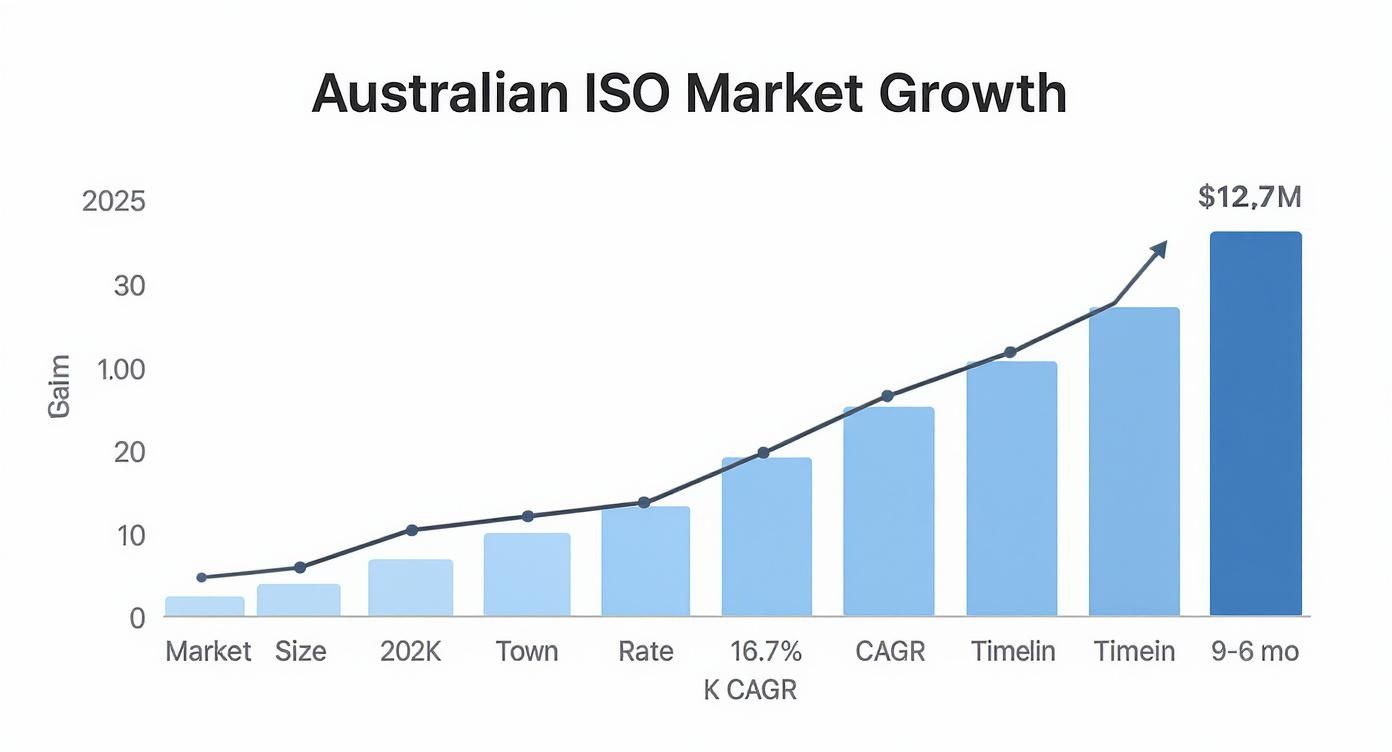
This data paints a clear picture. With a 16.7% CAGR, it’s obvious that businesses are serious about certification. They expect, and demand, consultants who deliver proven results without dragging the chain.
Anitech: The SME Cybersecurity Specialist
Anitech has smartly carved out a space for itself by zeroing in on small to medium-sized enterprises (SMEs) chasing ISO 27001 certification. Their whole approach is built for the reality of smaller businesses: you’ve got limited cash, tight deadlines, and no time for fluff. You just need a practical path to information security.
Their promise is straightforward: get you certified, fast, so you can start winning those bigger contracts. Digging through ISO consulting services reviews, a common theme emerges—Anitech excels at making the complexities of ISO 27001 feel manageable. Clients repeatedly mention how their structured, step-by-step process kept them on track without bogging down their internal teams.
"We're a small tech firm, and we needed ISO 27001 to land a major government contract. Anitech understood our urgency and resource constraints. They didn't just give us templates; they helped us build a security framework that actually works for our size." – Synthesised Client Feedback
Of course, that sharp focus on SME cyber security has its limits. If you’re a large, multi-site corporation or need to juggle multiple standards (like ISO 9001 and ISO 14001), their specialised, streamlined process might feel a bit too narrow. Their strength is their niche.
Ideal Business Profile:
- Australian SMEs (10-100 staff) in tech, IT services, or government supply chains.
- Businesses that need ISO 27001 certification on a tight deadline for a tender or contract.
- Organisations looking for a hands-on, guided process with a clear finish line.
ISO Global: The Enterprise Integration Expert
On the other side of the coin, you have ISO Global. These are the experts you call for the big, complex jobs. Their bread and butter is helping major corporations integrate multiple ISO standards into a single, seamless Integrated Management System (IMS). This is no small feat—it takes a sophisticated understanding of how quality, environmental, safety, and security standards overlap and interact.
Client feedback for ISO Global often highlights their big-picture, strategic thinking. They’re not just there to implement; they act as high-level advisors, helping align ISO frameworks with broader corporate goals like Environmental, Social, and Governance (ESG) targets. Their consultants tend to be veterans of the audit world, with heavy experience in regulated industries like manufacturing, construction, and logistics.
The trade-off? This level of comprehensive, strategic work commands a higher price and often involves a longer timeline. A nimble startup would likely find their methodical, document-heavy style too slow for their pace.
SAI Global: The Assurance and Training Powerhouse
SAI Global is a huge name in the assurance industry, and their consulting division leverages that powerful corporate backing. Their unique selling point is the ability to offer consulting, training, and certification services all from one place. While they maintain strict separation between consulting and certification for impartiality, clients get the benefit of a complete ecosystem.
This model is a fantastic fit for organisations wanting to build genuine, long-term capability in-house. SAI Global provides a wide range of training programs designed to upskill your own team so they can confidently manage the ISO system long after the consultants have left. Reviews often give top marks to the quality of their training materials and the deep knowledge of their instructors.
While this all-in-one approach is a major plus, it might not suit a business after a more personalised, boutique feel. Some client feedback hints that dealing with a massive organisation like SAI Global can sometimes feel a bit less personal than working with a smaller, more focused firm.
ISO Consulting Services Feature Comparison
To help you see the differences at a glance, here’s a table summarising the core strengths and best-fit clients for the consultants we've discussed. A direct comparison like this is a crucial part of doing your own thorough ISO consulting services reviews.
| Consulting Firm | Primary Specialisation | Average Client Rating (Aggregated) | Typical Certification Timeline | Ideal Business Profile |
|---|---|---|---|---|
| Anitech | ISO 27001 for SMEs | 4.9 / 5 | 3-6 Months | Small to medium tech and service businesses needing rapid security certification. |
| ISO Global | Integrated Management Systems (IMS) for Large Enterprises | 4.7 / 5 | 6-12 Months | Large corporations in regulated industries requiring multi-standard integration (e.g., ISO 9001, 14001, 45001). |
| SAI Global | Consulting, Training, and Assurance Services | 4.6 / 5 | 5-9 Months | Midsized to large organisations seeking a comprehensive solution, including extensive staff training and long-term support. |
This table lays out the fundamental differences, making it easier to see which provider aligns with your specific situation and priorities.
Making the Right Choice for Your Context
At the end of the day, the "best" ISO consultant is a myth. The right choice is completely dependent on your organisation’s unique situation.
-
If you're an agile SME in the tech sector with a critical contract on the line, a specialist like Anitech offers the most direct path to ISO 27001. Their process is built for exactly this scenario.
-
If you're a large manufacturing firm trying to untangle your existing quality, environmental, and safety systems into one efficient IMS, then ISO Global is the logical choice. Their strategic expertise delivers value far beyond just ticking a compliance box.
-
And if your organisation is serious about building a sustainable culture of compliance by empowering your own people, the integrated training and consulting model from SAI Global offers a compelling long-term partnership.
By looking beyond the marketing jargon and analysing what each firm truly offers, you can make a targeted, intelligent choice. The most effective ISO consulting services reviews are the ones you conduct yourself, using your own needs as the ultimate guide. This way, you don’t just find a consultant—you find a partner who’s genuinely aligned with where your business is headed.
Which Consultant Fits Your Business? Real-World Scenarios
Feature lists and abstract comparisons are a good starting point, but they don't tell the whole story. The real litmus test is figuring out how a consultant would perform in your world, facing your specific challenges. Choosing the right partner is all about context—your industry, the size of your team, and what you’re trying to achieve.
To cut through the theory, let's walk through three distinct, real-world business scenarios. For each one, we’ll pinpoint the best type of ISO consultant and unpack the thinking behind that choice. This should help you look past the sales pitches and find a genuine fit for your organisation.
The Tech Startup Needing ISO 27001 Yesterday
Scenario: Picture a promising Aussie tech startup. They've got 35 people, a brilliant new SaaS platform, and they're about to land a massive enterprise client. The catch? The whole deal hinges on them getting ISO 27001 certified within four months to prove their information security is up to scratch. Their team is sharp and agile but has zero experience with formal compliance.
Analysis: This is a classic case of two things: extreme urgency and a need for specialisation. The startup doesn't need a jack-of-all-trades consultant who dabbles in every standard under the sun. They need a laser-focused ISO 27001 specialist who gets the breakneck pace of a small, fast-moving tech company. The goal here isn’t a profound cultural shift; it's about getting certified quickly and effectively to unlock that crucial revenue stream.
Recommendation: A specialist firm with a proven, fast-tracked methodology for ISO 27001 is the only real option. A consultant like Anitech, which lives and breathes the SME tech space, would be ideal. Their process is built for speed and clarity, cutting out the bureaucratic fluff that would bog down a nimble team.
The key is finding a partner who can translate the dense clauses of ISO 27001 into practical, bite-sized tasks a tech team can knock over without derailing their product roadmap. Their real value is in providing a clear, direct path to certification, not a complete operational overhaul.
The SME Manufacturer Gunning for ISO 9001
Scenario: A family-owned manufacturing business in regional Australia with 80 employees is looking to become a supplier for a major national retailer. To even get a foot in the door, they need ISO 9001 certification to prove their quality control is reliable. The business has solid, time-tested ways of doing things, but none of it is formally documented in a structured quality management system (QMS).
Analysis: Here, the focus completely shifts from speed to smart integration. This manufacturer needs a consultant who respects their existing know-how and can formalise it to meet ISO 9001 standards. The worst thing you could do is steamroll their workshop floor with a generic, off-the-shelf QMS that ignores decades of practical experience.
The right consultant needs to be a gun at process mapping and great with people, working shoulder-to-shoulder with the team to document and polish what they already do so well. It calls for a hands-on, practical approach, not a purely academic one. This is becoming more important as Australian government procurement policies increasingly give smaller, local contractors a fair go.
The chart below shows just how big a role SMEs play in the management consulting market.
This data shows the growing opportunity for SMEs, which is why getting standards like ISO 9001 is fast becoming a game-changer for winning bigger contracts.
Recommendation: You absolutely need a consultant with deep, practical experience in Australian manufacturing. They have to speak the language of production lines, inventory, and supply chains. Their success won’t be measured by a fancy manual, but by how well they build a QMS that feels like a natural part of the business, not just more paperwork.
The Large Corporation Juggling Multiple Standards
Scenario: A large, publicly listed construction company with over 1,000 staff is under the gun from investors and regulators to step up its Environmental, Social, and Governance (ESG) game. The board has mandated that they integrate ISO 14001 (Environmental) and ISO 45001 (Occupational Health & Safety) into their existing ISO 9001 system, creating a single, unified Integrated Management System (IMS).
Analysis: This isn't just a project; it's a massive strategic undertaking. It requires high-level planning, not just ticking boxes. The consultant will have to navigate corporate politics, manage stakeholders across a dozen different departments, and understand how these standards overlap at both a policy and a boots-on-the-ground level.
The real challenge is building one cohesive system that gets rid of duplicated effort and paperwork while still meeting the unique demands of all three standards. This demands a sophisticated grasp of risk management, corporate governance, and continuous improvement on an enterprise scale. In Australia, these large, complex projects are the bread and butter of the management consulting sector, making up 75.79% of the market's revenue in 2024. While SMEs are growing fast, these big-ticket integrations are what the top-tier firms are built for. You can dive deeper into the Australian management consulting market with this report from Mordor Intelligence.
Recommendation: This is a job for a large, established consulting firm with a dedicated IMS practice, like ISO Global. Their team will have the strategic depth and project management muscle to handle an implementation of this scale. They can provide the high-level guidance needed to make sure the IMS aligns with the company’s bigger ESG and corporate goals, ensuring the project delivers real value well beyond just a compliance certificate.
Calculating the True Cost and ROI of ISO Consulting

Bringing an ISO consultant on board is a serious financial decision, and simply scanning iso consulting services reviews only tells you part of the story. To build a proper business case, you have to look past the initial quote and get a handle on the complete financial picture—both the money you'll spend and the real-world returns you can bank on.
It’s crucial to see this as a strategic investment, not just another line item on the expense sheet. The right consultant does more than just get a certificate on your wall; they help unlock measurable value that can easily dwarf the initial outlay. Let's break down how the numbers really stack up.
Decoding ISO Consultant Pricing Models
Here in Australia, you won't find a standard price tag for ISO consulting. The final cost really depends on the size of your company, the complexity of the standard you're aiming for, and how much heavy lifting is needed to get your current systems up to scratch. Generally, consultants stick to one of three main pricing models.
-
Fixed-Fee Projects: This is the go-to model for most straightforward certification jobs. You’ll agree on a single, all-in price that covers everything from the first gap analysis to getting you through the final audit. It’s great for budgeting because there are no surprises.
-
Daily or Hourly Rates: For more complicated or open-ended projects, some consultants will charge by the day or hour. You can expect rates to fall somewhere between $800 and $2,000 per day, depending on their expertise. This gives you flexibility, but it can make budgeting a bit trickier.
-
Ongoing Retainers: After you're certified, some businesses choose to keep their consultant on a monthly retainer. This is a smart move to make sure you stay compliant, nail your annual surveillance audits, and keep improving your management system.
No matter the model, make sure you get a detailed scope of work. It needs to spell out exactly what is—and isn't—included in the fee to avoid any nasty cost blowouts later on.
The Hidden Factors That Influence Your Final Cost
A few key variables can really shift the final figure on your consulting invoice. Knowing what they are will help you compare quotes fairly and set a realistic budget for your ISO journey.
The biggest cost drivers are:
- Company Size and Complexity: It's a simple matter of scale. A multi-site corporation with 500 employees is a much bigger undertaking than a single-office business with 20 staff members.
- Standard Complexity: Getting certified for a highly technical standard like ISO 27001 usually costs more than a foundational one like ISO 9001. It just requires a deeper level of specialised knowledge.
- Current System Maturity: If you've already got well-documented processes, the consultant’s job is much easier, and the price will reflect that. If they're starting from scratch, you can expect the cost to be higher.
The single best way to manage your costs is to pick a consultant who specialises in your specific industry and the standard you're targeting. Their efficiency and focused expertise almost always lead to a lower total investment and a much quicker path to certification.
For a more granular look at the investment required for information security, our detailed guide on the cost of ISO 27001 certification offers a much deeper financial breakdown.
Measuring the Tangible Return on Your Investment
The real story isn't about what you spend; it's about what you gain. The Return on Investment (ROI) from ISO consulting goes way beyond just ticking a compliance box. It generates real, quantifiable financial benefits that have a direct impact on your bottom line.
A solid business case for ISO consulting should always be built around these four key areas of return.
-
Accessing New Revenue Streams
Many government and corporate tenders now make ISO certification a non-negotiable requirement. Getting certified can suddenly open doors to contracts you were previously shut out from, creating a direct and measurable boost to your revenue. -
Driving Operational Efficiency
A huge part of implementing a standard like ISO 9001 is optimising your processes. A good consultant helps you spot and eliminate waste, cut down on errors, and streamline your entire workflow. This directly translates to lower operating costs and better productivity. -
Mitigating Financial Risks
For standards like ISO 27001, certification gives you a robust framework for managing information security risks. This massively reduces the odds of a costly data breach, which can bring a world of pain in the form of regulatory fines, legal fees, and serious damage to your reputation. -
Enhancing Brand Reputation and Value
An ISO certificate is a powerful, internationally recognised seal of quality and trust. This boost to your brand reputation can lead to greater customer loyalty, allow you to justify premium pricing, and make your business a much more attractive partner to work with.
By putting numbers to these benefits, you can clearly show that the cost of an ISO consultant is a smart, strategic investment that pays for itself many times over. The goal is to change the conversation from "how much will it cost?" to "how much value will it create?".
How to Select Your Ideal ISO Partner for Lasting Success
Alright, you’ve done the hard yards. You've weighed up the top players, crunched the numbers, and have a solid grasp of what this whole process involves. Now comes the most important part: making the final call. This isn’t just about getting a certificate on the wall; it’s about choosing a partner who will set your business up for success long after the ink is dry.
This last step is all about reading between the lines, asking the tough questions, and making sure the consultant you choose is the right strategic fit. It’s the difference between simply hiring a contractor and bringing a genuine expert into your corner.
The Definitive Interview Checklist
When you finally sit down with potential consultants, you need to get past their glossy brochures and well-rehearsed sales pitches. Your job is to dig into how they actually operate and what they’re like to work with when challenges pop up. A good, structured interview is the only way to compare apples with apples.
Try leading the conversation with these questions:
- Approach & Methodology: "Can you walk me through a recent project with a business like ours? What were the sticking points, and how did your process get them over the line?"
- Industry Expertise: "What’s your team’s direct experience in the Australian [your industry] sector? How does that hands-on knowledge actually change how you’d handle our implementation?"
- Customisation vs. Templates: "Everyone uses templates for efficiency, but how do you make sure our system is tailored to our unique way of doing things and not just a cookie-cutter solution?"
- Team Involvement: "Realistically, how much time will you need from our people? And more importantly, how do you make sure we have the skills to run this thing ourselves once you’re gone?"
Preparing for the Initial Consultation
To get the most out of these first meetings, a little prep work goes a long way. Showing up organised not only makes a great first impression but it also helps you get a far more accurate and relevant proposal.
Before you even make the first call, try to get these things sorted:
- Define Your Scope Clearly: Be crystal clear on which standard(s) you're aiming for and which departments or business units are involved.
- Identify Key Personnel: Know who will be the main contact and who else needs to be in the loop for the project to succeed.
- Gather Existing Documentation: Pull together any current process maps, policies, or handbooks. This gives the consultant a real snapshot of where you're starting from.
Laying this groundwork means a consultant can give you a proposal that’s actually built for your business, not just a generic quote. It signals that you’re serious and ready to get stuck in.
Think of this less like a procurement task and more like hiring a key strategic advisor. The right consultant becomes an extension of your team, gets what you’re trying to achieve, and genuinely cares about your success well beyond certification day.
How to Interpret Proposals and Spot Red Flags
When the proposals land in your inbox, it's time to read between the lines. A good proposal isn't just a price tag; it's a blueprint that shows the consultant has actually listened and understands what you need.
It can be helpful to think about the qualities of a good accountant who helps a business thrive. You’re looking for that same transparency, proactive thinking, and a clear focus on delivering real, long-term value.
What to look for in a strong proposal:
- It clearly links back to your specific business goals.
- There's a detailed project plan with clear milestones and realistic timelines.
- The costs are broken down transparently, with no fuzzy maths or hidden extras.
- It names the actual consultant or team members who'll be working with you.
Potential red flags to watch out for:
- Vague, cut-and-paste language that could apply to anyone.
- A big focus on getting certified quickly, with little talk of building an effective system.
- A price that’s dramatically lower than everyone else’s—this often screams "template-heavy" and low value.
- Hesitation or an inability to provide references from businesses in your industry.
Choosing your partner is the final, critical piece of the puzzle. With solid iso consulting services reviews, a clear picture of your needs, and a sharp evaluation process, you’re in a fantastic position to pick the right consultant, not just any consultant. For some extra pointers, our detailed guide on what to look for in an ISO consultant can help sharpen your focus. This one decision can turn a compliance headache into a powerful driver for genuine business improvement.
Your Top Questions About ISO Consulting, Answered
Let's be honest, diving into ISO certification can feel a bit overwhelming. You've probably got a list of questions running through your mind, especially when it comes to choosing the right consulting partner. Getting straight answers is the only way to feel confident you're making the right call.
We've been in this game a long time, so we've heard just about every question there is. Here are the answers to the most common queries we get from Australian businesses just like yours.
How Long Does Certification Take With a Consultant?
This is usually the first question on everyone's mind: what's the timeline? While there's no one-size-fits-all answer, bringing an expert consultant on board definitely puts you in the fast lane. For a typical small or medium-sized Aussie business aiming for a standard like ISO 9001 or ISO 27001, you're generally looking at three to six months.
Of course, a few things can influence that timeframe:
- The size and complexity of your operations.
- How much of a management system and documentation you already have in place.
- The amount of time and resources your own team can dedicate to the project.
A great consultant will lay out a clear project plan with realistic milestones from day one. Their experience is what helps you sidestep the common pitfalls and delays that can drag the process out.
What Should I Look for in Client Reviews?
When you're scrolling through iso consulting services reviews, it's easy to get fixated on the star rating. But the real gold is in the details. The best testimonials give you a glimpse into what it's actually like to work with the consultant and the real-world impact they had.
Keep an eye out for reviews that mention:
- Practicality: Did they offer genuine solutions that fit the business, or just hand over generic templates?
- Communication: Were they easy to get along with? Did they explain things clearly and respond promptly?
- Long-Term Value: Do clients talk about the benefits after the certificate was on the wall, like landing new contracts or running more efficiently?
A powerful testimonial doesn't just say, "They helped us get certified." It tells a story. It explains how the consultant solved a nagging business problem or opened up a new opportunity, showing a real partnership beyond ticking boxes.
How Much Internal Work Is Still Required?
Hiring a consultant is a huge help, but it's not a "set and forget" deal. Think of it as a partnership. Your consultant handles the heavy lifting—the complex documentation, the training, and keeping the project on track—but your team’s input is what makes the system truly work for you.
You can expect your team to be involved in:
- Sharing how your current processes work.
- Joining in on workshops and training.
- Giving the thumbs-up on new documents.
- Putting the new procedures into action in their day-to-day work.
A top-notch consultant makes this process as smooth as possible, but they'll always rely on your team's expertise to make sure the final system is a perfect fit, not a foreign object dropped into your business.
What's the Difference Between a Consultant and a Certification Body?
This one is crucial, as it’s a common point of confusion. These two roles are completely separate, and they have to be to keep the process unbiased.
-
An ISO Consultant is your guide and advocate. They work for you, helping you build a compliant management system and preparing you for the final audit.
-
A Certification Body (often called a Registrar) is the independent auditor. They work against the standard, assessing whether your system ticks all the required boxes. They hold the power to grant or deny certification.
Put simply: your consultant helps you study for the exam; the certification body is the one who marks it.
Ready to turn compliance into your competitive advantage? Anitech has over 20 years of experience helping Australian businesses achieve ISO 27001 certification with a 100% success rate. We simplify the process so you can focus on what you do best.
Recent Comments