

Trying to get ISO certified on your own can feel like attempting to navigate a maze blindfolded. You know there's an exit, but every turn is fraught with confusing jargon and technical dead ends. This is where ISO consulting services come in. They’re not just a guide; they’re the architects who draw the map for you, providing the expertise and tools to build a management system that actually works for your business—and sails through an audit.
They turn what feels like an overwhelming compliance chore into a clear, manageable project with a real payoff.
Why Smart Businesses Invest in ISO Consulting Services

Have you ever stared at the dense text of an ISO standard? It’s like trying to decipher a legal document written in another language. You know the destination is certification, but the path is littered with unfamiliar terms and complex requirements. This is exactly why so many Australian businesses are now bringing in professional ISO consulting services. They're after more than just a certificate for the wall; they're looking for a genuine competitive advantage.
Think about it this way. If you were putting up a new office building, you wouldn't just give your crew a stack of timber, the national building code, and wish them luck. You’d hire a top-notch architect and a seasoned project manager. These experts translate complex regulations into a practical blueprint and oversee every single step to make sure the final structure is solid, safe, and built for purpose.
An ISO consultant does precisely that for your business's management systems. They are the architects of your quality, security, and operational excellence.
From Compliance Burden to Strategic Advantage
Let's be honest, the push for ISO certification is often seen as a bureaucratic box-ticking exercise. But with the right guidance, it transforms into a powerful tool for building a much stronger, more resilient business. An expert consultant helps shift your team's focus from "just getting it done" to genuinely improving how your organisation runs.
This strategic mindset is catching on fast. Across Australia, demand for ISO consulting is on the rise as businesses realise that international standards are a key ingredient for staying competitive. Forward-thinking companies are actively pursuing certifications like ISO 9001 for Quality Management and ISO 27001 for Information Security to lock in their market reputation and streamline their operations.
A great consultant’s job is to demystify the standard and mould its principles to fit your business. This ensures the system you build is a practical tool that helps your team, not a set of rigid rules that just gets in the way.
Building Trust and Unlocking Opportunities
In business today, trust is everything. Your clients, partners, and stakeholders need to know you can consistently deliver, protect their data, and operate ethically. An ISO certification is a globally recognised stamp of approval that signals you do all of those things well.
- Winning High-Value Contracts: Many government tenders and major corporate supply chains now make ISO certification a non-negotiable requirement. A consultant gets you across that line, opening up lucrative opportunities that were previously out of reach.
- Strengthening Client Confidence: When a potential client sees you're ISO certified, it immediately tells them you have formal, audited processes for quality control and risk management. It simply makes you a safer bet.
- Enhancing Brand Reputation: Certification is a powerful marketing asset. It clearly separates you from the pack and positions your brand as a true leader in your field.
Creating Efficient and Resilient Operations
Beyond what the market thinks, the real magic of a guided ISO implementation happens inside your business. Certification is often a catalyst for streamlining operations, which naturally aligns with proven strategies for increasing productivity. The process forces you to take a hard look at how you do things, find the weak spots, and implement smarter ways of working.
A consultant brings a fresh pair of eyes to this process, spotting inefficiencies that your team might have accepted as "just the way things are." They can help you redesign workflows to cut out wasted effort, set up better data practices to slash the risk of costly mistakes, and establish clear protocols for when things go wrong.
This isn't just about passing an audit. It’s about building a more organised, predictable, and robust business from the ground up. The discipline you gain during the certification journey creates a solid foundation for growth and long-term success. You can dive deeper into the specific benefits of ISO certification in our detailed guide. Ultimately, investing in expert guidance isn't just buying compliance—it's an investment in a more profitable and secure future.
Navigating Your Path to ISO Certification
Tackling ISO certification can feel a lot like planning a major expedition. You know the destination is worthwhile, but the path is often riddled with technical jargon and unfamiliar terrain. This is where professional ISO consulting services come in—they act as your expert guide, turning what could be a confusing ordeal into a clear, manageable journey with distinct stages.
A great consultant demystifies the whole process from start to finish. They translate the dense language of the standard into practical, real-world actions your team can actually understand and get behind. This structured approach takes the guesswork out of the equation, so you can move forward with confidence.
This infographic shows just how a guided journey makes the complex path to certification clear and manageable.
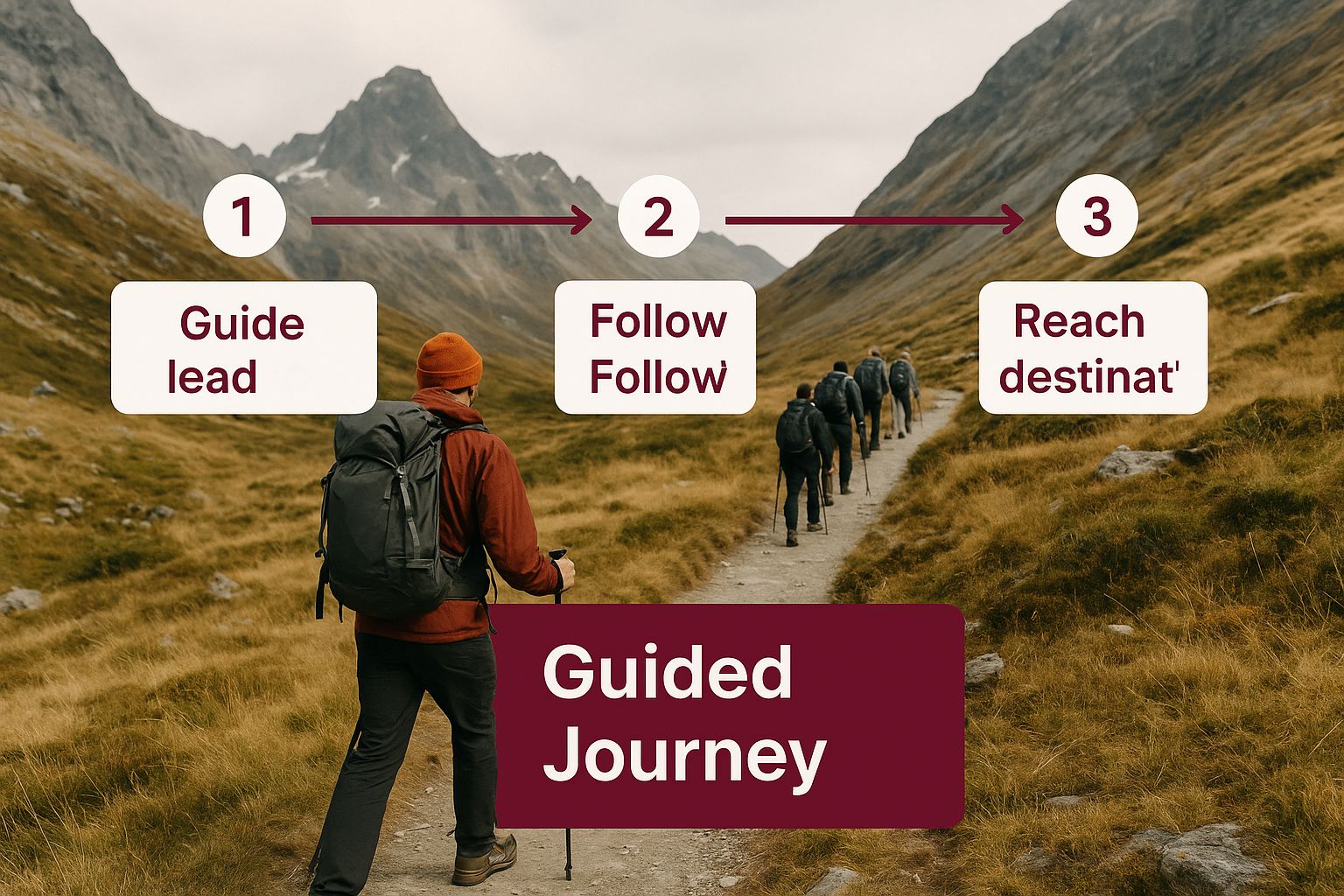
Having an expert lead the way means your team stays on track, sidesteps common pitfalls, and reaches the summit of certification without any wasted effort.
Stage 1: Surveying the Terrain with a Gap Analysis
Before you take a single step, you need to know exactly where you're starting from. This is done with a Gap Analysis, which is basically a deep-dive audit of your current operations measured against the specific requirements of the ISO standard you're aiming for.
Think of it like a seasoned mountain guide surveying the landscape before a climb. They need to spot every potential hurdle—a river that needs crossing, a steep incline, or a patch of unstable ground. In the same way, your consultant will meticulously comb through your existing policies, procedures, and day-to-day practices to find the "gaps" between what you do now and what the standard demands.
This isn't about pointing fingers or finding fault; it's about creating an honest, crystal-clear baseline. The insights from this analysis become the very foundation of your entire project plan.
A thorough Gap Analysis will usually pinpoint:
- Documentation Deficiencies: Are there any missing policies or procedures the standard insists on?
- Process Misalignments: Do your current workflows fall short of specific ISO controls?
- Resource Needs: What tools, training, or people will you need to bring everything up to scratch?
This detailed map ensures every action you take from this point on is targeted and effective. No more spinning your wheels on things that are already compliant.
Stage 2: Equipping Your Team During Implementation
Once the gaps are clearly laid out, it’s time for Implementation. This is where your consultant helps you build out all the necessary components of your new management system. It’s like packing the right gear for the expedition—you need equipment that not only meets the requirements but is also practical and easy for your team to use.
This phase is all about collaboration. A good consultant won't just dump a pile of generic templates on your desk. They'll work right alongside your team to develop policies, procedures, and controls that are designed for your unique business environment. This is how you make sure the system becomes a seamless part of your daily operations, not some awkward add-on that everyone ignores.
A crucial part of this stage is creating key documents like a Risk Treatment Plan. That might sound intimidating, but it’s really just a documented strategy for handling the risks you've identified, outlining the specific controls you'll use to neutralise them. For instance, if a risk is unauthorised access to client data, a control would be implementing multi-factor authentication.
The goal of implementation is to build a management system that your team will actually use. If the procedures are too complex or don't align with how your business works, they will inevitably fail. An expert consultant ensures the system is both compliant and practical.
Throughout this phase, your team gets the support they need. As businesses navigate their path to ISO certification, understanding and implementing effective compliance training is crucial for successful adherence to standards. This training empowers your people, making sure they understand their roles and responsibilities within the new framework.
Stage 3: Preparing for the Summit with Audit Readiness
The final stage before your formal certification audit is all about preparation. This is your "summit push," and your consultant acts as your coach, running drills and final checks to make sure everything is rock-solid for a successful outcome. This phase really boils down to two key activities: internal audits and management reviews.
An internal audit is essentially a dress rehearsal for the main event. Your consultant, or a trained member of your own team, will conduct a full audit of your new system to hunt for any non-conformities. This step is incredibly valuable because it lets you find and fix any issues before the external auditor shows up.
After the internal audit, you'll hold a management review. This is a formal meeting where your leadership team goes over the performance of the management system, the results from the internal audit, and any opportunities for improvement. This is critical for showing the external auditor that leadership is fully engaged and committed to the system's success.
Key preparations in this final stage include:
- Conducting Internal Audits: A thorough check-up to test the real-world effectiveness of your newly implemented controls.
- Implementing Corrective Actions: Systematically fixing any weaknesses uncovered during the internal audit to strengthen your system.
- Holding Management Reviews: Ensuring leadership is fully briefed and can demonstrate their commitment to the entire process.
By the end of this stage, you won't be just hoping you’ll pass the audit—you'll have the evidence and the confidence to prove you meet the standard. For a more detailed breakdown of these steps, you can check out our guide on how to get ISO certified. An expert from an ISO consulting services firm turns this complex journey into a successful and rewarding business initiative.
Unlocking the Real ROI of Professional ISO Guidance
Getting that ISO certificate is a fantastic milestone, but it’s really just the opening chapter of a much bigger story. The true value of bringing in professional ISO consulting services isn’t just about ticking boxes to pass an audit; it's about the deep-seated business improvements that happen along the way. This is where you graduate from simply being compliant to seeing a real, measurable return on your investment.
When built with an expert at your side, a management system becomes the engine for powerful, long-term growth. It stops being a line item on your expenses and turns into a strategic asset that pays you back in spades through smarter operations, tighter security, and a market reputation that opens doors to bigger and better deals.
Let’s break down how this guidance actually translates into a stronger, more profitable business.
From Operational Waste to Streamlined Efficiency
So many businesses run on hidden inefficiencies. Think about it: clunky workflows, duplicated tasks, and unclear processes that have just become "the way we do things around here." A huge benefit of a guided ISO implementation is that it forces you to put every single one of those processes under the microscope. And a consultant brings a fresh, objective pair of eyes to that review.
They have a knack for spotting and helping you eliminate the operational waste you’ve probably stopped even noticing.
- Standardising Processes: A good consultant helps you document and lock in your best ways of working. This ensures everyone follows the most efficient path every single time, which dramatically slashes errors and frustrating rework.
- Clarifying Roles and Responsibilities: A key part of any ISO standard is clearly defining who does what. This simple act of clarification gets rid of confusion, stops important tasks from falling through the cracks, and empowers your team by making their duties crystal clear.
- Data-Driven Decisions: ISO standards are all about making decisions based on evidence, not just gut feelings. A consultant will help you set up simple systems to collect and analyse performance data, allowing you to spot bottlenecks and make improvements based on hard facts.
This intense focus on refining your processes leads to a leaner, more agile operation. You save time, you cut costs, and you free up your team to focus on the work that actually grows the business.
Fortifying Security to Slash Business Risk
We live in a world where a single data breach can be absolutely catastrophic. For any business going for ISO 27001, professional guidance isn’t just helpful—it’s essential for building a security framework that genuinely protects you. The cost of a breach is so much more than just a fine; it’s the reputational damage, the loss of customer trust, and the massive business interruption.
Engaging an ISO 27001 consultant is like hiring a master locksmith for your digital fortress. They don't just hand you a set of locks; they help you architect a comprehensive security system that anticipates threats and neutralises vulnerabilities before they can be exploited.
This is about more than just writing a few security policies and hoping for the best. A consultant helps you weave security-conscious practices into your company's DNA, from training staff to spot phishing threats to implementing robust technical controls like access management and encryption. The end result? A massive reduction in your risk profile, giving you—and your clients—invaluable peace of mind.
Boosting Your Reputation to Win Bigger Contracts
In a crowded market, trust is your most valuable currency. An ISO certification is a globally recognised badge of honour. It instantly tells the world that your business is serious about quality, security, and professionalism, making you a far more attractive partner for high-value clients and government agencies.
This is particularly true in the booming Asia-Pacific market, where the demand for certified partners is skyrocketing. It’s become a powerful key for unlocking market access and expansion. In fact, the Asia Pacific ISO certification market is projected to grow from USD 2.1 billion in 2021 to USD 3.6 billion. Australia is a major driver of this trend, as organisations of all sizes use certification to prove their commitment to excellence. You can find more details on the growth of the Asia-Pacific certification market.
For many large contracts, especially in fields like tech, defence, and healthcare, ISO certification isn't a "nice-to-have"; it's a non-negotiable prerequisite. Without it, you can't even get in the door. Working with ISO consulting services ensures you meet these tough requirements, opening up revenue streams that were completely off-limits before. It's a direct investment in your company’s future growth.
Thinking about the difference between expert help and going it alone? The table below lays out the strategic outcomes pretty clearly.
How ISO Consulting Services Drive Business Value
| Benefit Area | With an ISO Consultant | Without an ISO Consultant (DIY) |
|---|---|---|
| Process Optimisation | Expert analysis identifies and removes deep-seated inefficiencies, leading to significant cost and time savings. | Surface-level fixes are common; core operational problems often remain unaddressed. |
| Risk Management | A comprehensive, tailored risk assessment and treatment plan is developed, genuinely reducing business vulnerabilities. | Generic templates are often used, which may not cover unique business risks, leaving critical gaps. |
| Audit Success | A 100% success rate is common with experienced firms, ensuring a smooth, first-time pass. | The risk of failing the audit is high due to misinterpretation of standards, costing time and money. |
| Market Access | Certification is achieved efficiently, quickly unlocking access to lucrative contracts and new markets. | A prolonged, difficult process can cause missed opportunities and damage client confidence. |
At the end of the day, professional ISO guidance is about building a fundamentally better business. It’s about creating systems that don’t just satisfy an auditor, but also drive lasting improvements in efficiency, security, and customer loyalty. That is the true ROI—a stronger, more resilient, and more profitable organisation.
How to Choose the Right ISO Consulting Partner

Let’s be honest: picking an ISO consulting partner is probably the most important decision you'll make on your journey to certification. This choice single-handedly affects whether you pass your audit, how practical your new systems are, and whether any of it actually sticks around for the long haul.
Get it right, and you’ve gained a strategic ally who genuinely strengthens your business. Get it wrong, and you could be looking at a failed audit, a mountain of debt, and a useless binder of generic documents collecting dust.
Think of it like hiring a specialist surgeon. You wouldn't just go for the cheapest option or the one with a flashy ad. You’d dig into their track record, their specific expertise, and how they treat their patients. Vetting the available ISO consulting services needs that same level of care, ensuring you find a true partner, not just a document factory.
This guide will give you a clear framework to cut through the sales pitches and find a consultant who will deliver real, lasting value.
Look for Deep Industry-Specific Experience
Not all consultants are created equal. Far from it. An ISO standard is just a framework; how you apply it to a software company versus a food manufacturing plant are two completely different worlds. A consultant who has lived and breathed your industry already knows your specific operational headaches, risks, and regulatory hurdles.
That kind of specialised knowledge is gold. They’ll know which security controls are non-negotiable for your sector and which can be handled more simply. For example, a consultant helping a tech company with ISO 27001 will have a deep understanding of cloud security and the software development lifecycle—something a generalist just won't have.
A consultant with experience in your field speaks your language. They can translate the abstract requirements of the standard into practical solutions that make sense for your team and your business model, dramatically speeding up the process and improving the outcome.
Prioritise a Tailored Approach Over Generic Templates
One of the biggest red flags is a consultant who relies heavily on one-size-fits-all templates. Sure, templates can be a decent starting point, but a quality consultant will insist on customising every single policy and procedure to reflect how your business actually works.
Auditors are sharp—they can spot a copy-pasted management system from a mile away, and it's a major reason so many DIY attempts go down in flames.
A great consultant will take the time to learn your workflows, talk to your team, and understand your company culture. They'll then help you build a system that fits your organisation like a glove, making it infinitely more likely to be adopted and maintained by your people.
Essential Criteria for Your Shortlist
As you start looking at different firms, use these key points to separate the real experts from the amateurs:
- Proven Track Record: You need to see a history of success. Experienced firms are proud to show off their pass rates. Many, like our team, have a 100% success rate on certification audits. Don't be shy about asking for the numbers.
- Transparent, Fixed-Fee Pricing: Run from consultants offering vague hourly rates that can easily balloon. A reputable partner will give you a clear, fixed-fee proposal that spells out every single deliverable. No hidden surprises.
- Focus on Practicality and Maintenance: The best systems are the ones people actually use. A top-tier consultant will be obsessed with making sure your management system is simple enough for your team to manage long after the certificate is hanging on the wall.
Critical Questions to Ask Potential Partners
Once you have a shortlist, it's time to dig deeper. The answers to these questions will tell you everything you need to know about a consultant's philosophy and whether they're the right fit. Go into your meetings armed with this checklist.
-
Can you share case studies or references from businesses similar to ours? This is the ultimate test of their industry experience. Hearing directly from a past client in your sector is invaluable.
-
How will you ensure our system is practical for our team to maintain post-certification? This question reveals if they’re in it for a long-term partnership or just a quick payday. A good answer should involve simple processes, proper training, and a clear plan for ongoing improvement.
-
What is your specific process for tailoring the documentation to our business? Listen for words like "interviews," "workshops," and "collaboration." If their answer is all about filling in blanks on a template, that's a huge warning sign.
-
How do you support your clients during the external certification audit? A real partner doesn’t just get you ready and then vanish. They should be there—in person or virtually—during the audit to provide support, help answer the auditor's questions, and make sure everything goes smoothly.
-
What does your fixed fee include, and are there any potential extra costs? Get this crystal clear. Does the fee cover internal audit training, support during the main audit, and any follow-up tweaks? A transparent partner will happily break it all down for you.
Making the right choice here is fundamental to your success. By following this structured approach, you can confidently pick a partner who will not only get you certified but will also help you build a stronger, more resilient, and more competitive business. To see how a dedicated partner can guide you, explore our detailed overview of ISO 27001 consulting services.
Avoiding the All-Too-Common ISO Certification Blunders
So many businesses charge into the ISO certification process full of optimism, only to get tangled in a web of dense documentation and vague requirements. It’s a surprisingly easy path to get wrong.
The stories I've heard of failed audits and abandoned projects are far more common than people think, and they nearly always trace back to the same few avoidable mistakes.
This is exactly where the experience of a professional ISO consulting service proves its worth. A good guide doesn't just show up to fix problems; they see the traps coming a mile away and steer you clear. They help you build a management system that actually becomes part of your company's DNA—not just another set of rules gathering dust on a shelf.
Let's walk through some of the most frequent missteps and, more importantly, how the right partner helps you sidestep them from the very beginning.
The Over-Engineered Documentation Trap
One of the biggest mistakes I see is creating a documentation system so ridiculously complex that no one on the team can realistically use it. This happens when people miss the entire point of ISO. The standard asks for documented information, sure, but what it really wants is for you to have consistent, effective processes—not to build a mountain of paperwork.
When you go it alone, it's incredibly tempting to overcompensate. You end up with procedures that are dozens of pages long for what should be simple tasks. What's the result? Your team finds shortcuts, the official system gets ignored, and your management system exists only in a folder somewhere. Come audit day, it's painfully obvious that your documents don't match reality, which is a massive red flag for any auditor.
An experienced consultant stops this dead in its tracks by focusing on lean, practical documentation. They know from experience that a simple one-page flowchart is often a hundred times more effective than a 20-page procedure. They’ll work with your team to create tools and documents that are genuinely helpful, making sure the system supports their work instead of getting in the way.
An expert's real value lies in knowing the difference between what the standard actually requires and what is just bureaucratic overkill. They help you build something that is compliant, efficient, and that people won't hate using.
Misreading the Intent of the Standard
Another classic blunder is taking the standard's clauses too literally, but completely missing the spirit of the rule. ISO standards are written to apply to everyone, from a tiny tech startup to a global manufacturing giant. Because of that, the language can be pretty general, leaving a lot of room for things to get lost in translation.
For example, a business might see a clause about "management review" and figure a quick, informal chat over coffee is enough. An auditor, however, is expecting to see a formal meeting with a set agenda, proper minutes, and clear action items. That single misunderstanding can lead directly to a non-conformity during an audit. A few of those, and you're looking at a failed audit, a lot of rework, and a very expensive second try.
A consultant is your translator. They’ve spent years seeing how these clauses play out in the real world and, most importantly, how auditors interpret them. They bridge that gap between the formal language of the standard and what it actually means for your daily operations, ensuring your setup is both compliant and makes sense.
The "Forgetting About Your People" Pitfall
You could design the most technically perfect management system in the world, but if your employees aren't on board, it's destined to fail. A classic mistake is when a small management group designs the whole system in a bubble and then just "launches" it at the rest of the company. That approach almost always breeds resistance and confusion.
Without genuine engagement, your team just sees the new system as another chore handed down from on high. They don't get the "why" behind it, so they don't follow the new processes consistently. That lack of buy-in is something auditors can spot instantly—it’s a clear sign the system isn't truly embedded in the company culture.
A skilled consultant knows this and makes employee engagement a core part of the whole project.
- Inclusive Workshops: They run workshops that bring in staff from all levels to help design the processes. This gives everyone a sense of ownership.
- Clear Communication: They help you explain the benefits in a way your team understands, focusing on how it makes their jobs easier and the company stronger.
- Targeted Training: They deliver practical, hands-on training that goes beyond clicking through slides, making sure everyone feels confident in their role.
By turning your employees into active participants instead of passive observers, a consultant helps build a system that is embraced, not just tolerated. This cultural shift is the real secret to a management system that lasts.
The table below neatly summarises these common issues and shows how expert guidance flips the script.
Common ISO Pitfalls and Expert Solutions
| Common Mistake | Potential Negative Impact | How an ISO Consultant Helps |
|---|---|---|
| Creating Overly Complex Documents | The system is ignored by staff, creating a disconnect between paper and practice, and ultimately causing an audit failure. | Designs lean, practical documentation people will actually use, ensuring the system is both compliant and efficient. |
| Misinterpreting the Standard | Key requirements are missed or implemented wrongly, leading to non-conformities and a failed certification audit. | Acts as an expert translator, applying the standard's requirements correctly to your specific business context. |
| Ignoring Employee Buy-In | Staff resist the new system, leading to inconsistent use and a failure to make it part of the company culture. | Drives engagement through workshops and training, creating a sense of ownership and ensuring widespread adoption. |
At the end of the day, the true value of bringing in ISO consulting services is their preventative expertise. They’ve seen these mistakes play out time and time again, and their whole approach is designed to help you avoid them. This proactive guidance saves an incredible amount of time, money, and frustration, ensuring your path to certification is smooth, successful, and adds real, lasting value to your organisation.
Your Questions About ISO Consulting Answered
When you start digging into ISO standards, a whole lot of practical questions pop up. It’s completely normal to wonder about the timeline, the cost, and what a consultant really brings to the table. Let’s tackle the big questions we hear from Australian businesses, so you can move forward with total confidence.
How Long Does ISO Certification Take with a Consultant?
This is usually the first question on everyone's mind, and the honest answer is: it depends. The timeline really hinges on a few key things, like the size of your business, how complex your work is, and what sort of processes you already have in place.
But here’s the good news: working with a consultant puts the whole process on the fast track. For most small to medium-sized businesses in Australia going for a standard like ISO 27001, you’re realistically looking at somewhere between three and nine months. That’s a world away from DIY attempts, which can easily drag on for over a year or just fizzle out altogether.
An experienced consultant has a proven roadmap. They provide efficient templates (that they’ll help you customise!) and expert guidance to keep the momentum going. They know how to steer you clear of common pitfalls, like getting bogged down in paperwork or misreading the standard, which means a much smoother, faster run to your certification audit.
Is Hiring an ISO Consultant a Worthwhile Investment?
It’s easy to look at the upfront cost of consulting and hesitate. But when you flip it around and look at the cost of not using an expert, the picture becomes much clearer. In the long run, it's almost always the more cost-effective move.
Just think about it. What’s the financial hit of failing a certification audit and having to pay for a second one? What about the hidden costs of implementing clunky, inefficient controls that frustrate your team and drain resources day after day? Or worse, imagine losing out on a game-changing contract because you couldn't get compliant in time. Those costs can dwarf a consultant's fee.
A good consultant doesn't just get you a certificate. They help you build a lean, effective management system that fits your business like a glove. This stops you from wasting money on over-the-top controls and delivers a real return on investment through smarter operations, lower business risk, and a stronger reputation in the market.
Why Can’t We Just Use Online Templates to Get Certified?
This is a great question, and it gets to the heart of a major trap many businesses fall into. Relying on generic, off-the-shelf templates is one of the biggest reasons companies fail their audits. ISO certification isn’t about ticking boxes and having a folder full of documents; it's about proving you have a living, breathing management system that’s woven into how you actually work.
Auditors are experts at spotting a copy-paste job. They won’t just read your manual; they’ll talk to your team and watch your processes in action to see if your paperwork matches reality. If there's a disconnect, you’re heading straight for a non-conformity.
The real magic of a consultant is their ability to help you take the standard’s requirements and make them your own. They make sure the system you build is practical, useful, and genuinely audit-proof because it’s a true reflection of your organisation.
What Kind of Support Can We Expect After Certification?
Getting that ISO certificate is a massive achievement, but it's not the end of the road. ISO standards are all about continuous improvement. To keep your certification, you'll have annual surveillance audits, and you’ll need to go through a full recertification every three years.
A quality consulting partner has this in mind from the very beginning. They don’t just race you to the finish line; they help you set up simple, sustainable habits for the long haul.
This usually involves getting you comfortable with things like:
- Internal Audits: Checking your own system to find and fix things before the external auditor does.
- Management Reviews: Regular meetings where your leadership team looks at how the system is performing and makes smart decisions.
- Corrective Actions: A clear process for dealing with any issues that come up.
Many firms, like us, also offer ongoing support retainers. This gives you peace of mind and access to expert advice whenever you need it, ensuring your system doesn't just stay compliant but keeps adding more and more value to your business. It’s about making sure your investment continues to pay off, year after year.
Ready to build a stronger, more secure business with ISO 27001 certification? At Anitech, we specialise in guiding Australian small businesses through a clear, efficient, and successful certification journey. Our 100% success rate means you can move forward with confidence. Contact us today to start your path to certification.
Recent Comments