

At its core, ISO consulting is about bringing in an expert to guide your business through the often-tricky process of getting certified to an international standard like ISO 27001. A great consultant is far more than a box-ticker; they’re a strategic partner who helps you weave operational excellence into the very fabric of your company. This comprehensive guide will walk you through every facet of ISO consulting, from building the initial business case to selecting the right partner and navigating the complexities of standards like ISO 27001. We will explore the tangible benefits, the step-by-step certification roadmap, and answer the most common questions businesses face, providing you with the knowledge to turn a compliance requirement into a powerful engine for growth and long-term success.
Why Top Companies Use ISO Consulting

Trying to decipher an ISO standard on your own can feel like reading a map in a foreign language. The text is dense, the demands are specific, and the path to compliance looks anything but clear. This is the exact moment an ISO consultant becomes your most valuable asset, turning a daunting challenge into a serious business advantage. They serve as the critical bridge between the theoretical requirements of a standard and the practical realities of your day-to-day operations.
Don't think of them as an auditor looking for mistakes. Instead, see them as an expert guide who knows the terrain inside out. They translate the complex language of compliance into a clear, actionable roadmap, ensuring you not only ‘pass the test’ but build a lasting framework for excellence. Their role is multifaceted: they are a project manager, a technical expert, a trainer, and a strategic advisor rolled into one. They bring an external, objective perspective that is often difficult for internal teams to replicate, helping to identify blind spots and challenge inefficient, long-held assumptions.
Turning Compliance Into a Competitive Edge
Let’s be honest, the goal of engaging ISO consulting isn't just to get a certificate for the wall. It’s about using the process to build a stronger, more efficient, and more competitive business. The certification is simply the proof that you’ve made a fundamental operational shift—a shift that a consultant helps you manage. This strategic partnership is designed to embed principles of quality, security, and continuous improvement deep within your company culture.
This transformation delivers tangible results that drive growth and stability:
- Winning Bigger Contracts: Many government and enterprise-level contracts list ISO certification as a non-negotiable requirement. It’s the key that gets your foot in the door for massive opportunities your non-certified competitors can’t even bid for. Certification acts as a pre-qualification, instantly elevating your status in procurement processes and signalling to potential clients that your organisation meets a global benchmark for quality and reliability.
- Building Unshakable Customer Trust: In a world of risk, certification is a globally recognised stamp of quality, security, and reliability. It shows clients you're serious about protecting their data and delivering consistent results, building instant trust. This is particularly crucial in industries where data sensitivity is high, such as finance, healthcare, and technology. The certificate becomes a powerful marketing tool, differentiating you from the competition.
- Creating Hyper-Efficient Operations: A sharp consultant helps you spot and cut out wasted time, redundant processes, and hidden risks. The result? Lower costs, better productivity, and smoother workflows from top to bottom. By mapping out your existing processes and aligning them with the ISO framework, a consultant can identify bottlenecks, eliminate duplicated effort, and introduce streamlined procedures that enhance overall operational efficiency and reduce the likelihood of costly errors.
By systematising processes and focusing on continuous improvement, ISO standards lay the groundwork for sustainable growth. A consultant ensures this framework is practical and adds real value, rather than just creating more bureaucracy.
A Navigator for Complex Standards
Every ISO standard is its own unique beast. Whether you’re tackling ISO 27001 for information security or ISO 9001 for quality management, a consultant brings a depth of knowledge your internal team simply won’t have. They’ve been through the certification process hundreds of times. They understand the nuances of the clauses, the intent behind the requirements, and how different elements of the standard interact with each other.
That experience is gold. They know the common traps, understand how auditors think, and can expertly adapt the standard’s rigid requirements to fit the reality of your business. For instance, many businesses aiming for operational excellence explore philosophies like Total Quality Management (TQM), and a consultant can seamlessly bridge these concepts with the ISO framework. They can ensure that the management system you build is not just compliant, but also practical and integrated with your existing business culture and objectives.
The Australian Focus on Excellence
Here in Australia, governance and operational integrity are held in high regard. The demand for ISO consulting has surged as local businesses recognise that strong compliance is a major competitive differentiator. Especially in sectors like manufacturing, finance, and government, certification isn't just a nice-to-have; it's a critical asset for both regulation and reputation. The Australian business landscape increasingly rewards organisations that can demonstrate a formal commitment to international best practices, making ISO certification a key strategic objective.
Ultimately, working with an expert is about turning a compliance headache into your greatest competitive strength. They give you the map, the compass, and the know-how to make sure you not only reach your destination but become a much stronger business along the way. If this sounds like the right move, exploring professional ISO consulting services is the perfect first step.
The Real Business Case for an ISO Consultant
Let's cut to the chase. When you're thinking about ISO consulting, the real question isn't about ticking boxes—it's about the return on your investment. What do you actually get for your money? The answer isn't just a shiny certificate for the wall; it’s a whole host of tangible business benefits that strengthen your company from the ground up. The business case extends far beyond mere compliance; it's about strategic risk management, operational optimisation, and market expansion.
Bringing in an expert is simply the fastest way to sidestep expensive blunders, slash the time it takes to get certified, and let your team get back to doing what they do best. It allows your internal resources to remain focused on revenue-generating activities while the consultant manages the complexities of the certification project.
Think of an ISO consultant as a risk-reduction engine. Their experience massively boosts your chances of passing the audit the first time around, saving you the financial hit and morale drain of a failure. And while that initial win is huge, the real value comes from building a sustainable culture of improvement that keeps paying you back long after the audit is over. They help embed a mindset of continuous improvement that becomes a part of your organisational DNA, delivering ongoing dividends in efficiency and quality.
Dodging Costly Mistakes and Accelerating Timelines
Trying to get ISO certified on your own can feel like navigating a minefield blindfolded. The standards are deliberately a bit vague, which leaves a lot of room for misinterpretation. This is where most internal teams stumble. They either build a system that’s too flimsy and fails the audit, or—more often—they create a monstrously complex system of documents that no one can actually use. Both are expensive ways to fail, not just in terms of direct cost but also in wasted employee hours and lost momentum.
A consultant’s first job is to translate the dense language of the standard into a practical, right-sized system that fits your business. They’ve been there, done that, and seen what works (and more importantly, what doesn’t). This foresight stops you from pouring hundreds of hours into building processes that are either non-compliant or so clunky they grind your operations to a halt. They ensure that the management system is proportionate to the size and complexity of your organisation, avoiding the common pitfall of over-engineering a solution.
An experienced ISO consultant is your project accelerator. They bring proven templates, clear directions, and a structured plan to the table. This alone can shave months off a typical certification timeline, meaning you start seeing the commercial benefits of being certified much, much sooner.
Transforming Chaos into a Competitive Advantage
Picture a growing tech company handling sensitive client data. Right now, their processes are a messy mix of informal emails, disconnected spreadsheets, and "we've always done it this way" instructions. Security is patchy, and if one key person leaves, a huge amount of knowledge walks out the door with them. This kind of chaos isn't just inefficient; it's a massive business risk that could lead to data breaches, reputational damage, and financial loss.
Now, bring in an ISO consultant. They don't just dump a rulebook on the desk; they guide a genuine transformation:
- Systematic Risk Identification: The consultant helps the team methodically uncover its biggest information security risks, from potential data breaches to weak password policies. This involves a structured risk assessment process that prioritises threats based on their likelihood and impact, allowing the business to focus its resources where they are most needed.
- Streamlined Process Design: They work with the staff to create clear, documented procedures for everything—from onboarding a new hire to handling a security incident. Chaos is replaced with clarity. This formalisation of processes ensures consistency, reduces errors, and makes it easier to train new employees, thereby creating a more scalable and resilient operation.
- Enhanced Brand Reputation: With ISO 27001 certification in hand, the company can now prove its commitment to security, building instant trust with bigger, better clients. It becomes a key differentiator in a crowded marketplace, signalling to potential customers that the company operates to a globally recognised standard of excellence.
- Unlocking New Markets: Suddenly, they’re eligible to bid on lucrative government and enterprise contracts that were previously out of reach. The compliance project just became a direct revenue generator. Certification opens doors to new sectors and geographies where it is a mandatory prerequisite for doing business.
This is a perfect example of how a consultant turns operational weaknesses into real strengths. The final result is a more resilient, efficient, and ultimately more profitable business.
Comparing DIY vs Consultant-Led ISO Certification
Deciding whether to go it alone or bring in an expert has huge implications for your budget, timeline, and the final result. The best path forward really depends on the expertise you have in-house, your resources, and how much risk you're willing to take on. A DIY approach may seem cheaper upfront, but the hidden costs of delays, rework, and a potential failed audit can quickly eclipse the initial savings.
Here’s a clear breakdown of what to expect with each approach:
Comparing DIY vs Consultant-Led ISO Certification
| Milestone | DIY Approach (Without Consultant) | Consultant-Led Approach |
|---|---|---|
| Interpretation | High risk of misinterpreting complex clauses, leading to non-compliant systems. Internal teams may lack the nuanced understanding of how auditors interpret specific requirements. | Expert interpretation ensures requirements are met practically and efficiently. Consultants know what auditors are looking for and can guide the implementation accordingly. |
| Timeline | Typically 50-100% longer due to a steep learning curve and trial-and-error processes. The project can often stall as day-to-day business priorities take over. | Accelerated timeline with a structured project plan and proven methodologies. The consultant acts as a dedicated project manager, ensuring momentum is maintained. |
| Resource Drain | Pulls key internal staff away from their primary roles for extended periods. This opportunity cost can be significant, impacting revenue and core business functions. | Minimises disruption by providing expert guidance and handling heavy lifting. The consultant does the majority of the documentation and system design, freeing up internal staff. |
| Audit Success | Lower first-time pass rate, often requiring expensive rework and re-audits. A failed audit can be demoralising for the team and damaging to the project's credibility. | High first-time pass rate (over 99% with experienced consultants), avoiding extra costs. This provides certainty and a clear return on investment. |
| System Quality | Risk of creating overly bureaucratic or ineffective management systems. The system may become a "paper tiger" that exists only for the audit and adds no real business value. | Builds a lean, effective system tailored to the business for long-term value. The focus is on creating a practical system that improves operations, not just passes an audit. |
When you look at it this way, the business case for an ISO consultant becomes crystal clear. It's an investment in certainty, speed, and strategic advantage. By tapping into their expertise, you don't just guarantee a successful certification—you build a stronger, more competitive company that’s ready for whatever comes next.
Your Roadmap to ISO Certification Success
Kicking off the journey to ISO certification can feel a bit like planning a major expedition. Without a clear map, it’s all too easy to get bogged down in the details. But when you’ve got a solid plan and an experienced guide—your ISO consulting partner—that journey becomes a clear, step-by-step process built for success. A structured roadmap is essential for managing expectations, allocating resources effectively, and tracking progress against key milestones.
This roadmap breaks the whole project down into manageable stages. It turns what feels like a monumental task into something your business can actually achieve. Each phase has a distinct purpose, with everyone knowing their role and what needs to be done, moving you steadily from where you are now to a fully certified management system. This phased approach ensures that no critical steps are missed and that the project remains on track from start to finish.
The infographic below shows how a good consultant can turn initial process chaos into certified clarity.
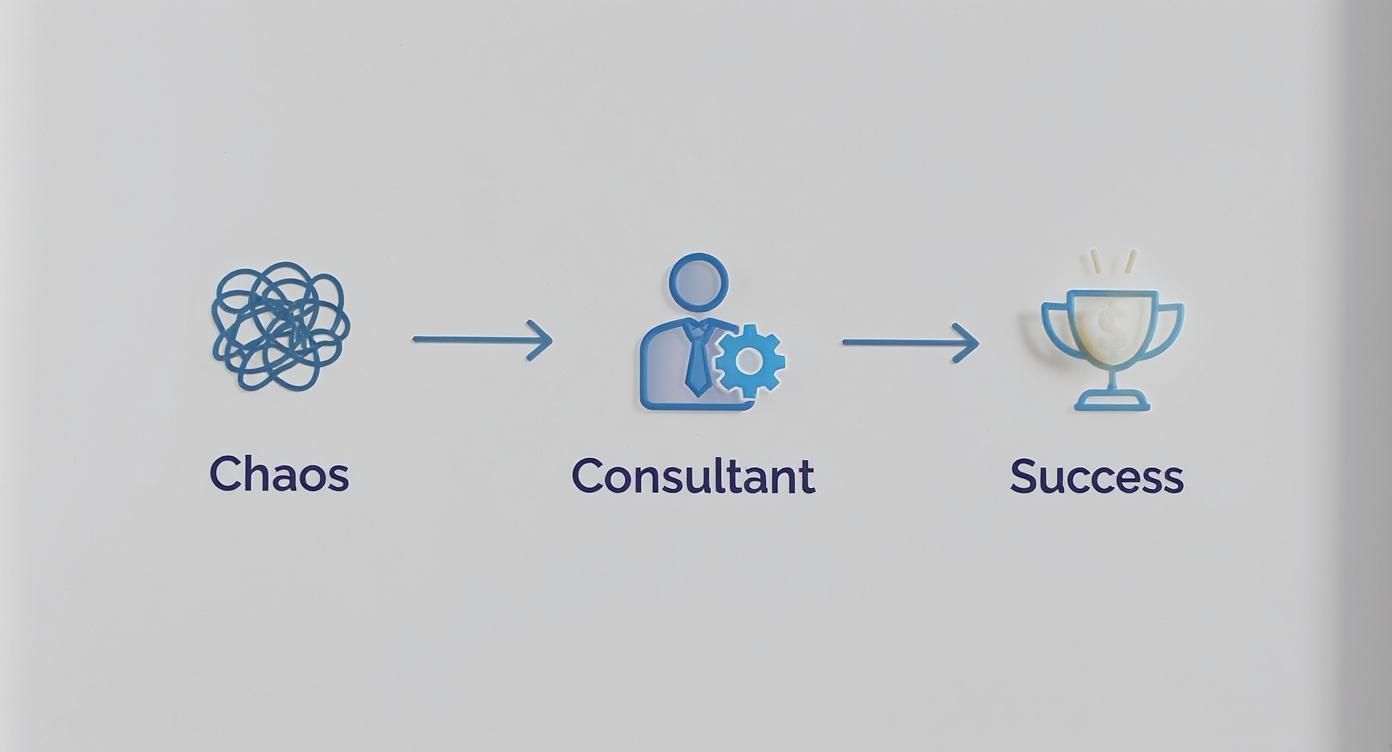
As you can see, the consultant is the critical link. They apply their expertise to untangle the complexity and deliver a straightforward, successful outcome.
Stage 1: The Gap Analysis
The first step on any journey is figuring out exactly where you're starting from. A gap analysis is basically a full diagnostic of your current processes, policies, and controls, all measured against the specific requirements of the ISO standard you’re aiming for. This foundational stage is arguably the most critical, as it sets the direction and scope for the entire project.
Think of it as a pre-flight check for a plane. Before you can even think about taking off, you need a complete picture of what's working, what's missing, and what needs to be fixed right away. The analysis provides a baseline measurement of your current state of compliance and identifies all areas that require remediation.
- Consultant's Role: The consultant spearheads this discovery phase. They use their deep knowledge of the standard to quickly pinpoint any areas that don't comply. They'll then give you a detailed report that becomes the blueprint for the entire project, highlighting every single gap. This report will typically prioritise the gaps based on risk and effort, creating a clear action plan.
- Your Team's Role: Your team’s job is to provide access to existing documents, key people, and honest answers about how work really gets done. Transparency here is absolutely crucial for an accurate assessment. This collaborative effort ensures the consultant gains a true understanding of your business operations, not just what is written down in old procedure documents.
Stage 2: System Design and Documentation
Once the gaps are identified, it's time to build the framework for your new management system. This means creating the core documentation—the policies, procedures, and records—that will guide how your business operates from here on out. This is the tangible output of the project, defining the "what," "why," and "how" of your compliant operations.
But this isn't about creating mountains of useless paperwork. A skilled consultant helps you develop a lean, practical system that actually fits your business, not some generic template that just gets in the way. The documentation should be a living tool that supports your employees, rather than a bureaucratic burden that hinders them.
The goal of documentation is clarity, not complexity. It should be a useful playbook that your team can actually follow, making sure everyone understands their part in staying compliant and driving quality.
This phase is where your consultant’s expertise really shines. They take the dense, technical clauses of the ISO standard and translate them into clear, actionable documents that make sense for your business. They will often bring a suite of proven templates and tools that can be customised to your specific needs, dramatically accelerating the documentation process while ensuring full compliance.
Stage 3: Team Implementation and Training
A system that only exists on paper is pretty much useless. The implementation stage is where you bring all those new processes to life, embedding them into your team's day-to-day routines. This is often the toughest part, as it means changing habits and getting people used to new ways of working. Effective change management is key to the success of this phase.
A smooth implementation really comes down to clear communication and great training. Your team needs to understand not just what they need to do, but why it’s so important for the business and for them. When employees understand the benefits of the new system—such as reduced errors, clearer responsibilities, and improved security—they are far more likely to embrace the change.
- Consultant's Role: Here, the consultant acts as a change manager and a trainer. They’ll create and deliver targeted training for different teams, answer questions, and provide hands-on support to make sure the new procedures are picked up correctly and used consistently. They can help overcome resistance and build buy-in across the organisation.
- Your Team's Role: Active participation is everything. Your people need to show up for training, start using the new processes, and give feedback on what’s working and what isn’t. It’s a genuine team effort. Management must lead by example, demonstrating their commitment to the new system and encouraging open communication.
Stage 4: The Internal Audit
Before you face the official external auditors, you need a full-scale dress rehearsal. The internal audit is a top-to-bottom check of your newly implemented system to make sure it’s running as planned and hitting every requirement of the ISO standard. It is a mandatory requirement of the ISO standard itself and serves as a critical final check.
This is your chance to find and fix any last-minute issues in a low-pressure setting. It builds confidence and helps ensure there are no nasty surprises during the final assessment. A consultant usually performs this audit with a fresh pair of eyes, simulating the real thing as closely as possible. They will produce a formal audit report, identifying any non-conformities or areas for improvement that must be addressed before the certification audit.
Stage 5: The Certification Audit
This is the main event—the formal assessment carried out by an accredited, third-party certification body. The auditor will conduct a thorough review of your management system to verify it complies with the ISO standard. It’s usually split into two parts.
- Stage 1 Audit: A review of your documentation to make sure your system is designed correctly on paper. The auditor assesses the design and completeness of your management system to determine if you are ready for the next stage.
- Stage 2 Audit: An on-site assessment to confirm your team is actually following the documented procedures in practice. The auditor will interview staff, observe processes, and review records to gather evidence of conformity.
Your consultant will be right there with you through the whole thing, helping you prepare, guiding you during the audit, and assisting with any follow-up. Their presence provides reassurance to your team and ensures that any questions from the auditor can be answered accurately and effectively. For a deeper dive into this final phase, you can learn more about how to get ISO certified in our complete guide.
Stage 6: Sustaining Excellence
Getting certified is a massive achievement, but it’s not the finish line. ISO standards are all about continuous improvement. While your certification is valid for three years, it's kept alive through annual surveillance audits. The journey doesn't end with the certificate; it marks the beginning of a long-term commitment to operational excellence.
This final stage is all about making compliance a natural part of your business rhythm. It involves ongoing activities like management reviews, regular internal audits, and always looking for ways to make your system better. Your ISO consulting partner can stick around to provide support, ensuring you not only keep your certification but get the most value out of it for years to come. This ongoing relationship helps maintain the integrity of the system and ensures it evolves as your business grows and changes.
How to Choose the Right ISO Consultant
Finding the right ISO consultant is probably the single most important decision you'll make on your certification journey. This isn’t just about hiring another contractor; it's about bringing on a strategic guide who will feel like an extension of your own team. A great ISO consulting expert can transform what looks like a complex compliance headache into a smooth, genuinely valuable business improvement project.
Think of it this way: the right consultant fits your business like a glove, gets your industry inside-out, and is personally invested in seeing you succeed. The wrong one? Well, that path leads to wasted time, a failed audit, and a clunky management system that gets in everyone's way. This is your practical playbook for finding a consultant who is the perfect fit for your organisation. The selection process should be as rigorous as hiring a key employee, focusing on experience, methodology, and cultural fit.
Start with Industry-Specific Experience
Not all ISO consultants are cut from the same cloth. Someone who has spent their career in manufacturing won't necessarily grasp the unique data security risks of a SaaS company aiming for ISO 27001. Real expertise isn't just about knowing the standard’s clauses—it’s about knowing how to apply them in the real world, within the specific context of your industry.
A consultant with deep industry experience brings more than just compliance checklists to the table. They bring battle-tested insights from solving the exact same problems for businesses just like yours. That means they won't waste your time on generic advice and can see potential roadblocks long before you do. They understand your terminology, your operational pressures, and the expectations of your customers and regulators.
To get to the heart of their experience, ask some direct questions:
- Can you show us case studies or references from companies in our industry?
- What are the common challenges you see for a business our size going for this standard?
- How will you adapt the standard’s requirements to fit our specific operations, not the other way around?
You’re looking for a partner who speaks your language and already understands the world you operate in. Everything else builds from this foundation.
Evaluate Their Approach and Methodology
The "how" they do it is every bit as important as "what" they do. Some consultants roll in with rigid, off-the-shelf templates, trying to shoehorn your business into a box that just doesn't fit. The result is often a bureaucratic mess that your team will actively avoid using. A top-tier consultant, on the other hand, acts more like a bespoke tailor, crafting a management system that’s custom-fit to your actual operations.
The best ISO consultants don't just sell you a pre-packaged solution. They build a system with your team, making sure it’s practical, efficient, and adds real value long after the auditor has left.
During those initial chats, really dig into their methodology. Ask them to walk you through a typical project. Do they talk a lot about collaboration, training, and empowering your people? Or do they just talk about handing over a stack of documents? A true partner is focused on building your team's capability, not just delivering a product. Their goal should be to make themselves redundant over time by transferring their knowledge to your team.
Here in Australia, the best ISO consulting work often blurs the lines with broader business improvement. A consultant shouldn't just get you certified; they should advise on how to weave these new, compliant processes into your existing tech stack and workflows. To get a better sense of this space, it’s worth checking out some of the latest management consulting trends in Australia.
Dig into Their Audit Support and Success Rate
At the end of the day, the goal is to pass that certification audit. Your potential consultant's track record here is a non-negotiable proof point. A confident, experienced consultant will be completely transparent about their success rate and how they support clients when the pressure of the audit is on.
Their job isn't done when the paperwork is finished. They should be right there with you during the certification audit, providing expert guidance, helping your team field the auditor’s questions, and making sure the whole experience is as smooth as possible. This hands-on support during the audit is a critical differentiator between a good consultant and a great one.
Here are the crucial questions to ask about their audit support:
- What is your first-time audit pass rate? A seasoned pro should have a success rate well over 95%. Anything less could be a warning sign that their methodology is flawed or their preparation is inadequate.
- Will you be on-site with us during our Stage 1 and Stage 2 audits? The only acceptable answer is a firm "yes." Their presence is invaluable for navigating tricky questions and keeping things on track. Remote support is simply not sufficient for this critical phase.
- How do you help us handle non-conformities? Look, even with perfect preparation, minor issues can pop up. A good consultant has a clear, proven strategy for fixing these findings quickly and effectively so you still get certified without delay. They should assist with root cause analysis and implementing corrective actions.
This level of hands-on support is what separates a true partner from a simple service provider.
The Non-Negotiable Vetting Checklist
When you’re down to your final few options, use this checklist to compare them and make sure you’ve covered all your bases. It’s designed to help you see past the sales pitch and find a consultant who is genuinely equipped to get you across the finish line.
| Vetting Criteria | What to Look For | Red Flags to Avoid |
|---|---|---|
| Industry Expertise | Demonstrable experience with companies like yours. Provides relevant case studies and client testimonials from your sector. | Vague answers about past clients or experience in unrelated sectors. Unable to discuss the specific challenges and nuances of your industry. |
| Customised Approach | Focuses on understanding your business processes before proposing solutions. Asks lots of questions about your operations and culture. | Pushes a one-size-fits-all template or pre-packaged documentation without a thorough discovery phase. The solution feels generic. |
| Audit Track Record | A high, verifiable first-time pass rate (e.g., 99-100%). Is transparent and confident when discussing their success metrics. | Hesitation to share success metrics or downplaying the audit’s importance. Blaming clients for past failures. |
| Hands-On Support | Commits to being present during audits and providing ongoing guidance. Their proposal clearly outlines their role during the audit process. | Offers remote-only support or vague promises about being "available." Their involvement seems to end once the documentation is delivered. |
| Team Chemistry | Communicates clearly and builds a good rapport with your team. You feel comfortable asking them questions and see them as a collaborative partner. | A condescending tone, poor communication, or a focus on problems, not solutions. They seem more interested in telling you what to do than listening. |
Choosing the right consultant is an investment in certainty. By following this practical playbook, you’re setting your business up to find a strategic partner who won’t just get you certified, but will help you build a stronger, more resilient, and more competitive organisation in the process.
Winning with ISO 27001 in a Digital World
In a business world that runs on data, information security has stopped being just an IT problem. It's now a boardroom-level priority. For any company that handles client information—especially tech firms, SaaS providers, and managed service providers (MSPs)—proving you’re serious about security isn't just good practice anymore. It’s a deal-breaker. A single data breach can lead to devastating financial penalties, reputational ruin, and a complete loss of customer trust.
This is exactly where ISO 27001 comes in. It’s the globally recognised gold standard for managing information security, providing a rock-solid framework to protect your most valuable asset: your data. Getting certified sends a clear message to the world that you're capable, trustworthy, and ready for business. It demonstrates due diligence and a proactive approach to managing cyber risk.
With the right ISO consulting partner, ISO 27001 isn't just another compliance checkbox to tick. It becomes a powerful tool to win new business. It helps you build deep client trust, defend your organisation from constant cyber threats, and unlock high-value contracts that your competitors simply can't access.
So, What Exactly is an Information Security Management System?
At the core of ISO 27001 is the Information Security Management System (ISMS). Now, this isn't a piece of software or a single policy document you can just buy off the shelf. Think of it more like the entire ecosystem you build to manage and protect your company’s information, day in and day out. It is a holistic management framework that integrates security into the fabric of the organisation.
An ISMS is your structured, risk-based approach to security. It weaves together the right policies, procedures, technical controls, and employee training to keep your data safe. A consultant's main job is to help you design an ISMS that not only passes the audit but is perfectly moulded to how your business actually operates, ensuring it is both effective and sustainable.
A properly built ISMS stands on three critical pillars:
- Confidentiality: Making sure information is only seen by those with the right permissions. This is about preventing unauthorised disclosure of sensitive data through measures like access control, encryption, and data classification.
- Integrity: Protecting the accuracy and completeness of your data and the systems that process it. This involves controls to prevent unauthorised modification or destruction of information, ensuring data reliability.
- Availability: Ensuring authorised users can get to the information they need, right when they need it. This pillar focuses on protecting against downtime and disruption through measures like backups, disaster recovery planning, and system redundancy.
This framework shifts your security mindset from being reactive (cleaning up messes) to proactive (stopping them from happening in the first place).
The Core Components of an ISO 27001 Framework
Working with an ISO consulting expert means you’ll methodically build out the essential parts of your ISMS. While the standard itself is comprehensive, the journey really centres on a few key areas where expert guidance makes all the difference.
It all starts with the risk assessment. This is the absolute foundation of your entire security system. It's a systematic process of identifying potential information security risks, figuring out how damaging they could be, and then deciding how to handle them—whether that means using a control to reduce the risk, accepting it, or transferring it. A robust risk assessment ensures that your security efforts are focused on the most significant threats to your business.
Next, you'll implement the Annex A security controls. Annex A is a catalogue of 114 potential controls, grouped into 14 categories. The key word here is potential—they aren't all mandatory. Your risk assessment is what tells you which ones are relevant to your business. An expert guide helps you pick and implement the right controls without creating a system so complex it grinds your business to a halt. This process results in a document called the Statement of Applicability (SoA), which justifies the inclusion or exclusion of each control.
ISO 27001 is not a one-size-fits-all checklist. It's a risk management framework. The goal is to apply controls that are proportional to the risks you face, creating a security system that is effective without stifling your business operations.
Finally, you need a bulletproof incident response plan. This document lays out the exact steps your team will follow if a security breach happens—from the first moment of detection and containment right through to communication and learning lessons afterwards. A well-practised plan can drastically reduce the financial and reputational damage of a security incident. And with remote work now the norm, it's crucial to ensure your ISMS covers your whole team, which is a key part of securing a remote workforce with ISO 27001 in Australia.
Why ISO 27001 is a Commercial Asset
Getting certified does so much more than just tighten up your security; it actively drives business growth. For tech companies and service providers in Australia, it has become a non-negotiable benchmark for proving your credibility.
Here’s how it gives you a commercial edge:
- Qualify for High-Value Contracts: Many government departments, financial institutions, and healthcare organisations won't even look at a proposal from a vendor without ISO 27001. It's your ticket to playing in those lucrative fields. Certification acts as a clear differentiator in tender responses and vendor questionnaires.
- Build Unbreakable Client Trust: When a customer hands over their sensitive data, they need to know it's in safe hands. Certification is the most universally understood proof that you're committed to protecting it. This can shorten sales cycles and reduce the need for lengthy security audits from potential clients.
- Strengthen Cyber Defences: The certification process forces you to find and fix security weaknesses you might not have even known existed. This makes you far more resilient to cyberattacks. A 2022 report found the average cost of a data breach in Australia had hit a staggering $4.97 million. A robust ISMS is a critical investment in mitigating this financial risk.
As you work towards ISO 27001, it's essential to implement solid security controls, and a great place to start is by understanding your product's security features. Knowing what you already have helps you spot the gaps. By partnering with an ISO consulting firm, you get the expertise to turn what seems like a compliance burden into a powerful competitive advantage that secures your business and wins you more clients.
Common Questions About ISO Consulting
Taking the leap towards ISO certification is a big move, and it's only natural to have a lot of questions swirling around. Before you invest your time, money, and energy, you need to know what you're really getting into. An informed decision is a better decision, so it's vital to address these common queries upfront.
This is where we cut through the noise. We're going to tackle the big questions we hear all the time from businesses just like yours. No jargon, no fluff—just straight, practical answers to help you move forward with confidence.
What Does ISO Consulting Actually Cost?
This is usually the first thing on everyone's mind, and for good reason. But the truth is, there's no simple price tag. The cost of ISO consulting isn't a fixed fee; it’s an investment shaped entirely by your business's unique situation. Anyone offering a one-size-fits-all price is a red flag, as it suggests they are selling a generic template rather than a tailored service.
A good consultant will want to understand your business inside and out before even thinking about a quote. They’ll look at a few key things.
- Your Company's Size: A small business with 15 staff in one office is a completely different ball game to a 200-person operation spread across multiple sites. More people, departments, and locations mean more complexity in process mapping, training, and auditing.
- The Specific ISO Standard: Getting certified for ISO 27001 (information security) is often a much heavier lift than ISO 9001 (quality management), especially if you're handling sensitive customer data. The technical depth really matters, as does the number of controls that need to be implemented.
- Where You're Starting From: Do you already have some documented processes? Great, you've got a head start. But if most of your workflows are informal and live in people's heads, there's more groundwork to be done. A thorough gap analysis is required to determine the true scope of work.
Think of it like this: you're not just buying a stack of templates. You're paying for an expert's time, their hard-won experience, and a proven roadmap. Be very wary of a quote that seems too good to be true or is thrown out after a five-minute chat. A cheap, generic solution often ends in a failed audit, which will cost you far more in the long run.
Ultimately, you have to weigh the cost against the return. The right ISO consulting partner doesn't just get you a certificate to hang on the wall. They help you build a smarter, more secure, and more competitive business that can land bigger clients and sleep better at night.
How Long Does It Take to Get ISO Certified?
Time is money, so knowing the timeline is crucial for planning. While every business is unique, a typical journey for a small to medium-sized Australian business to get ISO certified lands somewhere between six and twelve months. This allows for a thorough, well-paced project that doesn't overwhelm the organisation.
That might sound like a pretty wide window, but a lot of it comes down to you. A skilled consultant is like a project manager—they keep the train on the tracks and moving forward. But the actual speed of the train is often determined by how quickly your organisation can get on board.
Here are the main things that influence the timeline:
- Your Current Paper Trail: Just like with cost, if you have well-defined processes already written down, you're ahead of the game. If you're starting with a blank canvas, it'll naturally take longer to document everything from scratch.
- Your Team's Availability: The consultant leads the charge, but they need your team's input and involvement. If your key people are constantly pulled in a million different directions, you can expect delays. Securing dedicated internal resources is critical for maintaining momentum.
- The Complexity of Your Business: A company with a simple, straightforward service is going to have a quicker implementation than one with intricate, multi-stage operational processes. The scope of the management system directly impacts the timeline.
The implementation and training part is where most of the clock gets used. This is where the rubber hits the road—new processes are rolled out, and your team gets comfortable with the new way of doing things. A great consultant knows how to make this stage efficient with clear training and hands-on support, making sure the project doesn't stall on the home stretch.
Can We Achieve ISO Certification Without a Consultant?
The short answer? Yes, you technically can. But it’s a bit like trying to climb Mount Everest without a Sherpa. You might make it, but the path is full of hidden dangers that can cost you a huge amount of time, money, and frustration.
Going it alone puts an enormous strain on your internal team. They’ll have to become experts in the standard's dense, often confusing language, which is a massive distraction from their actual jobs. This diversion of focus from core business activities is a significant hidden cost of the DIY approach.
The most common traps we see people fall into on the DIY route are:
- Misinterpreting the Standard: This is the big one. You could misunderstand a crucial clause and build your entire system on a faulty foundation, only to find out when the auditor is standing in your office. This can lead to major non-conformities and a failed audit.
- Creating a Monster of a System: Without the experience to know what's truly necessary, teams often go overboard. They build a bureaucratic nightmare of paperwork and red tape that slows everyone down and is ignored within weeks. A consultant helps you build a system that is lean and effective.
- Failing the Certification Audit: It’s no surprise that the first-time pass rate for DIY attempts is much, much lower. A failed audit means paying for another one, plus all the time and effort to fix the problems you didn’t know you had.
An ISO consultant isn’t an expense; they’re an investment in certainty. You’re paying for a proven roadmap that avoids all the common pitfalls and gives you the best possible shot at a first-time pass.
Hiring an expert turns a high-stakes gamble into a well-managed project. You end up with a better, more practical system in a fraction of the time, with far less headache for everyone involved.
What Is Required After We Pass the Audit?
Earning your ISO certification is a fantastic achievement—definitely a time to pop the champagne. But it’s a major milestone, not the finish line. The whole point of ISO standards is continuous improvement. Your certification is the beginning of an ongoing commitment to maintaining and enhancing your management system.
Your certificate is valid for a three-year cycle. To keep it, you have to show that you're actively using, maintaining, and improving your management system. This isn't about a folder gathering dust on a shelf; it's about embedding these practices into your company's DNA.
Here's how that three-year cycle breaks down:
- Year One: The Certification Audit: This is the big, two-stage audit you pass to get certified in the first place.
- Year Two: Surveillance Audit: The certification body comes back for a smaller "check-up." They’ll look at key parts of your system to make sure you're still following the rules and keeping good records. This ensures the system hasn't been neglected post-certification.
- Year Three: Another Surveillance Audit: This is another check-up, similar to year two, just to confirm everything is still on track before your major renewal.
- Recertification Audit: At the end of the three years, you'll go through a full recertification audit to renew your certificate for the next cycle. This is a more comprehensive audit, similar in scope to the initial Stage 2 audit.
This ongoing process ensures the value you worked so hard to create doesn't fade away. It keeps your business sharp and aligned with industry best practices.
Your consultant can still play a vital role here. Many businesses keep their ISO consulting partner on board to help with things like annual internal audits, running management reviews, and tweaking the system as the business grows. It turns a one-off project into a long-term partnership focused on real, sustained improvement.
Ready to turn compliance into a powerful competitive advantage? At Anitech, we specialise in guiding Australian small businesses through the ISO 27001 certification process with a 100% success rate. Our experienced consultants provide the expert support you need to build a robust Information Security Management System, win new contracts, and secure your business for the future.
Start your journey to ISO 27001 certification with Anitech today.
Recent Comments