

When people hear "ISO cyber security," they're usually talking about the international standard ISO/IEC 27001. This isn't a piece of software you install; it’s a comprehensive framework for creating, implementing, and constantly improving what’s known as an Information Security Management System (ISMS).
Think of it as the complete rulebook for how your business manages and protects sensitive information. It’s about building a resilient security culture that permeates every part of your organisation. For businesses across Australia, from bustling Sydney tech startups to established Melbourne enterprises, understanding this framework is no longer optional—it's a critical component of modern business strategy. The digital landscape is fraught with perils, and ISO 27001 provides the map and compass to navigate it safely.
What Is ISO Cyber Security and Why It Matters for Your Business

Let's use an analogy. Imagine your business is a fortress. You could buy the strongest locks for your doors (firewalls) and post guards at the gates (antivirus software), but what if an employee accidentally leaves a side door unlatched? Or if your supply shipments aren't properly checked before they enter the walls? Your security is only ever as strong as its weakest link. This is a fundamental truth that many organisations learn the hard way, often after a costly and reputation-damaging incident.
This is where ISO 27001 comes in. It provides the master blueprint for your entire fortress. It doesn't just focus on the locks; it sets the rules for who gets keys, defines the procedures for vetting suppliers, and outlines the training your guards need. It’s an internationally recognised standard that gets your people, processes, and technology working together as a unified defence. It's a holistic methodology that acknowledges that cyber security is not merely a technological problem but a human and procedural one as well.
This approach flips the script, moving your business from a reactive state of just patching holes to a proactive one of strategic risk management. It gives you a robust framework to protect what matters most: your information. By embedding security into the DNA of your operations, you build resilience from the ground up, making your organisation less susceptible to both external attacks and internal errors.
The Rising Stakes in the Australian Market
For Australian businesses, the pressure to formalise security governance isn't a distant threat—it's right here, right now. In recent years, Australia has seen a record jump in mandatory data breach notifications. The Office of the Australian Information Commissioner (OAIC) reported a staggering 25% increase in notified breaches from the previous year. This trend shows no signs of slowing down, with malicious or criminal attacks being the leading cause of these breaches.
Worse still, it took Australian organisations an average of 266 days to even spot and contain a breach, with the average cost blowing out to an eye-watering AUD 4.26 million. You can dig deeper into these critical Australian cyber security trends and see why ISO 27001 is more important than ever. These figures are not just abstract statistics; they represent real financial losses, reputational damage, and operational disruption that can cripple even well-established businesses. The lag time in detection is particularly concerning, as it gives attackers a significant window to exfiltrate data, install backdoors, and cause extensive damage.
This reality has created a clear divide: there are businesses that can prove their security commitment, and those that can't. The latter group increasingly finds itself at a competitive disadvantage, struggling to win contracts with larger corporations or government bodies that demand verifiable security assurances.
An ISO 27001 framework isn't just a technical box-ticking exercise. It's a strategic business decision that demonstrates due diligence, builds trust, and prepares an organisation for the inevitable challenges of today's threat landscape.
Achieving this standard sends a powerful signal to clients, partners, and regulators that you take information security seriously, giving you a genuine competitive edge. It becomes a key differentiator in a crowded market, demonstrating a level of maturity and responsibility that clients are increasingly looking for.
More Than Just a Certificate
While the final certificate is a valuable asset, the real magic of an ISO cyber security framework happens during the implementation. It forces you to take a hard, honest look at your operations and uncover risks that might have otherwise flown completely under the radar. It's worth understanding the broader benefits of adhering to IT standards and best practices to see how this fits into overall business health. The process is transformative, often revealing inefficiencies and single points of failure that extend beyond pure security concerns.
The process itself instils a culture of security awareness that spreads through every department. Here’s what that looks like on the ground:
- Systematic Risk Management: You stop guessing and start following a structured process for identifying, assessing, and treating information security risks. This moves security decisions from the realm of intuition to a data-driven, repeatable methodology.
- Clear Policies and Procedures: Everyone in the organisation knows their responsibilities, from how to handle sensitive data to the right way to report a potential incident. This clarity eliminates ambiguity and reduces the likelihood of human error, which is a factor in the majority of data breaches.
- Enhanced Client Confidence: It gives you undeniable proof that your clients' data is safe, which is often a non-negotiable requirement for winning larger contracts. When clients see the ISO 27001 certification, they understand you've undergone a rigorous, independent audit of your security practices.
- Continuous Improvement: The framework is built on a "Plan-Do-Check-Act" cycle, making sure your security measures evolve as new threats emerge. This ensures that your security posture doesn't become obsolete a few months after implementation; it remains relevant and effective.
Ultimately, embracing ISO cyber security is about building resilience. It’s about creating an organisation that is not only ready to defend against today's threats but is also agile enough to adapt to whatever comes next. This proactive stance is no longer a "nice-to-have"—it's a fundamental requirement for survival and growth. In an era of constant change and escalating cyber threats, this adaptability is perhaps the most valuable benefit of all.
Breaking Down the ISO 27001 Framework

To really get what ISO cyber security is all about, we need to pop the bonnet and have a look inside. Forget the idea of a rigid, scary book of rules. The ISO 27001 framework is actually a logical and surprisingly flexible system designed to get better over time. It gives you the blueprint; you fill in the details that matter to your business. It's not a prescriptive list of technologies you must buy, but rather a management system that guides you in making intelligent, risk-based decisions about security.
Think of it as building a high-performance engine for your security. You've got the core engine block that gives it structure (the main clauses), a catalogue of top-tier parts to choose from based on your specific needs (the Annex A controls), and a dynamic process that keeps it all running smoothly (the PDCA cycle).
This combination is key. It ensures your security isn't just a one-off setup, but a living, breathing system that can adapt as new threats pop up and your business evolves. This adaptability is crucial in the fast-paced world of cyber security, where new attack vectors and vulnerabilities are discovered daily. A static defence is a weak defence; ISO 27001 ensures your defences are dynamic.
The Engine of Improvement: The PDCA Cycle
At the absolute heart of ISO 27001 is a simple but powerful methodology known as the Plan-Do-Check-Act (PDCA) cycle. This is the engine that drives constant improvement, making sure your Information Security Management System (ISMS) never gathers dust. It’s what turns security from a project with a finish line into an ongoing, core part of how you do business. It embodies the principle that security is a continuous journey, not a destination.
Here’s a quick look at how this cycle fuels your security efforts:
- Plan: This is where you map everything out. You'll establish your security policies, define clear objectives, conduct a thorough risk assessment to see where your vulnerabilities are, and then select the right controls to manage them. You’re essentially creating the blueprint for your entire ISMS. This stage involves understanding the organisational context, the needs of interested parties, and defining the scope of the ISMS.
- Do: Now it’s time to get your hands dirty and bring the plan to life. You implement the policies, procedures, and controls you just decided on. This could be anything from rolling out new software to running training sessions for your team. This is the implementation phase, where resources are allocated and responsibilities are assigned to put the plan into motion.
- Check: With everything in place, you need to measure how it’s all working. You monitor and review the performance of your ISMS to see if it's actually doing what you intended. This phase is all about internal audits and performance reviews to check if your controls are meeting your goals. Key performance indicators (KPIs) are crucial here to provide objective data on the effectiveness of your security measures.
- Act: Based on what you found in the 'Check' phase, you take action. You fix what's not working, fine-tune your processes, and make adjustments. This feeds right back into the 'Plan' phase, starting the cycle all over again, but this time, you’re a little bit smarter. This corrective and preventive action loop is what ensures the ISMS matures and strengthens over time.
This cyclical approach is precisely what makes an ISMS built on ISO 27001 so resilient. It creates a powerful feedback loop that guarantees your security measures are constantly being tested, evaluated, and strengthened. It prevents the common pitfall of "set and forget" security.
The Two Core Components: Clauses and Controls
To get this right, it's crucial to understand that the ISO 27001 standard is split into two very different parts: the mandatory clauses and the flexible Annex A controls. Getting these two mixed up is a common stumbling block. Put simply, the clauses tell you what you need to do, while the controls give you options for how you can do it. This distinction is fundamental to understanding the standard's structure and philosophy.
The main body of the standard is made up of clauses that are mandatory for certification. There's no getting around these. They lay down the law for the structure and processes your ISMS must have, covering high-level requirements like leadership commitment, risk assessment, and performance evaluation. These clauses (numbered 4 through 10) provide the framework for the management system itself.
On the other hand, Annex A is a comprehensive catalogue of 114 security controls, neatly organised into 14 categories. Think of it as a menu of security options. You are not required to implement every single one. Instead, you pick and choose the ones that make sense for your organisation, based on the specific risks you identified. This is where the framework’s renowned flexibility really shines. The controls cover a wide range of areas, including human resources, asset management, access control, cryptography, and physical security.
The real genius of the ISO 27001 framework is this separation. It mandates a robust management system through its clauses while allowing organisations to tailor their specific security defences using Annex A controls, ensuring the standard is adaptable for a small startup or a multinational corporation.
Let's break down their distinct roles in a bit more detail.
ISO 27001 Structure Main Clauses vs Annex A Controls
This table clarifies the difference between the mandatory management framework and the selectable security controls, which is a core concept of the standard.
| Component | Purpose | Focus | Implementation |
|---|---|---|---|
| Main Clauses (4-10) | Defines the structure and requirements of the ISMS. | What the management system must contain. | Mandatory for all organisations seeking certification. |
| Annex A Controls | Provides a list of security controls to treat identified risks. | How you can implement specific security measures. | Selectable based on your risk assessment and business needs. |
This two-part structure ensures every certified organisation has a solid, well-managed system in place, but the actual security measures on the ground are customised and genuinely relevant to them. If you want to dive deeper, you can explore a comprehensive guide to Information Security Management Systems to see how these pieces all fit together in practice. This tailored approach prevents businesses from spending resources on irrelevant controls and allows them to focus on what truly matters for their specific risk profile.
The Statement of Applicability: Your Security DNA
The critical link between the mandatory clauses and the optional Annex A controls is a document called the Statement of Applicability (SoA). This document is essentially the unique DNA of your company's security posture. It's one of the most important mandatory documents for an ISO 27001 audit.
The SoA is a formal list of every single control from Annex A. For each one, you must clearly state two things:
- Whether you have implemented it or not.
- Your justification for that decision.
For example, if a control about physical server room security isn't relevant because your business is 100% cloud-based, you simply document that and explain why. This is a perfectly valid justification. For the controls you do implement, you provide a brief note on how they're applied in your business. This might reference specific policies, procedures, or technical configurations.
This document is one of the most important things you'll produce on your ISO 27001 journey. It proves to auditors that you’ve systematically gone through all potential security measures and made deliberate, risk-based decisions about your strategy. It shows your approach is methodical, not accidental. The SoA is a living document; it should be reviewed and updated as your risk landscape and business operations change.
Putting Theory Into Practice: What ISO 27001 Looks Like on the Ground
Knowing the structure of a cyber security framework is one thing. Actually turning its requirements into meaningful, everyday business actions? That’s where the real work begins. It’s time to move beyond the theory and see what these standards actually look like in a real-world setting. Abstract concepts like "risk appetite" and "control objectives" must be translated into tangible processes and behaviours.
This isn't about just ticking boxes on some compliance form. It's about weaving smarter security practices into the very fabric of how you operate. We're going to demystify the key requirements of ISO 27001 and make them feel less like daunting hurdles and more like sensible, powerful upgrades to your business. The goal is to make security a natural part of the daily workflow, rather than an inconvenient afterthought.
It All Starts with a Proper Risk Assessment
Everything in ISO 27001 circles back to one core concept: risk. Before you can even think about security controls, you have to understand what you're protecting and what you're protecting it from. This is so much more than a simple IT check-up; it’s a strategic business analysis. It is the foundation upon which your entire Information Security Management System (ISMS) is built.
A meaningful risk assessment boils down to three key steps:
- Figure Out What Matters (Your Assets): What information is truly vital to your business? Don't just think about customer credit card numbers. Consider your intellectual property, employee records, financial reports, and those crucial client strategy documents. This process involves creating an asset register and assigning value or criticality to each asset.
- Identify the Dangers (Threats & Vulnerabilities): What could go wrong? A threat might be a cyber-attack, a disgruntled employee, or even a fire in the server room. A vulnerability is the weak spot a threat could exploit, like unpatched software or staff who haven't been trained to spot a dodgy email. You need to consider both internal and external threats, as well as accidental and deliberate actions.
- Weigh it All Up (Analyse & Evaluate): How likely is something bad to happen, and how much would it hurt if it did? This step is all about prioritisation, helping you focus your time and money on the dangers that pose the biggest threat to your business. This often involves a risk matrix, where you plot the likelihood and impact of each risk to determine its overall severity.
Think of it this way: a marketing agency might identify its client database and creative campaign files as critical assets. A major threat could be a ransomware attack, and the vulnerability might be that staff haven't been trained on phishing. The potential impact—lost data, a shattered reputation, and serious financial pain—would be huge, making this a top-priority risk to tackle head-on.
The point of a risk assessment isn't to eliminate every single risk—that's impossible. It's to make informed, deliberate decisions about which risks to accept, which to reduce, and which to avoid, ensuring your security spending is laser-focused on your biggest threats.
Building Your Strategic Security Roadmap
Once you’ve got a clear picture of your risks, you can build your security roadmap. In the world of ISO 27001, this roadmap has a formal name: the Statement of Applicability (SoA). As we touched on earlier, this is the document where you officially record which Annex A controls you're going to implement and, just as importantly, why. This document bridges the gap between your risk assessment and your practical security measures.
This process transforms a generic shopping list of controls into a security strategy that is uniquely yours. It becomes the central, go-to document for your entire Information Security Management System (ISMS), detailing the precise defences you’ve chosen to put in place. It serves as a clear declaration to auditors and stakeholders about the scope and rationale of your security program.
Understanding how different compliance models work is helpful here. For example, a quick look at a PCI DSS compliance checklist reveals how another industry-specific standard uses a highly structured approach to guide security actions, much like the SoA does for ISO 27001. Both frameworks emphasize the importance of documenting and justifying the controls that are in place.
Implementing Controls That Actually Work
With your SoA as your guide, it’s time to start putting specific controls into action. These are the tangible things that bring your ISMS to life. Let’s break down a couple of common examples.
Access Control in the Real World
One of the most fundamental areas of cyber security is Access Control (A.5). The guiding principle here is simple: "least privilege." It just means your employees should only have access to the information and systems they absolutely need to do their jobs. Nothing more. This principle is a cornerstone of effective information security.
Imagine a small business with sales, finance, and marketing teams. A solid access control policy would look like this:
- Sales Team: Can get into the CRM system but can't see the company’s sensitive financial reports.
- Finance Team: Can access accounting software and payroll data but can't get in and edit the company website.
- Marketing Team: Can manage social media accounts and the website but only has read-only access to basic sales figures for their reports.
This kind of granular control massively reduces your risk. If a marketing team member's account gets compromised, the attacker can't suddenly drain your bank account. It’s a simple, logical, and incredibly effective way to contain potential damage. It compartmentalizes risk and limits the "blast radius" of a security incident.
People Security: Before, During, and After
Your people are your greatest asset, but they can also be a security risk. The Human Resource Security (A.6) controls in ISO 27001 tackle this head-on, covering the entire employee lifecycle. It recognizes that security considerations start before an employee is hired and continue even after they have left the organization.
This goes way beyond simple background checks. It means putting practical processes in place:
- Before They Start: Clearly defining security responsibilities in job descriptions and including confidentiality clauses in every employment contract. This sets clear expectations from day one.
- While They're Here: Running regular security awareness training to keep staff up-to-date on new threats, like increasingly clever phishing scams. This also means having a clear "acceptable use" policy for company equipment. Continuous education is key to building a human firewall.
- When They Leave: Having a rock-solid off-boarding process that immediately revokes access to all systems, email, and buildings the moment an employee leaves. No exceptions. This prevents lingering access that could be exploited by disgruntled former employees or external attackers.
By embedding these ISO 27001 requirements into your core business processes, you close off common avenues for data breaches—whether they’re accidental or malicious. You’re not just following a standard; you’re building a stronger, more resilient organisation from the inside out.
What's Really in it for Your Business? The True Value of ISO 27001
Let’s be honest. When you first hear about ISO 27001, it can sound like just another technical hurdle—a complex, box-ticking exercise for the IT department. But if you’re a business owner asking, "what's actually in it for me?", the answer is far more strategic and has everything to do with your bottom line. The return on investment for ISO 27001 is measured not just in prevented losses, but in unlocked opportunities.
Getting certified isn't just about security metrics; it's a powerful business move. Think of it less as a cost and more as a key that unlocks serious growth, builds a bulletproof reputation, and gives you a clear roadmap for managing one of the biggest threats out there today. It is a strategic enabler that can elevate your brand and market position.
Open Doors to Bigger Contracts and Better Partnerships
In Australia, if you want to play in the big leagues—think government tenders or corporate supply chains—you have to prove your security credentials. It's often a non-negotiable. These organisations simply can't afford to take a punt on a partner with a shaky security posture. The risk of a supply chain attack, where a smaller partner becomes the entry point for an attack on a larger one, is a major concern for enterprise risk managers.
This is where ISO 27001 becomes your golden ticket. It's the internationally recognised language of trust.
Imagine walking into a negotiation and, instead of getting bogged down in endless security questionnaires, you can just present your certificate. It immediately shows you’re serious, proactive, and committed to protecting their data. It’s often the single factor that pushes your proposal to the top of the pile. It streamlines the due diligence process and accelerates the sales cycle.
- Win Government Tenders: Many federal and state government contracts list ISO 27001 as a must-have or, at the very least, a highly desirable trait.
- Secure Your Place in the Supply Chain: Big companies are under immense pressure to manage their third-party risks. Certification proves you’re a strong, secure link in their chain.
- Stand Out from the Crowd: In a competitive market, being the certified provider gives you a massive edge over others who can’t offer the same peace of mind.
Put simply, certification gets you into rooms and conversations that would otherwise be firmly closed off. It acts as a powerful marketing and sales tool, demonstrating a commitment to excellence that resonates with high-value clients.
Strengthen Your Position Legally and with Regulators
The regulatory landscape here in Australia is only getting tougher. With frameworks like the Notifiable Data Breaches (NDB) scheme, the legal onus is on you to protect personal information. If a breach happens, the fallout can be crippling. Regulators, including the OAIC, are increasingly scrutinizing the "reasonable steps" businesses take to secure data.
This is where having a certified Information Security Management System (ISMS) becomes one of your strongest defences. It’s hard evidence that you’ve done your homework and taken reasonable, structured steps to protect your data.
An ISO 27001 certification demonstrates to regulators, clients, and even the courts that your approach to security isn't just a hopeful guess—it's methodical, comprehensive, and built on global best practices. This can dramatically reduce the legal and financial sting of a security incident.
It proves you have a system for identifying, managing, and responding to cyber risks, which bolsters your legal standing and minimises liability. In the unfortunate event of a breach, being able to demonstrate that you have a functioning, certified ISMS can be a significant mitigating factor when it comes to regulatory fines and legal challenges.
Build the Kind of Customer Trust That Lasts
We see headlines about data breaches almost every day. In this climate, trust is the most valuable currency you have. People are more savvy than ever about their personal information and are actively choosing to do business with companies they can rely on. A single breach can erode years of brand loyalty in an instant.
An ISO 27001 certificate is a powerful, visible symbol of that reliability.
It’s not just a vague marketing promise; it’s a verifiable fact, confirmed by an independent, international audit. This tells your customers, loud and clear, that you’ve invested your time, money, and energy into creating a secure home for their data. That level of transparency is a game-changer.
- Boosts Customer Loyalty: Clients feel safer sharing their sensitive data with you, which helps build genuine, long-term relationships.
- Enhances Your Brand: Your name becomes synonymous with security and professionalism, attracting more discerning customers.
- Reduces Churn: If a minor incident does occur, customers are far more likely to stick with you if they know you have a robust security framework in place.
Laying this foundation of trust is essential for sustainable growth. You can even learn more about how to communicate the value of ISO 27001 certification to your clients and partners to get the most out of it. It becomes a core part of your value proposition.
Find Surprising Gains in Operational Efficiency
While security is the main event, one of the best side effects of implementing an ISMS is how much smoother your operations become. The process forces you to map out exactly how information flows through your business, define who is responsible for what, and standardise your procedures. It brings a whole new level of order to the chaos. This is often an unexpected but highly valued outcome.
For instance, by setting up clear access controls, you stop employees from wasting time hunting for information they can't access, or getting distracted by data that’s irrelevant to their job. Everything becomes a bit sharper, a bit more focused. Clearer processes reduce ambiguity and rework, leading to productivity gains across the board.
This standardisation also means that when a security incident happens, your response is fast, consistent, and effective. Instead of a mad panic, your team has a clear, well-rehearsed plan. This minimises downtime, limits the damage, and brings a welcome level of stability to your entire business. A documented incident response plan, tested regularly, is a key component of an ISMS and invaluable during a real crisis.
Your Roadmap to Achieving ISO 27001 Certification
Thinking about ISO 27001 certification can feel like staring up at the base of a mountain. It looks huge, intimidating, and you're not quite sure where to start. But like any big expedition, the key is to break it down into a clear, manageable roadmap. This isn't a chaotic sprint to the top; it's a methodical, step-by-step climb that makes the summit achievable.
Forget trying to tackle everything at once. Think of it more like building a house. You don't just start nailing boards together. You need a solid plan, a strong foundation, and a logical sequence of work to make sure the final structure is secure. Each phase of your ISO cyber security implementation builds upon the last, creating a robust system that actually works.
Phase 1: Laying the Foundation
Before you can even think about pouring concrete, you need the permits and a blueprint. In the world of ISO 27001, this means getting your leadership team on board and defining the boundaries of your project. Honestly, this is the most critical phase. Without it, the whole project can grind to a halt before it even begins.
Getting executive buy-in isn't just about securing a budget. It's about giving the initiative the authority and priority it needs to cut across departmental silos. Real information security isn't just an "IT thing"; it's a core business function. Leadership must understand the strategic benefits and champion the project throughout the organization.
Once you have leadership's support, the next job is to define the scope of your Information Security Management System (ISMS). This is where a lot of businesses go wrong. They try to certify their entire global operation in one go, which is a recipe for disaster. Be smart. Start small and focused.
- Start with a critical process: Maybe begin with your customer data management system or a specific product development lifecycle.
- Focus on a key department: You could scope your ISMS to just the finance and HR departments, as they handle incredibly sensitive information.
- Define clear boundaries: Clearly document what is "in" and what is "out" of scope. This prevents the dreaded scope creep and keeps the project from spiralling out of control.
This targeted approach makes the whole process feel much less overwhelming and helps you build momentum for the next phase. A successful initial project can then be expanded over time.
Phase 2: Drawing the Blueprints
With your foundation staked out, it's time to survey the land and draw up the detailed plans. This phase is all about understanding your specific security risks and designing a framework to protect against them. This is where you conduct your risk assessment.
You'll need to identify your key information assets, figure out the threats that could compromise them, and pinpoint the vulnerabilities those threats could exploit. This process gives you a prioritised list of risks, showing you exactly where to focus your time and money for the biggest impact. The choice of risk assessment methodology (e.g., qualitative, quantitative) should be appropriate for your organization.
A risk assessment is the diagnostic heart of your ISMS. It's what moves you from generic "best practices" to a security strategy that's precisely tailored to the real-world dangers your business faces.
Following the assessment, you’ll create your Risk Treatment Plan. This is your game plan, outlining how you'll handle each risk—whether you decide to mitigate it with a new control, accept it, avoid it, or transfer it. This is where you'll select the appropriate controls from Annex A, which become the building blocks of your security architecture. This plan must be formally documented and approved by management.
Phase 3: Building the Structure
Now it's time to bring those blueprints to life. The implementation phase is where you put your chosen controls into action. You'll be creating the policies, procedures, and technical measures that form the backbone of your ISMS. This is the "get it done" part of the project. It requires careful project management to ensure tasks are completed on time and within budget.
This could involve a whole range of activities, like:
- Writing new policies: Creating formal documents for things like access control, data classification, and your incident response plan.
- Training your team: Running awareness sessions to teach staff about the new rules and how to spot threats like phishing emails.
- Deploying new tools: Implementing software or reconfiguring existing systems to meet your security requirements.
Communication during this phase is key. All affected staff need to understand the changes, why they are happening, and what their new responsibilities are.
Phase 4: The Final Inspection
Before you call in the official certifier, you need to do your own checks. This phase ensures your ISMS is not only built correctly but is actually working as planned. It involves two crucial activities: the internal audit and the management review.
The internal audit is your dress rehearsal. You'll have an impartial auditor—either an internal staff member who wasn't involved in building the ISMS or an external consultant—systematically check your ISMS against the ISO 27001 standard. The goal here is to find any non-conformities (areas where you're falling short) so you can fix them before the real audit.
Next up, the management review brings your leadership team back into the picture. They'll review how the ISMS is performing, look at the internal audit results, and check on any outstanding risks to make sure the system is effective and still aligned with your business goals. This is a formal, documented meeting that is a mandatory requirement of the standard.
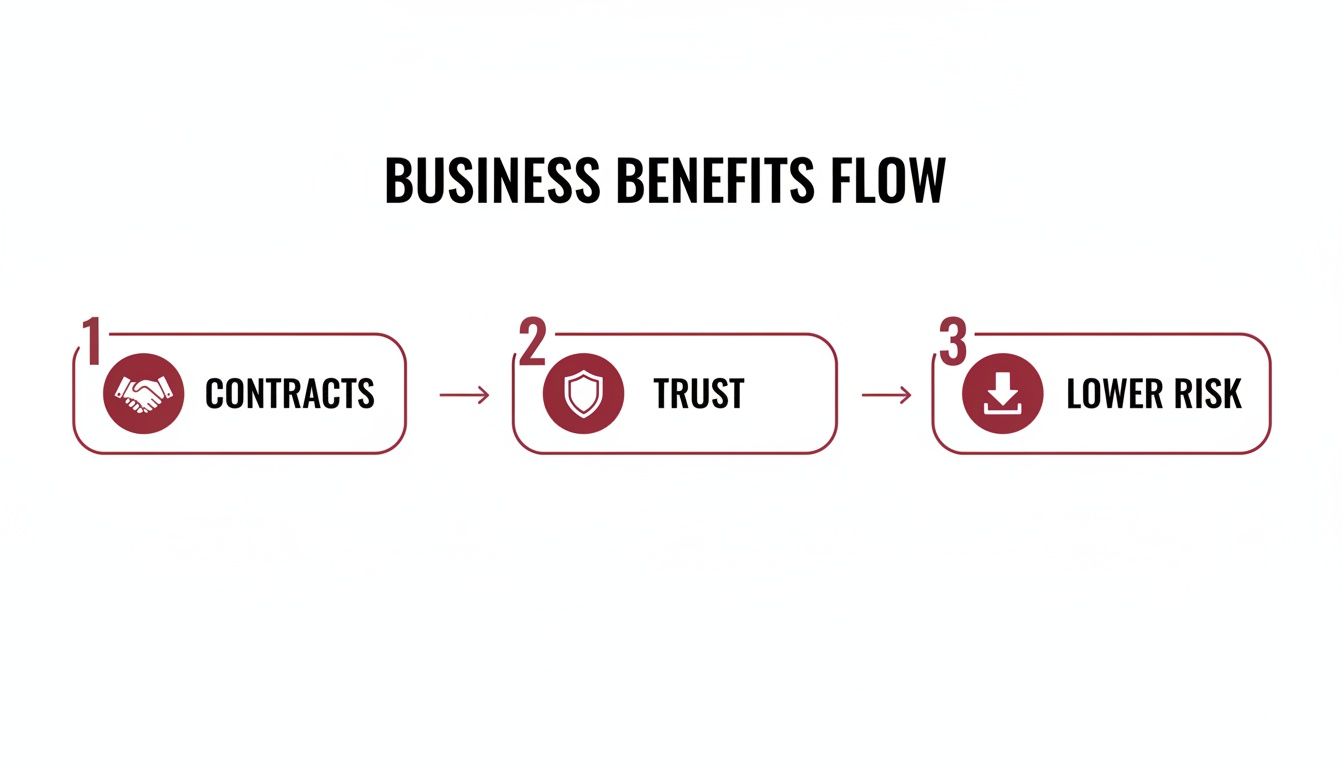
As you can see, a structured ISO approach doesn't just tick a compliance box. It delivers real business benefits by securing contracts, building customer trust, and ultimately, lowering your risk profile.
Phase 5: Achieving Certification
This is the final step: the external certification audit. You’ll hire an accredited certification body, and they will send an auditor to formally assess your ISMS. This usually happens in two stages.
- Stage 1 Audit: The auditor first reviews all your documentation. They're checking to see if your ISMS design meets the standard's requirements on paper. This includes your scope statement, risk assessment, Statement of Applicability, and key policies.
- Stage 2 Audit: The auditor then comes back to verify that you're actually following your own policies and procedures in the real world. They'll gather evidence through interviews, observations, and by reviewing records. This is a much deeper dive to confirm that the ISMS is truly operational.
If you pass both stages, congratulations—you'll be recommended for certification! This entire roadmap, from that initial planning meeting to the final audit, is a journey that systematically strengthens your security posture. To get ready, take a look at our detailed post on your guide to ISO 27001 implementation in Australia for more practical advice.
Busting the Biggest Myths About ISO Cyber Security
Let's be honest, the world of ISO cyber security can feel a bit intimidating. For many, it brings to mind a confusing maze of rules and regulations, distorted by myths that make the whole thing seem impossible. These misconceptions often stop businesses—especially smaller ones—from even looking into a powerful framework like ISO 27001.
It’s time to set the record straight. We’re going to tackle these common myths head-on, replacing fiction with fact. You’ll see that this standard is far more practical, accessible, and valuable than you might think. By busting these myths, we can clear the path to a more secure and resilient future for your business.
Myth 1: ISO 27001 Is Only for Big Corporations
This is probably the most damaging myth out there. When people hear "ISO 27001," they often picture huge multinational corporations with entire floors of staff dedicated to compliance. That picture couldn't be more wrong. The standard is explicitly designed for scalability and applicability to organizations of all sizes and types.
The standard was deliberately designed to be flexible. It isn’t a rigid, one-size-fits-all checklist. Instead, everything hinges on your own risk assessment. You identify the specific cyber security risks your business faces, then you choose the controls from Annex A that make sense for you.
Think about it: a small e-commerce startup has completely different security needs from a major bank. ISO 27001 gets this. It lets the startup build a tailored, manageable security system that protects its most important assets, without the crushing overhead a big corporation would need.
This scalability makes ISO cyber security a perfect fit for small and medium-sized businesses (SMEs). You get to define the scope, assess your unique risks, and build an Information Security Management System (ISMS) that actually works for your size, your budget, and your goals. An SME might have a much smaller scope and implement fewer, more targeted controls, making the entire process achievable and cost-effective.
Myth 2: It’s Just an IT Problem
This one is a classic. Many people assume ISO 27001 is a technical beast that you can just hand off to the IT department to sort out. In reality, that’s a recipe for failure. The standard calls for a holistic approach that weaves security into the very fabric of your entire organisation. Information security is everyone's responsibility.
For example, Clause 5 makes it crystal clear that top management has to show leadership and commitment. This turns security into a core business function, not just a task for the tech team. It’s also about your people. Clause 7 focuses on awareness and training for all relevant staff, not just the IT crew. The controls in Annex A cover everything from human resources (A.7) and physical security (A.11) to how you manage suppliers (A.15).
The best security systems are championed from the top down and embraced by everyone. ISO 27001 is fundamentally a business management standard, just applied to information security. For more on this, check out these insights on ISO 27001 compliance in Australia.
This company-wide focus is one of its biggest strengths. Here’s how different teams get involved:
- Human Resources: Plays a vital part in security during hiring and when an employee leaves.
- Finance: Manages the security budget and understands the financial fallout of a potential breach.
- Legal: Makes sure the ISMS aligns with laws like the Notifiable Data Breaches (NDB) scheme.
- Leadership: Provides the vision, resources, and unwavering support needed to make it all work.
Saying ISO 27001 is "just for IT" is like saying a building’s safety is only the architect’s problem. Everyone, from the builders to the people living inside, has a role to play.
Myth 3: Certification Is Just a Piece of Paper
It's tempting to see any certification as just a box-ticking exercise—something you get, hang on the wall, and promptly forget. But if you see ISO 27001 this way, you're missing the entire point. The certificate is the proof, but the real gold is in the journey and the system you create. The true value lies in the operational discipline and improved security posture that results from the process.
The standard is built on the "Plan-Do-Check-Act" (PDCA) cycle, a blueprint for continuous improvement. This means your ISMS isn’t a one-and-done project. It’s a living, breathing system that you constantly monitor, review, and make better over time. This ongoing commitment is what separates truly secure organizations from those who are merely compliant on paper.
So, what does that actually do for your business?
- Real Security Gains: The process forces you to find and fix vulnerabilities you probably never even knew you had.
- Tougher Operations: By formalising how you respond to incidents, you make sure your business can take a hit and get back on its feet faster.
- A Security-First Culture: Ongoing training and communication make security-conscious thinking second nature for your whole team, which drastically cuts down on human error.
Sure, the certificate is great for showing clients and partners you’re serious about security. But the management system itself is the engine that drives real, lasting improvements. It transforms security from a nagging cost centre into a powerful strategic advantage.
Got Questions About ISO 27001? We Have Answers.
Thinking about getting your business ISO 27001 certified is a big step, and it’s natural to have questions. Business leaders want straight answers, not jargon. Let's tackle some of the most common things people ask when they start exploring this powerful iso cyber security standard in Australia.
How Long Will It Take to Get Certified?
There’s no single answer here, but for most small to medium-sized Australian businesses, you’re typically looking at a timeframe of six to twelve months. This timeline covers the entire journey from initial gap analysis to the final certification audit.
What pushes you to one end of that scale or the other? Well, if you already have some decent security policies in place and a leadership team that's really driving the process, you could be on the faster side. On the other hand, a larger company starting from absolute zero will need more time to build its Information Security Management System (ISMS) from the ground up. The complexity of the scope, the availability of internal resources, and the level of executive commitment are all major factors influencing the timeline.
What’s the Real Cost in Australia?
The price tag for certification isn't just one number; it's a mix of a few different things. You've got to think about consultancy fees, the cost of the actual external audit, and any money you might need to spend on new security software or getting your team trained up.
For a small Aussie business, the total investment can be anywhere from $25,000 to over $60,000. It all depends on how complex your business is and how much help you need. The key is to stop thinking of it as a cost and see it for what it is: a strategic investment in your company’s future and its ability to weather a storm. When you consider the average cost of a data breach, this investment in prevention is highly justifiable.
Do We Really Need to Hire a Consultant?
Look, you could try to do it all yourself, but I wouldn't recommend it. It's a tough road to walk alone. A good ISO 27001 consultant brings a wealth of experience to the table, helping you sidestep common mistakes and making the whole process move a lot faster. They have been through the process many times and know what auditors are looking for.
A good consultant is like a guide on a tough hike. They know the trail, can read the map, and can translate the complex language of the standard into practical, actionable steps that actually make sense for your business. They stop you from wasting time and money on things you don't need, focusing your energy where it counts.
Bringing in an expert often saves you money in the long run. They know what it takes to pass the audit the first time, avoiding costly re-dos. Their expertise can dramatically accelerate the implementation timeline and increase the likelihood of a successful certification outcome.
We’re Certified! Now What?
Getting that certificate is a huge win, but it’s the beginning, not the end. Your certification is a living thing. To keep it, you need to show that you're continually keeping your ISMS sharp and effective. Compliance is not a one-time event; it's a continuous state.
This means a few things are now part of your regular business rhythm:
- Annual Surveillance Audits: Your certification body will drop in for regular check-ups to make sure your ISMS is still humming along and doing its job. These are less intensive than the initial audit but are mandatory to maintain certification.
- Ongoing Monitoring: You’ll need to keep up with internal audits, management reviews, and regular risk assessments. It's all about staying vigilant.
- Recertification: Every three years, you'll go through a full recertification audit to renew your certificate.
This cycle of continuous improvement ensures the iso cyber security framework doesn't just sit on a shelf. It becomes woven into the fabric of your organisation, helping you adapt as new threats emerge. It guarantees that your investment continues to pay dividends in the form of a strong, adaptive security posture.
Ready to build a more secure and competitive business with ISO 27001? The experts at Anitech simplify the entire certification process, providing tailored guidance every step of the way. Discover how our proven approach can help you achieve your security goals at https://iso-27001.com.au.
Recent Comments