

Quick Summary:
An ISO/IEC 27001 ISMS is a strategic framework for managing and protecting your company's information assets. This guide explains what an Information Security Management System (ISMS) entails, how the ISO 27001 standard provides the blueprint, and why certification is crucial for business growth, client trust, and operational resilience.
At its core, an ISO/IEC 27001 ISMS is the central command for your company's information security. Think of it as a comprehensive game plan, not just a random collection of security tools. It's a structured system designed to protect sensitive data, earn client trust, and keep you on the right side of regulatory requirements.
Let's cut through the jargon. We’ll break down what an Information Security Management System (ISMS) really is, and how it’s a world away from the usual reactive, band-aid approach to security. You'll see how ISO/IEC 27001 provides the blueprint for this system, turning a complex topic into a clear advantage for Australian businesses.
Essentially, an ISO/IEC 27001 ISMS is a strategic framework that pulls all your security efforts together. It establishes the policies, processes, and controls you need to systematically manage and safeguard your company's most valuable information, making sure it remains confidential, intact, and accessible. This isn't just an IT job; it's a fundamental part of running a smart, modern business.
Your Digital Fortress: A Practical Look at an ISO/IEC 27001 ISMS
Imagine your business is a castle. Inside, you're holding priceless treasures—customer data, financial records, and your unique intellectual property. An Information Security Management System (ISMS) is your entire defence plan for that castle.
It’s far more than just building a high wall (your firewall) or posting a few guards at the gate (antivirus software). A proper ISMS means knowing your potential attackers, finding the weak spots in your defences, and making sure everyone inside the castle walls knows exactly what to do when a threat appears.
Beyond Ad-Hoc Security Measures
So many Australian businesses are still stuck with a patchwork of security tools that don't talk to each other. You might have a password policy here, a backup system there, and some staff training over there, but these pieces often exist in their own little bubbles. This disjointed approach leaves gaps that cybercriminals are experts at finding.
An ISO/IEC 27001 ISMS completely flips this script from reactive to proactive. Instead of frantically trying to patch a hole after you've been attacked, you build a robust system designed to stop threats before they even get close.
This methodical way of thinking involves:
- Context and Stakeholders: Figuring out who cares about your data security—be it clients, regulators, or partners—and what they expect from you.
- Leadership Commitment: Making sure security is a priority in the boardroom, not just a task for the IT team.
- Risk Assessment: Proactively looking for potential threats to your information and ranking them by how much damage they could do.
- Continuous Improvement: Treating security as a living thing, constantly reviewing and tweaking your defences to handle new threats and business needs.
The Blueprint: ISO IEC 27001
If the ISMS is your defence strategy, then the ISO/IEC 27001 standard is the internationally respected blueprint for putting it all together. It doesn’t dictate which brand of firewall you must buy. Instead, it gives you a proven framework of requirements to ensure your security system is thorough, effective, and always getting better.
The table below breaks down the core components of this blueprint, showing how each piece contributes to your overall digital fortress.
| Core Components of an ISO IEC 27001 ISMS | ||
|---|---|---|
| Component | Description | Example in Practice |
| Information Security Policies | The high-level rules and direction for information security, formally approved by management. | Creating a company-wide "Acceptable Use Policy" that clearly outlines how employees can use company devices and networks. |
| Risk Assessment & Treatment | A formal process to identify, analyse, and evaluate information security risks, and then select controls to manage them. | Identifying the risk of a phishing attack and implementing mandatory staff training, email filtering, and a clear incident response plan. |
| Asset Management | The process of identifying all your information assets (data, software, hardware) and assigning ownership. | Maintaining an up-to-date register of all company laptops, specifying who is responsible for each one and the data it holds. |
| Access Control | Rules and mechanisms to ensure users only have access to the information and systems they absolutely need to do their job. | Implementing a "least privilege" policy where a new marketing team member can access marketing files but not financial records. |
| Operations Security | Procedures to protect systems and data during day-to-day operations, including malware protection and backups. | Establishing an automated daily backup schedule for all critical servers, with regular tests to ensure the backups can be restored. |
| Continuous Improvement | An ongoing cycle of monitoring, reviewing, maintaining, and improving the ISMS to adapt to new threats and business goals. | Holding quarterly security review meetings to analyse any recent incidents, review performance metrics, and update security controls. |
As you can see, each component plays a specific role, but they all work together to create a cohesive and resilient security posture.
An ISMS built on ISO/IEC 27001 isn't a one-off project; it’s an ongoing commitment to risk management that gets woven into your company's DNA. It sends a powerful message to clients and partners: we take protecting your information seriously.
By following this standard, you're not just ticking compliance boxes. You're building a stronger, more resilient business that can turn security from a headache into a real competitive advantage. To get into the nitty-gritty, you can learn more about how Information Security Management Systems work in practice.
Why Your Business Needs an ISO/IEC 27001 ISMS
Not too long ago, getting ISO 27001 certified might have seemed like a box-ticking exercise for the big end of town. For Australian small and medium-sized businesses today? It’s become a crucial tool for survival and growth. An ISO/IEC 27001 ISMS isn't just about compliance anymore; it’s a powerful engine for winning business.
This isn't just a minor shift—it's a fundamental change in how business is done. Data security is now front and centre in every commercial conversation, from government tenders to supply chain partnerships. Ignoring this reality is like willingly leaving money on the table.

Unlocking High-Value Contracts and Tenders
For many Aussie businesses, the clearest motivation for getting ISO 27001 certified is simple: it opens doors to new revenue. Government departments and large corporate clients are now frequently making certification a non-negotiable requirement for even getting a foot in the door.
Without it, your tender might be dead on arrival, no matter how good your product or service is. This is particularly true if you operate in sectors like finance, healthcare, professional services, or technology where sensitive information is the lifeblood of your work.
This creates a very real dividing line in the market. On one side, you have businesses with a certified ISO/IEC 27001 ISMS who can compete for those lucrative contracts. On the other, you have everyone else locked out. It’s a game-changer that allows smaller, security-savvy firms to go toe-to-toe with established giants.
The demand is only growing. Globally, the certification market is expected to jump from $16.14 billion in 2024 to an incredible $66.25 billion by 2034. This surge shows just how urgent this is becoming, especially here in Australia where cyber threats are a constant headline. You can find more insights on this growing demand and what it means for local businesses.
Building Unbreakable Client Trust
In an era of daily data breach notifications, trust has become your most valuable asset. Your clients are smarter and more cautious than ever about who they hand their data over to. A simple promise to "keep it safe" just doesn't cut it anymore. They want proof.
ISO 27001 certification is that proof. It's an independent, globally-recognised stamp of approval that shows you’re serious about information security. It immediately tells clients, both current and potential, that you have a robust, risk-based system for protecting their most critical assets.
This verifiable trust is a massive competitive advantage. It shifts the conversation from, "Can we trust you with our data?" to "We see you're certified, let's talk business." That shift can be the single factor that closes the deal.
This commitment to security pays off in very real ways:
- Boosts Client Confidence: Certification gives clients peace of mind, assuring them their data is managed according to world-class standards.
- Enhances Your Reputation: Publicly committing to security positions you as a responsible, trustworthy partner, strengthening your brand in the market.
- Cuts Down on Client Audits: Many clients will accept your ISO 27001 certificate instead of running their own time-consuming security audits, saving everyone a lot of hassle.
Driving Internal Excellence and Resilience
Beyond winning new work, implementing an ISO/IEC 27001 ISMS forces you to take a good, hard look in the mirror. The process shines a light on operational weaknesses and inefficient processes you probably didn't even know you had.
It helps your whole organisation mature from a reactive, "firefighting" mentality to a proactive, risk-aware culture. Suddenly, everyone from the leadership team to the front desk understands their role in protecting the business's information.
This structured approach leads to tangible improvements inside your business:
- Sharper Processes: By defining clear policies and procedures, you get rid of guesswork and make your operations more consistent and efficient.
- Minimised Incident Damage: Having a formal incident response plan means you can act faster and more effectively when something does go wrong, reducing the financial and reputational fallout.
- A True Security Culture: Security stops being "just an IT problem" and becomes everyone's responsibility—the single most effective defence against threats like phishing attacks.
At the end of the day, an ISO/IEC 27001 ISMS makes your business stronger, more efficient, and far better equipped to handle the challenges of a modern economy.
Getting to Grips With the Core of ISO/IEC 27001
At first glance, the ISO/IEC 27001 standard can seem a bit overwhelming. But when you peel back the layers, it’s actually built on a very logical foundation. The whole framework is propped up by two main pillars: the core management system clauses (Clauses 4-10) and a comprehensive list of security controls found in Annex A.
Think of it like building a house. The management clauses are your architectural blueprints – they define the structure, the process, and the ongoing maintenance plan. Annex A is your catalogue of fittings and fixtures – the specific locks, alarms, and firewalls you choose to install based on the unique risks to your property. Together, they create a complete, robust ISO/IEC 27001 ISMS.
The Engine Room: Clauses 4 to 10
The real heart of your ISO/IEC 27001 ISMS lies in seven mandatory clauses. These aren't just a checklist to be ticked off once; they form a continuous cycle of planning, doing, checking, and acting that keeps your security relevant and effective. It’s what turns security from a one-off project into a living, breathing part of your business culture.
Let's quickly break down what these clauses actually ask you to do in the real world.
ISO 27001 Clauses 4-10 Explained
Here’s a simplified table to help you understand the purpose of each management clause and what it means for your business on a practical level.
| Clause | Purpose | What It Means for Your Business |
|---|---|---|
| Clause 4: Context of the Organisation | To understand your unique business landscape. | You need to figure out who cares about your data security (clients, regulators) and decide what parts of your business the ISMS will cover. |
| Clause 5: Leadership | To secure genuine buy-in from the top. | Your management team must actively lead the charge, creating the security policy and making sure the right people and funds are available. |
| Clause 6: Planning | To create a clear strategy for managing risks. | This is where you conduct a formal risk assessment to find your weaknesses and then create a solid plan to address them. |
| Clause 7: Support | To ensure you have the necessary resources. | It’s about making sure your team is trained, aware of their responsibilities, and that all the necessary documentation is in place. |
| Clause 8: Operation | To put your security plans into action. | This is the "doing" phase. You roll out the controls and processes from your risk plan to manage security threats day-to-day. |
| Clause 9: Performance Evaluation | To check if your security measures are working. | You have to constantly monitor and measure how well you're doing, usually through internal audits and formal management reviews. |
| Clause 10: Improvement | To continuously get better. | Security is never "done." This clause ensures you’re always fixing issues and adapting to new threats and business changes. |
As you can see, these clauses provide the 'why' and 'how' for your security program, ensuring it remains aligned with your business goals from start to finish.
Your Toolkit: Unpacking the Annex A Controls
Annex A is your practical toolkit. The latest 2022 version of the standard lists 93 security controls, but don't panic – you don't have to implement every single one. That would be inefficient and costly.
Instead, your risk assessment will point you to the controls that are genuinely relevant to protecting your business. It's about a tailored fit, not a one-size-fits-all approach. These controls are neatly sorted into four themes:
- Organisational Controls (37 controls): The foundational policies and processes, like how you manage your assets or classify sensitive information.
- People Controls (8 controls): All about the human element, from security awareness training to setting clear rules for remote working.
- Physical Controls (14 controls): Protecting your tangible assets – think secure offices, locked server rooms, and visitor access policies.
- Technological Controls (34 controls): The tech-heavy hitters, such as access control systems, encryption, and network security measures.
Having a well-structured ISMS doesn't just protect you from hackers; it’s also a massive help in meeting your legal duties. For any Aussie business with European customers, this structure directly supports your GDPR compliance requirements by ensuring personal data is handled with care.
The Mandatory Switch to ISO/IEC 27001:2022
It's absolutely critical for Australian businesses to know that the standard has been updated. The old 2013 version is out, and ISO/IEC 27001:2022 is in. The new version is much more modern, with consolidated controls and a stronger focus on today's cyber threats.
For businesses that are already certified, this isn't just a friendly suggestion—it's mandatory. All existing certifications must be transitioned to the new 2022 framework to stay valid.
This means you’ll need to revisit your risk assessment, update your Statement of Applicability (the formal document explaining your control choices), and make sure your entire ISMS is in line with the new structure.
There’s a non-negotiable deadline for this. Any Australian business still on the old standard must transition to ISO/IEC 27001:2022 by 31 October 2025, or their certification will be withdrawn. With this foundation, you now have a much clearer picture of what the standard really involves.
Your Roadmap to ISO/IEC 27001 Certification
Getting certified for ISO/IEC 27001 might feel like a huge undertaking, but it’s more of a structured journey than a frantic sprint. For small and medium Australian businesses, the key is to break it down into clear, manageable steps. Think of it as a roadmap that turns a complex goal into a series of achievable milestones, building a system that’s not just compliant, but genuinely protects your business.
The whole process kicks off not with tech, but with people. The very first—and most crucial—step is getting your leadership team on board. This isn't just another IT project; it's a strategic business decision. Management needs to fully grasp this, committing the necessary resources, time, and active support to see it through.
This diagram shows how an ISMS works as a continuous cycle. It's not a one-and-done project but a constant process of understanding your environment, setting your strategy, and assessing how you're doing.
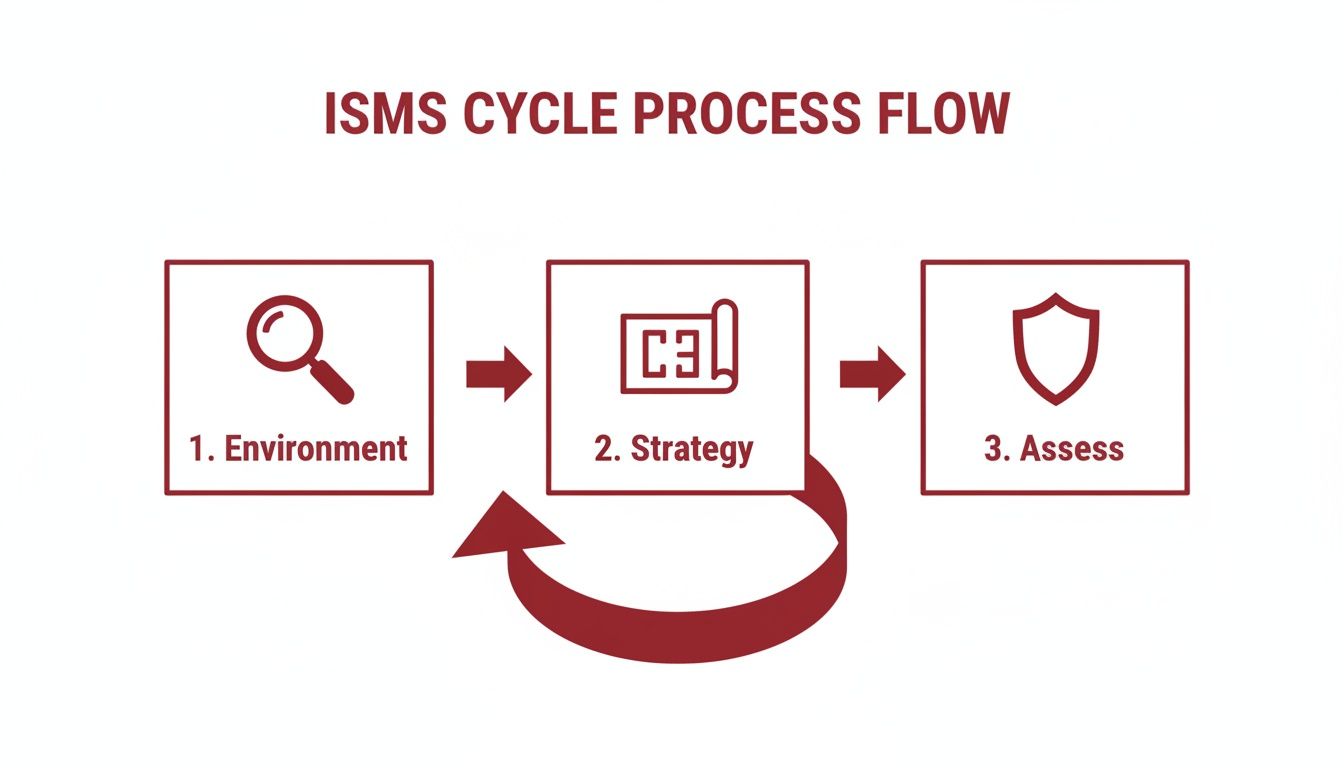
This ongoing commitment to improvement is what makes an ISMS so powerful.
Phase 1: Scoping And Risk Assessment
With leadership backing you, the first real task is to define the scope of your ISMS. What exactly are you trying to protect? You need to decide if the ISMS will cover the entire organisation or just a specific department, a single location, or a particular service you offer. Nailing down a clear scope early on prevents the project from spiralling out of control.
Once you know your boundaries, you dive into the risk assessment. This is the heart of your entire ISMS. You’ll systematically identify what could go wrong with your information, analyse your weak spots, and figure out the real-world impact if a security breach happened. This isn’t about fixing everything at once; it’s about smartly prioritising your efforts on the biggest threats first.
Phase 2: Documentation And Control Implementation
After you've identified your risks, it's time to build the core documents for your ISMS. The most important one is the Statement of Applicability (SoA). This is essentially your master list of all the Annex A controls, where you formally declare which ones you're using and, just as importantly, justify why you've chosen to include or exclude each one.
Then comes the hands-on part: implementing the controls. Guided by your risk plan and the SoA, you'll start putting your security measures into action. This can involve a whole range of activities, like:
- Writing a new access control policy that makes sense for your team.
- Rolling out encryption for your most sensitive customer data.
- Running security awareness training so your staff can spot a phishing email.
- Beefing up the physical security around your server room.
This is often the most demanding phase, so solid project management is a must. It's also a good time to get some expert advice on who leads your ISO 27001 prep to make sure someone is steering the ship.
An ISMS is built on evidence. As you implement your controls, you have to meticulously document everything—your policies, procedures, and day-to-day processes. When the auditors arrive, they need to see not just what you do, but proof of how you do it, all formally written down.
For a closer look at what this stage involves, our detailed guide on ISO 27001 implementation breaks it down even further.
Phase 3: Internal Audit And Certification
Before you call in the external auditors, you need to run an internal audit. Think of it as a full dress rehearsal. An impartial internal auditor (or a consultant) will review your entire ISMS against the ISO 27001 standard, pointing out any gaps or areas that need work. This is your chance to fix things before the main event.
Finally, it’s time to engage an accredited certification body for the external audit. This happens in two stages:
- Stage 1 Audit: This is primarily a documentation review. The auditor checks your key documents, like the SoA and risk assessment, to make sure you’re ready for the deep dive.
- Stage 2 Audit: Now the auditor comes on-site. They’ll interview your team, look at your records, and watch your controls in action to confirm that your ISMS is fully operational and effective.
Once you successfully pass the Stage 2 audit, congratulations are in order—you’ll be awarded your ISO/IEC 27001 certification.
Common Pitfalls on Your Certification Journey
Getting your business certified for ISO/IEC 27001 is a fantastic move, but the road to get there is often littered with traps that can trip up even the most well-intentioned teams. I’ve seen it time and again: companies eager to get the certificate stumble over the same hurdles. Knowing what these are from the get-go is the best way to keep your project on track and actually see a return on your investment.
One of the biggest mistakes is treating certification as a one-off IT project. That mindset is a one-way ticket to failure. An ISMS isn't a piece of software you just install and then forget about. It's a deep-seated change in how your business thinks about and manages information risk, and it needs everyone on board—not just the tech crew.
Mismanaging the Scope and Commitment
The first major challenge usually pops up right at the beginning: poor scoping. Figuring out the boundaries of your ISMS is a real balancing act. If you go too broad, you’ll be stuck in a long, expensive, and ridiculously complicated implementation. But if you make it too narrow, you might miss critical parts of your business, which cheapens the value of the certification itself.
Just as damaging is when management isn't truly behind it. Without real, visible support from the top, the project will constantly fight for resources and attention. If leadership sees it as just another compliance box to tick, the whole thing loses steam, and your staff will never get on board with the cultural shift required.
The success of an ISMS hinges on it being a strategic business initiative, not just a technical task. If the leadership team isn't championing the cause, the entire framework is built on a shaky foundation.
Creating 'Shelf-ware' Instead of a Living System
Another classic blunder is creating 'shelf-ware'. You know what I mean—beautifully written policies and procedures that look great but just sit on a shelf (or in a digital folder), completely ignored in the day-to-day running of the business. This usually happens when people rush the process or grab generic templates without thinking about how their business actually works.
Auditors can spot this from a mile away. They don’t just read your documents; they test your controls and talk to your people to see if what’s on paper matches reality. A system that only exists in a binder will quickly rack up non-conformities and lead to a failed audit.
- The Documentation Trap: Don’t fall into the trap of creating massive documents that no one will ever read. The goal is real, effective security, not just a set of thick binders.
- Ignoring the Human Element: Never underestimate the importance of training. Your employees are your first line of defence. If they aren't trained on the new policies, the best security tech in the world won’t save you.
A properly implemented ISMS should be a living, breathing part of your company culture. To get a better feel for what auditors are really looking for, it’s worth understanding the specifics of a formal ISO 27001 audit. By side-stepping these common mistakes, you can turn your certification journey from a massive headache into a genuinely valuable business improvement.
Your ISO 27001 Questions, Answered
Thinking about getting your business ISO/IEC 27001 ISMS certified? It’s a big step, and naturally, it brings up a lot of practical questions. How long will it take? What’s the real cost? Is it even right for my business?
We get it. As consultants, we hear these questions from Australian business leaders every day. Let's cut through the noise and give you some straight, honest answers to help you plan your next move with confidence.
How Long Does It Take to Get ISO 27001 Certified?
There’s no single answer here, but for a typical small or medium-sized Aussie business, you're generally looking at a timeline of three to nine months.
What makes the difference? It really boils down to three things: the size of your business, how complex your operations are, and where your security measures stand right now.
If you’ve already got some solid processes in place, you’ll be on the faster end of that scale. If you’re building your security framework from the ground up, it will naturally take a bit longer. The journey always involves a few key stages:
- The Initial Check-Up: We call this a Gap Analysis, where we see how your current setup stacks up against the standard.
- Risk Assessment: Figuring out what your biggest information security threats are and making a solid plan to tackle them.
- Putting Controls in Place: This is the hands-on part—implementing the policies, procedures, and tech needed to protect your data.
- The Dress Rehearsal: An internal audit to find and fix any issues before the official auditors walk in.
- The Main Event: The formal Stage 1 and Stage 2 audits with an accredited certification body.
A word of advice: don't rush it. Trying to fast-track certification often results in a system that’s just a pile of documents on a shelf—something that looks good on paper but crumbles under real scrutiny. Taking the time to do it right, with genuine buy-in from your leadership, is what makes it stick.
What Is the Difference Between ISO 27001 Certification and Compliance?
This is a big one, and the distinction is crucial. People often use these terms interchangeably, but they mean very different things when it comes to your ISO/IEC 27001 ISMS.
Compliance is something you do internally. It means you’ve adopted the ISO 27001 framework, you’re conducting risk assessments, and you’re using the controls. You’re essentially operating in line with the standard.
Certification, however, is the external proof. It’s when an independent, accredited auditor comes in, puts your entire system under the microscope, and officially confirms that you meet every single requirement of the standard.
Think of it this way: compliance is you saying you’re a great driver. Certification is the driver’s licence that proves it. It's the tangible evidence that instantly tells clients, partners, and regulators that you’re serious about security.
For many Australian businesses, that proof is what opens doors. It’s the certification that gets you past the gatekeepers for government tenders and big enterprise contracts, giving you a serious edge over the competition.
Is ISO 27001 Only for Large Tech Companies?
Absolutely not. This is probably the most common myth we have to bust. The ISO/IEC 27001 ISMS standard was brilliantly designed to be flexible. It scales up or down to fit any organisation, no matter its size or what industry it’s in.
Sure, it has its roots in tech, but the core ideas of managing risk and continuously improving are universal. We’re seeing a huge uptake across all sorts of sectors in Australia.
Just think about who handles sensitive information:
- Professional Services: Lawyers, accountants, and consultants with confidential client files.
- Healthcare Providers: Clinics and specialists who are guardians of private health records.
- Financial Services: Fintechs, brokers, and advisors handling people's financial data.
- Managed Service Providers (MSPs): Any company looking after the IT systems of other businesses.
The trick for a smaller business is to tailor the standard. It doesn’t expect you to build a fortress like a big bank. It asks you to implement controls that are right for your business and your risks. This is what makes it such a powerful and achievable goal for SMBs wanting to protect what they’ve built.
How Much Does ISO 27001 Certification Cost for a Small Business?
There’s no simple price tag, as the cost is really a mix of a few key things. It’s better to think of it not as a cost, but as an investment in your company’s future resilience and growth.
For a small Australian business, the main components of this investment are:
- Expert Guidance: The fees for consultants (like us!) to steer you through the entire process, from start to finish.
- Your Team's Time: The hours your staff will need to put in to help develop documents, implement new processes, and be part of the audits.
- New Tools or Tech: You might need to invest in some software or hardware to plug a security gap, like better encryption or monitoring tools.
- The Auditors' Fees: The cost for the certification body to conduct the formal Stage 1, Stage 2, and ongoing yearly check-up audits.
And the return on that investment? It comes back to you by helping you win contracts you couldn’t bid for before, building unbreakable trust with your clients, and—most importantly—dodging the catastrophic financial and reputational hit of a data breach. A smart, consultant-led approach makes sure you only spend where you need to, getting the maximum value for every dollar.
Ready to turn information security into your competitive advantage? At Anitech, we specialise in guiding Australian small businesses through the ISO 27001 certification process with a 100% success rate. Contact us today to start building your digital fortress.
Recent Comments