

In today's fiercely competitive global marketplace, organizations are constantly seeking ways to enhance their operational efficiency, ensure product and service quality, and build unshakable trust with their clients. This is the world of ISO professionals. These specialists are far more than mere compliance officers; they are strategic architects who translate internationally recognized standards into powerful business advantages. They guide companies through the intricate process of implementing robust management systems for quality, safety, security, and environmental responsibility. By embedding these global benchmarks into the very DNA of a business, they don't just help you meet the standard—they help you set a new one, creating a resilient, efficient, and market-leading organization. This comprehensive guide will explore the multifaceted role of ISO professionals, the critical standards they master, and how they drive tangible business excellence.
Why ISO Professionals Are Your Business's Secret Weapon
Imagine trying to navigate the treacherous waters of international commerce without a seasoned captain who knows the charts, understands the weather patterns, and can command the crew. Running a modern business without the guidance of an ISO professional can feel strikingly similar. You might possess an exceptional team, a groundbreaking product, and ambitious goals, but without an expert to instill strategic discipline and process integrity, you are essentially leaving your long-term success to chance.
This is precisely where ISO professionals step in. They are the seasoned captains of industry, the specialist coaches who transform potential into performance. Their work is not about creating a rigid bureaucracy or enforcing rules for the sake of rules. It is about fundamentally strengthening the business from its core. They take the complex, and sometimes intimidating, language of ISO standards—the universally accepted rulebook for operational excellence and customer trust—and translate it into a clear, actionable, and winning strategy for your company. They build systems that are not only compliant but are also custom-fit to your unique operational realities, ensuring that quality, safety, and efficiency become a natural, integrated part of your daily workflow.
The Coach for Your Championship Team
Visualize your business as a high-performance athletic team competing at the highest level. The league is tough, the competition is relentless, customer expectations are constantly evolving, and unforeseen risks can emerge at any moment. In this high-stakes environment, an ISO professional serves as your head coach, equipped with a proven playbook: the comprehensive suite of ISO standards. Their job is to elevate your team's performance from amateur to elite, building the discipline, coordination, and strategic foresight needed to win.
They achieve this by executing a clear, methodical game plan:
- Analysing Your Current Game Plan: The process begins with a deep, comprehensive diagnostic review. They conduct a thorough gap analysis to meticulously examine your existing processes, procedures, and workflows, identifying both inherent strengths and critical weaknesses.
- Designing Winning Strategies: Armed with this analysis, they architect robust management systems. These systems are designed to eliminate operational waste, streamline complex workflows, reduce errors, and ensure that every output, whether a product or a service, is delivered with consistent, predictable excellence.
- Ensuring Everyone Knows the Rules: A brilliant strategy is useless if the team doesn’t understand it. ISO professionals are exceptional trainers and communicators, ensuring that every single person in the organization, from the C-suite to the front line, understands their role and responsibilities within the new framework.
- Preparing for the Big Match: They meticulously prepare your organization for the final certification audit. This involves conducting internal "scrimmages" (internal audits), refining processes based on feedback, and ensuring all documentation is in perfect order, allowing you to face the external auditor with total confidence.
This caliber of expert coaching transforms your business from a mere contender into a dominant force in its field. It fosters a pervasive culture of continuous improvement, where every employee is empowered and focused on delivering exceptional value. This cultural shift is one of the most profound benefits of ISO certification that a skilled professional can help you unlock, creating a sustainable competitive advantage.
Navigating a Growing Field of Play
The escalating demand for this specialized expertise is not a fleeting corporate trend; it represents a fundamental evolution in how modern, successful businesses operate. The global market for ISO certification services is experiencing explosive growth, particularly in the Asia Pacific region. To put this into perspective, the market in this region was valued at approximately USD 2.1 billion in 2021 and is projected to surge to USD 3.6 billion by 2025. This represents a remarkable compound annual growth rate (CAGR) of 13.2%. This data clearly indicates that businesses across Australia and the wider region are seriously investing in international standards to sharpen their competitive edge and operate on a global scale. For a more detailed analysis of this market trend, you can review the report available on cognitivemarketresearch.com.
What does this rapid market expansion signify for your business? It means the game is changing, and your competitors are likely already enlisting their own expert coaches. Engaging an ISO professional is no longer a discretionary luxury for large corporations; it has become a strategic necessity for any business aspiring to thrive, grow, and compete effectively.
By weaving international standards into the very fabric of your business, ISO professionals do far more than just get you ready for an audit. They instil the discipline, structure, and foresight you need to thrive for the long haul in a tough market.
Ultimately, these experts hold the key to unlocking your business’s true potential. They empower you to build a company that is not just compliant with a set of rules but is fundamentally more robust, efficient, secure, and prepared for the challenges and opportunities of the future. They are the secret weapon that can elevate a good business into a great one, creating a lasting legacy of quality, trust, and operational excellence that is truly built to last.
What Does an ISO Professional Actually Do?
Let's move beyond the abstract concepts and industry jargon to understand what an ISO professional truly does day-to-day to create tangible value within an organization. Their role is profoundly more significant than simply checking off items on a compliance checklist. Think of them as multifaceted business architects who take dense, technical standards and skillfully translate them into practical, efficient, and user-friendly processes. Their primary mission is not to satisfy an external auditor but to build internal capability, drive sustainable growth, and foster a culture of excellence.
To fully appreciate their impact, it's helpful to deconstruct their work into four distinct but interconnected core functions. Each role builds upon the last, forming a comprehensive approach that strengthens the organization from its strategic foundations to its daily operations.
The Strategic Advisor
First and foremost, a top-tier ISO professional acts as a high-level strategic advisor. Imagine them as a business cartographer, tasked with charting the most direct, efficient, and safest route for your company to achieve its long-term objectives. They don't arrive with a generic, one-size-fits-all map. Instead, they work alongside your leadership team to understand the specific terrain of your industry, identify potential obstacles and risks on the horizon, and collaboratively choose the optimal path forward.
This strategic journey begins with a meticulous gap analysis. They conduct a deep dive into your current operational state, holding up your processes, policies, and practices against the precise requirements of the relevant ISO standard. This critical exercise quickly illuminates areas where your organization already excels and, more importantly, pinpoints the specific gaps that need to be addressed. Their strategic guidance is invaluable at this stage, helping you prioritize actions and allocate resources effectively, ensuring that your efforts are focused where they will deliver the greatest impact on both compliance and your bottom line. A significant part of this strategic value lies in their expertise in risk management, a cornerstone of modern ISO standards. You can explore the depth of this discipline in guides on topics like effective software project risk management.
The System Architect
Once the strategic roadmap is clearly defined, the ISO professional transitions into the role of a system architect. In this phase, they design the detailed blueprint for your new management system—be it for quality, environmental management, safety, or information security. This is akin to a building architect designing a structure where every room, corridor, and structural element serves a specific purpose and integrates seamlessly into the whole. The ISO professional designs an operational system where every process, procedure, and workflow is logically connected, efficient, and aligned with your strategic goals.
Think of your business as a complex, high-performance engine. The ISO professional is the master engineer who determines how every component—the pistons, gears, fuel systems, and electronics—should interact to generate maximum power with minimum waste and optimal reliability. They are the ones who document clear procedures, define unambiguous roles and responsibilities, and create intuitive workflows that are not only fully compliant with the standard but also make practical sense to the people who will use them every day.
An effective ISO management system isn't some rigid set of rules forced onto a business. It's a custom-designed framework that weaves into your existing operations to make them better, turning quality and efficiency into a natural part of the workday.
This design phase is absolutely crucial to the success of the entire project. A well-architected system feels intuitive, empowering, and supportive to your team. Conversely, a poorly designed system feels like an oppressive layer of bureaucracy and red tape. The true artistry of a great ISO professional lies in their ability to create a system that liberates your team to do their best work, rather than restricting them.
This infographic beautifully illustrates how ISO professionals guide businesses through challenges to achieve success, transforming obstacles into opportunities for growth.
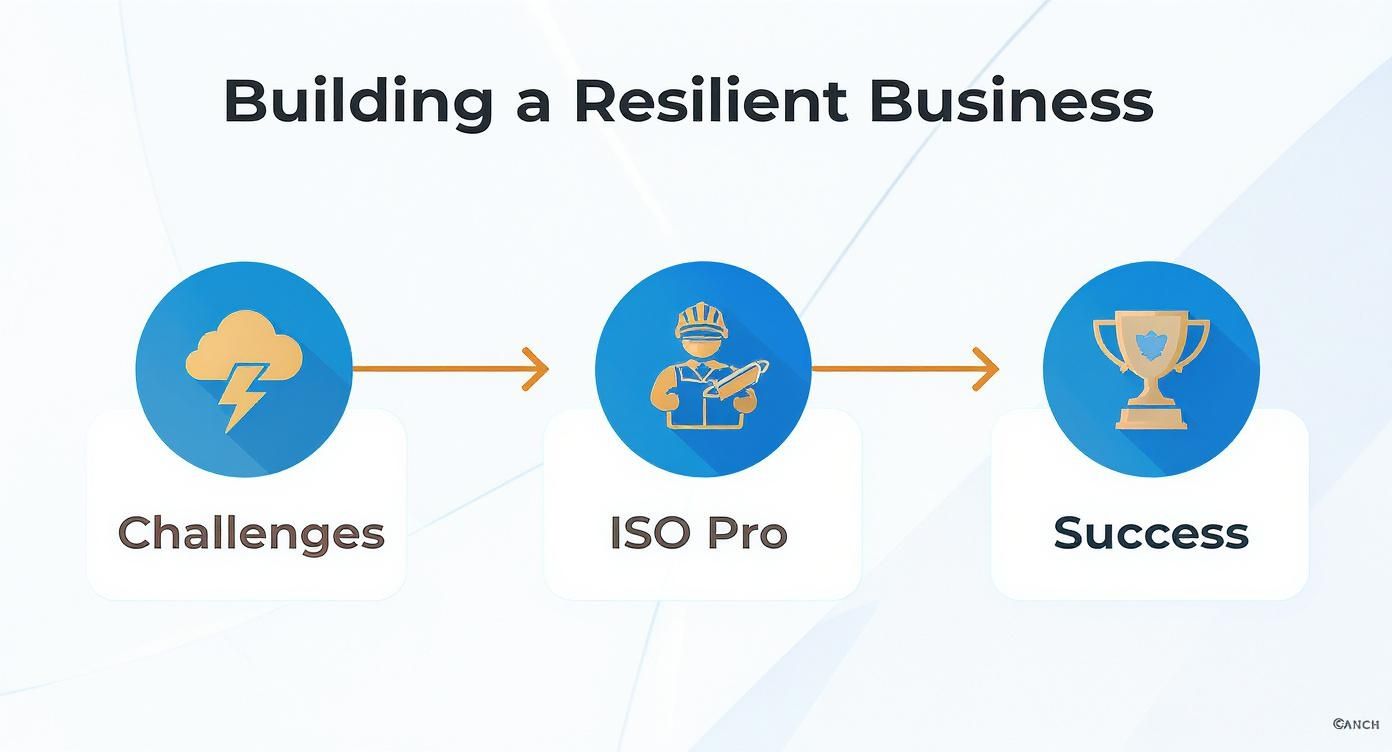
The journey from the storm cloud to the trophy really drives home that these experts aren't just fixing problems—they're strategic coaches who actively build a resilient and successful enterprise.
The Internal Auditor
With the new system designed, implemented, and operational, the ISO professional shifts into the critical role of an internal auditor. This function, however, is often misunderstood. It is not about policing, pointing fingers, or finding fault. Instead, it is a constructive process focused entirely on continuous improvement and system refinement. Think of them as a friendly mechanic performing regular, detailed tune-ups on that high-performance engine to ensure it continues to run at peak efficiency and reliability.
They conduct systematic internal audits to verify that the management system is:
- Operating as designed: Are employees consistently and correctly following the new documented processes and procedures?
- Achieving its intended results: Is the system actually delivering the desired outcomes, such as improved product quality, enhanced safety performance, or stronger data security?
- Still compliant with the standard: Have there been any changes within the business (or in the standard itself) that require the system to be updated or adjusted?
These internal audits provide an incredibly valuable feedback loop. They proactively identify areas of non-conformity, potential risks, or opportunities for improvement long before an external certification auditor ever sets foot in your facility. This proactive approach saves an immense amount of time, money, and stress, helping to ensure that the final certification audit is a smooth, predictable, and successful experience. It transforms the concept of auditing from a dreaded examination into a positive and powerful tool for organizational learning and growth.
The Team Trainer and Coach
Finally, and arguably the most critical role of all, an ISO professional is a dedicated trainer and coach. It’s a simple truth: you can have the most brilliantly designed system in the world, but it is utterly worthless if your team does not understand it, believe in it, or use it correctly. The professional’s job is to become a champion for the new system, building a genuine, sustainable culture of quality, safety, or security that permeates every level of the company.
This goes far beyond conducting a single, uninspired PowerPoint training session. A great ISO professional works tirelessly to achieve genuine buy-in from every stakeholder, from the CEO and senior leadership down to the newest front-line employee.
They accomplish this cultural shift by:
- Explaining the "Why": They clearly articulate how adhering to the ISO standard benefits not just the company as a whole, but also each individual employee in their specific role, making their job easier, safer, or more effective.
- Providing Practical Training: They deliver hands-on, role-specific guidance on the new processes, tools, and documentation, ensuring everyone feels confident and competent.
- Encouraging Ownership: They empower team members to take personal responsibility for quality and compliance within their own spheres of influence, fostering a sense of pride and accountability.
- Celebrating Successes: They recognize and celebrate progress, reinforcing positive behaviors and maintaining momentum throughout the implementation journey and beyond.
By acting as a dedicated coach, they help to embed the core principles of the ISO standard directly into your company's DNA. This is the crucial step that transforms compliance from a one-time project into an enduring, ongoing commitment to excellence. Through these four interconnected roles, an ISO professional provides end-to-end guidance for the entire certification journey—from initial strategic analysis and system design to the final audit and the culture of continuous improvement that follows—creating profound and lasting value at every step of the way.
The Essential Skills of an Expert ISO Professional
What is the defining difference between a standard, run-of-the-mill consultant and a truly transformative ISO professional? The distinction extends far beyond simply memorizing the clauses and sub-clauses of an ISO standard. The real magic, the element that drives profound business change, lies in their ability to translate that dense technical knowledge into tangible, measurable business results. They are masters at converting the perceived burden of compliance from a necessary cost center into a powerful, strategic engine for innovation, efficiency, and growth.
An elite ISO professional embodies a rare and valuable combination of skills: they are part technical wizard, part savvy business strategist, and part inspirational leader. They possess a unique blend of "hard" technical skills and "soft" interpersonal skills that allows them to not only design a technically flawless and compliant management system but, more importantly, to inspire and motivate your entire team to embrace it, own it, and make it work. Understanding the specific nature of these skills is the first and most critical step in identifying a true expert who can deliver real, sustainable results for your organization.
The Foundational Hard Skills
Hard skills represent the technical, verifiable, and teachable abilities that form the absolute bedrock of an ISO professional’s expertise. These are the non-negotiable qualifications—the tangible proof that they possess the deep knowledge of the 'what' and 'how' required to build, implement, and maintain a robust and effective management system. Without this solid technical foundation, even the most persuasive communication and best intentions will ultimately fail to deliver a compliant and value-adding system.
Think of these hard skills as a master builder's profound understanding of physics, engineering principles, and material science; they are absolutely essential for constructing a structure that is strong, stable, functional, and built to last for generations.
-
Deep Standard-Specific Knowledge: A true expert doesn't just have a superficial familiarity with a standard like ISO 9001 or ISO 27001; they possess a deep, nuanced understanding of the intent behind every single clause. They can articulate with clarity and precision how a high-level requirement for "leadership commitment" in ISO 9001 translates into specific, actionable behaviors for your executive team. They can explain exactly how the access control requirements in ISO 27001 will be implemented to protect your most sensitive commercial data from specific, credible threats.
-
Proven Auditing Techniques: Let's be candid: audits are rarely a welcome event. However, a skilled professional knows how to conduct internal audits that are constructive, insightful, and educational, rather than confrontational and accusatory. They employ sophisticated techniques like process-based auditing, which focuses on evaluating the effectiveness of an entire workflow rather than just hunting for isolated mistakes. This approach uncovers systemic issues and provides insights that lead to genuine, lasting improvements across the organization.
-
Robust Risk Assessment Methodologies: At the very heart of most modern ISO standards lies the principle of risk-based thinking. A true professional is fluent in various risk assessment frameworks (such as those outlined in ISO 31000) and can expertly guide your team through the process of identifying, analyzing, evaluating, and treating the unique risks that threaten your business objectives—whether those risks relate to quality failures, safety incidents, environmental impacts, or information security breaches.
These hard skills are the essential price of entry into the profession. They are your absolute guarantee that the advice you receive is technically sound, aligned with global best practices, and will stand up to the rigorous scrutiny of an external certification audit.
The Game-Changing Soft Skills
While the hard skills provide the essential skeleton of the management system, it is the soft skills that breathe life into it, give it a pulse, and make it a dynamic, functioning part of your organization. These are the critical interpersonal, communication, and leadership qualities that ultimately determine whether your new management system is merely tolerated by a reluctant workforce or is truly embraced as a valuable tool by an enthusiastic and engaged team. These skills are often the single most important factor that differentiates a project that soars and delivers transformative results from one that stalls, sputters, and ultimately fails to achieve its objectives.
Think of soft skills as the master architect's ability to not only create a brilliant blueprint but also to communicate that vision with passion and clarity, inspiring the entire construction crew to work together towards a common goal. Without these skills, the most technically perfect blueprint remains nothing more than an inert piece of paper.
A technically perfect management system that nobody uses is a complete failure. The most valuable ISO professionals are masters of human dynamics, capable of leading change and fostering a culture where quality and security become everyone's responsibility.
This profound ability to influence, guide, motivate, and inspire is what truly elevates the experts above the rest of the field.
Persuasive Communication and Leadership
An exceptional ISO professional must be a masterful and adaptable communicator. They need the versatility to articulate the value proposition of ISO standards to vastly different audiences within your organization. They must be able to confidently present the financial ROI and strategic benefits to the board of directors, and then, in the next meeting, explain the practical, day-to-day advantages of a new process to your front-line staff in a way that is relatable and meaningful to them.
They lead not by command and control, but by influence and inspiration. By consistently championing the new system, patiently answering questions, and clearly explaining the "why" behind every change, they build genuine momentum and secure authentic buy-in from the top of the organization all the way to the bottom. This leadership transforms the certification process from a top-down, imposed mandate into a collaborative, shared team effort.
Strategic Project and Change Management
It is crucial to remember that implementing an ISO management system is a significant and complex project. It demands meticulous planning, disciplined execution, and careful coordination of resources. An expert ISO professional is, therefore, also a skilled and experienced project manager. They can accurately define the project scope, establish realistic timelines and milestones, manage budgets, and keep the entire initiative on track from start to finish.
But their role extends beyond traditional project management; they are also effective change managers. They have the foresight to anticipate resistance to change, the empathy to understand the concerns of your employees, and the skill to proactively address those concerns, guiding your people through the transition as smoothly and positively as possible. They understand that this is not merely a technical implementation; it is a significant cultural shift that requires careful nurturing and reinforcement to become permanent. This is how you ensure that the positive changes are still delivering value long after the certificate is hanging proudly on the wall.
A Clear View of Core Competencies
To synthesize all of these elements, let’s break down precisely how these critical skills connect directly to tangible business value. The following table serves as an excellent checklist to use when assessing potential ISO professionals to partner with your organization.
Core Competencies of an Effective ISO Professional
| Skill Category | Specific Skill | Why It Matters For Your Business |
|---|---|---|
| Hard Skills | Deep Knowledge of Standards (e.g., ISO 27001, ISO 9001) | Ensures your management system is fully compliant with all requirements, thereby avoiding costly non-conformities and satisfying the stringent demands of customers or regulators. |
| Hard Skills | Proficient Auditing Techniques | Provides invaluable, objective internal feedback, spots potential areas for improvement before they escalate into major problems, and thoroughly prepares your team for a successful final audit. |
| Hard Skills | Risk Assessment & Management | Proactively identifies, analyzes, and mitigates threats to your business, protecting you from quality failures, safety incidents, or data breaches, and reducing potential financial and reputational damage. |
| Soft Skills | Persuasive Communication | Builds genuine, enthusiastic buy-in from your entire team, ensuring that new processes are consistently followed so that the system delivers its intended operational and financial benefits. |
| Soft Skills | Strategic Project Management | Keeps the complex certification project on schedule and within budget, minimizing disruption to your core business operations and ensuring a timely return on investment. |
| Soft Skills | Effective Change Leadership | Fosters a positive and sustainable culture of continuous improvement, embedding the principles of quality, safety, and security into your company's DNA for long-term, self-sustaining success. |
Ultimately, when you engage the services of an ISO professional, you are not just purchasing their technical knowledge of a standard. You are investing in their unique and powerful ability to blend that deep technical expertise with authentic leadership, strategic business acumen, and inspirational change management. It is this potent combination of skills that empowers them to deliver not just a certificate, but a fundamentally stronger, more resilient, and more competitive business.
Key ISO Standards and Their Business Impact
Let's be direct: from the outside, ISO standards can often seem abstract, academic, and even intimidating. When you first encounter them, you see a dense collection of clauses, requirements, and technical terminology that can feel disconnected from the urgent, day-to-day realities of running a successful business. However, when placed in the hands of a skilled and experienced ISO professional, these seemingly dry frameworks are transformed into powerful, practical tools meticulously designed to solve very real, very specific, and often very costly business problems.
This is not about the bureaucratic exercise of ticking boxes or the academic pursuit of memorizing clauses. It is about the strategic endeavor of building a more resilient, efficient, trustworthy, and competitive organization from the inside out. Instead of viewing each standard as a burden to be endured, think of it as a specialized, precision-engineered toolkit, with each tool expertly crafted to strengthen a critical function of your business—from delighting customers and ensuring their loyalty to fortifying your digital assets and protecting sensitive data.
Let’s pull back the curtain on some of the most crucial and widely adopted ISO standards to see precisely how they create real, tangible, and measurable value for businesses of all sizes and in all sectors.

ISO 9001: The Blueprint for Customer Loyalty
At its very core, ISO 9001 is the global standard for quality management. But what does "quality management" actually mean in a practical business context? It is the strategic framework for ensuring that you consistently design, produce, and deliver products or services that not only meet but genuinely exceed your customers' expectations. An ISO professional leverages this standard to build a comprehensive system that makes reliability, consistency, and excellence your organization's default operational setting.
Consider a top-tier restaurant renowned for its signature dish. ISO 9001 represents the master recipe, the rigorous staff training, and the meticulously controlled kitchen processes that guarantee every single plate that leaves the kitchen is perfect, time after time, without exception. It systematically embeds excellence into your operations, transforming quality from a random, fortunate accident into a deliberate, repeatable, and predictable outcome.
This standard provides a direct and effective solution to common business headaches such as:
- Inconsistent service delivery that leads to frustrating customer complaints, damaging online reviews, and ultimately, lost revenue and market share.
- Inefficient internal processes that waste valuable time, consume excess materials, and erode your profit margins.
- Vague or overlapping roles and responsibilities that create internal confusion, lead to costly errors, and hinder productivity.
By implementing the principles of ISO 9001, an ISO professional helps you foster a powerful and self-sustaining culture of continuous improvement. The ultimate objective is not merely to hang a certificate on the wall; it is to cultivate fiercely loyal customers who implicitly trust your brand to get it right, every single time.
ISO 27001: The Fortress for Your Digital Assets
In our modern digital economy, data has become one of the most valuable assets a company possesses—it is the new gold. Consequently, protecting that data is no longer an optional extra; it is a fundamental business imperative. ISO 27001 is the globally recognized gold standard for an Information Security Management System (ISMS). It provides a structured, systematic, and risk-based methodology for managing and protecting your sensitive company information from a wide array of threats.
Think of it as the detailed architectural plan for constructing a formidable digital fortress. An ISO professional acts as the master builder, expertly designing and erecting multiple layers of defense—from robust access controls and advanced encryption to comprehensive staff security training and well-rehearsed incident response plans—to shield your critical data from ever-present cyber threats.
This standard directly addresses some of the most pressing and potentially devastating business risks of our time:
- The relentless and ever-evolving threat of costly and reputation-shattering data breaches.
- The increasing regulatory pressure to comply with stringent data privacy laws such as the GDPR in Europe or Australia's Privacy Act.
- The commercial challenge of winning major contracts where sophisticated clients demand verifiable proof of your security practices.
A savvy ISO professional uses ISO 27001 not just as a defensive shield, but as a proactive business enabler, helping you build unshakeable trust with your customers, partners, and stakeholders.
ISO 27001 does more than just prevent bad things like data breaches; it actively creates good things, like new business. Certification can open doors to new markets and clients who simply won't work with a partner who can't prove their commitment to data security.
This framework is absolutely essential for any business operating in sectors like technology, finance, legal services, or healthcare, where sensitive data is the very lifeblood of the operation.
ISO 14001: The Framework for Sustainable Growth
In today's socially conscious world, demonstrating genuine environmental responsibility is no longer just a "nice-to-have" public relations gesture. It has become a core expectation from customers, investors, employees, and regulators alike. ISO 14001 provides the definitive blueprint for establishing an effective Environmental Management System (EMS), a framework that helps your organization systematically minimize its environmental footprint while, in many cases, simultaneously improving its financial bottom line.
An ISO professional utilizes this standard to help your business methodically identify, manage, monitor, and control its environmental impacts. This can encompass a wide range of activities, from implementing programs to reduce waste and improve energy efficiency to ensuring that all materials are sourced, used, and disposed of in a responsible manner. The approach is not just about broad, aspirational goals; it also helps navigate specific and complex compliance obligations, such as those covered by frameworks like E-Waste Certification Standards.
Implementing ISO 14001 helps you achieve several crucial business objectives, including:
- Slashing operational costs by promoting more intelligent and efficient use of energy, water, and raw materials.
- Ensuring ongoing compliance with complex and ever-changing environmental legislation, thereby steering clear of hefty fines and legal penalties.
- Significantly boosting your brand reputation and forging a stronger connection with the rapidly growing market of environmentally conscious consumers and business partners.
This standard enables you to authentically "walk the talk" on sustainability, transforming what could be perceived as a cost center into a genuine source of innovation, operational efficiency, and a powerful competitive advantage.
ISO 45001: The Commitment to Your People
Let's state a simple truth: your most valuable asset is not your equipment, your technology, or your real estate. It is your people, who walk out the door every evening. ISO 45001 is the premier global standard for Occupational Health and Safety (OH&S). Its entire focus is on providing a robust framework to create a safe and healthy workplace, enabling you to proactively prevent work-related injuries, illnesses, and fatalities.
When an ISO professional implements ISO 45001, they guide your business in moving beyond a reactive, compliance-driven, "box-ticking" approach to safety. The goal is to foster a proactive, preventative safety culture where the well-being of your people is genuinely and demonstrably priority number one. This involves a systematic process of identifying workplace hazards, thoroughly assessing the associated risks, and implementing effective controls to protect every member of your team.
The positive impact on the business is profound and multifaceted. In Australia, the strategic adoption of these key standards is on a sharp upward trajectory as we head into 2025. Organizations are increasingly integrating ISO 9001 for Quality, ISO 14001 for Environment, ISO 27001 for Information Security, and ISO 45001 for Health and Safety to build fundamentally stronger, more resilient, and more competitive operations.
Ultimately, it is vital to understand that these standards are not just isolated, standalone frameworks. They are interconnected and complementary tools. When skillfully woven together by an expert ISO professional, they create a holistic management system that results in a business that is more efficient, more secure, more environmentally responsible, and safer for its people—a business that is truly built to last and to lead.
How ISO Professionals Build Safer Workplaces
When we consider the concept of workplace safety, it is all too easy to get lost in a sea of compliance checklists, regulatory paperwork, and bureaucratic procedures. However, the true and vital work of a dedicated ISO professional in the realm of safety goes far deeper than mere administration. It is about fundamentally re-engineering the organization's culture to create a genuine, pervasive, and sustainable commitment to safety that protects your single most important asset: your people.
Leveraging powerful frameworks like ISO 45001, their primary objective is to build a workplace where every single team member—from the CEO to the most junior employee—feels secure, valued, and completely confident that they will return home safe and healthy at the end of every single workday. This represents a monumental shift in philosophy, moving away from a reactive posture of responding to incidents after they occur, towards a proactive, preventative mindset focused on eliminating hazards before they can ever cause harm.
This profound transformation begins by dismantling the passive, compliance-focused, tick-a-box mentality that often characterizes traditional safety management. An experienced ISO professional actively engineers a proactive safety culture through a series of structured and systematic activities. They achieve this through meticulous and ongoing risk assessments, deep-dive incident investigations that uncover the real systemic root causes of accidents, and by designing safety protocols that are so practical, intuitive, and well-communicated that your team not only complies with them but actively embraces and champions them.

From Reactive Measures to Proactive Prevention
Let's use an analogy to illustrate the difference. Think about workplace safety in terms of firefighting. The purely reactive approach is to wait for a fire to break out, then scramble the fire brigade to extinguish the flames while simultaneously dealing with the damage, injuries, and operational disruption that result. Unfortunately, this is precisely how many businesses approach safety, only taking significant action to address a hazard after an accident has already happened and harm has been done.
An ISO professional, in stark contrast, operates like a highly skilled fire prevention engineer. They do not stand idly by, waiting for the smoke alarm to sound. Instead, they meticulously inspect the entire building—the processes, equipment, and work environment—to identify flammable materials (hazards), check for faulty wiring (unsafe conditions), and ensure that all emergency exits are clear and accessible (control measures) before these factors can ever combine to create a disaster. This is the very essence of implementing the ISO 45001 framework.
This forward-thinking, preventative stance is built upon a foundation of several key, ongoing activities:
- Comprehensive Hazard Identification: They systematically scan every aspect of the work environment—physical, chemical, biological, and psychosocial—to pinpoint potential sources of harm. This includes obvious physical risks like unguarded machinery or working at heights, but also extends to less visible but equally dangerous threats like ergonomic strain from repetitive tasks or psychological stress from excessive workloads.
- Thorough Risk Assessment: Once a hazard has been identified, the professional leads a structured process to evaluate the associated risk. This involves determining how likely it is that the hazard will cause harm and how severe that harm could potentially be. This critical analysis allows the business to prioritize its resources, focusing its time, money, and effort on mitigating the most significant risks first.
- Root Cause Analysis: In the event that an incident or even a "near-miss" does occur, they facilitate a deep and unbiased investigation that goes far beyond assigning surface-level blame. Instead of simply pointing a finger at an individual's mistake, they dig down to uncover the underlying systemic failures—such as flawed procedures, inadequate training, poor supervision, or faulty equipment—that created the conditions for the incident to happen.
This methodical, structured, and data-driven approach means that safety is no longer left to luck or chance. It becomes a deliberate, integrated, and strategic component of your daily operations, effectively putting out fires long before they ever get a chance to ignite.
The Human and Financial Rewards of a Safety Culture
The impact of cultivating this proactive safety culture, skillfully guided by an ISO professional, extends far beyond the simple act of meeting legal and regulatory requirements. It delivers tangible, measurable benefits that create a positive ripple effect throughout the entire organization, profoundly affecting both the well-being of your people and the health of your financial bottom line.
Workplace health and safety (WHS) is a top-tier priority in Australia, and these expert professionals are crucial in helping businesses align their practices with the rigorous standards of ISO 45001:2018. Recent Australian WHS data projected for 2025 indicates that while workplace fatalities have thankfully shown a decreasing trend, there has been a concerning increase in claims related to mental health issues and other forms of injury. This data starkly highlights the evolving nature of workplace risks and the need for a more holistic approach to employee well-being.
Crucially, empirical evidence shows that organizations certified under ISO 45001 often report up to a 30% reduction in workplace injuries and consistently demonstrate far higher levels of employee engagement in safety programs and practices. You can explore more on these evolving trends and statistics by reading insightful reports on the state of Australian work health and safety.
A strong safety culture, built on ISO 45001 principles, is one of the most powerful investments a business can make. It sends a clear message to employees that their well-being is the top priority, which in turn fosters loyalty, boosts morale, and improves productivity.
Let's break down exactly what those extensive benefits look like in practice.
Building a Stronger, More Resilient Team
When your employees feel genuinely safe, respected, and cared for at work, the positive effects are both immediate and powerful. They are able to focus their full attention and energy on their tasks without the distracting burden of fear or anxiety, which naturally leads to higher quality work, greater creativity, and increased innovation.
This creates a workplace environment where:
- Morale and Engagement Soar: A clear, consistent, and demonstrated commitment to safety is one of the most powerful ways to show your employees that you value them as human beings, not just as units of production. This is a massive driver of employee satisfaction, loyalty, and discretionary effort.
- Absenteeism Drops: A safer and healthier work environment directly translates to fewer injuries and illnesses, meaning less time lost to sick leave and workers' compensation claims. This keeps your teams intact, your projects on track, and your productivity levels high.
- Recruitment and Retention Improve: In a competitive job market, a strong reputation as a safe and responsible employer becomes a significant competitive advantage. It makes you a magnet for top talent and increases the likelihood that your best employees will stay with you for the long term.
This intense focus on safety creates a powerful positive feedback loop. Engaged, motivated, and happy employees are more likely to actively participate in safety initiatives, report hazards, and suggest improvements, which strengthens the safety culture even further and drives a cycle of continuous improvement. To maintain the effectiveness of these systems, regular health checks are essential. You can learn more about how this verification process works in our detailed guide on what is an ISO internal audit.
Ultimately, investing in a world-class safety system is not an expense—it is a direct and high-return investment in the people who are the lifeblood of your business. An ISO professional is the architect of that system, building a solid foundation of safety that protects your team, enhances your brand reputation, and secures your company’s prosperous future.
Finding and Partnering With the Right ISO Professional
Choosing the right ISO partner for your business is unequivocally one of the most critical and impactful decisions you will make on your journey toward certification and operational excellence. This is not merely about hiring a temporary consultant to complete a task; it is about forging a strategic partnership with an expert who will become a pivotal part of your team's success.
A great partnership will serve as a catalyst, empowering your team, streamlining your operations, and embedding a culture of continuous improvement. The wrong partnership, however, can quickly devolve into a source of immense frustration, costly delays, and a significant waste of time, money, and morale. This section will provide a clear, practical guide to help you find, vet, and collaborate effectively with a high-calibre ISO professional, enabling you to make a confident and well-informed choice.
Where to Begin Your Search
Finding a genuine, seasoned expert requires looking in the right places. While a simple Google search can be a starting point, casting a wider, more targeted, and more strategic net will invariably yield a higher quality of candidates. Think of this process as you would recruiting for a senior leadership position in your company—you want to source candidates from trusted, reputable channels where credibility has already been established.
Here are several highly effective places to begin your search:
- Certification Body Directories: Major, accredited certification bodies (the organizations that perform the final audits) often maintain curated lists or directories of approved consultants. These are professionals they trust and have seen produce high-quality work. A listing here serves as a powerful third-party endorsement of credibility.
- Professional and Industry Associations: Reputable organizations such as the Australian Organisation for Quality (AOQ) or other industry-specific associations are excellent resources. Their members are typically committed to ongoing professional development, adhere to a strict code of ethics, and are at the forefront of best practices.
- LinkedIn and Professional Networks: A well-crafted, targeted search on LinkedIn can be highly effective for uncovering ISO professionals who possess direct, hands-on experience in your specific industry. Don't just glance at their profile; carefully review their recommendations, look at the professional groups they belong to, and assess the quality of the content they share.
- Referrals from Your Network: This is often the gold standard for finding top-tier talent. Reach out to trusted colleagues, mentors, or other business owners in your network and ask for a direct recommendation. A personal referral from someone who has already experienced positive results with a professional is an incredibly reliable and valuable indicator of quality.
Once you have diligently used these sources to compile a shortlist of promising candidates, the real work of vetting and selection begins.
Asking the Right Questions to Vet Candidates
The interview stage is your critical opportunity to dig much deeper than a polished CV or a list of certifications. A certificate on the wall proves they know the standard in theory, but your questions must be designed to determine if they possess the practical wisdom and strategic acumen to make that standard work effectively for your unique business.
You must come to the interview prepared with insightful, open-ended questions that probe their real-world expertise, problem-solving abilities, and strategic thinking.
The best ISO professionals don't just talk about clauses and compliance. They talk about business outcomes, risk reduction, and process improvement. Your goal is to find a partner who speaks the language of business, not just the language of ISO.
Here are some crucial questions you should be asking every candidate on your shortlist:
- "Can you provide a specific, detailed example of a business in our industry that you've successfully guided to certification?" This is a direct test of their relevant experience. An expert who already possesses a deep understanding of the unique challenges, risks, and operational realities of your sector will be exponentially more effective from day one.
- "How would you approach handling resistance to change from our long-serving, experienced employees?" This question directly probes their people skills and change management capabilities. A great professional is not just a technician; they are a skilled and empathetic change manager who knows how to build consensus, address concerns, and get your entire team on board.
- "What does your typical process look like after we achieve certification?" Their answer to this question is highly revealing. It will tell you whether they are focused on a long-term, value-adding partnership or are simply looking for a short-term, one-off project. True experts will always talk about continuous improvement, ongoing support, and periodic reviews to ensure the system remains effective.
- "How do you measure and demonstrate the ROI of implementing an ISO management system?" This is the key question that separates the compliance-focused box-tickers from the true business strategists. You want to hear answers that directly connect the implementation of the system to tangible, measurable business benefits like reduced operational waste, improved production efficiency, lower incident rates, or opening doors to new, lucrative markets.
Asking these types of strategic questions will help you effectively filter out the theorists and identify a hands-on practitioner who is capable of delivering real, sustainable, and measurable results.
Building a Successful and Lasting Partnership
Once you have made your selection, the final and most important step is to intentionally set the stage for a productive and successful working relationship. A strong professional partnership is built on a foundation of absolute clarity, open and honest communication, and mutual respect. Taking the time to get these foundational elements right from the very beginning will prevent misunderstandings, friction, and headaches down the track.
For the partnership to truly flourish and deliver maximum value, you need to establish a few key parameters from the outset.
Proven Best Practices for Collaboration:
- Set Crystal-Clear Objectives: What does success for this project actually look like? Push yourself to think bigger than just "getting the certificate." Define specific, measurable business outcomes you want to achieve, such as reducing customer complaints by 15% within six months or qualifying for that large government tender you've been targeting.
- Define a Detailed Scope of Work: Get everything in writing. Co-create a comprehensive document that meticulously outlines all deliverables, key milestones, timelines, and the specific roles and responsibilities of both the professional and your internal team. Who is responsible for writing the procedures? How much time commitment is required from your key staff members? Getting this level of clarity up front prevents scope creep, manages expectations, and avoids budget blowouts.
- Establish Open Communication Channels: Agree on a regular meeting schedule—even if it's just a quick weekly check-in call—and decide on the preferred methods of communication (e.g., email, project management software, phone calls). This ensures that information flows freely, keeps the project on track, and means you can proactively tackle potential roadblocks before they escalate into serious problems.
By investing the time and effort to find the right expert, you gain a powerful and dedicated ally in your pursuit of business excellence. With a clear, strategic plan for finding, vetting, and partnering with them, you can confidently choose an ISO professional who will not only guide you successfully to certification but will also help you build a fundamentally stronger, more efficient, and more resilient business. To explore your options further, consider learning more about what to look for in an ISO consultant who can help your small business succeed.
Got Questions About ISO Professionals? You're Not Alone.
Embarking on the journey into the world of ISO standards can often feel like learning a completely new language, filled with its own unique terminology, concepts, and acronyms. When you're contemplating the significant decision of bringing in an external expert, you're considering an investment that involves your valuable time, your hard-earned money, and the engagement of your team. It is therefore completely natural, and indeed wise, to have a number of questions before you commit to such a partnership.
Over our many years of experience in this field, we've found that most business owners and managers tend to ask a consistent set of core questions. To save you time and help you gain the clarity you need to move forward confidently, we've compiled and answered the most common questions we hear about working with ISO professionals. Think of this section as a straightforward, no-nonsense conversation designed to provide you with the essential information you need.
What’s This Going to Cost, and What’s the Real Payback?
Let's address the most pressing question head-on, as it's usually the first one on everyone's mind. The completely honest answer is: it depends. The total investment required to hire an ISO professional is contingent on several key variables: the size and operational complexity of your business, the specific standard you are pursuing (for example, a comprehensive ISO 27001 implementation is typically a heavier lift than a more straightforward ISO 9001 project), and the current state of your existing processes and documentation.
To use an analogy, imagine you're building a house. Are you starting with a completely empty block of land, or are you renovating a structure that already has sound foundations and a solid frame? A business that is starting from scratch with very few documented processes will naturally require a more intensive effort than one that already has robust, well-defined procedures in place. Consequently, costs can range from a few thousand dollars for a very small, straightforward project to a significantly larger investment for a complex, multi-site implementation.
However, focusing solely on the price tag is only looking at half of the equation. The more important question is about the return on that investment (ROI). And it's crucial to understand that the value you receive extends far beyond a simple certificate to hang in your reception area.
The true ROI of hiring an ISO professional isn't just about passing an audit or ticking a box. It’s found in smarter, leaner operations that slash waste, iron-clad security that prevents eye-watering data breach costs, and the kind of customer trust that opens doors to bigger and better contracts.
A good professional doesn't just get you certified; they help you build a fundamentally better business. For instance, data consistently shows that businesses achieving ISO 9001 certification often experience a 10-15% reduction in operational waste and rework. Meanwhile, possessing a hard-earned ISO 27001 certification can be the single differentiating factor that helps you land those highly lucrative government or large corporate clients who have strict security requirements and will not even consider working with a less secure partner.
How Much of My Team’s Time Will This Take Up?
This is another major and perfectly valid concern, particularly for lean small and medium-sized businesses where every team member is already wearing multiple hats and juggling numerous responsibilities. While your chosen ISO professional is there to do the heavy lifting—designing the system architecture, providing expert guidance, and steering the project—the active buy-in, participation, and involvement of your team are absolutely non-negotiable for success. After all, they are the ones who will have to live, breathe, and operate within the new system every single day.
You can typically expect the time commitment from your team to be most intense during the initial phases of the project.
Here’s a general breakdown of what to anticipate:
- Discovery & Gap Analysis: During this initial phase, your key managers, department heads, and process owners will need to dedicate several hours to sit down with the professional and walk them through your current operational workflows. This is the critical stage where the gaps between your current practices and the standard's requirements are identified.
- System Design & Rollout: This phase requires regular input and feedback from your team to ensure that the newly designed procedures are practical, efficient, and actually make sense for your specific workflow, not just on paper. You should plan for regular weekly check-ins or focused workshops over a period of a couple of months.
- Training & Internal Audits: Once the system is built, your staff will need to allocate time to be properly trained on the new processes and their roles within them. Subsequently, they will need to participate in a few "practice-run" internal audits before the final external assessment to ensure everyone is comfortable and prepared.
A seasoned and experienced ISO professional is an expert at being efficient and minimizing disruption to your daily operations. They know how to get the information and input they need without tying your team up in endless, unproductive meetings. They will focus on designing a system that seamlessly integrates into your current operations, rather than creating what feels like a mountain of burdensome extra paperwork. As a general rule of thumb, it is wise to budget for your key personnel to spend a few hours per week dedicated to the project during the main implementation phase.
What's the Difference Between an ISO Consultant and an ISO Auditor?
This is a point of confusion for many people, but understanding the distinction is absolutely crucial to grasping how the certification process works. The simplest and clearest way to think about it is by using a sports analogy: the consultant is your coach, and the auditor is the referee. They have completely separate, distinct, and independent roles, and to maintain the integrity of the system, they can never be the same person or from the same organization for a given certification project.
An ISO Consultant (Your Coach):
- Their Role: To get you match-fit and ready to win. They work for you and with you as part of your team to design, build, and implement your management system.
- Their Goal: Your success. They provide expert advice, customized training, and hands-on assistance to ensure you are fully prepared for the certification audit. They are unequivocally on your side.
An ISO Auditor (The Referee):
- Their Role: To call the game fairly, objectively, and impartially. They arrive after your system is fully implemented and operational to conduct an official, independent assessment to determine if it meets all the rules (requirements) of the ISO standard.
- Their Goal: Impartiality and compliance. They must remain completely independent and objective at all times. They are not permitted to give you advice or consult on how to fix a problem; they can only point out where your system does not meet a specific requirement of the standard.
In summary, you hire a consultant to help you develop a winning strategy and prepare your team. Then, you are formally assessed by an auditor from an accredited, third-party certification body who acts as the impartial judge. Any ethical and professional ISO professional will immediately tell you that they cannot be both your coach and your referee—it represents a massive and unacceptable conflict of interest. This strict separation of duties is precisely what ensures the entire ISO certification process remains credible, respected, and valued by businesses and governments all over the world.
Ready to build a more secure and resilient business? The experts at Anitech have over 20 years of experience and a 100% success rate in guiding Australian small businesses through the complexities of ISO 27001 certification. We simplify the process so you can focus on what you do best. Talk to an ISO 27001 expert today.
Recent Comments