

When people talk about ISO security, what they’re really getting at is a structured way to manage and protect your company’s most valuable information. It's not some abstract IT concept; it’s a business-wide framework for setting up, running, and constantly refining an Information Security Management System (ISMS). The gold standard for this is ISO 27001, which provides a risk-based roadmap to safeguarding sensitive data.
Why ISO Security Is Your Business Lifeline
Let’s be honest, the jargon can be off-putting. So, what is ISO security in plain English?
Think of your business as a high-security vault. You wouldn't just slap a padlock on the door and call it a day. You'd have reinforced walls, cameras, strict rules about who gets a key, and regular checks to make sure everything is secure. That's exactly what ISO 27001 helps you build for your information.
It’s so much more than a certificate for your reception wall. It's a living blueprint for your entire Information Security Management System (ISMS), turning security from a painful, reactive chore into a real strategic advantage. For any Australian business today, getting this right isn’t just a good idea—it’s essential for survival.
Navigating Today's Threat Environment
The sheer volume and cleverness of cyber-attacks are spiralling upwards. This isn’t some far-off global problem; it’s happening right here in Australia, every single day. We’re all dealing with a constant barrage, from convincing phishing emails trying to trick staff into giving up passwords, to full-blown ransomware attacks that can grind a business to a halt.
Add to that the widespread shift to remote working and cloud services, and suddenly your "attack surface"—all the potential weak spots a hacker could target—has grown exponentially. Without a proper, structured defence, you’re basically leaving your digital doors and windows wide open.
This is where ISO security truly proves its worth. It forces you to take a bird's-eye view of your entire operation, identifying vulnerabilities across your people, processes, and technology. It’s about being proactive in a world where data breaches feel almost inevitable.
Australian organisations are waking up to this reality, with ISO 27001 adoption climbing sharply in response to these threats and tougher regulations. In 2024 alone, a shocking 47 million data breaches were reported in Australia, cementing the need for a rock-solid security foundation. You can dig into more statistics on Australia’s cyber threat landscape over at securityquotient.io.
More Than Just a Defence Mechanism
While protecting your business is the immediate goal, if you only see ISO security as a shield, you're missing the bigger picture. Its real power is in how it builds trust and actively helps you grow.
When you implement a certified ISMS, you're making a powerful statement to the market: "We take the security of your information seriously." And it's not just a promise; it's a commitment that's been independently verified against a global standard.
This verification gives you a serious competitive edge. Put yourself in your client’s shoes. Who would you rather partner with? The company that just says they have good security, or the one that can prove it with an ISO 27001 certificate? The answer is obvious.
- Winning Major Contracts: Government tenders and large corporate deals increasingly make ISO 27001 a non-negotiable requirement.
- Building Customer Loyalty: Showing you protect data builds the kind of confidence that keeps customers coming back.
- Improving Internal Processes: The framework makes you document your procedures and clarify roles, which almost always leads to a more efficient business.
Shifting from Reaction to Strategy
Let’s face it, without a system like ISO 27001, security tends to be a frantic mess. An employee clicks a dodgy link, and the IT team drops everything to put out the fire. A new vulnerability is announced, and it's all hands on deck to patch servers.
This firefighting approach is exhausting, expensive, and ultimately, it doesn’t work against determined attackers. ISO security completely flips this on its head. It starts with a methodical risk assessment: you identify your critical information, figure out what could go wrong, and then put sensible controls in place to manage those specific risks.
This risk-based thinking ensures your security budget and efforts are focused where they'll have the biggest impact. You protect your crown jewels from the most probable threats, transforming security from a reactive cost centre into a strategic, managed investment that underpins the resilience and growth of your entire business.
Why Bother with ISO 27001? It’s More Than Just a Certificate
If you see ISO 27001 certification as just another compliance hoop to jump through, you’re missing the bigger picture. Smart businesses know it’s a powerful tool for growth. It turns security from a nagging cost into a genuine strategic advantage that touches every part of the business—from shortening sales cycles to building a rock-solid brand.
Getting certified isn't about ticking boxes on a checklist. It's about building a tough, intelligent security framework that delivers real, board-level benefits. It tells the world you’re serious about information security, opening doors that are slammed shut for your competitors.
Thinking about it this way is key to understanding the real return you get from investing in an ISO security framework.
Gain a Serious Competitive Edge
In today's market, trust is everything. And ISO 27001 certification is one of the clearest, most respected ways to prove you've earned that trust. It immediately gives you a leg up on competitors who can only offer hollow promises about their security.
This becomes crystal clear when you're bidding for bigger contracts. Many government departments and large corporate clients now make ISO 27001 a mandatory requirement. If you don't have it, your proposal is dead on arrival, no matter how good your actual product or service is.
- Open up new markets: Think of the certificate as a passport. It gets you into lucrative deals that demand the highest security assurances.
- Speed up your sales process: When a potential client sees you’re ISO 27001 certified, you've already answered half their security questions. It smooths out the friction and gets you to a 'yes' faster.
- Build a bulletproof reputation: It's a public declaration that you’re committed to protecting client data, positioning you as the responsible, trustworthy choice.
This isn’t a niche trend; it’s going global. The market for ISO 27001 certification was valued at USD 18.59 billion in 2025 and is expected to explode to USD 74.56 billion by 2035. This incredible growth shows just how vital it has become for any business, including those in Australia, wanting to compete on the world stage. You can dig into these market projections and their implications on businessresearchinsights.com.
Protect Your Bottom Line and Your Good Name
A single data breach can be financially crippling. You’re not just looking at regulatory fines and legal bills; there's the astronomical cost of fixing the mess. But the real, long-term damage is the loss of customer trust and the stain on your brand’s reputation.
An ISMS based on ISO 27001 is your best proactive defence. The framework’s focus on risk assessment forces you to find and fix your biggest security holes before a cybercriminal does.
By stopping incidents before they happen, you’re not just saving money—you’re protecting the very reputation you’ve worked so hard to build. It’s the best insurance policy you can have in a world full of digital threats.
This structured, methodical approach dramatically cuts the odds of a security incident. By putting strong controls and clear processes in place, you build a more resilient organisation that can absorb a hit and bounce back quickly, minimising the financial and operational fallout.
Tidy Up Your Own House: Better Efficiency and Clarity
Beyond winning new business, the journey to ISO 27001 certification forces you to take a hard look at your own internal processes. In doing so, you'll almost certainly uncover hidden inefficiencies and clumsy, outdated ways of working.
The process brings a new level of discipline to your operations. Suddenly, roles and responsibilities for security are crystal clear. There’s no more finger-pointing or ambiguity; everyone knows exactly what they need to do to protect the company's information.
Key Internal Improvements:
- Clear Accountability: The standard demands defined roles, so security is no longer some vague idea but a specific job. For instance, an "Information Security Manager" is now directly accountable for the system's success.
- Streamlined Processes: When you document everything from how you onboard a new employee to how you securely dispose of old data, you create consistency and cut down on human error. It’s a clear playbook for everyone.
- Smarter Decisions: The risk assessment gives your leadership team a data-driven map of the threat landscape. This means better strategic decisions and smarter spending on security.
This internal cleanup fosters a much more organised and effective business. Your team can finally stop firefighting and start managing security with a proactive, systematic approach.
Weave Security into Your Company's DNA
Perhaps the most powerful benefit of all is the cultural shift that happens along the way. Security stops being "the IT department's problem" and becomes a shared responsibility that everyone, from the CEO down, takes seriously.
The standard requires ongoing security awareness training, making sure every single employee understands threats like phishing and their personal role in stopping them. This continuous education builds a 'human firewall'—often your most effective line of defence.
In the end, ISO 27001 changes how your company thinks. It cultivates a mindset where security is baked into every new project, every new process, and every new partnership right from the start. This proactive culture is the hallmark of a modern, resilient organisation, making ISO security a fundamental investment in your future success.
Getting to Grips with the ISO 27001 Annex A Controls
If you think of the main ISO 27001 standard as the overall game plan for your security, then Annex A is the playbook. It’s where the high-level strategy gets translated into specific, practical actions.
Annex A is essentially a catalogue of 93 security controls—the actual safeguards you put in place to knock your information security risks down to a manageable level. But don't get spooked by the number. The goal isn't to memorise a massive, intimidating checklist. The real magic is in understanding why each control exists and how they all fit together.
To make things much simpler, the standard groups all these controls into four straightforward themes. It helps to think of it like securing an office building. You wouldn't just install a strong front door and call it a day, would you? You’d also have company rules (Organisational), trustworthy staff (People), secure server rooms (Physical), and things like security cameras and alarms (Technological). Your information security is built on the very same principles.
Organisational Controls
This first set of controls is all about laying a solid foundation. These are the high-level policies, ground rules, and management structures that shape how your entire organisation handles security. They make sure security is woven into the fabric of your business, not just bolted on as an afterthought.
A great example is the central information security policy. This document is your security constitution, signed off by top management. It's a clear, firm statement about your commitment to protecting information and points everyone in the same direction.
Other key organisational controls include:
- Defining Roles and Responsibilities: This eliminates any "I thought someone else was doing that" confusion. It makes security a concrete job, assigning specific duties so critical tasks never fall through the cracks.
- Asset Management: It’s simple: you can't protect what you don't know you have. This means creating a complete inventory of your information assets—from customer databases to company laptops—and figuring out how important each one is.
- Information Transfer Rules: This sets up clear, secure protocols for sharing information, whether it's being sent through email, uploaded to a cloud service, or passed along on a physical device.
Think of these controls as the command centre for your whole security system, making sure every other effort is coordinated, consistent, and pulling in the same direction as your business goals.
People Controls
Let's be honest: your team can be your strongest security asset or your biggest liability. It all depends on your approach. This group of controls zooms in on the human side of security, aiming to cut down on risks from simple human error, deliberate misuse, or theft of information. It’s all about nurturing a security-first culture.
Security awareness training is the perfect real-world example here. And I don’t mean a single, boring PowerPoint presentation. This should be an ongoing program that gives your team the skills to spot phishing emails, the know-how to create strong passwords, and the confidence to report anything that looks suspicious. When your staff become active participants in your defence, you've created something truly powerful.
The real aim of the people controls is to build a "human firewall." A team that is well-trained, alert, and motivated is often your best defence against the vast majority of cyber-attacks that target employees directly.
This theme also follows the entire journey of an employee:
- Before Employment: This involves proper background checks for people applying for sensitive roles, making sure you’re bringing trustworthy individuals into the fold.
- During Employment: This covers everything from having a clear disciplinary process for security breaches to making sure everyone understands and signs confidentiality agreements.
- Termination of Employment: This ensures that the moment an employee leaves, their access to all company systems, data, and physical locations is cut off—immediately and completely.
When you manage the human element effectively, you transform potential weak spots into a vigilant, well-informed line of defence.
Physical Controls
Information security isn't just about pixels and code. The physical world around you plays a huge part in keeping your data safe. These controls are all about stopping unauthorised physical access, damage, or interference with your offices, equipment, and the information stored there.
Just picture your server room—the physical heart of your digital operations. A classic physical control is simply securing that room. We're talking strong locks, keycard access limited to only those who absolutely need it, and maybe even a few security cameras. It's a basic but incredibly effective measure that stops an intruder from just walking in and grabbing a server.
Other crucial physical controls tackle a whole range of risks:
- Secure Areas: This means setting up clear security perimeters to protect areas where sensitive information is handled or stored.
- Equipment Security: This covers a surprising amount, from positioning computer screens away from public view (a clear screen policy) to using cable locks to secure laptops in the office.
- Secure Disposal: When it's time to retire old equipment, you can't just toss it in a bin. Proper disposal, such as using secure hard drive shredding for old computers and servers, is essential to make sure sensitive data is gone for good.
These controls make sure your digital treasures are protected by good old-fashioned locks, walls, and sensible procedures.
Technological Controls
Finally, we get to the controls that most people immediately think of when they hear "cybersecurity." These are the hardware and software tools you deploy to defend your networks, systems, and data. This theme covers all the technical safeguards that form your digital front line.
A brilliant, foundational example is access control. This is the digital version of a lock and key. It’s about making sure users are who they claim to be (authentication) and that they can only get to the information they truly need to do their job (authorisation). Rolling out multi-factor authentication (MFA) is one of the most powerful ways to beef up this control.
This is a broad category, so here's a quick look at the main areas and what they mean in practice.
Overview of ISO 27001 Annex A Control Themes
This table breaks down the four core themes of Annex A, showing what they're for and how they look in the real world.
| Control Theme | Core Purpose | Practical Example |
|---|---|---|
| Organisational | To establish the high-level policies, roles, and governance for security. | Creating an official Information Security Policy approved by management. |
| People | To minimise human-related risks through awareness, training, and lifecycle management. | Running regular phishing simulation tests for all employees. |
| Physical | To prevent unauthorised physical access, damage, or interference to assets. | Installing keycard readers and surveillance cameras for the server room. |
| Technological | To protect networks and systems using technical safeguards. | Implementing multi-factor authentication (MFA) for all remote access. |
These technological controls are your digital shield, giving you the tools needed to fend off a huge range of cyber-threats. When you bring all four of these themes together, you create a robust, layered defence that protects your entire organisation from the inside out.
Your Step-By-Step ISO Certification Roadmap
Embarking on the ISO 27001 certification journey can feel like planning a major expedition. From the outside, it looks complex, but with a clear map and a solid plan, reaching that summit is entirely achievable. The key is to see it not as one overwhelming task, but as a structured ascent with distinct stages, each one bringing you closer to a stronger, more secure organisation.
This roadmap will guide you from the initial planning at 'base camp' all the way to the final certification audit. Let's break down each phase into manageable steps, highlighting practical advice and common pitfalls to help you navigate the path with confidence.
Phase 1: The Groundwork And Planning
This first phase is all about preparation and laying the right foundation. It's tempting to rush this stage, but that's a classic mistake that causes significant headaches later on. Getting this right ensures your entire project is aligned with your business goals from day one.
The very first step? Getting management buy-in. Your leadership team has to understand that ISO security isn't just an IT project; it's a strategic business initiative. Without their visible support and commitment to providing resources, the whole thing becomes an uphill battle.
Once leadership is on board, you need to clearly define the scope of your ISMS. This means deciding which parts of your business the security system will cover. Will it be the entire organisation? A specific department? A single service line? A tightly defined scope keeps the project focused and manageable.
Phase 2: The Gap Analysis And Risk Assessment
With your scope locked in, it’s time to figure out where you are now versus where you need to be. This is the gap analysis, and frankly, it’s one of the most critical parts of the whole process.
Think of it as plotting your current location on a map. You'll hold up your existing security practices against the requirements of ISO 27001 and the controls in Annex A. This exercise quickly reveals your strengths and, more importantly, throws a spotlight on the gaps you need to fill.
Next, you dive into a formal information security risk assessment. This isn't just a box-ticking exercise; it involves:
- Identifying Assets: What information is most valuable to your business? Customer data, intellectual property, financial records?
- Identifying Threats: What could potentially harm those assets? Think cyber-attacks, human error, or even natural disasters.
- Identifying Vulnerabilities: What weaknesses could those threats exploit? Outdated software, a lack of staff training, poor physical security?
- Evaluating Risk: What’s the likelihood and potential impact of these scenarios actually happening?
This risk assessment becomes the bedrock of your ISMS. It ensures the controls you implement later are directly tied to genuine business risks, making your security efforts both relevant and cost-effective.
Phase 3: Building And Implementing Your ISMS
Now the real construction begins. Using what you learned from your gap analysis and risk assessment, you’ll start developing and putting in place the policies, procedures, and controls needed to close those gaps. Be prepared—this is often the longest and most intensive phase of the journey.
A core part of this is creating the Statement of Applicability (SoA). This document lists all 93 controls from Annex A and requires you to justify why each one is either applicable and implemented, or not applicable to your organisation. This is a non-negotiable document for the audit.
Key activities during this phase include:
- Writing essential documentation (like your overarching Information Security Policy).
- Implementing technical controls (like encryption, multi-factor authentication, or access controls).
- Rolling out security awareness training for all staff.
- Developing solid processes for incident management and business continuity.
This implementation phase can be complex, and getting expert guidance can be invaluable. For a deeper look into what this involves, our detailed guide on ISO 27001 implementation offers plenty of practical advice.
The following infographic visualises the core themes of the Annex A controls you will be implementing throughout your ISO security journey.
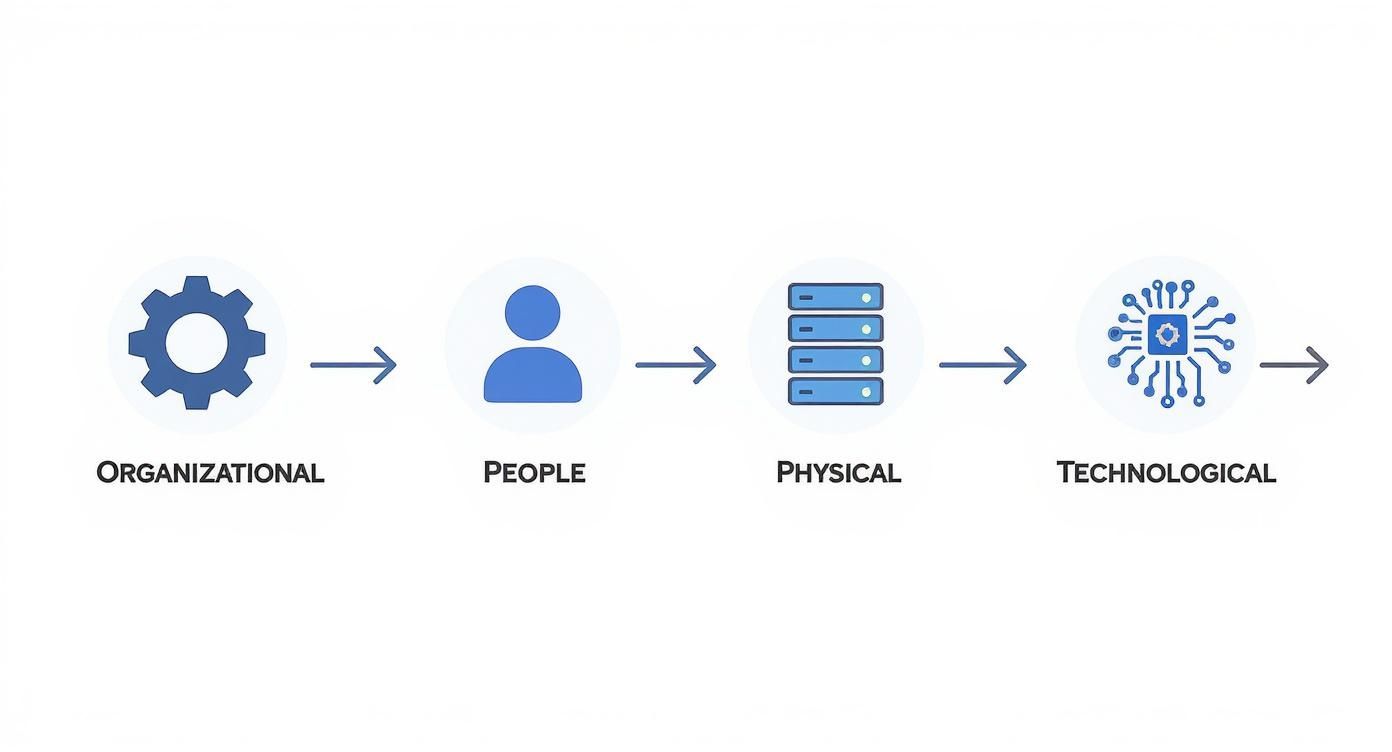
As you can see, a successful ISMS is built on a foundation of solid organisational policy, supported by trained people, protected by physical safeguards, and enforced with the right technology.
Phase 4: The Internal Audit And Review
Before you call in the external auditors, you must audit yourself. The internal audit is a mandatory step where you systematically check if your newly implemented ISMS is working as intended and actually meets the requirements of the ISO 27001 standard.
This process gives you an unbiased look at your system's effectiveness and helps you find any non-conformities—areas where you fall short of the standard. It’s your best chance to fix problems before the official audit.
Think of the internal audit as a full dress rehearsal. It lets you identify and correct any issues in a low-stakes environment, making sure you’re fully prepared for the main event.
After the internal audit, you'll conduct a management review. This is a formal meeting where your leadership team reviews the performance of the ISMS, the results of the audit, and any outstanding risks. It’s crucial for demonstrating that security is being managed and monitored at the highest level of the organisation.
Phase 5: The Final Certification Audit
This is the summit you’ve been climbing towards. The certification audit is performed by an accredited, independent certification body and happens in two distinct stages.
- Stage 1 Audit: This is mostly a documentation review. The auditor checks that you have all the necessary policies and procedures in place and that your ISMS is designed in line with the standard. They’ll point out any areas of concern that need fixing before Stage 2.
- Stage 2 Audit: Several weeks later, the auditor returns for the main event. This time, they conduct a much deeper investigation. They'll be interviewing your staff, checking records, and verifying that your controls are actually implemented and working effectively in the real world.
If you successfully pass the Stage 2 audit, the certification body will recommend you for ISO 27001 certification. It’s a huge achievement and a powerful testament to your organisation's commitment to robust information security.
Once certified, the journey isn't over. Your certificate is valid for three years, but it’s subject to annual surveillance audits to ensure your ISMS remains effective and that you're continuously improving your ISO security posture.
Mastering Risk Management Within Your ISMS
At its heart, a world-class ISO security program isn't about ticking off a long list of controls. It's about smart, proactive risk management that’s wired directly into your business goals. The whole point of ISO 27001 is to shift you away from a reactive, firefighting mindset, and that journey starts with a rock-solid information security risk assessment.
Think of this process as the foundation of your entire Information Security Management System (ISMS). It provides the "why" behind every security decision, ensuring your budget and effort are laser-focused on protecting what actually matters to your organisation.
Identifying Your Most Valuable Assets
You can’t protect what you don’t know you have. The first real step is to take stock and create a complete inventory of your information assets. This goes way beyond just servers and laptops.
An information asset is anything that holds value for your organisation. We're talking about:
- Databases: Things like your CRM, client lists, and confidential employee records are obvious targets.
- Intellectual Property: This could be your unique software code, special business processes, product designs, or even your secret marketing sauce.
- Digital Files: Think of crucial documents like financial reports, legal contracts, and strategic plans.
- Physical Hardware: Of course, the servers, laptops, and networking gear that store and move all this information are critical assets too.
Once you have your list, you need to figure out what’s most important. Which assets are absolutely essential for your daily operations? If you lost one, which would cause the biggest financial or reputational headache? This prioritisation is the key to everything that comes next.
Pinpointing Threats and Vulnerabilities
With your crown jewels identified, it’s time to think like an attacker. A threat is anything that could potentially harm your assets, while a vulnerability is a weakness that a threat could exploit to get in.
For instance, a ransomware attack is a common threat. The vulnerability might be an employee who hasn't been trained to spot a phishing email, or an unpatched server just waiting for a hacker to find it.
You need to systematically connect the dots, identifying the specific threats and vulnerabilities for each of your key assets. This isn't just about cyber-attacks; you also need to consider human error, system failures, and even physical events like fires or floods. This helps build a complete picture of your risk landscape.
Analysing Risk and Business Impact
Just having a long list of potential problems isn't useful. The critical next step is to analyse each risk by weighing up two key factors: its likelihood of happening and the potential impact it would have on the business if it did.
This analysis is what transforms a daunting list of "what ifs" into a prioritised action plan. A low-likelihood, low-impact risk is just noise. It’s the high-likelihood, high-impact events—the ones that could cripple your operations—that you need to worry about.
The goal of risk analysis is to give your leadership a clear, data-driven view of the security challenges you face. This is what enables smart, strategic decisions and ensures security funding goes where it will make the biggest difference.
This is often done with a risk matrix, where you score risks (say, on a scale of 1-5) for both likelihood and impact. The resulting score tells you which risks need your immediate attention and which can be managed over time.
Choosing Your Risk Treatment Strategy
Once your risks are prioritised, ISO 27001 asks you to decide how you're going to handle each one. You've got four main options, and your choice will hinge on your company's appetite for risk, your budget, and your overall strategy.
These four strategies are the core of your risk treatment plan:
- Mitigate (Treat): This is the most common approach. You put security controls in place to reduce a risk’s likelihood or impact. To protect a lost laptop, you'd use encryption. Another key part of mitigation is strong malware protection; you might consider the proactive steps in this guide for the best antivirus software for small business.
- Transfer (Share): This means shifting the financial hit of a risk onto someone else. The classic example is buying a cyber insurance policy. It won't stop a breach, but it can help you recover from the financial fallout.
- Avoid (Terminate): Sometimes a risk is just too big to handle, and the only sensible move is to stop the activity causing it. If an old piece of software is riddled with unfixable holes, you might just decommission it entirely to get rid of the risk.
- Accept (Tolerate): For some risks, the cost of fixing them is actually higher than the potential damage. If a risk falls within your organisation's accepted level, you can formally decide to live with it. This has to be a conscious, documented decision—not just ignoring the problem and hoping for the best.
By methodically applying these strategies, you build a security posture that’s based on real-world risk. This ensures your ISMS isn't just a random collection of security gadgets, but a carefully designed system that defends your business where it's most exposed and actively supports your biggest goals.
Answering Your ISO Security Questions
Thinking about ISO security often brings a whole raft of questions to the surface for business leaders. The journey to certification is a serious commitment, and it's only natural to want some straight answers on the timeline, costs, and what happens after you get the certificate on the wall.
This section is all about giving you direct, practical answers to the most common questions we hear from Australian businesses just like yours. We’ll cut through the jargon to give you the real-world insights you need to plan your next steps with confidence.
How Long Does It Take to Get ISO 27001 Certified?
There’s no magic number here. The timeline for getting ISO 27001 certified really depends on your company's size, complexity, and where your security measures stand today. You have to be realistic about the effort involved.
For a typical small to medium-sized Australian business that already has some good security practices in place, you’re likely looking at a timeframe of 6 to 12 months. This window covers everything from the initial gap analysis and risk assessment right through to implementing the necessary controls.
During this period, your team will be busy developing documentation, training staff, and running your own internal audits to get ready for the main event. For larger companies with more complex systems, the process can easily stretch closer to 12 to 18 months.
The single biggest factor that can speed things up is having your leadership team visibly on board. When executives champion the project, it gets the priority and resources it needs to keep moving forward.
Without that top-down support, even the best-laid plans can stall and lose momentum.
What Is the Real Cost of ISO Security Certification?
To budget properly, you need to understand the full investment required for ISO 27001. The costs really fall into three main buckets.
First up are the external costs. These are the fees you pay directly to your certification body for the two-stage audit process. This covers the initial Stage 1 and Stage 2 audits, plus the annual surveillance audits needed to keep your certificate valid. These fees can range from a few thousand to tens of thousands of dollars, depending on the scope of your system.
Next, you have the implementation costs. This is a much broader category. It could include new security software you need, like better endpoint protection, or hiring specialised consultants to guide you. It also covers things like dedicated training programs for your team.
Finally, and this is the one people often forget, is the internal cost of your team's time. Your staff will spend hundreds of hours on documentation, meetings, and putting everything into practice. While it sounds like a lot, you have to weigh this initial investment against the catastrophic financial and reputational damage of a data breach. Seen that way, it’s a strategic investment in your company’s future.
What Happens After We Achieve Certification?
A lot of people think that getting the ISO 27001 certificate is the end of the road. In truth, it’s just the beginning. It signals a shift from building your security system to actively maintaining and improving it.
Your ISO 27001 certificate is valid for three years, but that’s not a guarantee. To keep it, you have to pass annual surveillance audits. These aren't quite as intense as the first audit, but they are designed to make sure your Information Security Management System (ISMS) is a living, breathing part of your business—not just a folder gathering dust on a shelf.
Internally, the work never really stops. Your organisation will need to:
- Conduct ongoing risk assessments to stay ahead of new threats.
- Perform regular internal audits to spot and fix any issues.
- Hold formal management reviews so leadership stays plugged in.
- Continuously adapt your security controls as the world changes.
If you want a better feel for what these check-ins involve, learning more about the structure of an ISO 27001 audit can be really helpful. It’s this ongoing commitment that keeps your organisation protected and resilient, year after year.
Can Our Small Business Realistically Achieve ISO 27001?
Absolutely. This is a common worry, but one of the best things about the ISO 27001 standard is that it was designed from the ground up to be scalable. It’s just as achievable for a ten-person startup as it is for a global corporation.
The standard doesn’t force a rigid set of expensive rules on you. Instead, it gives you a framework that you tailor to your specific business, your industry, and your appetite for risk. A smaller business will naturally have a tighter scope and a more focused set of controls to manage than a sprawling enterprise.
Of course, resources can be tight for smaller businesses, but many succeed by being smart about it. They might take a phased approach, focus on their biggest risks first, and make clever use of cost-effective cloud security tools.
For a small or medium-sized Aussie business, the credibility you gain from ISO 27001 certification can be a genuine game-changer. It shows a level of security maturity that helps you win trust and land bigger contracts with clients who simply can’t afford to take risks.
At Anitech, we specialise in guiding Australian businesses through the complexities of ISO security. With over two decades of experience and a 100% success rate, we simplify the path to certification, allowing you to focus on growth while we handle the compliance. https://iso-27001.com.au
Recent Comments