

Quick Summary: ISO standards in Australia are globally recognised benchmarks helping businesses sharpen quality, security, and efficiency. Certification by a JAS-ANZ–accredited body proves your management systems align with world-class standards, boosting credibility and opening doors to major contracts and government tenders, including critical frameworks like ISO 27001 for information security.
What Do ISO Standards Mean for Your Australian Business?
Navigating the world of ISO standards in Australia is the first step toward demonstrating your business operates at an elite level. Think of ISO certification as earning a black belt in your industry. It’s a universal signal to customers, partners, and regulators that your organisation is committed to excellence. This credential is not just a certificate to frame on a wall; it’s a powerful tool for building resilience and enhancing your reputation.
In this guide, we’ll cut through the jargon to reveal how these internationally respected frameworks drive more efficient processes, stronger risk management, and provide clear proof of your operational quality.
Understanding The Key Players in Australia
Getting to grips with ISO standards in Australia means recognising the organisations that develop, adapt, and audit them. The ecosystem is designed to ensure credibility and trust at every level.
- Standards Australia: As the nation's peak non-government body, it adopts international ISO standards and tailors them for Australian industries and regulatory environments.
- JAS-ANZ (Joint Accreditation System of Australia and New Zealand): This is the official accreditation body. JAS-ANZ accredits the certifiers (Certification Bodies), ensuring their audits are fair, robust, and impartial.
Together, they form a network of trust. A certificate from a JAS-ANZ–accredited body carries significant weight not only across Australia but around the world.
At its core, an ISO standard provides a best-practice framework for managing a specific aspect of your business, whether it's quality control, information security, or environmental impact.
Now that you have an overview, we’ll dive deeper into key standards like ISO 27001 and map out the certification journey. For a more detailed breakdown, check out our article on ISO Certification in Australia.
The Australian ISO Certification Ecosystem Explained
Understanding the structure of ISO standards in Australia can feel complex at first, but it's a logical system built on trust and verification. This ecosystem ensures every certification is credible, consistent, and respected globally.
Imagine a pyramid of trust. At the very top sits the International Organization for Standardization (ISO), the global entity that develops the standards. These standards then flow down to Australia, where local bodies adapt and implement them for our specific market.

To make sense of it all, it helps to know who the main players are and the roles they play in your certification journey.
Key Organisations in Australian ISO Certification
| Organisation | Role in Australia | Key Function for Your Business |
|---|---|---|
| Standards Australia | The National Standards Body | Adopts global ISO standards and adapts them for the Australian context, creating the 'AS' and 'AS/NZS' standards you'll be audited against. |
| JAS-ANZ | The Accreditation Body | The official "auditor of the auditors." They assess and approve the companies (Certification Bodies) that are qualified to issue your certificate. |
| Certification Bodies (CBs) | The Auditors / Certifiers | These are the companies you hire to audit your business and, if you pass, issue your ISO certificate. They must be accredited by JAS-ANZ. |
Understanding these roles is the first step toward ensuring the certificate you work hard for will genuinely open doors for your business.
Standards Australia: Our National Standards Body
Standards Australia is our nation’s peak, non-government standards organisation. While they don't create ISO standards from scratch, they represent Australia's interests at the international level.
Their primary role is to take international standards and ensure they are fit for purpose here. This involves adapting them to align with Australian laws, regulations, and industry conditions. It’s why you’ll often see standards designated as AS/NZS ISO 9001, for instance. This process guarantees that when you achieve certification, you’re meeting a global benchmark that is directly relevant to the Australian market. Demonstrating this commitment, Standards Australia recently published 509 Australian Standards in a single year, its highest number in two decades. You can read more about this on the official Standards Australia news page.
JAS-ANZ: The Gatekeeper of Quality
If Standards Australia manages the what (the standards), then the Joint Accreditation System of Australia and New Zealand (JAS-ANZ) manages the who (the auditors).
JAS-ANZ is the government-appointed body responsible for accrediting the organisations that audit businesses like yours. They are, in essence, the auditors' auditor. Their job is to ensure that Certification Bodies are competent, impartial, and operate according to strict international guidelines.
A certification is only as credible as the body that issues it. A certificate from a non-accredited provider holds little to no weight in government tenders or major supply chains.
This leads us to a crucial point of distinction for businesses new to the ISO process.
Certification vs. Accreditation: What Is The Difference?
These terms are often used interchangeably, but they represent very different concepts. Understanding this distinction is vital to ensure your investment in certification pays off.
-
Certification is what your business earns. It is the formal recognition from a Certification Body stating that your management system (e.g., for quality or security) meets all the requirements of a specific ISO standard.
-
Accreditation is what the Certification Body earns. It is the formal endorsement from an authority like JAS-ANZ, verifying that the certifier is competent, qualified, and impartial enough to conduct audits and issue certificates.
Therefore, accreditation is the seal of quality for the certifier. For your business, this means choosing a JAS-ANZ accredited certifier is non-negotiable. It is the only way to guarantee your certificate will be recognised by government bodies, major corporations, and international partners. Always verify a certifier's status on the official JAS-ANZ Register before signing a contract.
Key ISO Standards for Australian Businesses
While thousands of ISO standards exist, a select few deliver the most significant impact for Australian businesses. These are the frameworks that build robust operational resilience, earn customer trust, and provide a clear competitive advantage. Identifying the right standards for your organisation is the first critical step.
Some standards address the fundamental aspects of a well-run company, while others have become essential for navigating today's digital landscape. Let’s explore the most important ISO standards that Australian organisations are leveraging for success.
Foundational Standards for Operational Excellence
These are the cornerstones of a great business, recognised across nearly every industry. They offer proven, structured methods for managing core business functions: quality and safety.
Two of the most common and powerful standards are:
- ISO 9001 Quality Management: As the world's most recognised standard, ISO 9001 provides a framework to ensure your products and services consistently meet customer expectations, fostering a culture of continuous improvement.
- ISO 45001 Occupational Health & Safety: This standard focuses on protecting your people. It provides a systematic approach to creating a safe and healthy workplace, helping you prevent work-related injuries and illnesses and demonstrating a commitment to your team's wellbeing.
Implementing these standards signals to stakeholders—from customers to employees—that you are serious about quality and safety, a powerful differentiator in a competitive market.
The Critical Standard for the Digital Age: ISO 27001
While quality and safety are timeless priorities, today's biggest challenges often revolve around data protection. This is where ISO 27001 Information Security Management becomes indispensable, not just for tech companies but for any business handling sensitive information.
ISO 27001 offers a clear, systematic approach to protecting your information assets, from client databases and financial records to intellectual property. By implementing an Information Security Management System (ISMS), you establish a structured defence against cyber threats, data breaches, and other security risks.
An ISMS isn't a "set and forget" project. It's a living, breathing part of your business that ensures you are always identifying, managing, and reducing information security risks.
Adopting this standard is also a proactive way to demonstrate due diligence and align with Australian privacy laws. It provides clients and partners with the confidence that you have robust controls in place to protect their data, strengthening trust and business relationships. For a closer look at the journey, you can learn more about achieving ISO compliance and its operational benefits.
Building a Holistic Resilience Framework
To create a truly robust organisation, you can integrate these core standards into a comprehensive management system that shields your business from risk and disruption.
Key standards that contribute to this holistic approach include:
- ISO 14001 Environmental Management: This standard helps you manage your environmental responsibilities. It provides a framework for improving resource efficiency, reducing waste, and demonstrating a commitment to sustainability—a factor of growing importance to customers and investors.
- ISO 22301 Business Continuity Management: This is your strategic plan for handling disruptions, whether from a cyber-attack, natural disaster, or supply chain failure. The goal is to ensure your critical operations can continue with minimal downtime.
By combining standards—such as ISO 27001 for security, ISO 22301 for continuity, and ISO 9001 for quality—you are not just collecting certificates. You are building an integrated management system that makes your entire organisation stronger, smarter, and more resilient.
The Strategic Benefits of ISO Certification for Your Business
Pursuing ISO certification is not merely a compliance exercise; it is a strategic investment in your company's future. Adopting internationally recognised ISO standards in Australia builds the credibility, resilience, and operational excellence needed to thrive in a competitive landscape.
The benefits extend across the entire organisation, from unlocking new commercial opportunities to streamlining daily operations. It’s about building a fundamentally stronger, more competitive, and more trusted company.
Unlock a Powerful Competitive Advantage
In a crowded market, ISO certification is a powerful differentiator. It can be the decisive factor in winning new business, especially for government tenders and large enterprise contracts where certification is often a mandatory requirement. An ISO 27001 certificate, for example, immediately signals that your information security practices are reliable and meet a global benchmark.
Time and again, smaller, certified businesses win major contracts over larger, non-certified competitors because certification removes a significant element of risk for the client. It provides objective proof that your systems and processes are best-in-class.
Certification transforms your business from just another supplier into a trusted partner. It answers the client's biggest unspoken question: "Can I trust you with my business?"
This is particularly true for small and medium-sized enterprises (SMEs), as it levels the playing field, allowing them to compete based on the maturity of their processes and the quality of their operations, not just their size.
Enhance Customer Trust and Brand Reputation
Trust is the foundation of modern business. ISO certification is one of the most effective ways to build and maintain it. It sends a clear message to your customers that you are committed to delivering consistent quality, safeguarding their data, and operating with integrity.
This commitment has a tangible impact on your brand. A certified business is perceived as more professional, reliable, and competent. This enhanced reputation leads to several positive outcomes:
- Increased customer loyalty: Clients prefer to work with suppliers they can depend on.
- Stronger brand equity: Your name becomes synonymous with quality and reliability.
- Easier market entry: A recognised certification can facilitate entry into new industries or international markets.
This strengthened trust translates directly into a more stable and profitable customer base.
Improve Operational Efficiency and Reduce Risk
While external recognition is valuable, the internal improvements driven by the certification process are equally significant. The journey requires you to scrutinise your own operations, identify inefficiencies, eliminate waste, and formalise best practices.
The result is a smarter, leaner organisation. Clearly defined roles, responsibilities, and processes reduce the risk of costly errors and foster a culture of continuous improvement. This systematic approach to risk management is central to most ISO standards. For instance, a recent report found that 45% of businesses are adopting technologies aligned with ISO standards to meet net-zero goals, driven by both regulatory and supply chain pressures. This highlights how standards are crucial for managing diverse risks, from operational to environmental. You can read more in this Australian industry research on technology adoption.
Ultimately, by proactively managing risks related to cybersecurity, safety, or environmental impact, you build a more resilient and sustainable business for the long term.
Your Path to ISO 27001 Certification: A Step-by-Step Guide
Embarking on the ISO 27001 certification journey is a significant commitment to protecting sensitive information. While it may seem daunting, breaking the process down into clear, manageable stages transforms it into an achievable strategic objective.
The process begins with genuine buy-in from your leadership team, as this ensures the necessary resources and authority. From there, the journey follows the logical "Plan-Do-Check-Act" cycle that underpins all ISO management systems.
Laying the Groundwork
The first practical step is to conduct a thorough assessment of your current security posture. This involves identifying what you already do well and where you fall short of the ISO 27001 standard's requirements. This analysis is crucial for defining a realistic project scope.
Key activities at this stage include:
- Gap Analysis: A detailed review of your existing security controls against the ISO 27001 requirements to create a clear action plan.
- Risk Assessment: The core of ISO 27001. You will identify potential threats to your information, assess their likelihood and impact, and determine how to treat them.
- Defining the Scope: Clearly documenting which parts of your organisation the Information Security Management System (ISMS) will cover, whether it’s the entire company or a specific department.
Building Your ISMS Documentation
Once you have a roadmap, the next step is to create the documents that form the backbone of your ISMS. This documentation serves as the official rulebook for how your organisation manages information security.
The most critical document is the Statement of Applicability (SoA). This lists all the security controls from ISO 27001's Annex A and justifies their inclusion or exclusion for your business. You will also develop the policies and procedures that bring these controls to life in your daily operations.
Implementation and Internal Audits
With your documentation in place, you can begin implementing your plans. This involves rolling out new security controls, training your staff, and integrating the ISMS into your day-to-day business processes. This is often the longest phase and requires consistent effort and clear communication.
A common challenge is the lack of existing process documentation. Systematically documenting how work is actually done is not only essential for certification but also makes your entire business more consistent.
Once the ISMS is operational, you must conduct an internal audit. This serves as a dress rehearsal for the external audit, allowing you to identify and correct any non-conformities before the official assessment.
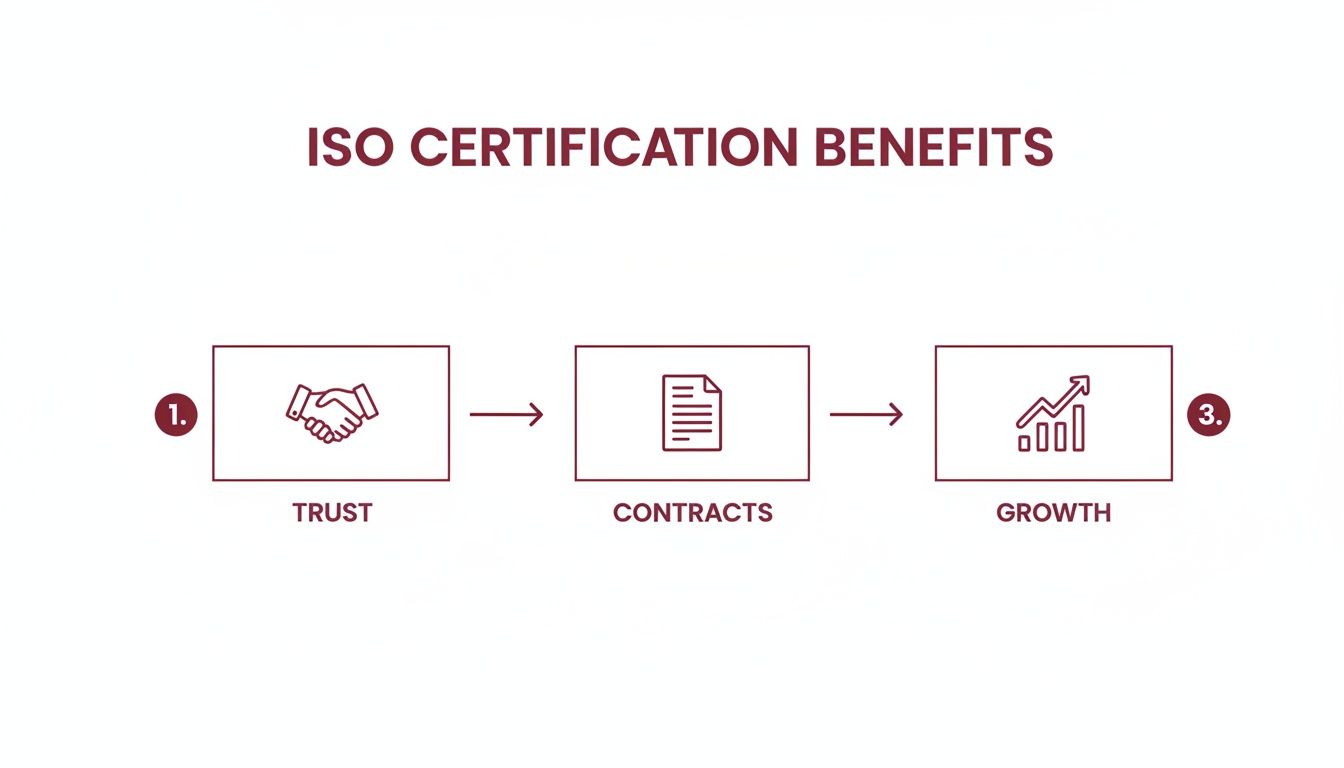
Achieving ISO certification builds trust, which in turn unlocks access to larger contracts and fuels your company's growth. It's a clear pathway where credibility gained through recognised standards leads directly to commercial success.
The Final Hurdle: The External Audit
This final step is conducted by an external, JAS-ANZ accredited certification body and is typically performed in two stages:
- Stage 1 Audit: The auditor reviews your documentation to ensure it meets the standard's requirements. This is essentially a readiness check to confirm you are prepared for the main audit.
- Stage 2 Audit: The auditor returns to observe your ISMS in action. They will interview staff, review records, and verify that your implemented controls are operating effectively.
If you successfully pass the Stage 2 audit, the certification body will recommend you for certification. For a deeper dive into this final phase, our guide on the ISO 27001 certification process offers a more detailed breakdown. Successfully navigating this process builds a genuinely more secure and resilient organisation.
Your ISO Questions, Answered
Navigating ISO standards in Australia often brings up a host of questions, especially for businesses new to the process. To provide clarity, we have compiled answers to some of the most frequently asked questions.
How Long Does ISO Certification Take for a Small Business?
While there is no fixed timeline, most small to medium-sized Australian businesses should budget for six to twelve months to achieve a certification like ISO 27001.
The duration depends on several factors:
- Business Complexity: A larger organisation with multiple services will require more time than a small consultancy.
- Resource Allocation: A dedicated project manager or team will significantly accelerate the process.
- Starting Point: Businesses with already well-documented processes have a considerable head start.
Rushing the process is rarely effective; the goal is to build a sustainable system that genuinely benefits your business.
Is ISO Certification a Legal Requirement in Australia?
For the vast majority of businesses, no. There is no general law mandating ISO 9001 or ISO 27001 certification to operate in Australia. It is a voluntary standard.
However, it often becomes a commercial necessity. Certification is frequently a prerequisite for:
- Winning contracts with government departments (federal, state, and local).
- Working with large corporations, particularly in sectors like finance, defence, and telecommunications.
- Operating in industries where trust and security are paramount.
In these contexts, certification is not just a "nice-to-have"; it's a ticket to play. While not a legal requirement, it is often a critical commercial one.
What Is the Difference Between JAS-ANZ and a Certification Body?
This is one of the most crucial distinctions to understand when dealing with ISO standards in Australia. Getting this wrong can render your certification worthless.
Simply put, the certification body is the team that audits your business. JAS-ANZ is the official body that audits the auditors.
JAS-ANZ (the Joint Accreditation System of Australia and New Zealand) is the government-appointed body that ensures certification bodies are competent, impartial, and adhere to international standards. They accredit the certifiers; they do not issue certificates to businesses.
When selecting a certification body, you must ensure they are accredited by JAS-ANZ. This guarantees that your certificate will be recognised nationally and internationally.
Can I Get Certified Without Hiring a Consultant?
Yes, it is possible to manage the certification process entirely in-house. If you have team members with expertise in compliance or quality management, you may be well-equipped to handle it.
However, the standards are complex and written in formal language, making misinterpretation a common risk that can lead to a failed audit. An experienced consultant can act as a guide and translator, helping you:
- Understand the standard's requirements in practical terms.
- Develop documentation that is effective for your business.
- Avoid common pitfalls during the audit process.
While a consultant represents an upfront cost, their expertise can save you time and money by ensuring a smoother, more successful certification journey.
How Does the New AI Standard Affect Australian Businesses?
The introduction of AS ISO/IEC 42001:2023, a standard for Artificial Intelligence Management Systems (AIMS), is a significant development. It is quickly becoming the benchmark for businesses that develop or heavily rely on AI technologies.
This standard provides a framework for managing the unique risks associated with AI, such as data bias, transparency, and accountability. For Australian businesses in sectors like tech, finance, and healthcare, adopting this standard is a powerful way to demonstrate responsible AI governance and build customer trust. It complements existing frameworks by tailoring core security and management principles to the specific challenges of artificial intelligence, building upon the foundation provided by a solid cyber risk management framework, including ISO 27001.
Recent Comments