

Quick Summary: IT Managed Security Services (MSS) provide businesses with outsourced cybersecurity expertise, proactively managing and monitoring digital defenses 24/7. This guide explains what these services include, their benefits for Australian SMEs, how they support ISO 27001 compliance, and what to look for when choosing a provider.
Here’s the bottom line: IT Managed Security Services (MSS) are all about bringing in a dedicated team of external cybersecurity pros to proactively manage and monitor your digital defences. Think of it as getting enterprise-level protection, expertise, and technology, but packaged into a simple subscription. This makes top-shelf security genuinely affordable for Australian small and medium businesses.
In a world where digital threats are always lurking, managed cybersecurity services offer a smart way forward. Instead of trying to build an expensive, complex security team from scratch, you're essentially handing the keys to a specialist third party. This gives you immediate access to powerful security tools and seasoned experts without the massive upfront cost.
What is This 'Digital Fortress' Everyone Talks About?
Imagine your business is a digital fortress. Inside, you're protecting everything that matters—customer data, financial details, and your unique intellectual property. You could try to recruit, train, and equip your own army of guards to patrol the walls. It’s a huge undertaking, demanding constant investment, the latest gear, and people on watch day and night.
Or, you could hire an elite security team that’s already trained, armed with cutting-edge tech, and ready to stand guard 24/7. That’s exactly what a Managed Security Service Provider (MSSP) does for your digital world.

Solving Real-World Business Problems
Most businesses, especially SMEs, run into the same brick walls when trying to build a solid security posture. An MSSP is designed to smash through these common roadblocks.
- The Cybersecurity Skills Shortage: Let's be honest, finding and keeping talented cyber professionals is tough and incredibly expensive. An MSSP gives you an entire team of them from day one.
- Always-On Threat Monitoring: Hackers don't clock off at 5 pm. An MSSP provides 24/7/365 monitoring from a Security Operations Centre (SOC), so threats are caught and dealt with, whether it's 3 pm or 3 am.
- Sky-High Costs: The price tag for building your own in-house SOC is eye-watering, from the tech to the payroll. The MSSP model flips this into a predictable monthly operational cost you can actually budget for.
Simply put, an MSSP lets you "rent" a world-class security team and their entire arsenal of technology. It’s about making top-tier protection practical and scalable, building genuine resilience for your business, not just fending off the occasional attack.
The proof is in the numbers. The IT Security Consulting industry in Australia, a space dominated by services like firewall management and endpoint security, is now worth a staggering $8.0 billion. This boom is fuelled by the simple fact that as our digital world gets more complex, businesses need a practical way to stay safe. Managed services have become a cornerstone of modern business strategy for a reason.
What Are the Core Components of IT Managed Security Services?
To really get your head around IT managed security services, you need to look under the bonnet. It’s not just one thing; it's a whole system of specialised technologies and human expertise working in perfect sync to keep you safe. Think of it like a high-performance car engine – a collection of critical parts, each with its own job, all firing together.
These components aren’t just off-the-shelf products. They’re integrated systems, managed by experts who live and breathe this stuff. Each piece of the puzzle is designed to tackle a different kind of risk, from blatant attacks trying to smash down the front door to the subtle, sneaky threats that are much harder to spot.
Let's break down the essential layers of defence that form the backbone of any solid managed security offering.
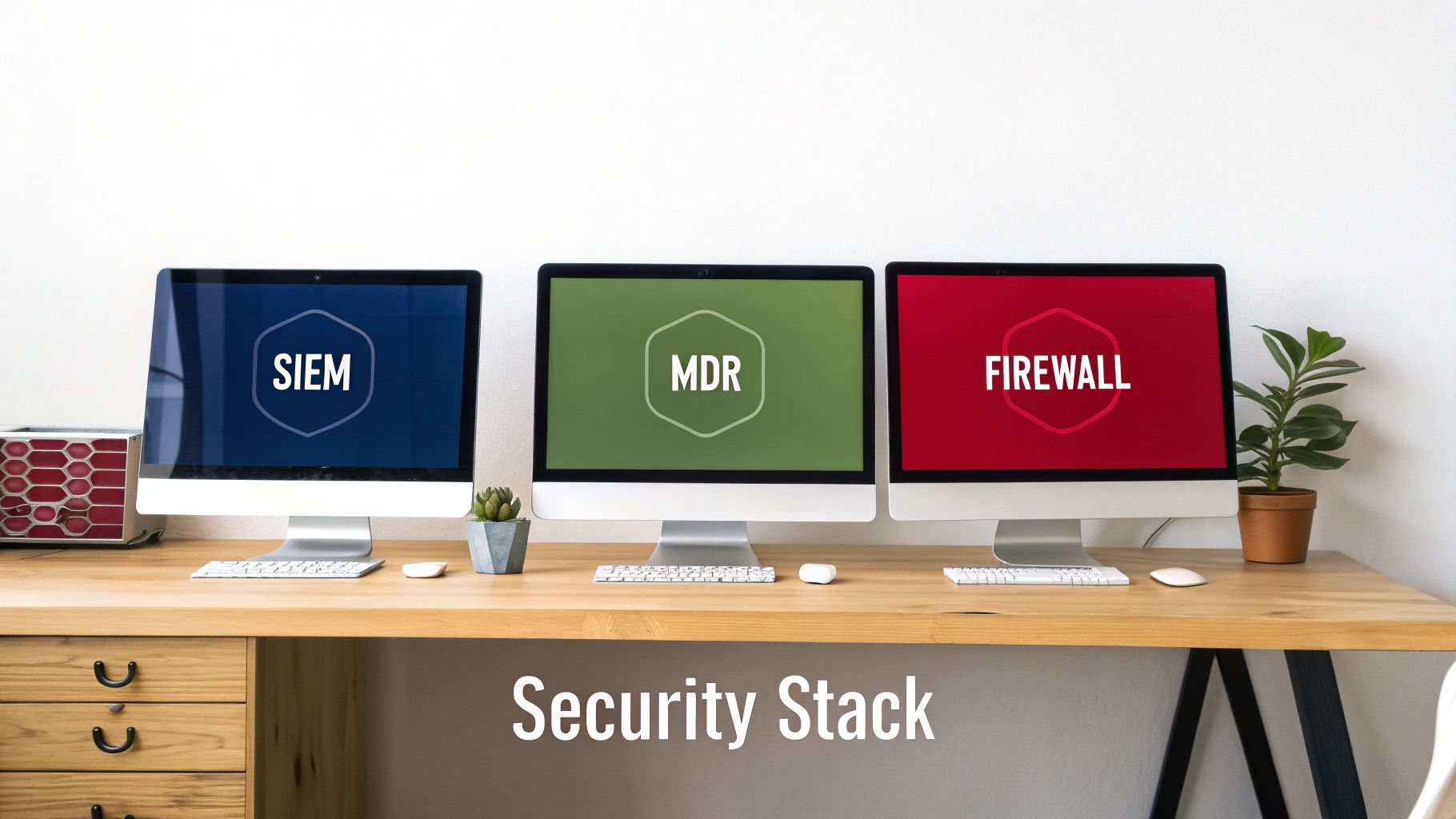
SIEM: The Central Nervous System
At the very heart of any modern security setup, you’ll find Security Information and Event Management (SIEM). The best way to think of it is as the central nervous system for your entire IT environment. It’s constantly collecting and making sense of log data—tiny digital footprints of activity—from every single corner of your network.
That means data from your servers, firewalls, and every computer in the office. By pulling together and correlating billions of these seemingly random events, a SIEM platform can spot suspicious patterns that a human could never hope to see. It effectively turns a chaotic flood of digital noise into clear, actionable security intelligence.
Managed Detection and Response: The Elite Threat Hunters
If SIEM is brilliant at collecting clues, Managed Detection and Response (MDR) is the elite team of detectives who follow the trail. MDR goes way beyond just reacting to automated alerts; its purpose is to actively hunt for threats that might have slipped past your initial defences. It’s about being proactive, not reactive.
MDR teams use sophisticated tools and behavioural analytics to spot anything out of the ordinary. For example, if an employee's account suddenly starts accessing sensitive files at 2 AM from a different country, MDR analysts are the ones who will be on it immediately.
This proactive stance is fast becoming essential. The Australian cybersecurity managed services market is already valued at around USD 990 million and is still growing. This boom is being driven by relentless cyber threats and a significant local skills shortage, pushing services like MDR to the forefront as businesses scramble for a stronger defensive posture.
SIEM vs MDR: What Is the Difference?
It’s easy to get SIEM and MDR confused, as they both deal with threat detection. But their roles are quite distinct. SIEM is the wide-angle lens, collecting and correlating data from everywhere. MDR is the zoom lens, focusing on actively hunting down and neutralising the most advanced threats.
Here’s a simple breakdown:
| Feature | SIEM (Security Information and Event Management) | MDR (Managed Detection and Response) |
|---|---|---|
| Primary Goal | Log collection, correlation, and alerting | Proactive threat hunting and incident response |
| Focus | Compliance and log management | Detecting and stopping active attacks |
| Human Input | Mostly passive monitoring of alerts | Active, human-led investigation and analysis |
| Scope | Broad network-wide data collection | Deep focus on endpoints and network behaviour |
| Response | Generates alerts for your team to handle | Provides a fully managed response to threats |
Ultimately, many businesses benefit from having both. SIEM provides the crucial visibility and compliance data, while MDR delivers the hands-on expertise to shut down threats before they can cause real damage.
Managed Firewalls: Your Digital Gatekeeper
A firewall is your business’s first line of defence, plain and simple. It acts as a digital gatekeeper for all the traffic flowing in and out of your network. A managed firewall service takes this a giant leap further by putting this critical device in the hands of security pros who configure, update, and monitor it constantly.
This is absolutely not a "set and forget" job. The experts managing it will:
- Update Policies: They continuously tweak firewall rules to block new threats and keep them aligned with your business.
- Apply Patches: They make sure the firewall's software is always up-to-date, closing off known security holes.
- Monitor Traffic: They keep a close watch for suspicious patterns or any attempts to breach your perimeter.
Endpoint Protection: Securing Every Single Device
Every single device connected to your network—laptops, desktops, servers, you name it—is an "endpoint." And every endpoint is a potential doorway for an attack. Managed endpoint protection deploys powerful antivirus and anti-malware software across all these devices, but the crucial part is that it’s all managed for you by the provider.
This guarantees every device has the latest protection, security policies are applied everywhere without exception, and any threats that pop up are dealt with immediately by the security team. It centralises your control over what is often a very scattered attack surface.
Vulnerability Management: Finding the Cracks Before the Bad Guys Do
Cybercriminals don’t always need to kick down the door; sometimes, they just stroll through an open window you didn't even know was there. Vulnerability management is all about proactively finding those "open windows"—software flaws or dodgy configurations—before an attacker can exploit them.
A managed vulnerability service is like having a professional security inspector for your digital property. It involves regular, automated scans of your network to find weak spots. The provider then gives you a prioritised report on what needs fixing first, so your team can focus on the biggest risks.
The 24/7 Security Operations Centre: The Human Element
Finally, the glue that holds all of this together is the 24/7 Security Operations Centre (SOC). This is the command centre, staffed around the clock by real-life security analysts who monitor alerts, investigate potential incidents, and coordinate the response. The SOC is what truly elevates a managed service. You can learn more about how these teams operate in our detailed guide to security managed services.
Without a SOC, even the most advanced technology just spits out alerts that can easily be missed, especially after hours or on a weekend. Having a dedicated team of experts watching over your systems 24/7/365 provides a level of protection that most small businesses could never dream of building themselves. It’s the essential human intelligence that makes the whole system work.
The Strategic Edge for Australian Small Businesses
For any small or medium business in Australia, bringing on a Managed Security Service Provider (MSSP) isn't just a tech upgrade—it's a sharp business move. It’s about more than just ticking a box for security; it’s about turning cybersecurity from a nagging cost centre into a real investment in your company's resilience, reputation, and future.
Let's be blunt: finding, hiring, and keeping top-tier cybersecurity talent in Australia is incredibly difficult and expensive. Partnering with an MSSP sidesteps this entire problem. You instantly gain access to a whole team of certified experts—people who live and breathe threat detection and response every single day. This is a level of expertise that would cost a fortune to build from scratch.
Unlock Serious Cost Savings
The numbers just make sense. If you were to build your own in-house Security Operations Centre (SOC), you'd be looking at a massive bill for technology, recruitment, ongoing training, and paying salaries for a 24/7 roster. We’re talking hundreds of thousands of dollars a year, which is simply out of reach for most SMEs.
An MSSP flips that model on its head. That huge capital outlay becomes a predictable, manageable monthly operational expense. You end up with far better protection for a fraction of the cost, freeing up cash you can pour back into growing the business. For a deeper dive into how this outsourced model benefits a business, you can explore the benefits of managed IT services.
The value proposition is crystal clear: you get an enterprise-grade security team without the enterprise-grade price tag. It levels the playing field, making top-shelf security accessible to the businesses that are the engine room of the Australian economy.
Stay Ahead of Compliance and Threats
In Australia, data protection isn't optional. The Notifiable Data Breaches (NDB) scheme, enforced by the Office of the Australian Information Commissioner (OAIC), puts the onus on businesses to safeguard personal information and report breaches. The penalties for getting it wrong can be severe.
This is where an MSSP's 24/7/365 monitoring becomes your best friend. The constant watchfulness, detailed event logging, and rapid incident response are exactly what you need to prove you’ve done your due diligence. It’s a proactive approach that not only helps you avoid fines but also builds trust with your customers, who care more than ever about how their data is handled. These are the kinds of practical steps we cover in our guide to cybersecurity for small businesses.
The market itself tells the story. The managed security services sector in Australia recently hit USD 994.0 million and is expected to rocket to USD 3,142.8 million by 2033. That explosive growth isn't happening in a vacuum; it’s a direct result of SMEs feeling the heat from sophisticated attackers and complex regulations.
Gain a True Competitive Advantage
At the end of the day, strong security is a powerful sales tool. When a potential client is weighing you up against a competitor, knowing you take data protection seriously can be the thing that seals the deal. It sends a clear message that you are stable, professional, and trustworthy.
By handing over the security reins to a dedicated expert, you and your team can get back to focusing on what you're brilliant at—running and growing your business. That freedom allows you to innovate and expand, knowing your digital foundations are solid. This isn't just about peace of mind; it's a strategic asset that fuels growth and cements your reputation in the market.
How Managed Security Strengthens Your ISO 27001 Journey
Getting your business ISO 27001 certified is a massive achievement. It’s a clear signal to your clients, partners, and the market that you’re serious about protecting data. But let's be honest—the road to compliance can feel like a steep, resource-draining climb. This is exactly where IT managed security services come in, acting as a powerful ally to make the whole process smoother and more achievable.
A Managed Security Service Provider (MSSP) doesn't just sell you software. They bring the expert team, the battle-tested processes, and the detailed documentation that align directly with the ISO 27001 standard's demands. Think of them as a strategic partner, helping you build and run the Information Security Management System (ISMS) that forms the very core of your certification.
Aligning Services with ISO 27001 Annex A Controls
The real magic of using an MSSP for your compliance journey is how neatly their core services map to the specific controls listed in Annex A of the ISO 27001 standard. Instead of you having to build these complex capabilities from scratch, your provider delivers them as a ready-to-go service.
Imagine Annex A as a detailed checklist of all the security measures you need to have in place. An MSSP walks in and helps you tick off a huge chunk of those boxes right away.
Here’s how it works in practice:
- A.12.2.1 Protection against Malware: This control is covered. A managed endpoint protection service deploys, updates, and monitors anti-malware software across all your company devices.
- A.16.1.7 Information Security Incident Management: The 24/7 Security Operations Centre (SOC) is your engine for this. It provides the constant monitoring, detection, and expert response you need to handle any security incident properly.
- A.12.4.1 Event Logging: A SIEM service is built for precisely this. It collects, correlates, and securely stores logs from across your entire network, giving you a crystal-clear audit trail.
This direct alignment makes everything simpler. When an auditor asks for proof of how you're managing malware threats or responding to incidents, your MSSP provides the reports, logs, and process documents that demonstrate you’re fully compliant.
The Evidence Locker for Auditors
Getting certified is one thing; staying certified through ongoing audits is another challenge entirely. Auditors need to see hard evidence that your security controls aren’t just well-designed on paper—they need proof that they are working effectively, day in and day out.
An MSSP is basically a built-in evidence-generation machine. Their services create a constant, documented stream of activity that proves your ISMS is a living, breathing system, not just a dusty folder on a shelf.
By partnering with an MSSP, you are effectively outsourcing the heavy lifting for many key security controls. This frees up your internal team to focus on the bigger picture of governance and strategy, rather than getting buried in the day-to-day operational details.
The infographic below shows how the key benefits of managed security—like cost savings, access to top talent, and business resilience—all contribute to a stronger compliance posture.
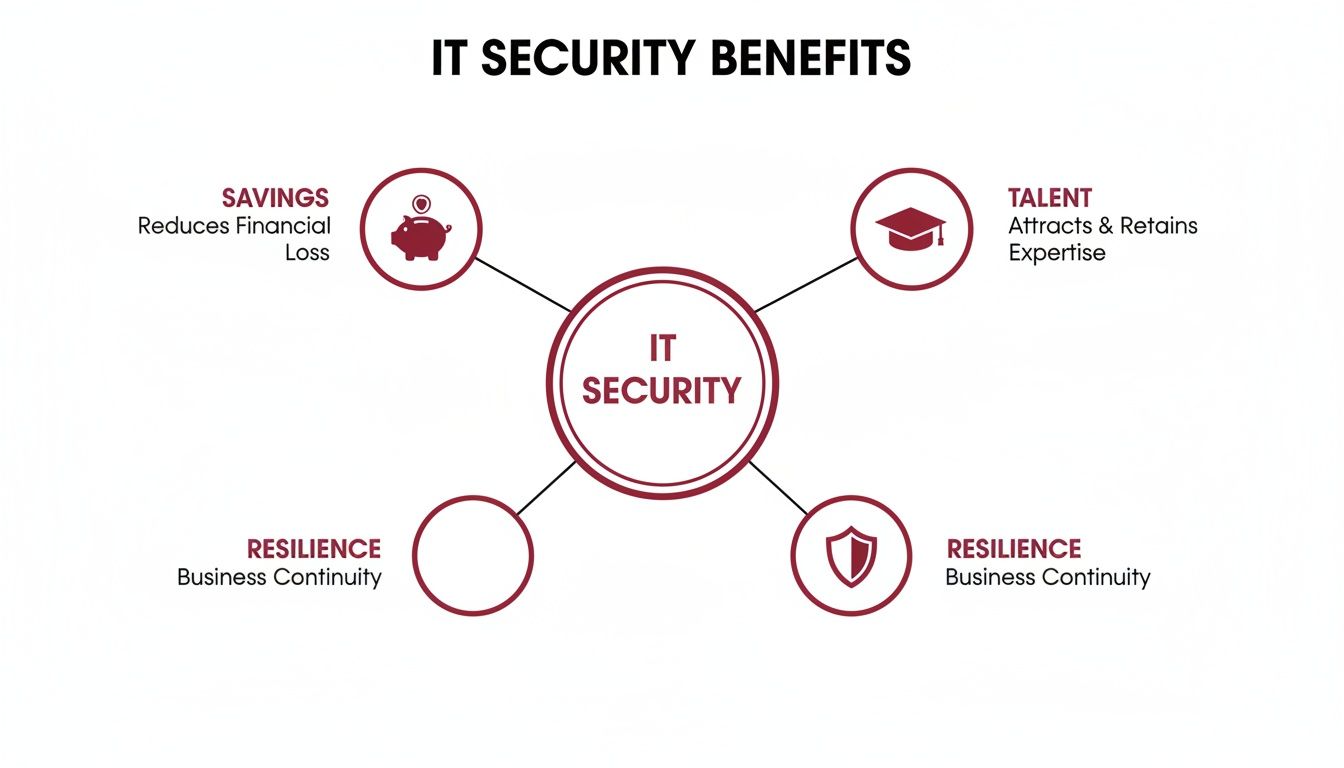
As you can see, the advantages are all connected. Each one reinforces the others to create a security framework that's not only stronger but also much easier to prove to an auditor.
Integrating into Your ISMS
One common myth is that an MSSP operates in a silo, completely separate from your business. Nothing could be further from the truth. A good provider works to integrate their services seamlessly into your ISMS. They collaborate with you to understand your business goals and risk appetite, then fine-tune their services to match your specific policies.
This partnership approach turns your ISO 27001 journey from a collection of disjointed tasks into a unified, coherent strategy. The MSSP brings the technical muscle and operational discipline, while you maintain complete strategic oversight. The end result is a much stronger security posture, far less stressful audits, and a clear, confident path to achieving and holding onto your certification.
How to Choose the Right Managed Security Provider
Picking a partner to handle your cybersecurity is a massive decision. Get it right, and you’ve got a trusted extension of your own team, someone in the trenches with you. Get it wrong, and you’re looking at costly protection gaps, miscommunications, and a whole lot of frustration. This isn't a choice to rush; you need a clear, methodical way to find a provider who actually gets your business.
Think of this less like hiring a vendor and more like entering a strategic partnership. You're not just buying a piece of software; you're bringing in a team of experts. They need the right skills, the best tools, and a genuine investment in your success. With so many MSSPs out there, a solid evaluation process is the only way to cut through the marketing fluff and find the perfect fit for your Australian business.
Verify Expertise and Certifications
Before you even glance at a price list, you need to check their credentials. Real-world cybersecurity expertise isn't just claimed; it's proven through industry-recognised certifications. These aren't just fancy logos for a website—they're proof that the team has met tough standards for both knowledge and ethical conduct.
You want to see that their people hold qualifications like:
- CISSP (Certified Information Systems Security Professional): This is the gold standard globally, covering a huge range of security principles. It shows deep, broad knowledge.
- CREST (Council of Registered Ethical Security Testers): This is a big one here in Australia. It signals a high bar for skills in penetration testing and handling security incidents.
- CompTIA Security+: A great foundational certification that proves a solid grasp of core cybersecurity skills.
A provider that invests in training its team is a provider that’s serious about quality. Don't be shy about asking who, specifically, will be watching your network and what their qualifications are.
Scrutinise the Service Level Agreement
The Service Level Agreement (SLA) is everything. This is the document that lays out the rules of engagement—what they promise to do and, crucially, how fast they’ll do it when things go bad. If an SLA is vague or full of weasel words, that’s a massive red flag.
Zero in on their incident response times. You need to ask direct questions and get concrete numbers:
- Mean Time to Detect (MTTD): On average, how quickly do they spot a threat after it first appears on your network?
- Mean Time to Respond (MTTR): Once they spot it, how long until a human analyst actually starts working to shut it down?
A top-tier provider should have an SLA that promises a response from a real person in minutes, not hours. Every second an attacker has free rein on your systems is another second they can do incredible damage.
Assess Their Technology Stack
While the people are vital, their effectiveness hinges on the tools they use. You have every right to know what technology is underpinning their service. Ask them to walk you through their tech stack—what SIEM platform are they running? What about their MDR and endpoint protection tools?
A good, transparent provider will be more than happy to explain why they chose their particular tools and how everything works together. This isn't just a technical chat; it's a window into their expertise and a chance to ensure their systems will play nicely with your existing IT setup. It also tells you if they’re using modern, effective platforms or coasting on outdated tech.
Prioritise an Australian-Based SOC
For any Australian business, this is a non-negotiable. Having a provider with a local Security Operations Centre (SOC) gives you a massive home-ground advantage. A local SOC means the analysts watching your network live and breathe the Australian threat landscape. They understand our specific regulations, like the Notifiable Data Breaches (NDB) scheme, inside and out.
Just as importantly, a local team works when you work. If a critical alert fires at 2 PM in Sydney, you’re talking to the A-team, not a handover crew on the other side of the planet. It makes communication smoother and response times faster right when it matters most.
Finding the right MSSP comes down to asking the right questions and carefully weighing the answers. To help you structure your evaluation, we've put together a quick-reference table. Use this as a checklist when you're talking to potential providers.
| Key Criteria for Selecting an MSSP in Australia | ||
|---|---|---|
| Evaluation Area | What to Look For | Why It Matters |
| Local Presence & Expertise | An Australian-based Security Operations Centre (SOC). Team members who understand the local threat landscape and regulations like the NDB scheme. | Ensures your security partner operates in your time zone, understands local compliance requirements, and can respond swiftly to incidents during your business hours. |
| Technical Credentials & Certifications | Industry-recognised certifications for their security analysts (e.g., CISSP, CREST, CompTIA Security+). A demonstrated commitment to ongoing professional development. | Certifications are tangible proof of expertise and adherence to industry best practices. It shows they invest in their team's skills, which directly benefits your security posture. |
| Service Level Agreement (SLA) | Clear, specific, and measurable commitments for incident response. Key metrics like Mean Time to Detect (MTTD) and Mean Time to Respond (MTTR) should be in minutes, not hours. | A strong SLA is your guarantee of service. It defines expectations and holds the provider accountable for performance, especially during a critical security incident where every second counts. |
| Technology Stack & Integration | Use of modern, reputable security platforms (SIEM, MDR, EDR). Transparency about the tools they use and a clear explanation of how they integrate with your existing IT environment. | The right technology is the foundation of effective security monitoring. You need to ensure their tools are up-to-date, comprehensive, and compatible with your business systems to avoid blind spots. |
| Communication & Reporting | A clear process for communication during an incident. Regular, easy-to-understand reporting that provides actionable insights, not just raw data. A dedicated point of contact. | Effective communication is critical during a crisis. You need a partner who can clearly explain complex threats and provide the insights you need to make informed business decisions. |
| Client References & Industry Experience | Willingness to provide anonymised case studies or connect you with current clients (of a similar size and in a similar industry). Demonstrable experience protecting businesses like yours. | Past performance is the best indicator of future success. Hearing directly from other clients and seeing relevant case studies gives you confidence that they can handle the specific challenges your business faces. |
Ultimately, the goal is to find a partner you can trust implicitly. This table should give you a solid framework for making an informed, confident decision.
Key Questions to Ask Potential Providers
When you sit down with a potential provider, you need to be ready to dig deep. The quality of their answers will tell you everything you need to know about their capabilities and whether they're the right cultural fit for your business.
Arm yourself with these questions:
- From the moment you detect a threat, walk me through your exact incident response process, step by step, all the way to resolution.
- What's your specific experience with businesses in our industry and of our size? Give me some examples.
- When a real security incident is unfolding, how exactly will your team communicate with us? Who calls who?
- Can you provide some anonymised case studies or put us in touch with a current Australian client for a reference?
- How do you keep your team and your technology ahead of the curve with all the new cyber threats emerging every day?
Got Questions About Managed Security Services? You're Not Alone.
Diving into the world of managed security can feel a bit overwhelming. As a business leader, you just want straight answers so you can make the right call for your company. Let's tackle the most common questions we hear from Australian businesses, cutting through the jargon to get to what really matters.
What’s the Difference Between an MSP and an MSSP?
This is easily one of the most common points of confusion, and getting it right is crucial. While Managed Service Providers (MSPs) and Managed Security Service Providers (MSSPs) sound similar, they play very different roles.
Think of it this way: your MSP is your trusted GP. They're fantastic for your business's day-to-day health—keeping your systems running, managing software updates, and handling all those essential IT functions. They have a broad skill set and are vital for keeping you operational.
An MSSP, on the other hand, is the specialist surgeon. Their focus is laser-sharp and incredibly deep: cybersecurity. They live and breathe threat detection, incident response, and proactive defence. While your MSP makes sure your IT works, your MSSP makes sure it’s safe from attack. You need both, but you wouldn't ask your GP to perform open-heart surgery.
How Much Do Managed Security Services Cost in Australia?
It's the million-dollar question, but thankfully the answer isn't a million dollars. There's no single price tag because the service needs to fit your business, but the cost models are designed to be predictable and scalable.
You’ll typically come across a few common structures:
- Per-User/Per-Device Model: Simple and straightforward. You pay a set monthly fee for each employee or device you want to protect, making it easy to scale as your team grows.
- Tiered Plans: Think of these as Bronze, Silver, and Gold packages. A basic tier might cover the essentials like monitoring, while a premium tier could add advanced threat hunting and in-depth compliance reporting.
- Customised Pricing: If your business has unique or complex needs, a provider will work with you to build a completely bespoke plan after a thorough review of your setup and risk profile.
But here’s the thing: it’s not about the cost, it's about the value. The real question isn't "What do I pay?" but "What do I save?"
Trying to build an equivalent security team in-house, with a 24/7 Security Operations Centre (SOC), means footing the bill for multiple expert salaries, expensive software, and constant training. That can easily run into hundreds of thousands of dollars a year. Partnering with an MSSP almost always makes more financial sense, turning a massive capital outlay into a predictable operational expense.
How Quickly Can We Get Started with an MSSP?
Getting set up with an MSSP isn't like flicking a switch—and that's a good thing. A proper, methodical onboarding process ensures there are no gaps in your defences. While everyone wants protection fast, a structured rollout is key to getting it right.
The journey from signing up to being fully protected usually follows a few clear stages.
A Typical Onboarding Process:
- Initial Assessment and Scoping (1-2 Weeks): This is the discovery phase. The MSSP will work closely with you to understand your current IT environment, pinpoint your most critical data and systems, and map out exactly what needs to be covered.
- Deployment and Configuration (1-3 Weeks): Now the technical work begins. This is where agents are deployed to your computers, log collectors are set up, and your firewalls and other network gear are connected to the central monitoring platform.
- Tuning and Baselining (2-4 Weeks): This step is absolutely critical. For the first few weeks, the security team watches your network to learn what "normal" looks like for your business. This careful calibration dramatically reduces false alarms so that when a real threat appears, it stands out.
- Full Operational Go-Live (After Baselining): Once the system is tuned, you’re officially live. From this point on, you have full 24/7 monitoring and response. You’ll get access to reporting dashboards, and the MSSP's SOC is actively defending your business around the clock.
It's smart to set realistic expectations. While some protections can be in place quickly, a fully integrated service usually takes between four to eight weeks to become completely operational. This deliberate pace is what builds a robust, effective, and long-lasting security partnership.
Are you ready to strengthen your security posture and simplify your ISO 27001 compliance journey? The expert team at Anitech is here to help. With our deep experience in guiding Australian businesses, we can provide the strategic advice you need to build a resilient and certified Information Security Management System. Contact us today to learn more.
Recent Comments