

Think of a managed cyber security service as your on-demand, expert security team. They're the specialists working behind the scenes, 24/7, to protect everything your business has built online, but without the eye-watering cost and headache of hiring an equivalent team yourself.
What on Earth is Managed Cyber Security?
Let's use an analogy. Imagine your business is a high-value warehouse. You wouldn't just pop a padlock on the front door and call it a day, would you? Of course not. You'd bring in a professional security company.
They’d install the cameras, rig up the alarms, and have a team watching the feeds from a central command centre, day and night. They'd have guards doing patrols, checking for weak spots, and a rapid-response crew ready to go the second an alarm sounds.
A managed cyber security service is exactly that, but for your digital world. It’s the expert team in that command centre, keeping a constant, watchful eye over your networks, servers, and precious data.
This kind of service, usually delivered by what’s known in the industry as a Managed Security Service Provider (MSSP), is no longer a 'nice-to-have'. For most Australian businesses, especially small to medium-sized ones, it's become a necessity. The core problem is that building your own in-house Security Operations Centre (SOC) is incredibly complex and expensive.
Why This Matters for Your Business Now
The hard truth is that cyber attacks aren't just a problem for the big banks and multinationals anymore. They are a direct, persistent threat to businesses of every shape and size. The attacks are getting smarter, and defending against them requires a level of skill and technology that's just plain difficult and costly for most companies to keep on the payroll.
This is precisely where a managed service flips the script and becomes a powerful strategic move. It gives you a scalable, expert-driven way to defend your business, letting you get back to what you do best—running it. You can rest a little easier knowing seasoned professionals are on the job.
A managed cyber security service isn't just about buying software. It's about plugging into a living, breathing team of specialists, proven processes, and top-tier tools that all work together to keep you safe. It effectively turns security from a massive, upfront cost into a predictable, manageable operational expense.
The demand for these services right here in Australia tells the story. The local managed security services market recently hit USD 994.0 million, and it's not slowing down. Projections show it rocketing to USD 3,142.8 million by 2033. This explosive growth is a direct response to the harsh reality on the ground, where a staggering 69% of Australian organisations have been hit by ransomware attacks in the last five years alone. You can read more about the surge in demand for these security services and gain further insights.
In-House Security vs Managed Cyber Security Service
For most business owners or IT managers, the big question is whether to build your own security team from scratch or partner with an outside provider. Getting your head around the differences in cost, expertise, and day-to-day responsibility is crucial. An in-house team gives you direct control, but it comes with a heavy price tag and the constant challenge of finding and keeping good people. An MSSP, on the other hand, gives you instant access to a deep bench of talent and enterprise-level tech.
So, let's lay it all out. Here’s how the two approaches stack up for a typical small to medium Aussie business.
| Aspect | In-House Security Team | Managed Cyber Security Service (MSSP) |
|---|---|---|
| Initial Cost | High—includes recruitment, salaries, software licensing, and hardware. | Low—predictable monthly or annual subscription fees. |
| Time to Implement | Slow—can take many months to hire staff and deploy technology. | Fast—providers have established systems ready for deployment. |
| Expertise & Skills | Limited to the knowledge of a small team, with constant training needed. | Access to a broad team of specialists in various security domains. |
| 24/7 Coverage | Extremely expensive and difficult to staff around the clock. | Standard offering, providing continuous monitoring and response. |
| Technology Access | Requires significant capital investment to acquire and maintain tools. | Leverages best-in-class, enterprise-grade technology at a shared cost. |
| Scalability | Difficult to scale up or down quickly based on business needs. | Highly flexible, allowing services to be adjusted as the business grows. |
Ultimately, the choice comes down to a simple trade-off. Building in-house means chasing scarce talent and sinking huge amounts of capital into technology that needs constant updating. Partnering with an MSSP gives you that capability straight out of the box, turning a major capital headache into a simple operational cost.
The Core Functions of a Modern MSSP
To really get what a managed cyber security service does for your business, we need to pop the bonnet and have a look inside. It’s more than just a vague promise of protection. A good Managed Security Service Provider (MSSP) runs on a set of distinct, critical functions that work together to form your outsourced defence mechanism.
This simple diagram breaks down the core value you get from an MSSP—a powerful mix of expert teams, advanced tools, and round-the-clock vigilance.
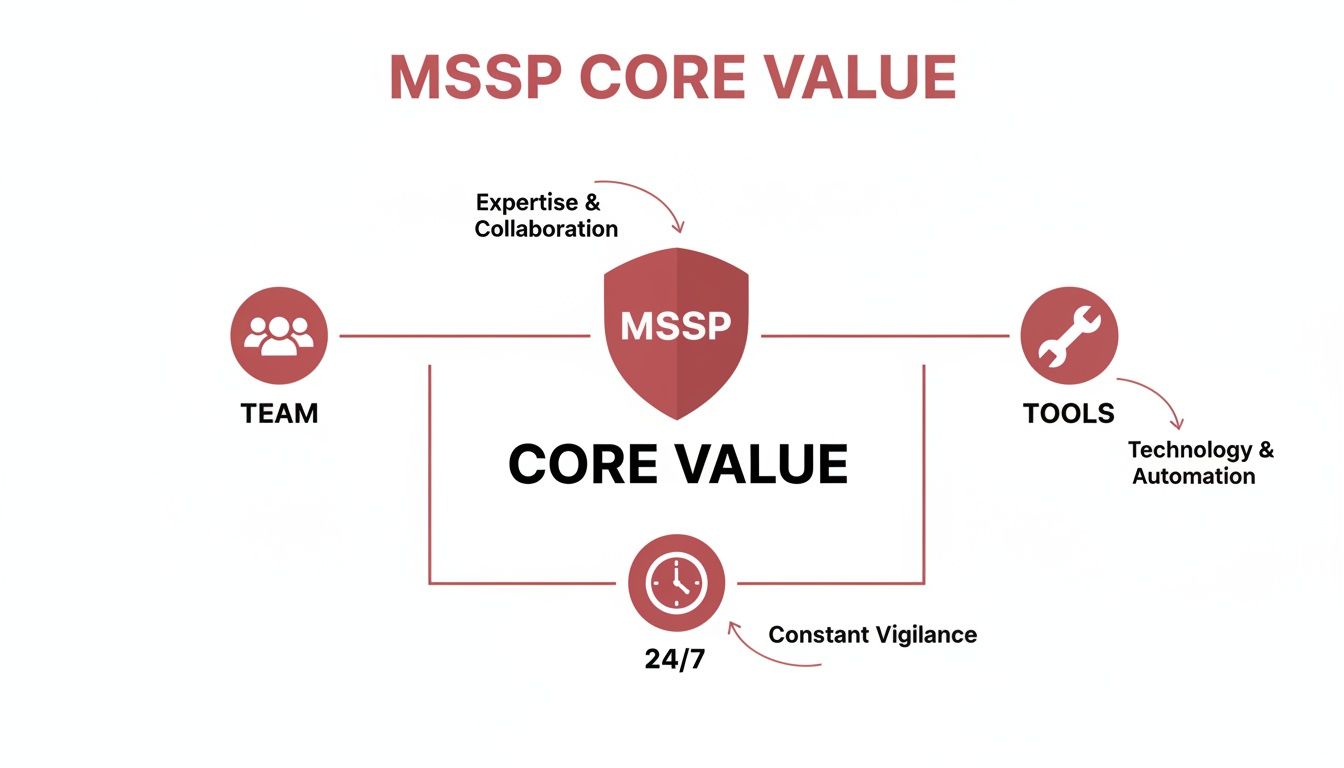
As you can see, an MSSP’s strength isn’t just in one area. It comes from the potent combination of having the right people with the right technology, working for you every minute of every day.
24/7 Security Monitoring and Detection
The absolute bedrock of any decent managed security service is constant vigilance. Cyber threats don't stick to a 9-to-5 schedule, so your defences can't afford to, either. This is why 24/7 security monitoring is completely non-negotiable.
Picture your entire digital world—every server, laptop, and cloud app—constantly sending out signals about what it's doing. An MSSP's job is to listen to all that noise and pick out the one faint signal that spells trouble.
They pull this off using a powerful technology called Security Information and Event Management (SIEM). Think of a SIEM as the central nervous system for your security. It pulls in log data from across your whole network, analyses it in real-time, and hunts for patterns or known signs of an attack.
Without a SIEM and the expert crew to run it, finding a real threat is like looking for a needle in a continent-sized haystack. With it, your MSSP can spot the early whispers of an attack and jump on it immediately, day or night.
Proactive Vulnerability Management
Strong security isn't just about reacting to attacks; it's about stopping them before they even start. That's the whole point of proactive vulnerability management, which you can think of as a continuous health check-up for your entire IT environment.
Cyber criminals are always looking for unlocked digital doors—software that needs patching, systems configured incorrectly, or outdated apps. Vulnerability management is the process of systematically finding and bolting these doors before an intruder can test the handle.
An MSSP handles this by:
- Regularly scanning all your systems for known weaknesses.
- Prioritising those weaknesses based on how serious they are and what damage they could do to your business.
- Managing the patching process to make sure critical updates are rolled out quickly and properly.
This proactive approach dramatically shrinks your "attack surface," making it much, much harder for attackers to get a foothold. It shifts your security posture from being purely defensive to being one step ahead.
Incident Response and Remediation
Even with the best defences in the world, a security incident can still happen. When it does, the speed and skill of the response is what separates a minor hiccup from a business-ending disaster. This is where an MSSP becomes your dedicated team of digital firefighters.
Their Incident Response and Remediation function is a highly organised process designed to contain a threat, kill it off, and get you back to business as fast as possible. The moment the 24/7 monitoring team spots a threat, a well-rehearsed plan swings into action.
A great response is about more than just stopping the attack. It involves figuring out how it happened, what was touched, and making sure it can never happen again. The goal isn't just to recover, but to come out stronger.
The process has several key stages, from locking down the threat to stop it spreading, to forensic analysis to understand the root cause. A chaotic reaction can often do more harm than the attack itself. To get a better feel for what’s involved, you can explore the key elements of a robust computer incident response plan and see why having a structured approach is so critical.
Advanced Threat Intelligence
The final piece of the puzzle that sets a modern MSSP apart is its use of advanced threat intelligence. This is what gives your business a predictive edge, helping you defend against threats that haven't even hit your radar yet.
Think of it like this: if a new burglary technique becomes popular in one city, the police in other cities are warned to watch for the same methods. Threat intelligence is the same idea, but on a global, digital scale.
Your MSSP is constantly plugged into threat feeds from all over the world, gathering data on:
- New malware strains and how to spot them.
- Active attack campaigns and which industries are being targeted.
- The specific tactics and techniques used by different cyber-criminal groups.
- IP addresses and domains known to be part of malicious activity.
All this global intelligence is then fed directly into your security tools. It allows the MSSP to block brand-new attacks before they even reach your network, effectively immunising your business against the latest threats doing the rounds online. It’s this forward-looking capability that turns a managed service from a simple watchdog into a true strategic partner in your defence.
How Managed Services Make ISO 27001 Compliance Real
For any Australian business, getting that ISO 27001 certificate is a massive win. It’s a powerful way to show clients and partners that you’re serious about protecting their data. But here’s the thing: certification isn’t the finish line. It’s the starting gun for a race that never ends. Staying compliant demands constant, provable effort, and that’s precisely where a managed cyber security service becomes your most valuable player.
Think of your Information Security Management System (ISMS) as the architect’s blueprint for a fortress. It details where the walls go, how thick they need to be, and the rules for guarding the gates. An MSSP is the professional garrison you hire to move in, man those walls 24/7, and execute those rules without fail. They take your compliance policies from a document sitting in a folder and turn them into a living, breathing security operation.
This kind of hands-on support is more critical than ever. The Australian managed cyber security services market is already valued at USD 360.98 million and is set to grow at a blistering pace. Why? Because IT environments are getting more complex and there's a serious shortage of in-house security talent. With millions of data breaches hitting Australia each year and phishing attacks constantly on the rise, businesses need a practical way to actually enforce their security policies. You can discover more insights about the forces driving the Australian MSSP market on cognitivemarketresearch.com.
Turning Key ISO 27001 Controls into Action
An MSSP doesn't just "help" with compliance in some vague, abstract way. They deliver the specific, tangible evidence you need to satisfy auditors for some of the most difficult and technical parts of the ISO 27001 framework. They provide the "how" for your policy's "what."
Let's look at a couple of real-world examples of how a managed service makes compliance a day-to-day reality.
-
A.12.1.2 Protection against malware: Your ISMS policy will demand that you have anti-malware measures in place. An MSSP goes way beyond basic antivirus, implementing and managing advanced Endpoint Detection and Response (EDR) tools. They provide non-stop monitoring and can neutralise threats in real-time, ensuring every single device is protected and logging all the activity as proof.
-
A.16.1.7 Information security incident management: This control requires you to have a formal plan for when things go wrong. An MSSP provides the 24/7 team and the Security Information and Event Management (SIEM) platform to actually run that plan. When an alarm bell rings at 2 AM, it's their experts who jump in to investigate, contain the threat, and fix the problem, documenting every step for your compliance records.
By taking care of these technical heavy-lifting controls, an MSSP frees up your own team. They can focus on the bigger picture of governance and risk management for your ISMS, instead of getting lost in the weeds of log files and malware alerts.
From Theory to Reality: The MSSP Advantage
An ISMS without strong operational security is little more than a collection of good intentions on paper. The real power of partnering with an MSSP for ISO 27001 is how they close the gap between your documented policies and your actual, day-to-day security reality.
They provide the continuous, evidence-based activity that auditors are looking for. Instead of you scrambling to pull reports and prove you've been following your own rules, the data is just… there. Collected, organised, and ready to go.
Your ISO 27001 certificate proves you have a plan. The detailed logs, incident reports, and vulnerability scans from your MSSP prove you are living that plan every single day. This continuous validation is the key to maintaining compliance with confidence.
This partnership ensures your security isn't just a snapshot taken during an audit, but a sustained, well-oiled program. Adhering to standards like ISO 27001 means managing the entire lifecycle of your data properly. This even includes getting rid of physical assets, where using secure hard drive destruction methods becomes a crucial, documented part of your security controls.
Building a Business That's Both Compliant and Resilient
At the end of the day, a managed cyber security service does far more than just tick boxes for an audit. It makes your entire organisation fundamentally stronger and more resilient. By bringing your ISMS to life, the MSSP helps embed a genuine culture of security throughout the business.
The reports and expert advice they provide give you priceless feedback for your risk management process. You can see which threats are being blocked, spot recurring weak spots, and make smarter decisions to constantly improve your defences. This cycle of monitoring, reporting, and improving is the very heart of the ISO 27001 standard.
For a deeper dive into the compliance journey itself, our guide on achieving and maintaining ISO 27001 compliance offers more valuable context for Australian businesses. By bringing a managed service on board, you’re not just outsourcing tasks. You’re investing in a partnership that makes your security smarter, your compliance stronger, and your business safer.
Your Checklist for Choosing the Right MSSP Partner
Picking a managed cyber security service is one of the biggest security decisions your business will ever make. This isn't just about buying a service; it's about starting a deep partnership built on trust. Get it right, and you’ve got a powerful ally in your corner. Get it wrong, and you could end up more exposed than you were before.
To make the right call, you need to push past the sales pitch and ask the tough, specific questions. This checklist is your framework for that exact conversation. Think of it as a guide to methodically evaluate potential partners and find the one that truly fits your business, your risk profile, and your long-term goals.
This is especially critical for small and medium businesses, which are often seen as easy targets by cyber criminals. Australia’s cybersecurity managed services market is now worth around USD 990 million, with services like Managed Detection and Response (MDR) leading the charge. This boom is fuelled by a surge in data breaches and a clear gap in security solutions built for SMEs, making a reliable MSSP an absolutely vital resource. You can explore the market dynamics and understand why MSSPs are critical for SMEs to see the full picture.
Choosing the right provider is a big decision, but breaking it down into key areas makes it manageable. This checklist outlines the critical questions to ask and the non-negotiables to look for.
| MSSP Selection Criteria Checklist | ||
|---|---|---|
| Evaluation Area | Key Question/Check | Importance (High/Medium/Low) |
| Australian Expertise | Do they have a deep, proven understanding of the Australian Privacy Act and the NDB scheme? | High |
| Data Sovereignty | Will my sensitive data and security logs be stored exclusively within Australia? | High |
| SOC Location | Is their Security Operations Centre (SOC) based in Australia and staffed by local experts? | High |
| SOC Staffing | Is the SOC staffed 24/7/356 with their own employees, not outsourced? | High |
| Analyst Credentials | What industry certifications (e.g., CISSP, GIAC) do their security analysts hold? | Medium |
| Technology Stack | What industry-leading SIEM and EDR platforms do they use? | High |
| Threat Intelligence | How do they source and apply threat intelligence to protect my business specifically? | Medium |
| Integration | Can they clearly explain how their tools will integrate with our existing IT systems? | Medium |
| Customisation | Is the service a rigid package, or can it be shaped to fit our unique needs? | Medium |
| SLA – Detection | What is their guaranteed Mean Time to Detect (MTTD) a potential threat? | High |
| SLA – Response | What is their guaranteed Mean Time to Respond (MTTR) once an alert is confirmed? | High |
| Incident Communication | Who is our dedicated contact during a crisis, and what is the communication protocol? | High |
| Reporting & Visibility | What kind of reporting and dashboard access will we have to see their work? | Medium |
| References | Can they provide references from Australian businesses similar to ours? | High |
By working through these points, you move beyond marketing claims and get to the core of what a provider can actually deliver for your business.
Australian Expertise and Compliance
Before you even glance at their tech, you have to verify their local knowledge. A partner who doesn’t live and breathe the Australian regulatory environment isn’t just unhelpful—they’re a liability.
Your potential MSSP needs to show a deep, practical understanding of key local laws. This isn't about reciting acronyms; it's about explaining how their service helps you meet your specific obligations.
Start with these deal-breaker questions:
- Australian Privacy Act: Can they explain exactly how their services help you comply with the Australian Privacy Principles (APPs)?
- Notifiable Data Breaches (NDB) Scheme: What is their precise process for helping you assess and report a breach within the NDB scheme’s tight deadlines?
- Data Sovereignty: Where will your data and logs be stored? For many businesses, especially in government, health, or finance, keeping data inside Australia is non-negotiable.
Security Operations Centre (SOC) Scrutiny
The Security Operations Centre, or SOC, is the heart of any managed cyber security service. It's the command centre where threats are detected, analysed, and shut down. You need total confidence in its people, processes, and location.
A world-class SOC isn't defined by the size of its video screens, but by the skill of its analysts and the efficiency of its response protocols. Your goal is to understand the human element behind the technology.
Don't be shy about digging into their SOC operations. A transparent provider will welcome these questions and have solid answers ready.
- Location: Is the SOC located in Australia? An Aussie-based SOC means the team operates in your time zone and truly understands the local threat landscape.
- Staffing: Is it staffed 24/7/365 by their own employees, or do they handball it to an overseas contractor after hours? You need direct access to their experts, anytime.
- Certifications: What industry certifications do their security analysts hold? Look for respected credentials like CISSP, GIAC, or OSCP that prove their expertise.
Technology Stack and Service Capabilities
Now it’s time to look under the bonnet. You need to understand the tools they use to protect you and, more importantly, how those tools talk to each other to form a unified defence. A pile of disconnected software isn't a security solution; it's a security headache.
Ask them to walk you through their core technology platforms. Pay close attention to how data flows between different systems to build a complete picture of a potential attack.
Here are the key areas to probe:
- SIEM and EDR Tools: What Security Information and Event Management (SIEM) and Endpoint Detection and Response (EDR) platforms do they use? Are they well-regarded, industry-leading tools?
- Threat Intelligence: Where do they get their threat intelligence? How is this global data refined and used to proactively block threats targeting Australian businesses like yours?
- Integration: How will they integrate their tools with your existing IT environment? A clunky, disruptive onboarding process is a major red flag.
- Customisation: Can their service be tailored to your specific needs, or are you being squeezed into a one-size-fits-all box?
Incident Response and SLA Deep Dive
A provider's true worth is tested when things go wrong. You need to know exactly what they will do and how quickly they will do it. This is where you have to comb through their incident response plan and their Service Level Agreement (SLA).
An SLA is more than just a document; it's their contractual promise to you. Read every line and look for clear, measurable commitments. Vague language is a warning sign that they’re giving themselves wiggle room.
When reviewing their SLA, focus on these critical metrics:
- Mean Time to Detect (MTTD): How quickly do they guarantee they will detect a potential threat?
- Mean Time to Respond (MTTR): Once detected, how fast will they begin active response and containment measures?
- Communication Protocol: Who is your dedicated point of contact during a crisis? How often can you expect updates?
Finally, ask for proof. Request to see anonymised incident reports or ask them to walk you through a simulated response drill. This gives you a real-world feel for how they perform under pressure, turning their claims into demonstrated facts.
Getting to Grips with Pricing and Service Agreements
So, what should a managed cyber security service really cost? It’s the million-dollar question, and honestly, the answer can feel a bit like smoke and mirrors. But cutting through the fog around pricing and service promises is absolutely essential if you want to find a genuine security partner, not just a vendor.

Ultimately, what you're looking for is total transparency. A great provider will sit down with you, walk you through their pricing, and help you budget properly. No nasty surprises down the track.
Breaking Down the Common Pricing Models
When you start shopping around for a provider, you’ll find that quotes come in a few common flavours. Each model has its own logic and its own pros and cons, so understanding them helps you compare apples with apples.
Here are the main pricing structures you're likely to see in the Australian market.
-
Per-Device Pricing: This one’s pretty straightforward. You pay a set fee for every single asset being protected—each server, workstation, laptop, and firewall. It’s simple to budget for, especially if your device count doesn’t change much. The catch? Costs can creep up quickly as your business expands and you add more gear.
-
Per-User Pricing: With this model, the cost is pegged to the number of people using the systems. It’s often a simpler way to go for businesses where each employee has multiple devices (like a laptop, desktop, and phone). It makes billing easier, but you need to get crystal clear on how they count contractors or temporary staff to avoid bill shock.
-
Tiered Packages: Many MSSPs bundle their offerings into packages—think Bronze, Silver, and Gold. Each tier comes with a different level of service. The basic tier might just cover monitoring, while a premium one could add proactive threat hunting and full incident response. This approach is clear, but you have to be careful you’re picking a tier that matches your actual risk profile, not just paying for bells and whistles you don’t need.
When you're looking at quotes, don't just focus on the monthly fee. Always ask for a detailed breakdown of what’s included versus what’s considered an 'add-on'. This is where the hidden costs love to hide.
Some of the more forward-thinking providers are now offering predictable, all-inclusive pricing. This means you get unlimited support and a full suite of services for one fixed monthly fee, which is a massive win for businesses that need budget certainty.
Making Sense of Service Level Agreements
Once you’ve got a handle on the pricing, the next crucial document to get your head around is the Service Level Agreement (SLA). This is the contract. It’s where the provider’s promises are laid out in black and white, in measurable terms. It’s your guarantee of service, but it’s often packed with technical jargon.
Don't let the acronyms scare you off. A solid SLA is your best tool for holding a provider accountable, so you need to understand what it’s actually saying and negotiate terms that work for your business.
Let’s translate two of the most important metrics you'll find in any security SLA.
Critical SLA Metrics You Can't Ignore
You really see the value of a managed cyber security service when things go wrong. How fast and how well they respond can be the difference between a minor hiccup and a full-blown business disaster. The SLA is what puts that speed in writing.
Two key metrics define their response capability:
-
Mean Time to Detect (MTTD): This is all about speed. It measures, on average, how quickly your provider can spot a potential security threat from the moment it happens. A low MTTD is non-negotiable. The longer a threat actor hangs around in your network undetected, the more damage they can cause. You should be looking for an SLA that promises detection in minutes, not hours.
-
Mean Time to Respond (MTTR): This metric tracks how quickly the provider takes action after a threat is confirmed. This isn't just about them sending you an alert email; it's about them actively starting to contain the threat and stop it from spreading. A strong MTTR is proof that the provider has a well-oiled plan to jump into action immediately.
These two numbers are the heartbeat of your security agreement. A provider can have all the flashiest tools, but if their MTTD and MTTR are slow, that technology isn’t really protecting you when it counts.
Practical Tips for a Fair and Effective SLA
Negotiating an SLA isn't about picking a fight; it's about making sure everyone is on the same page. A good provider will actually welcome this conversation because it helps build a strong, transparent partnership from day one.
Here are a few practical tips for negotiating an SLA that works for you:
- Define Business Hours Clearly: Make sure your definition of "business hours" is the same as theirs, especially when it comes to response times. If you operate on weekends, your SLA has to reflect that.
- Clarify Escalation Paths: The SLA should spell out exactly who you talk to during an incident and what the communication process looks like.
- Discuss Reporting: Agree on how often you’ll get reports and what information they’ll contain. This is your proof that the provider is holding up their end of the bargain.
- Review Termination Clauses: Understand how either of you can end the agreement. Make sure there’s a clear plan for a smooth handover of data and responsibilities if you ever decide to change providers.
By digging into both the pricing model and the SLA, you go from being a passive buyer to an informed partner. This due diligence ensures the managed cyber security service you choose is not just affordable, but is contractually bound to deliver the protection your business truly needs.
Taking Proactive Steps Toward a Secure Future
Alright, we’ve covered a lot of ground—the what, why, and how of managed security. But theory only gets you so far. The real test is turning all this knowledge into action. Think of a managed cyber security service not as a reactive cost you pay when something goes wrong, but as a strategic investment in the very future of your business. It's about resilience, growth, and protecting your hard-earned reputation.
This kind of partnership is what turns a security policy from a dusty document on a shelf into a living, breathing defence system. It’s what connects your security operations directly to your business goals, making sure everything is pulling in the same direction.
Your Path to Partnership
Kicking off this process doesn't need to be intimidating. If you break it down into a few common-sense steps, you can move forward with confidence and find a provider that genuinely gets what you're about.
The first step isn't about calling providers; it's about looking in the mirror. You need to understand your own organisation first. A solid internal assessment is the bedrock of any successful security partnership.
Here’s a practical path to follow:
- Know Your Risks First: Before you can ask a provider to protect you, you need to know what you're protecting. Pinpoint your most critical data, figure out where the threats are likely to come from, and get real about the business impact if you were breached.
- Set Clear Security Goals: What’s the end game here? Are you chasing ISO 27001 certification? Do you need to lock down customer data to comply with the Privacy Act? Or is your main goal simply to stop ransomware in its tracks? Your goals are the compass for your search.
- Create a Shortlist with Our Checklist: Go back to the checklist we provided earlier. Use it like a scorecard to narrow the field down to three or four potential MSSPs that look like they tick your most important boxes.
- Have a Real Conversation: Treat those initial calls less like a sales pitch and more like a consultation. A genuine partner will spend most of the time asking questions about your business and your challenges, not just rattling off a list of their services.
Making the Strategic Choice
Choosing a managed security service is so much more than a technical decision. You’re essentially handing over the keys to a critical part of your business, so it’s about trust and expertise. You need to vet their technical skills, of course, but you also need to gauge the cultural fit. A great provider should feel like they're part of your team, not just another vendor.
A proactive security strategy is built on a partnership that sees beyond immediate threats. It focuses on building long-term resilience, ensuring your business is prepared not just for the attacks of today, but for the evolving challenges of tomorrow.
This forward-thinking mindset is absolutely crucial. For instance, modern defence isn't just about putting up walls; it's about actively looking for threats that may have already slipped through the cracks. To get a better handle on this, check out our guide on proactive threat hunting. Understanding concepts like these will help you ask smarter questions when you're talking to potential partners.
Building a Resilient Future
At the end of the day, bringing in a managed service provider is a powerful statement. It shows you’re taking cybersecurity seriously and putting a professional, structured defence in place. The right partner won't just protect your data; they'll give you the confidence to innovate and grow your business without constantly looking over your shoulder.
Of course, even with the best defences, it pays to be prepared for the worst. For example, if a major incident still resulted in data loss, having a plan B is critical. Knowing you have access to reliable data recovery solutions is part of a complete security picture. It highlights why a holistic strategy—one that blends prevention with a solid recovery plan—is the only way to go.
Now, it's time to take that next step and start the conversation.
We Get It, You’ve Got Questions
Deciding to bring in a managed cyber security partner is a big move, and it's smart to have questions. We hear a lot of the same ones from Australian business owners, so let's tackle the big ones head-on with some straight-talking answers.
Is This Really Affordable for a Small Business?
This is usually the first question out of the gate, and the answer is a firm yes. The idea of having an elite security team on your side might sound like it comes with a massive price tag, but a managed service is built from the ground up to be cost-effective for small and medium-sized businesses.
It all comes down to economies of scale.
Imagine you needed to print 500 brochures. Buying your own commercial-grade printing press would be financial suicide. But paying a professional print shop to use their top-tier equipment for your small job? That’s incredibly affordable. They spread the huge cost of that machine across hundreds of clients, and you get a brilliant result for a fraction of the price.
That’s exactly how a managed security service works. They invest millions in the best technology and the sharpest minds in the industry, then make that power accessible to you.
This flips the financial model on its head:
- Predictable Monthly Costs: A huge, scary capital investment becomes a simple, manageable operational expense. No surprises.
- No Eye-Watering Salaries: You get the expertise without the six-figure salaries and recruitment nightmares of hiring security specialists yourself.
- Access to the Best Gear: You're protected by enterprise-level tools that would be completely out of reach if you had to buy them outright.
For almost every small business, partnering with a managed provider isn't just more affordable than building your own security team—it's profoundly more effective.
How Will This Work with My Existing IT Team?
This is another great question. Business owners worry that bringing in an external team will step on the toes of their internal IT crew, whether that’s a one-person show or a small department. In reality, the goal isn't to replace your IT team, but to supercharge them.
Think of your IT team as your brilliant local GP. They know you, they keep everything running day-to-day, and they're fantastic at what they do. A managed security provider is like a team of hospital specialists—the cardiologists and neurosurgeons. They have a deep, focused expertise in one incredibly complex area: security.
In practice, it’s a seamless partnership:
- Your IT Team Manages: They keep focusing on daily IT operations, user support, and making sure the business has the tech it needs to function.
- The MSSP Secures: Their team is locked in on 24/7 threat monitoring, hunting for vulnerabilities, and standing ready to respond to an incident.
- They Work Together: When a threat is detected, the security provider doesn't just send an alarm. They work directly with your IT team, giving them clear, expert guidance on what to do next.
This frees your internal IT staff from the impossible task of also being full-time security experts. It lets them get back to strategic projects that actually grow the business, all while knowing that a team of specialists is watching the perimeter.
Your managed security provider becomes a powerful extension of your own team, giving you the specialised skills and tools needed to deal with today's threats.
What Does Getting Started Actually Look Like?
A professional provider will have a tried-and-tested onboarding process designed to get you protected quickly, without causing chaos in your business. It’s not about flipping a switch; it’s a structured journey from discovery to full protection.
While every business is a bit different, the process usually follows these four logical steps.
- Consultation & Scoping: First, they get to know you. The provider will work with you to pinpoint your most critical assets, get a handle on your current security setup, and understand your unique risks. This isn't a one-size-fits-all service; it's about getting the fit just right.
- Deployment & Integration: Next, the tech gets rolled out. Their engineers will install the necessary software on your computers and servers and set up the systems that feed security data back to their operations centre. This is all done hand-in-glove with your own IT team.
- Tuning & Baselining: This is a crucial "learning" phase. Once the tools are active, the security analysts watch the flow of data to figure out what "normal" looks like for your business. This careful tuning is what separates real threats from harmless noise, preventing a flood of false alarms.
- Go-Live & 24/7 Monitoring: With everything dialled in, the service officially goes live. From this moment on, your business is under the constant watch of their Security Operations Centre (SOC). You’ll meet your key contacts, and the regular communication and reporting rhythm will kick in.
This methodical approach makes the whole process smooth and transparent, giving you confidence that you’re properly protected right from day one.
Navigating the complexities of cybersecurity and standards like ISO 27001 requires proven expertise. With a 100% success rate over 20 years, Anitech specialises in guiding Australian small businesses through this journey, transforming security from a challenge into a competitive advantage. If you're ready to build a truly resilient and compliant organisation, learn how our tailored consulting services can help.
Discover your path to ISO 27001 certification with Anitech at https://iso-27001.com.au.
Recent Comments