

At its core, managed cyber security services are about one thing: outsourcing your digital defence to a team of dedicated specialists. Think of this partner—known as a Managed Security Service Provider (MSSP)—as your elite, on-call security force, protecting your business 24/7 without the staggering cost and headache of building that team yourself.
Decoding Your Outsourced Digital Defence
Let’s use a real-world analogy. Imagine your business is a fortress. You wouldn't just lock the front gate and call it a day, would you? Of course not. You'd have guards on the walls, alarms on the doors, and experts monitoring camera feeds around the clock.
That's exactly what an MSSP does for your digital fortress. They are your digital guards, constantly patrolling your network perimeter, managing your defences, and standing ready to neutralise any threat the moment it appears.
The Role of a Managed Security Service Provider
An MSSP isn’t just another software vendor. They’re a genuine partner, weaving themselves into your operations with a single mission: to protect your data, your systems, and your hard-earned reputation. Their job is to provide non-stop security monitoring and management, so you can focus on running your business.
This kind of partnership brings immediate, tangible benefits to the table:
- Constant Vigilance: Cyber attacks don’t stick to business hours. An MSSP provides 24/7/365 monitoring, meaning threats are spotted and dealt with at 3 a.m. on a Sunday just as effectively as they are at 3 p.m. on a Tuesday.
- Access to Expertise: You instantly plug into a deep bench of seasoned security analysts, threat hunters, and engineers. Hiring even one of these professionals directly would be a major—and very expensive—undertaking.
- Enterprise-Grade Technology: Good security runs on powerful, sophisticated tools. MSSPs invest in enterprise-level platforms that are often well beyond the budget of most small and medium-sized businesses (SMBs).
Essentially, this model transforms a massive capital investment (building a security team and buying the tech) into a predictable, manageable operational cost. It's a strategic shift that empowers businesses to achieve a level of security that would otherwise be unattainable, fostering resilience and enabling growth in an increasingly hostile digital landscape. This proactive security posture is not just about reacting to alerts; it's about actively hunting for threats, managing vulnerabilities, and hardening your defences before an attacker can exploit a weakness.
Why This Model Is Gaining Traction in Australia
It's no secret that Australian businesses are embracing managed cyber security, and for good reason. We’re facing a perfect storm: a severe, ongoing shortage of cyber security talent makes it incredibly difficult for companies to hire the experts they need. The competition for qualified professionals is fierce, driving salaries to unsustainable levels for many organizations and leaving critical security roles unfilled for months on end. This talent gap creates a significant vulnerability that cybercriminals are all too eager to exploit.
At the same time, the threats are getting worse. Cyber-criminals are increasingly targeting SMBs with ransomware and data theft, realising they are often the path of least resistance. These smaller organizations are often seen as 'soft targets' because they may lack the robust security infrastructure and dedicated personnel of larger corporations. The need for top-tier security has never been greater, yet the in-house resources to deliver it have never been scarcer.
The market numbers tell the story. Australia’s managed security services market hit roughly USD 994 million in 2024 and is on a steep upward trajectory. This boom is driven by the undeniable value MSSPs bring. As detailed in recent Australian managed services market research, they fill a critical skills gap and offer a scalable, expert solution to a problem most businesses simply can't solve alone. This growth reflects a fundamental shift in how businesses approach cybersecurity—moving from a reactive, compliance-driven mindset to a proactive, risk-management-oriented strategy.
By teaming up with an MSSP, Australian businesses can finally level the playing field. They get access to the kind of security tools and talent that were once reserved for the big banks and multinationals, turning cyber security from a constant source of stress into a real competitive advantage. This partnership allows them to focus on their core competencies, innovate, and grow, secure in the knowledge that their digital assets are being protected by a team of dedicated experts around the clock. It's a strategic investment in business continuity, reputation, and long-term success.
The Core Services That Protect Your Business
When you partner with a Managed Security Service Provider (MSSP), you’re not just buying a bit of software. You're bringing on a team with a whole suite of interconnected services that act as a digital shield for your business.
These services go way beyond a simple antivirus program. They work in concert to build a defence that’s both proactive—stopping threats before they hit—and reactive, for when something does get through. To really get why managed cyber security services are such a game-changer, you need to see how these pieces fit together to keep you safe.
24/7 Security Monitoring and SIEM
The absolute heart of any modern security operation is 24/7 monitoring. This is powered by a technology called Security Information and Event Management, or SIEM (you say it like "sim"). Think of a SIEM system as the central nervous system for your entire IT setup.
It pulls in and makes sense of log data from every single corner of your network—servers, firewalls, employee laptops, cloud apps, you name it. The real magic is that it turns this mountain of digital noise into one clear picture of everything that’s happening. A good SIEM doesn't just collect data; it actively analyses it in real-time, hunting for anything out of the ordinary. It might flag a series of failed logins from an overseas IP address or notice a user suddenly trying to access files they’ve never touched before. Without this central hub, these crucial warning signs would be completely missed.
Managed Detection and Response (MDR)
If SIEM is the nervous system that senses a problem, Managed Detection and Response (MDR) is the elite response team that springs into action. This is where the human experts come in, using sophisticated tools to make smart, fast decisions. When the SIEM flags an alert, the MDR team jumps on it immediately. Their first job is to figure out if it's a real threat or just a false alarm, which is critical for stopping your team from chasing ghosts. If the threat is real, the MDR analysts move to contain it. That could mean isolating an infected computer from the network to stop ransomware spreading or blocking a malicious IP address to shut down an active attack. They do this around the clock, aiming to neutralise threats long before they can do any real damage. Effective MDR is the difference between reading about a data breach in the news and stopping it before it ever happens. It transforms security from a passive alert system into an active, hands-on defence.
Proactive Vulnerability Management
While watching and responding is vital, the best security is about getting ahead of the game. That's where vulnerability management comes in. It's the continuous process of finding, assessing, and fixing security weaknesses before an attacker can use them against you. Your MSSP will regularly scan your entire digital footprint—from your office servers to your cloud platforms—looking for known vulnerabilities. Think of these as unlocked doors and windows in your digital fortress that hackers are always rattling. Once a weakness is found, the provider prioritises it based on how serious it is and what kind of damage it could cause. They then get to work patching the software or implementing a fix to close that security gap. This constant cycle of scanning and patching hardens your defences, making your business a much tougher target for criminals.
Firewall and Network Security Management
Your firewall is the bouncer at the front door of your network, deciding who and what gets in or out. But just having one isn't enough; it needs to be configured by an expert and managed constantly to do its job properly. An MSSP handles the complex and tedious task of managing your firewall rules. This ensures legitimate business traffic flows freely while malicious attempts are stopped dead in their tracks. This service typically includes rule optimisation, firmware updates, and intrusion prevention. Proper firewall management makes sure your first line of defence never falters.
Advanced Threat Hunting
Beyond the world of automated alerts, a truly mature security service includes proactive threat hunting. This is where security analysts, armed with experience and intuition, actively search for signs of a breach that automated tools might have missed. Threat hunters work with the assumption that an attacker might already be inside the network. They use their deep knowledge of hacker tactics to look for tiny, subtle clues of malicious behaviour. For a closer look at how this works, check out this guide on proactive threat hunting to neutralise cyber threats. This human-driven detective work is essential for finding highly sophisticated attackers who try to stay hidden for weeks or months. It’s the pinnacle of a truly proactive security posture.
Key Managed Cyber Security Services Explained
| Service Component | Business Problem It Solves | Primary Benefit |
|---|---|---|
| 24/7 Monitoring (SIEM) | You're blind to what's happening across your complex IT environment. | Gives you a single, clear view of all network activity, enabling instant threat detection. |
| Managed Detection & Response (MDR) | You can't investigate and shut down security alerts quickly enough. | Provides rapid, expert-led incident response to contain and neutralise threats, minimising damage. |
| Vulnerability Management | Unpatched systems and software create easy entry points for attackers. | Systematically shrinks your attack surface by finding and fixing security holes before they're exploited. |
| Firewall Management | Poorly configured network defences let threats slip through the cracks. | Hardens your network perimeter to ensure it's properly configured to block intrusions. |
| Threat Hunting | Stealthy, advanced attackers could be hiding inside your network undetected. | Proactively uncovers hidden threats that automated tools miss, preventing major data breaches. |
When you bring all these services together, you get a cohesive, layered defence. The SIEM is your eyes and ears, the MDR team is your first responder, vulnerability management reinforces the walls, and threat hunting patrols the grounds for hidden intruders. This integrated approach is what makes these services so powerful for any modern business.
Why Australian Businesses Are Outsourcing Security
Making the switch to a managed cyber security services provider isn’t just another IT decision—it’s a sharp business move. For many Australian businesses, especially in the small and medium space, it's become a core strategy for staying afloat in a digital world that's getting more hostile by the day.
Let’s be honest, building an effective in-house security team from scratch is a near-impossible task for most. The appeal of outsourcing goes way beyond just cutting costs. It's about getting a genuine return on investment (ROI) that shows up as stronger business resilience, a real competitive edge, and freeing up your team to focus on what they do best: running your business.
Understanding why so many are making this shift is the first step toward building a more secure, more prosperous future for your own company.
The Numbers Just Don't Stack Up In-House
At first glance, a monthly fee for a managed security service might look like another line item on the budget. But when you start to pencil out the real cost of building your own security operations centre (SOC), the financial argument for outsourcing becomes crystal clear. For the vast majority of Australian businesses, it's not just the cheaper option; it's the only one that makes any financial sense.
Think about what it takes to run a 24/7 internal security team:
- Eye-Watering Specialist Salaries: Australia has a massive cyber security skills shortage, and that pushes salaries through the roof. A single senior security analyst can easily demand a six-figure salary, and you need a whole team of them for around-the-clock coverage.
- The Recruitment Merry-Go-Round: Just finding these experts is tough and expensive. Keeping them is even harder. Big corporations with deep pockets are constantly poaching from the same small talent pool.
- Never-Ending Training: The threat landscape changes literally every day. Your team would need constant, expensive training just to keep up with new attack methods and technologies.
When you pile these people-costs on top of the massive capital outlay for enterprise-grade security software, hardware, and recurring licence fees, the total investment is staggering. A managed security provider spreads these costs across hundreds of clients, giving you access to a world-class security function for a predictable, manageable monthly fee.
Get Your Hands on World-Class Tech, Instantly
One of the biggest wins of partnering with a managed provider is the immediate access you get to a serious arsenal of security tools. We're talking about technologies that are the bedrock of modern defence: enterprise-level Security Information and Event Management (SIEM) platforms, sophisticated Endpoint Detection and Response (EDR) solutions, and professional threat intelligence feeds.
For a small or medium-sized business, the cost of buying, implementing, and managing these systems is often completely out of reach. A high-end SIEM platform alone can run into the tens, or even hundreds, of thousands of dollars a year. An MSSP levels the playing field. It gives smaller businesses the same defensive firepower that was once reserved for multinational banks and government agencies, turning a huge capital expenditure into a simple operational one. By outsourcing, you’re piggybacking on their investment. They’ve already done the hard yards of selecting, integrating, and mastering these powerful tools. This means your business is protected by best-in-class technology from day one, without the painful learning curve or the massive financial hit. That immediate upgrade to your security posture is a powerful competitive advantage.
Untangling Australia’s Complex Regulatory Web
Compliance isn't just about ticking boxes; it's a critical business requirement with serious legal and financial teeth. Australian businesses have to operate under a tough regulatory framework, including the Privacy Act and its Notifiable Data Breaches (NDB) scheme, not to mention industry-specific standards from bodies like the Australian Prudential Regulation Authority (APRA). Staying on the right side of these rules requires deep expertise and incredibly meticulous record-keeping. You have to be able to prove you have solid security controls in place and that you can spot and report on incidents properly.
This is where a specialist provider becomes invaluable. They live and breathe these regulations. They provide the continuous monitoring and detailed logging you need to meet compliance rules. Their formal incident response plans help you meet your obligations under the NDB scheme. They generate the kind of detailed reports that auditors and regulators demand as proof you're doing your due diligence. Think of them as your compliance partner, helping you navigate this tricky landscape with confidence and dramatically reducing the risk of a costly fine.
Free Your Team to Actually Grow the Business
This might be the most underrated benefit of them all: giving your internal IT team their time back. When your IT staff are constantly putting out security fires, patching systems, and chasing down endless alerts, they have zero time for the projects that actually move the business forward. Their days are eaten up by defensive, reactive work instead of strategic, innovative work. This constant firefighting leads to burnout and stops your tech team from focusing on things that improve efficiency, create new revenue streams, or make customers happier.
By offloading the heavy lifting of security operations, you free up your internal experts to do what you hired them for: to innovate. They can finally get to those digital transformation projects, optimise your business processes, and find new ways to use technology for growth. This single move can transform your IT department from a cost centre into a genuine engine for business value. The market data backs this up, showing that service-led solutions are dominating Australia’s security spending. In fact, projections show managed services will grow at roughly 16.7% annually as organisations look to outsource complex work to combat the skills shortage. You can dig into the numbers in this Australian cybersecurity market analysis.
How an MSSP Accelerates ISO 27001 Compliance
For any growing business, tackling ISO 27001 certification can feel like a monumental task. It’s the gold standard for Information Security Management Systems (ISMS), and getting certified is one of the most powerful ways to build trust with customers and partners. The problem? The process is notoriously demanding, requiring a level of operational proof and documentation that can easily overwhelm smaller teams.
This is where bringing in a provider of managed cyber security services can be a total game-changer. An MSSP can't just hand you the certificate—that’s not how it works. Instead, they act as a powerful accelerator, giving you the technical muscle and auditable evidence needed to make compliance achievable. They turn abstract requirements into tangible, real-world actions.
Think of it like this: your business is the one taking the driving test, but your MSSP is the expert instructor who has tuned the car, mapped the route, and drilled you on every possible manoeuvre. You still have to pass the test, but your chances of success are suddenly much, much higher.
Mapping MSSP Services Directly to ISO 27001 Controls
The real magic of an MSSP in the compliance journey is how their core services directly map to the specific controls listed in ISO 27001’s Annex A. These controls are the practical safeguards your organisation must have in place. A good MSSP doesn’t just help you meet them; their day-to-day operations are the evidence an auditor is looking for.
Let's break down how this works with a few concrete examples:
- A.12.4 Logging and Monitoring: This control demands that you produce, collect, and analyse event logs to spot suspicious activity. An MSSP’s 24/7 Security Information and Event Management (SIEM) service is the perfect answer. It automatically gathers logs from your entire network while expert analysts review them for threats.
- A.16.1 Management of Information Security Incidents: This is all about having a formal process for handling security incidents. A provider’s Managed Detection and Response (MDR) service is a living, breathing example of this control in action, complete with documented procedures for incident triage, containment, and reporting.
- A.12.6 Management of Technical Vulnerabilities: This control mandates that you find and fix technical weaknesses in a timely manner. Your MSSP’s vulnerability management program—with its routine scanning, risk prioritisation, and patching support—directly fulfils this requirement, plain and simple.
This direct alignment takes a huge amount of risk and guesswork out of the certification process. Instead of trying to build these complex security functions from scratch, you inherit mature, proven operations that already tick the boxes.
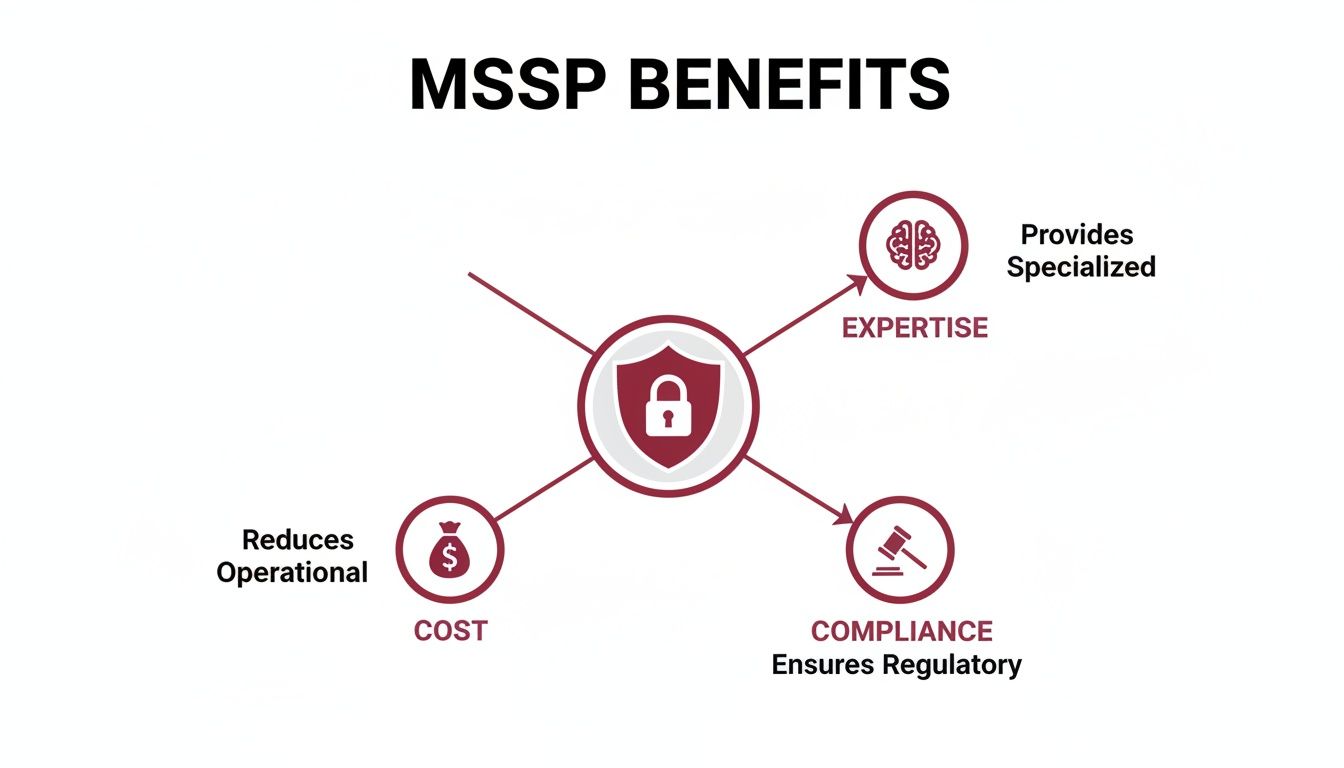
This visual perfectly illustrates how the pillars of an MSSP—expertise, cost savings, and compliance—work together to build a rock-solid security foundation for your business.
Providing the Audit Trail Auditors Demand
Getting ISO 27001 certified isn't just about having the right controls; it's about being able to prove it. Auditors don't take your word for it. They need cold, hard evidence—detailed reports, complete logs, and clear documentation showing that your ISMS is working day in and day out. This is another area where a managed security partner is worth their weight in gold. A core part of their service is generating the very proof you need.
An MSSP provides a continuous, automated audit trail. The detailed monthly reports, incident response tickets, and vulnerability scan results they produce are the exact artifacts an ISO 27001 auditor is looking for to verify your controls are working. Instead of your team spending weeks scrambling to gather data and write reports before an audit, the MSSP delivers it to you on a silver platter. They provide the objective, third-party proof that your security program is a living, effective system, not just a policy sitting in a folder. This is especially vital for small businesses that simply don't have the internal resources to produce this level of documentation. To get a better sense of the full scope of what's involved, you can learn more about the complete journey to ISO 27001 compliance here.
Navigating Broader Regulatory Requirements
The compliance benefits of an MSSP extend well beyond a single certification. The same operational discipline that helps with ISO 27001 also gives you a strong foundation for meeting other complex data protection and privacy regulations. Here in Australia, businesses have to deal with the Privacy Act and the Notifiable Data Breaches (NDB) scheme. On the global stage, regulations like the GDPR set a very high bar for protecting personal data. An MSSP’s structured incident response and detailed logging are critical for meeting the tight reporting deadlines and due diligence required by these laws. A key benefit is how an MSSP helps you navigate this complex regulatory landscape. They can offer guidance on achieving compliance with standards like ISO 27001 by using solutions like GDPR-compliant software integrations with Microsoft Purview. Their expertise ensures your security measures align with a whole spectrum of legal obligations, protecting your business on multiple fronts.
How to Choose the Right Security Partner
Picking a managed cyber security provider is one of the most critical decisions your business will make. This isn't like buying a new piece of software; you're entrusting a core part of your company's survival and resilience to a third party. A great partner becomes a genuine extension of your team, while the wrong one can create a world of frustration and, worse, introduce new risks.
To get this right, you have to look well beyond the monthly price tag. A true security partnership is forged from technical skill, deep industry knowledge, and a real alignment with your business goals. Let's walk through a clear framework for evaluating potential providers, so you can find a partner who will genuinely protect your business and support its growth.
Assess Their Technical Expertise and Technology Stack
First things first, you need to get under the bonnet and see what they're really working with. A slick sales pitch is worthless if the technology and the team behind it can't stand up to modern threats. When you're digging into their technical capabilities, here’s what to focus on:
- Technology Foundation: What specific Security Information and Event Management (SIEM) and Endpoint Detection and Response (EDR) platforms do they run? Ask them why they chose those tools and how that choice directly benefits a business like yours.
- Analyst Experience: How good are the people watching your screens? Ask about their team's certifications (like CISSP or GIAC), their ongoing training programs, and how long their analysts typically stick around in the security operations centre (SOC). High turnover can be a red flag.
- Automation and Orchestration: How do they use automation to speed up threat response? Mature providers use Security Orchestration, Automation, and Response (SOAR) platforms to handle the routine, noisy alerts, which frees up their human experts to focus on the complex, serious investigations.
This isn't about finding the provider with the longest list of fancy tools. It’s about finding one with a smart, integrated, and modern tech stack that's actually operated by a team of seasoned pros. Before you sign anything, a comprehensive approach to understanding vendor due diligence is non-negotiable.
Verify Their Industry-Specific Experience
Cyber security is absolutely not a one-size-fits-all game. The threats targeting a healthcare practice are worlds apart from those aimed at a manufacturing firm or a financial services company. A provider who already has deep experience in your industry brings an immediate advantage. They understand the unique risks you face and the specific regulatory hurdles you need to clear.
An industry-aware partner brings invaluable context. They know which threat groups are actively targeting your sector, which compliance frameworks (like APRA standards or the Privacy Act) matter most, and how to fine-tune their security alerts to your operational reality. Don't be shy about asking for case studies or references from other businesses in your field. A provider who truly gets your world will be happy to show you their track record and prove they can speak your language. This specialised knowledge turns your security from a generic, off-the-shelf defence into a highly targeted shield built for the real world you operate in.
Scrutinise the Service Level Agreement
The Service Level Agreement (SLA) is the single most important document in your relationship with a managed security provider. This is the contract that spells out their commitments to you, defining specific, measurable promises on performance and response times. Vague or weak SLAs are a massive red flag. Your potential partner's SLA must clearly define the metrics that matter most, especially for incident response. You need to see concrete numbers on:
- Time to Acknowledge: How quickly will they confirm receipt of a critical security alert? This needs to be measured in minutes, not hours.
- Time to Investigate: Once acknowledged, how long until a human analyst starts digging into the alert to figure out what's going on?
- Time to Contain: For a confirmed, critical incident, what's their target for stopping the bleeding—for example, isolating an infected laptop from the network?
A strong SLA provides the clarity and accountability you need. It ensures that when a crisis hits, there’s an agreed-upon plan for how fast your provider will jump in to protect your business. For more guidance on what a robust program looks like, our resources on cyber security consulting can offer some valuable direction.
Prioritise Local Australian Presence
In the world of cyber security, geography really matters. Partnering with a provider that has a real, established presence in Australia gives you several crucial advantages you just won't get from a purely offshore company. The biggest one is data sovereignty. Keeping your sensitive security data and logs within Australian borders is often a non-negotiable requirement for meeting local privacy laws and satisfying your own clients' expectations. An Australian-based provider ensures your data is handled according to our rules.
On top of that, a local team means local support. When you need to talk through a complex threat or an emergency incident, you'll be speaking with experts who understand the Australian business landscape and are actually awake during your business hours. That local expertise is irreplaceable. The Australian market for these services is exploding. Projections show it’s set to grow from roughly USD 5.87 billion in 2024 to over USD 13.31 billion by 2030, with services being the fastest-growing part of that. This boom means more vendors are flooding the market, making careful selection and prioritising local expertise more important than ever.
Critical Questions for Potential Providers
To get you ready for your evaluations, here is a checklist of essential questions to put to any potential security partner. Their answers will tell you a lot about their capabilities, their transparency, and whether they're the right fit for you.
- How do you tailor your services to our specific industry and risk profile?
- Can you walk me through your exact procedure for a critical ransomware alert, step by step?
- What are the specific time guarantees in your incident response SLA?
- Where is your security operations centre physically located, and where will our data be stored?
- How do you communicate with us during a major security incident? What’s the protocol?
- Can you show me some anonymised examples of the reports you deliver to clients like us?
- What does your onboarding process look like, and what exactly will you need from our team?
Choosing the right security partner is a foundational move in securing your business's future. By using this framework and asking these tough questions, you can cut through the sales noise and find a provider who will be a true ally in your defence.
Your Questions Answered: Getting Real About Managed Security
Taking the leap to partner with a managed cyber security provider is a big decision. It's not just about technology; it’s about trust, control, and making a smart investment in your business's future. It's totally normal to have a few questions.
To help you get clear on the details, we've compiled straightforward answers to the most common concerns we hear from Australian business owners. Let's cut through the jargon and get you the practical information you need to move forward with confidence.
How Much Do Managed Cyber Security Services Cost in Australia?
There's no one-size-fits-all price tag here. The cost really depends on your specific business—things like the number of staff, the complexity of your IT systems, and exactly which services you need. Most providers in Australia work on a tiered subscription model, which is great because it lets you find a plan that fits your budget and can grow with you. For a small business, a foundational package covering the essentials like 24/7 monitoring and endpoint protection could start from a few thousand dollars a month. For a mid-sized company with a more complex setup or heavy compliance obligations, that figure will naturally be higher.
But here's the real calculation to make: don't just look at the monthly fee. Weigh it against the catastrophic financial and reputational cost of a data breach. Then, consider the six-figure salaries and hefty software bills you'd face building a security team of this calibre yourself. Ultimately, a good managed service turns a massive, unpredictable risk into a predictable, manageable operating cost. It’s an investment in keeping the lights on.
Will I Lose Control Over My IT Environment?
This is a big one, and it's a completely valid concern. But the short answer is a firm "no." In fact, a true partnership with a quality provider enhances your control by giving you deeper visibility and expertise you simply wouldn't have otherwise. You always remain the owner of your IT strategy, your data, and all your digital assets. Think of your managed security provider as a specialist extension of your team, not a replacement. They handle the complex, time-consuming grind of security operations, but you stay firmly in the driver's seat for every strategic decision.
Here’s how you actually gain more control:
- You set the strategy: Your business goals and risk appetite dictate the entire security plan. The provider's job is to execute on your vision.
- They deliver clarity: Through detailed reports, regular meetings, and clear dashboards, you’ll get a clearer picture of your security posture than ever before.
- Roles are clearly defined: A good partnership starts by outlining who does what. This clarity ensures there’s no confusion and everyone is on the same page.
This frees up your internal people from the constant stress of security alerts, letting them focus on projects that actually drive the business forward.
What Is the Onboarding Process Like?
A smooth, well-structured onboarding is the hallmark of a professional provider. They know the transition has to be handled with care to avoid disrupting your business. While the specifics can vary, the process generally follows a logical path designed to integrate their services seamlessly. Here’s what that journey usually looks like:
- Discovery and Assessment: It all starts with a deep dive into your current setup. The provider works with you to map out your network, identify critical assets, review existing tools, and understand your key business risks. This is vital for tailoring the service properly.
- Deployment and Integration: Next, the team deploys the necessary security agents and tools. This might involve installing software on your computers and servers or setting up log collectors to feed data into their central monitoring platform (SIEM).
- Tuning and Stabilisation: This is where their expertise really shines. For the first few weeks, the security analysts fine-tune the systems. They get a feel for what "normal" activity looks like in your business, which allows them to slash the number of false alarms and ensure only genuine threats get escalated.
- Go-Live and Handover: Once everything is running smoothly, the service officially goes live. Your provider will walk you through their reporting, explain communication protocols, and clarify escalation procedures so you know exactly what to expect and who to call.
A top-notch provider will manage this entire process with you, keeping you in the loop and comfortable at every single step.
Can an MSSP Help After a Cyber Attack?
Yes, absolutely. While the main game is proactive prevention, many leading managed security providers also have dedicated Incident Response (IR) teams on standby. If you've already been hit by a breach, like a ransomware attack, these are the experts you call to get back on your feet. Their role in a crisis is critical. They focus on three key objectives to minimise the damage and restore your operations as quickly and safely as possible.
An IR team will immediately work to:
- Contain the threat: The first priority is to stop the bleeding. This often means isolating compromised machines from the rest of the network to stop a small problem from becoming a company-wide disaster.
- Eradicate the attacker: Once the attack is contained, the team meticulously hunts down and removes every last trace of the attacker from your systems. It’s a painstaking process to make sure they can’t get back in.
- Support recovery: Finally, they guide you through the recovery. This involves helping you safely restore from backups and advising on how to harden your defences to prevent the same thing from happening again.
These emergency services are often engaged on a separate retainer or as a one-off project. But having a relationship with a security provider before a crisis means you have a trusted partner to call when things go sideways.
Navigating cyber security is a journey, and you don’t have to go it alone. We specialise in helping Australian businesses build robust, compliant security programs that become a genuine asset. If you're ready to achieve ISO 27001 certification and turn security into a competitive advantage, we’re here to guide you. Contact us today to learn how we can help.
Recent Comments