

Imagine trying to build an elite, 24/7 security team to guard your digital assets from the ground up. It’s a massive undertaking, not just in cost but in finding the right expertise. That, in a nutshell, is the problem that managed IT security services solve. By partnering with a specialised third-party provider, you gain instant access to top-tier cybersecurity experts and advanced technology without the prohibitive overheads, ensuring robust protection against ever-evolving digital threats.
Who Are These Digital Bodyguards?
Trying to create your own sophisticated cybersecurity defence is a bit like building a high-tech security firm just to protect a single office building. You’d need a command centre, highly trained guards, the latest surveillance gear, and sharp intelligence analysts. For the vast majority of businesses, it's completely out of reach.
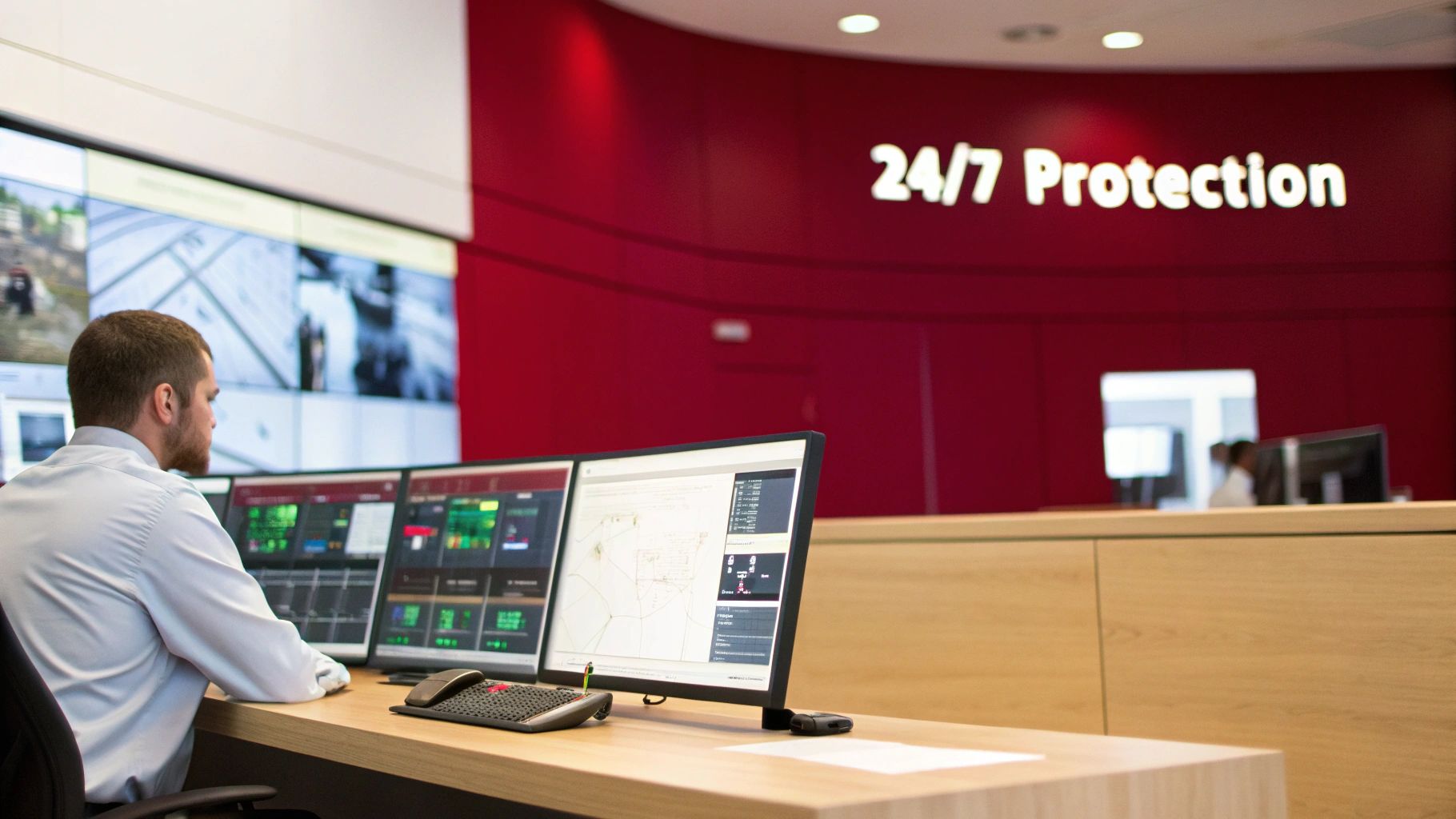
Managed IT security services provide a much smarter path. Instead of pouring money into your own Security Operations Centre (SOC), you bring in a Managed Security Service Provider (MSSP). This immediately plugs your business into a shared, world-class security infrastructure.
The Different Flavours of Managed Security
The managed security space isn’t one-size-fits-all. There are a few key service types, and knowing the difference is crucial for picking the right level of protection for your business.
- Managed Security Service Provider (MSSP): Think of this as the foundation. An MSSP manages your core security tools like firewalls, intrusion detection systems, and virtual private networks (VPNs). They keep the digital gates locked and monitored.
- Managed Detection and Response (MDR): This is a step up. MDR services are less about just reacting to alarms and more about actively hunting for threats that might have slipped past your initial defences. They bring in the forensics and rapid response teams.
- SOC-as-a-Service (SOCaaS): This is the full package. You essentially outsource your entire security operations to a dedicated team of analysts and engineers. They watch your systems around the clock, using their own powerful security platforms.
The real value here is simple: you get the peace of mind that comes with a fully staffed, expert security team for a predictable monthly fee. This frees you up to focus on what you do best—running your business.
This approach is no longer a luxury for Australian businesses; it's becoming a necessity. The local managed security services market recently hit USD 994.0 million and is on track to explode to USD 3,142.8 million by 2033.
What's driving this? A perfect storm of increasingly sophisticated threats like ransomware and a critical shortage of skilled cybersecurity talent, which makes building an in-house team almost impossible for many. To really grasp what's involved, a practical guide to managed network security solutions offers a great breakdown of how these services act as your digital protectors. You can dive deeper into the Australian market trends in this IMARC Group report.
Core Components of Managed IT Security Services
So, what exactly are you getting when you sign up? While every provider is a bit different, a solid managed security service is built on a few core pillars. These components work together to create a comprehensive defence for your business.
Here's a quick look at the key pieces of the puzzle:
| Service Component | Primary Function | Business Benefit |
|---|---|---|
| 24/7 Monitoring & Alerting | Continuously watches networks, servers, and devices for suspicious activity. | Catches threats as they happen, day or night, reducing potential damage. |
| Threat Intelligence | Gathers data on emerging threats, malware, and attacker tactics from global sources. | Proactively protects against new and unknown attacks, not just old ones. |
| Vulnerability Management | Scans systems for weaknesses and security gaps that could be exploited. | Helps you patch holes in your defence before attackers can find them. |
| Incident Response | Provides a structured plan and expert team to contain and resolve security breaches. | Minimises the financial and reputational impact of a successful cyber attack. |
| Firewall Management | Configures, manages, and updates firewall rules to control network traffic. | Ensures your first line of defence is always strong and correctly configured. |
| Endpoint Protection | Secures employee devices (laptops, phones) with advanced antivirus and threat detection. | Protects your business from threats that enter through its most common entry points. |
These elements form the backbone of a robust security posture, giving you a layered defence that would be incredibly difficult and expensive to replicate on your own.
The Essential Services a Modern MSSP Delivers
Partnering with a Managed Security Service Provider (MSSP) goes way beyond installing basic antivirus software. It's about wrapping your business in a multi-layered defence system, run by a team of dedicated experts. This comprehensive shield is built from several core services that all work together, protecting you from every angle imaginable. Once you understand these components, you'll see how managed IT security services can shift your cybersecurity from a reactive chore to a proactive business advantage.
These services are built to cover the entire lifecycle of a cyber threat—from preventing it in the first place, to detecting it, and finally, to launching a swift and decisive response. Let's break down what really makes up a modern managed security offering.
Constant Vigilance with 24/7 Threat Monitoring
Cybercriminals don’t work a 9-to-5, and your security shouldn't either. The absolute cornerstone of any good MSSP is its 24/7/365 threat monitoring. This is a non-stop watch over your entire digital footprint—your networks, servers, cloud accounts, and everything in between.
Think of it as having a security crew that never sleeps, never blinks, and never takes a holiday. This constant vigilance is absolutely critical, as a huge number of attacks are launched after hours or on weekends when internal IT teams are typically offline. With around-the-clock observation, an MSSP can spot and shut down suspicious activity the moment it happens, drastically limiting the potential damage.
The Central Command Centre: SIEM
At the heart of the operation is something called Security Information and Event Management, or SIEM. This is the brain, the central command centre that pulls in and analyses log data from every single part of your IT environment. Every firewall, server, and employee device is constantly feeding information back to the SIEM platform.
You can think of a SIEM like the head of security watching hundreds of CCTV monitors at once. But instead of relying on a person to spot one suspicious event among millions of normal ones, it uses powerful analytics and AI to connect the dots and identify patterns that point to a real threat. This frees up the human analysts to focus on genuine incidents instead of chasing ghosts.
Proactive Defence with Vulnerability Management
Waiting for an attacker to find a hole in your defences is a recipe for disaster. Vulnerability management is all about proactively finding and fixing those security gaps before criminals get a chance to exploit them. A good MSSP will regularly scan your systems, software, and applications to uncover known weaknesses.
This service typically includes:
- Regular Scanning: A mix of automated and manual scans to detect out-of-date software, poor configurations, and other security weak points.
- Prioritised Reporting: Not all vulnerabilities are created equal. The MSSP delivers clear reports that rank the most critical risks, so you know exactly what to fix first.
- Remediation Guidance: Your provider gives you expert advice on how to patch these vulnerabilities, making your defences stronger against common attack methods.
A huge part of finding these weaknesses involves controlled, ethical hacking. You can see how providers test your digital armour through services like penetration testing as a service, which simulates a real-world attack to find any cracks.
Guarding Your Devices with Endpoint Detection and Response
The laptops, desktops, and mobiles your team uses—known as endpoints—are prime targets for cyber attackers. Endpoint Detection and Response (EDR) is a huge leap forward from old-school antivirus. While traditional antivirus just looks for the fingerprints of known malware, EDR actively watches what’s happening on each device to detect and shut down more advanced threats.
Picture EDR as a highly trained security guard stationed at every single device. It doesn't just check IDs (signatures); it watches for suspicious behaviour, like an application trying to access files it has no business touching. If a threat is found, the EDR tool can instantly quarantine the infected device from the network to stop the attack from spreading, buying the security team precious time to investigate and eliminate it for good.
Why Australian Businesses Need an MSSP Partner
For many Australian businesses, outsourcing security has gone from a cost-saving tactic to a core strategic move. It's about survival and growth. The simple truth is, our local market has its own set of challenges, making a partnership with a Managed Security Service Provider (MSSP) less of a luxury and more of a necessity. Partnering with a specialist in managed IT security services helps you tackle these local issues head-on, so you can focus on running your business.
This isn't just a hunch; the numbers back it up. The IT Security Consulting industry here in Australia is on track to hit $8.0 billion in revenue. What's driving this? A massive wake-up call for businesses facing a relentless wave of cyber risks. And it's managed services leading that charge as the fastest-growing part of the sector. You can dig deeper into these trends with this detailed IBISWorld market analysis.
Overcoming the Local Skills Shortage
Let's be blunt: finding, hiring, and keeping good cybersecurity talent in Australia is incredibly hard and expensive. One of the biggest hurdles we face is a severe skills shortage. To build an in-house team that can monitor your systems 24/7, you'd need multiple expert analysts, threat hunters, and engineers—all commanding six-figure salaries.
An MSSP partner solves this problem instantly. You get immediate access to a deep bench of seasoned experts who live and breathe this stuff every day.
Instead of fighting for talent in a hyper-competitive job market, you tap into a ready-made, world-class team. This gives you enterprise-grade expertise without the recruitment nightmares and eye-watering payroll costs.
This talent gap is precisely why so many Australian organisations are turning to managed security. It’s the most practical way to bridge the divide between the expert protection you need and the people available to provide it.
Access Enterprise-Grade Defence on an SME Budget
Top-tier security tools—from sophisticated SIEM platforms to AI-driven threat detection systems—come with a price tag that can make your eyes water. For most small and medium-sized businesses, buying, setting up, and managing these systems is just out of the question.
This is where partnering with an MSSP really changes the game. They democratise security. Because they serve hundreds of clients, they can invest in the best technology on the market and offer it to you as part of a simple, predictable monthly fee. Suddenly, your business has the same level of protection that was once reserved for the big end of town, levelling the playing field against cyber criminals.
- Cost Efficiency: You dodge the huge upfront costs for software and hardware.
- Predictable Spending: A fixed monthly fee makes budgeting for security straightforward and transparent. No nasty surprises.
- Always-On Technology: The MSSP handles all the boring stuff—maintenance, updates, and licensing—so your protection is always current.
A Real-World Example of Proactive Defence
Imagine an Australian e-commerce business, gearing up for its biggest sale of the year. What they didn't know was that a ransomware group had already slipped into their network. The criminals were quietly getting ready to encrypt their entire system, timing it perfectly to cripple the business right before the sales launch.
But their MSSP’s 24/7 monitoring team saw something. Late on a Tuesday night, they picked up on faint but unusual outbound network traffic. The automated alert was immediately flagged for a human analyst, who recognised the pattern as a classic ransomware tactic. Within minutes, the compromised user account was locked, the malicious connection was severed, and the infected device was isolated from the network.
The attack was shut down before it even started. For this business, the MSSP didn't just stop a data breach; they saved the company's most important sales event and protected its reputation with customers. This is the real power of these services: they empower you to focus on what you do best, knowing that experts are vigilantly watching your back. With remote work now the norm, understanding these emerging cybersecurity threats in Australia has never been more critical.
Achieving ISO 27001 Compliance with Managed Security
For many Australian businesses, trying to get ISO 27001 certified can feel like a monumental task. Let’s be honest, it’s a demanding and complex standard that requires solid proof of your security controls at every turn. But what if there was a way to make this climb feel less like Everest and more like a manageable hike?
That's exactly where partnering with a managed IT security services provider comes in.
Think of an MSSP as your expert guide for this journey. Instead of you having to build an entire security operation from the ground up—hiring specialists, buying expensive tools, and developing complex procedures—you get immediate access to a seasoned team with all the right gear. This partnership doesn't just lighten the load; it accelerates your entire path to certification.
How Managed Services Directly Support ISO 27001 Controls
The real magic happens when you see how neatly a provider's services line up with the specific security controls listed in ISO 27001's Annex A. It’s a direct match. This gives auditors exactly what they need to see: clear, undeniable evidence that you have robust, professionally managed security measures in place. It's less about ticking boxes and more about genuinely implementing enterprise-grade security that naturally satisfies the standard.
For a clearer picture, let's look at how managed services directly address the requirements of the ISO 27001 standard.
| ISO 27001 Annex A Control | Control Objective | Supporting Managed Security Service |
|---|---|---|
| A.5.7 Threat Intelligence | To collect and analyse information related to information security threats. | Threat Intelligence Feeds: An MSSP provides curated threat feeds, identifying relevant attack vectors and indicators of compromise (IoCs) targeting your industry. |
| A.8.16 Monitoring Activities | To detect anomalous behaviour and potential security incidents. | 24/7 Security Operations Centre (SOC): This is the core of an MDR or SOCaaS offering. Experts constantly monitor your environment for suspicious activity. |
| A.8.23 Web Filtering | To protect against exposure to malicious content on external websites. | Managed Firewall & Web Security: Providers implement and manage web filtering policies to block access to known malicious sites and prevent malware downloads. |
| A.8.7 Protection Against Malware | To ensure that information and information processing facilities are protected from malware. | Managed Endpoint Detection and Response (EDR): This service goes beyond basic antivirus, providing advanced threat detection, investigation, and response on all endpoints. |
As you can see, you’re not just buying a service; you're implementing a specific control required by the standard. It’s a clean, efficient, and highly effective way to build your compliance case.
By bringing in an MSSP, you're essentially handing over the heavy lifting for many of these Annex A controls. This frees up your internal team to focus on the big picture—governance, strategy, and risk management—instead of getting bogged down in the daily grind of security alerts and log reviews.
This diagram breaks down how partnering with an MSSP helps businesses sidestep common roadblocks like the cybersecurity skills shortage, tight budgets, and the impossible demand for around-the-clock vigilance.
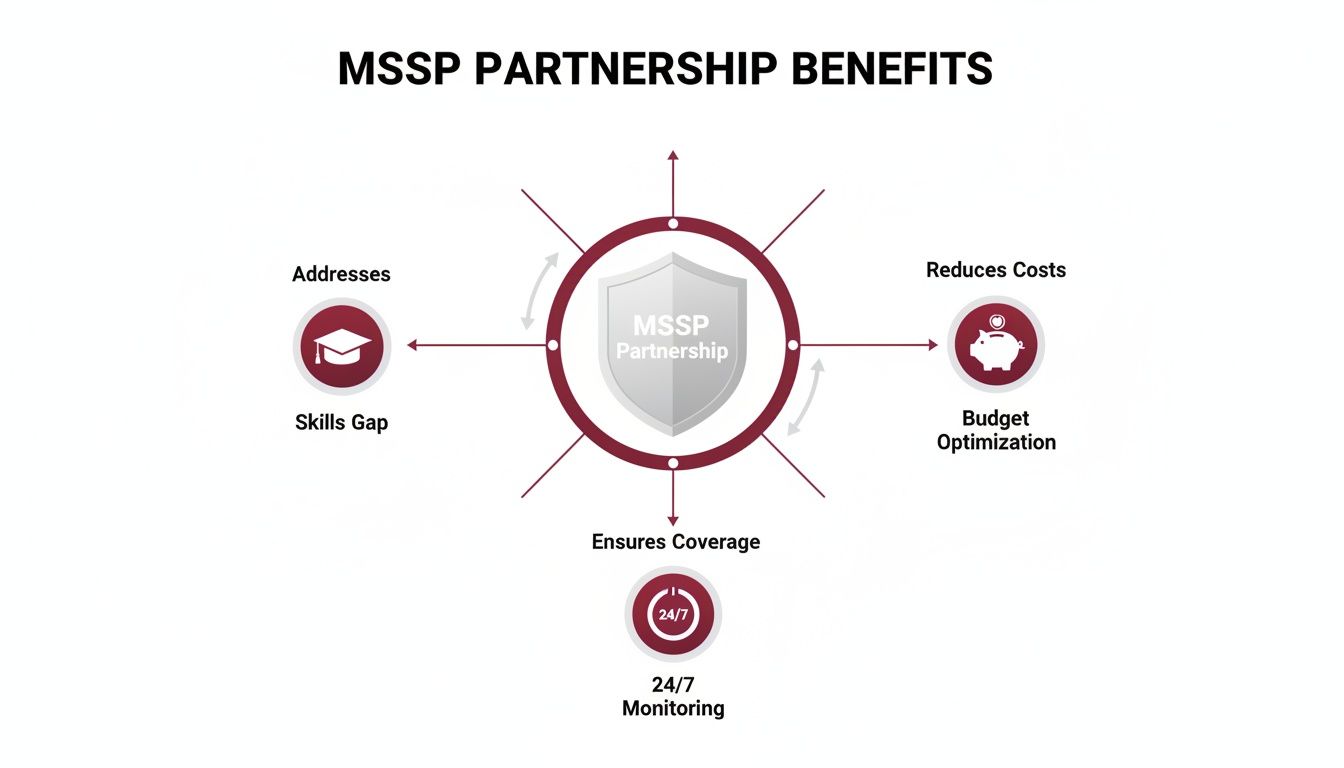
The bottom line is that a good MSSP solves several critical problems at once, making top-tier security both achievable and affordable for small and medium businesses.
Streamlining Audits and Keeping Your Certification
Getting certified is a huge milestone, but the work doesn’t stop there. ISO 27001 demands constant vigilance to prove your Information Security Management System (ISMS) remains effective. This is where an MSSP transitions from being a project partner to an indispensable part of your long-term strategy.
They provide the consistent, audit-ready evidence you need for your annual surveillance audits, making the process far less painful.
There’s a reason the demand for these services is exploding. Projections show that revenue from managed security services in Australia is on track to hit US$691.89 million, part of a much larger boom in the local cybersecurity market. This isn't surprising, given the combination of increasing cyber threats and stringent compliance rules that are pushing businesses to seek expert help.
A good MSSP becomes your secret weapon for audit season by providing:
- Consistent, Audit-Ready Reporting: Regular, detailed reports on incidents, vulnerabilities, and system health that you can hand straight to your auditor.
- Expert Guidance on Tap: Direct access to security pros who live and breathe this stuff. They know what auditors are looking for and can help you prepare and answer tough questions.
- Proof of Best Practice: The MSSP's own certifications and mature processes add a layer of credibility to your compliance claims, demonstrating a deep commitment to security excellence.
For any business serious about certification, it makes sense to explore how you can align with global standards like ISO 27001 and AI-powered risk detection. By turning a complex compliance project into a managed, ongoing process, you can maintain your certification with confidence.
Our team can walk you through everything that's involved in your ISO 27001 compliance journey. Ultimately, this approach doesn't just get you a certificate for the wall; it builds a genuinely resilient security posture that protects your business for years to come.
How to Choose the Right Australian Security Partner
Picking a managed security provider is one of the most critical decisions you'll make for your business. This isn't just about hiring a supplier; it's about finding a partner. You're bringing someone into the fold who you can trust to protect you, someone who becomes an extension of your own team—a guardian standing between your business and a world of very real threats.
To do this right, you need to look past the slick marketing and buzzwords. You're looking for a partner with a genuine, on-the-ground understanding of the Australian business scene, including the specific rules we all have to follow under the Privacy Act. This calls for a proper, structured look at what they offer to make sure it lines up with your business goals and what you're comfortable with, risk-wise.
Vetting Your Potential Partner
Before diving into the nitty-gritty, you need to do a quick gut check on whether a provider is even a potential fit. Think of it as a first-pass filter. Their experience, the tech they use, and their local presence are the big three.
- Australian Focus and Expertise: Are they actually here? A local team gets the nuances of regional threats, data sovereignty laws, and Australian compliance in a way an offshore call centre just can't.
- Proven Track Record: Ask to see their work. You want case studies and references from Australian businesses, preferably ones in your industry. If they've helped a business like yours before, they'll already know the challenges you face.
- Technology Stack: What tools are they using to protect you? You want a partner who invests in top-tier platforms for things like SIEM and EDR. Remember, their technology effectively becomes your technology.
Key Questions to Ask Every Provider
Once you've got a shortlist, it's time to get serious. You need to know exactly how they work, what to expect when things go wrong, and how they'll keep you in the loop. Think of this as a job interview for a crucial member of your team. Don't be afraid to dig deep.
This is your chance to really grill them. Their ability to handle pressure is what you're paying for, so test it.
Incident Response and Playbooks
How a provider acts in the first few moments of a crisis says everything. If their answers here are fuzzy, that’s a massive red flag.
- Walk me through your incident response process. I want to hear the step-by-step plan. What happens from the second your team confirms an alert is a real threat?
- What are your communication protocols during an incident? Who is my contact person? How often will I get updates, and will they be by phone, email, or a carrier pigeon?
- Can you share an anonymised example of a recent incident you handled? This is the best way to see how they think on their feet and solve real-world problems.
Service Levels and Reporting
You need absolute clarity here. It's essential to agree on what success looks like and how you'll measure it.
Service Level Agreements (SLAs) aren't just legal fluff. They are the foundation of your trust. Make sure they spell out clear, measurable targets for critical actions like ‘Time to Detect’ and ‘Time to Respond’.
- What are your specific SLAs? Get the actual numbers for key metrics. A good provider will have these ready and won't hesitate to share them.
- What do your standard reports look like? Ask for a sample. Is it a useful summary that gives you real insights, or just a giant, confusing spreadsheet?
- How do you tailor your services to our specific risks? A great partner will want to understand your business inside and out—what your "crown jewels" are and your appetite for risk—so they can customise how they monitor and respond to threats.
Your Onboarding and Implementation Journey
Taking the leap with a managed security provider might seem daunting, but a good partner makes the whole process smooth and, most importantly, doesn't get in the way of your day-to-day business. The aim is to get your new defences up and running fast, so you start seeing the value almost immediately. A clear, structured onboarding process takes the guesswork out of it, spelling out exactly what's needed from your team and what your new security partner will handle.
Think of it as a partnership from day one. It doesn’t kick off with a mountain of technical jargon, but with a simple conversation about your business.
Phase 1: Initial Discovery and Risk Assessment
First things first, your new security partner needs to get under the hood of your business. This initial phase is all about understanding your specific setup—your IT infrastructure, how your team works, and what unique risks you face. This isn't just a box-ticking technical audit; it’s a deep dive to figure out what your most critical digital assets are. We often call these the "crown jewels" of your organisation.
During this stage, you should expect your provider to:
- Map Your Network: Get a clear picture of every device, server, cloud service, and user account that needs protecting.
- Assess Your Current Security Posture: Take stock of the security tools and policies you already have and identify any obvious gaps or vulnerabilities.
- Define Key Objectives: Make sure the security strategy aligns with your business goals and compliance needs, like your obligations under the Australian Privacy Act.
This hands-on assessment ensures the security solution is built for your business, not some generic, one-size-fits-all template.
Phase 2: Deployment and Integration
Once there's a clear roadmap, the technical work begins. This is where the necessary security tools—things like endpoint agents on your computers and log collectors on your servers—are rolled out across your network. A huge focus here is making sure there’s zero disruption to your daily operations. The provider's engineers should work hand-in-glove with your own IT people to guarantee a smooth deployment.
This is where the partnership really comes to life. The provider’s job is to weave their advanced security tools into your existing systems, giving them a single, unified view of your entire digital footprint without creating headaches for your staff.
Phase 3: Fine-Tuning and Full Monitoring
After the tools are in place, there’s a critical period of fine-tuning. Some call it "baselining." Essentially, the security platform spends some time learning what "normal" activity looks like for your business. This calibration step is absolutely vital for cutting down on false alarms, making sure that when an alert does go off, it’s for a real threat.
Once that baseline is locked in, your service shifts into full 24/7 monitoring. From this point on, you have a dedicated Security Operations Centre watching over your business around the clock. This is the moment your investment in managed IT security services transforms into a tangible, always-on defence.
Answering Your Top Questions
Handing over the keys to your security is a big decision, and it’s only natural to have a few questions rattling around. Let's walk through some of the most common concerns we hear from business owners so you can move forward with confidence.
How Much Do Managed Security Services Cost in Australia?
There's no single price tag; the cost really hinges on your company's size and exactly what you need protecting. Many providers charge on a per-user basis, which can be anywhere from $30 to $60 per month. Others will offer tiered packages, where the price climbs with the level of protection.
So, what does that look like in real terms? A small Australian business with about 25 staff could expect to invest between $1,000 to $3,000 per month for a solid security service. Before you flinch at that number, stack it up against the cost of a single data breach, which can easily hit six figures. That's not even counting the eye-watering salaries you'd need to pay to build a security team of your own.
Will an MSSP Replace Our Current IT Team?
Not in the slightest. A good Managed Security Service Provider (MSSP) doesn't want to replace your IT people; they want to work with them. Think of them as a specialist security extension for your existing team, whether that's an in-house person or an external IT company (an MSP).
Your MSSP brings the heavy-duty security tools and the 24/7 eagle eyes, freeing up your IT team to focus on what they do best—keeping daily operations humming, running projects, and helping your staff. From day one, everyone knows their role and the communication lines are wide open, creating a really effective partnership.
As a Small Business, Are We Really a Target for Cyberattacks?
Yes, absolutely. It's a common misconception, but cybercriminals often see small businesses as the low-hanging fruit precisely because they assume security is weaker. A lot of attacks are automated anyway; bots are constantly scanning the internet for any open door, and they don't care how big the company is.
Criminals aren't just after your data. They often target small businesses as a backdoor into the supply chains of larger companies they work with. Protecting your business isn't just about your own assets and reputation; it's about being a trusted partner to your clients.
What Is the Difference Between an MSP and an MSSP?
Their names are similar, but their jobs are worlds apart. Here’s a simple way to think about it:
- A Managed Service Provider (MSP) is your IT generalist. They keep your systems running, manage the network, and make sure everything is working efficiently day-to-day.
- A Managed Security Service Provider (MSSP) is a laser-focused cybersecurity specialist. An MSP might install antivirus, but an MSSP is doing the deep-dive stuff: 24/7 threat hunting, emergency incident response, and sophisticated security monitoring.
Many businesses find the sweet spot by using both. The MSP keeps the engine running smoothly, while the MSSP acts as the high-tech alarm system, protecting the whole vehicle from hijackers. It’s a powerful combination that covers all your bases with dedicated experts.
Ready to secure your business and simplify your path to ISO 27001 compliance? The team at Anitech has over 20 years of experience helping Australian businesses build robust security programs. Get in touch with us today to learn how we can protect your organisation.
Recent Comments