

Managed IT security is more than just outsourcing your tech support; it's about forming a strategic partnership with a dedicated team of cybersecurity experts who proactively defend your business. This isn't about waiting for things to break. It's about 24/7 monitoring, active threat hunting, and having experts on standby to respond to incidents the moment they happen.
This approach gives your business access to enterprise-level security muscle without the staggering cost and complexity of building a specialist team from the ground up.
Why Your Business Needs a Strategic Defence Partner
Here in Australia, businesses are facing a constant barrage of sophisticated cyber threats. For most in-house IT teams, who are already stretched thin, keeping up is an almost impossible task. This relentless pressure inevitably leads to gaps in your defences—gaps that attackers are ready to exploit. This is where a strategic defence partner becomes a necessity, not a luxury.
Think of it like securing a commercial building. You wouldn't just install a few cameras and hope for the best. You'd hire a specialist security firm to manage everything: 24/7 surveillance, on-site guards, access control, and a clear plan for emergencies. It's a complete, expert-led solution designed for total peace of mind.
Managed IT security services work on the exact same principle for your digital assets. It’s not just about installing some antivirus software; it’s about embedding a team of specialists into your operations who act as a true extension of your business, safeguarding your data around the clock.
Moving Beyond Reactive Fixes
Traditional IT support is, by its nature, reactive. A server fails, an application crashes, an employee can't log in—and the team jumps in to fix it. That model works for day-to-day IT hiccups, but for cybersecurity, it's a recipe for disaster. A reactive approach means the breach has already happened and the damage is done.
A true security partner is relentlessly proactive. They're constantly hunting for vulnerabilities, monitoring network traffic for the slightest hint of suspicious activity, and fortifying your defences against the latest attack methods.
The real value of a managed security partner is their ability to see and stop threats before they can disrupt your business. It’s the difference between having a firefighter on speed dial and having a fire marshal working every day to prevent a fire from ever starting.
The Necessity of Specialised Expertise
Let's be blunt: cybersecurity has become far too complex for a generalist IT team to handle alone. The field now demands deep, specialised knowledge in areas like threat intelligence, cloud security, network forensics, and complex compliance frameworks.
For most Australian businesses, building an in-house team with that breadth and depth of expertise is simply not financially viable. A managed security provider gives you instant access to a whole team of these specialists. These are professionals who live and breathe cybersecurity every single day, bringing a wealth of experience from defending countless organisations against every kind of attack imaginable.
Deciding between an in-house team and a managed services provider often comes down to weighing capability against cost and complexity.
In-House IT vs Managed Security Services
| Capability | Typical In-House IT Team | Managed Security Services Partner |
|---|---|---|
| Availability | Operates during business hours, with limited on-call support. | 24/7/365 monitoring and incident response. |
| Expertise | Broad IT knowledge; often lacks deep security specialisation. | Team of dedicated specialists in various security domains. |
| Technology | Limited by budget for advanced security tools (SIEM, EDR). | Access to enterprise-grade technology and threat intelligence. |
| Cost Model | High fixed costs: salaries, benefits, training, software. | Predictable, scalable monthly fee. |
| Focus | Balances security with all other IT support tasks. | 100% focused on proactive threat detection and prevention. |
This comparison makes it clear that while in-house teams are vital, a managed partner brings a level of focus and specialisation that's incredibly difficult to replicate internally.
To build a truly resilient defence, you need to engage strategic IT partners who do more than just fix problems—they actively strengthen your security posture. This partnership frees you up to focus on what you do best, confident that your digital foundation is in expert hands.
Here’s how this changes the game for your business:
- From Cost Centre to Business Enabler: World-class security becomes a key selling point, building trust with clients and partners.
- From Reactive Scrambles to Proactive Defence: Your organisation shifts from constantly putting out fires to strategically preventing them.
- From Resource Drain to Force Multiplier: Your internal IT team is freed from the daily security grind, allowing them to focus on projects that drive growth.
Ultimately, choosing managed IT security isn't just an operational tweak; it's a core strategic decision. It’s about acknowledging the reality of modern threats and making the smart choice to partner with experts whose sole purpose is to keep your business safe, secure, and ready for whatever comes next.
The Market Forces Driving Australian Businesses to Outsource Security
The shift towards partnering with a managed security provider isn’t just a tech trend anymore; it’s a strategic business decision being made in boardrooms across Australia. Companies are waking up to the fact that top-notch cybersecurity is essential for survival and growth. But trying to build that capability in-house is proving to be a minefield of challenges.
This move to outsource is a direct response to some very real pressures in the market. At the top of the list is a massive imbalance between the demand for cybersecurity experts and the handful of qualified professionals available to fill those roles. This isn’t just a small gap; it's a chasm. For most businesses, building a security team from scratch is simply not a sustainable option.
Without the right people on your side, even the most expensive security software is little more than a digital paperweight. This reality is forcing leaders to look for smarter, more practical ways to defend their organisations.
The Unwinnable War for Talent
Let’s be blunt: the severe shortage of cybersecurity talent in Australia is the single biggest reason companies are turning to managed services. There's a fierce bidding war for anyone with skills in security analysis, threat hunting, or incident response. This competition has driven salaries into the stratosphere, putting experienced professionals well out of reach for most small and medium-sized businesses.
And even if you manage to land a great hire? Good luck keeping them. These experts are constantly headhunted by larger organisations offering bigger challenges, better tech, and more lucrative pay packets. The constant churn this creates is not only disruptive but leaves dangerous, gaping holes in your company’s defences.
Trying to build a comprehensive in-house security team today is like a local sports club trying to recruit a full roster of elite, international-level athletes. It's not only financially prohibitive but operationally impractical for long-term success.
This skills drought has poured fuel on the fire for the managed security services market in Australia. The growth is explosive. Valued at USD 994.0 million in 2024, the market is projected to more than triple to USD 3142.8 million by 2033. That’s a compound annual growth rate of 12.2%. Why? Because outsourcing gives you immediate access to the very experts you can't find or afford to hire directly. You can dig deeper into these market trends and their drivers in the full report.
The Escalating Costs of an In-House Security Operation
It’s not just about the salaries. The true cost of running your own internal Security Operations Centre (SOC) is staggering. When you start adding up all the associated expenses, you quickly realise the in-house model is a huge financial weight to carry.
These aren't just one-off costs, either. They form a financial barrier that most organisations simply can't push through on their own.
- Enterprise-Grade Technology: You need the big guns. Tools like Security Information and Event Management (SIEM) platforms, Endpoint Detection and Response (EDR) solutions, and threat intelligence feeds all come with hefty price tags for setup and ongoing licensing.
- Continuous Training and Certification: The threat landscape changes by the hour. To stay effective, your team needs constant training, workshops, and industry certifications. This costs a lot of time and money.
- 24/7/365 Operational Overhead: Cyberattacks don't stick to business hours. A true security operation needs to be watching 24/7. That means hiring enough staff to cover multiple shifts, which sends your salary, benefits, and management costs through the roof.
Working with a managed security services provider flips this script entirely. It turns all those unpredictable, lumpy capital costs into a flat, predictable operational expense. You get a complete, enterprise-grade security machine for a fixed monthly fee, which kills budget uncertainty and delivers a much better return on your investment.
Focusing on Core Business Objectives
Think about it this way: every minute your team spends trying to become cybersecurity experts is a minute they aren't spending on what actually makes your business money. More and more leaders are realising that while security is non-negotiable, it’s not their core business. Funnelling precious internal resources into managing a complex security operation can easily choke innovation and slow down the work that really matters.
Outsourcing lets you hand this critical, but specialised, function over to the experts. It’s a strategic move that frees up your people—from your IT helpdesk to your C-suite—to focus on what they do best: building amazing products, looking after customers, and growing the business.
When you trust your defences to a dedicated partner, your organisation can operate with real confidence. You know that your digital assets are being protected around the clock by a team whose only job is to stay ahead of the threats. It’s not just about offloading a task; it's about empowering your entire business to move faster, safer, and with greater purpose.
What's Actually in Your Managed Security Toolkit?
When you sign on with a managed security provider, what are you really paying for? It’s a fair question. You’re not just buying a piece of software or a subscription; you’re bringing on board a complete, living, breathing security operation. Let's pull back the curtain on the key services that make up your new defensive line, translating the technical jargon into real-world business value.
Think of it like this: a simple security camera might record a break-in after it's happened, but a dedicated security team actively patrols the perimeter, spots someone suspicious, and stops them before they can even touch the door. That's the difference a comprehensive managed it services security program makes. It’s all about being proactive, not just reacting to a crisis.
This infographic breaks down the foundational pillars of managed IT security, showing how essential functions like firewall management, endpoint protection, and round-the-clock monitoring create a powerful defensive structure.
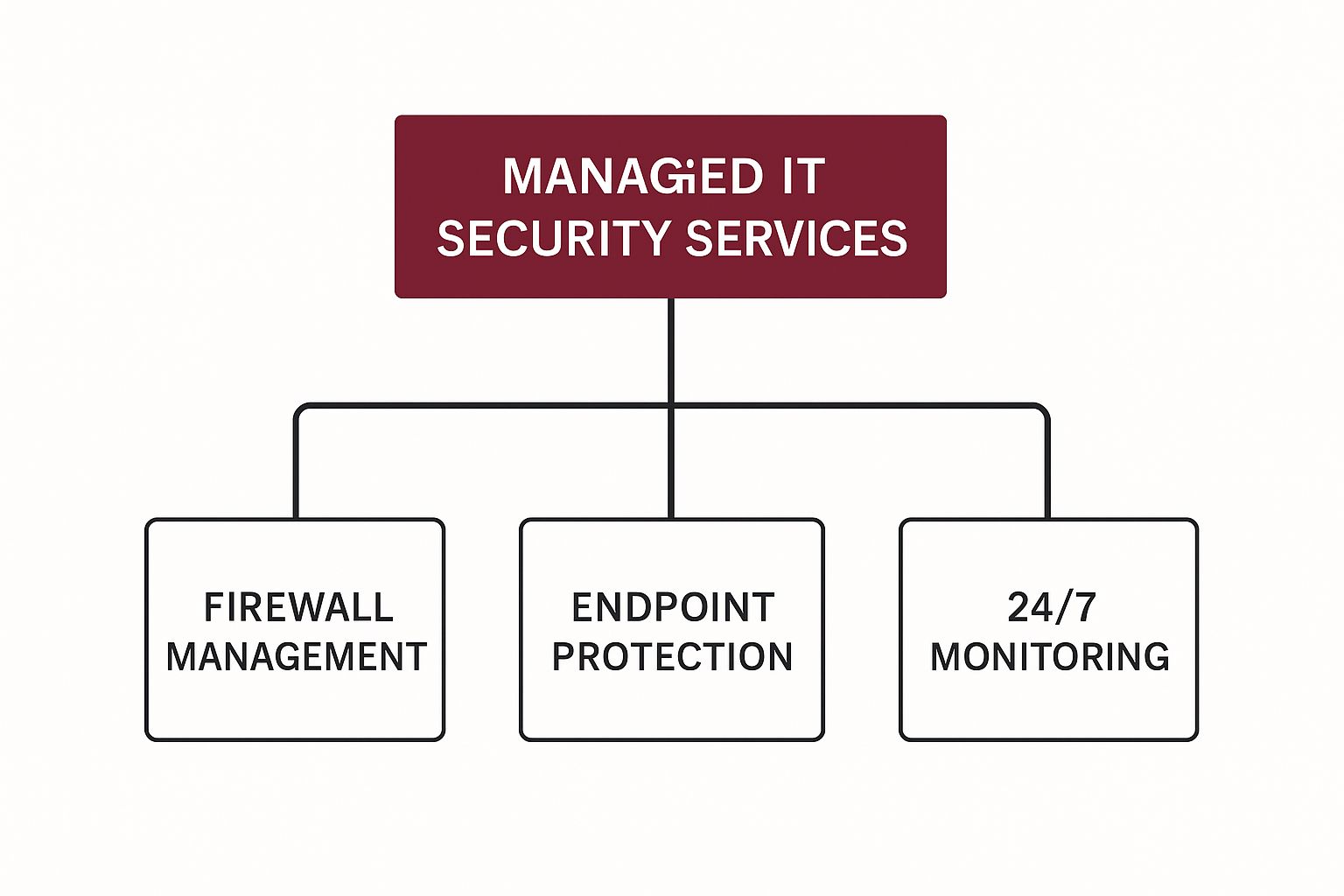
As you can see, a solid security posture isn't about one single tool. It's about multiple, interconnected layers of protection, all orchestrated by specialists. Let's get into the most critical services a top-tier provider should be delivering.
To better understand how these services work together, let's look at their specific functions and the tangible benefits they bring to your business.
Key Managed Security Services and Their Business Impact
| Service Component | Core Function | Direct Business Benefit |
|---|---|---|
| Managed Detection & Response (MDR) | 24/7 expert human monitoring and active threat hunting to contain threats that bypass automated defences. | Drastically reduces the time an attacker can spend in your network, minimising potential damage and data loss. |
| Vulnerability Management | Proactively identifying, prioritising, and assisting with fixing security weaknesses across your systems. | Systematically closes security gaps before they can be exploited, shrinking your overall 'attack surface'. |
| Security Information & Event Management (SIEM) | Collecting and analysing log data from all systems to spot suspicious patterns and potential attacks. | Provides a single, clear view of security events, turning millions of data points into actionable intelligence. |
| Threat Intelligence | Providing context on active threats, attacker methods, and new vulnerabilities relevant to your industry. | Allows for proactive defence by anticipating attacks and strengthening security controls before a threat arrives. |
These services form the engine room of a modern managed security program, working in concert to keep your organisation safe. Let's explore each one a bit more.
Managed Detection and Response (MDR)
Think of Managed Detection and Response (MDR) as the elite special forces unit in your security arsenal. It goes miles beyond traditional antivirus, which is more like a friendly security guard checking IDs at the front door. MDR is the team of expert hunters actively sweeping your entire digital territory, searching for the cunning threats that have already slipped past your initial defences.
MDR services use sophisticated tools to constantly watch your network, servers, and endpoints for the faintest signs of an attack. When something fishy is flagged, it doesn't just trigger an automated alert that gets lost in a sea of notifications. A human analyst immediately jumps in to investigate, figure out the risk, and take decisive action to shut it down.
This service is what separates a business that learns about a breach from the evening news from one that stops it cold. A 2024 report revealed that the average time to identify and contain a data breach is a shocking 277 days. MDR’s goal is to crush that timeline from months down to mere minutes.
Vulnerability Management
If MDR is your active patrol, then vulnerability management is your team of structural engineers, constantly reinforcing the building itself. It’s a continuous, proactive process of finding, assessing, and fixing security weaknesses in your systems before attackers even know they exist.
It’s like giving your entire digital infrastructure a regular, top-to-bottom health check. The provider scans everything—your network, applications, and cloud environments—to find potential entry points. These could be anything from unpatched software and misconfigured servers to outdated systems that have been forgotten.
And this isn't about just running a scan and dumping a jargon-filled report in your lap. A true partner helps you prioritise the most critical vulnerabilities based on the actual risk to your business and gives you clear, actionable advice on how to fix them.
Effective vulnerability management is all about systematically reducing your attack surface. It’s like methodically going through your building and locking every single unsecured window and door, making it exponentially harder for anyone to break in.
Security Information and Event Management (SIEM)
A modern business generates a mind-boggling amount of security data from firewalls, servers, apps, and employee devices. A Security Information and Event Management (SIEM) system is the central nervous system that gathers, analyses, and pieces together all of this information into a single, coherent picture.
Without a SIEM, trying to spot a genuine threat is like trying to hear a single suspicious whisper in a loud, packed stadium. The SIEM acts as a powerful filter, cutting through all the noise to amplify the signals that actually matter. It uses clever rules and machine learning to connect dots between seemingly unrelated events.
For example, a SIEM can link a failed login attempt from an unusual location, a strange process suddenly starting on a server, and an alert from an endpoint device. On their own, each of these might be ignored. Together, they paint a clear picture of an attack in progress. Strong managed it services security depends on solid Logging, Monitoring, and Incident Response procedures, all driven by a well-tuned SIEM.
Threat Intelligence Services
Threat intelligence is your early-warning system. It gives you critical information about new and emerging threats, attacker tactics, and vulnerabilities that are actively being exploited out in the wild. It’s the equivalent of getting a detailed briefing on an enemy’s battle plans before they even launch an attack.
A managed security provider subscribes to multiple global threat intelligence feeds and, more importantly, has a team of analysts who interpret that data for your business.
- Who is targeting businesses like yours?
- What new tricks are they using?
- Are your systems exposed to their latest tools?
This intelligence allows your provider to proactively tune your defences. For instance, if intelligence shows a new ransomware strain is hitting Australian financial firms through a specific software flaw, your provider can immediately patch it and configure your systems to block the attack’s known signatures. This forward-thinking approach is especially vital for protecting data in shared environments, a topic we cover in our guide to cloud security fundamentals.
Together, these core services create a powerful, layered defence. They ensure your business isn't just sitting behind static walls but is being actively defended by a dynamic, intelligent, and relentlessly vigilant security operation.
Why Businesses Now Demand Advanced Security Expertise

The game has changed. Gone are the days when Australian businesses just needed basic IT support. Now, they're looking for partners with seriously deep, specialised knowledge to help them navigate a much more dangerous digital world.
What used to be a simple service agreement has become a strategic necessity. This shift is all down to the explosion of complex security challenges that internal teams just don't have the time or training to handle. We're talking about new battlegrounds like cloud security governance, AI-driven threat analysis, and zero-trust architecture.
Companies aren't just asking for this level of expertise anymore—they're demanding it. They know that staying ahead of sophisticated, fast-moving threats is crucial for survival, let alone growth. This has completely changed what they look for in a managed security partner.
The Move from Generalists to Specialists
Not too long ago, a firewall and some antivirus software were considered a solid security plan. Today, that’s like trying to put out a bushfire with a garden hose. The threats we face are smarter, faster, and more destructive than ever before.
This harsh reality has forced businesses to accept that general IT knowledge just doesn’t cut it. They need specialists—people who live and breathe specific security disciplines.
-
Cloud Security Governance: As companies flock to the cloud, they're stepping into a minefield of new risks. A specialist knows exactly how to lock down environments like AWS and Azure, manage who gets access to what, and keep everything compliant.
-
AI-Driven Threat Analysis: Attackers are using AI to create more convincing and rapid-fire attacks. The only way to fight back is with our own AI-powered tools that can sift through mountains of data, spot tiny irregularities, and flag threats in real-time that a human would almost certainly miss.
-
Zero-Trust Architecture Implementation: The old "trust but verify" model is broken. A zero-trust approach works on a simple principle: trust no one. Implementing this philosophy requires a complete overhaul of network security, and it's a massive project that absolutely needs specialised skills. You can learn more about how a zero-trust architecture can reinvent your information security to get a better handle on this modern approach.
This isn't about just outsourcing a task anymore. It's about bringing in critical expertise that’s simply impossible to build in-house quickly or cost-effectively.
The High Cost of Falling Behind
Business leaders are keenly aware that the stakes have never been higher. A recent industry survey shows just how much Australian organisations now depend on managed IT service providers (MSPs). A massive 77% of Australian businesses already use MSPs for their security needs.
But here’s the kicker: the survey also found that 54% specifically need help managing the overwhelming complexity of their security tools. They're looking for partners who can simplify their setup, not just add another layer to it. For a deeper dive, you can discover more insights about MSP customer trends in the 2025 report.
This demand for advanced help isn't just talk—it's backed by serious investment. The same research revealed that 92% of organisations globally are willing to pay a premium, sometimes up to 25% more, for a provider who can deliver these high-level capabilities.
The message from the market is loud and clear: businesses see advanced security expertise not as a cost, but as a vital investment in their own resilience. They want a strategic advisor, not just a system administrator.
Why 24/7 Support and Tool Consolidation Are Non-Negotiable
Beyond the high-level skills, there are two practical demands that are now deal-breakers for Australian businesses.
The first is 24/7 support. Cyber threats don't stick to business hours. An attack launched overnight from the other side of the world can bring a company to its knees by morning. The data is stark: 48% of Australian organisations said they would ditch their MSP if they couldn't get round-the-clock security support.
The second is taming 'tool sprawl'. Many companies have accidentally collected a messy jumble of security products over the years. These tools rarely play well together, creating blind spots and flooding teams with useless alerts. A top-tier security partner cuts through this chaos. They integrate everything into a single, cohesive platform, giving a clear, unified view of the entire security posture.
This isn’t just about making life easier; it’s about making security work. By streamlining the tech stack, a good partner reduces complexity and ensures real threats don't get lost in the noise. It’s this ability to bring order to chaos that truly sets the best providers apart.
Talking Cybersecurity in the Boardroom
Cybersecurity is no longer a conversation confined to the server room; it's a permanent fixture on the boardroom agenda. It has fundamentally shifted from being a niche IT problem to a cornerstone of business resilience, brand reputation, and long-term financial health. This means the way we talk about it has to change, connecting the technical nuts and bolts of security services directly to the outcomes that boards and executives actually care about.
The old playbook of simply trying to prevent attacks is outdated. Smart organisations now realise that it’s not a matter of if a cyber incident will happen, but when. The real measure of success is how fast you can get back on your feet, which is why mature incident response and recovery capabilities are now front and centre.
This is where a strategic partnership with a managed security provider comes in. It’s the key to meeting these higher expectations, transforming security from a grudge purchase into a strategic asset that supports growth, builds trust, and secures the company's future.
From Tech-Speak to Business Impact
Let's be honest: terms like "malware signatures" or "firewall rule sets" make a board of directors’ eyes glaze over. They speak the language of risk, revenue, and reputation. A huge part of a managed IT services security partner's job is to act as a translator, bridging this gap by turning security actions into tangible business results.
So, instead of just reporting on the number of threats blocked, the conversation shifts to business continuity. The goal is to show a direct line between proactive security measures and the protection of revenue-generating operations, preventing the kind of downtime that can cripple a business.
A great security program isn't measured by the number of attacks it stops. It’s measured by its ability to ensure the business never stops. It’s about building resilience, not just resistance.
When you frame it this way, security is no longer seen as a cost centre. It becomes a direct contributor to the bottom line, protecting the very assets that make money and safeguarding the brand reputation that keeps customers coming back.
Meeting the Board's Expectations on Risk and Compliance
Directors and C-suite leaders are under more pressure than ever to get a handle on cyber risk. A failure here can lead to serious legal and financial pain. What they need is clear, unambiguous assurance that the company is not just secure, but also compliant with all the relevant industry and government regulations.
A managed security provider gives them that peace of mind through:
- Demonstrable Compliance: Delivering the detailed reports and audit trails needed to satisfy regulators and prove that you've done your due diligence.
- Proactive Risk Reduction: Constantly hunting for and fixing vulnerabilities to systematically lower the organisation's overall risk profile.
- Expert Guidance: Offering strategic advice on how to navigate complex regulatory minefields and stay ahead of future compliance demands.
This partnership provides the board with the confidence that their oversight responsibilities are being handled by genuine experts. It allows them to make sharp, strategic decisions because they have a crystal-clear understanding of where the company stands.
Justifying the Investment in Security
The discussion around cybersecurity spending is getting louder in Australian boardrooms, and for good reason. With IT spending in the country projected to top AUD 172 billion in 2026, security is a major priority. In fact, Australian companies are on track to boost their cybersecurity budgets by a massive 33% in 2025, largely to combat the rise of AI-driven social engineering and deepfakes. When 64% of C-suite leaders admit their organisations are significantly exposed to cyber risk, the need for expert-led services is undeniable. You can explore the top IT spending priorities for Australian businesses for a deeper dive.
A good managed security partner is essential for justifying this spend. They bring the data and the context needed to build a rock-solid business case.
This isn’t just about calculating the cost of a potential breach. It’s about showing a clear return on investment (ROI) by demonstrating how a strong security posture actually enables business growth. It gives a company the confidence to adopt new technologies, push into new markets, and innovate without constantly looking over its shoulder.
Making Security a Springboard for Growth
Ultimately, the goal is to stop thinking of security as a roadblock and start seeing it for what it is: a critical enabler of progress. When security is woven into the fabric of every new project from day one, the entire business can move faster and more safely.
A managed security partner helps make this happen by:
- Securing Cloud Adoption: Bringing in the specialised expertise to ensure cloud environments are locked down, letting the business reap the full benefits of the cloud.
- Enabling Remote Work: Implementing robust security that protects data wherever your people are, whether they're in the office or on the other side of the world.
- Building Customer Trust: Proving a rock-solid commitment to data protection, which is fast becoming one of the most powerful competitive advantages a business can have.
By aligning security strategy with core business objectives, a managed services provider helps shift cybersecurity from a defensive, reactive function to a proactive, strategic one. This partnership ensures that as your business grows and changes, your security grows right alongside it, satisfying the board and clearing the path for future success.
How to Select the Right Managed Security Partner for Your Business
Picking a partner for your managed IT security services is one of the biggest long-term decisions your business will face. This isn't like choosing a new piece of software; you're handing over the keys to your digital kingdom to a strategic partner. Get it right, and you can move forward with confidence. Get it wrong, and you could be left dangerously exposed.
It’s tempting to just compare quotes, but that’s a mistake. You need a solid framework to properly vet potential partners and find the one that genuinely fits your company’s specific needs, risk tolerance, and where you're heading. It’s all about asking the hard questions and digging deep into their skills, their processes, and their people.
Look for Proven Industry Experience
Your first filter should always be experience in your specific industry. A provider who’s a pro at protecting retail chains might be completely out of their depth with the compliance headaches and threat types common in healthcare or finance. Cybercriminals don't use a one-size-fits-all approach—they tailor their attacks—and your security partner needs to know exactly what kind of threats are knocking on your door.
When you’re talking to potential partners, ask them to show you case studies or give you references from businesses like yours. You want proof that they've walked this path before.
A provider with the right background will already be up to speed on:
- The specific regulations and compliance standards you have to follow.
- The common software you use and all its known weak spots.
- The types of data you handle and the best ways to lock it down.
This kind of specialised knowledge is gold. It means they can build a security strategy that works from day one, not some generic template that doesn't really fit.
Scrutinise the Service Level Agreement
The Service Level Agreement (SLA) is more than just a contract; it’s the rulebook for your relationship. It’s a critical document that sets out exactly what they promise to deliver in clear, measurable terms. If an SLA is vague or they’re unwilling to budge on terms, that's a huge red flag. It often points to a lack of accountability down the line.
A good SLA will nail down all the key metrics, leaving zero room for confusion when things go wrong.
Think of the SLA as a document of promises, not possibilities. It must clearly define response times, how they'll communicate, and who gets called when, so you know exactly what to expect when an incident hits.
Here’s what to look for in the fine print:
- Mean Time to Detect (MTTD): How fast will they spot a potential threat?
- Mean Time to Respond (MTTR): Once they find something, how quickly will an analyst jump on it?
- Communication Plan: Who are they calling on your team, and how, when there's a problem?
- Reporting Frequency: What reports will you get, and how often will you see them?
A transparent provider will have no problem walking you through their SLA line by line and might even be open to tweaking terms to better suit your needs.
Verify Their Security Credentials and Expertise
You wouldn't hire a security guard without checking their background, right? The same logic applies here. You absolutely must verify the provider’s own security credentials and the qualifications of their team. If they can't protect their own house, how can they possibly protect yours?
Look for internationally recognised certifications. These are independent proof that their processes are solid and that they take security seriously. The big one to ask about is ISO 27001 certification. This standard shows they have a comprehensive Information Security Management System (ISMS) in place and are committed to protecting their clients' data.
But don't stop at the company level. Ask about the certifications their security analysts hold. You want to see qualifications like CISSP, CISM, or other credentials relevant to the tools they use. A partner that invests in training its people is a partner dedicated to staying one step ahead of the bad guys. A credible partner will also understand that a detailed risk assessment for cyber security is the critical starting point for any robust security plan and should be able to explain their process thoroughly.
Answering Your Top Questions About Managed Security Services
Stepping into the world of managed security can feel a bit daunting, and it's natural for business leaders to have questions. Let's tackle some of the most common ones to give you a clearer picture of what partnering with a security specialist really looks like.
How Is Managed Security Different From Standard IT Support?
Think of it this way: your standard IT support team is like the brilliant mechanic who keeps your car running day-to-day. They fix things when they break—a software glitch, a hardware failure, a password reset. Their job is to react to problems and restore normal operations as quickly as possible.
Managed security, on the other hand, is your dedicated security detail. They aren't waiting for something to go wrong. Their entire focus is proactive defence. They’re constantly monitoring your systems 24/7, actively hunting for threats, and building a security strategy to stop attackers before they even get close. It’s the difference between fixing a broken lock and having a dedicated team making sure no one ever tries to break in.
Is My Small Business Really a Target for Cyberattacks?
Unfortunately, yes. It's a common misconception that attackers only go after the big players. In reality, small and medium-sized businesses are often seen as the perfect targets because they're presumed to have fewer defences. Attackers see them as an easy way to access valuable data or as a stepping stone into the networks of their larger corporate partners.
This is where managed security services really level the playing field. They give smaller companies access to the same powerful, enterprise-grade security tools and expert teams that large corporations rely on. It makes top-tier defence affordable and achievable, no matter how big your business is.
Essentially, it removes the "easy target" label from your back.
What’s the Onboarding Process Like?
Any good provider will have a clear, structured onboarding process designed to get you protected without causing chaos. While the exact steps might differ slightly between providers, it generally follows a proven path.
- Discovery and Assessment: First, they’ll do a deep dive into your current IT setup and security measures. This is all about understanding your specific risks, what your most critical assets are, and how your business actually operates.
- Tool Deployment: With that understanding, they'll roll out their monitoring and protection tools across your network, servers, and computers. This gives them the visibility they need to see everything that’s happening.
- Baseline Establishment: The system then spends a bit of time learning what "normal" looks like for your business. This is a crucial step that allows it to spot unusual activity that could signal a threat, without crying wolf every five minutes.
- Protocol Finalisation: Finally, you'll work together to lock in communication plans and incident response procedures. This makes sure everyone knows exactly what to do and who to call if a security event occurs, creating a true partnership.
Can a Managed Security Service Help With Compliance?
Absolutely. For many Australian businesses, complying with data protection and privacy regulations isn't optional. A quality managed security provider is an expert in these frameworks and becomes a crucial part of your compliance strategy.
They help by putting the right technical controls in place, providing the detailed reports you need for audits, and ensuring the continuous monitoring required to satisfy standards like the Privacy Act, APRA regulations, or even global frameworks like ISO 27001. They handle the technical heavy lifting, which dramatically eases your team's compliance workload and helps you stay on the right side of regulators.
At Anitech, we specialise in making complex security frameworks like ISO 27001 straightforward for Australian businesses. If you're ready to turn your security posture from a liability into a genuine asset, take a look at our expert consulting services. Find out how we can guide you to certification at https://iso-27001.com.au.
Recent Comments