

If your Australian business accepts card payments—whether online or in-store—then achieving PCI compliance in Australia isn't just a recommendation, it's an essential part of your operations. The Payment Card Industry Data Security Standard (PCI DSS) is the global benchmark for protecting sensitive cardholder data, building the customer trust you need to thrive. Ignoring these standards is a direct path to severe financial penalties, reputational damage, and a potential loss of your ability to process card payments.
Why PCI Compliance Is Non-Negotiable for Australian Businesses
For any business in Australia that processes, stores, or transmits credit card data, robust PCI compliance is the foundation of data security and customer trust. The Payment Card Industry Data Security Standard (PCI DSS) provides a critical framework of technical and operational requirements designed to protect this sensitive information from the ever-present threat of cyber attacks and data breaches.

Think of PCI DSS as the digital equivalent of a bank vault for your customers' data. It sets the minimum security standards for creating a secure payment environment, shielding both your operations and your clients from the catastrophic fallout of a data breach. In a market where a single security incident can erode years of brand loyalty, compliance becomes a powerful competitive advantage, not just another regulatory hurdle.
The High Stakes of Non-Compliance
Australians are avid users of card payments, with over 12.52 million credit card users and millions more relying on debit cards for daily transactions. This immense volume makes every Australian business that accepts cards a prime target for cybercriminals.
The risk is tangible and growing. In the first quarter of this year alone, data from approximately 1.8 million accounts was leaked in Australia—a number that continues to climb. The financial impact is equally staggering; the average data breach now costs an Australian business an average of AUD $4.26 million. This is a figure that could easily bankrupt most small to medium-sized enterprises.
Inaction is simply not an option. Ignoring PCI DSS can lead to hefty monthly fines, your merchant account being shut down, and the kind of damage to your brand that you may never recover from.
Building a Foundation of Trust
Proactively managing compliance does more than just protect data; it sends a clear message to your customers that you take their security seriously. It demonstrates a commitment to robust security practices that safeguard your entire business, far beyond just payment details. That commitment is what builds lasting customer loyalty and ensures your long-term viability.
A critical first step, especially for online businesses, involves securing your website with an SSL Certificate. This encrypts the connection between your site and its users, serving as a fundamental layer of defence against common cyber threats.
What's Your PCI Merchant Level in Australia?
Before you can begin your compliance journey, you must understand your specific obligations. PCI compliance isn’t a one-size-fits-all set of rules. Instead, your requirements are determined by your merchant level, which is based directly on the volume of card transactions you process annually. The more transactions you handle, the greater the risk, and the more stringent the compliance requirements become.
Correctly identifying your level from the outset is crucial. Overestimating it could lead you to spend unnecessarily on complex audits you don't need. Underestimating it, however, means you might fail to meet your obligations, leaving your business—and your customers—vulnerable to a data breach.
Finding Your Tier: A Quick Guide
The major card brands, like Visa and Mastercard, classify businesses into four distinct merchant levels based on the number of card transactions processed over a 12-month period. This tiered system ensures the compliance burden matches the potential risk. A small local cafe, for instance, faces a different risk profile than a large national retailer, and their compliance paths reflect this.
Here’s a clear breakdown of the Australian PCI DSS merchant levels and what you'll need to do to validate your compliance each year.
Australian PCI DSS Merchant Levels and Requirements
| Merchant Level | Annual Transaction Volume (Visa/Mastercard) | Validation Requirements |
|---|---|---|
| Level 1 | Over 6 million transactions (any channel) | • Annual Report on Compliance (ROC) by a QSA • Quarterly network scan by an ASV • Attestation of Compliance (AOC) |
| Level 2 | 1 million to 6 million transactions (any channel) | • Annual Self-Assessment Questionnaire (SAQ) • Quarterly network scan by an ASV • Attestation of Compliance (AOC) |
| Level 3 | 20,000 to 1 million e-commerce transactions | • Annual Self-Assessment Questionnaire (SAQ) • Quarterly network scan by an ASV • Attestation of Compliance (AOC) |
| Level 4 | • Up to 1 million transactions (any channel) • Less than 20,000 e-commerce transactions |
• Annual Self-Assessment Questionnaire (SAQ) • Quarterly network scan by an ASV (if applicable) • Attestation of Compliance (AOC) |
As the table shows, the higher your transaction volume, the more rigorous the validation process. Let's explore what this means in practice.
Level 1: The Heavy Hitters
This is the highest tier, reserved for the largest merchants. You fall into Level 1 if you process over 6 million card transactions annually. This category also applies to any business, regardless of size, that has experienced a data breach where cardholder information was compromised.
Level 1 merchants face the highest level of scrutiny. There is no self-assessment option; you must engage independent professionals for a formal audit every year.
This involves:
- An Annual Report on Compliance (ROC), which is a detailed, on-site audit conducted by a certified Qualified Security Assessor (QSA).
- Quarterly network vulnerability scans by an Approved Scanning Vendor (ASV) to identify and remediate security weaknesses.
- Completing an Attestation of Compliance (AOC) form to formally declare that all requirements have been met.
Levels 2, 3, and 4: The Path for Most Aussie Businesses
The vast majority of small and medium-sized businesses in Australia will fall into one of these three categories. The key difference from Level 1 is that you can use a Self-Assessment Questionnaire (SAQ) to validate your compliance, which is a significantly less intensive and costly process.
Here’s the simple breakdown:
- Level 2: You process between 1 million and 6 million transactions annually.
- Level 3: You are an e-commerce business handling 20,000 to 1 million online transactions per year.
- Level 4: This covers all other merchants, including those processing fewer than 20,000 e-commerce transactions or up to 1 million in-person transactions annually.
If you’re in one of these tiers, you'll need to complete the appropriate SAQ annually and likely conduct quarterly ASV scans. Understanding your level is also vital when consulting a comprehensive guide to choosing the right POS system, as your technology choices directly impact your compliance scope and complexity.
You don't need to figure this out alone. Your acquiring bank or payment provider is your primary resource—they will confirm your exact merchant level and specify which SAQ you are required to complete.
Getting Ready for PCI DSS 4.0: What’s Changing and Why It Matters
The payment security landscape is undergoing its most significant evolution in a decade with the introduction of PCI DSS 4.0. This is not merely a minor update; it's a fundamental overhaul designed to equip Australian businesses against more sophisticated and modern cyber threats. The transition period is ending, and the deadline for full compliance is fast approaching.
This update was long overdue. Cybercriminals have evolved their tactics, moving beyond traditional attacks to sophisticated methods like e-skimming, where they steal card data directly from a website's payment page. They are also adept at executing targeted phishing campaigns and exploiting vulnerabilities in cloud services. Version 4.0 is the response to these modern dangers, shifting the focus of security from a static, annual checklist to a continuous, proactive process.
One of the most significant changes is the introduction of a more flexible, objective-based approach. Instead of mandating a single method for every control, the new standard allows businesses to design and implement customized security controls that meet the same protective goal. This provides greater freedom but also requires a deeper understanding of the why behind a control, not just the what.
Key Changes Hitting Australian Businesses
While there are numerous updates, several new requirements will have a direct and immediate impact on how you manage PCI compliance in Australia. These are not minor adjustments—they will require careful planning, new processes, and potentially new technology investments.
Here’s where you need to focus:
- Tougher Multi-Factor Authentication (MFA): MFA is no longer limited to system administrators. It is now mandatory for all access into the cardholder data environment. This includes internal staff, third-party vendors, and anyone connecting remotely, significantly strengthening access security.
- Detailed Risk Analyses: If you opt to use a customized control, you must now conduct regular, targeted risk analyses to prove that your unique solution remains effective over time. This involves actively assessing, documenting, and managing the specific risks your business faces.
- New Rules for E-commerce Scripts: To combat e-skimming attacks, new requirements have been introduced for managing scripts on payment pages. You must maintain a complete inventory of every script, ensure each one is authorised, and implement a system to detect any unauthorised modifications.
The big idea with PCI DSS 4.0 is to make security a part of your daily operations, not just a frantic scramble before an annual audit. It's about shifting your mindset from, "Are we compliant today?" to, "Are we secure every day?"
The Deadline is Real, and You Can't Afford to Wait
The hard deadline for full PCI DSS 4.0 enforcement is fast approaching, and it's a serious concern for Australian businesses. Failing to comply can lead to hefty monthly fines from your bank. This update introduced 64 new requirements designed to tackle critical payment risks, including crucial new rules for script management (6.4.3) and tamper detection (11.6.1). As you can learn more about what Aussie businesses need to know, many are finding the transition challenging. While the standard offers new flexibility, it also means working closely with a Qualified Security Assessor (QSA) to validate your customised approaches.
Delaying this transition is a significant risk. The penalties from your bank are substantial, but more importantly, non-compliance leaves your business vulnerable to the very attacks 4.0 was designed to prevent. A data breach would be financially crippling and could cause irreparable harm to your reputation. Creating a clear, structured plan for adoption isn’t just a good idea—it's essential for business continuity.
A Practical Roadmap to Achieving Compliance
Understanding the requirements is the first step, but implementing them can feel overwhelming. The good news is that achieving PCI compliance in Australia becomes much more manageable when broken down into a clear, step-by-step process. Let’s walk through a practical roadmap to turn this daunting task into a structured project.
Step 1: Figure Out Your "Scope"
First and foremost, you must define your scope. This is the most critical step, as it determines the entire landscape of your compliance efforts.
Think of it as drawing a boundary around every system, process, and person in your business that comes into contact with customer card data. Everything within that boundary—your payment terminals, e-commerce platform, servers, networks, and staff who access this information—constitutes the Cardholder Data Environment (CDE). This is the area you must protect.
A common mistake is underestimating the scope, such as forgetting an old database server or a third-party software integration. Each oversight is like leaving a back door unlocked for cybercriminals. Defining your scope accurately from the start is essential, as it dictates all subsequent actions.
The world of payment security is always shifting. New threats pop up, and the standards have to evolve to keep pace, as this graphic shows.
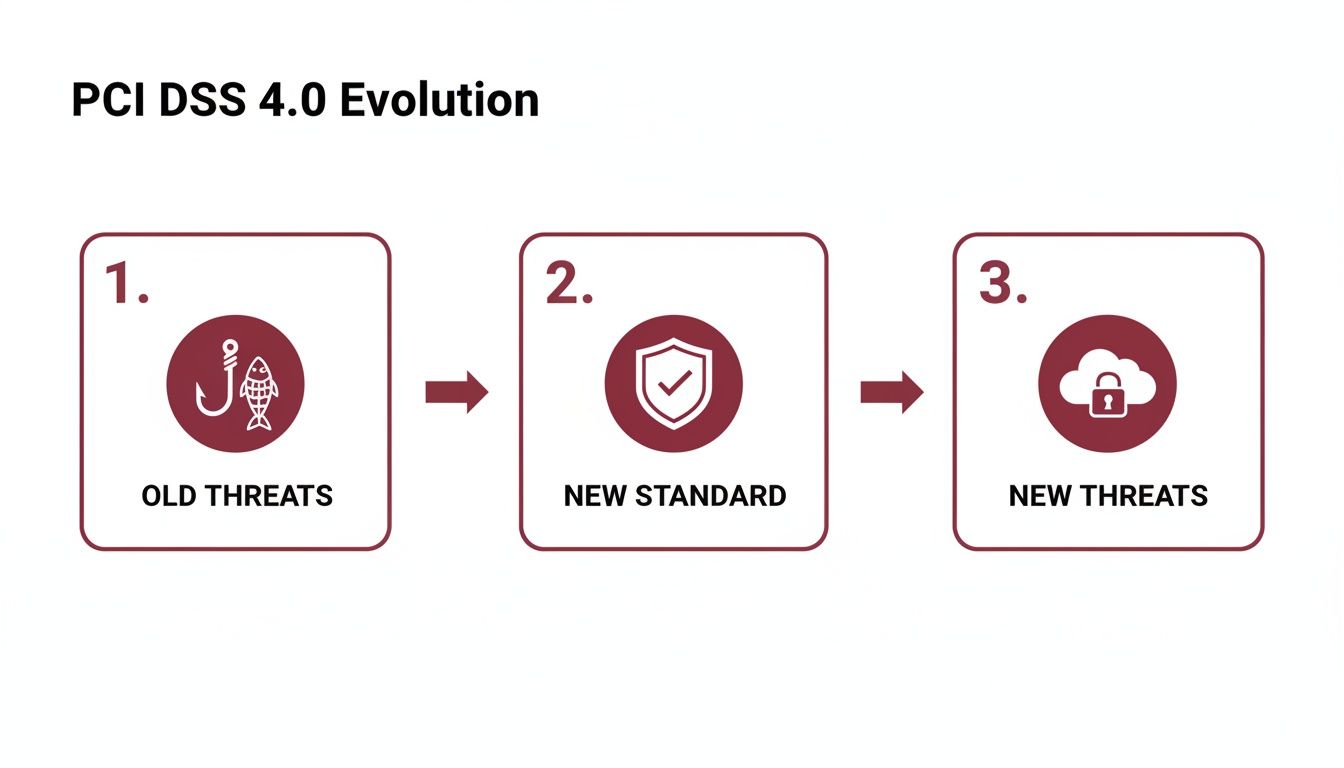
This constant evolution is precisely why compliance is not a one-time project but an ongoing commitment to mitigating the latest risks.
Step 2: Find Your Security Gaps
Once your scope is defined, it's time to conduct a gap analysis. This involves a thorough review of your current security measures, comparing them directly against the applicable PCI DSS requirements to identify where you fall short.
While you can begin this process internally, many businesses find immense value in engaging a Qualified Security Assessor (QSA). These certified professionals provide an expert, independent perspective, spotting vulnerabilities you might have missed and providing a clear remediation plan. Think of it as getting a professional diagnosis before starting treatment.
This process is a cornerstone of any effective security strategy. To delve deeper into the principles behind it, our guide on how to conduct a risk assessment for cyber security is an excellent resource.
A thorough gap analysis isn't about assigning blame; it's about building a rock-solid security foundation. By identifying your weak spots early, you can focus your resources where they will have the greatest impact—preventing a breach before it happens.
Step 3: Choose How You'll Prove Compliance
After you have remediated any identified gaps, you must formally validate your compliance. For most small to medium-sized businesses (Levels 2, 3, and 4), this involves completing a Self-Assessment Questionnaire (SAQ).
The SAQ is a tool for self-validation, but there are several different versions. The correct one for your business depends entirely on how you process payments. Selecting the wrong SAQ can lead to wasted effort or, worse, a false sense of security.
Choosing the Right Self-Assessment Questionnaire (SAQ)
Navigating the various SAQs can be confusing. This table breaks down the most common types for Australian businesses, helping you identify which one most likely applies to your operations.
| SAQ Type | Who It's For (Example) | Key Characteristic |
|---|---|---|
| SAQ A | An online store using a third-party gateway (like Stripe or PayPal) where the customer never enters card details on your site. | You have fully outsourced all card data functions. You don't see, touch, or store any cardholder information at all. |
| SAQ A-EP | An e-commerce site that sends customers to a secure payment page hosted by a third party, but your website still plays a role in the transaction. | Your website doesn't handle card data directly, but it can impact the security of the payment process. |
| SAQ C-VT | A mail-order or telephone-order business that keys in card details one by one into a virtual terminal on a web browser. | All card data is entered directly into a third-party virtual terminal; no electronic storage occurs on your systems. |
| SAQ P2PE | A retail shop using a payment terminal that is part of a certified Point-to-Point Encryption (P2PE) solution. | Card data is encrypted from the moment it’s swiped or tapped, drastically reducing your compliance scope and effort. |
Remember, your acquiring bank (the financial institution that processes your payments) has the final say on which SAQ you must complete, so always confirm with them.
For large merchants (Level 1), the process is far more intensive, requiring a formal Report on Compliance (ROC) conducted via an on-site audit by a QSA. Additionally, businesses at nearly every level must conduct quarterly network scans with an Approved Scanning Vendor (ASV) to check for vulnerabilities accessible from the internet.
How PCI DSS Fits Into Australian Law
For any Australian business accepting card payments, achieving PCI compliance is about more than just satisfying your bank's requirements. It is a fundamental component of your legal obligation to protect personal information under Australia's stringent privacy laws. Failing to do so can lead to legal consequences far beyond PCI-related penalties.
The primary legislation here is the Privacy Act 1988. This Act governs how organisations must handle all personal information, which explicitly includes financial data. A cornerstone of the Act is the Australian Privacy Principles (APPs), which establish the rules for securing sensitive information.
This is where your PCI DSS efforts serve a dual purpose. The security controls mandated by PCI DSS—such as encryption, strict access controls, and continuous network monitoring—are precisely the types of "reasonable steps" that the Privacy Act requires you to take to protect the personal data you hold.
The Australian Privacy Principles and Your Customer's Data
The connection is most evident in APP 11, which legally obligates organisations to take active measures to protect personal information from misuse, interference, loss, and unauthorised access.
Think of it this way: following the PCI DSS framework is one of the clearest, most powerful ways an Australian business can demonstrate it's meeting its legal duties under APP 11. It gives you a globally recognised blueprint for what "reasonable steps" look like when handling payment card data.
A breach involving cardholder data is not just a PCI issue; it is a potential breach of Australian law, which brings the government's privacy regulator into the picture.
What You Need to Know About the Notifiable Data Breaches Scheme
This legal link becomes even stronger under the Notifiable Data Breaches (NDB) scheme. Administered by the Office of the Australian Information Commissioner (OAIC), this scheme legally compels most organisations to report serious data breaches.
A breach must be reported if it is likely to result in "serious harm" to any individual whose information was compromised. The theft of credit card details almost always meets this threshold due to the immediate and high risk of financial fraud.
This creates a significant double-jeopardy for non-compliant businesses:
- First, you will face penalties from the card brands. These can include substantial fines, increased transaction fees, or even the revocation of your ability to accept card payments.
- Second, you will be subject to action from the OAIC. The OAIC has the power to investigate and impose massive financial penalties for breaches of the Privacy Act.
Strong PCI compliance is your most effective defence. By implementing the required security controls, you dramatically reduce the likelihood of a breach occurring. This proactive approach not only protects your customers but also keeps you on the right side of the law.
For businesses in other regulated sectors, such as finance, understanding these overlapping responsibilities is critical, much like it is for standards such as APRA CPS 234. Ultimately, the smartest strategy is to view PCI DSS not as an isolated task but as an integral part of your overall legal and risk compliance framework.
Using ISO 27001 to Accelerate Your PCI Compliance
When it comes to securing your business, you don’t have to start from scratch for every compliance standard you need to meet. In fact, two of the most powerful security frameworks, PCI DSS and ISO 27001, work together seamlessly. Leveraging them in tandem can significantly accelerate your journey to achieving PCI compliance in Australia.
A simple analogy is to think of ISO 27001 as the architectural blueprint for your entire business's security structure—the foundation, walls, and roof that protect everything. PCI DSS, in this context, is the specialised, reinforced steel vault built within that structure, designed specifically to protect cardholder data.

While PCI DSS is highly prescriptive and focused on payment data, ISO 27001 provides a broader, more flexible framework for your company's entire Information Security Management System (ISMS).
How ISO 27001 Creates a Strong Foundation
Certifying your ISMS to the ISO 27001 standard is not a separate activity; it directly addresses many of the core principles of PCI DSS. By building this robust security foundation first, you will find that you have already completed a significant portion of the work required for PCI compliance.
This approach fosters a security-first culture across the entire organisation, rather than treating compliance as a siloed, checklist-driven exercise. You shift from a reactive mindset to a proactive, risk-based approach to information security.
The overlap between the two standards is clear when you compare their shared requirements:
- Risk Assessment: Both mandate that you conduct thorough and regular risk assessments to identify threats and vulnerabilities.
- Security Policies: An ISO 27001 ISMS requires the development and maintenance of comprehensive security policies, which aligns directly with PCI Requirement 12.
- Access Control: Both frameworks demand stringent controls to ensure that only authorised individuals can access sensitive data on a need-to-know basis.
- Continuous Monitoring: ISO 27001 is built on a cycle of continuous improvement and monitoring, which mirrors the ongoing vigilance required by PCI DSS.
Pursuing ISO 27001 certification isn't a detour; it's a strategic accelerator. It provides the structure, policies, and risk management processes that make achieving and maintaining PCI DSS compliance a much more efficient and logical process.
Streamlining Your Compliance Efforts
By starting with ISO 27001, you build a single, unified security program that is robust, adaptable, and easier to manage over the long term. Many Australian businesses discover that their regular ISO 27001 internal audits and management reviews are invaluable for staying on top of PCI obligations throughout the year.
This integrated approach saves considerable time, money, and resources. Instead of managing two parallel compliance projects, you can map PCI controls back to your existing ISO 27001 framework. To better understand the fundamentals, you can learn more about how Information Security Management Systems operate and deliver tangible business value.
Ultimately, using ISO 27001 as your foundation transforms compliance from a recurring burden into a sustainable, strategic business advantage.
Your PCI Compliance Questions, Answered
Let's clarify some of the most common questions about PCI compliance in Australia. It's easy to get lost in technical jargon, so here are straightforward answers to what Australian businesses ask most often.
Is PCI Compliance Actually a Legal Requirement in Australia?
This is a frequent point of confusion. The direct answer is no, PCI DSS is not a law enacted by the Australian government.
However, in practice, it is effectively mandatory. Compliance is a contractual obligation embedded in your agreement with your acquiring bank or payment provider. When you sign up for a merchant facility to accept cards like Visa or Mastercard, you agree to adhere to their operating regulations, which include PCI DSS.
Ignoring these rules means you are in breach of your contract. Your bank can impose serious penalties, from significant monthly fines to the complete termination of your merchant facility. Furthermore, if a data breach occurs, you could face investigation by the Office of the Australian Information Commissioner (OAIC) for failing to meet your obligations under the Privacy Act.
What’s the Real Cost of Getting PCI Compliant?
The cost of achieving PCI compliance in Australia varies widely depending on several key factors.
- Your Merchant Level: A Level 4 business completing a simple SAQ will have far lower costs than a Level 1 merchant requiring a full on-site audit by a QSA. The difference can be tens of thousands of dollars.
- Your Current Security Posture: If you already have strong security practices, the cost will be lower. If you are starting from scratch and need to implement new firewalls, employee training, and secure software, the initial investment will be much higher.
- Your Payment Environment Complexity: A simple setup that outsources all card processing to a compliant third-party provider is significantly cheaper to secure and validate than a complex, in-house system.
For a small business, the annual cost might be a few hundred dollars. For a large corporation, it could easily run into the tens of thousands.
But here’s the most important thing to remember about cost: the money you spend on getting compliant is a tiny fraction of what a data breach will cost you. The average breach in Australia runs into the millions, factoring in fines, remediation, legal bills, and the crippling damage to your reputation.
What's the Difference Between a QSA and an ASV?
It's easy to confuse these two roles, but they perform distinct and separate functions.
- A Qualified Security Assessor (QSA) is a highly-certified and accredited security professional. Think of them as the expert auditors who conduct the in-depth, on-site assessments for Level 1 merchants, examining everything from policies and procedures to network configurations and physical security.
- An Approved Scanning Vendor (ASV) is a company authorised by the PCI Security Standards Council to perform external vulnerability scans. These are automated, quarterly scans of your internet-facing systems (like your website and servers) to identify security weaknesses that could be exploited by hackers. Most merchants are required to have these scans performed.
At Anitech, we specialise in making complex security standards simple. Our expert consultants can help your business build a robust Information Security Management System with ISO 27001, which creates a powerful foundation to streamline your PCI compliance journey. Find out more at iso-27001.com.au.
Recent Comments