

Quick Summary: For any Australian business taking card payments, PCI DSS compliance is mandatory for protecting sensitive cardholder data. This guide covers your scope, validation path (SAQ vs. RoC), the 12 core requirements of PCI DSS 4.0, and how to maintain continuous compliance to avoid hefty fines and reputational damage.
If you're an Australian business taking card payments, you're not just offering convenience—you're stepping into a high-stakes arena where security is non-negotiable. For any organisation that handles cardholder data, achieving PCI DSS compliance in Australia isn't just a good idea; it's the mandatory standard for protecting that sensitive information.
Think of it as the rulebook for building a secure payment environment. It's what stands between your business and the criminals trying to exploit it.
The Rising Tide of Payment Fraud in Australia
Let's cut to the chase: payment card fraud in Australia is a serious and growing problem. Cybercriminals are increasingly setting their sights on small and mid-size enterprises (SMEs), seeing them as easier targets than big corporations with massive security budgets. Ignoring this reality is a gamble you can't afford to take.
This threat isn't just theoretical—it has a real and painful financial sting. In 2024, card fraud in Australia exploded to an eye-watering $913 million. The vast majority of this came from card-not-present (CNP) transactions, where your customers are typing their details into a website. This isn't just a statistic; it's a massive escalation in losses for businesses and their customers, hammering home just how urgent robust PCI DSS compliance has become.
This explosion in fraud runs parallel to Australia’s booming e-commerce scene, which has quickly become the primary battleground.

Why PCI DSS Is Your Best Defence
The good news is that the controls required by the Payment Card Industry Data Security Standard (PCI DSS) were specifically created to fight these threats. The major card brands—Visa, Mastercard, American Express—developed this framework as a unified playbook to protect the entire payment system, from the smallest online store to the largest bank.
These requirements hit the most common attack methods for CNP fraud head-on:
- Strong access control measures are designed to keep unauthorised people out of your critical systems.
- Regular network monitoring and testing help you spot a breach and shut it down before real damage is done.
- Encryption of cardholder data—both when it's being sent and when it's stored—makes any stolen information completely useless to thieves.
PCI DSS compliance isn't about ticking boxes to pass an audit. It’s about building genuine, resilient security that protects your revenue, your reputation, and the trust your customers place in you.
It's About More Than Just Financial Penalties
The fallout from non-compliance goes way beyond the fines your acquiring bank can levy, which can run anywhere from $5,000 to $100,000 per month. A data breach can inflict deep, lasting damage to your reputation that is often far more costly than the initial financial hit.
Imagine the aftermath: customers fleeing to your competitors, damaging media coverage, and the very real possibility of class-action lawsuits. For a small or medium-sized business, the operational chaos alone can be devastating. For a deeper dive into the world of payment security, you might want to look at resources from trusted payments experts.
Ultimately, getting and staying PCI DSS compliant is a smart, strategic business move. It proves to your customers, your partners, and your bank that you are serious about protecting data. It's a cornerstone of trust and a critical piece of a well-run information security management system.
Defining Your PCI DSS Scope to Reduce Complexity and Cost
Getting started with PCI DSS compliance in Australia always boils down to one fundamental question: where is the cardholder data? It’s a simple question, but the answer is rarely straightforward. Before you can even think about building a fortress, you have to know exactly what—and where—you’re protecting.
This initial step, known as scoping, is honestly where most businesses get it wrong. They either over-scope, bringing hundreds of irrelevant systems into the audit, or under-scope, leaving a gaping hole for a breach. Get this right, and you’ll save a mountain of time, money, and headaches.
Scoping is all about identifying every single system, network, application, and even person that comes into contact with cardholder data. This entire collection of parts is what we call your Cardholder Data Environment (CDE). Everything inside the CDE has to meet every single relevant PCI DSS requirement.
But here’s the secret: the real power of scoping isn’t what you include, it’s what you can exclude. By drawing a clear, defensible line around your CDE, you can shrink your compliance footprint dramatically.
Mapping the Journey of Card Data
To do this properly, you need to map out how card data moves through your business. This isn't just a job for your IT team; it’s about understanding the entire payment lifecycle, from the moment a customer pulls out their card to the settlement in your bank account.
Let's walk through a common scenario for an Australian retail business with both a physical store and an e-commerce site.
In-Store Payments:
- A customer taps their card on an EFTPOS terminal. Critically, this terminal is on its own isolated network segment.
- The terminal instantly encrypts the card data and sends it directly to the payment processor.
- The processor fires back an approval or decline. The full card number never touches the point-of-sale (POS) system or the main store network.
Online Payments:
- On the website, a customer enters their card details into a payment form.
- This form is actually an iframe, hosted directly by a compliant payment gateway like Stripe or Braintree.
- The data travels from the customer’s browser straight to the gateway’s secure servers, completely bypassing the retailer’s own web server.
In both cases, the business has cleverly minimised its scope. By making sure sensitive data never actually lands on their core systems, they've sidestepped a huge compliance burden. The first thing any assessor will ask for is a data flow diagram that illustrates these pathways.
The Power of Network Segmentation
By far, the most effective strategy for shrinking your scope is network segmentation.
Think of your business network as a big office building. Segmentation is like building a high-security vault inside that building just for your payment systems. By isolating everything in the CDE on its own network—completely separate from your day-to-day corporate traffic like emails, file sharing, and guest Wi-Fi—you contain the reach of PCI DSS controls.
Effective segmentation means that a virus on your marketing manager’s laptop has absolutely no path to your payment environment. This single strategy can be the difference between having hundreds of systems in scope versus just a handful.
Proper segmentation isn't just a concept; it's enforced with firewalls and strict access control lists that police every bit of traffic moving in and out of the CDE. For businesses relying on third-party payment providers, managing these relationships is a critical piece of the puzzle. To get a better handle on this, you can learn more about effective third-party risk management in our detailed guide.
Documenting Your Scope for Success
Once you’ve mapped the data flows and segmented your network, the final piece is to document it all in a clear network diagram. This isn’t just for you; it’s for your auditor.
This visual map needs to show:
- Every component inside the CDE.
- All connections between the CDE and other networks.
- The placement of key security controls, like firewalls.
These diagrams, alongside your data flow documents, are the foundation of your entire PCI DSS compliance Australia program. They're the evidence that shows your assessor and your bank that you've got a firm grip on your environment and have taken smart, deliberate steps to protect cardholder data.
Choosing Your Validation Path: SAQ vs. RoC
Alright, you've mapped out your scope. Now comes the real question: how do you actually prove your compliance? This isn't a one-size-fits-all situation. The path you take really depends on your transaction volume and how much you let cardholder data touch your systems.
Essentially, there are two ways to validate: the Self-Assessment Questionnaire (SAQ) and the Report on Compliance (RoC). You can think of the SAQ as a detailed, guided self-declaration, while the RoC is a full-blown, formal audit conducted by an independent expert.
For the vast majority of small to mid-sized Aussie businesses, the SAQ is the way to go. It's a tool from the PCI Security Standards Council designed to help you check your own homework. But here's the catch: there isn't just one SAQ. There are several versions, and each one is built for a specific type of business setup.
Understanding the Self-Assessment Questionnaires
Picking the right SAQ is absolutely critical. If you fill out the wrong one, your validation is worthless. You’ve wasted time, money, and you’re still technically non-compliant in the eyes of your bank. The correct choice hinges entirely on how you handle card payments.
For example, a typical e-commerce store that has smartly outsourced all payment handling to a provider like Stripe using a secure iframe will probably only need to complete SAQ A. It’s the simplest one. On the other hand, if your business has a more complex environment where payment data actually enters your network, you'll be looking at something far more involved, like the SAQ D.
This decision tree gives you a great visual on how those early scoping decisions directly impact which compliance path you'll need to follow. It shows how you can separate what's in-scope from what's safely segmented out.
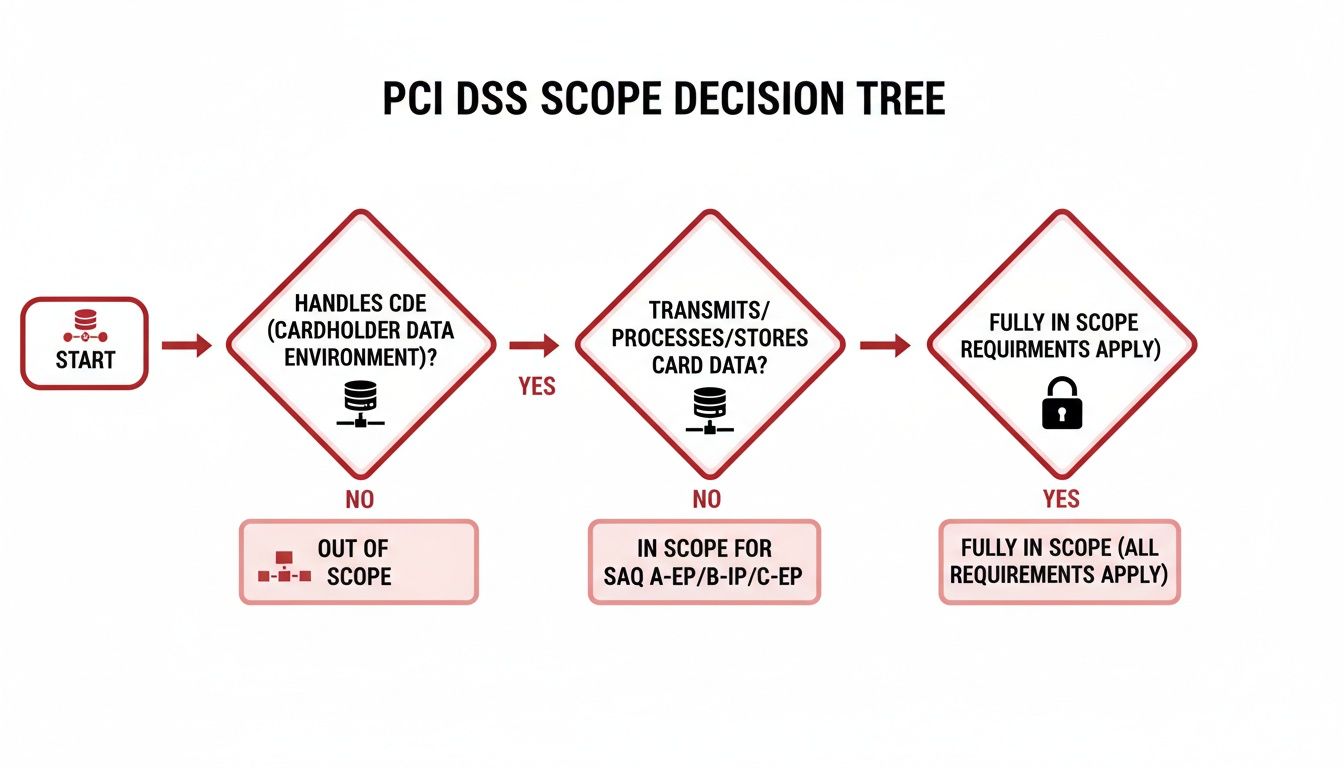
The big takeaway here? Smart decisions made upfront, especially around network segmentation, will drastically simplify your validation requirements and lighten the compliance load later on.
To help you get a feel for which SAQ might be right for your business, here is a quick comparison of the most common ones we see in Australia.
Choosing the Right Self-Assessment Questionnaire (SAQ)
| SAQ Type | Typical Business Scenario | Number of Requirements | Key Eligibility Criteria |
|---|---|---|---|
| SAQ A | E-commerce merchants who completely outsource all cardholder data functions to a PCI DSS compliant third party. | 22 | No electronic storage, processing, or transmission of cardholder data on your systems or premises. |
| SAQ A-EP | E-commerce merchants who outsource payment processing but have a website that could impact payment security. | 191 | Your website doesn't handle card data directly, but the payment page originates from your site. |
| SAQ B-IP | Merchants using standalone, IP-connected payment terminals (EFTPOS machines). | 84 | Terminals are on an isolated network; no electronic cardholder data storage. |
| SAQ D | Any merchant not meeting the criteria for other SAQ types. This is the most comprehensive SAQ. | 329 | Applies if you store any electronic cardholder data or don't meet other SAQ requirements. |
As you can see, the difference between needing to meet 22 requirements and 329 is massive. It all comes down to how you're set up to take payments.
When a Report on Compliance is Mandatory
The rules of the game change completely once you hit a certain size. Your acquiring bank and the card brands (Visa, Mastercard, etc.) have specific merchant levels based on how many transactions you process each year. In Australia, if your business is handling more than six million Visa or Mastercard transactions annually, you're almost certainly classified as a Level 1 Merchant.
For a Level 1 merchant, a Self-Assessment Questionnaire is simply not an option. You are required to undergo a formal, on-site audit and produce a Report on Compliance (RoC).
An RoC is a much heavier lift. It means hiring an independent Qualified Security Assessor (QSA)—a certified auditor approved by the PCI SSC—to conduct a forensic-level review of every single applicable PCI DSS control in your environment.
This isn't just a paper exercise. The QSA will:
- Review your documentation: Every policy, procedure, network diagram, and data flow chart will be scrutinised.
- Interview your staff: They'll talk to everyone from system admins to developers and senior managers to ensure processes are being followed.
- Inspect your systems: They’ll get hands-on, examining server configurations, firewall rules, application settings, and more.
All the QSA’s findings get documented in the RoC, which then goes to your acquiring bank as formal proof of compliance. If you're processing at this volume, understanding the rigorous demands of Level 1 PCI compliance is non-negotiable; it's just part of the cost of doing business at that scale.
Preparing Your Evidence for Validation
Whether you’re filling out an SAQ or gearing up for a full-blown RoC, the fundamental task is the same: you need to provide evidence that you're meeting each requirement. Start gathering this from day one.
Get your evidence file organised and ready to go. This could be anything from screenshots of system configurations and firewall rules to security monitoring log files, copies of your internal policies, and records of staff security training. A well-prepared business makes the entire validation process smoother, faster, and a whole lot less stressful.
Right, let's get down to the brass tacks. You’ve done the scoping and figured out your validation path. Now it’s time to roll up your sleeves and actually implement the 12 core PCI DSS requirements.
This is where theory hits the road. Think of these requirements not as a rigid checklist, but as a cohesive framework for building real-world security muscle. Each one exists for a very specific reason: to slam the door on a known tactic criminals use to steal payment card data.
For any Australian business, getting this right means translating these global security principles into concrete, practical controls that fit your unique setup. The end game is a security posture that’s strong, repeatable, and ready to be proven.

A Practical Breakdown of the 12 Requirements
To make this easier to digest, let's group the requirements by their security goal. We’ll look at the ‘why’ behind each one and touch on some of the key changes introduced with PCI DSS 4.0.
Goal 1: Build and Maintain a Secure Network and Systems
- Requirement 1: Install and Maintain Network Security Controls. This is your perimeter defence. It’s all about using firewalls and other controls to build a fortress around your Cardholder Data Environment (CDE). The aim is to meticulously control all traffic flowing in and out, allowing only legitimate, expected communication.
- Requirement 2: Apply Secure Configurations to All System Components. Never, ever leave default settings in place. They’re an open invitation for attackers. This requirement is about changing all vendor-supplied defaults (like passwords) and disabling any services or functions you don't absolutely need. It’s all about shrinking your attack surface.
Goal 2: Protect Account Data
- Requirement 3: Protect Stored Account Data. The golden rule is simple: if you don't need it, don't store it. If you have a legitimate business reason to keep cardholder data, this requirement spells out exactly how to protect it. It demands strong encryption for any stored Primary Account Number (PAN) and flat-out prohibits storing sensitive authentication data (like CVV codes) after a transaction is authorised. Ever.
- Requirement 4: Protect Cardholder Data with Strong Cryptography During Transmission. When card data zips across open networks like the internet, it's a prime target. This means you must use strong, modern encryption protocols like TLS 1.2 or higher to shield it from prying eyes and prevent it from being intercepted.
The entire philosophy of data protection boils down to one thing: making stolen data worthless to a thief. Whether you use strong encryption or tokenisation, the objective is to ensure that even if they get in, they walk away with a bunch of useless, unreadable junk.
Getting this wrong can be devastating. The average cost of a data breach in Australia hit a staggering AUD $4.26 million in 2024, which is a 27% jump since 2020. In our card-obsessed economy, with 12.52 million credit card users and nearly 44 million debit cards in circulation, poor payment data security is a major driver of these incidents. You can read more about the direct link between PCI DSS and breach prevention in recent Australian reports.
Goal 3: Maintain a Vulnerability Management Program
- Requirement 5: Protect All Systems and Networks from Malicious Software. You need to have anti-malware software running on all systems that are typically targeted, especially PCs and servers inside your CDE.
- Requirement 6: Develop and Maintain Secure Systems and Applications. Security can't be an afterthought; it has to be baked into your processes. This means patching systems as soon as fixes are available and following secure coding guidelines for any software you develop in-house.
Key Shifts in PCI DSS 4.0
PCI DSS 4.0 brought some big changes, moving the standard towards a more flexible, risk-based approach while dialling up the security in a few key areas.
- Customised Implementation: This is a game-changer. It lets you meet a requirement’s objective using a different control than what's specified, as long as you can prove it delivers the same (or better) level of security.
- Stronger Authentication: Multi-factor authentication (MFA) is no longer just for remote access. It's now mandatory for all access into the CDE. This is a massive defence against stolen passwords.
- Continuous Monitoring: The new standard heavily pushes the idea that security is an ongoing process, not just a once-a-year audit.
Goal 4: Implement Strong Access Control Measures
- Requirement 7: Restrict Access to System Components and Cardholder Data by Business Need to Know. This is the principle of least privilege in action. Simply put, people should only have access to the specific data and systems they need to do their jobs—and nothing more.
- Requirement 8: Identify Users and Authenticate Access to System Components. Every single person who accesses the CDE needs their own unique ID. This creates accountability and kills the dangerous practice of using shared or generic accounts.
- Requirement 9: Restrict Physical Access to Cardholder Data. This isn't just about servers. It covers everything from locking server room doors and keeping visitor logs to securely storing paper receipts and properly destroying old hard drives or documents.
Goal 5: Regularly Monitor and Test Networks
- Requirement 10: Log and Monitor All Access to System Components and Cardholder Data. You need a clear audit trail of who did what, and when. Keeping detailed logs and, crucially, reviewing them regularly is fundamental to spotting suspicious activity and minimising the damage from a potential breach.
- Requirement 11: Test Security of Systems and Networks Regularly. This means you have to be proactive. Run regular vulnerability scans and, for most businesses, get annual penetration tests done to actively hunt for and fix security holes before criminals find them.
Goal 6: Maintain an Information Security Policy
- Requirement 12: Support Information Security with Organisational Policies and Programs. Finally, you need to wrap all these technical controls in strong policy. This means having a formal information security policy that everyone understands and follows. It includes things like security awareness training, having a solid incident response plan, and clearly defining who is responsible for what.
Keeping Your Compliance Posture Strong All Year
Getting that PCI DSS certificate is a huge win, but it’s the starting line, not the finish. The real test—and where so many Australian businesses stumble—is keeping that security posture solid, day in and day out. You have to shift your thinking from a frantic, once-a-year project to weaving compliance into the very fabric of your daily operations.
This isn't just about ticking a box for best practice; it's a cold, hard necessity. The threat landscape is always shifting, and so is your business. New hires, system updates, and changing workflows can all accidentally poke holes in your Cardholder Data Environment (CDE).
With the final deadline for PCI DSS 4.0 looming on March 31, 2025, this continuous approach is no longer optional for any Australian organisation handling card payments. The grace period for moving from version 3.2.1 is ending, and what used to be 'best practices' are now concrete requirements.
When you consider the potential non-compliance fines of $5,000 to $100,000 per month, in a market with over 12.52 million credit cards and 43.77 million debit cards, the stakes couldn't be higher. You can find out more about the PCI DSS 4.0 deadline and what it means for Aussie businesses here.
Building Your Annual Compliance Rhythm
To break free from that end-of-year panic, you need to establish a steady, predictable rhythm of compliance activities. Think of it as a calendar of security checks and balances that keeps everything on track. This proactive schedule means you're always ready for your annual assessment and, more importantly, always genuinely protected.
While this checklist should be a living document, these are the non-negotiables:
- Quarterly Vulnerability Scans: At least once every three months, you need to run internal and external vulnerability scans with an Approved Scanning Vendor (ASV). These are automated tools that hunt for known weaknesses, giving you a regular health check of your perimeter and internal systems.
- Annual Penetration Testing: You need to go deeper than automated scans with a proper penetration test every year. This is where ethical hackers simulate a real-world attack to find vulnerabilities that automated tools simply can't. To understand the crucial difference, see our breakdown of penetration testing services.
- Daily Log Reviews: It sounds tedious, but someone has to review the security logs from your firewalls, servers, and critical applications every single day. Automated alerts help, but nothing beats a trained human eye for spotting the subtle signs of a brewing incident.
- Bi-Annual Firewall Rule Reviews: Twice a year, pull apart your firewall and router configurations. The goal is to justify every single rule. Is it still needed? Is it configured correctly? Is there clear business documentation for it?

The Critical Role of Change Management
If you're looking for the fastest way to derail your compliance, it's through uncontrolled changes. A developer pushing a "minor" code update or a sysadmin opening a new port without oversight can instantly blow a hole in your CDE.
That’s why a rock-solid change management process is non-negotiable for maintaining PCI DSS compliance in Australia.
Every single change to your Cardholder Data Environment—no matter how small—must be documented, formally approved, and tested for security impact before it goes live. This isn't bureaucracy; it's your safety net.
Your process has to start with a formal request that outlines the change, its business purpose, and an honest assessment of its security implications. This forces security to be part of the initial conversation, not a panicked afterthought.
Preparing for Your Annual Assessment
When your annual SAQ or RoC assessment does roll around, a year-round approach makes all the difference. Instead of a mad scramble to hunt down evidence, you’ll have a neat, organised folder with a year’s worth of proof ready to go.
A few tips to make your next assessment a breeze:
- Gather Evidence as You Go: Don't wait. As soon as a quarterly scan is done, file the report. After a firewall review, save the meeting notes and sign-offs. Create a central, digital repository for every piece of compliance evidence.
- Give Everyone a Heads-Up: Keep your leadership team, IT crew, and your QSA in the loop. Let them know the assessment timeline well in advance so they can book the time and resources needed. No one likes surprises.
- Dust Off Your Documentation: Policies and procedures aren't meant to sit on a shelf. Make sure they actually reflect what you do today. An outdated policy is an instant red flag for any assessor and shows a lack of maturity.
By adopting this year-round operational mindset, you transform PCI DSS compliance Australia from a dreaded annual audit into a strategic asset that builds genuine resilience and reinforces trust with your customers every single day.
Your PCI DSS Compliance Questions Answered
Let's cut through the noise. When it comes to PCI DSS, there's a lot of confusion out there. These are some of the most common questions from Aussie business owners and IT managers, so let's tackle the big ones head-on.
Does PCI DSS Really Apply to My Small Business?
In a word, yes. If you take card payments, you're in the game. It doesn't matter if you're processing ten transactions a week or ten thousand a day.
Your contract with your acquiring bank (the one that processes your payments) legally obligates you to be PCI compliant. The scale is different for a small business, of course. You'll most likely be validating your compliance with a Self-Assessment Questionnaire (SAQ) instead of a full-blown audit, but the core security responsibilities are exactly the same. There's no escaping it.
What’s the Big Deal with PCI DSS 4.0?
Version 4.0 is a pretty significant shake-up. It moves away from a rigid, "tick-the-box" mentality and towards a more modern, objective-based view of security. Think less about how you do something and more about what security outcome you're achieving.
A few key changes you absolutely need to know about:
- Tougher Authentication: Multi-factor authentication (MFA) is now mandatory for all access into your cardholder data environment. Previously, it was just for remote access, but now it applies to everyone, everywhere. This is a huge step in stopping attacks that use stolen passwords.
- New E-commerce Defences: There are brand-new rules for how you manage scripts on your payment pages. This is a direct shot at e-skimming attacks, where hackers sneak malicious code onto checkout pages to steal customer card details right under your nose.
- The 'Customised Approach': This is the game-changer. It gives you the flexibility to meet a security goal using a different control, as long as you can prove and document that your method provides the same (or better) level of security. It’s a way to innovate without compromising on safety.
I Use Stripe/Square, so I’m Compliant, Right?
Wrong. This is probably the most common—and most dangerous—misconception.
Using a fully compliant payment processor like Stripe, Square, or Braintree is brilliant. It massively shrinks your compliance workload, but it never makes it disappear entirely.
Outsourcing your payment processing is the smartest move you can make to reduce your PCI scope. But remember, you can outsource the function, not the responsibility. You're still on the hook for securing your own systems.
For most Aussie businesses in this boat, you'll still need to complete a Self-Assessment Questionnaire—usually SAQ A or SAQ A-EP.
This is basically you attesting that your business environment isn't doing anything to mess up the secure process your provider has built. Getting your pci dss compliance in australia sorted is a partnership, and you have to own your part of it.
We specialise in demystifying complex standards like ISO 27001, which has a lot of overlap with PCI DSS. If you're ready to build a security framework that genuinely protects your business and your customers, let's talk about building a world-class ISMS.
Recent Comments