

Quick Summary:
Penetration Testing as a Service (PTaaS) is a modern cybersecurity model replacing traditional, one-off pen tests with a continuous, on-demand platform. It provides real-time vulnerability data, integrates with developer workflows for faster fixes, and offers predictable subscription pricing. PTaaS is crucial for maintaining robust security and achieving compliance with standards like ISO 27001 by providing continuous auditable evidence.
Penetration Testing as a Service, or PTaaS, marks a fundamental shift in how businesses handle their security testing. It’s a move away from the slow, expensive, and often outdated annual audit cycle to a more dynamic, platform-based model that keeps you a step ahead of threats. For businesses navigating compliance standards like ISO 27001, PTaaS provides the real-time vulnerability data, rapid remediation cycles, and clear reporting needed to stay secure and prove compliance.
What Is Pen Test as a Service?
Think of a traditional pen test like a yearly visit to the doctor. It gives you a snapshot of your health at that moment, but a whole lot can change in the 12 months until your next appointment.
PTaaS, on the other hand, is like wearing a fitness tracker 24/7. It provides constant feedback, letting you spot and deal with security vulnerabilities the moment they appear, not months down the track. This modern approach, often called continuous penetration testing, offers a blend of automated scanning and expert human analysis.
This simple change solves a massive headache for most business leaders. We've all seen those traditional pen test reports—huge, static PDFs that are already out of date by the time they land on your desk. Your team scrambles to fix the issues, but by then, new code has been pushed, and new threats have emerged. PTaaS flips this on its head by delivering findings in real-time through a collaborative platform, so you can take action immediately.
The Strategic Value of PTaaS
This modern approach isn't just a "nice-to-have"; it's essential. The Australian Cyber Security Centre (ACSC) recorded over 1,100 major cyber incidents in the 2023-2024 financial year and fielded more than 36,700 calls from Aussie businesses needing help. That constant barrage of threats is precisely why more responsive solutions like PTaaS are no longer optional.
Penetration Testing as a Service elevates security from a tick-box compliance exercise into a genuine strategic advantage. It weaves continuous testing right into your development workflow, hardening your defences and setting you up for success with certifications like ISO 27001.
This model is a perfect fit for any organisation embracing a DevSecOps culture, because it builds security testing right into the software development lifecycle (SDLC). To really get your head around the impact of Pen Test as a Service, it helps to see where it fits into the broader cybersecurity landscape.
Traditional Pen Testing vs Pen Test as a Service
To make the difference crystal clear, let's compare the old way of doing things with the new PTaaS model. The table below breaks down exactly what sets them apart.
| Feature | Traditional Penetration Testing | Pen Test as a Service (PTaaS) |
|---|---|---|
| Testing Cadence | One-off, point-in-time (e.g., annual) | Continuous, on-demand, and scheduled |
| Delivery Model | Project-based with a final static report | Platform-based with real-time dashboards |
| Findings | Delivered in a lengthy PDF report at the end | Disclosed instantly on the platform as found |
| Remediation | Manual tracking via spreadsheets or email | Integrated with developer tools (e.g., Jira) |
| Collaboration | Limited; mainly between client and test team | Seamless between testers, developers, and security |
| Retesting | Requires a new, separate engagement | Fast and easy retesting of fixes on-demand |
| Cost Structure | High upfront cost per engagement | Subscription-based (e.g., monthly or yearly) |
As you can see, PTaaS is built for the speed and agility that modern businesses require, turning security from a roadblock into a smooth part of the process.
Key Benefits of the PTaaS Model
Switching to a PTaaS solution brings some serious advantages over the old-school methods:
- Continuous Vulnerability Data: No more waiting around for an annual report. Your team sees findings in real-time as testers uncover them.
- Faster Remediation Cycles: With direct integration into tools like Jira, vulnerabilities are assigned and squashed almost instantly, dramatically shrinking your window of exposure.
- On-Demand Testing: Need to test a new feature before it goes live? You can kick off a test whenever you want, breaking free from a rigid annual schedule.
- Improved Collaboration: The shared platform gets everyone on the same page. Security experts, developers, and managers can communicate and track progress without endless email chains.
In the end, PTaaS makes top-tier security testing more accessible, affordable, and effective. You can find out more about the different ways to use pen testing as a service in our detailed guide. This approach delivers the auditable, continuous evidence you need to prove you have a strong security program—a non-negotiable for achieving and holding onto an ISO 27001 certification.
The Financial Case for Pen Test as a Service (PTaaS)
It’s easy to fall into the trap of viewing cybersecurity as just another business expense. But that's a dangerous oversimplification. Thinking about Penetration Testing as a Service (PTaaS) isn’t about adding another line item to the budget; it's a strategic move to protect your company from a financial catastrophe. The numbers alone tell a pretty scary story.
Here in Australia, the fallout from a single security incident is staggering. The average data breach now costs a company AUD 4.45 million—a figure that shot up by 15% in just one year. That alone makes proactive security testing a financial no-brainer, especially for small businesses on the path to ISO 27001 certification. With the ACSC fielding over 36,700 cyber assistance calls last year, the threat is very real. You can learn more about the real cost of skipping penetration testing on coresentinel.com.
That multi-million dollar figure isn't just an abstract number; it represents tangible, business-ending consequences.
Deconstructing the Cost of a Breach
When a breach hits, the costs spiral out of control on multiple fronts. Once you break it down, it becomes painfully clear why sitting back and waiting for something to happen is no longer a viable financial strategy.
- Regulatory Fines: Getting hit with penalties for non-compliance with data protection laws can be enough to sink a small business on its own.
- Reputational Damage: Trust is everything. A breach shatters customer confidence, making it incredibly difficult to keep the clients you have, let alone win new ones.
- Customer Churn: After a security incident, a large chunk of your customer base will simply walk away, taking their business—and your revenue—with them.
- Operational Downtime: In the immediate aftermath, you’re looking at system shutdowns, forensic investigations, and recovery efforts. All of this brings your operations to a dead stop.
The old way of doing things—a one-off pen test once a year—leaves huge gaps where these risks can quietly fester. A single test is just a snapshot in time, but your systems are constantly changing with every software update or new feature release. It's in these months-long gaps between tests that attackers find their way in.
Shifting from CapEx to OpEx with PTaaS
One of the smartest financial arguments for PTaaS is how it completely changes the way you account for cybersecurity spending. Traditional pen tests are big, one-off capital expenditures (CapEx). They're expensive, a nightmare to budget for, and create unpredictable spikes in your spending.
PTaaS flips that model on its head.
By moving to a subscription, PTaaS turns unpredictable security costs into a manageable and predictable operational expense (OpEx). This makes continuous, high-end security accessible even for smaller businesses that don't have a huge pile of cash sitting around for a massive one-time test.
This shift is a game-changer for financial planning. Instead of reacting to security threats with large, unplanned bills, you can build a consistent, proactive defence right into your operational budget. This gives your leadership team the confidence to plan for growth, knowing their security can scale right alongside the business.
Calculating the ROI of Continuous Testing
The return on investment (ROI) for PTaaS becomes crystal clear when you weigh its predictable subscription fee against the astronomical cost of a potential breach. PTaaS provides a constant stream of testing, which means you find out about vulnerabilities almost as soon as they appear.
This continuous feedback loop allows your development team to fix security flaws on the fly, not months after a dusty report lands on their desk. Fixing things faster means the window of exposure—the time an attacker has to exploit a weakness—shrinks dramatically. That, in turn, seriously lowers the odds of a successful attack. This proactive approach is fundamental to understanding the complete ROI of cyber security investments.
At the end of the day, the financial argument is simple. The modest, predictable cost of a pen test as a service subscription is a tiny price to pay to avoid a multi-million dollar disaster. Ignoring modern, continuous security testing isn’t just a technical blind spot; it's a massive, unacceptable financial risk.
Aligning PTaaS with Your ISO 27001 Certification
For anyone who's been in the trenches with an ISO 27001 certification, you know it’s a marathon, not a sprint. It’s not just about ticking off security controls; it’s about proving to auditors, time and again, that they actually work. This is where Penetration Testing as a Service (PTaaS) stops being just another security tool and becomes your secret weapon for compliance. It can genuinely simplify and strengthen your entire certification journey.
Think about the old way of doing things with traditional, one-off pen tests. It’s a compliance nightmare. You get a static report, scramble to fix the problems, and then cross your fingers hoping nothing new crops up before the auditor arrives. A PTaaS platform flips this script completely. It gives you a live, continuous stream of evidence showing your Information Security Management System (ISMS) is working day in, day out.
It's the difference between showing an auditor a single, year-old photo versus giving them a live feed from your security cameras. The choice is obvious.
This concept map really brings home the financial logic of shifting from a reactive to a proactive security stance with PTaaS.
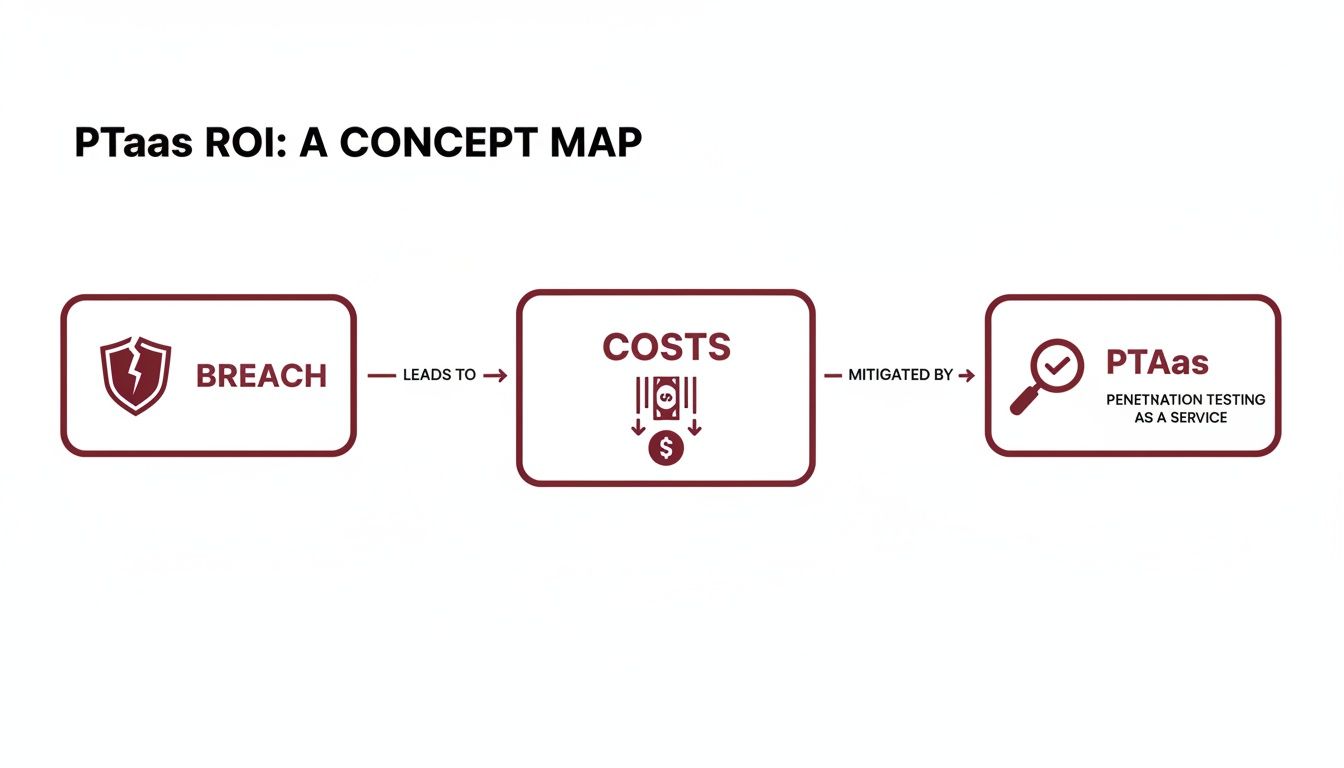
It clearly shows that investing in continuous testing isn't just an expense; it directly slashes the devastating financial fallout that always follows a breach.
Mapping PTaaS to Key ISO 27001 Controls
The real magic of PTaaS for compliance is how it directly generates the hard evidence you need for specific Annex A controls. Forget about manually wrestling with spreadsheets and documents. The PTaaS platform becomes a living, breathing repository of your compliance artefacts.
Let's look at two of the most important controls where PTaaS makes a direct impact: A.12.6 and A.14.2.
A.12.6 Management of Technical Vulnerabilities: This control is all about getting timely information on technical vulnerabilities, figuring out how exposed you are, and taking the right steps to shut down the risk. PTaaS was practically built for this.
A good PTaaS platform automates this whole cycle. As soon as testers find a vulnerability, it appears on the platform in real-time, complete with severity ratings and the nitty-gritty technical details. That’s your "timely information" right there, exactly what auditors want to see.
When your dev team pushes a fix, they can request a re-test with a single click in the platform. The successful re-test confirmation becomes a time-stamped, auditable record proving you’ve neutralised the threat. Done.
Demonstrating Security in Development Processes
Another area where PTaaS is a game-changer is proving the security of your software development lifecycle.
A.14.2 Security in Development and Support Processes: This control requires you to have solid rules for secure development and to actually follow them. If you’re running a modern CI/CD pipeline, showing this without the right tools can be a real headache.
By weaving PTaaS into your development pipeline, you can automatically kick off security tests on new code before it ever sees the light of day. This integration demonstrates to an auditor that security isn't an afterthought—it's a fundamental, automated part of how you build software. Vulnerability tickets can be automatically created and assigned in Jira, and the platform’s dashboard gives a crystal-clear view of your security posture over time.
This is the kind of concrete, irrefutable proof that shows you’re actively managing security within your development lifecycle. To see how this fits into the bigger picture, you can find a comprehensive breakdown of all the ISO 27001 controls in our detailed guide.
PTaaS as Your Audit Evidence Engine
When the auditor comes knocking, you need to produce clear, organised evidence. The outputs from a pen test as a service platform are precisely what they need to see, beautifully organised and ready to go.
- Detailed Vulnerability Reports: Live dashboards and one-click reports give a full history of every vulnerability found, its severity, and its current status (open, fixed, re-tested).
- Remediation Tickets: Integration with tools like Jira or Azure DevOps creates a perfect, undeniable audit trail. It shows exactly when a flaw was found, who it was assigned to, and when it was fixed and verified.
- Re-test Confirmations: This is the gold-standard proof that your fixes worked, closing the loop on the entire vulnerability management process.
- Trend Analysis: Dashboards that show a downward trend in critical vulnerabilities over time are a powerful way to demonstrate the growing maturity and effectiveness of your ISMS.
For any consultant or manager guiding a business toward certification, using a PTaaS solution is a massive strategic advantage. It not only builds a stronger, more resilient ISMS but also streamlines the audit itself, paving the way for a much smoother and more successful ISO 27001 certification.
Your Checklist for Choosing the Right PTaaS Vendor
Picking a partner for your pen test as a service needs is a huge decision. Get it right, and you'll strengthen your security and smooth out your compliance journey. Get it wrong, and you're stuck with a platform that creates more problems than it solves.
The market is packed with providers, and it's easy to get tangled up in technical jargon and slick sales pitches. This checklist is designed to cut through that noise. It gives you the right questions to ask and the critical areas to investigate, helping you make a choice that truly fits your business. Many of these points are similar to what you'd consider when choosing a cyber security firm for any project, as it all comes down to expertise, process, and a genuine partnership.
Tester Expertise and Certifications
Let's be clear: the human element is what makes a real pen test valuable. Without skilled, creative testers, you're just running an automated scan. You're paying for their brains, so make sure you're getting top-tier talent.
Key Questions to Ask:
- What industry-recognised certifications do your testers hold? Look for names like OSCP, CREST, or GPEN.
- Can we see anonymised profiles or CVs of the actual testers who would work on our account?
- How do you keep your team's skills sharp? What does your continuous training look like?
Platform Capabilities and Integration
The "as a service" part of PTaaS is all about the platform. It has to be more than a clunky portal for downloading PDF reports. Think of it as a collaborative workspace that should slot right into your team's existing daily workflow. A great platform makes remediation faster, not harder.
A clunky interface will just create friction and slow your team down, defeating the whole purpose.
A great PTaaS platform should feel like an extension of your own team. It must streamline communication, automate tedious tasks, and deliver clear, actionable insights directly where your developers already work.
Key Questions to Ask:
- Does your platform integrate with the tools we already use, like Jira, Azure DevOps, or Slack?
- How do you handle re-testing a fix? Is it on-demand, or do we have to wait for a scheduled window?
- Can you walk us through a live demo showing the real-time reporting and collaboration features?
Scope Flexibility and Customisation
Your business isn't a cookie-cutter template, so your testing scope shouldn't be either. A one-size-fits-all approach is a red flag. Your provider needs the expertise and flexibility to test your entire technology stack, from modern cloud services to that legacy app everyone's afraid to touch.
Make sure they can confidently cover all your critical assets, including:
- APIs: Testing for both RESTful and GraphQL endpoints that drive your applications.
- Cloud Configurations: AWS, Azure, and GCP misconfigurations are a massive source of breaches.
- Mobile Applications: Specific, in-depth testing for both iOS and Android platforms.
- Internal and External Networks: A complete look at your entire digital footprint.
Reporting and Remediation Support
Finding vulnerabilities is only step one. A truly valuable PTaaS partner shines in helping you fix them. The reports you receive must be crystal clear, giving your developers everything they need to replicate and resolve the issue without a drawn-out back-and-forth.
The game-changer here is direct access to the testers. Swapping confusing email chains for a quick, direct chat can turn a multi-day problem into a ten-minute fix.
Key Questions to Ask:
- Can our developers communicate directly with your testers through the platform?
- What does a typical vulnerability report look like? Can you share a sanitised sample?
- What is your standard Service Level Agreement (SLA) for responding to questions about a finding?
Commercial Terms and Service Levels
Finally, it all comes down to the contract. The commercial agreement needs to be transparent and align with how your business actually operates. Look past the headline price to understand the total value. A vendor that looks cheap initially can end up costing you more through limited support, slow re-testing, or an inflexible contract that traps you.
Key Questions to Ask:
- What are your pricing models? Do you offer subscriptions, pay-per-test, or something else?
- Are there any hidden costs for essentials like re-testing, integrations, or support?
- What specific guarantees are built into your Service Level Agreement (SLA)?
To help you organise your thoughts, we've put together a summary table. Use it to quickly compare potential PTaaS providers and ensure you’re covering all the bases, especially with your ISO 27001 goals in mind.
Key PTaaS Vendor Evaluation Criteria
| Evaluation Category | Key Questions to Ask | Why It Matters for ISO 27001 |
|---|---|---|
| Tester Expertise | What certifications (OSCP, CREST) do your testers hold? Can we see anonymised CVs? | A.12.6.1 & A.14.2.9 require that security testing be performed by competent personnel. This proves you've done your due diligence. |
| Platform Integration | Does the platform integrate with our SDLC tools (Jira, Azure DevOps)? | A.14.2.8 & A.14.2.9 demand a systematic approach. Integration creates auditable evidence of your vulnerability management process. |
| Scope Flexibility | Can you test our entire tech stack (APIs, cloud, mobile)? | A.8.2.1 (Asset Management) requires you to identify and protect all assets. Your testing scope must align with your asset inventory. |
| Remediation Support | Can developers talk directly to testers? What are your SLAs for support? | A.12.6.1 mandates timely action on vulnerabilities. Direct access to testers drastically speeds up the remediation lifecycle. |
| Reporting Quality | Can we see a sample report? Is it clear and actionable for developers? | A.18.2.3 (Technical Compliance Review) requires clear records of security testing. Reports are key evidence for auditors. |
| Commercial Terms | Is re-testing included? Are there hidden costs? What does the SLA guarantee? | A.15.1.1 (Information Security in Supplier Relationships) requires clear agreements. The contract must define security responsibilities. |
By working through these categories, you’ll be in a much stronger position to select a PTaaS provider that not only finds vulnerabilities but also becomes a trusted partner in building a more secure and compliant organisation.
Integrating PTaaS Into Your Security Program
So, you've decided on a pen test as a service provider. That's a great first step, but the real magic happens when you move beyond just buying a service and start embedding it into the very fabric of your security operations. The goal is to turn your PTaaS solution into a continuous improvement engine for your Information Security Management System (ISMS), not just another tool that generates reports.
This process creates a powerful feedback loop. Security insights from your PTaaS platform flow directly into your established workflows, making your entire security program smarter, faster, and more responsive. It's about shifting from a reactive, "check-the-box" mentality to a proactive, always-on security posture.
But a successful integration isn't a flip-of-the-switch event; it's a deliberate journey that begins with strategy, not technology. Before you connect a single API, you need to be crystal clear on your objectives. What are your most critical assets? What level of risk is your business willing to stomach?

Answering these questions allows you to define a sharp, focused testing scope. It ensures your PTaaS efforts are aimed squarely at the parts of your business that truly matter, giving you the biggest security bang for your buck.
Making PTaaS Part of Your Core Security DNA
With clear objectives in place, the next move is to physically wire the PTaaS platform into your core security processes. The aim here is simple: make the journey from vulnerability discovery to remediation as smooth and automated as possible.
- Vulnerability Management: Findings from the PTaaS platform shouldn't land in an email inbox to die. They should automatically create tickets in your vulnerability management system, ensuring every issue is logged, prioritised, and assigned without anyone lifting a finger.
- Incident Response: When a critical or high-severity vulnerability pops up, the platform should be able to sound the alarm, triggering your incident response plan for a swift, coordinated reaction.
- Change Management: After a fix is developed and pushed live, it needs to follow your standard change management process. The PTaaS platform closes the loop by providing on-demand re-testing to validate that the fix actually worked.
This deep integration makes security testing a natural, everyday activity rather than a siloed, once-a-year event. It demolishes the walls that often stand between security, development, and operations teams.
Connecting PTaaS to the Tools Your Team Already Uses
The true power of a modern pen test as a service solution is unleashed when it starts talking to the software your teams live in every day. This is where you swap tedious, manual tasks for slick automation, speeding up your response time and creating a bulletproof audit trail.
A great PTaaS solution doesn't force your team to learn a whole new ecosystem of tools. It meets them where they work, plugging directly into their existing environment to make their jobs easier, not harder.
The most crucial integrations you'll want to set up are:
- Ticketing Systems: This is non-negotiable. Connecting to tools like Jira or Azure DevOps means that when a tester finds a flaw, a ticket is instantly created, populated with all the technical details, and assigned to the right developer. No more copy-pasting.
- Communication Tools: Integrating with platforms like Slack or Microsoft Teams brings security events into real-time. Imagine a critical vulnerability is found, and the responsible team gets an instant notification in their project channel. The right people can swarm the problem immediately.
A Real-World Integration Scenario in Action
Let's picture a growing Australian tech company. They've just finished connecting their PTaaS platform to their Jira and Slack workspaces. During a test of a new feature, a PTaaS ethical hacker uncovers a critical SQL Injection vulnerability in their customer API.
Here’s what happens next:
- Instant Alert: The PTaaS platform automatically fires off a high-priority ticket in the company's Jira backlog, assigning it directly to the lead backend developer. At the exact same moment, a notification pops up in their '#security-alerts' Slack channel.
- Coordinated Response: The dev and security teams see the alert instantly. They use the Jira ticket as a central hub to collaborate on a patch, using the detailed, step-by-step replication instructions provided by the tester.
- Verified Remediation: Once the developers deploy a fix, they click a "Request Re-test" button right inside the Jira ticket. This notifies the PTaaS tester, who quickly validates the fix is effective. The ticket is then automatically updated and closed, leaving a perfect, time-stamped audit trail.
This is what a mature, effective ISMS looks like. By integrating their tools and assigning clear responsibilities, the company shrinks the timeline from vulnerability discovery to verified remediation from weeks down to just a few hours. This seamless workflow is the hallmark of a truly modern security posture.
Common Pen Test as a Service Mistakes to Avoid
Adopting a pen test as a service model is a smart move, but a few classic missteps can completely torpedo its value. Knowing what these are ahead of time means you can sidestep them and get the real security improvements you're paying for.
Mistake 1: Getting the Scope All Wrong
One of the fastest ways to waste a pen test is to define the scope poorly. It sounds basic, but it happens all the time, usually because a business isn’t crystal clear on what its most important digital assets actually are.
Picture this: a company spends its entire testing budget on its slick marketing website but completely overlooks the clunky old API that handles all its customer data. This leaves a massive, gaping hole wide open for attackers, all while the team has a dangerously false sense of security.
Here’s how to avoid that mess:
- Map your digital footprint: Get your team in a room and whiteboard every single application, API, bit of cloud infrastructure, and database you rely on. Don't leave anything out.
- Think like an attacker: Ask yourselves, "If someone breached this, how bad would it be?" Prioritise the assets that would cause the most financial or reputational damage.
- Get it in writing: Your statement of work should be explicit. List every asset you’ve prioritised so there’s absolutely no confusion between you and the vendor.
Mistake 2: Treating It as a 'Set and Forget' Solution
Buying a PTaaS subscription and then walking away is like buying a gym membership and expecting to get fit without ever going. The platform isn't an automated security shield; it's a diagnostic tool designed to show you where the weaknesses are. The real work starts after you get the report.
A PTaaS platform is meant to kickstart a continuous loop: find a problem, fix it, then test it again. Just finding vulnerabilities and letting them sit is like a doctor giving you a diagnosis and you never bothering to pick up the prescription.
It’s a common story. A developer sees a critical vulnerability pop up on the dashboard, but they’re under pressure to ship a new feature. The security ticket gets pushed to the bottom of the backlog, the vulnerability stays open, and the company is no safer than it was before the test.
Mistake 3: Not Having Anyone to Do the Work
Another huge pitfall is underestimating the internal effort required. A good PTaaS engagement will uncover a list of issues, but if your development team is already stretched to 110% capacity, who is going to fix them? Those security tickets will just pile up.
A successful pen test as a service program demands a real commitment to remediation. Before you even think about signing a contract, you need a solid plan for who will fix the findings and when. This means baking security remediation time right into your development sprints, not treating it as an afterthought.
Mistake 4: Choosing a Vendor on Price Alone
Look, budget is always a reality. But picking your PTaaS provider just because they're the cheapest is a recipe for disaster. That low price tag often comes with hidden costs: junior testers, an over-reliance on basic automated scans, or a clunky platform that makes it impossible to work with the results.
This kind of thinking completely misses the point. The value of a pen test comes from the expertise of the people trying to break your systems and the clarity of the report they give you. Paying a bit more for a quality provider with experienced, human testers gives you actionable insights that genuinely make you more secure—a much better return on your investment in the long run.
Your Pen Test as a Service Questions, Answered
Thinking about bringing Pen Test as a Service into your security strategy? It’s a smart move, but it’s natural to have a few questions. Let's clear up some of the most common ones that pop up when businesses first explore this approach.
So, Is This Just a Glorified Automated Scan?
Not even close. This is one of the most important things to understand. An automated vulnerability scanner is like a night watchman who just jiggles the door handles. It’s great for spotting the obvious, unlocked doors—the known, common vulnerabilities—but that’s where its usefulness ends. It completely lacks the creativity and intuition of a human mind.
Pen Test as a Service (PTaaS), on the other hand, brings real human expertise into the mix. You get seasoned ethical hackers who think just like the bad guys. They're the ones who can spot tricky business logic flaws, chain together a series of seemingly small issues to create a major breach, and adapt their attack on the fly. That's something an automated tool will simply never be able to do.
How Often Should We Be Running These Tests?
This is where the power of PTaaS really shines: it’s completely flexible. There's no single right answer here, because the best testing schedule is the one that fits your business.
A few things should guide your testing frequency:
- Your Risk Profile: If you're a high-value target or handle sensitive customer data, you’ll naturally need to test more often.
- Your Pace of Development: Pushing new code to production every week? Your testing needs to keep up. In a CI/CD environment, continuous testing becomes essential.
- Your Compliance Goals: Standards like ISO 27001 aren't about a single "pass/fail" test. They demand that you have an ongoing process for managing vulnerabilities, and PTaaS is built for exactly that.
What Do the Reports Actually Look Like?
Forget about those clunky, 100-page PDF reports that no one ever reads. A modern PTaaS platform gives you dynamic reports built for the people who need to use them.
You can typically expect two main types:
- High-Level Executive Summaries: This is for the leadership team. It’s a straight-to-the-point, non-technical look at your security posture, risk trends, and the business impact of the most critical findings.
- Deep-Dive Technical Reports: These are for your developers. They get all the nitty-gritty details they need to fix things fast—step-by-step instructions to replicate the bug, vulnerable code snippets, and clear guidance on how to patch it.
Does PTaaS Work for Cloud Setups?
Absolutely. In fact, it's pretty much essential for securing modern cloud infrastructure. Any good pen test as a service provider will have specialists who live and breathe cloud environments like Amazon Web Services (AWS) and Microsoft Azure.
Their work goes way beyond just checking your application code. They’ll hunt for those common but incredibly dangerous cloud misconfigurations that automated scanners often fly right past, giving you a much stronger security posture from the ground up.
At Anitech, we specialise in guiding Australian small businesses through the complexities of ISO 27001 certification. Our expert consulting simplifies the process, ensuring your Information Security Management System is not only compliant but also robust and effective. Achieve a competitive edge and build lasting trust with your customers.
Recent Comments