

Quick Summary: A pen testing service, or penetration testing, is a controlled, ethical cyberattack on your systems to uncover vulnerabilities before criminals do. This guide explains what a pen testing service delivers, the different types of tests available, how it supports ISO 27001 compliance, and what to look for when choosing a provider to strengthen your cybersecurity posture.
Let’s cut to the chase: a pen testing service is essentially a controlled, authorised cyberattack on your own systems. You're hiring a team of 'ethical hackers' to find the holes in your digital security before the real criminals do. This guide will provide in-depth, valuable information about how these cybersecurity solutions work and why they are a critical investment for modern businesses.
Think of it as the ultimate stress test for your defences. It moves cybersecurity from a theoretical checklist to a practical, real-world demonstration of your strengths and, more importantly, your weaknesses.
Why a Professional Pen Testing Service is a Non-Negotiable Security Investment
For businesses today, the question isn't if you'll face a cyber threat, but when. Sitting back and waiting for an attack is a recipe for disaster. A professional penetration test flips the script, putting you on the front foot by simulating a real-world attack scenario.
It’s all about answering one simple, terrifying question: Could an attacker actually get in?
A pen test gives you the answer. It shows you precisely how a determined hacker could exploit a vulnerability, bypass your security tools, and access your critical data. For any business that takes its data security seriously, especially those aiming for ISO 27001 certification, regular pen testing is a fundamental part of the game.

Forging a Battle-Ready Defence
The best part? A pen test doesn't just hand you a list of problems. It gives you a clear, prioritised roadmap to fix them. You’ll know exactly which vulnerabilities pose the biggest threat, allowing your team to focus their efforts where they’ll make a real difference.
This ensures you’re not just spending money on security, but investing it wisely. For example, you might have the best firewall for small business, but a pen test is what truly validates if it’s configured correctly and holding up under a simulated attack. It’s the proof in the pudding.
This guide is your complete walkthrough for understanding and choosing the right pen testing service. We'll break down everything you need to know, so you can see it not as a chore, but as one of the smartest moves you can make to protect your business.
What a Pen Testing Service Actually Delivers
Let's cut through the technical jargon for a moment. At its heart, a pen testing service is a controlled, human-driven intelligence mission targeting your own digital assets. It’s designed to copy the creative, persistent, and often unpredictable methods that real hackers use, giving you a genuine look at how strong your defences really are.
Here’s an analogy I like to use: imagine an automated vulnerability scan is like a security guard walking around your office building with a checklist. They're checking if all the doors and windows match a list of known weak models. It's helpful, sure, but it's a very limited view.
A penetration test, on the other hand, is when you hire an expert locksmith to actively try and pick the locks, jimmy open a window, or find that one forgotten skylight someone left ajar. They don't just check a list; they actively try to break in.
This hands-on, creative approach is what really sets it apart. A pen tester doesn't just find isolated flaws. They figure out how to chain them together. A seemingly minor server misconfiguration, combined with a slightly out-of-date piece of software, could suddenly become a gaping hole leading straight to your customer database. That’s the kind of critical insight a simple scanner will almost always miss.
The Human Element is Everything
The word "service" here is key. You're not just buying a piece of software. You're hiring the critical thinking, experience, and sheer cunning of seasoned security professionals. Their entire job is to think like a criminal and figure out the real-world business impact of every weakness they uncover.
A great pen testing service doesn't just hand you a list of technical problems. It delivers a prioritised, business-focused roadmap that tells you exactly what to fix first to shut down the biggest risks to your organisation.
This focus on business context is what turns the final report from a messy data dump into a strategic tool. You won't just learn what's vulnerable; you'll understand why it matters to your revenue, your reputation, and the trust your customers place in you.
Real-World Impact and Your Compliance Goals
For Australian businesses, especially small and medium-sized ones, getting on the front foot with security has never been more critical. The demand for proper security assessments isn't new; way back in 2013, Australian businesses were already spending an estimated $200-300 million a year on pen testing. You can read more on this in a comprehensive analysis from Delling Advisory.
That spending is driven by a very clear need. If your business is aiming for a certification like ISO 27001, regular pen testing isn't just a good idea—it's essential. It’s how you prove your security controls actually work under the pressure of a simulated real-world attack. Since SMEs are often seen as easier targets, a professional pen testing service is one of the best investments you can make to find and fix holes before a real attacker does.
The main thing you get from this whole process is a detailed report. This isn't just a summary of what's broken; it’s a blueprint for fixing it, giving you clear, actionable steps to improve your security posture over time. To get a better feel for this, check out our detailed guide on what to expect from penetration testing reporting.
Exploring the Different Types of Penetration Testing
So, what exactly are penetration testing services? Think of them as controlled, ethical hacking missions designed to stress-test your digital defences. They simulate real-world attacks to find those hidden vulnerabilities you’d otherwise never know about, turning your security budget into a concrete, actionable plan to get stronger.
There are a few key flavours of pen testing, each focused on a different part of your business. Let's break them down.
External vs. Internal Testing
An external penetration test looks at your systems from the outside in, exactly like a real attacker would. Imagine a burglar probing your building's doors, windows, and security cameras from the street. Testers map out your entire public-facing footprint—everything visible on the internet—and search for a way in.
An internal penetration test, on the other hand, starts from a position of trust. It mimics what could happen if an attacker has already bypassed your perimeter, perhaps through a phishing email, or even what a disgruntled employee could do. This is like having someone in disguise wandering your office halls, testing locked doors and trying to access sensitive server rooms. The goal here is to uncover risks like lateral movement and privilege escalation inside your network.
Web Application and Mobile Testing
With so much business happening online, your website is a prime target. A web application test specifically hammers on your customer-facing portals, e-commerce platforms, and web services. Ethical hackers will try everything from SQL injection and cross-site scripting to breaking your authentication process, all to see if they can steal customer data or manipulate your system.
Similarly, mobile application testing focuses on your iOS and Android apps. These tests are crucial for uncovering issues that only appear out in the wild, like insecure data storage on a user's phone or weak encryption over public Wi-Fi. A tester might discover, for example, that your app leaves sensitive customer details unencrypted in a temporary file, ready for any other malicious app to grab.
Advanced and Specialised Scenarios
Beyond the basics, you get into more advanced, objective-based testing.
Red Teaming is the ultimate security drill. It’s not just a quick test; it's a full-blown, multi-week or even multi-month campaign that simulates an Advanced Persistent Threat (APT). The red team targets your people, processes, and technology to achieve a specific objective, like "breach the finance system and exfiltrate the annual budget."
Black Box, White Box, and Grey Box testing describes how much information the pen tester has. A black box test gives them zero inside knowledge—just your company name. A white box test gives them everything, including source code and network diagrams, for a deep and thorough analysis. Grey box, a common middle ground, gives them the access a typical user would have.
Sometimes, the biggest risks aren't purely technical. That's where social engineering (like sophisticated phishing campaigns) or even physical penetration tests (involving on-site lock picking or bypassing access controls) come in. These exercises reveal critical gaps in human awareness and physical security that a standard network scan would completely miss.
Before committing to a particular path, it’s helpful to understand where a simple automated scan ends and where a true penetration test begins. This decision tree helps clarify the difference.
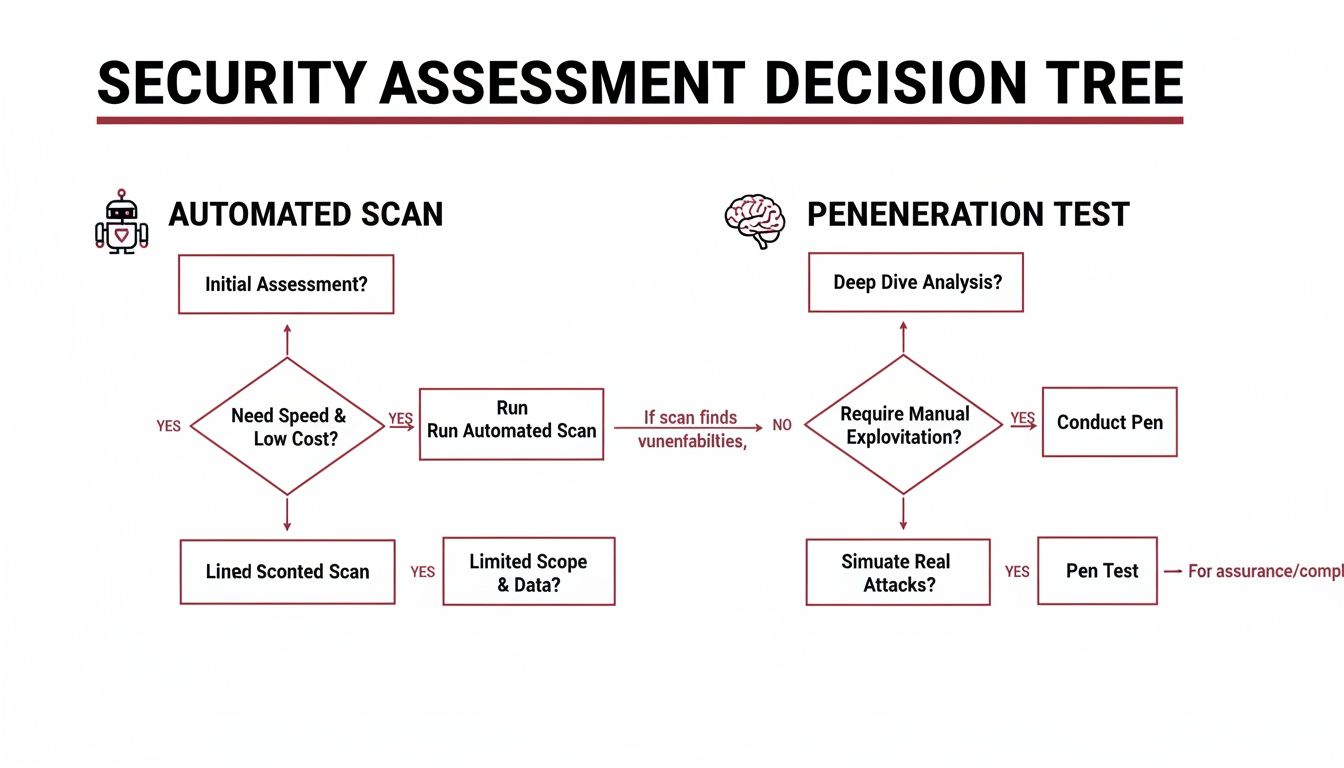
As the diagram shows, automated scans are great for flagging potential issues, but only a human-led penetration test can confirm if a vulnerability is genuinely exploitable. The creativity and intuition of an expert are what make the difference.
Key Insight: A human-led penetration test typically uncovers 80% more exploitable vulnerabilities than an automated scan alone. It's a powerful reminder of the value that a creative, human-driven approach brings to security assessments.
Comparing Common Pen Testing Services
To help you decide which service aligns with your business goals, this table breaks down the most common types of penetration testing.
| Service Type | Primary Target | Objective | Best For |
|---|---|---|---|
| External Network Test | Internet-facing servers, firewalls, and applications | Find and exploit vulnerabilities visible from the public internet. | Any business with an online presence or internet-exposed infrastructure. |
| Internal Network Test | Internal servers, workstations, and network devices | Simulate a post-breach scenario or an insider threat. | Organisations concerned about insider risk or containing a breach. |
| Web Application Test | Websites, customer portals, and web services | Uncover vulnerabilities like SQL injection or broken authentication. | Companies with e-commerce sites, SaaS platforms, or critical web portals. |
| Mobile Application Test | iOS and Android apps and their backend APIs | Find flaws in data storage, API security, and session management. | Businesses that rely on mobile apps to interact with customers. |
| Red Team Engagement | The entire organisation—people, processes, technology | Simulate a long-term, sophisticated attack to test overall resilience. | Mature organisations with high-security needs or regulatory pressures. |
Ultimately, each of these services answers a different question about your security posture, helping you allocate resources where they'll have the most impact.
How to Choose the Right Test for Your Business
Making the right choice comes down to understanding your specific situation. There's no one-size-fits-all answer.
Start by asking a few key questions:
What are my business objectives? What are our most critical assets? Is it customer data, intellectual property, or operational uptime? Your answer will point you toward the systems that need testing most.
What is our risk appetite? How much potential disruption from an attack can we realistically tolerate? This helps balance the cost of testing against the potential impact of a breach.
What scope and methodology will be used? A reputable vendor should be transparent. Ask if they follow industry-standard frameworks like the OWASP Top 10 or PTES (Penetration Testing Execution Standard) and if they provide clear Rules of Engagement.
What does the reporting and follow-up look like? The final report is one of the most valuable parts of the service. Look for a vendor that provides a clear, risk-prioritised report and offers retesting to confirm that your fixes actually worked.
For a deeper dive into structuring a continuous testing program, you can learn more in our detailed guide on Pen Testing As A Service.
Selecting the right penetration testing service is about more than just ticking a compliance box. It’s about gaining genuine clarity on your risk profile, which gives you the confidence to lead security discussions and make informed decisions for your business.
How Pen Testing Supports ISO 27001 Compliance
If your business is aiming for ISO 27001 certification, professional pen testing services aren't just a good idea—they're essential. Achieving compliance means going far beyond simply having policies written down. You need to prove that your security controls actually work under pressure, and a pen test is how you do it.
Think of your Information Security Management System (ISMS) like a fortress you’ve designed using the ISO 27001 standard as your blueprint. A penetration test is when you hire a team of specialists to see if they can break in. Their final report is the hard evidence you can show an auditor to prove your fortress is genuinely secure.
Satisfying Key ISO 27001 Annex A Controls
A proper penetration test directly helps you meet several crucial controls in the ISO 27001 framework, especially in Annex A. The most obvious connection is to control A.12.6.1 – Management of technical vulnerabilities.
This control demands that you stay on top of new technical vulnerabilities, understand how they could affect you, and take the right steps to manage that risk. A pen testing service is, without a doubt, the most effective way to tick this box.
- It finds the real issues: A pen test goes deeper than an automated scan, uncovering exploitable weaknesses that hackers would actually use.
- It measures the true risk: Testers don't just find a flaw; they show you what a real attacker could do with it, helping you prioritise the most urgent fixes.
- It gives you a clear path forward: You get a report with actionable steps to fix every problem, creating a documented record of your proactive risk management.
A pen test report serves as independent, third-party proof that you are actively managing your technical weak points. To an auditor, this is powerful evidence that your ISMS is a living, working system, not just a folder of documents on a shelf.
Building a Resilient and Compliant ISMS
Penetration testing does more than satisfy a single control; it strengthens the very core of your ISMS. It champions a culture of continuous improvement, which is a fundamental principle of the ISO 27001 standard. When you regularly challenge your own defences, you create a powerful feedback loop that makes your entire security posture stronger over time.
This proactive approach is more important than ever. The demand for real-world security validation is growing fast, with the penetration testing market expected to expand at an incredible 16.4% CAGR from 2025 to 2034. For businesses working toward ISO 27001, this trend highlights what the market already knows: pen testing is critical for proving your security works. For more on this, you can explore the comprehensive research from Grandview Research.
Meeting Broader Regulatory Requirements
The value of a pen testing service doesn't stop with ISO 27001. Companies also need to adhere to regulations like the Notifiable Data Breaches (NDB) scheme. This scheme mandates that you take "reasonable steps" to protect personal information.
Hiring a pen testing service is a fantastic way to demonstrate you're taking those reasonable steps seriously. If a data breach ever happens, having a history of regular, professional testing and follow-up fixes can make a huge difference in how regulators view your efforts.
It provides documented proof that you are actively trying to secure sensitive data, not just hoping for the best. To see how this fits into your overall security planning, have a look at our guide on conducting a risk assessment for cyber security. In the end, penetration testing turns compliance from a theoretical goal into a tested, proven reality.
Choosing the Right Pen Testing Service Provider
Picking a partner for your pen testing service is one of the most critical security decisions you’ll make. This isn't just another vendor relationship. The right provider becomes an extension of your team—a trusted advisor who helps you build a stronger, more resilient business. Get it wrong, and you could be facing a wasted budget, a false sense of security, and critical flaws left wide open.
This isn’t about finding the cheapest quote. It’s about finding a partner who delivers genuine value by understanding your business and translating technical jargon into a clear, strategic security roadmap.

Evaluating Provider Credentials and Expertise
First things first: look at the team’s qualifications. When you hire a pen testing company, you're really hiring the expertise of the individual testers. So don't be shy about asking for proof of their skills.
You're looking for industry-recognised, hands-on certifications. These aren't just acronyms on a resume; they represent proven, practical skill in ethical hacking.
- Offensive Security Certified Professional (OSCP): This is the gold standard for many. It’s a gruelling 24-hour practical exam where testers have to prove they can compromise multiple machines in a live network. It's tough, and it proves real-world skill.
- CREST Registered Penetration Tester (CRT): CREST is an international not-for-profit that sets a high bar for the industry. A CREST certification is a sign of a professional who meets globally recognised standards.
- GIAC Penetration Tester (GPEN): Another top-tier certification that validates an expert's ability to conduct a thorough penetration test using best-practice techniques and methodologies.
A provider that invests in their team's training and certifications is showing you they're serious about maintaining technical excellence.
Scrutinising the Testing Methodology
Once you've confirmed their expertise, you need to understand how they actually work. A reputable pen testing service will be completely transparent about their methodology. Their process should follow established industry frameworks, ensuring the test is structured, repeatable, and thorough.
Ask them if their approach is built on recognised standards like:
- OWASP Top 10: For any web application test, this is non-negotiable. It’s the definitive guide to the most critical web security risks.
- Penetration Testing Execution Standard (PTES): This standard maps out the seven key phases of a proper penetration test, covering everything from the initial planning to the final report.
A transparent methodology is the hallmark of a mature, professional operation. If a provider is vague about their process or can't point to the frameworks they use, consider it a major red flag.
This clarity is vital. It tells you what to expect and gives you a baseline for judging the quality of the work.
The Report is the Product
At the end of the day, the most valuable thing you get from any pen testing service is the final report. This document needs to be far more than a raw data dump of technical findings. A high-quality report is a strategic tool that empowers your business to take meaningful action.
A great report has three distinct parts:
- Executive Summary: A clear, non-technical overview written for business leaders. It should explain your overall risk posture, the potential business impact of the findings, and the strategic recommendations for getting better.
- Detailed Technical Findings: This is the "how-to" for your technical team. Each vulnerability needs to be documented with its risk level, solid evidence (like screenshots), and a step-by-step guide showing exactly how it was exploited.
- Actionable Remediation Steps: This is arguably the most important part. The report must provide clear, practical, and prioritised guidance on how to fix every single issue found.
And don't forget to ask about what happens after the report is delivered. Will they be available to answer your developers' questions? Do they offer re-testing to verify your fixes actually worked? A true security partner doesn't just hand over a report and disappear. They stick around to help you see the remediation through to the end.
Getting to Grips with Pen Testing Costs and Frequency
So, what's this all going to cost, and how often do we really need to do it? This is usually the first question on everyone's mind, and for a good reason. You need to budget for it, both in time and money. The honest answer is: it depends. The price tag for a professional pen test is directly linked to the size and complexity of what you want tested.
It’s crucial to stop thinking of penetration testing as a one-off project you tick a box for. That’s a common mistake. Instead, see it as an ongoing health program for your business's security. You wouldn't go to the doctor once in your life and assume you're set forever, right? The same logic applies here; your systems are constantly changing, and so are the threats.
What Actually Drives the Cost of a Pen Test?
The final quote for a pen test can swing pretty wildly between different providers and different jobs. To make sense of the proposals you get, you need to understand what's behind the numbers. It's a bit like building a house – the final cost hinges on the size, the materials you choose, and how complex the architectural plans are.
Here are the main factors that shape the price:
- Scope and Size: Testing a handful of public-facing IP addresses is a world away from a deep dive into a sprawling corporate network with dozens of web apps and internal servers. The more ground the testers have to cover, the more time and resources it takes.
- Testing Depth: A "black box" test, where the ethical hacker starts with zero information (just like a real attacker), is typically faster and cheaper. A "white box" test, however, is far more involved. Here, the testers get access to source code and architectural diagrams, allowing for a much more thorough, but also more labour-intensive, assessment.
- System Complexity: A simple brochure website is one thing. A sophisticated e-commerce platform with custom business logic, different user roles, and hooks into various payment gateways is another beast entirely. The more intricate your systems are, the more skill and time are needed to test them properly.
A reputable pen testing service provider will never give you a price off the cuff. They'll want to talk with you first, understand your specific environment and what you want to achieve. Only then can they scope the work properly and give you a quote that reflects the actual effort involved.
How Often Should You Be Testing?
While the cost is a big piece of the puzzle, how often you test is just as critical for building a solid defence. A pen test is really just a snapshot in time. Your digital world, on the other hand, is in constant motion. New code gets pushed live, new employees come on board, and new cyber threats pop up every single day.
So, what's the right rhythm for testing?
- Annually, at a minimum: Think of an annual pen test as your baseline. It's the standard for most organisations, giving you a regular, predictable checkpoint to see where you stand and helping you meet compliance obligations like ISO 27001.
- After any big changes: Just launched a new customer-facing app? Moved your servers to a new cloud provider? Rolled out a major network upgrade? These are all perfect times for a targeted pen test to make sure no new doors were accidentally left unlocked.
- When compliance demands it: Sometimes, the decision is made for you. Your industry regulations, cyber insurance policy, or a major client contract might specify exactly how often you need to get tested.
This proactive mindset is especially important for small and medium businesses (SMEs). We're seeing a massive surge in demand for penetration testing from SMEs, with the market predicted to grow at a staggering 18.29% CAGR. This isn't surprising when you consider that insurers are tightening their requirements and many cyber attacks target SMEs. With businesses losing billions to cybercrime each year, investing in proactive testing that can cut remediation costs by up to 50% is simply smart business. If you'd like to dig deeper into the numbers, you can explore the full penetration testing market analysis.
Your Pen Testing Questions, Answered
Deciding to bring in a penetration testing service means you're getting serious about your security. It also means you’re inviting experts to legally and ethically try to break into your systems. It’s completely normal to have questions before you start, so let’s tackle the most common ones we hear from business owners and IT managers.
How Is a Pen Test Different from a Vulnerability Scan?
This is probably the most important question we get, and the distinction is critical.
Think of a vulnerability scan as an automated security inventory. It's a piece of software that runs through your network, servers, and applications, checking them against a massive list of known security flaws. It's fast and gives you a report of potential issues.
A pen test, on the other hand, is a hands-on investigation driven by human expertise. It’s what happens after you get that list of potential issues. A pen tester acts like a real-world attacker, using their creativity, experience, and problem-solving skills to see if those potential flaws can actually be exploited. A scan might tell you a door is unlocked; a pen tester will actually try to open it, see what’s inside, and figure out how far they can go.
How Often Should My Business Get a Pen Test?
For most businesses, an annual pen test is the standard. It’s a solid rhythm that keeps your security in check and satisfies many compliance requirements, like those for ISO 27001.
But you shouldn't just set your watch to it. Your business isn't static, and your testing schedule shouldn't be either. You absolutely need to conduct a pen testing service after any significant event, such as:
- Major infrastructure changes: Like moving your services to a new cloud platform or redesigning your office network from the ground up.
- New application launches: Always test a new web or mobile app before it goes live and faces the real world.
- Significant feature updates: Rolling out major new functionality to an existing application can unintentionally open new security holes.
Testing after these milestones is just good practice. It ensures you haven't accidentally left a window open while doing renovations.
What Happens After Vulnerabilities Are Found?
A good pen test doesn't just hand you a list of problems and walk away. The real value is in the roadmap it provides for fixing them.
After the test, you'll get a detailed report. This isn’t just a data dump; it’s an action plan. Each vulnerability will be prioritised based on its real-world risk to your business—not just some abstract technical score. The report will give your technical team clear, step-by-step guidance on how to patch the holes.
Great security partners also stick around. They'll be available to answer your team’s questions and will often offer re-testing to verify that your fixes have actually worked and the vulnerability is gone for good.
Is Penetration Testing Safe for My Live Systems?
Yes, it is—when done by professionals. Any reputable pen testing service operates under a strict, pre-defined set of "Rules of Engagement". This is a formal agreement we establish with you before any testing begins. It clearly spells out what systems are in scope, the testing window, and exactly which techniques are allowed.
Ethical hackers use controlled methods designed to find weaknesses without causing damage or disrupting your day-to-day operations. The whole point is to simulate an attack in a safe, managed way. It’s like a fire drill: the goal is to test your response and find weaknesses without having to deal with an actual fire.
At Anitech, we specialise in guiding Australian businesses through the complexities of information security. Our expert consultants can help you integrate penetration testing into your ISO 27001 strategy, turning a compliance requirement into a powerful tool for building a more resilient organisation. Visit our ISO 27001 site to learn how we can help.
Recent Comments