

Quick Summary: A professional pen testing service simulates a real-world cyberattack to uncover security vulnerabilities automated scanners miss. This guide explains what a pen test involves, the different types available, its critical role in achieving ISO 27001 compliance, and how to choose the right partner to strengthen your digital defenses.
A penetration test – or ‘pen test’ – is a controlled, ethical cyberattack on your own systems. A professional pen testing service is crucial for hiring security experts to identify vulnerabilities in your digital infrastructure before a malicious actor does. This proactive security assessment is a critical step in modern cybersecurity and essential for demonstrating due diligence for compliance standards like ISO 27001.
A professional pen testing service uses human intelligence and sophisticated ethical hacking techniques, not just automated tools, to mimic the exact tactics and creative thinking of a genuine attacker. This hands-on approach digs much deeper than a simple vulnerability scan, giving you a true picture of your security weaknesses and a clear roadmap to fix them.
Putting Your Digital Defences to the Test
Imagine your standard security audit is like a building inspection. An auditor walks around, checks that the doors have locks, the windows are shut, and the alarm system is turned on. It's a useful checklist.
A penetration test, on the other hand, is like hiring a team of ex-burglars to actually try and break into your building. They won’t just jiggle the front doorknob. They’ll look for that one window left unlocked on the second floor, see if they can pick the lock on a side door, or even try to trick an employee into letting them in.
That’s exactly what a pen testing service does for your digital assets. It’s not just a technical tick-box exercise; it’s a strategic investment in your business’s ability to withstand a real attack. The goal is simple: find and patch the holes before they cost you your data, your customers’ trust, and your reputation.

Why You Can't Afford to Skip Proactive Testing
In today's threat-heavy environment, simply having defences in place isn't enough. You have to be sure they actually work under pressure. A pen test delivers that real-world proof in a way that automated scanners just can't match.
Here’s why it’s so crucial:
- Finds What Scanners Miss: It uncovers the complex, multi-step vulnerabilities that only human creativity and persistence can find.
- Confirms Your Controls Work: It tests if your expensive firewalls, security software, and policies are actually doing their job when faced with a clever adversary.
- Satisfies Compliance Demands: It provides the hard evidence you need to meet stringent requirements for standards like ISO 27001 and PCI DSS.
The demand for this level of assurance is growing fast. Here in Australia, businesses are spending an estimated $200-300 million a year on penetration testing. This isn't just a niche service anymore; it’s a mainstream business priority. The market is also incredibly diverse, meaning you can find specialised firms that really understand your industry. You can discover more insights about the Australian pen testing market and its opportunities.
By simulating a real attack, you stop being a passive target and start thinking like an attacker. It helps you answer the one question that really matters: "If we were hit today, would we survive?" A quality pen testing service gives you the answer.
At the end of the day, a pen test isn't about pointing fingers or finding fault. It’s about building a stronger, more resilient organisation. You walk away with a prioritised, practical list of what to fix, allowing you to spend your security budget where it will have the biggest impact.
Choosing the Right Type of Pen Test
Not all security risks are created equal, so why would your testing strategy treat them that way? Picking the right kind of pen testing service is a bit like a doctor choosing the correct diagnostic tool; you wouldn't use a stethoscope for a broken bone. You have to match the assessment to your specific operations, your tech stack, and, most importantly, the threats that keep you up at night.
Get this wrong, and you're just throwing money away while leaving critical security holes wide open. For example, if your biggest worry is protecting customer data funnelled through your website, running an internal network test won't even touch your most significant risk. Understanding the different kinds of tests is the first step to getting real, actionable results that actually support your ISO 27001 goals.
External and Internal Network Testing
For most businesses, External Network Testing is the logical place to start. Think of it as a professional security check on your digital front door. Our ethical hackers will look at everything visible from the public internet—your website, your servers, your firewalls—and see if an outsider can force their way in. It’s a fundamental first step because this is exactly where most opportunistic attacks begin.
On the flip side, Internal Network Testing answers a more sinister question: what happens if the bad guy is already inside? This scenario could be a disgruntled employee, or a criminal who got a foothold through a simple phishing email. This test reveals just how far they could burrow into your systems, whether they can get their hands on sensitive files, and if they can elevate their access to take over the whole show.
Web and Mobile Application Testing
If your business runs on custom-built software, you need a far more specialised approach. Web Application Pen Testing puts your websites and online platforms under the microscope, hunting for common but devastating flaws like SQL injection or cross-site scripting. These are the kinds of vulnerabilities that let attackers steal customer data or completely deface your site.
In the same vein, Mobile Application Pen Testing zeroes in on the apps you’ve built for your customers on iOS and Android. This test checks for things like insecure data storage on a user's phone, sloppy communication with your servers, and other security gaps unique to the mobile world. With so much business now happening on phones, locking down these apps is simply non-negotiable.
A proper pen test isn’t just about the tech—it's about context. The right test answers the question, "How would an attacker realistically compromise our most valuable assets?" and then hands you a clear roadmap to stop them.
For businesses with more mature security programs, a Red Team Engagement is the ultimate reality check. This isn't just a single test; it's a full-scale, objective-driven campaign that mimics a persistent, real-world adversary. The red team will use any means necessary—technical hacks, social engineering, even trying to physically access your office—to achieve a specific goal, like stealing sensitive project files. These exercises are priceless for testing how well your security team can actually detect and respond to a genuine attack.
Matching the Pen Test to Your Business Needs
To make sense of it all, it helps to see how these common services stack up against different business concerns. This table breaks down which test is designed to address specific threats.
| Pen Test Type | Primary Target | Key Objective | Ideal For Businesses Worried About |
|---|---|---|---|
| External Network | Internet-facing servers, firewalls, and public IPs. | Find vulnerabilities that an outside attacker can exploit. | Defacement, denial-of-service, and initial compromise. |
| Internal Network | Internal servers, workstations, and user accounts. | Assess damage from an insider threat or compromised account. | Data theft by employees or lateral movement by malware. |
| Web Application | Customer portals, e-commerce sites, and online forms. | Uncover flaws that could lead to customer data breaches. | Stolen credit card numbers or compromised user accounts. |
| Mobile Application | iOS and Android apps and their backend APIs. | Identify vulnerabilities specific to mobile platforms. | Insecure data on customer phones or API abuse. |
| Red Team | The entire organisation (people, process, technology). | Test detection and response capabilities against a real APT. | Advanced, persistent threats targeting specific assets. |
Ultimately, choosing the right pen testing service is a strategic business decision, not just an IT one. As we cover in our complete guide to penetration testing services, aligning the scope of the test with your real-world business risks is what separates a successful engagement from a box-ticking exercise. And as technology evolves, so does testing; specialised assessments like smart contract auditing are now vital for businesses building on blockchain, proving that security must always keep pace with innovation.
What Actually Happens During a Pen Test?
Let's be honest, hiring a pen testing service can feel a bit like inviting a team of professional lockpickers into your office to see if they can break into the safe. It's totally normal to feel a little nervous about the process. But the reality is a world away from a chaotic free-for-all.
A professional penetration test is a highly structured, carefully managed engagement. Think of it less as a surprise raid and more like a planned fire drill for your digital security. We operate under strict rules of engagement that you sign off on before we even touch a keyboard.
This methodical approach is exactly what auditors for standards like ISO 27001 look for. It proves you're not just crossing your fingers and hoping for the best; you're actively and responsibly testing your defences to find and fix weaknesses before a real attacker does.
Step 1: Setting the Rules of the Game (Scoping & Planning)
This first step is, without a doubt, the most important one. Before any testing kicks off, we sit down with you to define the 'rules of the game'. It’s a collaborative process where we figure out exactly what’s in scope, what’s off-limits, and what you want to achieve.
During this phase, we'll get crystal clear on questions like:
- What are we testing? Are we looking at a specific web application, the entire office network, or something else?
- What keeps you up at night? Is it protecting sensitive customer data, preventing a costly outage, or something else entirely?
- When can we test? We can work during business hours or schedule testing for overnight to minimise any potential disruption.
- Who do we call? We establish clear points of contact on both sides to keep communication flowing smoothly.
Getting the planning right ensures the entire test is laser-focused on your business goals and specific risks. It eliminates surprises and makes sure our ethical hackers are putting their energy where it will have the biggest impact.
Step 2: Casing the Joint (Reconnaissance & Analysis)
With the plan in place, our team gets to work. The first move is reconnaissance. This is the digital equivalent of an attacker watching your building from across the street. We gather publicly available information about your organisation—things like employee names, software versions you use, and network details—to see what an outsider could discover.
Next, we move into vulnerability analysis. This is where we combine powerful automated scanning tools with old-fashioned human ingenuity. We probe the systems you've asked us to test, looking for known weaknesses and misconfigurations. It's more than just running a scan; it's about connecting the dots to build a detailed map of your potential attack surface.
It’s one thing to find a slightly unlocked window. It’s another to realise that window leads to the key to the front door. We think like an attacker to understand how small, seemingly low-risk issues could be chained together to create a major breach.
This infographic breaks down the common areas a pen test will focus on, from your external perimeter right through to your internal network and applications.
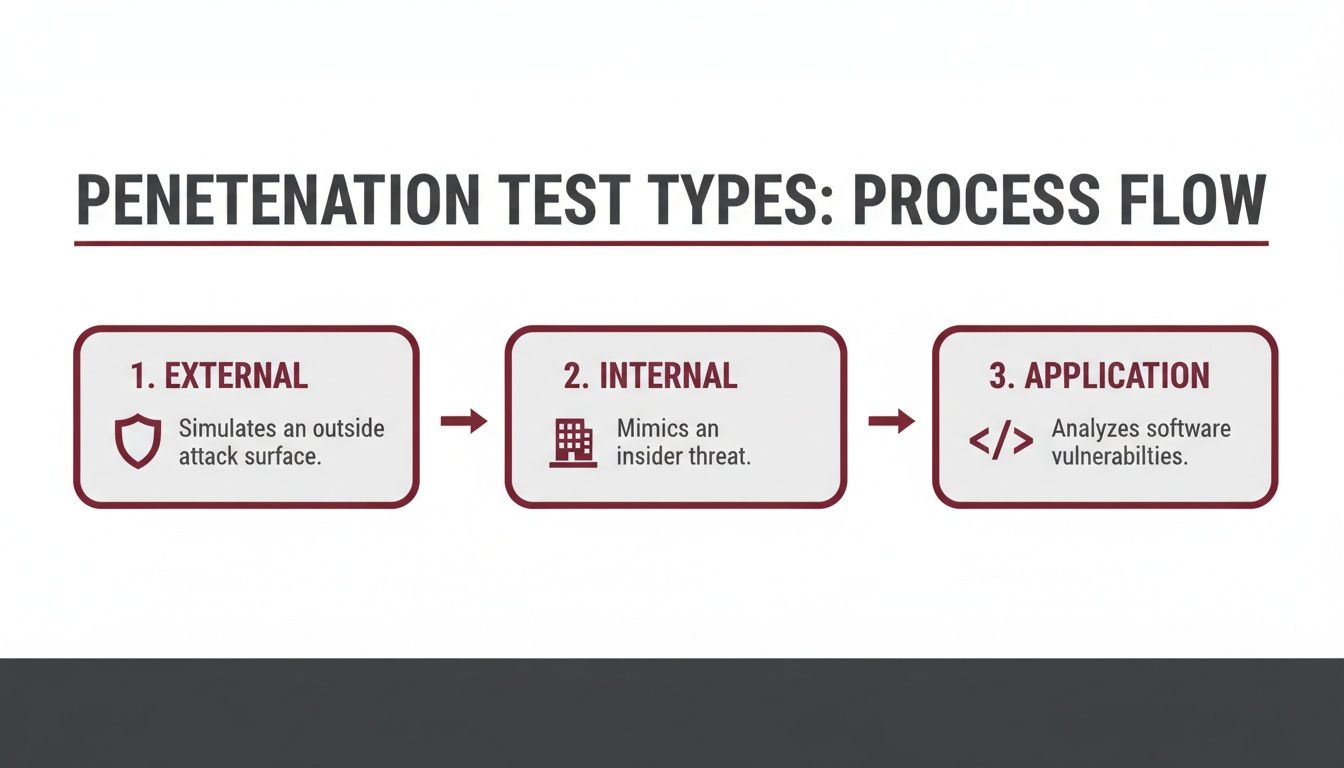
Each of these areas represents a different way an attacker might try to get in, and a solid security posture needs to cover them all.
Step 3: Proving the Risk (Exploitation & Reporting)
This is the phase that gives penetration testing its name. During exploitation, our ethical hackers will carefully and safely try to take advantage of the vulnerabilities they found. The goal is never to cause damage. It's to prove, without a doubt, whether a vulnerability is a real, exploitable threat or just a theoretical one.
Finally, we deliver what is arguably the most valuable part of the whole engagement: the report. We compile every finding into a comprehensive document, but this is no mere list of technical jargon. A great report translates our findings into tangible business risk, giving you a clear, prioritised, and actionable roadmap for fixing things. This document is your proof of proactive security management, perfect for showing to auditors, executives, and clients.
For organisations looking for a more continuous approach, flexible models like Pen Testing as a Service can integrate this cycle of testing and remediation directly into your operations.
How Pen Testing Drives ISO 27001 Compliance
If you're working towards ISO 27001 certification, a professional pen testing service is more than just a good idea—it's a massive compliance advantage. It takes the abstract concept of "risk management" and turns it into hard evidence that you're actively finding and fixing weaknesses in your security. When an auditor comes knocking, a history of penetration test reports is powerful, undeniable proof that you take cybersecurity seriously.
This process transforms your security posture from a theoretical checklist into a battle-tested reality. Imagine an auditor asking how you know your security controls actually work. Handing them a professional penetration test report is one of the strongest answers you can give. It shows a mature, proactive mindset focused on protecting your company's information.
Directly Addressing Key ISO 27001 Controls
The link between pen testing and ISO 27001 is very direct. It helps you satisfy specific requirements laid out in the standard's Annex A controls. The most obvious one is A.12.6.1 Management of technical vulnerabilities, which requires you to find out about vulnerabilities in a timely way, understand your exposure, and do something about the risk.
A penetration test is hands-down the best way to meet this requirement. It doesn't just scan for potential weaknesses; it actively tries to exploit them to demonstrate the real-world damage they could cause.
But it doesn't stop there. A good pen testing service also helps you prove you're meeting other key controls, including:
- A.5.15 Access Control: Pen testing is perfect for checking if your access controls are really working. Can an attacker sneak past them to steal data or gain higher privileges? A pen test will find out.
- A.8.2 Protection against malware: By simulating real attacks, a pen test can determine if malware could realistically get through your defences and wreak havoc on your systems.
- A.14.2.8 System security testing: This control is all about testing during development. An application pen test does exactly that, finding coding flaws before they ever make it into a live environment.
The Pen Test Report: A Cornerstone of Your ISMS
Your Information Security Management System (ISMS) is the engine of your ISO 27001 certification, and a detailed report from a pen testing service is a critical component of that engine. It’s far more than a technical summary of findings; it's a strategic tool for managing risk.
The final report is more than a list of vulnerabilities. It is your evidence-based roadmap for continuous improvement, proving to auditors, stakeholders, and clients that your risk management process is both active and effective.
The report gives you a prioritised list of risks, ranked by how severe they are and how easy they are to exploit. This clarity allows you to point your security budget and team's effort where it matters most, tackling the biggest threats first. This is precisely the kind of documented, risk-based approach that ISO 27001 auditors love to see.
The demand for this kind of security assurance is skyrocketing. The global penetration testing market is on track to hit USD 5.51 billion by 2031, and here in Australia, small and medium-sized businesses are ramping up their spending at a rate of 18.29% per year. This push is often coming from insurers and major clients who now demand tangible proof of security—the kind a pen test delivers. You can explore detailed market analysis on Mordor Intelligence to see how these global trends are playing out.
This shift shows that pen testing is no longer a "nice-to-have" but a core business requirement for proving due diligence. For businesses that want to make this a regular part of their operations, looking into models like our Pen Test as a Service can weave security validation right into your workflow, making your ISMS and compliance posture even stronger.
Selecting the Right Pen Testing Partner
Choosing a provider for your pen testing service is just as important as the test itself. Think of it this way: the right partner becomes a long-term ally in your security efforts, while the wrong one can deliver a shallow report that burns through your budget and, worse, leaves you exposed.
A great provider doesn't just hand you a list of problems. They help you understand the business context behind those vulnerabilities and give you a clear, practical roadmap to a stronger security posture. This decision is fundamental to protecting your assets and nailing compliance goals like ISO 27001.

Beyond the Sales Pitch
The security market is crowded, and it's getting tougher to tell the difference between a simple vulnerability scan and a genuine, in-depth penetration test. When you're choosing a cyber security firm, it's crucial to know what you're actually buying. A vulnerability scan is automated—it’s like a spell-checker looking for known typos. A true pen test, on the other hand, involves a human expert actively trying to break in, showing you what a real attacker could actually do.
To find a partner who will genuinely lift your security game, you need to look for a few key things:
- A Proven Methodology: Don't be afraid to ask them to walk you through their entire process. A professional outfit will have a transparent, structured plan covering everything from the initial scoping call to the final report.
- Actionable Reporting: The report is the most valuable part of the whole engagement. It should be written in plain English, prioritise findings based on business risk, and offer concrete, step-by-step advice for fixing things—not just a wall of technical jargon.
- Remediation Support: What happens after they send the invoice? A top-tier partner won't just disappear. They’ll offer support to help your team understand the findings and even verify that the fixes you've put in place have actually worked.
Credentials and Expertise Matter
Certifications aren't just fancy acronyms; they are a critical sign of a provider's technical skill and commitment to ethical standards. They offer independent proof that the testers have the knowledge and discipline to conduct a safe, effective, and professional assessment.
When you hire a certified professional, you're not just buying a service; you're investing in proven expertise. Certifications like CREST and OSCP are the industry's gold standard, signalling a commitment to quality and ethical conduct.
You should be looking for testers who hold industry-recognised credentials, such as:
- CREST (Council of Registered Ethical Security Testers): An internationally respected body that accredits both companies and individual testers, ensuring high standards across the board.
- OSCP (Offensive Security Certified Professional): A notoriously tough, hands-on certification that proves a tester has the practical skills to find and exploit vulnerabilities in the real world.
- CEH (Certified Ethical Hacker): A well-known certification that confirms a broad knowledge of security tools and hacker techniques.
Finally, a provider's flexibility is a huge plus. Modern businesses are dynamic, especially with agile development and cloud infrastructure. This has led to the rise of newer models like penetration testing as-a-service (PTaaS), a market expected to grow from USD 2.34 billion in 2024 to an incredible USD 11.07 billion by 2034. This explosive growth shows a real demand among Australian businesses for more continuous and scalable security testing.
Finding a partner who can adapt their pen testing service to the rhythm of your business is a massive advantage in today's environment.
Getting a Handle on Pen Testing Costs and Frequency
Let's talk about two of the most common questions we get: "How much does it cost?" and "How often do we need to do it?" Getting these right is key to building a security program that actually works for your business without breaking the bank.
Think of pen testing not as a one-off expense, but as an investment in your company's resilience. The cost reflects the level of expertise needed to genuinely stress-test your defences. Similarly, the frequency isn't just about ticking a box; it’s about creating a rhythm of continuous improvement that keeps you a step ahead of attackers.
What Goes Into the Price of a Pen Test?
There's no simple price list for penetration testing, and for a good reason. The cost is a direct reflection of the time and skill required from an ethical hacker. It’s a bit like commissioning a custom piece of furniture – the price depends entirely on the complexity of the design and the materials used.
Several things shape the final quote you'll receive:
- Scope: This is the big one. Testing a single, small website is a very different beast from assessing a large corporate network with multiple servers and applications. The bigger and more complex the target, the more time it takes.
- Complexity: A standard WordPress site is one thing; a custom-built financial services platform with intricate user permissions and third-party integrations is another. The more moving parts, the more potential weak points a tester needs to investigate.
- Methodology: The approach matters, too. A "black box" test, where the tester has zero prior knowledge, involves a lot of initial discovery work. A "white box" test, where they're given full access and source code, requires deep analysis and a different kind of effort.
A huge mistake we see is treating pen testing like a commodity and just picking the cheapest provider. A top-tier pen test doesn't just give you a list of problems; it delivers a clear, risk-prioritised roadmap. That clarity saves you immense time and money by showing you exactly what to fix first. The real value is in the actionable insights, not just the raw findings.
When you get a quote from a quality provider, it should clearly explain how these factors contribute to the final cost. That transparency is a hallmark of a partner you can trust.
How Often Should You Be Pen Testing?
Figuring out the right schedule for pen testing is a core part of managing your business risk. While an annual test is a common starting point, it's rarely enough by itself. The best approach is to let your business activities and compliance needs dictate the timing.
Here’s a practical guide for when to schedule a pen testing service:
- Annually: Think of this as your minimum. An annual test of your most important systems gives you a regular security health check. It's also a standard requirement for compliance frameworks like ISO 27001 and PCI DSS.
- After Major Changes: Just launched a new feature? Migrated to a new cloud environment? Overhauled your office network? Any significant change can accidentally introduce new security holes. It’s crucial to test right after these events.
- To Meet Compliance Requirements: Sometimes, the decision is made for you. Specific regulations or contracts with large clients will often dictate testing schedules. For something like ISO 27001, regular testing is the hard evidence auditors need to see that you're actively managing your technical vulnerabilities.
By using these events as triggers, you ensure your security posture keeps pace with your business. It’s how you keep your defences sharp and your compliance in good standing.
Got Questions? We've Got Answers.
Stepping into the world of cybersecurity can feel a bit like learning a new language. To make things clearer, we’ve put together some straightforward answers to the questions we hear most often from business owners and IT managers about professional pen testing services.
What’s the Real Difference Between a Vulnerability Scan and a Pen Test?
This is probably the single most important question to get your head around, and the answer is simple: automation vs. human intelligence.
Think of a vulnerability scan as an automated security guard doing a quick patrol. It uses a checklist of known problems to spot obvious weaknesses, like an unlocked window on the ground floor. It’s fast, it’s useful, but it doesn’t have the creativity or intuition to understand what a real attacker would do next.
A pen testing service, on the other hand, is like hiring a professional security consultant to try and break in. A real person—an ethical hacker—is actively trying to outsmart your defences. They don't just find the unlocked window; they figure out how to climb through it, avoid the motion sensors, and crack the safe. This is the kind of real-world risk insight you need for standards like ISO 27001.
How Long Does a Pen Test Actually Take?
There's no single answer here, as the timeline really depends on the size and complexity of what we're testing. Every project is scoped to fit the specific organisation.
But to give you a rough idea:
- A simple external test on your public-facing websites and servers might take one to two weeks.
- A more involved test, like digging into a complex web application or your internal company network, could easily stretch to three weeks or more.
This timeframe always covers everything from the initial planning and scoping sessions, right through to the hands-on testing, analysis, and writing your final report. We'll map out a precise schedule with you right from the start.
Will a Pen Test Cause Downtime for My Business?
It’s a fair question, but the short answer is no. A professional pen test is carefully designed to have minimal to zero impact on your daily operations. Before we touch a single thing, we'll establish clear 'rules of engagement' with you. You approve everything.
A professional pen test is a controlled and collaborative exercise, not a chaotic attack. Testers are explicitly instructed to avoid actions that could cause system instability or data loss, and any potentially disruptive steps are always discussed with you for approval first.
Our team is skilled at working quietly in the background. We can even schedule the more intensive testing for after-hours or on weekends, ensuring your business runs without a hitch. The whole point is to find risks, not create them.
Ready to move beyond checklists and truly understand your security posture? The expert team at Anitech provides comprehensive pen testing services designed to meet ISO 27001 requirements and give you a clear, actionable path to stronger security. Secure your free consultation and learn how we can help at https://iso-27001.com.au.
Recent Comments