

Think of pen testing services as your organisation's secret weapon. They are essentially controlled, ethical cyber-attacks designed to uncover security weak points before genuine attackers can exploit them. It's a proactive security measure and a critical investment for any business serious about protecting its digital assets. By simulating real-world threats, these services give you a clear roadmap to reinforce your defences.
So, What Are Modern Pen Testing Services, Really?

Imagine you've built a fortress to protect your company's crown jewels. You've got high walls, strong gates, and guards on patrol. But what about the hidden weaknesses? Is there a secret passage you overlooked? A loose brick in the wall? Could a clever intruder simply talk their way past a guard?
This is exactly what pen testing services are designed to find out.
Penetration testing, or pen testing for short, goes far beyond a simple automated scan that just rattles the doorknobs. It’s about hiring a team of elite, ethical 'security specialists' to actively try and breach your systems. They don't just point out known vulnerabilities; they dig deeper, attempting to exploit them, chain them together, and see just how much access they can really get.
The entire point is to find and fix security flaws before malicious actors get a chance to use them against you. This proactive approach doesn't just strengthen your defences; it also helps you meet compliance standards and builds crucial trust with your customers and partners.
This whole process is a simulated attack, carried out in a completely controlled environment so there’s no real harm to your operations. The goal is to give you a real-world demonstration of how an attacker could compromise your security, offering invaluable insights that automated tools simply can't provide.
Why Proactive Testing Is No Longer Just an Option
In the past, cybersecurity was often a reactive game. A breach would happen, and companies would scramble to clean up the mess. That approach just doesn't work anymore. The financial and reputational damage from a single successful cyber-attack can be catastrophic. Proactive security, with pen testing leading the charge, has become a fundamental cost of doing business.
This shift is being driven by a few key things:
- Threats Are Getting Smarter: Attackers are constantly finding new ways to get around traditional security. A pen test helps you think like them and stay one step ahead.
- Our Systems Are More Complex: Modern businesses run on a tangled web of apps, cloud services, and networks. This complexity naturally creates more potential entry points for attackers.
- Regulatory Pressure Is On: Many industries now face strict compliance standards (like PCI DSS or GDPR) that require regular security assessments and pen tests.
The demand for these specialist services is skyrocketing. In fact, the Australian penetration testing market is projected to hit USD 23.24 million by 2025, growing at a compound annual rate of 19.5%. This growth is largely fuelled by the massive shift to cloud computing and tightening government regulations. You can get a deeper dive into these figures by exploring the full penetration testing market report.
It’s More Than Just a Compliance Checklist
It’s easy to see pen testing as just another box to tick for compliance, but that's missing the real value. While it absolutely helps you meet regulatory demands, its true power is in the actionable intelligence it delivers. A proper pen test gives you a detailed, attacker's-eye view of your security posture.
Here’s what that looks like in practice:
- Reconnaissance: The ethical hackers start by gathering information about your organisation, just as a real attacker would, to pinpoint potential targets.
- Scanning and Analysis: They use a mix of tools to find live systems, open ports, and potential soft spots in your network and applications.
- Exploitation: This is where the action happens. The testers actively try to exploit the vulnerabilities they've found to gain a foothold in your systems.
- Post-Exploitation: Once they're in, they try to elevate their privileges and move sideways through the network to see how much damage a real breach could do.
- Reporting: Afterwards, you get a comprehensive report. It doesn't just list the problems; it details the risk level of each one and provides clear, practical steps to fix them.
When you bring in professional pen testing services, you're not just buying a report. You're making a strategic investment in the resilience and long-term security of your entire organisation.
The Real Business Case for Proactive Security
It’s easy to look at penetration testing services and see another line item on the expense sheet. But that’s a critical mistake. Viewing proactive security as a technical cost misses the point entirely—it’s actually a strategic investment in your company’s survival and future growth. This isn't just about tweaking code; it's about protecting your entire operation from financial ruin, reputational implosion, and hefty regulatory fines.
Think about it like this: you'd never build a new office without installing fire alarms, sprinkler systems, and decent locks on the doors. Pen testing is the digital equivalent of that inspection, making sure your virtual locks are strong enough to keep a determined intruder out and your most valuable assets safe.
Beyond the Code: Preventing Financial Ruin
The numbers don’t lie—a single data breach can be financially devastating. According to IBM, the average cost of a breach hit a staggering $4.45 million in 2023. A figure like that could easily bankrupt a small or medium-sized business. This isn't just about money stolen from an account; it covers everything from forensic investigations and system restoration to legal fees and the cost of notifying every affected customer.
But the immediate financial hit is often just the beginning. The real long-term damage comes from the loss of customer trust, something far harder to measure but incredibly destructive to your bottom line. Once customers feel their data isn't safe with you, they'll simply take their business elsewhere, chipping away at your market share and future revenue.
This is where the true value of pen testing really shines. By finding and helping you fix just one critical vulnerability, a single penetration test can stop an attack that might have cost your business millions. It flips the script on security, turning it from a reactive, expensive scramble into a proactive, value-adding strategy. For any business leader, understanding the return on investment of cyber security is fundamental to making smart decisions.
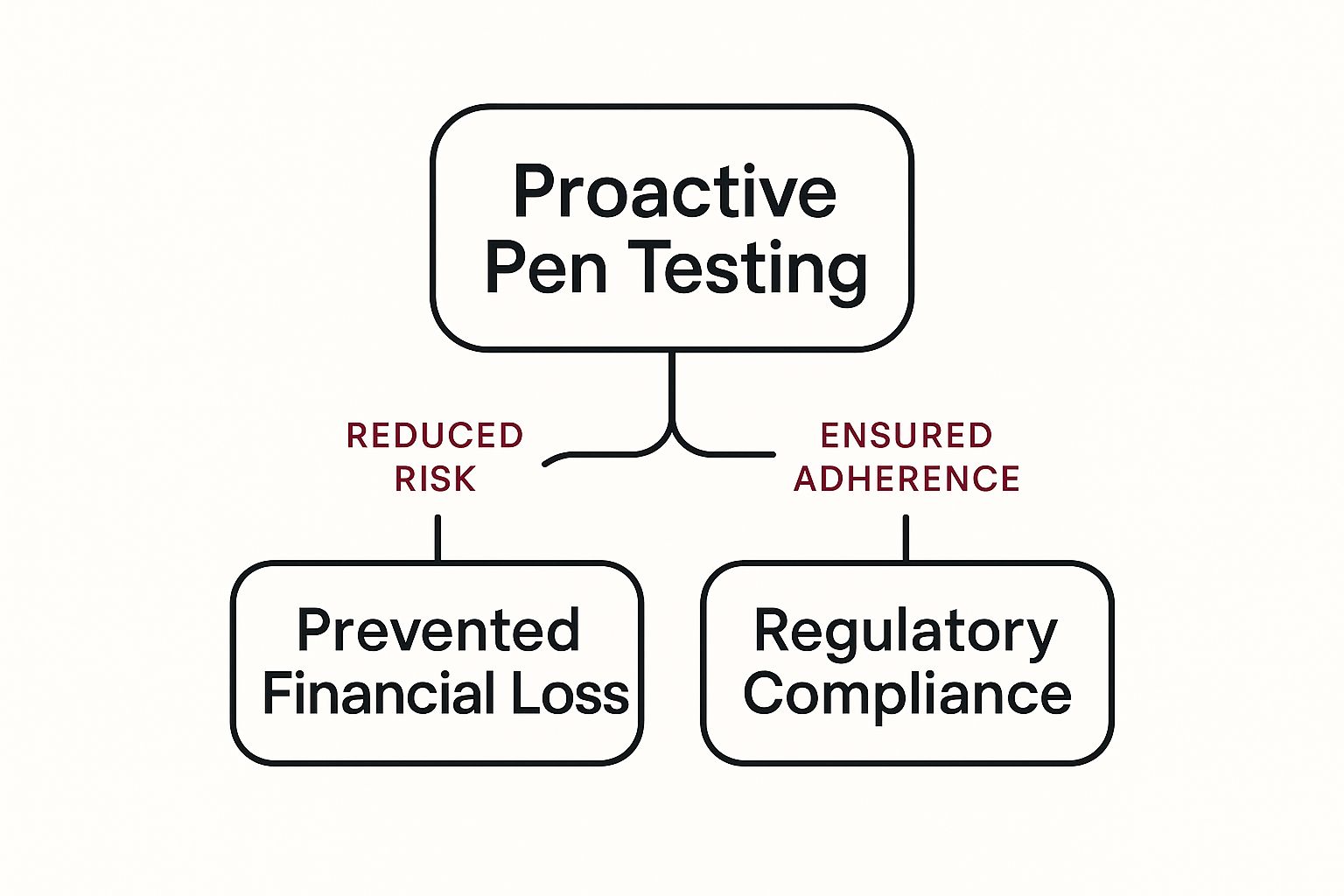
As you can see, a single investment in pen testing directly helps mitigate severe financial risks while also ensuring you tick the boxes on crucial legal and industry standards.
Protecting Your Hard-Earned Reputation and Trust
Your brand’s reputation is one of your most valuable assets. It’s built over years of hard work, great service, and genuine customer engagement. A cyber-attack can tear all that down in a matter of hours. News of a breach travels fast, sparking negative headlines and creating a public perception that your organisation is careless with sensitive data.
Nothing is more important than maintaining customer trust. When clients hand over their personal or financial details, they are putting their faith in your ability to protect it. A breach shatters that trust completely.
By regularly engaging pen testing services, you send a powerful message to your customers, partners, and stakeholders. You are demonstrating a serious commitment to security and a proactive stance on protecting the data they entrust to you. This builds confidence and strengthens relationships, turning security into a competitive advantage.
This proactive approach is especially vital in today’s market. Consumers are more security-savvy than ever, and showing them you have robust security practices can be a key differentiator that wins and keeps customers who value their privacy.
Navigating the Complex Web of Compliance
Let's be clear: regulatory compliance isn't an optional extra anymore; it's a legal minefield. For Australian businesses, frameworks like the Privacy Act and industry-specific standards like the Payment Card Industry Data Security Standard (PCI DSS) have strict data protection rules. Fail to comply, and you’re looking at severe penalties, including massive fines and legal action.
Many of these regulations don’t just suggest security testing—they demand it. For example:
- PCI DSS Requirement 11.3 explicitly requires merchants to perform penetration testing on both internal and external networks at least once a year, and after any significant change to their infrastructure.
- The GDPR, which affects any organisation holding data on EU citizens, calls for "a process for regularly testing, assessing and evaluating the effectiveness of technical and organisational measures."
Penetration testing provides the documented, third-party proof that you’re doing your due diligence. It's an independent validation of your security controls that is worth its weight in gold during a regulatory audit. What's more, a good pen test will also check the effectiveness of your existing defences, like your robust anti-malware protection, ensuring they're actually working as intended.
Ultimately, investing in regular pen testing isn't just a job for the IT department—it’s a core business function. It's a strategic decision that supports your financial stability, brand integrity, customer loyalty, and legal standing, ensuring your business stays resilient and successful for the long haul.
Inside the Ethical Hacker's Toolkit

To really get what pen testing services bring to the table, you have to understand how these experts actually think and act like an attacker. It’s not just a chaotic smash-and-grab. It's a calculated, disciplined exercise that’s shaped by one crucial factor: how much the tester knows before they start.
Let's use an analogy. Imagine you’ve hired a team to test the security of a brand-new, high-tech bank vault. How they go about it depends entirely on what you tell them. Do you give them the full blueprints? Just the street address? Or something in between?
This single variable is what separates the three core methodologies in an ethical hacker's playbook: Black Box, White Box, and Grey Box. These aren’t just technical jargon; they’re different strategies designed to answer very different questions about your security. Getting this choice right is the key to getting the insights you actually need.
The Black Box Approach: Simulating a Real-World Attacker
Let's start with the first scenario. The vault-testing team is given nothing but the bank's address. That's it. No blueprints, no staff schedules, no intel on the alarm systems. They have to figure everything out from scratch, just like a real-world criminal would. This is the essence of a Black Box penetration test.
In this situation, the ethical hacker has zero prior knowledge of your internal systems, source code, or network layout. They come at your organisation as a complete outsider, relying on public information and their own wits to find a way through your defences.
This approach is invaluable for answering one critical question: how well do your external defences hold up against a blind, opportunistic attack? It gives you a raw, unfiltered view of your security from the outside, showing you exactly what a determined adversary can see and exploit. It’s the most realistic simulation of an external threat.
The White Box Approach: An Insider's View
Now, let's flip the script entirely. This time, the bank hands over the complete vault blueprints. The team gets every detail: the locking mechanisms, the server passwords, the alarm schematics, and even the source code for the security software. This is a White Box penetration test.
Here, the pen testers are given the "keys to the kingdom"—full access to all the information about the target system. The goal isn't to see if they can get in, but to conduct an exhaustive audit from a position of complete knowledge, hunting for flaws that an outsider would never find.
White Box testing is the most thorough and comprehensive approach you can take. It allows testers to meticulously pick apart your code and architecture, spotting deep-seated design flaws and misconfigurations.
This method is perfect when you need to do a deep-dive security review of a specific application, especially during its development. It’s less about mimicking an attacker and more about a systematic effort to find and squash every single potential bug before it becomes a problem.
The Grey Box Approach: The Best of Both Worlds
Back to our vault analogy for the last time. In this final scenario, the security team is given a standard employee access card and a basic building layout, but not the detailed vault blueprints. They have some privileged access—like a typical user—but no admin-level knowledge. This balanced approach is a Grey Box penetration test.
Grey Box testing cleverly blends elements from the other two methods. The ethical hacker is provided with limited information, usually a set of user-level credentials or some basic knowledge of the network. This allows them to simulate a different, and very common, type of threat: a malicious insider or an external attacker who has already stolen a user’s login details.
This approach is incredibly efficient. Testers get to skip the time-consuming reconnaissance work of a Black Box test and jump straight to probing for vulnerabilities from a privileged position. It delivers a powerful mix of realism and depth, making it one of the most popular and cost-effective options for many businesses.
A Quick Comparison of Pen Testing Methods
Understanding the key differences between Black Box, White Box, and Grey Box testing is crucial to see which approach fits your security needs. Each one is a different tool for a different job.
| Methodology | Tester Knowledge | Time & Cost | Primary Goal |
|---|---|---|---|
| Black Box | None | High | To simulate a realistic external attack and test perimeter defences. |
| White Box | Full & Complete | Very High | To conduct an exhaustive, in-depth security audit of code and architecture. |
| Grey Box | Limited (e.g., user account) | Moderate | To simulate an insider threat or an attacker with a compromised account. |
In the end, there’s no single "best" methodology. The right choice depends entirely on your specific goals, your appetite for risk, and your budget.
Are you most worried about an unknown attacker from the outside? A flaw buried deep in your code? Or a disgruntled employee with an axe to grind? Answering that question is the first step toward building a security testing strategy that delivers real, actionable results.
Finding the Right Pen Testing Service Model
Deciding on the right type of penetration test goes beyond just picking a methodology like Black Box or White Box. You also need to think about how the service is delivered. Pen testing isn't a one-size-fits-all solution; the service model you choose needs to mesh with your organisation's speed, budget, and overall security maturity.
The world of pen testing services has evolved. We've moved on from the traditional, once-a-year project to far more dynamic and continuous options. Getting your head around these modern delivery models is the key to making sure your security investment actually pays off.
The Old School Way: One-Off Engagements
For a long time, a pen test was a bit like an annual check-up at the doctor. You'd hire a team for a few weeks, they'd test your systems, hand over a massive report, and then you wouldn't hear from them again for another year.
This approach, known as a one-off or project-based engagement, definitely still has its place. It's a great fit for:
- Compliance: Ticking the box for an annual requirement for standards like PCI DSS.
- Specific Projects: Kicking the tyres on a brand-new application just before it goes live.
- Budgeting: It’s a single, predictable line item that's easy to plan for.
But this "snapshot in time" model has a huge blind spot. Your systems—and the threats targeting them—are changing every single day. A report that was spot-on in January could be dangerously out of date by June, leaving you wide open to newly discovered vulnerabilities.
The Rise of Continuous Testing
To fix the problems with one-off tests, the idea of continuous testing came along. Instead of a single, intense test, this model involves ongoing, regular security checks. It’s almost like having a security team on retainer, constantly probing your defences as they shift and grow.
This approach bakes security right into your development and operational cycles. As your developers push out new code or your IT team rolls out new infrastructure, security testing happens right alongside it. It’s all about keeping your security posture in sync with the pace of your business.
Continuous testing gives you a live, up-to-the-minute view of your security risks. It helps you find and fix vulnerabilities as they pop up, instead of letting them pile up for months between annual tests.
It’s a powerful way to keep security tight, but let's be honest, it often requires a serious investment in both sophisticated tools and specialised people.
The Modern Solution: Penetration Testing as a Service (PTaaS)
The most exciting evolution in pen testing services is undoubtedly Penetration Testing as a Service, or PTaaS. This model blends the best of both worlds: the deep, human-led expertise of manual pen testing with the slick efficiency of a modern software platform.
Think of it this way: a one-off test is like buying a paper map of a city. A PTaaS platform is like having a live GPS on your phone that's constantly updating with new roads, traffic jams, and points of interest. It gives you instant access to findings, lets you chat directly with testers, and makes tracking fixes a breeze.
Here’s why PTaaS is really taking off:
- Real-Time Insights: Vulnerabilities show up on the platform the moment they’re found, not weeks later in some static PDF report.
- Accessibility: It makes top-tier, expert-driven testing more affordable and reachable for businesses of all sizes, not just giant corporations.
- Agility: PTaaS fits perfectly with modern, fast-paced development, allowing for on-demand testing and a constant feedback loop.
This model is a true game-changer, especially for small and medium enterprises (SMEs). The growth of penetration testing in Australia is tied to the explosion of cybersecurity across the Asia-Pacific region, which is seeing a compound annual growth rate of 17.04%. This boom is fuelled by things like cyber-insurance requirements and new government rules. For Australia, this means more businesses are adopting PTaaS to get real-time threat intelligence and meet those strict regulatory standards. You can dive deeper into the data and its impact on the penetration testing market.
For any business looking to build proactive security without the massive overhead of older models, understanding what's involved with pen testing as a service is a vital first step. It marks a shift to a more strategic, efficient, and ultimately more effective way to manage your cyber risk. The right service model turns pen testing from a periodic chore into a continuous, value-adding security partnership.
How to Choose a Pen Testing Partner You Can Trust

Alright, you understand the risks and you're ready to invest in pen testing services. This next step is easily the most important decision in the entire process: picking the right partner. This isn't like signing up for a new piece of software; you're handing over the keys to your digital kingdom and asking someone to find all the broken locks.
The gap between a great pen testing partner and a mediocre one is massive. One will give you a generic, automated report that just ticks a box for compliance, offering little real-world value. The other delivers deep, actionable insights that will genuinely strengthen your organisation’s security for years to come.
Your goal is to find a true security ally, not just a vendor. That means looking past the sales pitch and really digging into their qualifications, processes, and track record. Let’s walk through exactly how you can do that.
Verify Industry-Recognised Certifications
The first, most basic check is for proof of expertise. In the cybersecurity world, certifications aren’t just letters after a name—they are hard-won credentials proving a tester has the technical skills and ethical grounding to do the job right.
Don't be afraid to ask for the specific qualifications of the team that will be testing your systems. You're looking for credentials like these:
- OSCP (Offensive Security Certified Professional): This is the gold standard. It's a gruelling, hands-on exam that forces candidates to prove they can compromise machines in a live lab environment.
- CREST (Council of Registered Ethical Security Testers): This international accreditation means the entire company, not just an individual, has been rigorously assessed against high technical and ethical standards.
- CEH (Certified Ethical Hacker): This certification confirms a professional has a broad understanding of network security tools and hacking methodologies from a vendor-neutral standpoint.
A provider that openly shares their team's certifications is showing a commitment to excellence and professional development. Think of it as the minimum entry fee for earning your trust.
While certifications are a critical starting point, they only confirm technical ability. Next, you need to see if their approach and reporting style actually fit what your organisation needs.
Scrutinise Their Testing Methodology
Every half-decent firm follows a structured methodology, but the devil is in the details. Ask them to walk you through their process, from the first conversation about scope right through to delivering the final report. A transparent partner will have zero issues explaining their approach in plain English.
A solid methodology should always include these key phases:
- Scoping and Rules of Engagement: A detailed discussion to define exactly what's being tested, what's off-limits, and what you want to achieve.
- Reconnaissance: The information-gathering phase, where testers map out your public digital footprint to see what an attacker would see.
- Vulnerability Analysis: A mix of automated scanning and, more importantly, manual inspection to find potential weaknesses.
- Exploitation: The active part of the test, where ethical hackers manually try to exploit the vulnerabilities they found to confirm the real-world risk.
- Reporting and Debrief: Delivering a clear, comprehensive report and sitting down with your team to discuss the findings.
This is also the perfect time to look into how they package their work. When you're checking out potential partners, take a close look at their specific generalstrategiesllc's service offerings to get a clear picture of their specialisations.
Ask for Sanitised Sample Reports
At the end of the day, a pen test is only as good as its final report. This document is the one tangible thing you get from the engagement, and it needs to be clear, actionable, and useful for everyone from your engineers to your executive team. The best way to judge this is to see one for yourself.
Ask for a sanitised sample report (with all client-specific details removed). When you get it, here’s what you should look for:
- An Executive Summary: Can a non-technical manager read the first page and understand the biggest risks to the business?
- Detailed Technical Findings: Does it clearly explain each vulnerability, how it was found, and how it was exploited?
- Clear Risk Ratings: Is there a simple system (e.g., Critical, High, Medium, Low) that helps you prioritise what to fix first?
- Actionable Remediation Steps: Does it provide practical, step-by-step guidance your team can actually follow to fix the problems?
If the report is just a confusing mess of technical jargon with no clear guidance, run for the hills. A great partner delivers a roadmap for improvement, not just a list of problems.
Assess Their Industry Experience
Cybersecurity isn't a one-size-fits-all game. The threats targeting a bank are completely different from those facing a hospital or an e-commerce startup. A partner with experience in your sector will already understand the specific threat actors, compliance rules, and common weak points relevant to you.
In Australia, the demand for specialised pen testing services is booming, driven by a national focus on technology and security. The local application security market is a complex web covering B2C, B2B, and B2G organisations, with market analysis factoring in everything from company financials to GDP. This environment makes it essential to find providers who offer solutions tailored to Australian businesses.
Don’t be shy—ask direct questions:
- "Have you worked with other companies in our industry?"
- "How familiar are you with compliance standards like ISO 27001 or PCI DSS?"
- "What's a common vulnerability you see in organisations like ours?"
A provider with relevant experience will speak your language and provide insights a generalist simply can't. This is especially crucial for compliance. For instance, if you're working towards certification, a seasoned partner can ensure the pen test aligns perfectly with the requirements of an ISO 27001 audit. Choosing someone who already knows your turf gives you a massive head start.
Your Pen Testing Questions, Answered
When business leaders start looking into pen testing services, a lot of questions naturally come up. It's a big decision, and you want to be sure you're making a smart investment that actually lines up with your security goals and budget.
Let's cut through the noise and tackle some of the most common questions we hear every day. Think of this as a straightforward chat to give you the clarity you need.
How Often Should We Really Be Doing a Pen Test?
This is easily the most frequent—and important—question we get. The honest answer? It depends. There’s no magic number that works for every single business out there. The right rhythm for testing comes down to your unique risk profile, any industry rules you have to follow, and how quickly your technology is changing.
That said, we can definitely lay down some solid ground rules. For most businesses, especially any that need to meet standards like PCI DSS, an annual penetration test is the bare minimum. Consider this your yearly security health check; it makes sure your fundamental defences are still solid.
But in today’s world, once a year often isn't enough. To build a truly strong security posture, you need to test more often, especially when certain things change.
A good rule of thumb is to run a pen test after any significant change to your applications or network. This could be a major software update, a move to a new cloud provider, or the launch of a new app for your customers.
If your business is in a high-stakes industry, handles sensitive data like health or financial records, or is a juicy target for cybercriminals, you need to be more aggressive. In these scenarios, think about quarterly tests or even a continuous approach like PTaaS. It’s the only way to keep up.
What’s the Real Difference Between a Pen Test and a Vulnerability Scan?
This is a critical one. Getting these two mixed up can give you a dangerous false sense of security. They’re both vital tools in your cybersecurity kit, but they do completely different jobs.
Think of your business as a house.
A vulnerability scan is like sending a robot around your property to automatically check every single door and window, making a list of which ones are unlocked. It’s quick, efficient, and great for finding the obvious, known weak spots.
A penetration test, on the other hand, is like hiring a clever security specialist (an ethical hacker) to try and break in. This person doesn't just jiggle the handle on an unlocked door; they’ll walk right in, see if they can get past the alarm system, find the key to the office, and try to crack the safe.
Here's how they stack up:
-
Vulnerability Scan:
- Automated: It's a software tool looking for a list of known issues.
- Identifies potential problems: It flags things that could be a risk.
- Broad, not deep: It quickly covers a lot of ground on the surface.
- The result? A long list of possible issues, often with a lot of noise (false positives).
-
Penetration Test:
- Human-powered: It’s driven by a skilled expert’s creativity and experience.
- Proves actual risk: It actively exploits weaknesses to show what a real attacker could do.
- Deep, not broad: It focuses on a few key areas to see how far an attacker could get.
- The result? A focused report on verified, exploitable holes with clear instructions on how to fix them.
A vulnerability scan asks, "What doors might be unlocked?" A pen test answers, "Can someone get through that unlocked door and steal the family jewels?" You really need both, but only a pen test tells you if your security actually works when put to the test.
How Much Should I Budget for Pen Testing?
This is the classic "how long is a piece of string?" question. The cost of pen testing services varies hugely because the price is tied directly to the size and complexity of the job. There's simply no one-size-fits-all price list.
It’s a bit like getting a quote for a building inspection. A quick once-over of a small studio apartment is going to be a lot cheaper than a full structural analysis of a skyscraper. The more you need to be checked—and the deeper the inspection needs to go—the higher the cost.
A few key things drive the price:
- Scope: This is the biggest factor. How many applications, IP addresses, or servers are we talking about? A bigger playing field for the testers means more time and resources are needed.
- Complexity: A simple marketing website is a world away from a complex online banking platform with dozens of user roles and intricate functions.
- Methodology: A White Box test, where testers get full access to your source code, is far more intensive (and expensive) than a Black Box test, where they start with zero information.
- The Team's Experience: You get what you pay for. Top-tier testers with years of experience and advanced certifications cost more, but their insights are often what separates a good test from a great one.
The best way forward is to clearly define what you need tested first. What are your crown jewels? What are you most worried about? With a clear scope in hand, you can go out and get detailed quotes from a few reputable providers. This lets you compare apples with apples and find a service that ticks all your boxes without breaking the bank.
What Happens After We Get the Pen Test Report?
Getting that final report isn't the finish line—it’s the starting gun for the most important part of the whole process: fixing the problems. A proper pen test isn’t a one-and-done deal; it’s a cycle. A good partner won’t just email you a PDF and wish you luck.
The real work begins after the test, and it should be a team effort. Here’s what you should expect from a provider who’s genuinely invested in your security:
-
The Report: The final document needs to be crystal clear. It should have a sharp executive summary for the leadership team, explaining the business risks in plain English, plus all the nitty-gritty technical details your IT team needs. Every finding should be rated for risk (Critical, High, etc.) and come with clear, practical steps to fix it.
-
The Debrief: Your provider should offer to walk your team through the report. This is your chance to ask questions, understand exactly how they broke in, and make sure the remediation advice makes sense. It gets everyone on the same page.
-
Remediation: Now it's over to your team. Armed with the report, your developers and sysadmins get to work patching the holes and tightening up your defences.
-
Re-testing: This is the step that closes the loop. Once you’ve made the fixes, the pen testers should come back to verify that the vulnerabilities are actually gone. Without this final check, you’re just hoping you’ve solved the problem.
A successful pen test doesn’t just find flaws; it helps you eliminate them. The whole point is to leave you stronger, more resilient, and more confident in your security than you were before.
Ready to move beyond questions and take proactive steps to secure your business? At Anitech, we specialise in helping Australian businesses navigate the complexities of cybersecurity and achieve ISO 27001 certification. Our expert guidance ensures you not only identify your risks but build a robust security framework for long-term resilience. Secure your competitive edge by visiting us at https://iso-27001.com.au.
Recent Comments