

Think of a penetration test service like this: you hire a team of highly-skilled, ethical "burglars" to try and break into your business's digital headquarters. You give them permission to try everything in their power to get past your defences. Why? So you can find the weak spots before a real criminal does.
It's a controlled, ethical cyberattack designed to uncover those hidden vulnerabilities in your systems, applications, and networks that you don't know exist.
Why a Penetration Test Is Your Best Defence

At its heart, a penetration test (or "pen test") is a proactive security exercise. It’s not about just running an automated tool and getting a long, confusing list of potential problems. Far from it. This is a human-led effort, combining sophisticated software with the creative, outside-the-box thinking of a seasoned ethical hacker.
The process goes way beyond simply pointing out weaknesses. The real goal is to actively exploit those weaknesses in a safe, controlled way to see what the actual business impact would be. It's the difference between seeing a crack in a wall and having an engineer test if that crack could actually bring the whole building down.
It’s no surprise that the demand for this kind of rigorous security testing is skyrocketing. The penetration testing market in Australia was valued at around USD 23.24 million in 2025 and is projected to grow at a massive compound annual growth rate (CAGR) of 19.5%. This isn't just a trend; it's a direct response from Australian businesses getting serious about rising cyber threats and stricter compliance rules.
The Human Element That Tools Cannot Replicate
Automated vulnerability scanners are great for catching the obvious, well-known issues—the low-hanging fruit. They’re fast and efficient, and they absolutely have their place in a solid security strategy. But they have a critical blind spot: they can't think like a person.
An ethical hacker leading a pen test can:
- Spot Business Logic Flaws: They can find vulnerabilities in the way your application works that a scanner would completely miss. Think manipulating a shopping cart process to get products for free.
- Chain Multiple Vulnerabilities: A single, low-risk flaw might seem harmless. But an expert can often link several of these minor issues together, creating a pathway for a major security breach.
- Adapt to Your Unique Setup: Pen testers don't use a one-size-fits-all approach. They tailor their attack based on your specific infrastructure and custom-built software, just like a real-world attacker would.
A penetration test answers the question, "Can someone actually break in and what damage could they do?" while a vulnerability scan answers, "What are the known potential weak spots in my system?"
This distinction is absolutely crucial. To learn more about the wider world of digital protection, the IT security blog category is a fantastic resource for expanding your knowledge.
Penetration Test vs Vulnerability Scan At a Glance
To truly grasp the value a penetration test service brings to the table, it helps to see it side-by-side with a standard vulnerability scan. While both are essential security measures, they serve very different purposes and give you completely different levels of confidence in your defences.
Here’s a quick comparison to highlight the key distinctions.
| Aspect | Penetration Test Service | Vulnerability Scan |
|---|---|---|
| Primary Goal | Simulate an attack to see if vulnerabilities can be exploited to gain access and cause real damage. | Identify and create a list of known potential vulnerabilities and configuration errors. |
| Methodology | Mostly manual, human-driven creativity, supported by automated tools. | Almost entirely automated, using software to check against a database of known issues. |
| Depth of Analysis | Deep. It analyses the business context and real-world impact of a successful breach. | Surface-level. It flags potential flaws but doesn't try to exploit them or confirm their impact. |
| Results | An actionable report detailing exactly how they got in, what they could access, and the potential business impact. | A list of potential vulnerabilities, usually with a generic severity rating (High, Medium, Low). |
| Analogy | Hiring a professional to try and pick your locks, bypass your alarm, and see what they can steal. | Walking around your house with a checklist to note which windows are unlocked or which doors look flimsy. |
In the end, a vulnerability scan gives you a great high-level overview of your security health, perfect for routine check-ups. A penetration test, on the other hand, delivers a realistic, in-depth assessment of how you'd hold up against a determined, skilled attacker. It’s the proof you need to justify security investments and truly understand your risk.
Exploring the Different Flavours of Penetration Testing

You wouldn't use a single key for every lock in your building, and the same logic applies to your digital security. A one-size-fits-all approach just doesn’t cut it. Your business is a unique mix of websites, internal networks, mobile apps, and cloud services, and each one has its own set of potential weaknesses. A quality penetration test service understands this, offering specialised assessments designed to zero in on the specific risks each area faces.
Getting to know these different tests is the first real step toward making a smart investment in your security. It helps you move past generic security theatre and instead focus your time and money on protecting what’s most important from the most likely threats. This targeted strategy is how you get real value and actionable insights from the process.
Think of each type of penetration test as simulating a different kind of attacker with a different objective. Let’s break down the most common ones and see what they’re built to protect.
Web Application Penetration Testing
Imagine your website is your digital storefront. It’s open 24/7, welcoming customers, but it's also exposed to anyone on the internet with bad intentions. A web application penetration test is like hiring a security expert to meticulously check every door, window, and hidden entry point of that storefront.
The main goal here is to find flaws in your application's code and logic that a real attacker could exploit. This goes way beyond a surface-level scan. Testers dig deep into things like user login systems, data entry forms, and the databases humming away in the background to uncover vulnerabilities that could lead to a massive data breach.
Some of the usual suspects they find include:
- SQL Injection: A nasty attack that could let a criminal walk away with your entire customer database.
- Cross-Site Scripting (XSS): A flaw that lets an attacker slip malicious code onto your site, potentially to steal your users' login details.
- Broken Access Control: A simple mistake where a regular user might accidentally be given the keys to the kingdom, with access to sensitive admin functions.
With so much business happening online, this kind of testing is absolutely fundamental. In fact, data from 2025 shows that web application penetration testing is the most requested security service among Australian businesses, making up 36% of the entire penetration testing market. That's a huge slice of the pie, and it proves just how focused companies are on protecting their internet-facing assets from constant attack.
Network Penetration Testing
If your web apps are the storefronts, then your network is the system of secure highways and private roads connecting all your operations. A network penetration test is all about checking the security of this critical infrastructure—your servers, firewalls, routers, and even the computers your team uses every day.
The process starts by mapping out your entire network to see how everything connects and where the weak points might be. The test can be run from two very different perspectives.
External Network Testing: This simulates an attack from a complete outsider who knows nothing about your internal systems. The ethical hacker behaves like a typical cybercriminal on the internet, probing your defences from the outside, looking for any crack that could let them in.
Internal Network Testing: This test assumes the attacker is already inside. This could be a disgruntled employee or someone who has already tricked a staff member into giving up their password. From there, the goal is to see how far they can get, whether they can gain more power, and what sensitive data they can access once they’re past the front door.
Mobile Application Penetration Testing
With so much of our lives—and business—running on smartphones, mobile apps have become a massive target for attackers. A mobile app penetration test is designed specifically to find security holes in your iOS and Android applications.
The assessment looks at the app itself, how it stores data on a user’s phone, and how securely it talks to your servers.
An insecure mobile app can be a direct pipeline into your company's most sensitive information. Testers look for everything from data being stored insecurely on the phone to weak communication channels that could be easily intercepted.
These tests are a must-have for any business with an app, especially if it handles personal details, payments, or any other kind of confidential information.
Cloud Security Penetration Testing
As more businesses shift their operations to cloud platforms like AWS, Azure, and Google Cloud, a whole new world of security challenges has opened up. Cloud security penetration testing is built to tackle the unique risks of these environments.
While your cloud provider (like Amazon or Microsoft) secures the physical data centres, you are completely responsible for securing how you set up and use their services. A simple misconfiguration in the cloud is one of the leading causes of major data breaches today.
A cloud pen test will focus on:
- Identity and Access Management (IAM) Misconfigurations: Checking for user accounts with far too many permissions that an attacker could hijack.
- Insecure Storage Buckets: Making sure sensitive data stored in services like Amazon S3 isn’t accidentally left open to the public internet.
- API Security: Testing the interfaces that connect your cloud services to everything else.
For any organisation that relies on the cloud, this type of test is simply non-negotiable for keeping your data safe.
Social Engineering Testing
At the end of the day, the most advanced security technology can be completely bypassed by one person making a simple mistake. Social engineering tests are all about probing this human element of your security.
These are simulated attacks designed to see how well your employees can spot and resist the manipulation tactics used by real attackers. The goal isn't to catch people out, but to see how effective your security awareness training is and where you might need to improve. If this is a key area for you, you might be interested in our guide on the continuous improvement model of Pen Testing as a Service.
Common social engineering tests include:
- Phishing Campaigns: Sending convincing-looking fake emails to see if employees click on malicious links or give up their passwords.
- Vishing (Voice Phishing): Calling employees and trying to trick them into revealing sensitive information over the phone.
- Physical Intrusion Attempts: In some scenarios, this can even involve testers trying to physically gain access to your office to test building security.
By understanding these different types of penetration testing, you can build a security strategy that truly aligns with your business assets and risks, ensuring your defences are being tested where it counts the most.
The Penetration Testing Process: A Step-by-Step Walkthrough
Handing the keys to your digital kingdom over to a penetration test service can feel a bit daunting. To get comfortable with the idea, it’s helpful to understand that this isn’t some chaotic free-for-all. Far from it. Ethical hacking is a highly structured, methodical journey designed to safely uncover your weaknesses and give you a clear, actionable plan to fix them.
From the first chat to the final report, every single step has a purpose. Let’s walk through the five core stages of a professional penetration test so you know exactly what to expect when you bring in a security expert.
Stage 1: Planning and Reconnaissance
This is all about laying the groundwork. The process kicks off with an in-depth conversation between your team and the testers to set the rules of engagement. This is where you’ll define the scope—what’s on the table and what’s off-limits—and agree on the main objectives and how you’ll communicate throughout the test.
With the ground rules set, the reconnaissance (or "recon") begins. Think of it like a team of architects studying the blueprints of your digital building before they even think about picking a lock. They meticulously gather publicly available information to map out your organisation’s online footprint. This initial intelligence gathering can involve various methods, including sophisticated data scraping techniques.
This stage is purely about gathering intel, not launching attacks. The aim is to get a deep understanding of the target environment.
Stage 2: Scanning and Discovery
Armed with a detailed map, the testers move on to scanning. Here, they start probing your systems for potential entry points using a mix of automated tools and manual checks. It's like walking the perimeter of your digital fortress, methodically checking every door and window for a way in.
They'll be looking for things like:
- Open Ports: Identifying services and applications that are exposed to the internet.
- Outdated Software: Pinpointing systems running older, vulnerable versions of software.
- Misconfigurations: Spotting common setup mistakes that could leave a door wide open.
This phase kicks up a lot of dust, generating a ton of data. The real skill lies in the testers’ ability to sift through the noise, separating the genuine, exploitable vulnerabilities from the low-risk findings to find the signals that point to a real security gap.
The infographic below shows how this whole process flows, from initial recon right through to reporting.
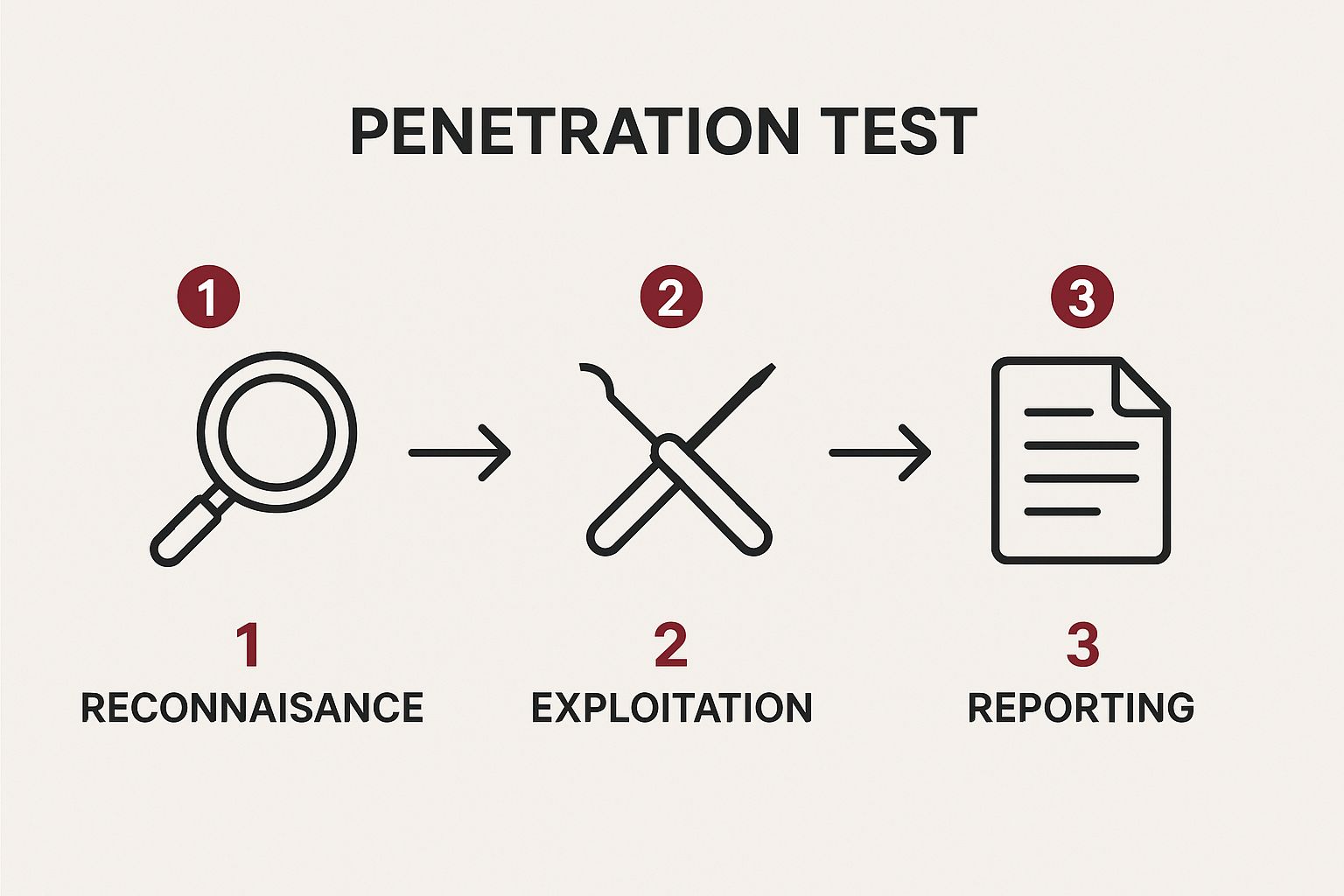
As you can see, each stage builds on the last, ensuring a methodical and structured approach to finding security flaws.
Stage 3: Exploitation
Now we get to the heart of a true penetration test. All the information gathered during recon and scanning is put to the test—literally. The ethical hackers will now actively try to exploit the vulnerabilities they’ve found to gain unauthorised access.
This is what separates a real pen test from a simple vulnerability scan. Instead of just flagging a potential weakness, the testers prove its real-world impact by using it to get past your defences, all in a controlled and safe way.
The goal of exploitation isn't to cause damage. It's to demonstrate the actual risk a vulnerability poses by answering the question: "If an attacker found this, what could they really do?"
For instance, if they found an outdated web server, they might use a known exploit to gain a foothold on that machine. This step is always handled with extreme care to make sure your business operations aren't disrupted.
Stage 4: Post-Exploitation
Getting in is often just the beginning. The post-exploitation phase is all about answering the question, "What could an attacker do after they've breached the perimeter?" Here, the testers try to escalate their privileges, move sideways across your network, and get their hands on sensitive data.
This simulates what a real attacker would do. Their goal isn't just to get in; it's to find and steal your most valuable information.
During this stage, the testers might try to:
- Escalate Privileges: Attempt to turn a basic user account into an all-powerful administrator account.
- Move Laterally: Use the first compromised machine as a jumping-off point to access other systems inside your network.
- Identify Sensitive Data: Locate critical files, databases, or intellectual property to show the potential business impact of a breach.
This phase gives you priceless insights into how resilient your internal security is and how well you can detect and contain an intruder once they’re inside.
Stage 5: Analysis and Reporting
The final, and arguably most critical, stage is the report. A top-tier penetration test service won’t just dump a list of technical jargon in your lap. They’ll deliver a detailed, easy-to-digest report that translates their findings into business-focused insights you can actually use.
A quality report will always include:
- An Executive Summary: A high-level overview for non-technical leaders, spelling out the key risks and business impact in plain English.
- Detailed Technical Findings: A breakdown of every vulnerability, complete with evidence (like screenshots) and a clear severity rating.
- Actionable Remediation Steps: A prioritised, step-by-step guide on how to fix every issue, from quick wins to longer-term strategic changes.
This report becomes your roadmap for a stronger security posture. It gives you the evidence you need to justify security investments and helps your tech teams focus on fixing the biggest problems first. For businesses wanting to formalise this process, using a structured guide like a cybersecurity risk assessment template can be a massive help in documenting and managing these risks effectively.
The Business Case for Proactive Security Testing

It’s easy to think of a penetration test service as just another technical task on the IT department's to-do list, like seeing a fire alarm as just a box on the wall. But that view misses the bigger picture entirely. This isn't just an IT expense; it's a strategic investment in the survival and health of your business. It's a calculated move to protect your money, your reputation, and your future.
Too many companies still work in a reactive mode, only scrambling to fix things after a security incident has already happened. That approach isn't just risky; it's incredibly expensive. A penetration test flips that script, letting you find and patch security holes before a real attacker finds them, saving you from a world of hurt down the line.
When you take this proactive stance, security stops being a cost centre and starts becoming a business advantage. You build a more resilient company, earn genuine trust from your customers, and ultimately protect your bottom line.
Avert Catastrophic Financial Losses
Let's be blunt: the most compelling reason to invest in a penetration test is to avoid the staggering costs that come with a data breach. The financial fallout from a cyberattack is never a one-time hit; it's a cascade of expenses that can genuinely cripple a business.
Think about the direct costs that pile up almost immediately:
- Regulatory Fines: Government bodies are handing out harsher penalties than ever for data breaches, especially if they find you've been negligent.
- Legal Fees: The bill for lawsuits from angry customers and partners can quickly become astronomical.
- Incident Response: You'll need to hire forensic experts, PR firms, and other specialists to manage the crisis, and their services don't come cheap.
- Customer Notification: Just the process of telling everyone affected and offering services like credit monitoring adds up fast.
For Australian businesses, this isn't a hypothetical problem. The average cost of a data breach for local startups and SMEs hit an eye-watering AUD 4.67 million in 2024. That number alone shows why being proactive is no longer a choice. Globally, the market for Penetration Testing as a Service (PTaaS) is set to explode from USD 2.34 billion in 2024 to USD 11.07 billion by 2034. This isn't a fluke; it's a clear signal that businesses everywhere are choosing to invest in prevention rather than cure. You can dig into the data on the PTaaS market to see just how serious this shift is.
Protect Your Hard-Won Brand Reputation
Your brand’s reputation is one of your most valuable assets, and it’s also one of your most fragile. It takes years of consistent, excellent service to build trust with your customers. A single, public data breach can shatter that trust overnight.
When customers give you their personal information, they're trusting you to keep it safe. A breach is a betrayal of that trust. The resulting loss of confidence leads to customers leaving, negative media coverage, and long-term damage to your brand that can be incredibly difficult—if not impossible—to fix.
Investing in a penetration test is a clear, demonstrable commitment to protecting your customers. It sends a powerful message that you take their security seriously, turning a potential liability into a source of customer loyalty and trust.
Taking this step shows you're not just crossing your fingers and hoping for the best. You're actively fortifying your defences, building a foundation of trust that’s essential for any business hoping to last.
Satisfy and Exceed Compliance Mandates
For many organisations, meeting regulatory compliance standards isn't optional—it's a requirement to stay in business. Frameworks like ISO 27001, the PCI DSS for handling payments, and various government rules all require regular security testing, either explicitly or implicitly.
A penetration test provides objective, third-party proof that your security controls aren't just policies sitting in a binder; they actually work in the real world. It takes you beyond just ticking a box on a compliance checklist.
A good penetration test service gives you the hard evidence that auditors and regulators demand, showing you've done your due diligence. This not only helps you sail through audits but also puts you in a much stronger position to win contracts with large clients who have their own strict security standards.
Gain a Competitive Edge
In a tough market, security can be a surprisingly powerful way to stand out. When potential clients are weighing you up against your competitors, being able to prove you have a rock-solid security posture can be the very thing that seals the deal.
By regularly getting your systems tested, you can tell customers and partners with confidence that you've been rigorously vetted by independent experts. This isn't just a marketing slogan; it's a verifiable fact that builds instant credibility.
This commitment shows that your organisation is mature, responsible, and a trustworthy partner. It positions you as a leader in your field, giving you a clear competitive advantage that helps you win and keep the high-value clients who care most about security. This is how you turn a security investment into a genuine driver of business growth.
How Penetration Testing Supports Your ISO 27001 Certification
If your Australian business is aiming for or already holds an ISO 27001 certification, you know it's the gold standard for information security. But here’s the thing: achieving this certification means more than just having well-written security policies. You need to prove your defences actually work.
This is exactly where a penetration test service becomes non-negotiable. Think of it as the ultimate reality check for your Information Security Management Systems. It provides independent, third-party proof that your security controls can stand up to a real-world attack, shifting your compliance efforts from theory to proven fact.
From Paper Policies to Real-World Proof
The ISO 27001 standard is all about managing and mitigating security risks through a framework of controls. When an auditor walks in, one of the first questions they’ll ask is, "How do you know your controls are effective?" A penetration test report is the most powerful answer you can give.
It’s one thing to say your firewalls are configured correctly. It’s another thing entirely to present a report showing an ethical hacker actively tried to breach them and couldn't. That kind of evidence is far more convincing than any internal checklist.
A pen test transforms your compliance from a paper-shuffling exercise into a living, breathing defence system that has been properly put through its paces.
Meeting Specific ISO 27001 Annex A Controls
Penetration testing is crucial for the standard as a whole, but it directly tackles some key requirements in Annex A. The most obvious is control A.12.6.1 Management of technical vulnerabilities.
This control states that you must get timely information on technical vulnerabilities, understand your exposure, and take action to fix the risk. A pen test is arguably the most effective way to tick all those boxes.
Here’s how a penetration test service helps you nail this control:
- Finds the Flaws: The main deliverable is a detailed report of every technical weakness in your systems, from simple misconfigurations to complex software bugs.
- Shows the Real Impact: The testers don't just find vulnerabilities; they try to exploit them. This shows you the actual damage a real attacker could do.
- Creates a Clear Action Plan: The report gives you a prioritised to-do list, so you can focus on fixing the most critical risks first, proving you have a structured approach to vulnerability management.
An ISO 27001 auditor doesn't just want to see a process on paper. They want to see hard evidence that your process works, and a penetration test report is the strongest evidence you can possibly provide.
On top of that, the insights from a test also bolster other controls related to access control (A.9), cryptography (A.10), and communications security (A.13). By simulating an attack, you're not just testing one control in isolation—you're testing how they all work together as a cohesive system.
Showing a Commitment to Continuous Improvement
ISO 27001 isn't a "set and forget" certificate; it’s a commitment to getting better over time. Regular penetration testing is a massive part of that philosophy. When you schedule tests at regular intervals—like every year or after a major system change—you show auditors you're serious about maintaining your security.
This regular cycle of testing provides invaluable feedback for your security program. It flags new threats, uncovers weaknesses that might have crept in over time, and confirms that your existing controls are still holding strong.
This proactive mindset is precisely what auditors love to see. It proves you aren't just ticking boxes but are actively hunting for and fixing weaknesses before attackers can find them. This demonstrates a mature security culture, strengthens your compliance, and builds incredible trust with your customers and partners.
How to Choose the Right Penetration Test Service Provider
Picking a partner for your security testing is one of the most critical decisions you'll make. The right penetration test service provider acts as an extension of your own team, giving you real, actionable insights to improve your defences. The wrong one? They can leave you with a false sense of security and a report that isn't worth the paper it's printed on.
This isn’t a decision to be rushed. A cheap, quick-and-dirty test is often just a glorified vulnerability scan in disguise. It completely misses the creative, human-led analysis that uncovers the kind of risks that actually keep you up at night. To make a smart choice, you need to look past the slick marketing and dig into the details that truly matter.
We've put together a practical playbook to help you evaluate potential partners. This is about asking the right questions to find a provider who will deliver the assurance your Australian business deserves.
Verify Industry Recognised Certifications
The first thing to check is the team's credentials. Certifications aren't just fancy acronyms on a website; they're proof that the testers have put in the hard yards, passing tough, hands-on exams to prove their skills in ethical hacking. Think of them as a baseline for competence and professionalism.
When you're talking to a potential provider, ask them straight up about the certifications their testers hold.
You want to see globally respected qualifications like:
- Offensive Security Certified Professional (OSCP): This is the big one. It's a highly practical, hands-on certification that proves a tester can genuinely think like an attacker and compromise systems in a controlled environment.
- CREST Registered Penetration Tester: CREST is an international not-for-profit body that provides a verifiable seal of approval for both security testing companies and the individuals who work for them.
- GIAC Penetration Tester (GPEN): This certification confirms a professional's ability to conduct a comprehensive penetration test using best-practice techniques and a structured methodology.
A provider that proudly shows off these qualifications is signalling a genuine commitment to quality. If a company gets cagey or evasive when you ask about their team's certs, that’s a massive red flag.
Request and Scrutinise Sample Reports
At the end of the day, the report is what you’re paying for. It's the roadmap you'll use to strengthen your defences, so its quality is absolutely crucial. Before signing anything, always ask for a sanitised sample report to get a feel for what you'll actually receive.
Don't just give it a quick skim. Look for these key elements:
- A Clear Executive Summary: Is there a simple, high-level overview written in plain English that a non-technical leader can actually understand? It needs to clearly spell out the business impact of the findings.
- Detailed Technical Findings: Does the report give you clear, step-by-step instructions on how to reproduce each vulnerability? It should include solid proof like screenshots or code snippets.
- Actionable Remediation Guidance: A good report does more than just point out problems. It must offer practical, prioritised advice on how to fix each issue, helping your team focus on the biggest risks first.
A great penetration test report tells a story. It should clearly narrate how an attacker could move from an initial foothold to compromising your most critical assets, translating technical flaws into tangible business risk.
If you get a report that's just a wall of jargon, lacks context, or looks like a printout from an automated scanner, you're looking at a low-quality penetration test service.
Confirm Their Industry Experience
Every industry has its own quirks, technologies, and regulatory headaches. A pen tester who's a wizard at securing financial institutions might not be the best choice to test the operational technology in a manufacturing plant. Experience in your specific sector is a huge plus.
A team that already gets your world will be far more efficient and effective. They'll know the common attack paths, the compliance hurdles you face (like APRA standards in finance or privacy laws in healthcare), and the typical business logic flaws found in your kind of software.
Ask potential providers for case studies or references from other companies in your industry. This shows they have a proven track record in an environment similar to yours and won't be learning the ropes on your time.
Define a Crystal-Clear Scope of Work
Ambiguity is the enemy of a successful pen test. One of the most common reasons an engagement goes off the rails is a poorly defined scope, which can lead to critical assets being missed or costs spiralling out of control. Before any testing kicks off, you and the provider must lock in a detailed and unambiguous Scope of Work (SOW).
This document needs to spell out, in no uncertain terms:
- What systems, applications, and IP ranges are in scope.
- What is explicitly out of scope (to prevent any accidental disruptions).
- The rules of engagement, including testing windows and how you'll communicate.
A professional provider will walk you through this process, asking smart questions to make sure nothing is overlooked. This collaborative approach prevents nasty surprises and ensures the test focuses on what's most important to your business. A solid scope is the foundation of a valuable security assessment.
Choosing the right partner requires a bit of due diligence, but the payoff is enormous. To help you structure your evaluation, we've put together a checklist of key questions to ask any potential provider.
Vendor Selection Checklist
| Evaluation Criteria | What to Look For | Why It Matters |
|---|---|---|
| Certifications & Expertise | What specific, industry-recognised certifications do your testers hold (e.g., OSCP, CREST)? | Certifications validate technical skill and a commitment to professional standards, ensuring your test is conducted by qualified experts. |
| Reporting Quality | Can you provide a sanitised sample report? Does it have a clear executive summary and actionable remediation advice? | The report is your primary deliverable. It must be clear, detailed, and useful for both technical teams and leadership. |
| Industry Experience | Have you worked with other companies in our industry? Can you share anonymised case studies or references? | Sector-specific experience means the testers understand your unique threats, compliance needs, and business context, leading to a more relevant test. |
| Methodology & Process | Can you walk me through your testing methodology? How do you handle communication during the test? | A transparent and well-defined process ensures the engagement is structured, predictable, and aligned with your expectations. |
| Scoping Process | How do you work with clients to define the scope of work? What questions do you ask? | A collaborative scoping process is crucial for ensuring the test focuses on your most critical assets and avoids any dangerous misunderstandings. |
| Post-Engagement Support | What support do you offer after the report is delivered? Do you provide re-testing to verify fixes? | Good providers offer support to help your team understand the findings and will verify that your remediation efforts have been successful. |
Using a checklist like this ensures you're making an informed, apples-with-apples comparison. It moves the conversation beyond a simple price comparison and towards a focus on finding a true security partner who will genuinely help protect your business.
Your Penetration Testing Questions, Answered
Thinking about getting a penetration test service for the first time? It’s completely normal to have questions. You need to know what you’re getting into, from costs and timelines to what actually happens during the test. Getting these details straight from the start helps you set the right expectations and squeeze every bit of value out of the exercise.
We've put together answers to the most common questions we hear from Australian businesses, tackling the practical concerns that pop up before, during, and after a security assessment.
How Much Will a Penetration Test Service Cost?
There's no one-size-fits-all answer here. The cost of a penetration test is directly linked to how big and complex the job is. A simple test on a small web application might set you back a few thousand dollars, but a full-scale assessment of a large corporate network could easily be tens of thousands.
The main things that influence the price are:
- The number of applications or systems to be tested.
- The size and complexity of your network.
- The depth of testing you need.
Our advice? Always ask for a detailed quote based on a crystal-clear scope of work. That’s the best way to avoid any nasty surprises down the track.
How Long Does a Penetration Test Take?
Most penetration testing projects take somewhere between one and four weeks to complete. Just like the cost, the timeline really depends on the size and intricacy of what's being tested. A quick look at a single mobile app will be a lot faster than a deep-dive into your entire cloud environment.
A good provider will give you a firm, realistic timeline during the planning phase. This makes sure your team knows what’s happening and can work smoothly with the testers from start to finish.
What’s the Difference Between Automated and Manual Testing?
This is a fantastic question, and it gets to the heart of what makes a good test. Automated testing uses software to scan for common, well-known vulnerabilities. Think of it as a quick health check—it’s fast and great for catching the obvious, low-hanging fruit.
Manual testing is where the real magic happens. This is when a skilled human expert uses their intuition, experience, and creativity to find complex flaws in your business logic and unique vulnerabilities that automated tools simply can’t see. They think like an attacker would.
A top-tier penetration test service will always blend the efficiency of automated tools with the deep-thinking, creative approach of a manual tester. This hybrid model gives you the most comprehensive and true-to-life picture of your security.
Ready to move from theory to action and get your business secure? The expert team at Anitech has over 20 years of experience helping Australian businesses fortify their defences and achieve ISO 27001 certification. We can guide you through a penetration test that delivers genuine peace of mind. Find out how we can help by exploring our ISO 27001 services.
Recent Comments