

Quick Summary: This guide provides a comprehensive overview of penetration testing in Australia for businesses seeking to enhance their cybersecurity and achieve ISO 27001 compliance. Learn how to plan, scope, and select the right pen testing partner, understand different test types, and turn your report into actionable security improvements.
When you're running a business in Australia, thinking about cybersecurity can feel overwhelming. But it's shifted from being just an IT problem to a core part of business strategy. With data breach costs on the rise and regulators watching closely, getting on the front foot with your security is the only smart move. This guide provides an in-depth look at penetration testing in Australia, a crucial piece of that puzzle, especially if you're aiming for ISO 27001 certification.
Why Your Business Needs a "Friendly" Hacker
Let's cut through the jargon. A penetration test, or 'pen test', is basically a controlled cyberattack on your own systems, carried out by ethical hackers you've hired. Their job is to find and exploit weaknesses before a real attacker does.
Think of it as the ultimate fire drill for your digital world. It’s one thing to have security policies and tools in place; it's another thing entirely to see how they hold up under a realistic, simulated attack. This is where you move from theory to reality, testing your defences under pressure.
A solid approach to Website Security is your first line of defence, but a pen test is what truly validates whether those defences are working as well as you think they are. It uncovers the subtle gaps that automated scanners often miss.
The Australian Context: Why Now?
The push for penetration testing in Australia isn't happening in a vacuum. Our region is seeing the fastest growth in this field globally, and for good reason. As more businesses go digital, adopt cloud services, and rely on data centres, the opportunities for cybercriminals expand.
Regulations are also getting tighter. The Notifiable Data Breaches (NDB) scheme, for instance, saw over 1,500 breaches reported in 2022-23 alone. For Australian businesses, a single breach can be financially devastating and ruin your reputation. Integrating pen testing into a security framework like ISO 27001 is a direct, practical response to this high-stakes environment.
A pen test transforms your understanding of risk from a theoretical list on a spreadsheet into a tangible demonstration of your security's real-world effectiveness. It's the difference between looking at the architect's blueprints and actually pressure-testing the building's foundation.
The Missing Piece for Your ISO 27001 Puzzle
If your business is on the path to ISO 27001 certification, penetration testing isn't just a 'nice to have'—it's a game-changer. The standard is all about proving you can effectively manage information security risks. A pen test delivers the independent, hard evidence you need to show your Information Security Management System (ISMS) is more than just a document.
Here’s how it directly supports your certification efforts:
- Pinpoints Real Weaknesses: It goes beyond checklists to find actual, exploitable vulnerabilities in your applications, network, and system configurations.
- Tests Your Team's Response: A good pen test can also assess how quickly and effectively your team detects and reacts to a security incident.
- Gives Auditors What They Want: You get a detailed, third-party report that demonstrates due diligence and a genuine commitment to security improvement—something auditors love to see.
At the end of the day, a penetration test gives you much more than a list of problems. It provides peace of mind that your security investments are sound and hands you a clear, prioritised roadmap for shoring up your defences. This proactive approach is exactly what you need to build lasting trust with your customers, partners, and regulators.
How to Plan and Scope Your First Penetration Test
Kicking off a penetration test without a solid plan is a recipe for wasted time and money. Think of it like a building project – you wouldn't start without a detailed blueprint. A well-defined scope is that blueprint for your security test, ensuring the entire exercise is a targeted, valuable investment.
This critical planning stage turns a vague request like "can you test our website?" into a sharp, meaningful objective. A much better goal would be: "validate security controls for our new e-commerce checkout, specifically ensuring we meet ISO 27001 control A.12.6.1 for technical vulnerability management." See the difference? That level of clarity gets everyone on the same page, focused on the outcomes that actually matter to your business.
Defining Your Testing Objectives
Before you even think about the technical side of things, you need to answer one simple question: why are we doing this? The answer to that question will shape every decision you make from here on out.
For most Australian businesses, the drivers usually fall into one of these buckets:
- Ticking a Compliance Box: Are you chasing ISO 27001 certification? Do you need to satisfy regulators like APRA (CPS 234) or meet PCI DSS standards for handling card payments? Your test objectives must map directly back to the specific clauses in these frameworks.
- Pre-Launch Sanity Check: You’re about to push a new app or website feature live. The goal here is simple: find and fix the big, scary vulnerabilities before the bad guys do.
- Proactive Risk Management: Maybe you’ve identified a high-risk part of your business, like a portal holding sensitive customer data or an internal finance system. A focused test can validate the security around that specific asset.
- Winning New Business: Often, a major client or corporate partner will ask you to prove your security posture before they’ll sign a contract. In this case, your objective is to get a formal report that gives them the assurance they need.
Once you’re crystal clear on your "why," you can build a scope that directly supports your business goals.
Think of your scope as the "rules of engagement" for the ethical hackers. It tells them exactly what’s in play, what attack methods are allowed, and what a successful breach looks like. A vague scope leads to a vague, and often useless, report.
Choosing the Right Testing Approach
With your objectives locked in, it's time to decide on the type of test. This choice really comes down to one thing: how much information you give the testing team upfront.
- Black Box Testing: The testers start with virtually nothing – maybe just your company name and a URL. This is the closest you'll get to simulating a real-world attack from a complete outsider. It's fantastic for checking how well your external defences and monitoring systems hold up.
- White Box Testing: This is the complete opposite. You give the testers everything: source code, network diagrams, admin credentials, the lot. It's the most exhaustive approach, allowing them to dig deep into your application's logic to find those really complex, hidden flaws.
- Grey Box Testing: This popular middle-ground gives testers some basic info, like a standard user-level login. It simulates an attack from an insider threat or a scenario where a customer's account has been compromised. It’s a realistic way to see what damage a malicious user could do from the inside.
For most businesses dipping their toes into pen testing for the first time, a grey box approach usually hits the sweet spot. It delivers a great balance of real-world simulation and cost-effectiveness by focusing the effort on the most likely attack paths.
This simple visualisation shows how penetration testing isn't just a one-off task, but a cycle that moves your organisation from identifying threats to building genuine customer trust.
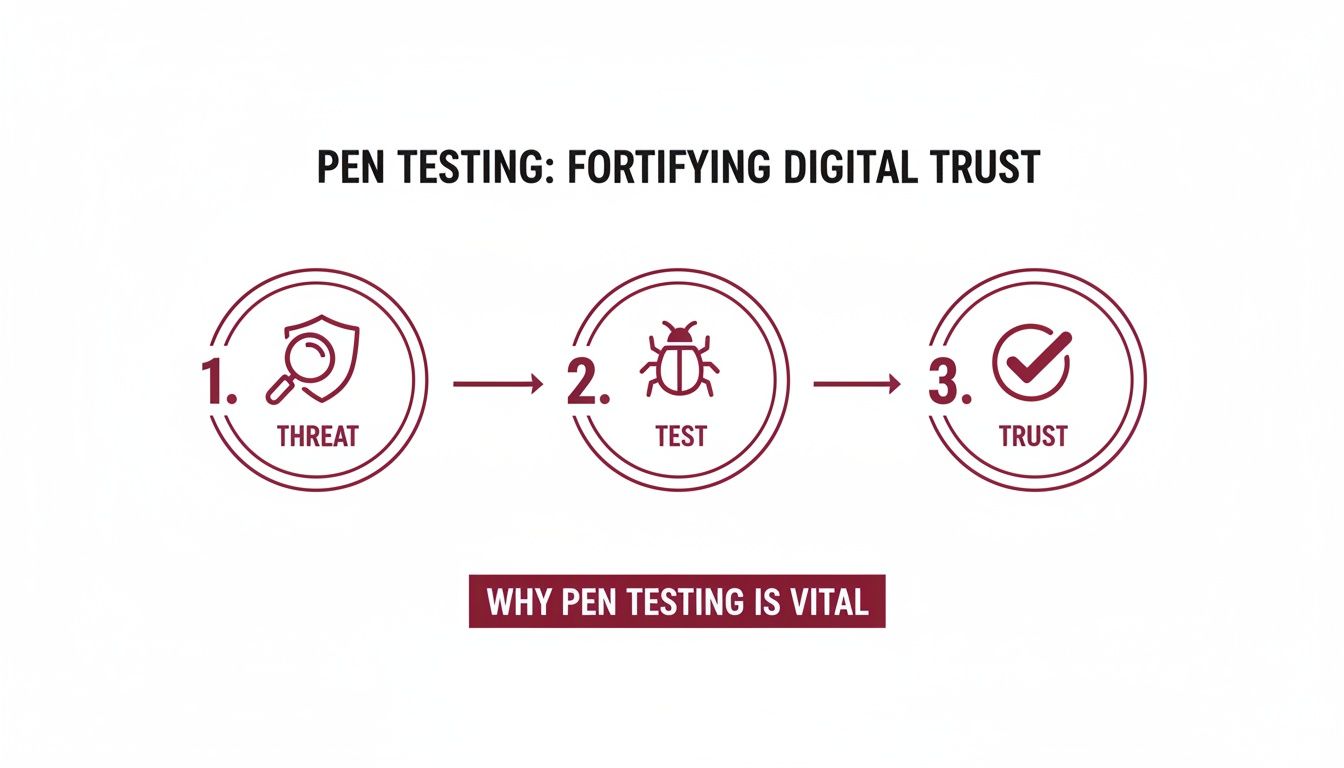
It’s a strategic process that constantly reinforces your security and proves to clients and partners that you’re taking this seriously.
Navigating Australian Legal and Compliance Waters
As you draw up your scope, you absolutely must consider the local legal landscape. The last thing you want is for your security test to accidentally breach Australian laws like the Privacy Act 1988.
It is non-negotiable to have a formal, signed agreement with your testing provider that explicitly authorises their activities. This contract is your "get out of jail free" card – it protects both you and the testers by making it clear the "attack" is sanctioned.
This document must spell out exactly which systems are in scope and the precise timeframe for the test. Getting this paperwork sorted isn't just red tape; it's a sign of a mature security program. If you need help structuring this, using a cybersecurity risk assessment template is a great way to formalise your preparations and ensure you've covered all your bases.
Choosing the Right Penetration Testing Partner in Australia
Finding the right team for penetration testing in Australia isn’t just another line item in your IT budget; it’s about finding a security partner you can trust. The right partner does more than just hunt for vulnerabilities. They deliver clear, practical insights that genuinely toughen your defences and help you nail your bigger goals, like achieving ISO 27001 certification.

The market is crowded, and it's easy to get lost. You need to look past the glossy brochures and focus on real proof of expertise, a solid methodology, and a genuine grasp of the Australian business landscape.
What to Look For: Provider Types
Penetration testing isn't a one-size-fits-all service. The provider you choose depends heavily on your budget, risk appetite, and specific needs. Here’s a quick rundown of the main players you’ll find in the Australian market.
Comparing Penetration Testing Provider Types
This table helps you compare the typical characteristics of different types of penetration testing providers in Australia to find the best fit for your business needs and budget.
| Provider Type | Typical Cost | Best For | Key Strengths |
|---|---|---|---|
| Boutique Security Firms | $$ | Small to medium businesses, startups, specific application tests. | Highly specialised, agile, direct access to senior testers, often more flexible. |
| Large Consulting Firms | $$$$ | Large enterprises, government, highly regulated industries (e.g., finance). | Comprehensive services, strong brand reputation, integrated compliance/advisory. |
| Managed Security Providers (MSSPs) | $$ – $$$ | Businesses needing ongoing testing as part of a broader security service. | Integrated with other security services, continuous monitoring, predictable costs. |
| Independent Freelancers | $ – $$ | Startups, small projects, businesses with strong internal oversight. | Cost-effective for specific tasks, direct communication. Can be a mixed bag on quality. |
Ultimately, there’s no single "best" type. A boutique firm might give you the focused, hands-on attention you need, while a larger consultancy could be better equipped for a massive, multi-faceted engagement tied to complex compliance demands.
Core Credentials and Certifications: The Table Stakes
Before you even start a conversation, you need to filter for firms with industry-recognised credentials. Think of these as the absolute baseline—proof that their team has the technical chops and ethical grounding to be trusted with your systems.
Here are the big ones to look for:
- CREST (Council of Registered Ethical Security Testers): This is a huge one in Australia and internationally. A CREST-accredited company has had its entire operation—from methodologies to data handling—put under the microscope and verified. It’s a powerful assurance of quality.
- Offensive Security Certified Professional (OSCP): This isn't a multiple-choice exam. The OSCP is a gruelling, hands-on test where individuals have to prove they can break into systems in a controlled lab. It’s the gold standard for pure technical skill.
- GIAC (Global Information Assurance Certification): GIAC offers a whole family of specialised certifications. Keep an eye out for specific ones that match your needs, like GWAPT for web apps or GPEN for network testing.
A lack of these certifications is a major red flag. You wouldn't let an unlicensed builder work on your house, so don’t let an uncertified tester poke around in your network.
Vetting Providers with the Right Questions
Once you have a shortlist of certified providers, it's time to dig deeper. Your goal here is to understand their process and communication style. You're looking for a partner who feels like an extension of your own team.
Fire these questions at any potential provider:
- What's your methodology? Can they walk you through how they approach a test? Do they follow established frameworks like the PTES (Penetration Testing Execution Standard) or OWASP guidelines?
- Can I see a sample report? This is crucial. Is it a clear, concise document that links technical findings to actual business risk? Or is it just a 100-page data dump from an automated scanner?
- What happens after the report? Great providers don't just drop a report and disappear. Ask about their post-engagement support. Will they host a debrief to walk you through the findings and help your team prioritise fixes?
- What’s your Australian experience? Have they worked with businesses like yours? Do they understand local regulations like APRA CPS 234 or the nuances of the Privacy Act 1988? Local context is a massive advantage.
- Who is on the team? Who will actually be doing the testing? What’s their experience level? You want to know if they rely on senior talent with deep manual testing skills to find those tricky, logic-based flaws that scanners always miss.
A quality provider will welcome these questions. Their answers will quickly separate the experts who deliver real value from the commodity "scan-and-run" shops.
The Non-Negotiable Paperwork
Before a single packet is sent, two documents must be signed: a Statement of Work (SOW) and a Non-Disclosure Agreement (NDA). These are not just formalities; they are your legal safety net.
- Statement of Work (SOW): This is the rulebook for the engagement. It must clearly outline the scope, objectives, timeline, testing methods, and what you’ll get at the end. A solid SOW prevents "scope creep" and ensures everyone is on the same page.
- Non-Disclosure Agreement (NDA): Your testers will likely see your most sensitive data. A rock-solid NDA is non-negotiable to legally bind them to confidentiality.
Taking the time to choose the right partner is the most important step you'll take. It sets the tone for the entire process and ensures you get a meaningful assessment that genuinely improves your security posture. To get a better feel for what a professional engagement looks like, you can learn more about our penetration testing service here.
Choosing the Right Test for Your Australian Business
The good news for Australian businesses is that the penetration testing market isn't a monopoly. It's a healthy, fragmented ecosystem filled with specialists. This is a huge advantage for you. Instead of a one-size-fits-all approach, you can find a team that genuinely understands your industry, whether you're running a boutique e-commerce site or a complex SaaS platform.
This means you get to be strategic. Forget just ticking a box that says "pen test done." The real value comes from picking the right type of test that targets your biggest risks. It's about aligning the test with specific business threats and, if you're on the journey, mapping it directly to the controls in your ISO 27001 program. This way, every dollar you invest is pulling its weight.
Web Application Penetration Testing
For most businesses today, your website or web app is your front door. It’s your store, your customer portal, your entire service delivery platform. That’s why web application testing is, without a doubt, the most common and critical security check-up you can get.
Think of it as hiring a team of ethical hackers to do their worst to your application, all through a web browser. They'll try to sneak past your login screens, manipulate the code to access data they shouldn't, and essentially pull apart everything your developers built to find the weak spots.
What are they usually looking for?
- SQL Injection (SQLi): This is a classic, but it's still devastating. It’s where an attacker tricks your database into giving up secrets, potentially letting them view, change, or even delete all your customer data.
- Cross-Site Scripting (XSS): A sneaky attack where malicious code gets injected into your website, which then runs in the browsers of your unsuspecting visitors.
- Broken Access Control: This is a big one. It's when a regular user can find a way to access admin-level functions or peek at another user's private information.
In the world of ISO 27001, a solid web app pen test report is pure gold. It gives you concrete proof that you're living up to controls like A.14.2.1 (Secure development policy) and A.12.6.1 (Management of technical vulnerabilities). You’re not just saying your app is secure; you're proving it.
Mobile Application Penetration Testing
If you have a mobile app, you've opened up a whole new playground for potential attackers. Testing a mobile app is a different beast entirely. It involves scrutinising the app on both iOS and Android, pulling apart the APIs it relies on, and digging into how it stores data right there on the user's phone.
Testers will be on the hunt for things like insecure data storage—where sensitive details like passwords or session tokens are saved in a way that other apps (or a savvy user) could easily access them. They’ll also put the communication between the app and your servers under a microscope, looking for any unencrypted data that could be snagged over a dodgy public Wi-Fi network.
We often see businesses pour all their effort into securing the flashy front-end of their mobile app, completely forgetting about the backend API that does all the heavy lifting. A single flaw in that API could expose the data of every single user. It's a massive blind spot.
This kind of testing is vital for demonstrating your diligence around ISO 27001 controls like A.13.2.1 (Information transfer policies) and A.8.2.3 (Handling of assets). It confirms you're protecting customer data whether it's flying through the air or sitting on their device.
Internal and External Network Penetration Testing
Finally, we have network testing, which looks at the fundamental plumbing of your IT infrastructure. It's usually broken down into two key perspectives.
- External Testing: This is the view from the outside world. A tester acts like a hacker on the internet, probing your firewalls, servers, and anything else visible to the public, trying to find a crack to slip through into your private network.
- Internal Testing: This simulates a much scarier scenario: the attacker is already inside. Maybe they got in through a phishing email, or perhaps it's a disgruntled employee. The goal here is to see how much damage they can do once they're past the front gate.
Looking at the Australian market, the focus is clearly on protecting digital assets. Analysis shows that web application testing commands a 35.6% share of the market, which tells you where most businesses see their primary risk. While big corporations have always been the main drivers, we're now seeing a huge surge in demand for penetration testing in Australia from small and medium businesses. Often, this is being driven by pressure from larger partners or new compliance requirements.
This market structure is perfect for SMEs, allowing them to engage specialists who can deliver practical, focused tests that align with crucial frameworks like ISO 27001 or the ASD Essential Eight. You can learn more about these trends from the latest penetration testing market reports at Mordor Intelligence.
Network testing is foundational for validating core ISO 27001 controls like A.13.1.1 (Network controls) and A.12.2.1 (Protection against malware). It provides assurance that your network is tough enough to withstand attacks from both the outside and within.
Turning Your Pen Test Report into Actionable Fixes
So, the penetration testing report has just landed on your desk. This is where the real work begins. A detailed report filled with technical jargon is useless if it just gathers dust. Its true value isn't in the problems it finds, but in how you use it to build a stronger, more resilient defence.
Let's be honest, the first look can be overwhelming. The key is to cut through the noise and find your starting point. Any decent report will rank vulnerabilities using a framework like the Common Vulnerability Scoring System (CVSS), which gives a score from 0 to 10. Your eyes should immediately jump to anything marked 'Critical' (9.0-10.0) or 'High' (7.0-8.9). These are the gaping holes in your security armour, and they need your attention first.

From Finding to Fix: The ISO 27001 Workflow
If you're working towards ISO 27001 certification, this next part isn't just good practice—it's essential. Each finding in that report is a golden opportunity to prove your Information Security Management System (ISMS) actually works. It's how you demonstrate continuous improvement.
The process is refreshingly straightforward but incredibly powerful:
- Get it in the Register: Every single vulnerability, no matter how small it seems, needs to be logged in your risk register.
- Create a Corrective Action: This is where you get formal, aligning with Clause 10.2 (Nonconformity and corrective action) of the ISO 27001 standard. You'll document what went wrong, the plan to fix it, who owns the task, and when it's due.
- Fix It and Prove It: Your tech team rolls up their sleeves and implements the fix. But you're not done yet. You need to verify it worked, which often means asking the pen testers to perform a quick re-test.
Following this structure transforms a technical issue into a traceable, auditable trail. It shows that your ISMS is a living, breathing system, not just a folder of policies. If you want to dig deeper into structuring these outcomes, our guide on effective penetration testing reporting is a great resource.
Think of your penetration test report as a gift. It's a highly detailed, expert-written to-do list for making your business safer. The difference between a mature security program and one that's just ticking boxes is having a clear, actionable process to tackle that list.
A Real-World Remediation Example
Let's walk through a common, and scary, scenario. Your report flags a critical SQL Injection (SQLi) vulnerability on your customer login page. Here’s how you’d handle it within an ISO 27001 framework.
- Risk Register Entry: Log the vulnerability with a high-risk rating. The description is stark: an attacker could potentially access the entire customer database.
- Corrective Action Plan: A formal plan is raised. The root cause is pinpointed as 'improper input validation in the web application code'. The fix is defined: 'implement parameterised queries'. The Head of Development is assigned the task with a two-week deadline.
- Implementation: The development team gets to work and rewrites the vulnerable code.
- Verification: You bring the penetration testing firm back in for a focused re-test to confirm the SQLi vulnerability is gone for good.
- Close Out: With confirmation in hand, the corrective action is closed, and the risk register is updated to show the risk has been successfully mitigated.
This entire cycle provides rock-solid evidence for your next ISO 27001 audit. It proves you don’t just find problems—you solve them systematically.
Integrating Pen Testing into Your Broader Security Strategy
The value of penetration testing in Australia is nothing new. Back in the early 2010s, the market was already estimated at $200-300 million annually, driven largely by compliance requirements from APRA in finance and the Protective Security Policy Framework (PSPF) in government. This history underlines how vital these assessments are, tying directly into Annex A control A.12.6.1 (Technical vulnerability management) in ISO 27001.
A good report doesn't just list flaws; it suggests practical improvements. For example, a finding about weak passwords might lead to a recommendation for implementing two-factor authentication, a move that elevates security across the entire company. This is how a single finding can create a positive ripple effect, sparking much broader security enhancements.
Ultimately, your penetration test report is a dynamic roadmap. Use it to assign tasks, track progress, and make your business tangibly more secure. This proactive, action-oriented mindset is what separates the resilient organisations from the rest.
Your Top Penetration Testing Questions, Answered
When you're digging into something as technical as penetration testing, having questions is a great sign. It means you’re taking your business's security seriously. Let's tackle some of the most common queries we hear from Australian business owners, IT managers, and compliance officers to give you the clarity you need.
How Much Does a Pen Test Cost in Australia?
Let's get straight to the point: the cost of a pen test is one of the first things everyone asks, and the honest answer is, "it depends." The price for a penetration testing engagement in Australia is directly linked to how big and complex the job is. A straightforward external network test on a handful of systems might start from a few thousand dollars.
But for something more involved, like a deep dive into a custom-built web application with multiple user roles and complex workflows, you could be looking at anywhere from $10,000 to over $30,000. It all comes down to the time and expertise required.
So, what pushes the price up?
- The Size of Your Digital Footprint: More applications, servers, and networks simply mean there's more ground for the testers to cover.
- The Complexity of Your Systems: Testing a custom-built e-commerce platform is a different beast entirely compared to a simple, static website.
- The Type of Test: A "white box" test, where the tester gets full access to your source code and documentation, is far more intensive (and expensive) than a "black box" test, which mimics an external attacker with no prior knowledge.
My best advice is to focus on value, not just the price tag. A cheap test that just runs a few automated scans and misses the real, human-discoverable flaws isn't a bargain—it's a waste of money. Always get detailed quotes based on a well-defined scope so you know you're comparing apples with apples.
How Often Should We Be Pen Testing for ISO 27001?
This is a big one for any business working towards or maintaining an ISO 27001 certification. While the standard itself doesn't demand a rigid schedule, a clear best practice has emerged over the years. You should plan for a penetration test at least annually, and crucially, after any significant changes to your systems or applications.
What exactly is a "significant change"? Think of things like:
- Launching a brand new app for your customers.
- A major infrastructure overhaul, like shifting from on-premise servers to a new cloud provider.
- Plugging in a new third-party system that handles sensitive customer data.
Ultimately, your own risk assessment should drive the frequency. High-risk assets, like a payment gateway or a database of sensitive personal information, might even justify testing twice a year. Being able to show an auditor that you have a regular, risk-based testing program is gold. It demonstrates a genuine commitment to continuous improvement, which is exactly what ISO 27001 is all about.
Is Penetration Testing a Legal Requirement in Australia?
This is a great question, and the answer isn't a simple yes or no. While there's no single law that says "every business must get a pen test," it has become a non-negotiable expectation in many areas.
For some, the rules are black and white.
- APRA-Regulated Businesses: If you're in finance or insurance, the prudential standard APRA CPS 234 explicitly requires regular testing of your security controls, and pen testing is a key part of that.
- Government Agencies: Any organisation bound by the Protective Security Policy Framework (PSPF) has clear obligations around security testing.
For everyone else, the Privacy Act 1988 is the major consideration. The Act requires you to take 'reasonable steps' to protect the personal information you hold. In today's threat landscape, it's very hard to argue that you're taking 'reasonable steps' if you've never had an independent expert try to break into your systems. Failing to do so could look like negligence if a data breach occurs.
Beyond the law, it's also becoming a commercial reality. Many large enterprises and government departments simply won't do business with you unless you can prove you conduct regular security testing.
Recent Comments