

Penetration testing reporting is where the real work begins. It’s the art of turning a mountain of technical findings from a simulated cyberattack into a clear, compelling story about business risk. A great report doesn't just list vulnerabilities; it builds the bridge between discovering a security flaw and actually getting it fixed, ensuring everyone from the C-suite to the sysadmin understands what’s at stake and what needs to happen next.
Why Most Penetration Test Reports Fail
Let’s be brutally honest for a moment. The real measure of a pen test’s value isn't how many vulnerabilities you find; it's how many get fixed. Yet, so many reports end up as expensive, unread PDFs gathering digital dust on a server somewhere.
So, where does it all go wrong?
The problem is a fundamental misunderstanding of what a report truly is. Too often, they're treated as a technical data dump—dense, jargon-filled documents that only a security engineer could love. They fail because they’re written as a technical artefact, not the persuasive business document they need to be. A successful report doesn't just list problems; it builds a compelling case for change.
This failure often starts before a single line of code is tested. It begins with a fuzzy scope that isn't tied to what the business actually cares about. If your final report doesn't answer the questions keeping executives up at night, it's already missed the mark.
Mismatched Audiences and Muddled Messages
A single pen test report has to speak to multiple audiences, each with vastly different priorities and levels of technical know-how. The CEO needs to grasp the financial and reputational risk. The IT Manager has to juggle resources and priorities. The developer needs the exact, repeatable steps to patch the code.
When a report tries to use one voice for all, it ends up speaking effectively to none. This communication breakdown is where all the value leaks out. An executive who can't see the business impact won't sign off on the budget. A developer handed a vague, confusing finding will simply move on to the next ticket in their queue.
The most effective penetration test reports tell a story. They frame each vulnerability not as a technical glitch, but as a potential narrative of business disruption, data theft, or a compliance nightmare waiting to happen.
To sidestep this common pitfall, you have to structure your report with these distinct audiences in mind from the get-go.
Thinking about who reads the report and what they need from it is crucial. A well-structured document guides each person to the information they need to make decisions and take action.
Connecting the Report to Your Audience
| Audience | Primary Interest | Report Section of Focus |
|---|---|---|
| C-Suite/Board | "How does this affect the bottom line? Are we at risk of fines or brand damage?" | Executive Summary, Risk-Ranked Overview |
| IT/Security Manager | "What's our biggest risk? What do we need to fix first? How many resources will it take?" | Technical Summary, Prioritised Findings List |
| Developers/Engineers | "What's broken? How do I replicate it? How do I fix it?" | Detailed Findings, Proof of Concept, Remediation Steps |
| Compliance/Legal | "Does this violate any regulations (e.g., GDPR, Privacy Act)? What are our legal obligations?" | Executive Summary, Compliance Mapping (e.g., ISO 27001) |
Ultimately, a report that isn't tailored to its audience is a report that won't drive change. By understanding these different perspectives, you can craft a document that delivers value to everyone involved.
The Foundation: Scope and Methodology
The success of your reporting hinges entirely on what happens during the initial engagement. Getting the scope and methodology crystal clear isn't just a box-ticking exercise; it's non-negotiable. This is where you ask the right questions to make sure the final report provides genuine business value.
Here are the foundational elements you absolutely must lock down:
- Business Objectives: What are the crown jewels? Is the main game protecting customer data, guaranteeing operational uptime, or satisfying a compliance mandate like ISO 27001?
- Asset Inventory: What specific applications, networks, and servers are in play? Crucially, what is explicitly out of scope to avoid any "oops" moments that could cause a production outage?
- Rules of Engagement: What testing techniques are on the table? Are there blackout periods or specific times when testing must happen to minimise business disruption?
Nailing these details upfront transforms your report from a generic security audit into a bespoke business intelligence tool. The findings will directly map to the risks the organisation actually cares about, making the conversation about fixing them infinitely more productive.
Translating Technical Jargon into Business Impact
One of the biggest hurdles in this game is the language barrier between the security team and the business leaders. A report littered with CVSS scores and CVE identifiers is gibberish to an executive. Your job is to translate those technical metrics into tangible business impact.
Instead of just stating, "We found a critical SQL injection vulnerability (CVE-2023-XXXX)," you need to reframe it.
Think more along these lines: "We discovered a flaw that would allow an attacker to access and steal your entire customer database. This could lead to significant fines under the Privacy Act and cause irreparable damage to your brand's reputation."
See the difference? This shift in language connects a technical finding to a direct, painful business outcome, making the need for action impossible to ignore. This is especially true in Australia's current cyber climate, where good reporting is a cornerstone of risk management. According to recent industry analyses, an examination of 2,500 penetration tests uncovered a staggering 26,000 findings. Overwhelmingly, 90% of these originated from just three core areas: Application and Development Security, Identity and Access Management, and Configuration and Patch Management. You can explore more data on Australian penetration testing trends to appreciate the prevalence of these risks. This data underscores a critical point: common vulnerabilities pose a direct and significant threat to businesses, which is why clear, impactful reporting has never been more vital.
Structuring Your Report for Readability and Impact
Let's be blunt: a pentest report that no one can read is a useless one. It doesn't matter how technically brilliant your findings are; if stakeholders can't find what they need, the report has failed. A well-structured report is the blueprint for action, guiding everyone from the C-suite to the sysadmin to the exact information they need in seconds.
The entire process, from that initial scoping call to the final patch deployment, is a continuous flow.
This visual nails the simple, effective lifecycle of pentesting and reporting: define the scope, deliver a clear report, and drive the fix.
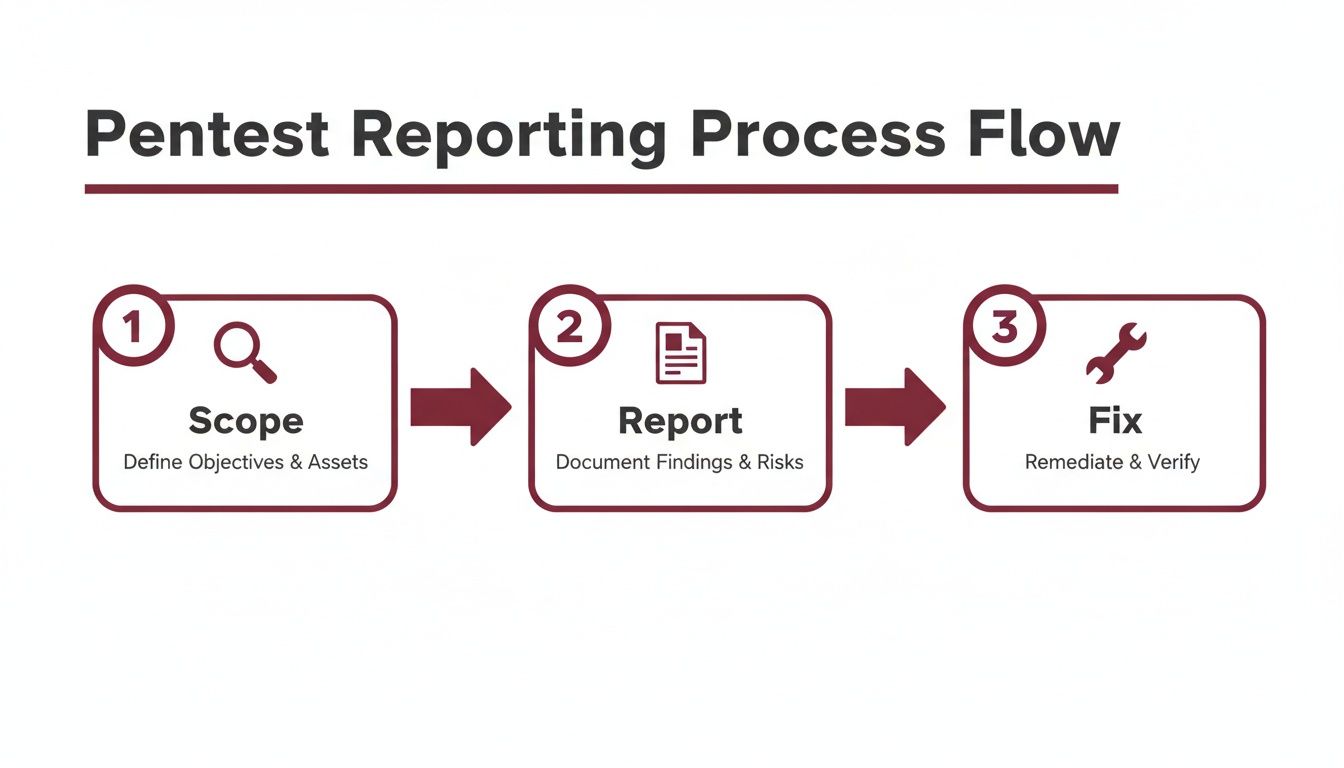
This workflow hammers home the point that the report isn't the finish line. It's the critical link that turns your technical discoveries into real security improvements.
Start with the Executive Summary
The Executive Summary is the most valuable real estate in your entire document. For many senior stakeholders, it's the only part they will ever read. This is your one shot to translate complex technical risks into clear, compelling business imperatives.
Your goal here isn't to dump a list of every vulnerability you found. Instead, you need to craft a jargon-free story that sums up the company's overall risk posture, spotlights the most critical findings, and ties them directly to business impact. You need to answer the big questions: What are the key threats? Which parts of the business are most exposed? And most importantly, what strategic action do they need to take now?
For some great tips on grabbing their attention and driving decisions from the get-go, check out these best practices for writing compelling executive summaries. A powerful opening sets the tone for the entire remediation effort.
Building the Technical Findings Section
Once you get past the summary, the technical findings section is the heart of the report. This is where you lay out the hard evidence for the developers, engineers, and IT managers who will be doing the fixing. Clarity and consistency are everything here. A disorganised brain-dump of vulnerabilities just creates confusion and slows everyone down.
To make this section genuinely useful, structure each finding with a consistent template. When your readers know what to expect, they can scan findings quickly, compare risks, and prioritise their work without having to decipher a new format for every single issue.
A solid, repeatable format for each finding should include:
- Vulnerability Title: A clear, concise name for the problem (e.g., "Authenticated Cross-Site Scripting on User Profile Page").
- Risk Rating: An objective score, ideally using a well-known framework like the Common Vulnerability Scoring System (CVSS).
- Detailed Description: A plain-English explanation of the vulnerability and what could happen if it's exploited.
- Proof of Concept (PoC): The step-by-step instructions, screenshots, and code snippets that prove the issue exists and show how to reproduce it.
This consistent structure makes your report easy to navigate and ensures the technical teams have exactly what they need to validate and crush the bug.
The Power of Clear Risk Ratings
Assigning a risk rating to each vulnerability is one of the most powerful things you can do in a report. It cuts through the noise and immediately directs attention where it's needed most. Without a clear rating system, every finding can seem equally urgent, leading to "analysis paralysis" or, worse, wasting time on low-impact issues.
The CVSS is an industry standard for a reason. It gives you an objective, numerical score (0-10) based on concrete factors like attack complexity, whether user interaction is needed, and the impact on confidentiality, integrity, and availability.
By using a standard framework like CVSS, you take the guesswork out of prioritisation. A "Critical" (9.0-10.0) finding instantly signals a far greater threat than a "Medium" (4.0-6.9) one, giving teams a clear signal on how to triage their workload.
This is absolutely vital for creating a practical remediation roadmap. It allows managers to tackle the biggest fires first while scheduling the lower-risk items for later sprints.
Organising the Narrative for Different Readers
While the core of your report is technical, the overall structure has to work for a mixed audience. A logical flow ensures that both executives and engineers can find what they need without getting frustrated. From my experience, a battle-tested structure follows this path:
- Executive Summary: The high-level business overview.
- Scope and Methodology: A clear outline of what was tested, the rules of engagement, and the techniques used. This builds credibility and sets the context.
- Summary of Findings: A prioritised list of all vulnerabilities, often in a table with the title, risk rating, and affected system. This is basically the table of contents for the technical deep-dive.
- Detailed Findings: The main body of the report, where each vulnerability gets its own dedicated, consistently formatted section as we talked about above.
- Appendices: This is the place for all the supporting info—raw tool outputs, long lists of tested assets, or detailed logs that would just clutter the main report.
This layered approach lets readers drill down to the level of detail they care about. An executive might only read sections one and three, while a developer will live in section four. The key is to make that journey intuitive. This disciplined approach not only helps with compliance but also makes for a far more professional and impactful report.
From Finding to Fix: The Art of Actionable Guidance
This is where the rubber really hits the road. Finding a vulnerability is one thing, but explaining it so clearly and providing such precise guidance that a developer can fix it without a second thought? That’s a completely different skill. This is the moment your report transforms from a simple list of problems into a practical, valuable solution guide.
The biggest mistake I see testers make is assuming the internal team has the same context they do. They don’t. Your job is to bridge that gap with irrefutable evidence and remediation advice that is so specific it’s impossible to misinterpret.

Crafting Irrefutable Evidence
Before a developer will act on a finding, they have to believe it. Ambiguity is your worst enemy. Every single vulnerability you report must be backed by clear, step-by-step instructions that let the internal team reproduce the issue on their own.
Think of yourself as writing a recipe for an exploit. Each step must be explicit, leaving zero room for guesswork. This not only builds trust but also dramatically speeds up the validation process on their end.
But remember, effective evidence isn’t just a massive data dump. It's a curated collection of proof points presented cleanly. You want to provide just enough information to prove the vulnerability exists without completely overwhelming the reader.
Here are the essentials you absolutely must include:
- Screenshots: A picture is worth a thousand lines of log files. Use annotated screenshots to highlight the exact input field, the resulting error message, or the sensitive data that was exposed.
- Code Snippets: When you’re dealing with injection attacks or insecure configurations, showing the exact payload you used (like the SQL injection string or the XSS script) is non-negotiable.
- Request/Response Pairs: For web application tests, providing the raw HTTP requests you sent and the server's vulnerable response is the gold standard of proof. Use code blocks to make these easy to read and copy.
By providing this level of detail, you eliminate the painful back-and-forth that happens when findings are disputed. The proof is right there in black and white.
Moving Beyond Generic Remediation Advice
This part is absolutely critical. Just telling a team to "patch the server" or "sanitise user inputs" is lazy and, frankly, unhelpful. It just shifts the burden of research onto an already-overloaded development team.
Your real value as a security professional shines when you provide specific, context-aware remediation steps. You need to do the homework for them, turning your advice from a vague suggestion into a direct instruction.
Instead of writing 'Validate user input to prevent XSS,' your report should provide a secure coding example in the client's programming language, demonstrating exactly how to implement output encoding for the specific context where the vulnerability was found.
This level of detail turns your report into a genuine partnership. It shows you're invested in helping them fix the problem, not just in pointing it out.
The Anatomy of Great Remediation Guidance
To make your advice as impactful as possible, structure it for clarity and immediate action. Don't bury the lead. Start with the most important fix, then provide the supporting details.
Consider this structure for each remediation section:
- Primary Recommendation: Kick off with a clear, direct instruction. For example, "Upgrade the Apache Struts library to version X.X.X or later."
- Specific Details: Give them the exact patch numbers, configuration file changes, or specific commands needed to implement the fix.
- External Resources: Include direct links to official vendor security advisories, patch download pages, or well-regarded documentation (like the OWASP cheat sheets). This validates your recommendation and gives the team a path for further reading.
- Verification Steps: Briefly explain how the team can confirm the fix has been successfully applied. This might be as simple as re-running a specific command and showing the expected secure output.
This approach removes all friction. An engineer can read your guidance, click the link, apply the patch, and verify the fix without ever having to open a search engine.
Using Risk Ratings to Drive Action
While detailed remediation is crucial, you also need a way to help teams prioritise. Let's be honest, not all vulnerabilities are created equal. A robust risk rating framework is essential for directing attention to the most severe threats first.
Frameworks like the Common Vulnerability Scoring System (CVSS) provide a standardised method for assessing severity. But raw CVSS scores don't always tell the whole story. It's vital to add business context. A "Medium" vulnerability on a public-facing e-commerce server might be a much higher business priority than a "High" vulnerability on an internal development server.
Choosing the right framework helps quantify this impact.
Choosing the Right Risk Rating Framework
A comparative look at common risk rating systems to help you quantify vulnerability impact accurately.
| Framework | Scoring Basis | Best For | Example |
|---|---|---|---|
| CVSS v3.1 | Objective, mathematical score based on exploitability and impact metrics. | Standardised, repeatable scoring for technical severity. Ideal for most engagements. | A vulnerability gets a score like 7.5 (High) based on its attack vector, complexity, and impact on confidentiality/integrity. |
| DREAD | Subjective model rating Damage, Reproducibility, Exploitability, Affected Users, and Discoverability. | Adding qualitative business context to a risk. Great for executive summaries. | A flaw might be rated as having High damage and affecting All Users, making it a top priority. |
| Custom Matrix | A simple matrix of Likelihood vs. Impact, often using a Low/Medium/High scale. | Quick, easy-to-understand prioritisation for less technical audiences. | A vulnerability is plotted as High Impact and High Likelihood, placing it in the "Critical" quadrant. |
Ultimately, combining a standardised system like CVSS with your own contextual analysis provides a powerful tool for triage. This allows managers to allocate resources effectively, ensuring the most dangerous fires are put out first.
The process of conducting these tests and delivering such detailed reports is a specialised skill. For businesses looking to ensure this is done right, exploring a professional pen testing as a service offering can provide the necessary expertise and deliver the actionable insights needed to genuinely improve security posture. This ensures the guidance is not just technically sound but also strategically aligned with business protection.
Mapping Technical Risks to Business and Compliance Goals
A great penetration test report does more than just list security flaws; it builds a solid business case for fixing them. This is where you connect the technical dots to the things leadership truly cares about: profit, reputation, and staying out of legal hot water.
Without this crucial link, even the most critical technical finding can be dismissed as "just an IT problem." Your job is to translate those esoteric vulnerabilities into clear, undeniable business risks. When you show how a specific flaw could lead to a hefty fine under the Privacy Act, you get immediate attention.
The Language of Business Risk
Let's be blunt: executives don't think in terms of CVEs or CVSS scores. They think in terms of financial loss, operational disruption, and brand damage. To be persuasive, your report has to speak their language.
Instead of just stating a technical fact, you need to frame it as a business risk scenario. This simple shift in perspective is incredibly powerful.
Technical Finding: "A misconfigured S3 bucket allows for public read access."
Business Risk Translation: "A critical data storage misconfiguration has left sensitive customer documents publicly exposed. This creates a direct risk of a data breach, which could result in significant fines under the Australian Privacy Act and cause severe reputational damage that impacts customer trust and sales."
See the difference? The first is a technical problem. The second is a business catastrophe waiting to happen. It moves the conversation from the server room to the boardroom, where the real decisions are made.
Aligning with Australian Compliance Mandates
For Australian businesses, compliance isn't optional. Regulations like the Privacy Act, APRA CPS 234 for financial institutions, and global standards like ISO 27001 create a firm set of security expectations. A truly effective pen test report explicitly maps its findings to these requirements.
This accomplishes two things. First, it demonstrates due diligence to regulators and auditors. Second, it gives internal teams a clear, compliance-driven mandate to act.
When a vulnerability is presented not just as a security weakness but as a direct compliance gap, remediation becomes a non-negotiable governance issue, not just a suggestion from the IT department.
This alignment also strengthens the company’s overall governance, showing that security efforts are directly tied to meeting legal obligations. When mapping these risks, getting the specific regulatory nuances right is key. For instance, if you're dealing with health information, you might reference a guide on HIPAA Compliance for Email to ensure all relevant controls are covered.
Checklist for Australian Compliance Reporting
To make sure your report hits the mark with key Australian standards, use this checklist to guide how you frame your findings.
- Privacy Act (Notifiable Data Breaches scheme): Does the vulnerability create a "likely risk of serious harm" that would trigger mandatory breach notification? State this explicitly.
- APRA CPS 234: Does the finding compromise an "information asset" as defined by APRA? Does it violate controls related to access security, data leakage, or third-party risk?
- ISO 27001: Which specific Annex A control does the vulnerability contravene? Map it directly (e.g., "This finding violates control A.12.6.1 – Management of technical vulnerabilities").
This direct mapping turns a technical issue into a clear-cut compliance failure. Suddenly, the need for a fix becomes undeniable. A robust approach here is fundamental, and a detailed guide to a risk assessment for cyber security can ensure you've covered all your bases.
Beyond Compliance: Legal and Contractual Considerations
Your report is more than just a technical document; it's a sensitive legal and contractual artefact. It details the organisation's security weaknesses, and it needs to be handled with care.
Here are a few essential points to consider to ensure your report strengthens, rather than weakens, the company's legal standing:
- Confidentiality Statement: Every report should begin with a clear confidentiality statement, defining who is authorised to view it and restricting its distribution.
- Controlled Distribution: Use encrypted methods to share the report and maintain a strict access list. An accidental leak of a pen test report can be a security incident in itself.
- Defined Scope: The report must reiterate the agreed-upon scope and rules of engagement. This protects both your team and the client from misunderstandings or disputes over what was or was not tested.
Treating the report as a formal, confidential document reinforces its importance and protects the sensitive information within it.
Weaving Findings into a Compelling Narrative
The most persuasive reports I've ever written (or read) weave individual findings into a larger story about the organisation's risk posture. Instead of a disconnected list of bugs, group them thematically to show patterns of weakness.
For example, you might find several vulnerabilities related to outdated software components across different applications. Don't just list them; tell the story.
Thematic Grouping Example:
| Theme | Vulnerabilities Included | Business Impact Narrative |
|---|---|---|
| Systemic Patch Management Failure | 1. Outdated Apache Struts library 2. Unpatched WordPress plugin 3. End-of-life Java runtime |
"Our findings reveal a systemic failure in patch management processes, leaving multiple critical systems exposed to well-known exploits. This pattern suggests a high likelihood of compromise from automated attacks, threatening data integrity and system availability across the board." |
This approach elevates your report from a simple bug list to a strategic assessment. It helps leadership see the root causes of risk, not just the symptoms—and that's what drives meaningful, long-term improvements to the company’s security program. This is the hallmark of truly exceptional reporting.
Delivering the Report and Driving Remediation
Handing over a penetration testing report isn't the finish line. Far from it. It’s the starting pistol for the real work of shoring up the organisation's defences. Your findings are basically worthless if they aren't understood, accepted, and, most importantly, acted upon. This is where you switch gears from technical analyst to communicator, persuader, and project manager.
Think of the final document as a tool. Its real power is only unlocked in how you present it. A confrontational, "gotcha" approach will get you nowhere fast—it just creates defensiveness and resistance. But if you frame the debrief as a collaborative, supportive exercise, you’ll turn stakeholders into security partners, all working towards the same goal: making the business more resilient.

Leading a Collaborative Debrief Meeting
The report debrief is your main stage. It's your chance to transform the static words on the page into a dynamic conversation about genuine risk and practical solutions. The goal is not to read the report aloud. It's to build understanding and get buy-in for the remediation work ahead.
To really nail this meeting, you need a clear purpose and a keen awareness of who’s in the room. This is never a one-size-fits-all presentation. You have to adapt your message for different audiences, often all in the same meeting, speaking to each group's primary concerns and translating technical jargon into their language of risk, resources, and responsibility.
Tailoring Your Message for Every Audience
Your delivery has to be as multi-faceted as the report itself. Here’s how I’ve learned to pivot my communication style to get through to the key players:
- For the Boardroom (C-Suite/Executives): Keep it high-level. Stick to the Executive Summary and frame everything in terms of business impact, compliance gaps, and strategic risk. I find analogies work wonders here. Instead of talking about a buffer overflow, compare it to a faulty lock on the main vault.
- For the Server Room (Engineers/Developers): Now you can get your hands dirty. This is where you dive deep into the most critical or complex findings, walking them through your proof-of-concept and detailed remediation steps. Be ready for some tough, technical questions and treat them as the experts they are.
- For the Managers (IT/Security Leads): These folks are the bridge between the boardroom and the server room. They need to grasp the business risk to justify budgets and resources, but also understand the technical details to guide their teams. I focus on prioritisation, estimated effort, and how we'll verify the fixes.
By speaking to each group on their own terms, you show that you get their role and value their input. That alone goes a long way in fostering a collaborative vibe.
From Report to Remediation Plan
A successful debrief doesn't just end; it transitions. The conversation has to shift from "Here's what's broken" to "Here's our plan to fix it." The penetration testing report is the input, and a practical, achievable remediation plan is the output.
This plan can't be created in a vacuum. It has to be a joint effort, turning your recommendations into a structured project with clear owners, realistic timelines, and measurable success metrics.
The ultimate goal of a debrief is not just to inform but to empower. You want to leave that room with every single stakeholder knowing exactly what their role is in the remediation process. This creates a shared sense of ownership over the organisation's security.
This shared ownership is the secret sauce. It’s what turns a report's insights into tangible security improvements and transforms a simple audit into a true partnership.
A Framework for Post-Report Management
The real measure of your value shines through after you’ve delivered the report. By offering a structured follow-up process, you show a long-term commitment to the client's security posture and ensure your work leads to lasting change.
An effective post-report framework really comes down to three key parts.
- Remediation Tracking: This isn't about micromanaging their teams. It’s about setting up a simple system to monitor progress, whether it's a shared spreadsheet, a board in a project management tool like Jira, or just regular check-in calls. The idea is to have a single source of truth for the status of every finding.
- Verification and Re-testing: Once a team marks a vulnerability as fixed, you have to verify it. For critical issues, this almost always means a targeted re-test to confirm the patch works and hasn't accidentally introduced a new problem. This step is completely non-negotiable for proving fixes are effective.
- Ongoing Advisory Support: Questions will pop up during remediation—it's inevitable. Making yourself available to provide a bit of clarification or extra guidance transforms you from a contractor into a trusted advisor. This ongoing support strengthens the collaborative partnership and adds immense value.
This kind of structured follow-up ensures the momentum from the debrief isn't lost. It creates a cycle of continuous improvement that strengthens the organisation’s security long after your initial test is done. This proactive management is the final, critical step in excellent penetration testing reporting.
Your Top Penetration Testing Reporting Questions, Answered
Let's be honest, even when you have a solid process, penetration testing reports can throw some curveballs. I’ve seen these same questions pop up time and time again, whether I’m talking to a seasoned pen tester or a client who’s just received their very first report.
Getting these common queries sorted out from the start just makes everything smoother. It ensures the final document actually does its job: driving real, tangible security improvements. Here are the questions I hear most often and the practical answers I’ve learned to give over the years.
How Long Should a Typical Penetration Test Report Be?
This is the classic "how long is a piece of string?" question. The truth is, there’s no magic number. A report’s length is a direct reflection of the engagement's scope and, of course, how many vulnerabilities we managed to uncover.
A tightly focused test on a single web app might wrap up in a neat 20-30 pages. On the other hand, I've delivered reports well over 100 pages for large corporate networks with dozens of systems in scope.
The golden rule is always quality over quantity. A great report is detailed enough to walk someone through every finding, the evidence, and the fix, but concise enough that it doesn't become a paperweight. The Executive Summary is a perfect example—it should be a punchy one or two pages, max. Its job is to give leadership the critical, business-level takeaways, not a blow-by-blow account of the entire test.
What’s the Most Common Mistake to Avoid?
If there’s one mistake that completely undermines the value of a report, it’s providing generic, non-actionable remediation advice. It’s the kind of vague guidance that sounds helpful but leaves the technical teams high and dry.
Simply telling someone to "update the server" or "sanitise user input" is lazy. It dumps all the hard work of research and implementation onto the client’s developers and engineers, who are already stretched thin.
A report that actually gets things fixed is crystal clear. It practically hands the solution to the reader on a silver platter.
- Don’t just say "patch the system." Give them the exact patch number or version they need to install.
- Instead of a vague "secure the code," show them how with a secure code snippet they can actually use.
- Always include a direct link to the vendor's security advisory or the relevant technical docs.
Your job is to make it as easy as humanly possible for the technical team to understand the problem, see it for themselves, and then fix it. No guesswork required.
How Should I Handle a Client Disputing a Finding?
It happens. And when it does, the best way to handle it is with professionalism, patience, and bulletproof evidence. When a client pushes back on a finding, the first thing you need is a rock-solid report.
Every single vulnerability you list must be backed by clear, reproducible steps and solid proof. We’re talking annotated screenshots, server logs, or the raw request-and-response data. This prep work is your best friend when a dispute arises.
If a client questions something, get on a call and walk their technical team through the replication process live. More often than not, what seems like a disagreement is just a simple misunderstanding that a quick demo can clear up. It's also vital to actually listen to their side of things; they understand their environment and its context far better than you do and might be aware of compensating controls you missed.
At the end of the day, this is all about collaborative security improvement, not about winning an argument. If a finding turns out to be a false positive or a risk the business has already formally accepted, document it professionally and amend the report. That’s how you build trust and show you’re a true partner in the process.
What's the Difference Between a Report and a Vulnerability Scan Result?
This question gets to the heart of what real security testing is all about. A vulnerability scan and a penetration test report might both point out weaknesses, but they are worlds apart in terms of depth, context, and genuine value.
A vulnerability scan is purely automated. A tool checks your systems against a big database of known issues and spits out a list of potential problems. It’s a wide net, but it’s shallow, and it’s often plagued by false positives.
A penetration testing report, however, is the result of a manual, human-led effort. A skilled tester doesn't just find vulnerabilities; they exploit them to show the real-world business impact. The report tells a story about risk, connecting seemingly minor issues into a critical attack chain and offering remediation advice that’s tailored to the client's specific situation. A scan gives you data points; a pen test report gives you intelligence.
How Often Should We Conduct a Penetration Test and Get a Report?
How often you should get a pen test really depends on your industry, any compliance rules you're subject to, and how quickly your technology changes. That said, a good rule of thumb for most businesses is to get one done at least annually.
Beyond that yearly check-up, you should absolutely commission a test in a few other key situations:
- After any major infrastructure or application changes: New code and new systems mean new, unexpected holes.
- To meet compliance requirements: Frameworks like PCI DSS and ISO 27001 often require regular testing.
- Following a security incident: You need to be sure you've found and fixed every related vulnerability.
Consistent, regular testing gives you a reliable benchmark of your security posture. It lets you track your progress over time and confidently show stakeholders and regulators that you're doing your due diligence.
Navigating the complexities of ISO 27001 and ensuring your penetration testing reporting meets compliance standards can be a challenge. At Anitech, we specialise in helping Australian businesses achieve and maintain certification with a 100% success rate. If you want to strengthen your security posture and turn compliance into a competitive advantage, explore our ISO 27001 consulting services.
Recent Comments