

Quick Summary: A penetration testing service, or pen test, is a controlled, ethical cyberattack on your business's digital systems. It's designed to find and fix security vulnerabilities before malicious hackers can exploit them. This proactive approach is essential for modern cybersecurity and a key requirement for compliance standards like ISO 27001.
A penetration testing service isn't just another item on your security checklist; it's an active, hands-on hunt for weaknesses. We're talking about bringing in ethical hackers—the good guys—to systematically try and break into your network, your apps, and even test your people. It’s their job to think like a malicious attacker and exploit any vulnerability they can find. This guide explains how this vital service works and why Australian businesses need it.
Getting Ahead of the Bad Guys with Proactive Security
Imagine your business is a fortress. You’ve got walls (firewalls), guards (antivirus), and locked doors (passwords). A pen test is like hiring a specialised team to try and breach those defences. They won't just rattle the front gate. They’ll check for loose bricks in the walls, see if they can scale a forgotten tower, or even try to talk their way past a guard.
This simulated attack shows you exactly how a real intruder could get in, giving you a clear roadmap of what to fix before you end up on the news. This guide is all about showing Australian businesses how this works and why it’s so critical for staying safe and compliant.

Why a Pen Test is Miles Ahead of a Simple Scan
It’s really important to understand that a pen test and a vulnerability scan are two very different things.
A vulnerability scan is automated. It’s like a robot that walks around your fortress and makes a list of all the unlocked doors and open windows it finds. It's useful, but it stops there. A pen test, on the other hand, is when a human expert takes that list, tries to open those doors, climbs through the windows, and sees how far they can actually get inside without setting off any alarms.
This hands-on, creative approach delivers real-world results you just can't get from a simple scan.
- Finds What's Truly Exploitable: It moves beyond a theoretical list of "potential" issues to confirm which ones an attacker could actually use against you.
- Tests Your Defences Under Fire: It shows you how well your security tools and your team hold up during a live incident.
- Tells You What to Fix First: You get a clear, prioritised list of what’s most critical, so you can put your resources where they matter most.
- Meets Compliance Demands: It gives you solid evidence that you’re doing your due diligence for things like ISO 27001 and government contracts.
By mimicking the tactics of a real-world attacker, a penetration testing service gives you an unfiltered look at your security posture that automated tools simply can’t match.
These services are more crucial than ever, especially when you hear about things like the rising threat of infostealer malware leading to massive data breaches.
The market numbers back this up. The global penetration testing market was valued at a whopping USD 2.45 billion in 2024 and is expected to hit USD 6.25 billion by 2033. Here in the Asia-Pacific, we’re seeing the fastest growth, driven by our rapid move online and the constant cyber threats that come with it.
For any Australian business or government contractor, engaging a proper penetration test service has shifted from a "nice-to-have" to a core part of any sensible security strategy.
The Different Flavours of Pen Tests: Which One Do You Need?
Penetration testing isn't a one-size-fits-all service. Just as you wouldn't use the same security plan for a small retail shop and a sprawling corporate campus, your digital assets need a tailored approach. The real value comes from picking the right kind of test to uncover the specific risks your business actually faces.
Think of your business as a fortress. You have external walls, internal corridors, public-facing gates (your website), and of course, the people inside. Each area has unique vulnerabilities. A good security strategy tests them all, but with the right tools for the job.
External vs. Internal Network Testing
This is the classic starting point for most businesses. The core difference is the attacker’s perspective: are they on the outside looking in, or have they already breached the gates?
An external network penetration test is the digital equivalent of a would-be burglar rattling your front door and checking for open windows. The ethical hacker starts with zero knowledge, just like a real-world attacker on the public internet. They’re looking for any crack in your perimeter defences.
They’ll probe for things like:
- Open ports on your firewall that shouldn't be.
- Outdated and vulnerable software running on your public-facing servers.
- Weak or default passwords on login portals that are easy to guess.
On the other hand, an internal network penetration test assumes the attacker is already inside. This is a crucial simulation of what could happen if an employee’s laptop gets compromised by malware or a disgruntled staff member decides to cause trouble. The tester is given basic user access and their goal is to see how far they can get. Can they escalate their privileges and seize control of critical systems?
An external test asks, "Can an outsider get in?" An internal test asks, "Once someone is in, what's the worst they can do?" You absolutely need to know the answer to both.
Web and Mobile Application Testing
For countless Australian businesses, your website or mobile app is the business. It's your digital storefront, your customer database, and your payment processor all rolled into one. These applications are complex beasts and prime targets for attackers, requiring a much deeper dive than a standard network scan.
A web application pen test focuses specifically on the logic and code of your site or platform. Testers hunt for common but devastating flaws that network scanners often miss, such as:
- SQL Injection: A classic technique where an attacker tricks your database into spilling sensitive customer information.
- Cross-Site Scripting (XSS): This allows an attacker to inject malicious code into your website that can then steal data from your genuine users.
- Broken Access Control: A flaw that might let a standard user access high-level admin functions or view another customer's private data.
Mobile application testing is a similar beast but tailored to the unique risks of iOS and Android apps. Testers will look for insecure data storage on the phone itself, unencrypted communications back to your servers, or even attempt to reverse-engineer the app to find hardcoded passwords or secrets.
Social Engineering and Physical Assessments
Let's be honest: technology is often the easy part. The biggest security variable is, and always will be, human nature. A social engineering test is designed to see how well your team holds up against the psychological tricks and manipulation tactics that attackers love to use.
These engagements simulate the real-world threats that land in your team's inboxes and ring their phones every day:
- Phishing Emails: Carefully crafted emails are sent to see who clicks a dodgy link or gives up their login details.
- Vishing Calls: Testers will phone employees, perhaps posing as IT support, to try and coax sensitive information out of them.
A physical penetration test takes it one step further into the real world. This is where an ethical hacker tests your physical security controls—locks, alarms, and access card systems. They might try to tailgate an employee through a secure door or simply see what sensitive documents are left lying around on desks. This is particularly vital for government contractors or any business handling highly confidential information.
With so many options, how do you choose? This table should help you map your business needs to the right kind of test.
Choosing the Right Penetration Test for Your Business Needs
This table compares different penetration testing types, their primary targets, and the common business scenarios where each is most valuable.
| Testing Type | Primary Target | Best For Scenarios |
|---|---|---|
| External Network | Internet-facing servers, firewalls, routers | Validating the strength of your perimeter security against attacks from the public internet. It’s your first line of defence. |
| Internal Network | Internal servers, employee workstations, databases | Assessing the potential damage from an insider threat or a compromised user account. Essential for containing a breach. |
| Web Application | E-commerce sites, customer portals, APIs | Protecting sensitive customer data, ensuring online transactions are secure, and safeguarding your brand's reputation. |
| Social Engineering | Employees, contractors, front-desk staff | Measuring the effectiveness of your security awareness training and identifying which teams are most vulnerable to manipulation. |
Ultimately, a strong security posture often involves a blend of these tests. You might start with an external test to lock down your perimeter and then move to an internal or web application test to protect your most valuable assets from the inside out.
The Penetration Testing Process from Start to Finish
So, what does a penetration test actually look like in practice? It might sound like letting a stranger into your house to see if they can pick the locks, and in a way, it is—but it's a carefully planned and controlled exercise. A proper engagement isn't a chaotic free-for-all; it's a structured journey from start to finish.
Think of it as a methodical investigation. We move from broad intelligence gathering to focused, hands-on testing, and it all wraps up with a clear blueprint showing you exactly how to bolster your defences. Understanding how this unfolds demystifies the whole thing and puts you in the driver's seat.
This visual gives you a good idea of the typical flow, showing how we assess everything from your network and web apps to your cloud setup and even your people.
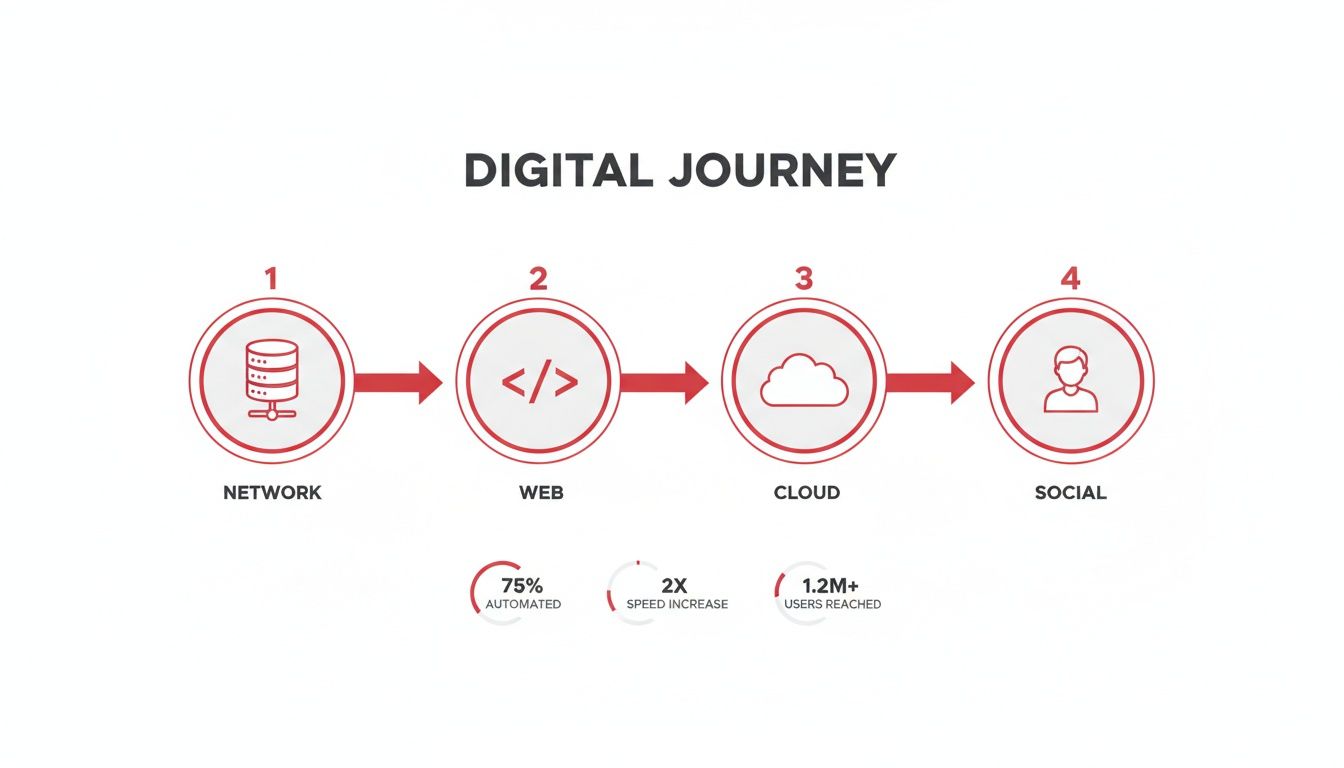
Each stage logically builds on the one before it, letting the ethical hackers get a progressively deeper understanding of your security posture as they go.
Phase 1: Scoping and Planning
Honestly, this is the most important part of the entire process. Before a single line of code is run, we sit down together to define the Rules of Engagement. This conversation sets the boundaries, goals, and ground rules for the whole project.
Here’s what we nail down:
- Defining the Scope: We get crystal clear on what's in play and what's off-limits. This means listing the specific IP addresses, applications, servers, or even office locations that are fair game.
- Setting Objectives: What are we trying to achieve? Is the main goal to stress-test a new app before it goes live, meet an ISO 27001 compliance requirement, or see if you could withstand an attack from a specific type of cybercriminal?
- Establishing Communication Channels: We agree on who talks to who, when, and how. This is especially crucial if a critical vulnerability is found that needs your immediate attention.
Getting this planning phase right ensures the test is focused, safe, and perfectly aligned with your business goals. No surprises, no scope creep.
Phase 2: Reconnaissance and Discovery
With the rules locked in, the ethical hackers get to work. The first step is reconnaissance, or "recon" for short. This is the intelligence-gathering stage where the testers act like digital private investigators, trying to learn everything they can about your systems from publicly available information.
They’ll be mapping out your digital footprint, looking for potential entry points and weak spots. The key here is that this stage is mostly passive—they're looking, not touching, so it won’t set off any alarms on your end.
The whole point of reconnaissance is to build a detailed map of your environment. The more information a tester uncovers here, the more precise and effective the next phase will be.
Phase 3: Exploitation and Post-Exploitation
Alright, this is where the action happens. Armed with the intel from the recon phase, the testers now try to actively exploit the vulnerabilities they’ve found. This is the moment that separates a real penetration test from a simple vulnerability scan.
The goal isn't just to find a weakness but to use it to gain a foothold in your system.
But getting in is only half the battle. Once they have initial access, the post-exploitation phase kicks off. Here, the tester will see how far they can go. Can they escalate their privileges to become an administrator? Can they move sideways across the network to other machines? Can they get their hands on sensitive data? They'll do all this while trying to stay under the radar, just like a real attacker would.
Phase 4: Analysis and Reporting
This final phase is where you get the real value. The testing team takes all their findings and compiles them into a comprehensive, easy-to-understand report. This isn't just a mountain of technical jargon; a great report is a strategic document that gives you a clear path forward.
A report worth its salt will always include:
- An Executive Summary: A jargon-free overview for management and non-technical folks.
- A Technical Breakdown: The nitty-gritty details of each vulnerability, including how it was found and exploited.
- Risk Prioritisation: Every finding is ranked by severity (Critical, High, Medium, Low) so you know exactly where to start.
- Actionable Remediation Steps: Clear, practical guidance on how to fix every single issue we uncovered.
Throughout the project, everything is handled according to strict responsible disclosure practices to ensure sensitive information is managed ethically and securely. To see what a truly useful report looks like, check out our deep dive on crafting effective penetration testing reports. This final document becomes your roadmap to a much stronger, more resilient security posture.
How Pen Testing Drives ISO 27001 Compliance
If your business is chasing ISO 27001 certification, think of a penetration testing service as less of a "nice-to-have" and more of a non-negotiable part of your strategy. It’s the difference between having a security blueprint and proving the building can actually withstand a storm.
Penetration testing moves your organisation beyond simply saying you have security controls in place. It gives you hard, tangible proof that you're actively trying to break them—and an auditor loves nothing more than seeing that kind of proactive validation. It’s evidence that speaks far louder than any policy document ever could.

Connecting Pen Tests to Key ISO 27001 Controls
The findings from a professional pen test don't just sit in a vacuum; they directly feed into some of the most important parts of ISO 27001's Annex A controls. This isn’t a vague exercise—it’s a targeted activity that demonstrates your due diligence.
Here’s a practical look at how it all lines up:
- A.12.6.1 Management of Technical Vulnerabilities: This control is all about finding and fixing weaknesses in a timely manner. What better way to do that than having an expert actively search for those very vulnerabilities within your own environment?
- A.14.2.8 & A.14.2.9 System Security Testing: These controls specifically call for security testing when you're developing new systems or making big changes. A pen test on a new web app before it goes live is the perfect way to satisfy this requirement.
- A.18.2.3 Technical Compliance Review: You need to regularly check if your systems are actually meeting your own security policies. A pen test report is the ultimate independent verification, showing how your configurations stand up against a real attack.
In short, when you commission a penetration test, you’re creating the exact evidence an auditor needs to tick these boxes. It makes the entire audit process significantly smoother and less stressful.
Beyond the Audit: A Culture of Improvement
Getting that ISO 27001 certificate isn't the finish line. It's the starting gun for an ongoing commitment to information security, and penetration testing is what keeps you in the race.
The real goal of a pen test in an ISO 27001 context isn't just to pass an audit. It's to find and fix weaknesses, proving your management system is a living, breathing process that actively reduces risk.
This approach shows real security maturity. It tells auditors, clients, and partners that you aren’t just compliant on paper but are genuinely dedicated to strengthening your defences against threats that exist in the wild.
The market reflects this growing need for validation. Australia's security testing market is forecast to hit USD 9.47 billion in 2025 and swell to USD 20.82 billion by 2031. This explosive growth is fuelled by the constant rise in cyberattacks and regulations demanding this level of proof. You can discover more insights about the Australian security testing market trends and what’s driving them.
Investing in regular pen testing turns your Information Security Management System (ISMS) from a static pile of documents into a dynamic, effective framework for managing risk. It simplifies compliance, hardens your security, and builds a solid foundation of trust with everyone you do business with.
How to Choose the Right Pen Testing Partner
Picking a provider for your penetration testing service is easily one of the most important security decisions you’ll make. Get it right, and you have a genuine partner dedicated to hardening your defences. Get it wrong, and you’re left with a generic report and a dangerous false sense of security.
The goal here isn't just to tick a compliance box. You're looking for a team that becomes an extension of your own, offering real-world insights, not just a laundry list of problems. This means you need to look past a slick website or a rock-bottom price. You need to dig into their technical skills, their reputation, and their ability to explain complex issues in a way your team can actually use. A true partner takes the time to understand your business before they even think about launching a test.
Evaluating Technical Expertise and Certifications
First things first, you have to verify their technical chops. Penetration testing is a hands-on, highly skilled discipline, and industry certifications are the clearest sign that a team knows what they're doing. Don't be shy about asking for proof.
You want to see testers who hold respected, practical certifications that prove they can walk the walk. Key ones to look for include:
- CREST (Council of Registered Ethical Security Testers): This is a huge one. It’s a highly regarded international accreditation that validates both a company’s processes and the skills of its individual testers.
- Offensive Security Certified Professional (OSCP): This exam is famously difficult. It’s a hands-on, 24-hour marathon that proves a tester can think on their feet, get creative, and find ways to break into systems under serious pressure.
- GIAC (Global Information Assurance Certification): This organisation offers a whole suite of specialised certifications, covering everything from web app testing (GWAPT) to network penetration testing (GPEN).
When a provider's team holds these kinds of qualifications, it shows they’re serious about technical excellence and are committed to keeping their skills sharp.
Assessing Industry Experience and Reporting Quality
Beyond the certs, you need a partner who has proven experience in your field. A team that already understands the specific threats facing an Australian government contractor or the compliance headaches in the financial services sector will deliver a far more relevant and valuable test. It just makes sense.
The most valuable thing you get from any penetration test is the final report. It should be a clear, actionable roadmap for fixing things, not a confusing data dump that just leaves you with more questions.
When you're talking to potential partners, always ask to see a sanitised sample report. A good one will always have these three things:
- A Clear Executive Summary: Written in plain English for the non-technical bosses, explaining the business risk.
- Prioritised Findings: A ranked list of vulnerabilities (e.g., Critical, High, Medium) so you know exactly where to start.
- Detailed Remediation Guidance: Step-by-step instructions that your technical team can actually follow to patch the holes.
If a company is cagey about sharing a sample report, or if the one they show you is vague and unhelpful, that’s a massive red flag. That document is the ultimate proof of whether they can deliver real value.
The industry is also moving towards more modern, flexible ways of working. The Penetration Testing as-a-Service (PTaaS) market, for instance, is projected to explode from USD 2.34 billion in 2024 to USD 11.07 billion by 2034, with application security testing leading the way. As you look at providers, it's worth exploring this model—you can learn more about how Pen Test as a Service works and its benefits. This incredible growth just goes to show how essential these services have become. For a deeper dive, you can read the full research about PTaaS market trends to get a better sense of where things are headed.
Your Top Penetration Testing Questions Answered
If you’re an Australian business looking into professional penetration testing services, you probably have a few questions. Getting clear, straightforward answers is the first step to making a smart decision, so let’s unpack some of the most common queries we hear.
What’s the Difference Between a Vulnerability Scan and a Pen Test?
This is easily the most important question to get your head around, and the answer is simpler than you might think.
Imagine a vulnerability scan as an automated security drone flying around your office building. It uses a database of known issues to methodically check every door and window, creating a list of potential weak spots—like an unlocked window on the third floor or an old, easily picked lock on a side door. It’s fast, great for routine checks, and gives you a good baseline.
A penetration test, on the other hand, is the human expert who takes that list and actually tries to break in. They don’t just note the unlocked window; they try to climb through it. They’ll see what rooms they can access, what sensitive files they can get their hands on, and whether anyone on the inside even notices them. It’s a real-world simulation of an attack.
A vulnerability scan tells you a window is unlocked. A penetration test tells you an intruder got through that window, walked past your reception, and made off with your client files from the server room. It’s about demonstrating real-world risk, not just listing theoretical problems.
How Much Does a Penetration Test Cost?
There's no simple price tag for a penetration test, and if a vendor gives you one instantly, you should be wary. The cost is entirely shaped by the size and complexity of the job. A small e-commerce business needing its single website checked will have a very different quote from a government contractor who needs their entire network and cloud environment put through its paces.
Here’s what really drives the cost:
- Scope Complexity: How many systems, applications, and IP addresses are we talking about? The bigger the playground, the more time it takes.
- Testing Depth: Are you after a high-level check-up, or do you need a deep, methodical dive that involves a lot of manual, hands-on-keyboard effort from an expert?
- Methodology: The type of test matters. An external network test is different—and often less involved—than an internal test or a social engineering campaign designed to test your staff.
Any reputable provider will sit down with you for a proper scoping call to understand your business and your goals before they even think about putting a number on paper.
How Often Should We Be Doing This?
For most businesses, an annual penetration test is a solid baseline. Think of it as your yearly security health check-up. Given how quickly cyber threats change, this frequency keeps you on top of emerging risks. But an annual test is just the starting point.
You should absolutely book a test more often in specific situations:
- After Major Changes: Just rolled out a new application, made significant changes to your network, or migrated services to the cloud? It's time for a test.
- To Meet Compliance Needs: Some regulations, like the PCI DSS for handling card payments, demand more frequent testing—sometimes as often as quarterly.
- After a Security Scare: If you’ve just dealt with a breach or even a close call, a pen test is critical to make sure you’ve properly fixed the root cause.
The key is to see penetration testing as a regular part of your security program, not just a one-off task you tick off a list.
What Happens After the Pen Test Finds Things?
Finding vulnerabilities isn't the end of the story; it's the beginning of the fix. The final report you receive from the testing team is the most valuable part of the entire engagement—it's your roadmap to a stronger defence.
Here’s how the process usually unfolds:
- The Report Arrives: You'll get a detailed report outlining every weakness the testers found. More importantly, these findings will be prioritised by risk (e.g., Critical, High, Medium, Low) so you know what to tackle first.
- Your Team Gets to Work: Your IT team or security partner uses this prioritised list to start fixing things. A good report won’t just point out problems; it will provide clear, practical advice on how to resolve them.
- Ongoing Support: A great penetration testing partner doesn't just email the report and vanish. They'll be on hand to walk your team through the findings and answer any technical questions.
- Verification and Retesting: Once your team has rolled out the fixes, many providers offer a retest. This crucial step verifies that the vulnerabilities are actually gone, giving you confidence that your security posture has genuinely improved.
This structured follow-up is what turns the investment in a test into a real, measurable improvement in your ability to fend off attackers.
Recent Comments