

Ever wondered what would happen if a real hacker targeted your business? Penetration testing services answer that question in a safe, controlled way. It’s essentially a simulated cyberattack, where ethical hackers (the good guys) use the same tools and techniques as malicious attackers to find and exploit weaknesses in your systems.
Think of it as a fire drill for your cybersecurity. You don't just talk about escape routes; you practise them. A pen test is a hands-on, authorised drill to see just how strong your digital defences really are, giving you a crystal-clear roadmap to patch up the holes before someone else finds them.
What Do Penetration Testing Services Actually Involve?

Let's use an analogy. Imagine your business is a high-security bank vault. You’ve got thick walls, alarms, and state-of-the-art locks. A vulnerability scan is like a security guard doing their nightly rounds with a checklist. They check that all the doors are locked and the windows are shut. It's an automated process that's great for spotting known, obvious weak points.
But penetration testing services are a whole different game. This is like hiring a team of elite safecrackers to actually try and break into your vault. They don't just rattle the locks; they study their design, look for undiscovered flaws, and might even try to con a staff member into handing over the keys.
This hands-on approach is what makes it so valuable. It moves past theory and into reality, answering the one question that really matters: "If a determined attacker came for us, what damage could they actually do?"
The Real Goal of Ethical Hacking
The point of a penetration test, or 'pen test', isn't just to get a long list of security flaws. It's about showing their real-world impact. We task ethical hackers with thinking like the bad guys, giving your defence team a powerful, insider advantage.
Their mission boils down to a few key objectives:
- Find the Cracks: Uncover weaknesses in your networks, applications, and even your team's security awareness that a real attacker would pounce on.
- Prove the Risk: Safely exploit those weaknesses in a controlled way to show that a vulnerability isn't just theoretical, but a genuine, exploitable threat.
- Measure the Impact: Figure out what a successful attack would mean for you—from data theft and financial loss to serious reputational damage.
- Provide a Fix-It Plan: This is the most critical part. The final report is a detailed, prioritised roadmap showing you exactly how to fix every issue found.
This shift towards proactive security is gaining serious momentum. The Australian penetration testing market is valued at around USD 23.24 million as of 2025 and is expected to grow at an incredible 19.5% compound annual growth rate. This shows just how seriously Aussie businesses are taking these simulated attacks to shore up their defences. You can dig deeper into these market trends and their drivers in the full report.
Human Ingenuity vs. Automated Scanning
One of the biggest points of confusion is the difference between a vulnerability scan and a full-blown penetration test. While both are vital for security, they are worlds apart in what they achieve.
A vulnerability scan is fantastic for finding the "low-hanging fruit." Think missing software patches, common server misconfigurations, and other known issues. They are fast, efficient, and a great way to get a baseline security check-up. But that's where their usefulness ends.
An automated tool simply can't replicate the creativity, intuition, and persistence of a human expert. A skilled pen tester can link several seemingly minor vulnerabilities together to create a major security breach—something an automated scanner would never spot.
A penetration test doesn't just find flaws; it tells a story. It maps out the exact path an attacker could take from an initial foothold all the way to your most valuable data, providing context that automated tools simply can't.
That human element is the secret sauce of genuine penetration testing services. Testers adapt their approach on the fly, just like a real attacker. They can exploit flaws in your business logic, craft clever social engineering attacks, and find zero-day vulnerabilities in your custom-built software. These are all blind spots for automated scanners.
Let's break it down.
Penetration Test vs Vulnerability Scan At a Glance
The table below gives you a quick snapshot of how these two security assessments stack up against each other.
| Aspect | Vulnerability Scan | Penetration Test |
|---|---|---|
| Methodology | Automated software scans for known vulnerabilities. | Manual, human-led process using both automated and manual techniques. |
| Depth | Surface-level. Identifies potential weaknesses. | In-depth. Actively exploits vulnerabilities to confirm their existence and impact. |
| Goal | To create a list of potential vulnerabilities. | To simulate a real-world attack and assess the business impact of a breach. |
| Scope | Broad, but not deep. "A mile wide and an inch deep." | Narrow and deep. Focuses on exploiting specific targets. |
| Human Element | None. Entirely automated. | Essential. Relies on the creativity and problem-solving skills of an ethical hacker. |
| False Positives | High potential for false alarms that need verification. | Very low. Vulnerabilities are confirmed through successful exploitation. |
| Best For | Regular, frequent health checks and patch management. | Annual or bi-annual deep dives, compliance checks, and pre-launch security validation. |
Ultimately, a scan tells you what might be wrong. A pen test shows you what is wrong and exactly how much it could hurt you.
The Main Flavours of Penetration Testing

Not all security tests are cut from the same cloth, and picking the right one is crucial. Imagine you’ve hired a team to test the physical security of your office building. The amount of information you give them—from nothing at all to a full set of blueprints—completely changes their approach and what they’re likely to find.
It’s the same in the world of penetration testing services. The industry breaks this down into three core approaches: black box, white box, and grey box testing. Each one mimics a different kind of attacker, giving you a completely different perspective on your security weaknesses. Matching the right test to your goals is the first, and most important, step to getting results you can actually use.
Black Box Testing: Seeing Through an Attacker’s Eyes
Black box testing is the closest you can get to simulating a real-world external attack. The ethical hackers start with almost nothing—often just your company name or a web address. They have zero inside knowledge of your network, your software, or how you operate.
This forces the testers to think and act exactly like a genuine cybercriminal. They have to start from square one, piecing together your digital footprint from public information, scanning for entry points, and probing for any crack in your armour.
It’s like asking a security expert to break into your building without giving them any clues. They don’t have a map, they don't know the guard schedules, and they have no idea what alarm systems are in place. Their success depends entirely on what they can figure out from the outside.
This kind of test is fantastic for understanding your external attack surface. It directly answers the question, "What could a determined hacker with no inside help actually find and exploit?"
For instance, if you're launching a new website for your customers, a black box test is perfect. It gives you a brutally honest assessment of how your site would stand up to the most common type of threat out there.
White Box Testing: The Full Internal Audit
On the other end of the scale, we have white box testing, sometimes called "clear box" testing. Here, the penetration testers are given the keys to the kingdom. We’re talking full access to source code, network maps, admin passwords, and architectural documents.
The goal isn't to mimic an external attacker anymore. It's about conducting the most exhaustive and deep-diving analysis possible. With full knowledge of how everything works, the ethical hackers can inspect every line of code and every system setting for subtle flaws that would be almost impossible to spot from the outside.
This comprehensive approach is ideal for your most critical, high-risk systems—the ones where a breach would be an absolute disaster.
- Financial Platforms: Think core banking systems or online payment gateways.
- Healthcare Systems: Securing an application that holds sensitive patient records.
- Custom Software: Analysing your own proprietary software before rolling it out company-wide.
By giving the testers complete transparency, you empower them to uncover deep-seated vulnerabilities, complex logic flaws, and sloppy coding practices. It's about hardening your most valuable digital assets from the inside out.
Grey Box Testing: The Insider Threat Perspective
Grey box testing sits right in the middle, blending elements of the other two. In this scenario, the testers are given some information, but not the whole picture. A typical setup is to provide them with a standard user account and some basic knowledge of the system.
This approach is specifically designed to simulate two very common—and very dangerous—threats: a malicious insider or an attacker who has already stolen a legitimate user's login details. It answers the crucial question, "What damage could someone do once they're already inside our network?"
By starting with a foothold, the testers can focus their efforts on trying to escalate their privileges, accessing data they shouldn't be able to see, and moving sideways through your network. A 2023 report revealed that incidents involving insiders now cost companies an average of $16.2 million globally, which really drives home why this kind of test is so important.
A few practical scenarios where grey box testing shines:
- Customer Portals: What could a malicious customer do beyond their normal permissions?
- Internal Staff Applications: How much damage could a disgruntled employee cause?
- Partner Portals: Simulating a breach that starts from a compromised third-party vendor account.
This method offers a powerful mix of realism and efficiency. It lets the testers skip the initial reconnaissance and get straight to probing the very real dangers posed by insider risks.
So, Which Penetration Testing Service is Right for You?
Choosing the right test isn't about finding the "best" one; it's about aligning the test with what you need to achieve. Each method provides a unique lens for viewing your security posture.
| Testing Type | Level of Knowledge | Simulates | Best For |
|---|---|---|---|
| Black Box | None | An external, uninformed attacker | Validating external defences and public-facing applications |
| White Box | Complete | A developer or insider with full access | Deep code reviews and securing critical internal systems |
| Grey Box | Partial | A malicious user or compromised account | Assessing insider threats and privilege escalation risks |
By understanding these fundamental differences, you can make a smart decision and invest in a penetration testing service that delivers the insights you actually need. Whether you're worried about a hacker across the globe, a rogue employee, or a hidden flaw in your code, there’s a testing method designed to bring that specific risk into the light.
What a Professional Penetration Test Actually Looks Like
Forget the Hollywood cliché of a hacker frantically typing in a dark room. A real-world professional penetration test is nothing like that. It’s a meticulous, structured, and carefully controlled process. Think of it less like smashing a window and more like a skilled locksmith carefully picking a lock to show you exactly where its weaknesses are.
This methodical approach ensures the test is thorough, safe, and gives you the most bang for your buck. Let's pull back the curtain on the five phases that make up a professional penetration testing service.
Phase 1: Planning and Reconnaissance
Before a single tool is fired up, everything starts with planning. This first step is all about setting the ground rules, and we do this through a document called the Rules of Engagement. It’s a critical agreement that clearly defines the scope—what’s on the table for testing, what’s off-limits, and how we’ll communicate to make sure we don’t disrupt your daily business.
Once we've all agreed on the game plan, the reconnaissance (or 'recon') begins. This is essentially the intelligence-gathering phase. Our ethical hackers act like detectives, using publicly available information to map out your organisation's digital footprint and get a feel for your technology and potential weak spots.
This involves two key activities:
- Passive Reconnaissance: Gathering intel without touching your systems directly. This could be anything from checking public records and employee social media profiles to looking at domain registration details.
- Active Reconnaissance: Gently probing your systems for more technical clues, like identifying which services are running on your public-facing servers.
This groundwork is absolutely vital. The more information a tester uncovers here, the more precise and effective their simulated attacks will be later on.
Phase 2: Scanning and Enumeration
Armed with intelligence from the recon phase, the testers now move to scanning. They use specialised tools to systematically check your networks and applications for open doors and windows. This goes far beyond what a simple automated scanner can do; for a pen tester, this is just the beginning.
The goal here is to map out the entire attack surface we defined in the scope. Testers identify open ports, the services running on them, and even the specific software versions you're using. They then cross-reference all this data against known vulnerability databases to pinpoint potential ways in.
After the initial scan, they dig deeper with enumeration. This involves actively querying the services they found to get more detailed information, like user accounts, network shares, or system configurations. It’s like a burglar finding an unlocked window, then carefully peeking inside to see what’s worth grabbing and if any alarms are set.
The infographic below shows how each of these steps flows into the next, building a clear picture from start to finish.
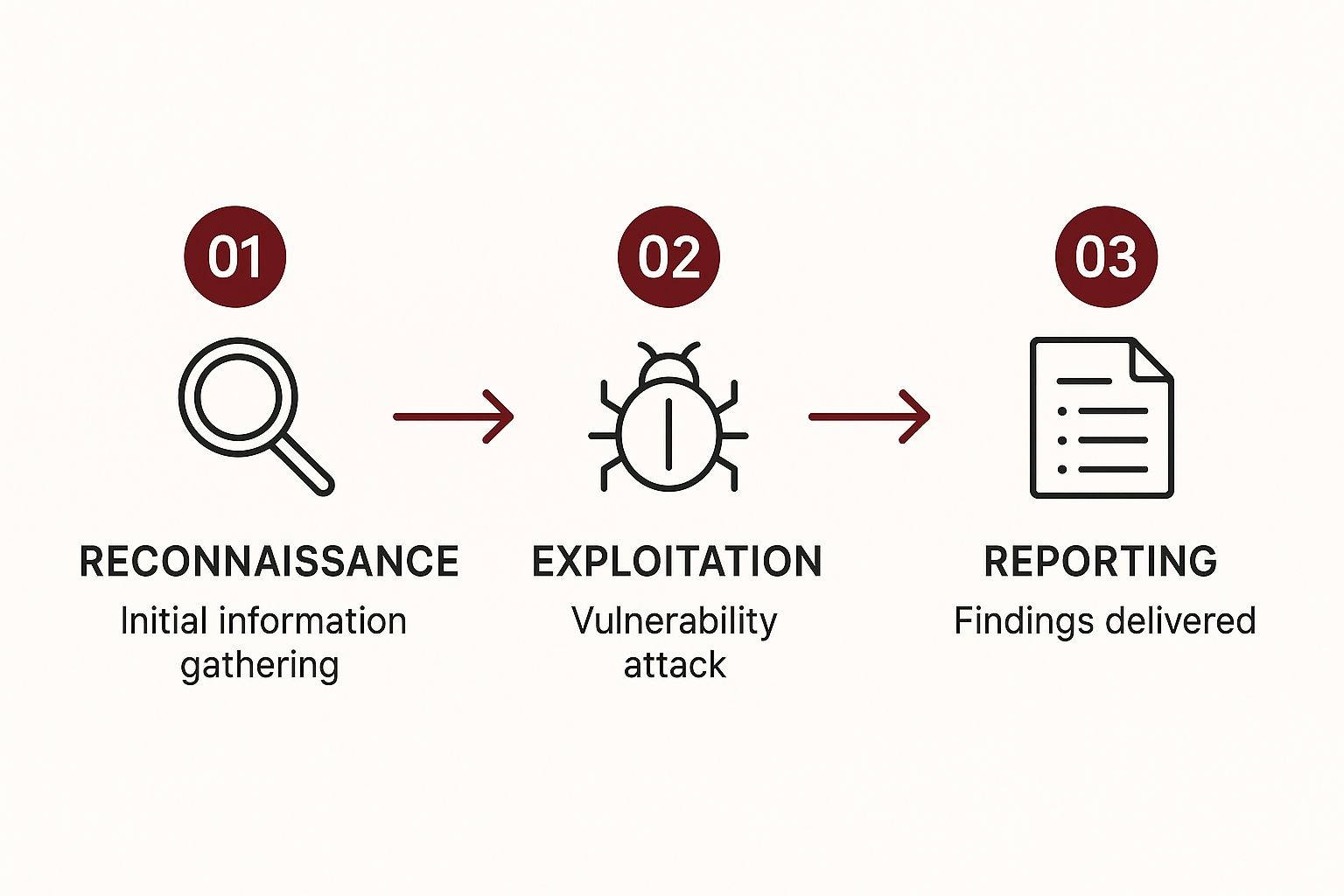
As you can see, it’s a logical progression—transforming raw data into a targeted plan and, eventually, a report full of actionable insights.
Phase 3: Gaining Access
This is the part that everyone thinks of as "hacking." Using the vulnerabilities found during scanning, the ethical hacker will now try to exploit them to gain access to the system. It’s the most delicate part of the test, and it requires a huge amount of skill and precision to do it safely.
The point isn't to cause damage. It's to prove that a vulnerability is a real, tangible threat that an attacker could actually use against you. A successful exploit might involve bypassing a login screen, running code on a server, or tricking an app into giving up sensitive data. This step is the proof in the pudding, showing that a theoretical weakness is a genuine risk.
Phase 4: Maintaining Access and Escalation
Getting that initial foothold is a huge step, but a real attacker wouldn’t just stop there. So, the next phase is all about seeing how far inside they can get. This is where we simulate a persistent threat—an attacker who wants to stick around and expand their control over your network.
To do this, our testers will try to:
- Establish Persistence: They might create a backdoor or another way to get back into the system later, even if you patch the original entry point.
- Escalate Privileges: They’ll attempt to go from being a regular user to an administrator, giving them full control over the machine.
- Move Laterally: Once they control one system, they'll try to jump to other computers on your internal network, showing how a breach can spread like wildfire.
This phase is critical for understanding the real business impact of an attack. It moves beyond "Can they get in?" to answer the more important question: "What's the worst that could happen if they do?" This proactive mindset is a cornerstone of modern security; you can explore similar strategies in our guide on threat hunting.
Phase 5: Analysis and Reporting
Ironically, the most important part of a penetration test doesn't involve any hacking at all. It’s the final report. This is where all the technical findings are translated into a clear, comprehensive document that your team can actually use.
A good report is much more than a list of vulnerabilities. It connects the dots between a technical flaw and the business risk it creates. It answers the "so what?" question, detailing the potential impact on your operations, finances, and reputation.
The final report is the entire point of the exercise. It's not about breaking things; it's about providing a strategic, prioritised roadmap that empowers your team to fix what matters most, turning a simulated crisis into a powerful security improvement plan.
A high-quality report will always include:
- An Executive Summary: A simple, high-level overview for decision-makers, written in plain English.
- Technical Details: In-depth explanations of each vulnerability and the exact steps taken to exploit it.
- Risk-Based Prioritisation: A clear ranking of issues from critical to low, so you know where to focus your efforts first.
- Actionable Remediation Guidance: Specific, practical advice on how your team can fix every single issue we found.
The insights from this report are a crucial foundation for building or improving your organisation's Vulnerability Management Policy. It ensures the lessons learned from the test are baked into your everyday security culture, turning a one-off project into a catalyst for long-term improvement.
The Business Case for Penetration Testing
When it comes down to it, the decision to invest in penetration testing services boils down to one simple question for business leaders: "Is it actually worth it?"
The answer is a resounding yes. Thinking of proactive security as just another IT expense is a mistake; it's a strategic business decision with a clear and compelling return. It’s about shifting your mindset from reactive crisis management to proactive prevention, stopping disasters before they even have a chance to happen.
This forward-thinking approach directly translates into real savings, both in your bank account and your brand’s reputation. When you stack up the astronomical costs of a data breach—regulatory fines, legal bills, customer exodus, and brand damage—the price of a professional penetration test looks like a very minor, very smart investment. It's the difference between paying for a solid security fence now or paying to rebuild your entire business after a break-in.
Neutralise Threats Before They Become a Crisis
The real magic of penetration testing is its ability to find and patch security holes before a real attacker does. Every single vulnerability an ethical hacker discovers and helps you fix is a potential crisis you've just sidestepped. It's a direct, measurable reduction of your business risk, stopping a data breach from ever making headlines.
Think of it this way: an undiscovered flaw in your web application is like a ticking time bomb. A penetration test lets you safely find and defuse that bomb on your own terms, rather than waiting for it to detonate at the worst possible moment. This proactive work saves your organisation from the immense pressure, chaos, and financial bleeding that always follows a real security incident.
Satisfy Critical Compliance Mandates
In many industries, penetration testing isn't just a good idea—it's a non-negotiable requirement. Regulatory bodies and industry standards need you to prove you're taking security seriously. Failing to comply can lead to crippling fines, losing your certifications, and even being locked out of lucrative contracts.
Key standards that often demand regular penetration testing include:
- ISO 27001: This global benchmark for information security requires organisations to regularly test and evaluate their security controls.
- APRA Standards: If you're a financial institution in Australia, proving you have robust security is a core part of regulatory oversight.
- PCI DSS: Any business that handles credit card data must conduct regular penetration tests to stay compliant.
By commissioning penetration testing services, you’re not just tightening your security. You're also generating the concrete evidence needed to satisfy auditors and regulators, ensuring your business stays compliant and competitive. To see the bigger picture, it helps to understand the full cyber security risk assessment process and how it shapes your testing strategy.
Build Unbreakable Customer Trust
In a world where data breaches are front-page news, trust is your most valuable currency. Customers and partners are more careful than ever about who they give their data to. Showing them you have a serious, proactive commitment to security is one of the most powerful ways to earn and keep that trust.
When you can confidently show that you regularly put your systems through rigorous, independent security testing, you send a clear message: you value and protect your clients' information. This builds confidence, strengthens relationships, and gives you a genuine edge over the competition.
Investing in penetration testing is a public declaration of your commitment to security. It tells your customers, partners, and stakeholders that you don’t just talk about data protection—you actively prove it.
This commitment is the bedrock of long-term customer loyalty and a strong brand reputation.
Avoid Catastrophic Breach Costs
The financial fallout from a single data breach can be devastating for any business, but it can be an extinction-level event for small and medium-sized enterprises. The costs snowball far beyond the immediate technical cleanup.
Just think about the cascading financial impact:
- Regulatory Fines: Hefty penalties for non-compliance.
- Legal Fees: The cost of fighting lawsuits from affected customers.
- Customer Notification: The expense of informing every single person impacted.
- Credit Monitoring Services: Often offered to victims to mitigate the damage.
- Business Downtime: Lost revenue for every minute your systems are offline.
- Reputational Damage: The long-term loss of customers and future business.
Penetration testing is simply effective financial risk management. It directly tackles the single greatest cyber threat to your bottom line.
Gain a Clear, Unbiased Security Perspective
Your internal IT team is fantastic at what they do—building and maintaining your systems. But they're often too close to the project to see its flaws. They operate with an insider's knowledge, which can create unconscious biases and blind spots. And those are the very things attackers hunt for.
A professional penetration testing service brings a fresh, unbiased, and adversarial perspective to the table. The ethical hackers have one mission: think like a criminal and find a way in. This external, objective assessment gives you a true, clear-eyed view of your security posture, free from any internal assumptions. They’ll shine a light on risks you didn't even know you had, giving you the clarity needed to make smarter security investments.
To see how penetration testing fits into a wider security strategy and the software development lifecycle, it's worth exploring these essential DevOps Security Best Practices. This field is also getting more efficient. Penetration testing in Australia is being shaped by the global move toward automation. Worldwide, organisations using AI-powered pen testing tools report cutting their manual testing time by up to 30%. A huge 80% of them also say that meeting regulatory compliance is a primary reason for adopting these advanced tools.
How to Choose the Right Pen Testing Provider

Picking a partner to assess your security is one of the most important calls you’ll make. This isn't just about buying a service; it's about handing someone the keys to your kingdom and trusting them to find the weak spots before a real attacker does.
The quality, skill, and sheer professionalism of your chosen provider will make or break the entire exercise.
The market is flooded with companies offering penetration testing services, but let's be clear: they are not all created equal. Some deliver the deep, insightful analysis that actually makes you safer. Others? They just run an automated scan, slap a logo on the report, and call it a day. Choosing poorly doesn’t just waste money—it can leave you with a false sense of security that’s far more dangerous than knowing you’re vulnerable.
Think of this as your playbook for finding a provider you can genuinely trust. We'll walk through what really matters, so you can see past the sales pitch and find a team with true expertise.
H3: First Things First: Check Their Credentials
Certifications are your first, most basic litmus test. They’re independent proof that the testers have the technical chops and ethical grounding to do the job properly. While a certificate doesn't tell the whole story, a complete lack of them is a massive red flag.
You want to see providers whose team members hold respected, hands-on certifications. These aren’t easy to get; they involve gruelling, practical exams that prove a tester can think and act like a real-world hacker.
Keep an eye out for these heavy hitters:
- OSCP (Offensive Security Certified Professional): This is the gold standard for many, famous for its intense 24-hour practical exam.
- CREST (Council of Registered Ethical Security Testers): CREST offers internationally recognised accreditations for both individuals and companies, ensuring high standards across the board.
- GIAC (Global Information Assurance Certification): GIAC provides a whole family of specialised certifications, like the GIAC Penetration Tester (GPEN), which validate specific, in-demand skills.
A provider that invests in these credentials is a provider that’s serious about quality.
H3: The Report Is Everything: Demand a Sample
Here’s the thing: the real value of a pen test isn't the hacking itself. It’s the final report. This document is where all the technical wizardry gets translated into a clear, actionable roadmap for your business. A weak report makes the entire test a waste of time.
Because of this, you must insist on seeing a sanitised sample report before signing anything. This is your best glimpse into the quality of their work and how well they communicate business risk.
When you're looking at that sample report, try to ignore the technical jargon for a moment. Ask yourself one simple question: "Does this give me, a manager, a clear picture of the risks and a prioritised plan to fix them?"
A great report always kicks off with a sharp executive summary, followed by detailed technical findings (with steps to reproduce them), risk-based prioritisation, and genuinely practical advice on how to fix things. If it looks like a raw data dump from a scanning tool, run.
H3: Do They Get Your Business? Assess Industry Experience
Cybersecurity isn't a one-size-fits-all game. The threats facing a fintech company are worlds away from those targeting a healthcare provider or an online retailer. A provider with deep experience in your industry already speaks your language. They understand your unique challenges, compliance headaches, and the specific attack vectors that keep you up at night.
Don't be shy about asking for case studies or client references from companies like yours. A provider who knows your world will tailor their approach, focusing on what matters most to your operations. This is what turns a generic test into a truly valuable business investment.
This vetting process is a core part of your security program and aligns perfectly with the principles of solid third-party risk management, ensuring your partners are a source of strength, not a weak link.
H3: Set the Ground Rules: Define the Rules of Engagement
A professional penetration test is a carefully controlled exercise, not a chaotic free-for-all. It’s governed by a crucial document: the Rules of Engagement (RoE). This is the formal agreement that lays out the scope, limitations, communication plan, and boundaries for the entire project.
The RoE protects everyone. It makes sure the testers stick to the agreed-upon systems and establishes a clear protocol for what happens if something unexpected crops up.
A professional firm will insist on developing a detailed RoE with you before a single packet is sent. If a potential vendor is hazy on this or tries to downplay its importance, it’s a sure sign of inexperience.
H3: Spotting the Red Flags
Knowing what to look for is only half the battle; you also need to know what to avoid. A few tell-tale signs can expose a low-quality provider before you make a costly mistake.
The biggest red flag? Suspiciously low pricing. A proper, manual penetration test takes time and highly skilled experts—and that has a real cost. A quote that seems too good to be true is almost always a sign that you’re not buying a pen test at all. You’re buying a cheap, automated vulnerability scan dressed up to look like one.
Remember, you are paying for human creativity and expertise, not just a piece of software.
H3: Vendor Evaluation Checklist
Choosing the right partner is a big decision. Use this checklist to methodically compare potential penetration testing services and find the best fit for your business.
| Evaluation Criterion | What to Look For | Red Flags to Avoid |
|---|---|---|
| Certifications | Team members hold respected credentials like OSCP, CREST, or GIAC. The company itself may have certifications like CREST. | Vague answers about team qualifications or reliance on obscure, unknown certifications. |
| Reporting Quality | A clear, detailed sample report with an executive summary, risk prioritisation, and actionable remediation advice. | Reports that are just data dumps from automated tools, lack business context, or offer generic, unhelpful advice. |
| Methodology | A clear, structured methodology (like PTES or NIST) and a commitment to manual, expert-led testing. | A process that seems to rely entirely on automated scanning without significant human analysis or creativity. |
| Industry Experience | Demonstrable experience in your sector, with relevant case studies or references available upon request. | A generic client list with no specialisation, or an inability to speak to the specific threats your industry faces. |
| Rules of Engagement | Insistence on a detailed RoE document that clearly defines scope, communication protocols, and limitations. | Vague or dismissive attitude toward scoping and planning. A "we'll figure it out as we go" approach. |
| Pricing | Pricing that reflects the cost of expert time and a detailed manual process. Transparent quotes with no hidden fees. | Suspiciously low prices that suggest they are only running an automated scan. Unclear or complex pricing structures. |
Ultimately, choosing the right penetration testing provider is a critical investment in your company’s resilience. By using a structured approach like this, you can cut through the marketing noise and find a genuine partner who will help you build a stronger, more secure business.
Your Top Questions About Penetration Testing Answered
Thinking about bringing in a team to test your security for the first time? It’s a smart move, but it naturally comes with a lot of questions. As a business leader or IT manager, you need to know what you’re getting into before you invest. Understanding the nuts and bolts—the cost, the frequency, and the process—is the key to making a decision you can feel good about.
This is where we clear the air. We’ll walk through the most common questions we hear from businesses just like yours, giving you straight, no-nonsense answers so you know exactly what to expect.
How Much Does a Penetration Test Cost?
This is usually the first question on everyone's mind, and the most honest answer is: it depends. There’s no simple price list for penetration testing because every business is unique. A good way to think about it is like getting a building inspection; the cost is tied directly to the size, complexity, and specific areas you need checked.
A few key factors will always shape the price tag:
- Scope: This is the big one. Are we looking at a single web application, or are we testing your entire corporate network? A larger, more complex environment simply takes more time and expertise to assess properly.
- Complexity: A simple marketing website is a world away from a sophisticated financial platform with layers of business logic and different user roles. Custom-built software, in particular, often needs a lot more hands-on, manual analysis.
- Methodology: The type of test matters, too. A deep-dive "white box" test, where our team has full access to your source code, is far more intensive—and therefore more expensive—than a "black box" test that mimics a real-world external attacker with no prior knowledge.
Be very wary of a suspiciously low price. It’s often a red flag that you’re not getting a true, manual penetration test, but a basic automated scan dressed up to look like one. Real expertise comes at a cost, but it’s a tiny fraction of what a data breach would set you back.
So, while a small, focused test on one application might start in the low thousands, a full-scale assessment of a large network could easily run into the tens of thousands. The best path forward is always to get a detailed quote based on a clearly defined scope. That way, you know exactly what you’re paying for.
How Often Should We Be Doing This?
Working out the right frequency for penetration testing is a huge part of managing your security risk. This isn't a one-and-done deal. Your digital world is always shifting—new code, new features, new threats—and your testing has to keep up.
For most organisations, an annual penetration test is the absolute minimum. Think of it as your yearly security health check-up. It provides a structured review of your defences and ticks the box for most compliance standards. But in today's world, once a year might not cut it if your business is moving fast.
You should definitely plan for more frequent tests if you’re:
- Making major system changes: Rolling out a significant update to your infrastructure, applications, or network? That’s your cue for a new test. This includes big moves like migrating to a new cloud provider or launching a major new feature.
- Handling high-risk applications: If you’re responsible for sensitive data like financial details or personal health records, moving to quarterly testing is a much safer bet.
- Meeting strict compliance rules: Some industry standards, like the Payment Card Industry Data Security Standard (PCI DSS), have very clear rules about how often you need to test.
Ultimately, the right rhythm comes down to your unique risk profile. The goal is to make sure your testing schedule is in lockstep with the pace of your business and the ever-changing threat landscape.
What Happens After the Test Is Over?
The end of the active testing is really just the beginning of the most important part of the process. A pen test report is only as valuable as the action you take on it. Once the ethical hackers have done their work, the focus shifts from finding flaws to fixing them.
The post-test phase is a powerful cycle of improvement:
- You Get the Final Report: We’ll hand over a detailed report that outlines every single vulnerability we found. It will explain the potential business impact, give each one a risk score to help you prioritise, and—most importantly—provide clear, actionable steps on how to fix it.
- Your Team Starts Remediation: Your developers and IT team take this report and get to work. They’ll start patching the vulnerabilities and hardening your systems, tackling the most critical issues first.
- We Come Back for Re-testing: Once you’re confident a vulnerability is fixed, the penetration testing team comes back to verify it. This is a crucial step. It confirms the patch actually works and hasn’t accidentally opened up a new hole.
- You Drive Continuous Improvement: The lessons you learn from the test should feed directly back into your overall security program. Maybe it highlights a need for better coding standards, updated security policies, or more training for your staff.
This cycle turns a one-off test into a long-term engine for security maturity. You're not just fixing today's problems; you're building a stronger defence against tomorrow's.
Is It Safe to Run a Pen Test on Our Live Systems?
This is a perfectly reasonable concern. You're literally paying someone to try and break into your production environment. How can you be sure they won't accidentally break it for real? The answer comes down to the professionalism, planning, and methodology of a reputable provider.
Professional penetration testing services are designed from the ground up to be safe and controlled. It’s the difference between a sledgehammer and a surgeon's scalpel. A whole series of safeguards are put in place to ensure there’s no disruption to your business.
The cornerstone of this is a document called the Rules of Engagement (RoE). Before any testing kicks off, we establish this formal agreement which clearly defines:
- The exact scope of what is—and is not—in play.
- The testing window, often scheduling more intensive activities for off-peak hours.
- A clear communication plan with emergency contacts, just in case.
- Specific techniques that are off-limits, like any that could cause a denial-of-service and bring a system down.
Expert testers use controlled, non-destructive methods. Their goal is to prove a weakness exists, not to cause actual damage. By sticking to a strict methodology and keeping the lines of communication wide open, a professional pen test can be run safely on live systems with minimal risk.
Ready to build a stronger, more resilient security posture? At Anitech, we specialise in guiding Australian businesses through the complexities of information security and ISO 27001 certification. Our expert team can help you not only meet compliance but also build a security framework that protects your business and builds customer trust. Strengthen your defences with Anitech today.
Recent Comments