

Quick Summary: Pentesting as a Service (PtaaS) replaces traditional, once-off security audits with a continuous, subscription-based model. It provides on-demand access to elite security testers via a real-time platform, integrating directly into development workflows. This guide covers how PtaaS streamlines vulnerability management, accelerates remediation, and simplifies ISO 27001 compliance.
Let's face it, cybersecurity testing used to be a frustrating, once-a-year scramble. You'd pay a small fortune for a penetration test, wait weeks for a massive PDF report to land on your desk, and by the time your team could even start fixing things, the findings were already out of date.
Enter Pentesting as a Service (PtaaS). This isn't just another buzzword; it's a completely different way of thinking about security. PtaaS ditches the old, rigid project model for a subscription that gives you ongoing access to elite security testers through a slick online platform. Think of it as moving from a once-off security audit to having a dedicated security team on call, all the time.
This modern approach ensures your digital defences are constantly being challenged, not just on a single day of the year.
Redefining Security with Pentesting as a Service
Let's use an analogy. Imagine your business is a fortress. Traditional pentesting is like hiring an inspector to check the walls once a year. They'll poke around, find a few cracks, and then send you a 100-page report a month later. By then, your builders have already added a new gate or window, making half the report useless.
Pentesting as a service, on the other hand, is like having a security patrol guarding the walls 24/7. They find a weak spot and report it immediately through a live dashboard. Your team can then chat directly with the patrol to understand the problem and patch it up, long before an enemy even knows it's there.
This is the game-changer, especially for small and medium-sized businesses that can’t afford huge upfront costs or an in-house team of security experts.

The Strategic Shift from Projects to Partnerships
At its heart, PtaaS is about moving away from a one-and-done transaction to a genuine security partnership. You’re no longer just buying a report; you're gaining a continuous feedback loop that keeps pace with your business. In a world of agile development where you're pushing out new code every week, this is absolutely essential.
What makes this model work so well?
- Real-Time Reporting: Forget waiting for a report. Findings pop up in your dashboard the moment they’re discovered, so your developers can get to work right away.
- Direct Communication: Your engineers can talk directly with the testers to ask questions, clarify vulnerabilities, and get fixes validated on the spot. This slashes the time it takes to secure your systems.
- Continuous Coverage: Testing isn't crammed into a two-week window. A diverse pool of testers provides ongoing analysis, bringing fresh eyes and different skills to find weaknesses others might miss.
This shift is critical. In a traditional pentest, by the time the final report arrives, developers have often introduced new code, making the findings outdated. PtaaS eliminates this lag, integrating security directly into the development lifecycle.
To truly understand the difference, let’s break down the two approaches side-by-side.
Traditional Pentesting vs Pentesting as a Service
| Feature | Traditional Pentesting | Pentesting as a Service (PtaaS) |
|---|---|---|
| Engagement Model | One-off, project-based | Subscription-based, continuous partnership |
| Testing Schedule | Fixed, limited time window (e.g., 2 weeks) | Ongoing, on-demand testing throughout the year |
| Reporting | A static PDF report delivered at the end | Live, real-time dashboard with instant alerts |
| Remediation | Manual tracking; re-testing costs extra | Integrated platform for remediation tracking and free re-testing |
| Communication | Limited; usually via a project manager | Direct, collaborative chat between testers and developers |
| Cost Structure | High upfront cost per project | predictable monthly or annual subscription fee |
| Scalability | Difficult; requires new project scoping | Easily scales with your needs and development cycles |
As you can see, the PtaaS model is built for the speed and agility of modern business, turning security from a roadblock into a seamless part of how you operate.
A Foundation for ISO 27001 Compliance
This proactive approach is a massive advantage if your business is aiming for a standard like ISO 27001 certification in Australia. Auditors don't just want to see a point-in-time test; they want to see a mature, ongoing process for managing vulnerabilities.
PtaaS delivers exactly that. It provides a constant stream of evidence showing that you are actively identifying, assessing, and treating security risks. It transforms compliance from a stressful, periodic event into a state of permanent readiness, proving your commitment to information security all year round. For many forward-thinking organisations, pentesting as a service is now a cornerstone of their compliance strategy.
Why PtaaS Is Replacing Traditional Security Testing
The old way of doing security testing—the big, annual penetration test—is starting to look like a relic from a bygone era. For years, this was the gold standard: you’d commission an intensive, one-off assessment and, weeks later, receive a mammoth PDF report. But in a world where software is deployed continuously and infrastructure changes in a blink, this model just can't keep pace.
This once-a-year security check-up creates a dangerous cycle of risk. By the time that hefty report lands on your desk, your developers might have already pushed new code to production, making many of the findings irrelevant or outdated. The high upfront costs and long lead times make it a slow, cumbersome affair that fails to deliver the real-time feedback modern businesses desperately need.

The Problem with Point-in-Time Security
The fundamental weakness of a traditional pentest is that it’s static. Your security posture isn't a fixed state; it’s a constantly moving target. An application that was buttoned up and secure in March could have a critical, business-ending vulnerability introduced in April.
Traditional testing simply isn't built for this reality, which leads to some pretty serious downsides:
- Delayed Fixes: Development teams often have to wait weeks for the final report. This creates a massive gap between when a vulnerability is found and when they can actually start fixing it.
- A Poor Fit for Agile: The rigid, project-based structure of a one-off test clashes with modern DevSecOps workflows, where speed and tight integration are everything.
- Zero Visibility: You have almost no insight into what’s happening during the test. You're essentially left in the dark about emerging risks until that final report shows up.
This reactive approach leaves your organisation exposed for long periods, giving attackers plenty of time to find and exploit weaknesses. This is precisely the problem Pentesting-as-a-Service (PtaaS) was designed to solve, offering a model built for agility and continuous security.
A traditional pentest is like taking a single photograph of a moving train. PtaaS, on the other hand, gives you a live video feed, aligning your security efforts with the continuous nature of modern threats. It transforms testing from a rare event into an ongoing process.
PtaaS Delivers Speed and Continuous Insights
The PtaaS model completely flips the script by providing on-demand access to security experts through a collaborative online platform. Think of it less as a faster way to get a report and more as a fundamentally different, and better, way of managing cyber risk.
With PtaaS, vulnerabilities are flagged in real-time, the moment they’re discovered. Your developers can see the issue, understand its impact, and start working on a fix immediately. This simple change drastically shortens the window of exposure.
The platform becomes a central hub for collaboration. Engineers can chat directly with the security testers to get clarification on a finding or ask for help validating a patch. This constant feedback loop weaves security directly into the development lifecycle, instead of tacking it on as a final, painful step. It empowers your team to build more secure products from the ground up.
Making Elite Security Talent Accessible to Everyone
Another powerful force driving the shift to PtaaS is the chronic shortage of cybersecurity talent. Finding, hiring, and retaining skilled penetration testers is a massive headache, especially for small and medium-sized businesses. PtaaS offers a practical and surprisingly cost-effective way around this problem.
Instead of trying to compete for a handful of expensive experts, you can tap into a global pool of vetted security professionals through a simple subscription. This makes top-tier security skills, which were once the exclusive domain of large enterprises, accessible to everyone.
Here in Australia, pentesting as a service has become a crucial tool for SMEs working to meet demanding compliance standards like ISO 27001. This is happening against the backdrop of a booming local market, which is projected to hit USD 10.04 billion in 2026. Because of talent shortages, services like PtaaS are expected to make up a staggering 37.27% of all cybersecurity spending by 2025, far outpacing product solutions. You can dive deeper into these market trends and their impact on Australian businesses to see where the industry is heading.
How PtaaS Powers Your ISO 27001 Certification
If you're gearing up for an ISO 27001 certification audit, you know it can feel like a high-stakes exam. You spend months pulling everything together, hoping you’ve done enough. A traditional penetration test gives you a single, static report to show for it—a snapshot in time that's often outdated by the time the auditor sees it.
But what if you could give them a living, breathing record of your security diligence? That’s exactly where Pentesting as a Service (PtaaS) changes the game.
PtaaS transforms compliance from a last-minute scramble into a state of constant readiness. Instead of handing over a six-month-old report, you can show a real-time dashboard that proves you’re on top of security every single day. This continuous stream of evidence is precisely what auditors want to see. It shows your Information Security Management System (ISMS) is a dynamic part of your business, not just a folder of documents gathering dust.
Directly Addressing Key ISO 27001 Controls
The real strength of PtaaS is how perfectly it aligns with specific ISO 27001 controls. The most obvious one is Annex A.12.6 Technical Vulnerability Management, which requires you to "obtain information about technical vulnerabilities… in a timely fashion," assess your exposure, and act on it.
A one-off annual pentest really struggles to meet that "timely" requirement. A PtaaS platform, on the other hand, is built for it.
- Timely Information: New vulnerabilities pop up on a live dashboard the moment they’re found, not weeks later in a PDF report. You get an immediate, up-to-the-minute view of your risk.
- Exposure Evaluation: PtaaS findings come with rich context, severity ratings, and clear steps to replicate the issue. This helps your team instantly understand what matters most and where to focus first.
- Appropriate Measures: The platform makes fixing things easier by integrating with your development tools. You can even chat directly with the testers to confirm that your fixes have worked.
This whole process creates a clean, auditable trail for every single vulnerability, from discovery right through to resolution. For an auditor, this is the gold standard for proving you have a mature and effective vulnerability management program.
From Static Reports to Living Evidence
Picture this: an auditor asks how you manage vulnerabilities. With the old-school approach, you dig out a chunky PDF report from a test conducted months ago. Then, you have to painstakingly cross-reference it with spreadsheets and Jira tickets to prove you actually fixed anything.
Now, imagine the PtaaS way. You just open a dashboard.
The platform itself becomes your body of evidence. Auditors can see a complete history of discovered vulnerabilities, the speed of your response, and detailed notes on remediation. This provides undeniable proof of a continuous commitment to security, which is far more powerful than any single report.
This is a fundamental shift in the conversation. It goes from "Did you do a pentest?" to "Show me your ongoing process for managing security weaknesses." PtaaS gives you a clear, compelling answer that demonstrates maturity and control over your security environment.
Gaining a Strategic Advantage in Compliance
Integrating PtaaS into your ISMS isn't just about ticking boxes; it gives you a real strategic edge. You can close security gaps faster with real-time feedback, making sure vulnerabilities are dealt with before they can be exploited. This proactive stance naturally lowers your overall risk profile, which is a core goal of the ISO 27001 standard. If you want to explore this further, you’ll find some great insights in discussions on global standards for ISO 27001 and AI-powered risk detection.
Ultimately, pentesting as a service gives you complete, continuous visibility into your security posture. This empowers you to make smarter, risk-based decisions and helps build a stronger security culture across the organisation. When your ISO 27001 audit rolls around, you won't just be armed with a report—you'll have a robust, evidence-backed security program that’s active all year round.
Weaving PtaaS into Your Security Operations
Adopting pentesting as a service isn't just about buying another security tool. Think of it as a fundamental upgrade to your entire security operation. To really get your money's worth, you need to weave PtaaS into the very fabric of your Information Security Management System (ISMS). This is how you transform it from a once-off, isolated test into a powerful engine driving your whole security program.
This is where PtaaS truly comes alive. It stops being about a static report and starts creating a continuous feedback loop that sharpens your risk management, makes audits a breeze, and helps you squash threats faster. Security becomes something you do every day, not just a box you tick for compliance.
Aligning the PtaaS Scope with Your ISMS
First things first: your PtaaS scope and your ISMS scope need to be perfectly aligned. Your ISMS is built to protect the crown jewels—your most critical information assets. Your pentesting has to cover those same assets, or you’re just leaving the back door wide open.
Here’s how to get it right:
- Map Your Critical Assets: Grab your ISMS asset register. Pinpoint every crucial application, server, API, and network segment that either holds sensitive data or runs a key business process. These are your non-negotiables.
- Define the Testing Boundaries: Sit down with your PtaaS provider and draw a clear line in the sand. The scope you agree on must explicitly cover the critical assets you just identified. This ensures the continuous testing is focused where it matters most.
- Schedule Regular Scope Reviews: Your business changes, and your ISMS has to keep up. Set a reminder to review the PtaaS scope every quarter or six months. This keeps it in sync as you launch new services, update systems, or retire old ones.
Getting this alignment right from the start means every dollar you spend on security testing is directly tied to the risk management goals of your ISO 27001 framework.
From Findings to Actionable Audit Evidence
One of the best things about PtaaS is the constant stream of audit-ready evidence it produces. A traditional PDF report is out of date the moment it's written. A PtaaS platform, on the other hand, is a living, breathing record of your vulnerability management—which is exactly what ISO 27001 auditors love to see.
This flowchart shows how PtaaS becomes an evidence-generating machine, smoothing your path to ISO 27001 certification and beyond.
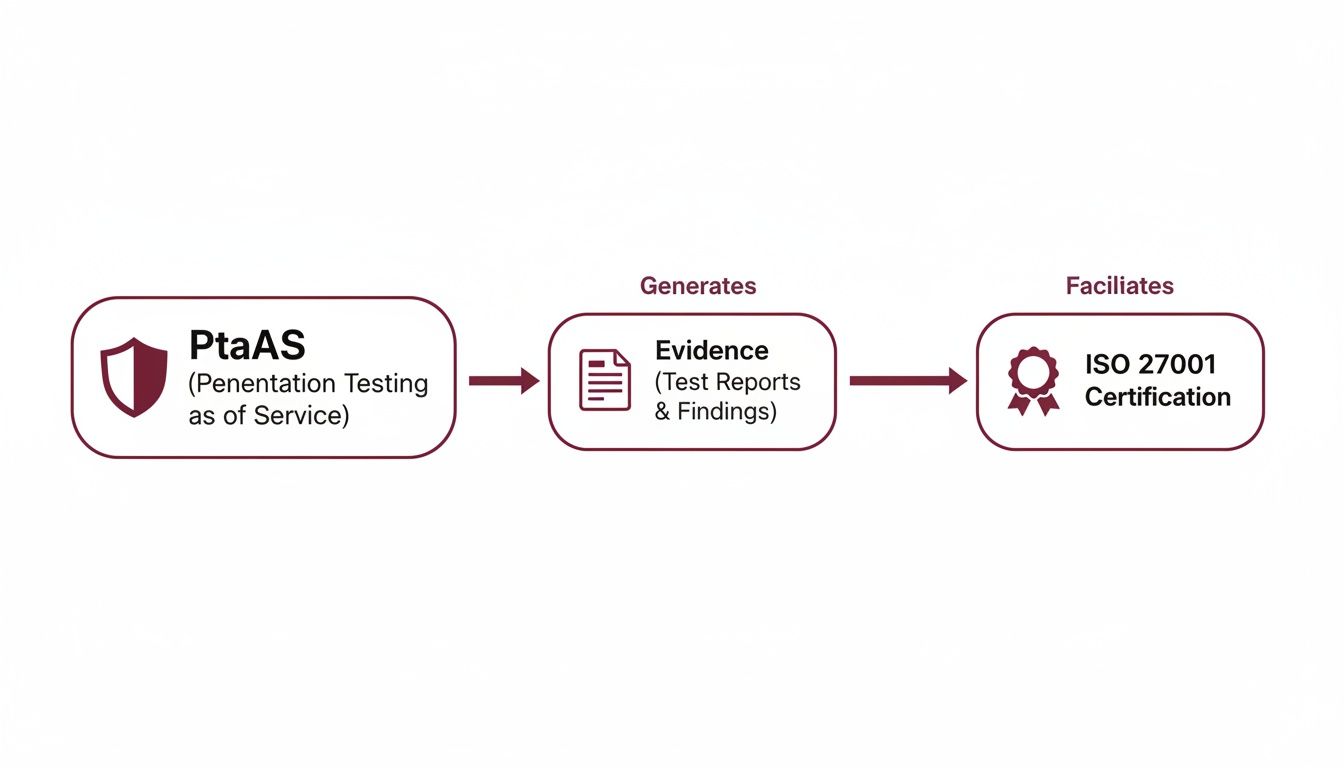
As the visual makes clear, PtaaS feeds the whole process, giving you the tangible proof you need to achieve and maintain your certification with far less stress.
Every vulnerability flagged in the platform—complete with its severity rating, when it was found, and the full history of how it was fixed—is a solid piece of evidence. It proves you have an active, ongoing process for finding and treating risks, ticking a major box for key ISO 27001 controls.
Streamlining Remediation with Smart Integrations
Let's be honest, finding vulnerabilities is the easy part. Fixing them is what really counts. This is another area where modern PtaaS platforms shine, thanks to direct integrations with the tools your dev and ops teams live in every day, like Jira, Slack, or Azure DevOps.
This integration means vulnerability alerts automatically become actionable tickets. When a pentester finds a weakness, a ticket pops up for the right team with all the context they need. No more manual copy-pasting, just a much faster path from detection to fix.
This kind of operational glue is a game-changer. It breaks down the old walls between security and development, helping build a genuine DevSecOps culture. Developers can chat directly with testers inside the platform, and once they push a fix, the tester can re-check it straight away.
This tight feedback loop is particularly important in Australia, where demand for PtaaS is skyrocketing to meet compliance needs. Frameworks like the Essential Eight push for frequent, regular testing to keep defences strong. This continuous cycle of test-fix-retest is the heart and soul of ISO 27001, where solid vulnerability management is a cornerstone of the whole standard. You can find more on Australian pentesting requirements and trends to stay on top of local expectations.
By truly embedding pentesting as a service into your daily workflows, you're not just buying a service. You’re building a more resilient, evidence-backed security program that actively reduces risk, day in and day out.
Choosing the Right PtaaS Partner for Your Business
Picking the right provider is just as important as deciding to use PtaaS in the first place. A great pentesting as a service partner becomes an extension of your own team, lending you the expertise and tech you need to really toughen up your defences. A bad choice? You’ll end up with generic reports, a clunky platform, and a frustrating hole in your security budget.
You have to look past the slick marketing and get to the heart of what they actually offer. To make PtaaS work for you, it's crucial to think carefully about the details of choosing a security outsourcing partner that truly fits your business. This means really digging into their technical skills, the usability of their platform, and whether they understand your specific industry and compliance headaches.
Evaluating Technical Expertise and Methodology
Let's be clear: not all PtaaS providers are the same. A lot of them just put a pretty dashboard on top of a basic vulnerability scanner, which is guaranteed to miss the complex, business-specific flaws that can cause real damage. Your job is to find a partner whose service is actually powered by smart, experienced humans.
When you're talking to potential providers, don't be afraid to ask the hard questions about their team and their process:
- Human-Led Testing: Ask them straight up: what percentage of the testing is manual versus automated? Real PtaaS relies on skilled ethical hackers finding the creative, high-impact vulnerabilities that scanners always miss.
- Tester Skill and Diversity: What’s the experience level of their testers? Do they have a deep bench of talent with different specialisations? Having a mix of experts brings fresh eyes to the problem, so you don't keep missing the same blind spots year after year.
- Local Threat Knowledge: How well do they know the Australian threat landscape? A partner who gets the specific threats and compliance pressures facing local businesses will give you much more relevant and useful advice.
Honestly, the depth of a provider’s human expertise is the single most important thing to look for. Automated tools are great for finding the obvious stuff, but expert pentesters find the critical risks that could actually sink your business.
Assessing the PtaaS Platform and Reporting
The platform is your main window into the entire testing process, so it absolutely has to be easy to use, collaborative, and effective. A clunky interface or reports that show up a week late completely defeats the purpose of the "as-a-service" model. Your team should be able to log in and get a clear picture of your security status instantly.
A top-notch platform should give you:
- Real-Time Findings: Vulnerabilities should pop up on your dashboard the moment they’re found and confirmed, not days or weeks later.
- Collaborative Tools: Look for features that let you chat directly with testers, track remediation efforts right in the platform, and easily request re-testing.
- Clear, Actionable Reports: Findings need to be detailed but also easy to grasp, with clear, step-by-step instructions that help your developers reproduce and fix the issue.
The best PtaaS platforms are built to tear down the walls between your security and development teams. They make it easy for engineers to ask questions, check their fixes, and learn directly from the testers, which helps build a stronger security culture throughout the whole company.
Finally, demand total transparency on their service level agreements (SLAs) and pricing. You need to know exactly what’s included in your subscription, what their response times are for critical findings, and be certain there are no hidden fees for re-testing or support. Our guide to penetration testing services dives deeper into what separates a good provider from a great one. Making the right choice here is a strategic move that will heavily influence your ISO 27001 journey and your overall security maturity.
How PtaaS Engagements and Costs Actually Work
So, how does a pentesting as a service engagement actually unfold, and what’s it going to cost? Let's get straight to the point. Understanding this is your first step to building a solid business case and getting your budget approved.
Forget the old model of a rigid, one-off project with a definite start and stop. PtaaS is more like a continuous partnership, a security rhythm that keeps time with the way your business actually operates. It all kicks off with a really clear and structured onboarding.
The whole thing starts with a deep-dive scoping session. This is where you sit down with your PtaaS provider and map out what’s most important to protect – your web apps, APIs, cloud setups, internal networks, you name it. Getting this right from the beginning is non-negotiable; it ensures the ongoing testing is aimed squarely at your biggest risks.
Once that scope is locked down, the real work begins. The PtaaS model isn't a straight line; it's a loop of constant activity.
The Lifecycle of a PtaaS Engagement
This isn't a one-and-done deal. It’s a continuous cycle designed to weave security testing directly into your day-to-day operations, not just some isolated check-up you do once a year.
Here’s what that flow typically looks like:
- Onboarding and Scoping: First, we define the assets, sort out access credentials, and agree on the rules of engagement. This sets the foundation for everything that follows.
- Continuous Testing: A mix of smart automated scanning and hands-on, human-led testing kicks off. Real experts start probing your systems, looking for the kind of tricky business logic flaws that automated tools almost always miss.
- Real-Time Findings: The moment a vulnerability is found and confirmed, it pops up on your dashboard in the PtaaS platform. You get an instant heads-up for anything critical, so you can forget about waiting weeks for a massive PDF report to land in your inbox.
- Fix, Chat, and Retest: Your developers can see the findings, ask the pentesters questions directly on the platform, and deploy fixes. As soon as a patch is live, they can hit a button to request an immediate retest to make sure the door is actually shut.
What Drives PtaaS Costs?
Figuring out the cost of pentesting as a service is a lot less painful than trying to budget for those massive, one-off traditional tests. The subscription model gives you predictable, recurring costs, but what you ultimately pay will depend on a few key things.
The real value in PtaaS pricing is its predictability. You’re not just buying a report; you're investing in a continuous security program. This flips the script, turning a huge capital expense into a manageable operational cost that grows with you.
Here are the main factors that will shape your subscription:
- Scope and Complexity: The biggest cost driver is simply how many assets you need tested and how complicated they are. A big, messy web application with a dozen APIs is obviously going to need more attention than a simple marketing site.
- Testing Cadence and Depth: How often and how deep do you want the testers to go? PtaaS is always on, but you might decide to ramp up the manual testing effort around a major product launch, which would naturally affect the cost.
- The Human Element: How much expert brainpower is involved is a huge factor. A service that leans heavily on skilled, creative pentesters to find those unique, high-impact vulnerabilities will be priced differently from one that’s mostly just running automated scans.
When you get a handle on these elements, you can work with a provider to build a plan that fits your security needs and your budget. For a deeper look at what a good outcome looks like, check out our guide on what to expect from penetration testing reporting.
Got Questions About Pentesting as a Service? We've Got Answers
Stepping away from the familiar once-a-year pentest can feel like a big move. If you're weighing up a more modern approach like Pentesting as a Service, it’s only natural to have a few questions. Let's tackle the big ones so you can feel confident about what’s right for your business.
How Is PtaaS Different from a Vulnerability Scanner?
This is a really important one to get right. Think of a vulnerability scanner as an automated spell-checker for your code. It's great at flagging common, known mistakes from a pre-defined list, but that's where its usefulness ends. It’s a good first-pass tool, but it has massive blind spots.
PtaaS, on the other hand, is all about human creativity and expertise. Yes, the testers use sophisticated tools, but their real value is in thinking like an attacker. They don't just check for known vulnerabilities; they actively hunt for flaws in your business logic and string together multiple low-risk issues to create a major security gap. These are the kinds of unique, high-impact risks that an automated scanner will always miss.
A scanner might tell you a door is unlocked. A human pentester will figure out how to trick the guard, impersonate a staff member, and walk right into the vault.
Plus, every finding in a PtaaS engagement is validated by a human. This cuts out the flood of false positives that scanners are notorious for, meaning your developers only spend their valuable time fixing real, confirmed threats.
Is PtaaS Genuinely Affordable for a Small Business?
You bet. In many cases, PtaaS is actually a more budget-friendly option than the old-school approach, especially for small to medium-sized businesses. Traditional pentesting often hits you with a large, one-off project cost that can be tough to budget for and even harder to justify.
The Pentesting as a Service subscription model flips this on its head. It smooths out the cost into a predictable operational expense, just like your other SaaS subscriptions. You get access to the same high-calibre security talent and technology that the big players use, but for a manageable monthly or annual fee.
It’s an approach that makes serious security both accessible and scalable. You can start with a testing scope that matches your immediate needs and budget, then easily scale up as you grow. No more massive, unexpected security bills.
How Much of Our Team’s Time Will This Take to Manage?
This is a huge point of concern for teams that are already stretched thin, and it’s a fair question. The great news is that a good PtaaS platform is designed to reduce your administrative overhead, not add to it. Forget the painful back-and-forth of emails, spreadsheets, and endless meetings that come with managing a traditional pentest.
Modern PtaaS platforms give you a central hub for everything. It's a single place for communication, vulnerability reports, and tracking fixes from start to finish.
This means you get:
- Direct Lines of Communication: Your developers can chat directly with the pentesting team inside the platform to get instant clarification on a finding. No more playing project manager.
- Seamless Workflow Integration: Findings can be pushed straight into the tools your team already uses, like Jira, turning security issues into standard development tickets.
- Effortless Tracking: The platform provides a clean, auditable record of every vulnerability, from the moment it’s found to the moment it’s fixed. Manual tracking becomes a thing of the past.
Ultimately, this frees up your team from administrative chaos so they can focus on what really matters: building a secure product.
Ready to make your security continuous and your compliance journey smoother? The expert team at Anitech can help you integrate Pentesting as a Service into your ISO 27001 strategy. Learn how we can secure your business today.
Recent Comments