

A quality management system internal audit is your chance to get an honest, structured look at how your business is actually running. It's a formal process where you gather real evidence to see how well your QMS lines up with the criteria you’ve set for it, like the ISO 9001 standard.
Think of it as a health check for your company. The goal isn't to catch people out; it's to spot non-conformities, uncover risks, and find opportunities to get better before they start affecting your customers or your profitability.
Building Your Audit Foundation for Success

The best internal audits don't just happen. They're the result of careful planning and groundwork laid long before anyone starts asking questions or reviewing documents. If you jump straight into the fieldwork without this preparation, you’ll likely end up with shallow findings and a lot of missed opportunities.
Let’s shift our mindset here. An audit isn't a dreaded inspection you have to endure. It's a powerful, collaborative tool for strengthening your entire organisation from the inside out. It's about genuine improvement, not just ticking compliance boxes.
Defining a Purposeful Audit Scope
Your audit scope is your roadmap. It sets the boundaries, telling you exactly which processes, departments, and locations are under the microscope. A vague scope leads to confusion and wasted time, but a well-defined one focuses your resources where they’ll have the most impact.
The key is to align the scope with your company's strategic goals, not just the clauses in a standard. For instance, if your main objective this year is to cut customer complaints by 20%, your audit scope should zero in on the processes that directly influence customer happiness.
This might include looking at:
- The entire customer feedback and complaint handling process.
- Your design and development stages to ensure customer needs are actually being met.
- Production and service delivery to check for quality consistency.
A crucial part of this foundation is having the right tools in place. Using one of the top document management software options, for example, ensures all your audit-related documents are properly controlled and accessible.
Assembling an Impartial and Skilled Audit Team
The credibility of your entire audit rests on the shoulders of your audit team. They must be competent, but just as importantly, they must be impartial. A core principle in ISO standards is that auditors cannot audit their own work—it's a non-negotiable rule to avoid conflicts of interest.
This can be a real challenge in smaller organisations. Imagine a manufacturing business where the Head of Production is also the lead internal auditor. If they're reviewing their own department, they might subconsciously downplay issues or go easy on non-conformities. It’s human nature.
A much better approach is to create a cross-functional team. Have an engineer from R&D audit the production process, while the production manager audits the sales department. This fresh set of eyes is invaluable.
The objectivity of the audit process is paramount. An audit team compromised by internal politics or conflicts of interest cannot produce reliable findings, ultimately eroding trust in the entire quality management system.
Even with the best intentions, a lack of dedicated resources can be a huge hurdle. This isn't just a small business problem. A study of major companies revealed that a significant portion lacked an established internal audit function. While many do, it means a substantial number of these major companies didn't have dedicated resources, highlighting a potential weakness in their governance.
Creating a Risk-Based Audit Schedule
A static, "once-a-year" audit schedule is a relic of the past. It rarely delivers maximum value. A far more effective method is a dynamic, risk-based approach that focuses your attention and resources on the areas that pose the biggest threat to your quality and business goals.
This simply means you audit high-risk areas more often than low-risk ones. It’s common sense, really.
To build this kind of smart schedule, you need to weigh up a few factors:
- Process Criticality: How vital is this process to your product quality or customer satisfaction?
- Past Performance: Which departments had issues or non-conformities in previous audits?
- Organisational Changes: Have you introduced new processes, equipment, or key people?
- Customer Feedback: Are complaints consistently pointing to a specific area?
By prioritising audits based on risk, you ensure your efforts are always aimed at protecting the most critical parts of your operation. If you're looking to dive deeper, our guide on what is an ISO internal audit breaks down the preparation and process in more detail.
Communicating the Plan to Achieve Buy-In
Finally, remember that your audit plan shouldn't be a secret document locked in a drawer. Communication is absolutely essential if you want to change the perception of an audit from a threat into an opportunity.
Share the audit schedule and its objectives with department heads and their teams well in advance. More importantly, explain the "why" behind it all—clarify that the goal is collective improvement, not pointing fingers or assigning blame.
This transparency goes a long way in reducing anxiety and encouraging people to be open and cooperative. When your team understands the purpose and sees the audit as a constructive exercise, they become active partners in improving quality, not just defensive subjects of an investigation.
Executing the Audit with Precision and Skill

This is it. The moment where all that meticulous planning comes to life. Conducting the audit fieldwork is so much more than just ticking boxes on a checklist; it's a dynamic dance of inquiry, observation, and real-time analysis.
Forget the stiff, formal interviews you see in movies. Your real mission is to create an environment where people feel comfortable enough to talk openly. A truly successful quality management system internal audit isn't an interrogation. It’s a genuine conversation aimed at uncovering how things actually work day-to-day, not just how the manual says they should. Your ability to build that rapport will make or break the value of your final report.
Turning Interviews into Productive Conversations
How you talk to people sets the whole tone. If you come in with a rigid, accusatory stance, you’ll be met with defensive walls and one-word answers. That gets you nowhere. The goal is to position yourself as a curious partner in improvement.
Start by clearly explaining why you're there—to make the system better for everyone, not to point fingers. This one small act can completely shift the dynamic from a dreaded inspection to a collaborative problem-solving session.
From there, it’s all about asking the right kinds of questions. You need to use open-ended questions that invite a story, not a simple 'yes' or 'no'. So, instead of asking, "Do you follow the procedure for calibrating this equipment?" try a different angle.
- "Could you walk me through how you’d normally calibrate this piece of equipment?"
- "What are some of the biggest challenges you run into with this process?"
- "How do you know when a calibration is due or if it's been done right?"
Questions like these get people talking. They share their real-world knowledge and experiences, often revealing clever workarounds or undocumented best practices that a rigid checklist would have missed entirely.
Gathering and Verifying Objective Evidence
Objective evidence is the currency of a credible audit. It’s the collection of verifiable facts, records, and statements that back up everything you observe. Without it, your findings are just opinions, and opinions don’t hold much weight.
Think of yourself as a detective, piecing together clues from multiple sources to build a complete and accurate picture. It's a classic mistake to rely on a single piece of information. This is where the principle of triangulation becomes your best friend.
Triangulation is an auditor's secret weapon. It means you confirm a finding by checking it against at least two or three different sources. This approach massively boosts the reliability of your conclusions, ensuring they’re built on a solid foundation of fact.
Let’s say a procedure states all technicians must complete a specific training module. To triangulate this, you would:
- Review the Docs: Pull the training records for a sample of technicians.
- Interview the People: Chat with those technicians about the training and how they use it.
- Observe the Process: Watch a technician perform the task to see if the training is actually being applied correctly.
If all three sources line up, you've got solid evidence of conformance. But if there’s a conflict—the records say they’re trained, but the technician can’t explain the process—you’ve just uncovered a potential non-conformity that needs a closer look.
Analysing Findings in Real-Time
A seasoned auditor doesn't just collect data and wait to analyse it back at their desk. They’re connecting the dots as they go, spotting patterns and potential systemic issues right there in the field. An isolated incident might seem minor on its own. But when you see similar issues popping up in different departments, you’re likely onto something much bigger.
Imagine you find an uncalibrated measuring device in production. That's a non-conformity. But then, later in the day, you discover incomplete maintenance logs in the engineering department and outdated calibration procedures in the document control system. Suddenly, you're not just looking at one faulty tool.
You’re seeing the symptoms of a systemic breakdown in the entire equipment management process. This kind of high-level insight is infinitely more valuable than just flagging a single error. It's the difference between finding problems and driving real, lasting improvement.
Maintaining a Constructive and Professional Tone
You're going to find things that are wrong. It’s inevitable. Some of these non-conformities might be sensitive, and how you handle these moments is critical. The key is to stay objective, professional, and focus on the process, not the person.
When you spot a non-conformity, present the evidence calmly and clearly. Just state the facts, without any emotion or blame.
Ineffective Approach: "Why didn't you follow the procedure? This is wrong."
Effective Approach: "I'm looking at the log, and the procedure requires an entry every hour, but I see a three-hour gap here. Can you help me understand what might have been happening at that time?"
This phrasing gives the auditee a chance to explain. Maybe a machine broke down, a system crashed, or there was a simple misunderstanding. Their answer gives you crucial context to find the root cause. By keeping the focus on improvement, you maintain a positive relationship and ensure the audit remains a powerful force for change.
Conducting audits with this level of skill requires a mix of technical know-how and interpersonal finesse. For businesses that want to ensure their audit process is as robust as possible, you can get help with ISO 27001 internal audits from experienced professionals who live and breathe this stuff.
Crafting Audit Reports That Drive Action

You’ve finished the fieldwork, gathered your evidence, and conducted all the interviews. It might feel like the hard work is over, but in reality, the most critical part of your quality management system internal audit is just getting started. An audit’s real impact isn’t measured by the stack of notes on your desk; it’s measured by a clear, compelling report that actually gets management to take action.
This is where you translate technical observations into a powerful narrative for improvement. Don't fall back on generic templates that simply list out findings. A truly effective report tells the story of the audit, weaving together strengths and weaknesses to paint a balanced, actionable picture of your QMS's health. Think of it as your primary tool for turning what you found into real, tangible change.
Structuring a Report for Maximum Impact
A brilliant audit report is much more than a list of problems; it’s a strategic communication tool. The structure needs to guide the reader seamlessly from a high-level overview right down to the nitty-gritty of each finding. This logical flow ensures your key messages don’t get buried and decision-makers can quickly see what matters most.
From my experience, a structure that consistently works well includes:
- An Executive Summary: Honestly, this is the most important page. It’s your one-page snapshot of the audit's scope, key conclusions, and a summary of any major findings. Many senior managers will only read this, so you have to make it count.
- Audit Details: Get the housekeeping out of the way. List the audit criteria (e.g., ISO 9001:2015), the audit team members, the dates, and the specific departments or processes you reviewed.
- Positive Observations: Always, always start with what’s going right. Highlighting strong performance or clever best practices builds goodwill. It shows that the audit is a balanced assessment, not just a witch hunt.
- Detailed Findings: This is the heart of the report. Here, you’ll lay out the non-conformities and opportunities for improvement with precision.
- Conclusion and Recommendations: Wrap it up by summarising the overall state of the area you audited and suggesting the logical next steps.
This structure provides clarity and helps frame the audit in a constructive light. To protect the integrity of your reports and all QMS documents, it’s also wise to implement solid document version control best practices. This maintains a clear and defensible audit trail.
Writing Non-Conformity Statements That Are Impossible to Ignore
A vague non-conformity statement is your worst enemy. It’s subjective, easily dismissed, and won't lead to any meaningful action. A powerful one, on the other hand, is precise, evidence-based, and leaves zero room for misinterpretation. It has to be a statement of fact that anyone, at any level, can understand.
The best way to achieve this is to build each finding around three core components:
- The Requirement: State the specific rule that wasn't followed. Reference the exact clause from the standard, the section of the internal procedure, or the legislative requirement.
- The Evidence: Describe exactly what you saw, heard, or read that proves the requirement wasn't met. Get specific—mention document numbers, dates, locations, and even direct quotes if you have them.
- The Non-Conformity: Clearly connect the evidence back to the requirement, spelling out the gap between what should have happened and what actually happened.
Here's the difference in practice:
Vague Example: "The calibration process isn't being followed properly." (This is useless.)
Powerful Example: "Procedure CAL-002, section 4.1, requires all pressure gauges to be calibrated annually. However, pressure gauge #PG-103 in the main production area had a calibration sticker dated January 2022, making it over 10 months overdue at the time of the audit."
The second example is undeniable. It gives the procedure, the requirement, the specific piece of equipment, and the cold, hard evidence. This is the level of detail that forces effective corrective action.
Classifying Findings and Leading a Collaborative Closing Meeting
Not all findings carry the same weight. Classifying them helps management prioritise resources and understand the true severity of the issues. While it isn't strictly required for internal audits, adopting the classification system used by certification bodies is a fantastic best practice that adds a layer of professionalism.
- Major Non-conformity: A total breakdown of a system or a failure to address a key clause of the standard. This is something that could directly impact customers or compromise the entire QMS.
- Minor Non-conformity: A single lapse or slip-up in a process that is otherwise working. It’s a deviation, but it doesn’t point to a complete system failure.
- Opportunity for Improvement (OFI): This isn't a non-conformity yet, but it's a situation that could become one if left unchecked. Think of it as a proactive suggestion to head off future problems.
The closing meeting isn't just a presentation; it's a negotiation for commitment. Your role is to present the findings so clearly and objectively that the need for action is self-evident, fostering a sense of shared ownership for the solutions.
This meeting is your final opportunity to make sure your report lands with the intended impact. Present your findings calmly, starting with the positives. When you get to the non-conformities, stick to the evidence and avoid making it personal. Your goal is simple: get everyone in the room to agree on the validity of the findings and commit to digging into the root causes to implement proper corrective actions.
The importance of this can't be overstated. Research into corporate governance has shown that an audit leader's position in the hierarchy can directly impact their ability to influence decisions. This just goes to show that for an audit report to work, it must not only be well-written but also be delivered within a structure that empowers real change.
By mastering the art of the audit report and the closing meeting, you elevate your audit from a simple compliance check into a powerful catalyst for genuine business improvement.
Turning Findings into Lasting Improvements
An audit doesn't really end when the report is handed over. Its true value is only realised when your findings spark meaningful, lasting change. This post-audit phase is where the real work begins, turning observations from a moment in time into a powerful engine for continuous improvement in your quality management system internal audit process.
So many organisations stumble right here. They treat the audit report as the finish line, but it’s actually the starting pistol for improvement. The entire cycle—from planning actions and digging into root causes to actually verifying the fix worked—is what separates a QMS that just ticks a box from one that drives genuine business excellence.
Think of it like this simple workflow. It shows the essential steps that come after the audit, moving from simply listing findings to actively tracking the actions they create.
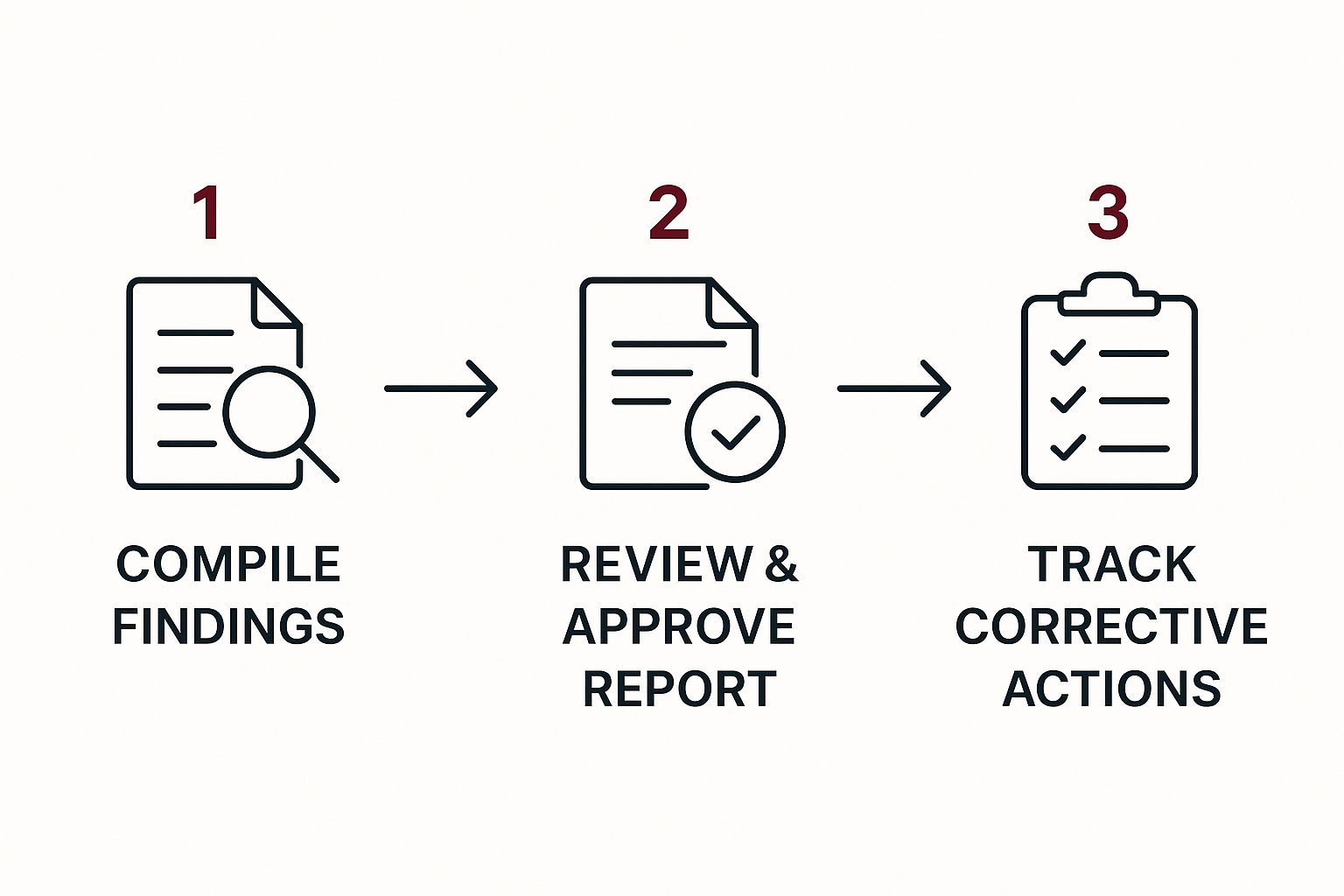
This really brings home the point that the report isn't the final product. It’s the catalyst that kicks off the whole corrective action and improvement cycle.
Driving an Effective Corrective Action Process
Once a non-conformity has been identified and everyone agrees, the clock starts on fixing it. The biggest mistake I see teams make is jumping straight to a quick, surface-level fix. A truly effective corrective action process is always built on a solid foundation of root cause analysis.
Slapping a bandage on a deep wound doesn't solve anything long-term. In the same way, just retraining one employee or tweaking a line in a procedure rarely stops an issue from popping up again. You have to dig deeper and ask why the failure happened in the first place.
A corrective action that only addresses the symptom is a wasted opportunity. The goal isn't just to fix the immediate problem; it's to eliminate the root cause so thoroughly that the problem can't happen again—anywhere in the organisation.
To get there, you need to encourage your teams to use structured problem-solving methods. Simple but powerful techniques like the "5 Whys" or a Fishbone (Ishikawa) diagram are brilliant for this. They help everyone move beyond the obvious symptoms and uncover the systemic weaknesses that allowed the non-conformity to happen.
The Power of Root Cause Analysis
Let's walk through a real-world scenario. An auditor finds that a critical piece of manufacturing equipment is overdue for its scheduled calibration. That’s a clear non-conformity.
An ineffective response? Simply calibrate the equipment and close the finding. Problem solved, right? Wrong.
A solid root cause analysis would uncover something much deeper. Maybe the maintenance scheduling software didn’t send a reminder. Why? The asset was entered with the wrong maintenance plan. Why? The employee who entered it was never properly trained on the new system. And why was that? Because the training program was rushed during a major system upgrade.
Suddenly, you see the true root cause isn't a missed calibration; it's a flawed training process tied to a system change. The real corrective action is to retrain all relevant staff and build a verification step into the process for new asset entries. This doesn't just prevent this one issue; it stops a whole class of similar potential failures from ever happening. If you're looking to master this, the principles behind corrective action for ISO 27001 certification offer fantastic insights that are relevant across any management system.
It's crucial to distinguish between fixes that just patch the immediate problem and solutions that prevent it from ever coming back. This table breaks down the key differences.
Spotting Effective vs Ineffective Corrective Actions
| Characteristic | Ineffective Action (Symptom-Based) | Effective Action (Root Cause-Based) |
|---|---|---|
| Focus | Reacts to the immediate, visible problem. | Proactively addresses the underlying system or process failure. |
| Example | "Retrain Bob on the procedure." | "Revise the training program and certification process for all operators." |
| Scope | Fixes a single instance of the non-conformity. | Prevents recurrence of this and similar issues across the organisation. |
| Longevity | The problem is likely to reappear elsewhere or with another person. | The solution is permanent and embedded in the system. |
| Mindset | "Let's close this finding quickly." | "Let's make sure this never happens again." |
Ultimately, investing the time to find the root cause pays dividends by building a more resilient and reliable quality system.
Assigning Ownership and Tracking Progress
A corrective action plan with no clear owner or deadline is just a wish list. Every single action must be assigned to a specific person who is accountable for seeing it through. This simple act creates a powerful sense of responsibility.
Alongside ownership, setting realistic but firm deadlines is vital. An action item with a vague "ASAP" timeline will always get pushed to the bottom of the pile. Use a central tracking system—it doesn't have to be fancy, a shared spreadsheet can work just as well as dedicated QMS software—to monitor progress.
This system should clearly show:
- The original non-conformity finding.
- The identified root cause.
- The planned corrective action.
- The assigned owner.
- The due date.
- The current status (e.g., Planned, In Progress, Awaiting Verification).
This kind of transparency ensures nothing falls through the cracks and gives management a bird's-eye view of how audit findings are being tackled across the business.
Verifying Effectiveness: The Final, Crucial Step
Just because you've implemented a fix, it doesn't mean the job is done. The most important part of this whole process is verification. This means going back after a reasonable amount of time to confirm that the solution isn't just in place, but that it's actually effective.
Verification answers the million-dollar question: Did our actions really solve the problem for good?
This could involve a small follow-up audit, a review of performance data, or simply observing the process in action. For our calibration example, verification might mean checking the records for all similar equipment three months later to confirm every single one has been calibrated on time since the new training was rolled out.
Only when you have objective evidence that the fix has worked and is sustainable can you truly close the audit finding. This final loop is what transforms your internal audit from a simple check-up into a dynamic and powerful tool for lasting improvement.
Evolving Your Audit Program into a Strategic Asset
A lot of organisations treat their internal audit program like a necessary evil—a chore you have to get through just to keep your certification. Honestly, that mindset misses the whole point. A truly mature quality management system sees its audit program for what it really is: a powerhouse for driving strategic advantage.
When you shift your perspective, the entire function transforms. It stops being about simply finding problems and starts being an engine for genuine business intelligence. It becomes the very mechanism that uncovers systemic risks before they blow up and highlights organisation-wide opportunities for real, measurable improvement. This evolution is the final, crucial step in mastering your quality management system internal audit.
Analysing Trends to Identify Systemic Risks
A single audit finding is just one piece of the puzzle. The real magic happens when you start connecting the dots. When you see a pattern of similar findings popping up across multiple audits, that's no longer a coincidence; it's a critical insight. This is how you stop patching up symptoms and start curing the underlying disease.
Think about it. One audit might flag an overdue calibration on a piece of equipment. Another, in a completely different department, finds an outdated procedure still in use. A third uncovers a team member who missed a required training module. On their own, they seem like minor, unrelated hiccups.
But when you zoom out and look at these findings together, a bigger picture emerges. What if all three stem from a chaotic document and records control system? Suddenly, you've pinpointed a systemic weakness that's quietly chipping away at quality across the entire business.
The greatest value of an audit program isn't in the individual non-conformities it finds, but in the systemic patterns it reveals. Trend analysis turns isolated audit findings into predictive intelligence that can prevent future failures.
To do this properly, you need a way to categorise and track your findings. This doesn't require a fancy, expensive piece of software—a well-organised spreadsheet can work wonders. Start tracking your findings by:
- Process or Department: Are issues consistently popping up in the same area?
- Clause of the Standard: Is there a specific part of ISO 9001, for instance, that your organisation always seems to struggle with?
- Type of Finding: Are you noticing a glut of issues related to documentation, training, or equipment maintenance?
Reviewing this data every quarter gives you the intelligence you need to launch targeted, high-impact improvement projects that fix the root cause, not just the latest problem.
Translating Audit Data into Strategic Insights for Management
Let's be blunt: raw audit data is just noise to senior management. Your job is to be the translator. You need to turn that data into a compelling story about risk, opportunity, and the bottom line. The Management Review meeting is your stage.
Instead of just reading out a laundry list of non-conformities, you need to frame the audit results in a business context they understand. Connect the dots for them.
Show them how that trend of minor documentation errors in production could realistically lead to a major, costly product recall. Explain how repeated procedural slip-ups in the sales process are directly hurting your customer satisfaction scores.
Visuals are your best friend here. Use simple charts and graphs to illustrate trends over time. Imagine showing a graph where customer complaints are rising in perfect lockstep with non-conformities found during final inspections. That kind of data-driven narrative is incredibly persuasive. It instantly shifts the conversation from "Are we compliant?" to "How do we fix this to improve business performance?"
This is how you solidify the audit program’s role as a vital source of business intelligence. It proves that the audit function isn't a cost centre, but a value-adding strategic asset that informs smart planning and resource allocation.
Creating a Feedback Loop to Refine Your Audit Process
The principle of continuous improvement shouldn't just apply to the departments you're auditing; it applies to your audit process itself. An audit program that never changes or evolves is one that's doomed to become stale and ineffective. To keep it sharp, you have to actively ask for feedback.
After each audit cycle wraps up, create a simple way to gather input from everyone involved—both your auditors and the people being audited. Don't be shy; ask direct questions to figure out what's working and what isn't.
- For Auditees: Did you feel the audit was fair and objective? Did the auditor clearly explain their findings? Do you feel this audit will actually help your department improve?
- For Auditors: Did you have enough time and resources? Were there any roadblocks when gathering evidence? Do you have any suggestions for improving our checklists or the overall methodology?
This feedback is gold. It will quickly tell you if your auditors need more training, if your checklists are becoming outdated, or if the communication around scheduling needs a rethink.
Regularly reviewing this input and making small, iterative adjustments ensures your audit program remains relevant, efficient, and—most importantly—respected within the organisation. This feedback loop is the key to building a culture where audits are genuinely seen as a catalyst for growth, cementing the long-term health and resilience of your entire QMS.
Your QMS Audit Questions, Answered
Even with the best-laid plans, questions always come up when you're navigating the world of QMS internal audits. Getting clear, practical answers is the key to demystifying the whole process for your team and keeping everyone focused on what really matters: improvement.
Let's tackle some of the most common questions I hear from businesses just like yours.
How Often Should We Run a QMS Internal Audit?
There's no single magic number here. While a full system audit once a year is a decent starting point, the smartest approach is to let risk guide your schedule. You want to focus your energy where it will have the biggest impact.
Think about these factors when planning your audit calendar:
- Critical Processes: Any area that directly impacts product quality or customer safety is high-risk. These should get a closer look, maybe even twice a year.
- Past Performance: If a department has a track record of non-conformances, you’ll want to audit them more frequently to make sure their corrective actions have stuck.
- System Maturity: A brand-new QMS will naturally need more attention in its first couple of years than a well-established system that’s been humming along for a decade.
This flexible, risk-based thinking means you’re not just ticking a box. You’re actively managing your quality system instead of wasting time on low-risk areas while a bigger problem brews elsewhere.
What's the Difference Between a Non-Conformance and an Observation?
Getting this right is crucial for both the auditor and the person being audited. It sets the tone for everything that follows.
A non-conformance is black and white. It’s objective, factual proof that a requirement hasn’t been met. The evidence clearly shows a gap between what should be happening (according to a standard, regulation, or your own procedures) and what is happening.
An observation, on the other hand, is a bit of a friendly heads-up. It's often called an "Opportunity for Improvement" (OFI) for good reason. It flags a situation that, while not technically a breach of the rules right now, looks like a potential problem waiting to happen.
Think of it like this: a non-conformance is a fire you have to put out immediately. An observation is like spotting some frayed wiring—it’s a warning that helps you prevent a fire from ever starting.
Acting on OFIs is a hallmark of a mature, proactive quality culture.
Can an Internal Auditor Audit Their Own Department?
This one’s easy: absolutely not.
This is one of the foundational rules of auditing, and it’s non-negotiable. For an internal audit to have any shred of credibility, the auditor must be completely impartial and objective.
Auditing your own work or your own team creates a massive conflict of interest. It’s just human nature—it’s incredibly difficult to be critical of processes you’re responsible for or colleagues you share a desk with every day. Trying to do so completely undermines the integrity of the audit.
I know this can be tricky in smaller businesses with limited staff. The solution? Cross-departmental audits. Get someone from operations to audit the finance team, and have someone from sales audit the warehouse. Not only does this solve the impartiality problem, but it also brings a valuable fresh set of eyes that can spot things an insider might have become blind to.
What Really Makes a Good Internal QMS Auditor?
Knowing the ISO standard inside and out is just the price of entry. A truly effective internal auditor has a powerful mix of technical know-how and people skills. Their real talent lies in uncovering the facts without making people feel like they’re being interrogated.
Here are the key skills that separate the great auditors from the merely good ones:
- Diplomacy: They know how to deliver tough news constructively, always framing findings around the process, never the person.
- Active Listening: They're masters at hearing not just what’s being said, but also what’s not being said, to get the full picture.
- Sharp Observation: They have a knack for noticing the little details in a document or during a walkthrough that might point to a bigger systemic issue.
- Analytical Mind: They can connect the dots between seemingly unrelated findings to identify the root cause of a problem.
At the end of the day, the best auditors act as partners in improvement, not police officers looking to hand out tickets. They build trust and encourage open conversation, and that’s the secret ingredient to an audit that actually adds value.
We specialise in simplifying the complexities of ISO certification for businesses. Our experts can guide you in establishing a robust internal audit program that not only meets compliance requirements but also drives real business improvement. Learn more about how we can support your journey at https://iso-27001.com.au.
Recent Comments