

Quick Summary: Recovery Point Objective (RPO) and Recovery Time Objective (RTO) are critical metrics for disaster recovery. RPO defines the maximum acceptable data loss, measured in time before a failure, dictating backup frequency. RTO sets the maximum tolerable downtime after a failure, guiding recovery speed and technology. Understanding both is essential for effective business continuity planning and ISO 27001 compliance.
Understanding your recovery point objective and recovery time objective is the absolute cornerstone of a solid business continuity plan. When a disaster strikes, you face two massive problems: how much data did you just lose, and how long until you're back up and running? The answers, known as Recovery Point Objective (RPO) and Recovery Time Objective (RTO), are core business decisions that dictate your resilience strategy.
The Two Pillars of Business Resilience: RPO and RTO
Let's cut through the jargon. Think of it like this:
- Recovery Point Objective (RPO): This answers the question, "How much work and data can we stand to lose?" It's a measure of data loss tolerance.
- Recovery Time Objective (RTO): This answers the question, "How long can we afford to be down?" It's a measure of downtime tolerance.
Understanding the difference isn't just for the IT team. These two metrics shape how your entire organisation prepares for, and survives, a crisis. They have a direct line to your revenue, your reputation, and the trust your clients place in you.

Why RPO and RTO Actually Matter
Imagine your customer database is your most critical asset.
Your RPO is like setting your rewind point. If you decide on an RPO of 15 minutes, you're making a commitment: at any given moment, the backup of that database will never be more than 15 minutes old. That directly tells you how often you need to be backing things up. This is a crucial data protection metric.
On the flip side, your RTO is the ticking clock. If you set an RTO of two hours for that same database, you're setting a deadline. From the second it goes down, your team has a maximum of two hours to get it restored and fully functional again. This decision will drive what kind of technology and recovery processes you invest in. This is a critical service availability metric.
At its heart, defining your RPO and RTO is about putting a number on your tolerance for pain. It forces you to move from vague worries about "risk" to concrete, measurable goals that give your recovery plan real teeth.
The Strategic Edge for Australian Businesses
For any Australian business, and especially those aiming for ISO 27001 certification, having a clearly defined RPO and RTO strategy isn't optional. It’s essential for robust information security management.
When auditors come knocking, these metrics are the proof that you've thought seriously about business risks and have put the right controls in place. They show you've moved beyond wishful thinking. You can see exactly how this fits into the bigger picture in our guide to business continuity planning.
Without clear objectives, a recovery plan is just a document filled with hopeful guesses. With them, it becomes a tested, reliable roadmap to get you through the storm. Let's walk through how to build that roadmap.
Understanding The Critical Difference Between RPO and RTO
To build a truly resilient business, you must first grasp two key concepts: the Recovery Point Objective (RPO) and the Recovery Time Objective (RTO). They sound similar and are often discussed together, but they measure two completely different aspects of disaster recovery. Confusing them is a common and costly mistake.
Let’s break it down simply: RPO is all about your data loss. RTO is all about your service downtime.
RPO: How Much Data Can You Afford To Lose?
Think of the Recovery Point Objective (RPO) as the ultimate "undo" button for your business data. It looks backward from the moment a disaster strikes and defines the maximum amount of data you're willing to lose, measured in time. It forces you to answer a tough but essential question: how much work can we afford to re-do from scratch?
Your RPO is all about the age of the files you need to recover from your backup systems.
- An RPO of 24 hours is a common baseline for many businesses. It means you run your backups once a day. If your server fails at 4 PM and your last good backup was from 6 PM the previous day, you've lost 22 hours of data. Everything done in that window is gone.
- An RPO of 15 minutes is for a business that cannot afford to lose recent transactions, like an e-commerce store. This demands a much more aggressive backup or data replication schedule to keep that potential data loss to an absolute minimum.
Essentially, your RPO directly sets your backup schedule. A shorter, more aggressive RPO (a "near-zero RPO") means more frequent backups, which naturally requires more storage, bandwidth, and budget.
RTO: How Long Can You Afford To Be Down?
The Recovery Time Objective (RTO), on the other hand, is the stopwatch that starts ticking the second your systems go down. It's forward-looking and sets the target for how long it should take to get your services back up and running. RTO answers an equally critical business question: how quickly do we need to be operational again?
RTO is measured in the minutes, hours, or days after an incident occurs.
- An RTO of 4 hours might be set for your main customer-facing website or application. From the moment it goes offline, the clock is ticking, and your IT team has a four-hour window to get everything restored and working.
- An RTO of 72 hours could be perfectly acceptable for an internal development server. It’s not customer-facing, and while the disruption is an inconvenience, it's not stopping the entire business from generating revenue.
Your RTO dictates the kind of recovery technology and processes you need. A very short RTO often demands sophisticated solutions like automated failover systems and a team that has drilled the recovery plan to perfection.
In a nutshell: RPO is about the data you might lose, measured by its age. RTO is about the time you're out of action. They are two separate dials you need to tune for your business continuity plan.
To make this crystal clear, let's lay out the key distinctions side-by-side.
RPO vs RTO Key Distinctions
| Dimension | Recovery Point Objective (RPO) | Recovery Time Objective (RTO) |
|---|---|---|
| Primary Focus | Maximum acceptable data loss | Maximum tolerable service downtime |
| Measurement | Time leading up to a disaster (e.g., minutes, hours) | Time after a disaster occurs (e.g., hours, days) |
| Business Question | "How much work can we afford to lose?" | "How long can we afford to be offline?" |
| Impacts | Backup frequency and data replication strategy | Recovery infrastructure and failover technology |
| Example | An RPO of 1 hour requires backups at least hourly. | An RTO of 4 hours requires service restoration within four hours. |
Getting this difference right is the absolute first step in crafting a disaster recovery plan that actually works. It helps you separate the conversation about protecting your data from the one about restoring your services, ensuring both get the focused, strategic thinking they deserve.
How to Define Your RPO and RTO Targets
Figuring out your RPO and RTO targets isn’t something you can just delegate to the IT team. It’s a critical business conversation that requires a hard look at what truly keeps your organisation running. The process begins with a Business Impact Analysis (BIA), which is the formal method for identifying the consequences of a disruption to business functions and processes.
Think of the BIA as a full health check for your business operations. It pinpoints your most vital systems and puts a real financial and operational value on the pain you'd feel if they stopped working. This is about translating abstract risks like lost sales, reduced productivity, and reputational damage into clear, time-based targets that shape your entire recovery plan.
Start with a Business Impact Analysis
The main purpose of a BIA is to draw a straight line from your systems and software to the business functions they support. This step changes the conversation from technical jargon to business priorities, ensuring your recovery point objective and recovery time objective are perfectly aligned with what matters most.
You need to kick things off by asking some direct questions about every single business process:
- What's the financial hit from an outage? Get specific. Calculate the lost revenue per hour, day, or week. For an e-commerce website, this is painfully obvious and immediate. For other functions, it might involve missed sales opportunities or even contractual penalties.
- What's the operational damage? How does this outage impact your team's productivity? Can other departments perform their jobs without this system?
- What's the hit to our reputation? How much will an outage erode customer trust and your brand's standing? A short glitch might be a minor inconvenience for customers, but a long outage can be a significant blow.
Answering these questions provides the hard data needed to move forward. It helps justify spending on more aggressive recovery goals and prevents over-investing in the protection of less critical systems. To see how this fits into the broader security framework, you can check out our guide on risk assessment for cyber security.
Tier Your Applications by Criticality
Let's be honest: not all applications are created equal. Trying to give every single system the same gold-plated, zero-downtime treatment is a fantastic way to burn through your budget. A much smarter approach is to sort your applications into tiers based on the findings from your BIA.
This tiering system creates a clear pecking order for your recovery efforts. It means that when a crisis hits, your team knows exactly which system to restore first, no questions asked.
A simple, practical framework could look something like this:
- Tier 1: Mission-Critical These are the systems your business simply cannot function without for more than a few minutes. We’re talking about your customer-facing e-commerce site, payment processing systems, or the central CRM your sales team relies on.
- Tier 2: Business-Critical These applications are vital for day-to-day operations, but the business could likely survive a few hours of downtime. Think of internal ERP systems, inventory management, or company-wide communication platforms.
- Tier 3: Non-Essential These are important, but not urgent. The business can continue operating for a day or more without them. This tier often includes things like development servers, marketing analytics tools, or deep file archives.
By categorizing your assets, you shift from a one-size-fits-all disaster plan to a tailored, cost-effective strategy. This is a core principle of good risk management and a key part of what auditors look for when assessing ISO 27001 compliance.
Assigning RPO and RTO Values to Tiers
Once you’ve sorted your tiers, assigning the actual RPO and RTO numbers is the logical next step. The targets you set should be a direct reflection of how critical that tier is to the business.
Here’s a real-world example of what this might look like on paper:
| Application Tier | Example Systems | RPO Target (Data Loss) | RTO Target (Downtime) |
|---|---|---|---|
| Tier 1 | E-commerce Site, CRM | Seconds to < 15 Minutes | < 1 Hour |
| Tier 2 | ERP System, Internal Email | 1 to 4 Hours | < 4 Hours |
| Tier 3 | Dev Server, File Archive | 12 to 24 Hours | < 24 Hours |
This tiered model provides clarity and focus. It guarantees your biggest investments in backup and recovery technology are aimed squarely at the systems that have the most significant impact on your revenue. For instance, an effective SharePoint Migration Planning process is all about managing risk, and it relies on this exact kind of tiered analysis to set sensible RPO and RTO targets for critical company data.
Ultimately, defining your recovery objectives is the art of turning business risk into a practical, technical game plan. It’s the bridge between knowing what a disaster could cost you and putting the right measures in place to make sure it never does.
Understanding the Costs of Your Recovery Plan
Let's be direct: when it comes to business continuity, faster recovery and minimal data loss cost significant money. The decisions you make about your recovery point objective and recovery time objective are not just technical benchmarks; they are fundamental budget decisions that directly dictate how much your organisation will spend on resilience.
This is where strategic planning meets financial reality. Chasing near-instant recovery means investing in advanced, and expensive, technology. On the other hand, accepting a longer recovery window can open up simpler, more cost-effective solutions.
The Speed vs. Spend See-Saw
The basic financial principle is simple: the shorter your RTO and RPO, the higher the price tag. If you're aiming for near-zero downtime (a low RTO) and near-zero data loss (a low RPO), you must be prepared to pay for high-availability systems, real-time data replication, and automated failover mechanisms. This isn't just about buying software; it's a deep investment in a complex infrastructure that needs constant maintenance and testing.
Conversely, a more relaxed RTO of, say, 48 hours allows you to rely on much cheaper backup and recovery methods. You could use periodic cloud-based snapshots, which are a fraction of the cost of maintaining a live, fully redundant copy of your entire production environment.
Getting this balance right starts with a clear process for defining your objectives. The first step is always aligning your recovery goals with what the business can realistically afford.
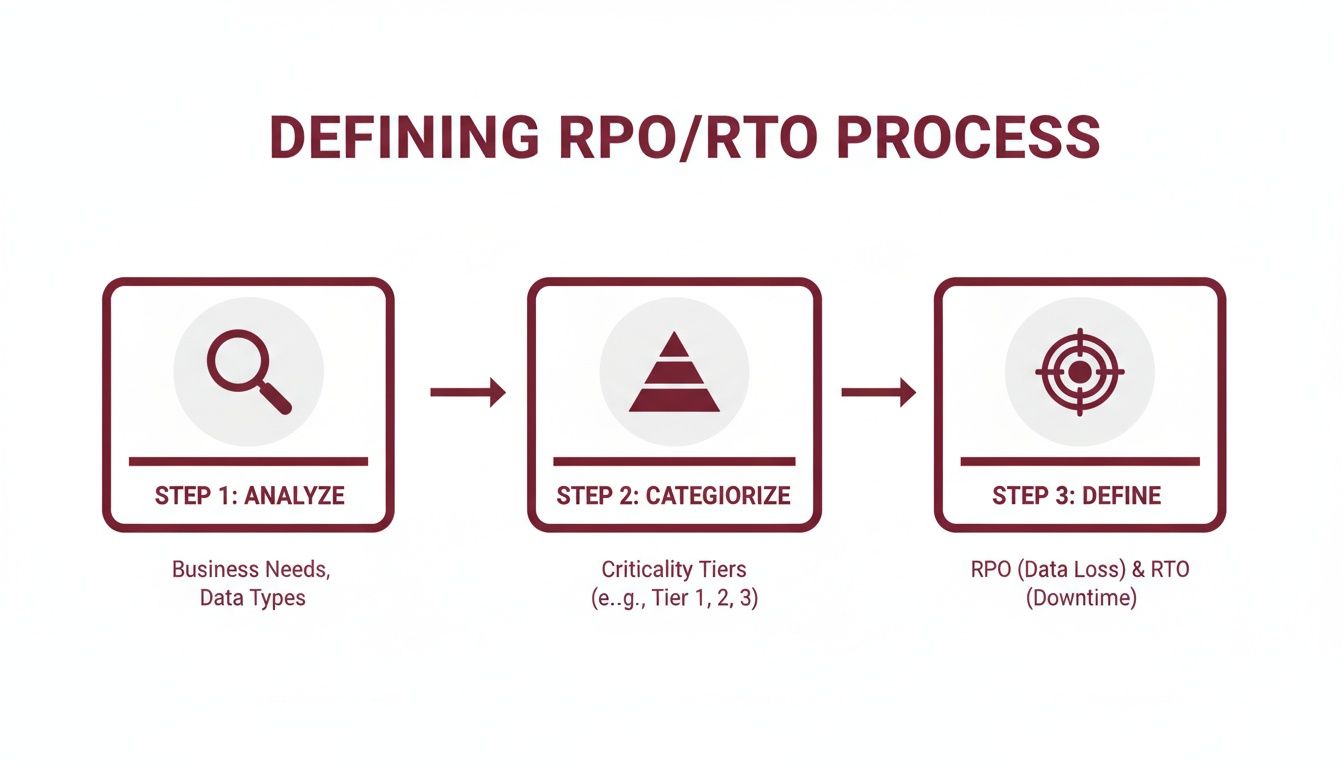
Walking through these steps—analysing impact, sorting your systems by priority, and then setting your targets—is critical for making smart financial decisions about your disaster recovery plan.
Running a Meaningful Cost-Benefit Analysis
To make the right decision, you must weigh the cost of preparedness against the potential cost of an outage. Think of it less like buying technology and more like purchasing insurance for your business operations.
Start by getting real about what downtime actually costs your business. Be specific and put a dollar figure on it:
- Lost Revenue: For every hour your e-commerce site is down, how much cash are you not earning?
- Lost Productivity: How much are you paying staff who are unable to work because a critical system is offline?
- Reputational Damage: This is harder to quantify, but what is the long-term financial fallout from losing customer trust or damaging your brand?
Once you have those numbers, that investment in a shorter RTO starts to look less like an IT expense and more like a smart, protective measure. It's a well-established pattern that the investment required for disaster recovery rises sharply as the RTO gets shorter. An organisation targeting a 2-hour RTO needs far more expensive redundant systems than one with a 24-hour RTO. For Australian businesses, getting this balance right is crucial, and you can discover more about how RTO impacts disaster recovery budgeting to see how this plays out locally.
A proper cost-benefit analysis completely reframes the conversation. It shifts disaster recovery from the "IT expense" column over to the "essential business insurance" column—a perspective that leadership can actually get behind.
Building Your Business Case for the People with the Pursestrings
When you take your plan to the leadership team, skip the technical jargon. Lead with the business case. You need to frame your recommended recovery point objective and recovery time objective in the language they understand: risk and money.
Make your argument clear, concise, and compelling:
- Quantify the Risk: "Our analysis shows that an eight-hour outage of our CRM system will cost the company an estimated $75,000 in lost sales and productivity."
- Present the Solution: "To manage this risk, we're proposing a recovery solution that gives us a four-hour RTO. This will cut our potential loss in half."
- Justify the Cost: "The annual cost for this is $15,000. We're essentially making a strategic investment to protect against a $75,000 exposure from just one incident."
- Connect to Compliance: "On top of that, this plan gives us the documented proof of due diligence we need to maintain our ISO 27001 certification, which helps protect our competitive edge."
When you present the numbers this way, you're not just asking for a budget. You're demonstrating a clear return on investment, protecting the bottom line, and ensuring the business can continue operating, no matter what happens.
Putting Your Recovery Plan to the Test
A disaster recovery plan gathering dust in a folder is nothing more than a theory. It's a collection of well-intentioned assumptions about what might happen and how your team might react. To move from theory to true confidence, you have to put that plan through its paces.
Testing is the only way to prove that your carefully defined recovery point objective and recovery time objective are actually achievable when it matters most. It’s where you uncover the hidden flaws, communication gaps, and technical hitches that look fine on paper but crumble under real-world pressure. Without regular testing, you're not planning for recovery; you're just hoping for the best.

Different Ways to Validate Your Plan
Not every test needs to be a full-scale, "pull the plug" simulation. The key is to use a mix of methods to check different parts of your plan—from the people and processes right down to the technology itself. A layered approach builds resilience without causing unnecessary disruption.
- Tabletop Exercises: Think of this as a low-impact walkthrough. Key stakeholders gather in a room to talk through a disaster scenario, step-by-step. The goal isn't to actually restore systems but to identify holes in the plan, clarify everyone's roles, and ensure people know what to do under pressure.
- Failover Simulations: This one is more technical. You deliberately simulate a failure of a primary system to see if the backup or redundant system kicks in as expected. This is a direct test of your RTO, proving your technology can meet the recovery timeline you've set.
- Full Restoration Tests: This is the ultimate proof. You take a real backup and attempt to restore it in a separate, isolated environment. It’s the definitive test of your RPO, verifying that your backed-up data is complete, uncorrupted, and actually usable.
Avoiding Common Testing Pitfalls
Far too many organisations treat testing as a tick-box exercise, which completely misses the point. The entire purpose is to find your weaknesses so you can fix them before a real disaster strikes.
A striking local example comes from audit findings right here in Australia. According to the Victorian Auditor-General's Office, a concerning number of government agencies were not performing consistent or functional disaster recovery tests. The audit found that no agency could actually verify whether their systems could recover within their stated recovery point objective and recovery time objective. This highlights a widespread failure to see if recovery goals are truly achievable. You can read the full report on ICT disaster recovery planning to see the critical gaps they identified.
For ISO 27001 compliance, regular, documented testing isn't just a good idea—it's non-negotiable. It serves as mandatory evidence that your business is exercising due diligence and actively managing its information security risks.
Your Essential Testing Checklist
To build a solid, repeatable testing process, you need to focus on verifying the core parts of your recovery plan. This simple checklist helps ensure you cover the essentials every time you run a test. Having a clear process is a great starting point, and you might find our incident response plan template useful for structuring your documentation.
- Time the Full Restoration: The moment you begin the recovery, start a stopwatch. Stop it only when the system is 100% functional. Does that final time fall within your defined RTO?
- Verify Backup Integrity: Confirm that the restored data is all there and isn't corrupted. Check file counts, database records, and critical configurations to make sure nothing was lost along the way.
- Test Application Functionality: Once restored, does everything actually work? Can users log in? Can they access key features and data? A restored system that doesn't function is no better than one that's still down.
- Document Everything: Record everything—every step, every result, and every lesson learned. This documentation is crucial for refining your plan and providing evidence for compliance audits.
Nailing Your ISO 27001 Compliance
For a growing number of Australian businesses, achieving ISO 27001 certification is more than just a compliance exercise; it's a significant competitive advantage. This global standard for information security management demands a structured approach to resilience, and your recovery point objective and recovery time objective are central to this framework.
ISO 27001 requires more than just a plan on a shelf. It demands documented proof that your business continuity strategy is well-considered, thoroughly tested, and directly linked to the specific risks your business faces. When auditors review your ISMS, they will look very closely at how you've prepared for business continuity.
How RPO and RTO Fit into Annex A Controls
The standard addresses continuity directly through its Annex A controls, particularly within the domain covering information security aspects of business continuity management. Auditors need to see clear, documented evidence that you have:
- Conducted a Proper Business Impact Analysis: Your BIA is the foundation. It must clearly link your most critical business functions to the RPO and RTO targets you've set for the systems that support them.
- Set Formal, Documented Objectives: Vague goals are insufficient. You need a concrete artifact, like an RTO/RPO matrix, that explicitly defines the recovery targets for each of your application tiers.
- Implemented and Tested the Plan: This is non-negotiable. You must maintain records of your disaster recovery tests, complete with results and any lessons learned. It’s the only way to prove your RTO and RPO are realistic and achievable.
To an ISO 27001 auditor, your RPO and RTO are more than just technical statistics. They are solid proof of your organisation's commitment to protecting its information assets and maintaining operational resilience, even in the face of adversity.
This global push for provable resilience is fuelling massive investment in disaster recovery. The market for these solutions, all built around RPO and RTO frameworks, reached USD 4.5 billion in 2021 and is projected to explode to nearly USD 28 billion by 2027. This incredible growth highlights how seriously businesses are now taking their recovery planning. You can explore more data on the disaster recovery market to see the full picture.
Building a Stronger Security Posture
Aligning your recovery strategy with ISO 27001 does more than just prepare you for an audit. It instills a discipline that genuinely strengthens your entire organisation against any kind of disruption. It helps you move from a reactive, fire-fighting mode to proactively managing risk before it becomes a problem.
For any business serious about meeting these strict security standards, understanding the mindset of a Cyber Security Governance, Risk, and Compliance Professional is key. When you integrate well-defined recovery objectives into the fabric of your information security management system (ISMS), you build a culture of resilience that safeguards your revenue, reputation, and customer trust for years to come.
Common Questions About RPO and RTO, Answered
Let's conclude by addressing some of the most common questions that arise when businesses start defining their recovery point objective and recovery time objective. Understanding these practical points is what transforms a good theory into a great, real-world recovery plan.
Can My RPO and RTO Be the Same?
While technically possible, it is extremely rare in practice because it's not how recovery logistics typically work.
Think about it: an RPO and RTO of one hour would mean you need to restore a backup that's no more than an hour old, and you have to complete the entire restoration process within that same one-hour window.
Usually, your RTO will be longer than your RPO. The reason is simple: the actual work of detecting the incident, initiating the recovery process, restoring the data, and verifying that everything is functional takes time.
Does Every Single System Need an RPO and RTO?
Absolutely, yes. But—and this is a critical distinction—they definitely do not all need the same ones. This is where smart application tiering can save you a significant amount of money and effort.
- Mission-Critical Systems: Consider your online store or the CRM your sales team uses. These demand aggressive, low RTO and RPO targets, often measured in minutes, not hours.
- Important but Not Urgent Systems: What about an internal development server or a long-term file archive? These can easily have much more relaxed targets—perhaps 24 hours or even longer—without bringing the entire business to a halt.
This tiered approach ensures you focus your budget and resources where they matter most, protecting the core of your operations.
The goal isn’t to achieve zero downtime and zero data loss across the board. It's to find the optimal balance between what your business can tolerate and what your budget can support.
Is Lower Always Better for RPO and RTO?
Not at all. In the context of business continuity, 'better' simply means 'right for your business'. A near-zero recovery point objective and recovery time objective might sound ideal, but the cost and complexity of the technology required to achieve it are substantial.
The 'best' objectives are those that protect your business from significant harm without overspending on systems that can handle a bit more downtime or data loss. It's all about making a sensible, risk-based trade-off.
Ready to make sure your business continuity plan is up to scratch for ISO 27001? The expert team at Anitech can help you define, test, and document your RPO and RTO targets, ensuring you're not just resilient but also ready for certification. Find out how our tailored consulting can sharpen your security posture by visiting us at https://iso-27001.com.au.
Recent Comments