

When you're preparing for an ISO 27001 audit, you'll hear a lot about your Information Security Management System (ISMS). But how do you actually show an auditor everything you’ve done? That’s where the report of compliance comes in.
This isn’t just another document; it's the master story of your organisation's entire information security program. Think of it as the complete architectural blueprint for your security, laying out every policy, control, and procedure in one cohesive narrative. It’s your single source of truth, proving exactly how you safeguard your most valuable information.
Demystifying the Report of Compliance
Imagine trying to convince a building inspector your new skyscraper is safe without showing them the blueprints. You could point to the strong steel beams and solid foundations, but without the plans connecting every element, your claims are just words. They lack verifiable proof.
That’s exactly the position you’d be in during an ISO 27001 audit without a solid report of compliance. This document is so much more than a simple checklist or a binder full of disconnected policies. It’s the central narrative that weaves together every security measure, risk assessment, and operational detail into a story that’s logical and compelling for auditors, your management team, and other key stakeholders.
Its Strategic Role Goes Beyond the Audit
While its most immediate job is to get you through an external audit, the real value of a compliance report runs much deeper. It forces your organisation to stop talking about security in abstract terms and start translating those ideas into tangible, provable actions.
This process naturally builds a stronger, more resilient security culture. It holds teams accountable by making them document their actions, justify their decisions, and prove that their controls are actually working. This isn't just about ticking boxes to pass an audit; it's about building a sustainable security framework that genuinely protects your business from risk.
Modern tools can significantly ease this process. For instance, using AI for corporate compliance can help automate the tedious work of gathering evidence and streamline risk management, making your report creation both faster and more accurate.
Why It's So Much More Than Just Paperwork
It's easy to fall into the trap of seeing the report as a bureaucratic hurdle—something to get done and then forget about. That’s a huge mistake. In reality, it’s a powerful business tool that serves several crucial functions:
- A Centralised Evidence Hub: It’s the one place where all your evidence lives, linking every security claim you make to concrete proof like access logs, staff training records, or system configuration files.
- A Tool for Management Accountability: The report gives your leadership team a clear, high-level view of the company's security posture, helping them make smarter decisions and allocate resources effectively.
- The Foundation for Continuous Improvement: By documenting where you are now, the report creates a baseline. You can use it to measure progress, pinpoint weaknesses, and plan future security upgrades.
- A Demonstration of Due Diligence: If a security incident ever occurs, a well-kept report is powerful proof that your organisation took reasonable and proactive steps to protect its data.
A well-crafted Report of Compliance transforms security from a cost centre into a business enabler. It provides the assurance that customers, partners, and regulators demand, turning your commitment to data protection into a clear competitive advantage.
To put it simply, this report is the backbone of your certification effort. The table below breaks down its core purpose and benefits.
ISO 27001 Report of Compliance at a Glance
| Aspect | Description |
|---|---|
| Primary Purpose | To provide a consolidated, structured body of evidence that demonstrates your Information Security Management System (ISMS) meets all requirements of the ISO 27001 standard. |
| Key Audience | External Auditors, Senior Management, Regulators, and Key Business Partners. |
| Core Function | Acts as the central narrative connecting security policies, risk assessments, and implemented controls to prove their effectiveness and alignment with business objectives. |
| Strategic Benefit | Moves security from a theoretical concept to a measurable, auditable practice, fostering a culture of accountability and continuous improvement. |
| Business Advantage | Serves as tangible proof of due diligence, strengthens stakeholder trust, and provides a clear competitive differentiator in the market. |
As you can see, investing time in a thorough report pays dividends far beyond the audit itself.
The Global Context and Evolving Standards
The need for structured compliance reporting isn't just a corporate issue. Governments and global bodies use similar frameworks to ensure transparency and accountability on a massive scale. The drive for standardized data governance and statistical development is a clear example of how vital formal compliance frameworks are for coordinating large-scale, complex efforts.
Ultimately, preparing and maintaining your compliance documentation is a fundamental part of the entire certification journey. To get a better sense of what's involved, feel free to explore our guide on navigating https://iso-27001.com.au/audits-and-compliance/. Your report is the prime opportunity to showcase the maturity of your ISMS, proving that your security program is not just a theory, but a well-oiled, operational reality.
Building the Core of Your Compliance Report
A strong Report of Compliance does more than just tick boxes; it constructs a fortress of evidence, brick by brick. To really impress an auditor, you need to tell a compelling story that connects your high-level security strategy directly to your day-to-day operations. This means mastering the non-negotiable components that form the very heart of your Information Security Management System (ISMS).
Think of it like building a house. You start with the architectural plans, lay a solid foundation, erect the frame, and then prove every single element is built to code. Each part flows logically into the next. This is how you demonstrate not just compliance on paper, but genuine security maturity in practice.
This chart shows how all your documentation fits together, from the high-level report down to the specific controls you have in place.
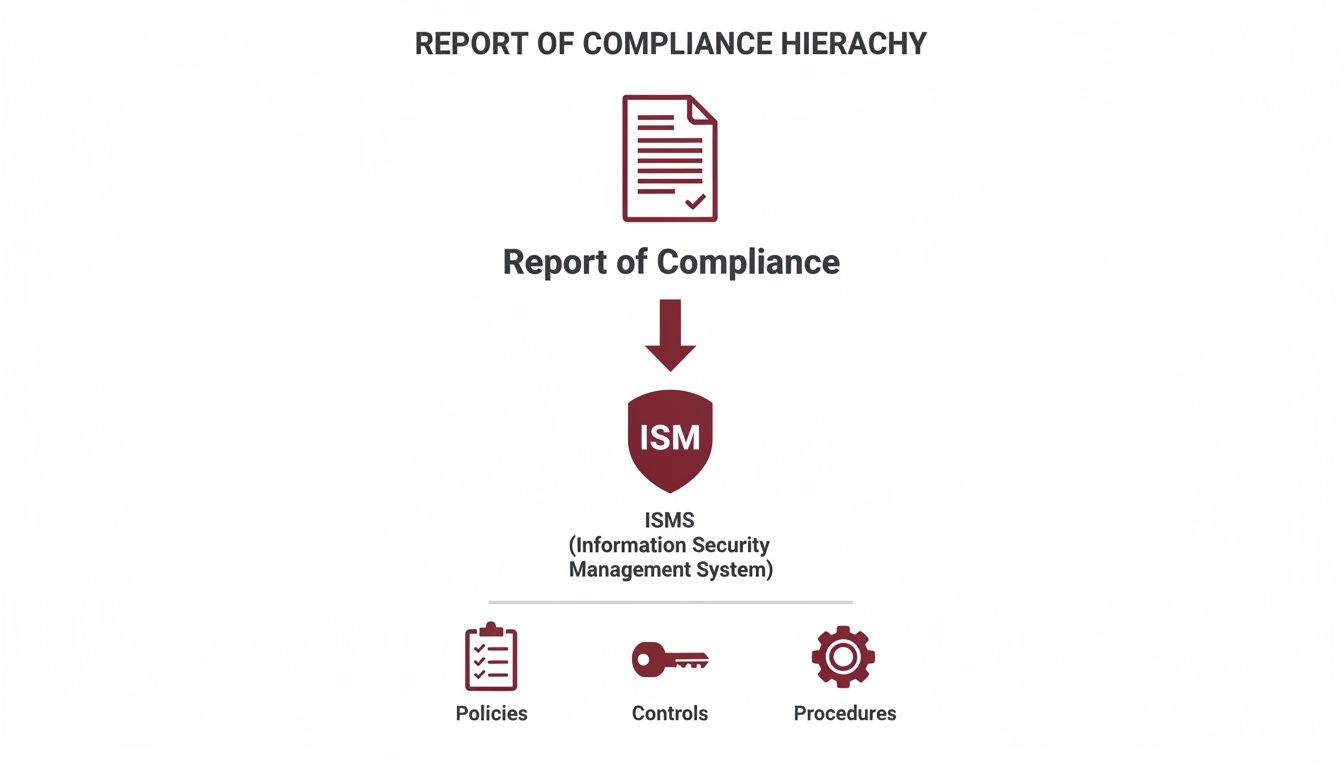
As you can see, the Report of Compliance is the umbrella that covers your entire ISMS, which itself is built on a foundation of clear policies, controls, and procedures.
The Statement of Applicability: Your Definitive Guide
The cornerstone of your whole report is the Statement of Applicability (SoA). This isn't just a simple checklist; it's a strategic declaration. It goes through every single one of the Annex A controls and states, without ambiguity, whether it applies to your organisation.
But just saying "yes" or "no" will get you nowhere. For every control you decide to implement, you have to explain why and connect it back to your specific business needs and risks. And just as importantly, for any control you exclude, you must provide a rock-solid justification for leaving it out. An auditor will pore over these justifications, so they have to be logical.
This document is your best first chance to prove you've critically thought about your security landscape. A well-crafted SoA shows a deep, practical understanding of your own operations, not some generic, copy-paste approach. For a closer look at what needs to be formally recorded, check out our guide on the minimum documented information for achieving ISO 27001 certification.
The Risk Assessment and Treatment Plan
If the SoA answers what you're doing, your Risk Assessment and Treatment Plan explains why you're doing it. This is the engine room of your ISMS. It's where you identify, analyse, and evaluate all the potential threats to your valuable information assets. This is the proof that your security controls aren't just arbitrary—they're targeted responses to real-world risks.
Your risk assessment has to be methodical and thorough. It needs to clearly outline:
- Identified Risks: A complete list of all the threats and vulnerabilities that are relevant to your business.
- Risk Analysis: An evaluation of how likely each risk is to happen and the potential damage it could cause.
- Risk Evaluation: A process for prioritising which risks you need to tackle first based on their severity.
Once the assessment is done, your Risk Treatment Plan shows exactly how you'll handle each major risk. You generally have four options: mitigate it, transfer it, accept it, or avoid it. Your plan must be explicit, assigning ownership and deadlines for every action. This shows a proactive, forward-thinking approach to managing security, rather than a reactive one.
Presenting Policy Documentation and Evidence
With your risks identified and controls chosen, you now have to prove you’ve actually put your plans into action. This is where your policy documents and implementation evidence become critical. Your report needs to present a clear, organised library of proof that your controls aren't just words on a page, but are living, breathing parts of how you operate every day.
This proof can come in many forms, including:
- Policy Documents: Your high-level Information Security Policy, Acceptable Use Policy, Access Control Policy, and so on.
- Procedural Documents: Step-by-step guides for key processes like responding to an incident or backing up data.
- Technical Evidence: System configurations, firewall rules, antivirus logs, and vulnerability scan reports.
- Human Evidence: Records of staff training, signed confidentiality agreements, and attendance sheets for security briefings.
The real goal here is to create an undeniable trail of evidence. When an auditor asks, "How do you manage user access?" you shouldn’t just point to a policy document. You should be able to show them the policy, the procedure for granting access, and the system logs that prove the procedure was followed correctly every single time.
Showcasing Continuous Improvement
Finally, your Report of Compliance has to prove that your ISMS isn’t a one-and-done project. ISO 27001 is fundamentally about continuous improvement. You demonstrate this commitment through the outputs of two essential activities: internal audits and management reviews.
Your report should include the findings from your own internal audits, showing that you're actively looking for non-conformities and weaknesses in your system. More importantly, it must include the corrective action plans you developed to fix those issues.
Likewise, the minutes and outcomes from your management review meetings are vital. These records prove that your senior leadership is actively involved, reviewing the ISMS's performance, dedicating resources, and making strategic decisions to strengthen your security posture over time. This closes the loop and shows an auditor that your commitment to information security is ingrained in the organisation, from the top down.
Mastering Evidence Collection for Your Audit
When you're facing an ISO 27001 audit, making a claim without being able to back it up is a recipe for failure. The auditor’s job is to verify, not just trust. Their favourite phrase is often "show me," and if you can't produce tangible proof for what you say you're doing, your report of compliance will unravel pretty quickly.
This is why mastering evidence collection isn't just a tedious box-ticking exercise; it's a strategic advantage.
Think of it like building a legal case. Every security policy you've written is a theory, and every control you've put in place is a claim. The evidence—the logs, the screenshots, the signed documents—is the irrefutable proof that convinces the jury (your auditor) that your security program is real, active, and effective every single day.
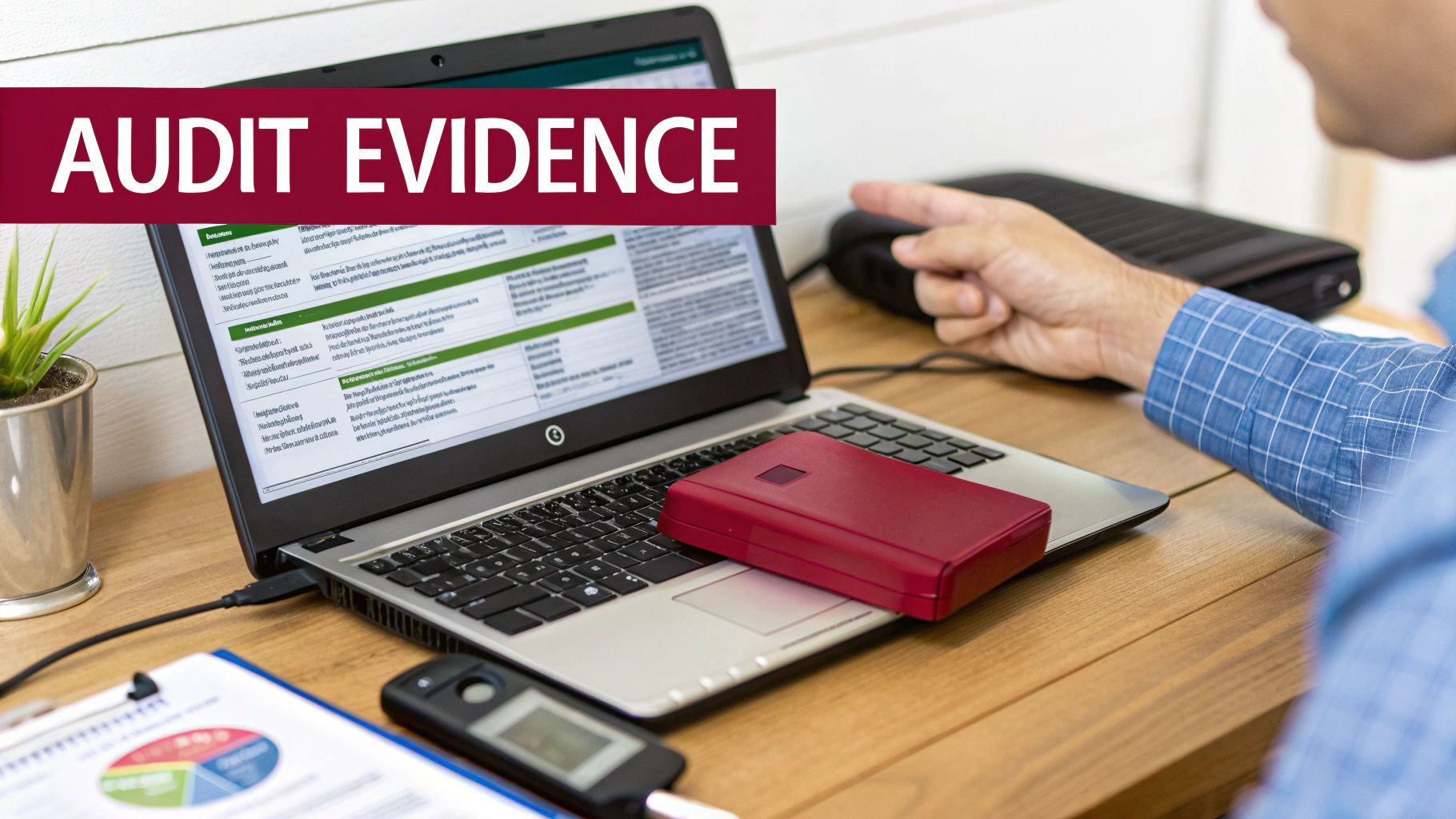
Once you start thinking like an auditor, you’ll begin to see potential evidence in everything you do. This mindset transforms routine security tasks into a powerful library of proof, ready for inspection.
The Two Pillars of Audit Evidence
Solid evidence generally falls into two buckets: technical and procedural. A convincing report of compliance needs a healthy mix of both. It’s not enough to have perfectly configured tech if your team doesn't follow the right processes. And great processes mean very little if the systems themselves are full of holes.
One without the other tells an incomplete story. Imagine having a state-of-the-art firewall, but your staff ignore the official process for rule changes, leaving security gaps wide open. You need to prove both sides of the coin: your technology is secure, and your people consistently uphold that security.
Uncovering Technical Evidence
Technical evidence is the hard data pulled directly from your systems. It’s objective, often automated, and gives the auditor a direct window into how your controls are actually performing. They love this stuff because it’s difficult to argue with and provides a clear snapshot of your security posture.
Your collection efforts should focus on gathering concrete examples like:
- Firewall and Router Configurations: Don't just say your network is secure. Show them. Provide screenshots or exported config files that prove your access rules are strict and align with your policies.
- Vulnerability Scan Reports: Regular reports from tools like Nessus or Qualys are gold. They demonstrate that you're proactively hunting for weaknesses and, more importantly, fixing them.
- Access Control Logs: Pull system logs showing user login attempts, especially for privileged accounts. This proves you’re monitoring who is accessing what and when.
- Antivirus and Malware Protection Dashboards: A simple report from your endpoint protection platform showing that all devices have the latest updates and are actively scanning for threats is powerful proof.
This kind of data forms the factual bedrock of your report of compliance.
Capturing Procedural Evidence
While technical data is crucial, it doesn't show the full picture. Procedural evidence demonstrates that security is embedded in your company culture and followed by your team. It proves that your policies aren't just dusty documents sitting on a server somewhere; they're living principles that guide daily operations.
This type of evidence requires a bit more organisation to capture, but it’s absolutely essential for demonstrating maturity.
An auditor wants to see a living, breathing security program. Procedural evidence—like meeting minutes and training records—brings your documentation to life, proving that security is an active conversation within your organisation, not a static document.
Look for opportunities to document the human side of your security program. Great examples include:
- Signed Policy Acknowledgments: Simple records showing that every team member has read and agreed to your key security policies.
- Incident Response Post-Mortems: After a security incident, your detailed report on what happened, how you handled it, and what you learned is compelling evidence of a mature response process.
- Management Review Meeting Minutes: Show the auditor official notes from leadership meetings where the Information Security Management System (ISMS) was discussed, decisions were made, and resources were approved.
- Employee Training Records: Attendance sheets or quiz results from security awareness training prove your team is being kept up-to-date on modern threats and best practices.
As you gather this evidence, don't forget the entire asset lifecycle, right through to disposal. For hard drives and other physical media, simply deleting files isn't enough. Proving a secure chain of custody is vital. A key piece of evidence here can be a Certificate of Destruction, a third-party document that confirms sensitive data was destroyed permanently and securely.
A Framework for Organising Your Evidence
Collecting a mountain of evidence is one thing, but presenting it in a clear, organised way is what will truly impress an auditor. A chaotic dump of files will only create confusion and raise doubts about your competence. The secret is to link every single piece of evidence back to a specific ISO 27001 control.
Create a simple but robust system. A well-structured spreadsheet or a dedicated folder system can work wonders. For each Annex A control listed in your Statement of Applicability, create a specific place to store its proof.
For example:
- Control A.9.4.1 (Password Management): In this folder, you’d have your password policy document, screenshots of your system's password complexity rules, and perhaps logs showing forced password resets.
- Control A.12.6.1 (Management of Technical Vulnerabilities): Here, you’d store your vulnerability management procedure, your last four quarterly scan reports, and the associated tickets showing that critical issues were patched.
This methodical approach means that when an auditor asks for proof for a specific control, you can pull it up instantly. It screams professionalism, showcases a mature security program, and builds incredible confidence. This level of preparation is what separates a stressful, painful audit from a smooth, successful certification.
Your Blueprint for an Unbeatable Report Structure
Staring at a blank document can be the most intimidating part of the whole ISO 27001 journey. We get it. To take that fear out of the equation, let's walk through a clear, chapter-by-chapter blueprint for your report of compliance. This isn't just some generic template; think of it as a strategic framework you can mould to tell your organisation’s unique security story with confidence.
Following this structure will turn what feels like an overwhelming task into a series of logical, manageable steps. You’ll end up with a report that not only ticks all the boxes for an auditor but also becomes a powerful tool for your own internal governance and ongoing improvement.

A structured approach like this ensures you cover all your bases, leaving no room for doubt or ambiguity when the auditor comes knocking. Let’s break down what each essential chapter of your report should look like.
Setting the Stage with an Executive Summary
First impressions count, and your executive summary is the very first thing an auditor will read. It needs to be sharp, compelling, and professional. The best way to think about it is like the blurb on the back of a book—it should hook the reader and give them a clear picture of what’s inside without drowning them in detail.
This is where you briefly introduce your organisation, clearly state the purpose of the report, and define the scope of your Information Security Management System (ISMS). Crucially, it must end with a formal statement of compliance, declaring that your ISMS meets all the requirements of the ISO 27001 standard.
Defining Your Information Security Management System
Next up, you need a chapter that’s all about the ISMS itself. This section sets the context for everything that follows. It should paint a high-level picture of your organisation’s approach to information security, making sure to ground it in your specific business goals.
Here, you’ll detail the "who, what, and why" of your security program. You should outline the key roles and responsibilities, describe the critical information assets you’re protecting, and explain the internal and external factors that shape your security decisions. This narrative helps the auditor understand the real-world environment your ISMS operates in.
Your report’s structure is its backbone. A logical flow, from the high-level summary to the detailed evidence, demonstrates a mature and well-organised approach to security management. It shows the auditor you’re not just compliant, but in complete control.
This need for clear, structured reporting isn't just for corporate compliance. Government bodies rely on it, too. For example, large-scale fiscal recovery programs often require tens of thousands of recipient governments to submit detailed reports, proving exactly how funds are used to ensure accountability.
The Statement of Applicability: Your Control Centre
As we've already covered, the Statement of Applicability (SoA) is a mandatory and absolutely critical document. In this section of your report, you'll present the SoA in full. It’s usually best to format it as a clean, easy-to-read table for the auditor's review.
This table is the heart of your control implementation story. It’s a methodical rundown of all the Annex A controls, and for each one, you must provide:
- Control Reference: The specific Annex A control number (e.g., A.5.1).
- Inclusion/Exclusion: A clear "Yes" or "No" to show if you've implemented the control.
- Justification: A short, sharp explanation for your decision, especially for any exclusions.
- Reference to Evidence: A direct link or reference to the policy, procedure, or log file that proves the control is in place and doing its job.
This level of detail makes the SoA much more than a simple checklist; it becomes a powerful index for your entire body of evidence.
Demonstrating Risk Management in Action
A significant chunk of your report must be dedicated to your risk management process. This is where you prove that your security controls weren’t just picked at random but are direct, thoughtful responses to identified threats. It’s your chance to showcase how methodical and proactive your ISMS truly is.
Kick things off by outlining your risk assessment methodology. From there, present the results of your assessment, often summarised in a risk register. Finally, you’ll include your Risk Treatment Plan, which details the specific actions you’ve taken (or plan to take) for each significant risk. This section is your proof that security at your organisation is a strategic, risk-driven discipline.
The Core Chapters: Evidence and Improvement
The final parts of your report of compliance are where the rubber meets the road—this is where you present the granular proof. You’ll be linking to all the policies, procedures, and records that back up every single claim you've made in the SoA and Risk Treatment Plan. For clarity, this section is usually organised by control domain, making it easy to navigate.
You must also include a chapter on monitoring, measurement, analysis, and evaluation. Here, you'll detail how you track the performance of your ISMS, including the results of internal audits and management reviews. This is non-negotiable, as it proves your commitment to the continuous improvement cycle, a cornerstone of the ISO 27001 standard.
To help you visualise this, the table below provides a sample structure you can adapt for your own report.
Sample Report of Compliance Template
| Section Number | Section Title | Purpose and Key Content |
|---|---|---|
| 1.0 | Executive Summary | Provides a high-level overview of the report, states the scope of the ISMS, and includes the formal declaration of compliance. |
| 2.0 | Introduction to the Organisation & ISMS | Details the business context, defines key roles, outlines the scope, and explains the factors influencing the ISMS design. |
| 3.0 | Information Security Policies | Presents the top-level Information Security Policy and references other key supporting policies that govern the ISMS. |
| 4.0 | Risk Management Process | Describes the risk assessment methodology, summarises the key findings from the risk assessment, and presents the Risk Treatment Plan. |
| 5.0 | Statement of Applicability (SoA) | Includes the complete SoA, detailing which Annex A controls are implemented and why, with clear justifications for any exclusions. |
| 6.0 | Evidence of Control Implementation | Provides references and links to the specific evidence (documents, logs, records) that proves each control in the SoA is effective. |
| 7.0 | Performance Evaluation & Continuous Improvement | Contains the results from internal audits, management reviews, and other monitoring activities to demonstrate ongoing improvement. |
| 8.0 | Conclusion | Briefly summarises the report's key points and reaffirms the organisation's commitment to maintaining its ISMS. |
By following this blueprint, you will create a professional, comprehensive, and auditor-friendly report of compliance that powerfully demonstrates your genuine commitment to information security.
Sidestepping the Common Hurdles on Your ISO 27001 Journey
Going for ISO 27001 certification is a major undertaking. And while getting that certificate is a fantastic achievement, the path to get there is often littered with traps that can trip up even the most well-intentioned businesses. It's frustrating to see companies stumble over the same mistakes, turning a manageable project into a source of stress and delays.
But here’s the good news: you don't have to learn these lessons the hard way. This section is your field guide to navigating the most common pitfalls. We'll look at everything from treating security like a one-off task to failing to get the leadership team on board, and I’ll share some proven advice to keep you on the straight and narrow. By understanding where others have gone wrong, you can build an Information Security Management System (ISMS) that’s not just compliant, but genuinely resilient.
Mistake #1: Treating Compliance as a Finish Line
Probably the biggest mistake I see is treating ISO 27001 certification like a project you can tick off a list. Teams go into a mad dash to write documents and pull evidence together for the audit. Once the certificate is hanging on the wall, everyone breathes a huge sigh of relief and gets back to their "real" jobs. This "set it and forget it" mindset is a surefire way to fail your next audit.
An ISMS isn't a static monument you build once. It’s a living, breathing part of your business that needs constant attention. Threats change, your company evolves, and new tech brings new risks. Your report of compliance has to reflect this living reality; it’s a live dashboard of your security health, not a dusty old photograph.
The only way to succeed long-term is to bake security into your company culture. It needs to be part of the daily rhythm of the business, just like sales or finance. This means shifting from a "project" mentality to a "process" one, ensuring your ISMS stays strong and relevant long after the auditors have packed their bags.
Mistake #2: Not Having the Right Evidence (or Enough of It)
When an auditor is sitting across the table, your word means nothing without proof. A classic stumble is failing to collect not just enough evidence, but the right kind of evidence. So many businesses write beautiful security policies but then draw a blank when asked to prove that anyone is actually following them.
An auditor doesn't just want to read your password policy; they want to see the system logs that prove those complexity rules are actually enforced. They don't just want to see your incident response plan; they want to see the report from your last security scare, showing what you learned and what you fixed.
Your evidence needs to tell a story. It should draw a clear line from a high-level policy, to a specific procedure, all the way to a tangible record that proves the procedure was followed. If that chain is broken, your compliance claims fall apart.
To get this right, start thinking like an auditor from day one. For every single control you put in place, ask yourself: "How would I prove to a complete stranger that this is actually working?" Gathering evidence proactively will save you a world of pain later and make your report of compliance virtually bulletproof.
Mistake #3: Creating Documentation That No One Reads
Another common pitfall is creating a mountain of documentation that is so dense and jargon-filled that it just gathers dust on a digital shelf. These "shelfware" policies might tick a box for the audit, but they do absolutely nothing to improve your company’s actual security.
If your incident response plan is buried on page 73 of a 100-page PDF that nobody can find, you might as well not have one. Your documentation has to be a practical tool, not a bureaucratic chore. It needs to be easy to find, simple to understand, and directly useful to the people who need it.
Try these simple rules for creating documentation that actually gets used:
- Keep it simple: Use plain English. A good flowchart or diagram can often say more than five pages of dense text.
- Make it easy to find: Put it all in one central spot, like your company intranet or a shared knowledge base that everyone can access.
- Focus on the user: A developer needs different security instructions than someone in the marketing team. Tailor your guides to specific roles.
When you make your documentation user-friendly, it stops being a compliance burden and becomes a genuine asset that makes your business safer.
Mistake #4: Forgetting to Get the Bosses on Board
This one is the deal-breaker. If you fail to get genuine, active support from your senior leadership, your ISO 27001 initiative is likely dead in the water. When management sees it as just another "IT problem" or a tick-box exercise, you'll constantly struggle for the budget, time, and authority to make real change.
Real compliance has to come from the top down. Your leaders need to do more than just sign off on the budget; they need to become champions for information security. This is particularly crucial in today's business world, where good governance and reporting are non-negotiable.
The trick to getting leaders on your side is to speak their language. Don't talk about vulnerabilities and controls; talk about protecting revenue, winning new clients, and reducing business risk. When they see the ISMS as a tool that helps the business succeed, they’ll become your biggest supporters in building a security-first culture.
How Anitech Speeds Up Your Journey to Certification
Trying to navigate the complexities of ISO 27001 on your own can feel like you’re hacking through a dense jungle with a pocket knife. The path is confusing, full of technical jargon, endless documentation, and the looming pressure of an audit. This is where having an experienced guide by your side changes everything, turning a stressful ordeal into a clear, manageable path to success.
At Anitech, we become that expert guide for your business. We don't just dump a pile of generic templates on your desk and walk away. Our specialists work directly with your team, getting to know your business from the inside out so that the entire process is built around how you actually operate.
From Guesswork to a Clear Game Plan
The first steps towards certification are often the most daunting. It's easy to feel stuck before you even start. Instead of you sinking hundreds of hours into frustrating guesswork, we give you a proven, straightforward roadmap that clears the fog and gets you moving from day one.
We kick things off with a detailed gap analysis. Think of it as a health check for your security. We meticulously compare what you’re currently doing against the ISO 27001 standard, pinpointing exactly where you’re already strong and where the gaps are. This gives us a clear, prioritised action plan, so you can put your time and money where it matters most.
This foundational work is absolutely essential for building a risk assessment that actually makes sense for your business. We help you identify and weigh up the real-world threats you face, making sure your security controls aren’t just ticking a box, but are actively protecting your most critical assets.
Crafting a Report of Compliance That Shines
A well-crafted report of compliance is the star of the show during an audit. It needs to be thorough, logically organised, and backed up with solid proof. We’ll guide you through creating it, ensuring your report tells a convincing story of your commitment to security.
Our approach includes:
- Custom Policy Development: We help you write clear, practical policies that are designed for your business, not just copied from a textbook. This makes them easier for your team to understand and follow.
- Smart Evidence Gathering: We show you how to collect the right evidence in a structured way—from system logs to meeting minutes—so you have everything you need to back up your claims without drowning in paperwork.
- Pre-Audit Dry Runs: Before the official auditor even sets foot in your office, we conduct our own tough internal audits. It’s like a dress rehearsal that finds any last-minute issues and gets your team comfortable and confident for the real thing.
Anitech’s mission isn't just about getting a certificate on your wall. It's about building a robust security framework that gives you a real competitive edge. We translate the complex requirements of ISO 27001 into a practical system that makes your business stronger for the long haul.
This hands-on approach saves you a huge amount of time and frees up your internal team. By relying on our 20 years of experience and 100% success rate, you’ll sidestep the common mistakes and get certified faster, letting your people stay focused on what they do best.
Your Partner for the Long Haul
Getting certified is a massive achievement, but it’s not the finish line. Staying compliant means keeping your guard up. Anitech sticks with you as a trusted advisor, giving you the support you need to maintain your Information Security Management System (ISMS) and breeze through future surveillance audits.
We help you build a true culture of security, not just a set of rules. This deep-seated commitment to protecting information builds incredible trust with your clients, opens up new business opportunities, and sets you apart from the competition.
If you’re ready to trade uncertainty for a clear path to certification, our experts are here to help. To learn more about how we can guide your organisation, explore our dedicated ISO 27001 consulting services and see how we can fast-track your success. With Anitech, you don’t just get a consultant; you get a partner committed to your security and your growth.
Frequently Asked Questions
Getting into the nitty-gritty of ISO 27001 often unearths a few tricky questions, especially when you’re neck-deep in paperwork. Let's tackle some of the most common queries that pop up on the path to certification.
Think of this as your go-to cheat sheet for clearing up those final points of confusion.
Report of Compliance vs. Statement of Applicability
One of the first hurdles people run into is telling the difference between a Report of Compliance and a Statement of Applicability (SoA). It’s a common mix-up because they're closely linked, but they play two very distinct roles in your Information Security Management System (ISMS).
Here's a simple way to think about it: your Report of Compliance is the master binder for your entire security program. It’s the whole story—the risk assessments, the policies, the procedures, and all the tangible proof (like logs and records) that shows you’re actually doing what you say you’re doing.
The Statement of Applicability, on the other hand, is a specific, non-negotiable document that lives inside that binder. It’s essentially a detailed checklist against Annex A of the ISO 27001 standard. For every single control listed, your SoA must state whether you’ve applied it and, crucially, justify why or why not.
- The SoA is a formal, mandatory document focused entirely on your chosen controls from Annex A.
- The Report of Compliance is the complete portfolio that contains the SoA, along with everything else, to give an auditor the full picture of your ISMS.
So, while you can't have a credible Report of Compliance without an SoA, the SoA is just one vital piece of a much bigger puzzle.
Keeping Your Compliance Report Current
"How often do we need to update this thing?" That's a question we hear all the time. The biggest mistake you can make is viewing your compliance report as a one-and-done project you dust off just for an audit.
Your report needs to be a living, breathing document. It must accurately reflect your security posture right now, which means it needs an update whenever your ISMS undergoes a significant change.
So, what counts as a "significant change"?
- Rolling out new systems or critical software.
- Making major tweaks to business processes that touch sensitive data.
- Facing a new class of cyber threats targeting your industry.
- Undergoing organisational restructuring that shuffles security roles and responsibilities.
Even if things are quiet, your report needs a formal review and update at least annually. This usually lines up with your management review cycle. This regular check-in ensures the document never gets stale and always tells a true story about your security practices.
Using Software for Report Generation
Can software help you build your report of compliance? Absolutely, and for many businesses, it’s a brilliant move. The right compliance tool can be a massive help in your ISO 27001 journey.
These platforms are fantastic at handling the grunt work of documentation. They can help you:
- Centralise all your evidence in one organised place.
- Track the implementation status of every control.
- Directly link policies to the specific files that prove they're in action.
- Set up automatic reminders for reviews so nothing falls through the cracks.
But—and this is a big but—it's vital to know their limits. Software is a tool, not a strategist. It can’t write the compelling narrative explaining why you made certain security trade-offs, and it certainly can’t provide the unique business context that an auditor is looking for.
The best results come from combining the efficiency of a great compliance tool with the strategic brainpower of your security team. The software handles the ‘what,’ while your people explain the all-important ‘why.’
Ultimately, the software is there to lift the administrative weight, freeing up your team to focus on what truly matters: building a security program that genuinely protects your business. This balanced approach ensures your report of compliance is not just a stack of documents but a powerful story of your commitment to security.
Ready to stop guessing and start building a clear, effective path to ISO 27001 certification? The experts at Anitech can guide you through every step, from gap analysis to your final audit. Visit our ISO 27001 services page to learn how our proven methodology can accelerate your success.
Recent Comments